Project Naming is Expanding!

This article contains historical language and content that some may consider offensive, such as language used to refer to racial, ethnic and cultural groups. Please see our historical language advisory for more information.

In early 2002, Library and Archives Canada (LAC) teamed up with the Nunavut Sivuniksavut Training Program and the Government of Nunavut’s Department of Culture, Language, Elders and Youth, to create Project Naming. The goal was to digitize photographs of Inuit from present-day Nunavut in LAC’s photographic collections in order to identify the people depicted in the images. At the time of the launch, LAC expected that the project would be concluded the following year. We never imagined that this initiative would become such a successful and popular project with the public.

To mark the annual National Aboriginal History Month in June 2015, LAC is pleased to announce the launch of Project Naming. While the project still includes communities located in Nunavut, it will be expanded to Inuit living in Inuvialuit (Northwest Territories), Nunavik (northern Quebec) and Nunatsiavut (Labrador), as well as First Nations and Métis communities in the rest of Canada. Project Naming: 2002–2012 will still be available online, but new content will only be added to the new project site.

Project Naming: 2002–2012 began with the digitization of 500 photographs from the Richard Harrington fonds. Since then, LAC has digitized approximately 8,000 photographs from many different government departments and private collections. Thanks to the enthusiasm and support from Inuit and non-Inuit researchers, nearly one-quarter of the individuals, activities or events portrayed in the images have been identified, and this information along with the images is now available in the database.

Over the years, LAC has received many wonderful stories and photographs from members of the public who have reconnected with their family and friends through the photographs. Among these was a photograph shared by the Kitikmeot Heritage Society that organized several community slide shows during the winter of 2011. Mona Tigitkok, an Elder from Kugluktuk, discovered her photograph as a young woman during one of these gatherings.
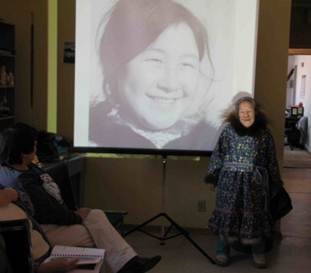
Colour photograph of an elderly Inuit woman wearing a fur-trimmed floral parka posing in front of a screen with a slide projection of her photograph when she was a young woman, taken at a community hall.

Mona Tigitkok posing with a picture of herself taken more than 50 years ago, Kugluktuk, Nunavut, February 2011. Credit: Kitikmeot Heritage Society.

Author and historian, Deborah Kigjugalik Webster, has used Project Naming, both personally and professionally. In her words:

I was first introduced to Project Naming a few years ago through my work in the Inuit heritage field, but there is also a personal connection for me—the database allows people to search by communities in Nunavut so I’ve discovered photographs of relatives and community members.

It was not uncommon in the past for photographers not to name the subjects of images. Often photo captions were simply “group of Eskimos” or “native woman” and so on. One afternoon, over tea, I showed some of the photographs from the Project Naming database to my mother, Sally Qimmiu’naaq Webster, and we were able to add a few names to faces from our home community of Baker Lake (Qamanittuaq). I felt a sense of satisfaction in identifying unnamed individuals in photographs and providing names to replace nondescript captions provided by the photographer. In a sense, when we do this we are reclaiming our heritage.
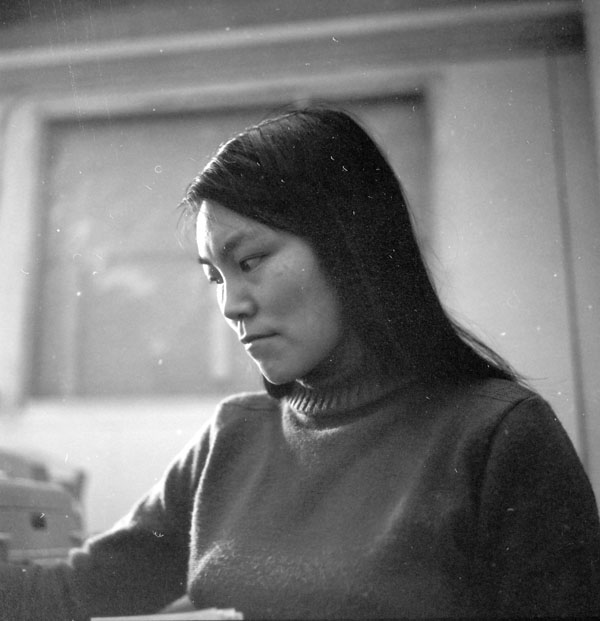
Photograph of a young Inuit woman wearing a turtle neck sweater looking away from the camera.

Photograph of the late Betty Natsialuk Hughson (identified by her relative Sally Qimmiu’naaq Webster). Taken in Baker Lake (Qamanittuaq), Nunavut, 1969 (MIKAN 4203863)

Project Naming allows people to not only identify individuals in images, but to add information including corrections to the spelling of names in an online form. It is well worth checking out the database, especially with an Elder, because seeing the image opens up discussion.

As part of my work I manage a Facebook page Inuit RCMP Special Constables from Nunavut to acknowledge the contributions of our Inuit Specials and pay tribute to them. Last year I posted a portrait photograph that I found on the Project Naming database of Jimmy Gibbons, taken in Arviat in 1946. Special Constable Gibbons was a remarkable man who joined the RCMP in 1936 and retired to a pension in 1965. This post was met with many enthusiastic likes, shares and comments from S/Cst. Gibbons’ descendants saying that he was their father, uncle or great-grandfather. Some people also simply said “thank you.” Shelley Ann Voisey Atatsiaq proudly commented, “No wonder I wrote earlier that I highly respect the R.C.M.P. I’ve got some R.C.M.P-ness in my blood. Thank you for sharing!”
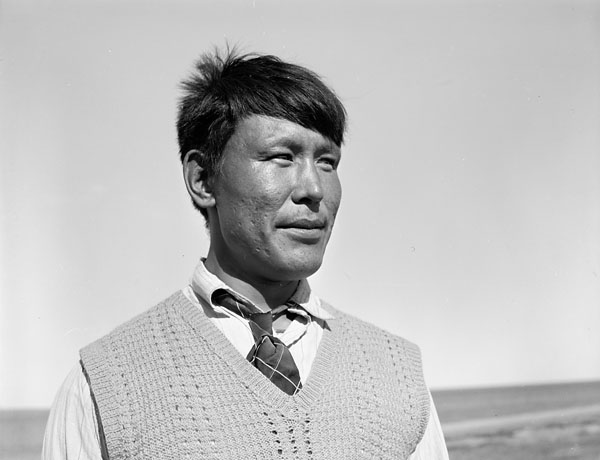
Black-and-white photograph of a close-up of an Inuit man wearing a knitted vest and tie standing outside.

Jimmy Gibbons, Royal Canadian Mounted Police Special Constable, Arviat, Nunavut, August 1, 1946 (MIKAN 4805042)

For more information about the history of the project, read the article Project Naming / Un visage, un nom, International Preservation News, No. 61, December 2013, pp. 20–24.

As with the first phase of the project, LAC wants to hear from you through The Naming Continues form.

Start your search for Aboriginal content

Arctic Images from the Turn of the Twentieth Century

Explorers and travellers have long been documenting their Arctic adventures in diaries, manuscripts, maps, sketches and watercolours. Their accounts portray the Arctic as a mystical land, whose inhabitants and way of life seem unspoiled, and this imagery was further disseminated to audiences abroad with the invention of the photograph.

The following photographs are part of the Arctic Images from the Turn of the Twentieth Century exhibition presented at the National Gallery of Canada. Featuring material from Library and Archives Canada’s collections, the exhibition showcases rarely seen images, which document photographers’ travels in the Canadian north. In many cases, these images present a romanticized view of the people and places.

One of the earliest images is this photograph of a hunter, taken by George Simpson McTavish while he was stationed at the Hudson’s Bay Company at Little Whale River, Quebec, in 1865.

Portrait of a hunter, a beluga, a seal skin “daw” (a buoy), and a kayak along the edge of the Little Whale River, Quebec. Photographer: George Simpson McTavish (MIKAN 3264747)

Portrait of a hunter, a beluga, a seal skin “daw” (a buoy), and a kayak along the edge of the Little Whale River, Quebec. Photographer: George Simpson McTavish (MIKAN 3264747)

The majority of photographers who ventured to the Arctic regions were men, and for the most part, were employed by the Hudson’s Bay Company and the Canadian government. Geraldine Moodie was one of the few female photographers. She had a successful photography studio prior to moving north with her husband when he was posted to the North West Mounted Police station in Fullerton (Qatiktalik in Inuktitut), Nunavut. Her portrait of an Inuit widow and her children, taken around 1904, is a good example of her beautifully composed images.

Widow and her children, Nunavut, by Geraldine Moodie (MIKAN 3376416)

Widow and her children, Nunavut, by Geraldine Moodie (MIKAN 3376416)

The vast majority of photographs of Inuit emphasized the ethnological attitudes of the era by presenting them as “types,” such as this 1926 image of an unidentified man.

Unidentified man, Chesterfield Inlet (Igluligaarjuk), Nunavut, by Lachlan T. Burwash, Department of Indian and Northern Affairs (MIKAN 3376543)

Unidentified man, Chesterfield Inlet (Igluligaarjuk), Nunavut, by Lachlan T. Burwash, Department of Indian and Northern Affairs (MIKAN 3376543)

In other cases, Canadian government staff took photographs to highlight federal government initiatives and policies, such as this 1948 image of four women looking at a family allowance poster. Below it, also from Health and Welfare Canada’s Medical Services Branch, is the portrait of Bella Lyall-Wilcox carrying her baby sister, Betty Lyall-Brewster. Taken in 1949, the lighting and composition of this portrait link it aesthetically to the pictorial tradition of the majority of photographs in this exhibition.

Women looking at a family allowance poster, Baker Lake (Qamanittuaq), Nunavut, by unknown photographer, Health and Welfare Canada (MIKAN 3613868)

Women looking at a family allowance poster, Baker Lake (Qamanittuaq), Nunavut, by unknown photographer, Health and Welfare Canada (MIKAN 3613868)

Bella Lyall-Wilcox (left) and Betty Lyall-Brewster, Taloyoak (formerly Spence Bay), Nunavut, by Studio Norman, Health and Welfare Canada (MIKAN 3613832)

Bella Lyall-Wilcox (left) and Betty Lyall-Brewster, Taloyoak (formerly Spence Bay), Nunavut, by Studio Norman, Health and Welfare Canada (MIKAN 3613832)

The Arctic Images from the Turn of the Twentieth Century exhibition opened on March 14, 2014, and will continue until September 1, 2014, at the National Gallery of Canada. For more information about LAC’s photographic collections portraying Inuit and the Arctic, visit our Project Naming web page.

Reconnecting families through digitization

As part of Project Naming, a community engagement and photo identification project that aims to reconnect Inuit and their past, Library and Archives Canada (LAC) has undertaken the digitization of a series of photographs from the Indian and Northern Affairs Collection. These albums have been the starting point of a great story regarding a family from Nunavut.

In this collection, are a number of images of the Weetaltuk family taken during the summer of 1949 on the Cape Hope Islands in Nunavut. The original captions accompanying the photographs provided basic details. Fortunately, the database records for these images are now more complete after several family members contacted LAC to provide the names of relatives and other relevant information about these pictures. Most importantly, they were able to correct the Weetaltuk surname, as well as community names that had been incorrectly recorded. From the original captions, we knew that George Weetaltuk was a community leader, a skilled hunter and an expert boat builder. His family members explained the detailed process that George followed in creating his boats, as seen in this photograph of him with his son, William, and his adopted son, Simon Aodla, constructing an 11.58 metre (38-foot) boat.

Another record that the Weetaltuk family was able to correct was this group photograph taken in front of a log cabin. The caption states that this picture was taken on Cape Hope Islands. We now know that the picture was probably taken on nearby Charlton Island, James Bay, where for many years, George and his family resided while he was employed seasonally by the Hudson’s Bay Company. In addition to this information, the family was also able to identify five of the people in the photograph, and provide genealogical connections.

Weetaltuk family photograph. Back row: Adla (far left), married to William, George’s oldest son (2nd from left),  George Weetaltuk (centre) and his first wife, Ugugak (4th from left). Front row: George’s sons Alaku (far left) and Tommy (sitting on the ground). (PA-099605)

Weetaltuk family photograph. Back row: Adla (far left), married to William, George’s oldest son (2nd from left), George Weetaltuk (centre) and his first wife, Ugugak (4th from left). Front row: George’s sons Alaku (far left) and Tommy (sitting on the ground). (PA-099605) Source

In addition, another of George’s sons, Edward, was a member of the Princess Patricia’s Canadian Light Infantry. He was the first Canadian Inuk to serve in military combat with the Canadian Army during the Korean War. Following his 15 years of service, he began writing his life story. According to a news article, Edward (Eddy) Weetaltuk “wanted to show young Inuit that education was important and that Inuit can become anything they want and even become famous, if that’s what they want.” (Nunatsiaq Online, July 16, 2009)

Although Eddy started writing E9-422: Un Inuit, de la toundra à la guerre de Corée in 1974 (in French only), it was not published until 2009 only a few days before his death.

Through these family connections and dialogue with the community, our photographic collections are constantly improved and enriched for future generations.

For more information about Project Naming, read our Blog article, published on May 9, 2013, and listen to our Project Naming and Canada’s North podcast.

Project Naming: The first ten years and beyond

Initiated in 2002, Project Naming is a community engagement and photo identification project that aims to reconnect Inuit with their past by identifying the people and events portrayed in photographs held at Library and Archives Canada (LAC). We have added the names of individuals and descriptions of activities to our database, which you can search online.

Over the last ten years, we have digitized more than 8,000 of those photographs and have received identifications for approximately 1,900 individuals. New information about these pictures is gathered through a variety of methods, including an online form, community slide shows and other social gatherings, weekly features in local newspapers, social media and on-site research visits.

Quite often, identifications come as a result of intergenerational conversations that take place in person or virtually—or both. Such was the case when Nunavut News/North published a photograph of Rhoda Qaqsauq, and her daughters, Lucy Evo and Janet Tagoona, on February 11, 2013; upon discovering this picture, Deborah Kigjugalik Webster shared it on Facebook, thus sparking a lively conversation between her and other family members.

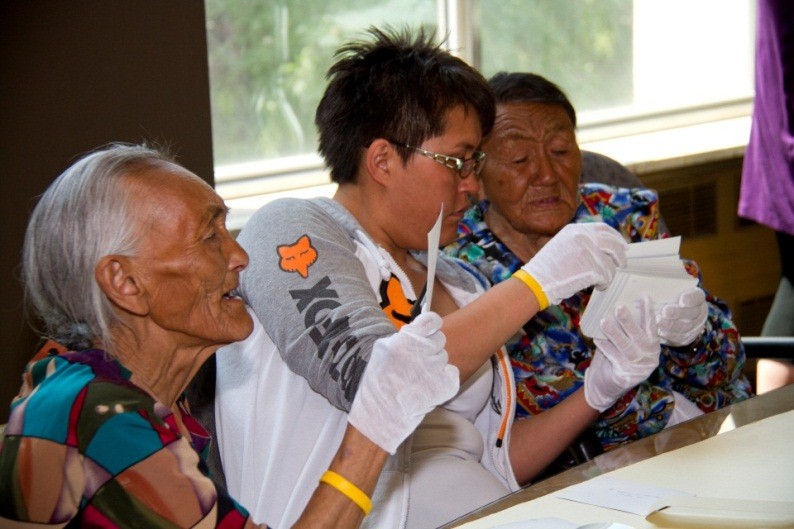
An example of a successful on-site visit occurred in June 2012 when a group of Elders and youth from Arviat, Nunavut, located on the southwest coast of Hudson Bay, made a trip to Ottawa. They looked through hundreds of photographs and negatives taken between the 1920s and the 1970s.

This enabled them to identify 31 family members in 17 images. Louisa Gibbons discovered her mother, Catherine Kopak, and her grandmother, Yarat, in a picture taken in Kingayualik, near Padlei.

Elder Eva Muyunaganiak (left), Louisa Gibbons (centre) and Elder Mary Nowtalik (right).

Elder Eva Muyunaganiak also discovered a photograph of her mother, Uyaupiak, dating from the late 1960s. Today, the remaining 22 Elders in the community of Arviat are the only ones able to recognize people and describe what life was like in photographs taken more than 50 years ago. Elder Muyunaganiak passed away in September 2012; her death reminds us of how time-sensitive an initiative Project Naming is.

Project Naming has now evolved into a broader community engagement initiative that has expanded beyond the territory of Nunavut to other Aboriginal communities in the Yukon, the Northwest Territories, Nunavik (northern Quebec) and Labrador. We hope to build upon this dialogue with members of Northern communities using new technologies and social media.

To learn more, listen to our Project Naming and Canada’s North podcast.