Vimy Memorial visit: fact or fiction (now a trilogy)

Version française

By Rebecca Murray

In 2022, I wrote about researching my great-grandfather’s attendance at the 1936 unveiling of the Vimy Memorial. A year later, I shared another instalment, and now, I’m back with what feels like the conclusion to this journey through my family history.

We left off with the exciting discovery that Thomas C. Phillips had indeed been at or very near the Vimy Memorial in July 1936. However, we were still missing a key piece of the puzzle—how exactly did he get there and back home again?

Given the era, it’s likely that Thomas travelled by passenger ship. Family documents tell us that he sailed to France on the SS Alaunia and I confirmed online that this ship left Montréal on July 20, 1936—a tight, but feasible window for him to make it to the unveiling on July 26. So, this is where we pick it back up!

I turned my attention to passenger lists and related records, hoping to trace Thomas’s journey. My first stop—because I have learned that a problem shared is a problem halved AND I know how smart my colleagues are—was the Genealogy Desk! I spoke with one of my colleagues (you can do this too!), who advised me that post-1935 passenger lists are under the custody of Immigration, Refugees and Citizenship Canada and are accessible through Access to Information requests. Pre-1935 records, however, are organized into various datasets that are searchable on the Library and Archives Canada (LAC) website using a variety of keywords such as “passenger,” “immigration,” and “border.”

I hummed and hawed over this—those of you who love research will understand that handing over the reins to someone else wasn’t my first choice. Not wanting to rely entirely on others, I approached the research from a new angle. Which angle you ask? Well, I went all the way to the other side of the ocean! Instead of looking for arrival records, I decided to look for departures (or, Thomas’s return trip)! This led me to the National Archives of the United Kingdom and their digitized records on Findmypast, where I discovered not one, but two passengers named Thomas Phillips who sailed to Montréal in the summer of 1936. Another big thank you to my colleagues at the Genealogy Desk, whose expertise proved invaluable in this stage of the research.

I reviewed the search results knowing that I should look for a departure date in the late summer and use Thomas’s birth year (1877) as an additional filter. I quickly found the relevant record: a passenger list for the SS Antonia, a Cunard ship built in the 1920s. Spotting Thomas’s name felt like one of those moments in the Reference Room where you want to fist pump and high-five someone—except, when you’re working remotely, all you get is a side-eye from the dog for interrupting his nap.

The form tells us a lot about the voyage and about Thomas. The SS Antonia departed Liverpool on August 28, 1936, bound for Quebec City and Montréal, Quebec. While most of the passenger data is standard, I found it neat to see column 8 or “Country of Last Permanent Residence,” which offers a breakdown of regions across the United Kingdom as well as options for “Other Parts of the British Empire” and “Foreign Countries.” Unsurprisingly, most of the passengers heading to Quebec on this voyage are listed as from “Other Parts of the British Empire”—perhaps other Canadian pilgrims who, like Thomas, had been in France the previous month for the unveiling of the Vimy Memorial.
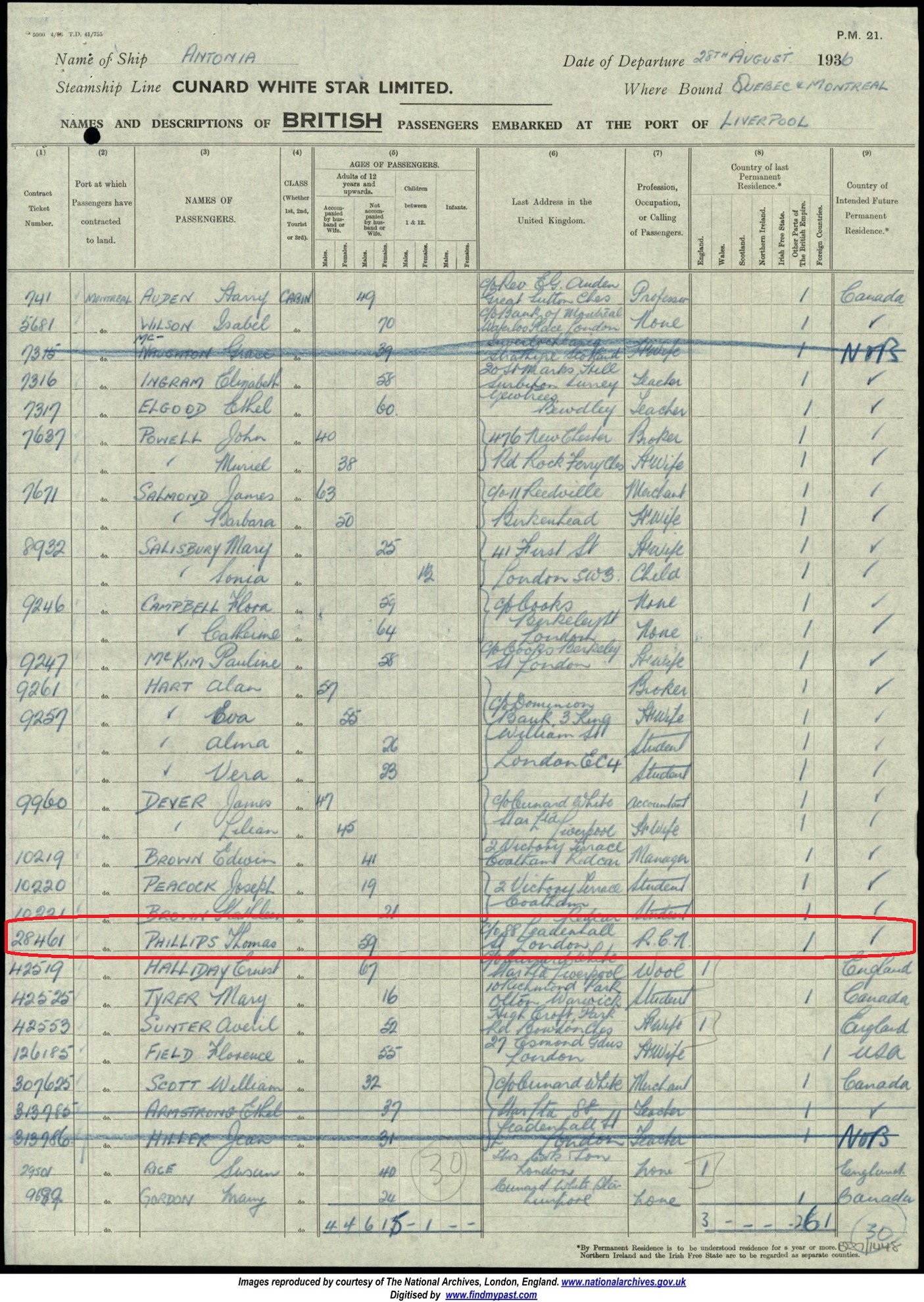
Page from the passenger list of the SS Antonia, featuring the name of Thomas Phillips circled in red.

Passenger list for Cunard White Star Line’s SS Antonia with a departure date of August 28, 1936, from Liverpool, England. Information about Thomas Phillips is circled in red. Source: National Archives of the United Kingdom.

We also learn that Thomas’s last address in the United Kingdom was “c/o 88 Leadenhall St, London.” Naturally, my curiosity led me to investigate what was located at 88 Leadenhall Street in 1936. A quick Internet search revealed it was Cunard House, an eight-story building that housed the business offices of Cunard Line and its affiliated companies. Further digging suggested that it wasn’t uncommon for travellers by sea to use a “care of” (c/o) address, likely for ease of correspondence during their journey.

With this new information in hand, I turned to LAC’s archives to explore what else I could find about the SS Antonia and Thomas’s voyage. Archival holdings at LAC provide a rich narrative of the SS Antonia—from her early days as a passenger liner to her later role as a troop transporter during the Second World War. But of most interest to this researcher are the records related to the Vimy Pilgrimage! LAC even holds footage of the SS Antonia, as well as this beautiful photograph of her Europe-bound voyage earlier that summer.
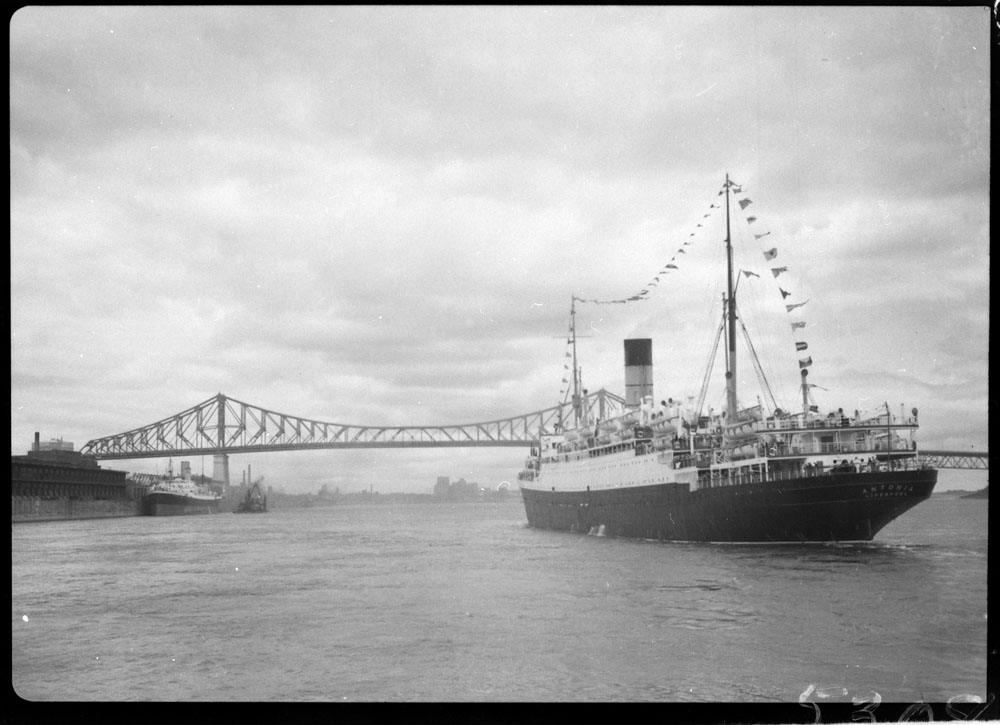
A black-and-white photograph showing the SS Antonia, a two-toned passenger ship, moving across the water. In the background, the Jacques-Cartier Bridge and several docked ships can be seen.

Members of the Vimy Pilgrimage aboard the SS Antonia, departing from Montréal, Quebec, 1936. Source: Clifford M. Johnston/Library and Archives Canada/PA-056952.

I even scoured Montréal newspapers from early September to see if Thomas’s return was noted in the shipping news. While the Antonia’s arrival was documented, my great-grandfather didn’t make the papers. And so, this brings me to the conclusion of my research—sometimes the hardest part of archival work is knowing when you’re done.

I’ve delved into the original question of why my great-grandfather attended the unveiling of the Vimy Memorial, and along the way, uncovered answers to how he made the journey there and back. The research brought both exciting discoveries and inevitable disappointments—common in any archival exploration. Along with new insights, I’ve gained valuable research skills, which is always a welcome bonus. And far from feeling discouraged, I’m more eager than ever to tackle the next family history mystery. Bring it on!


Rebecca Murray is a Literary Programs Advisor in the Outreach and Engagement Branch at Library and Archives Canada.
My Dear Friend: Letters from Normandy to our Canadian Soldiers

Version française

By Ariane Gauthier

As part of my work as a reference archivist at Library and Archives Canada (LAC), I often find myself delving into the many documents in the Second World War collection. Many people around the world are interested in the history of Canadians in this conflict and, more specifically, in the experiences of our soldiers. What I find even more fascinating is how the quest begins for the researchers I am lucky enough to work with. The starting point is often a personal story, passed down in a family or a small community: “I found out that my mother served in the Royal Canadian Air Force” or “I heard that my village hid a Canadian spy during the Second World War.” This is enough to fuel the fire of researchers, who then dig to find evidence or fill in these stories with new details.

My colleagues and I participate in this quest on an ad hoc basis, mainly to facilitate access to documents from LAC’s vast collection. When circumstances allow, we delve into the information in these documents in search of relevant details that can help researchers piece together the story they seek to understand.

That is how I found three letters from Normandy addressed to our Canadian soldiers. Unfortunately, the context of the letters, including the identity of the recipient, remains a mystery. I found these letters in a file from Royal Canadian Air Force headquarters (Reference: R112, RG24-G-3-1-a, BAN number: 2017-00032-9, Box number: 30, File number: 181.009 (D0624)). This file documents the experiences of Canadian soldiers who were captured and interned in prison camps during the Second World War. It also contains transcripts of interviews about the soldiers’ experiences.

In this case, the three letters are not linked to specific interviews and are included in this file as loose sheets. There is no correspondence explaining why they were placed in this file. Nor is it known whether these were letters addressed to soldiers who had been taken prisoner during the war. The information in these letters is truly the only information we have. In reality, though it may not seem like much, these three letters tell us a great deal about the experience of soldiers in Normandy and of the French, especially the risks faced by those who resisted the Germans.

Here are the letters in question:

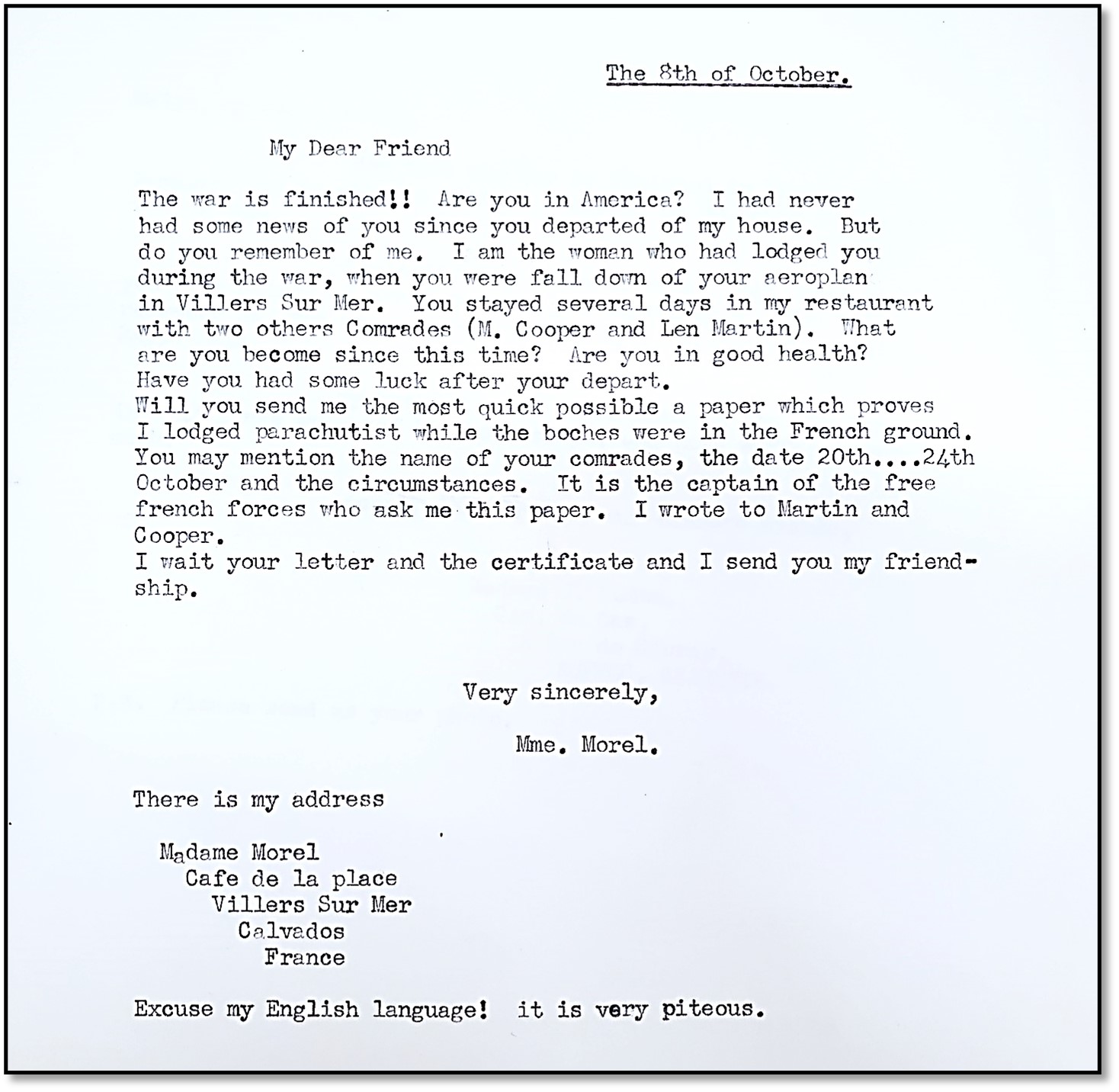
Letter to a Canadian soldier from Mrs. Morel, written on October 8. The year is not indicated on the letter. We only know that it was written and sent once the war was over.

Letter to a Canadian soldier from Mrs. Morel, dated October 8 (MIKAN 5034948)

In this first letter, we discover part of the story of Mrs. Morel, who apparently sheltered one of our soldiers after he jumped from a plane near Villers-sur-Mer. We learn that this soldier was a paratrooper and that he had taken refuge in Mrs. Morel’s restaurant with two of his fellow soldiers, M. Cooper and Len Martin, while the village was still under German occupation.

Letter written by Mrs. J. Cottu, expressing her desire to receive news of the soldier she sheltered in November 1943.

Letter to a Canadian soldier from Mrs. J. Cottu (MIKAN 5034948)

This second letter gives us a glimpse into the story of Mrs. J. Cottu and could possibly be related to that of the paratrooper mentioned in Mrs. Morel’s letter. Without more specific information, it is difficult to confirm this hypothesis, but the second letter refers to a Sergeant Martin (possibly Len Martin?) and places his departure in November. Mrs. Morel stated that she had taken in the soldier at the end of October, without specifying the year, so everything could fit together chronologically.

Mrs. J. Cottu mentions having housed three soldiers in her house in Ruffec in November 1943: the recipient of the letter, Sergeant Martin and Captain Ralph Palm. Although this story seems to have gone well, she said that she was arrested by the Gestapo in 1944 because of her husband’s activities. The seriousness of the situation is clear from this confession: “I was arrested by the Gestapo, and have suffered very much.”

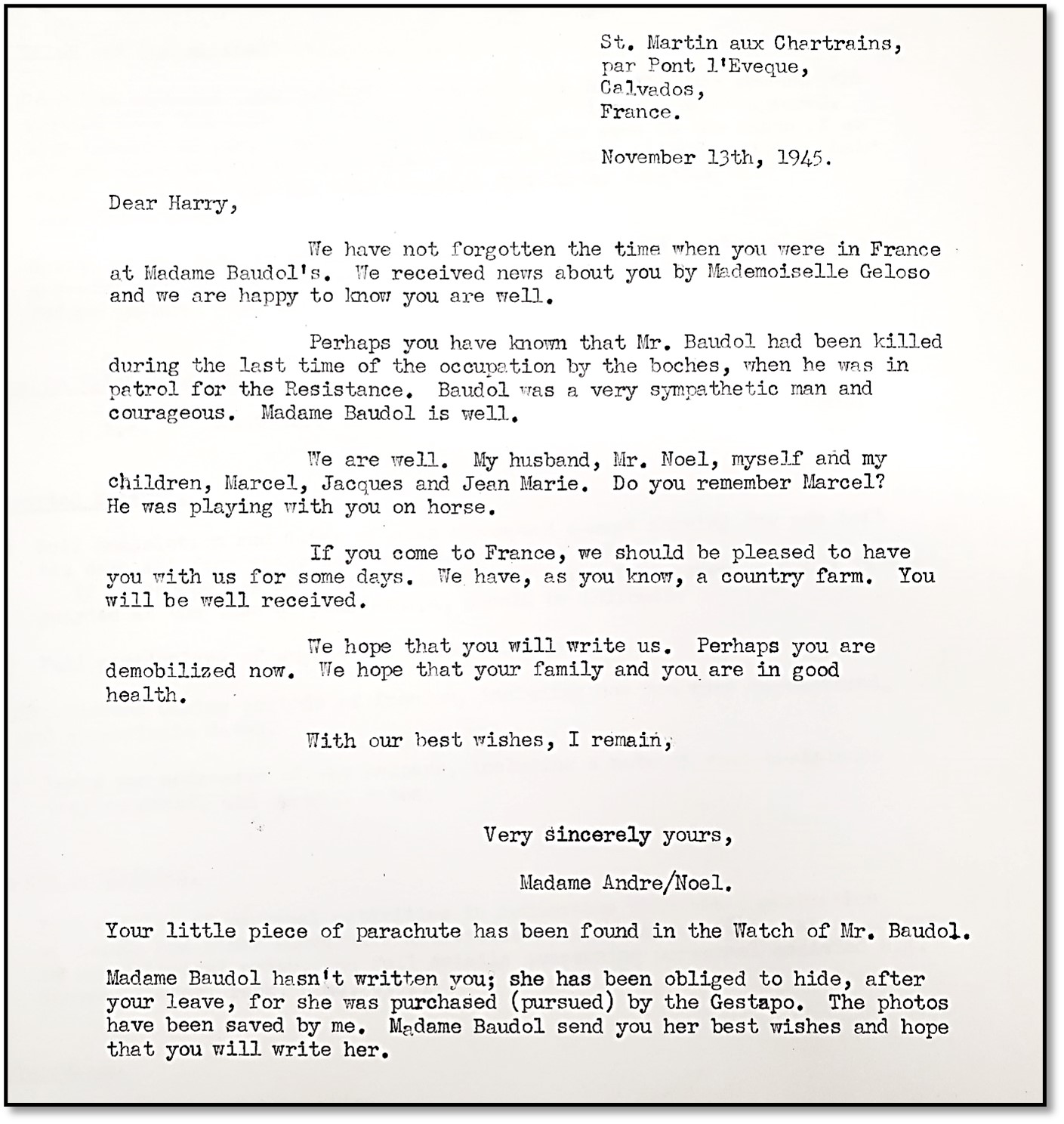
Letter written by Mrs. Noel to check on Harry and give him news about the French people he met during his stay in Saint-Martin-aux-Chartrains.

Letter to Harry from Mrs. Andre Noel, dated November 13, 1945. (MIKAN 5034948)

In this third letter, Mrs. Noel clearly illustrates the dangers that members of the Resistance faced. She bears the burden of announcing the death of Mr. Baudol, a member of the Resistance, who was killed while on patrol. She also shows us the strong bonds that Harry seems to have formed with the residents of Saint-Martin-aux-Chartrains. Although this letter expresses suffering, grief and fear, it also highlights the bravery and sacrifice of three families who came to the aid of a Canadian soldier.


Ariane Gauthier is a reference archivist with the Access and Services Branch at Library and Archives Canada.
Teamwork makes the dream work

Version française

By Ellen Bond

I walked up to Tanya Talaga at a Know History conference in June 2023, after her keynote speech about her search for her great-great-grandmother, Annie Carpenter, and said, “I work with a lot of photos of First Nation, Inuit and Métis Nation peoples at Library and Archives Canada (LAC), and I can help you.” “Send me an email,” she said. Thus began the teamwork between the two of us.

I found Tanya’s email address at The Globe and Mail and emailed her an explanation of Project Naming, the program I manage at LAC, as well as how I could help her. In her return email, Tanya explained more of her search for Annie and what little she knew of her. She gave me her birthdate, her maiden name, her married names, her children’s names and where she was in 1905.

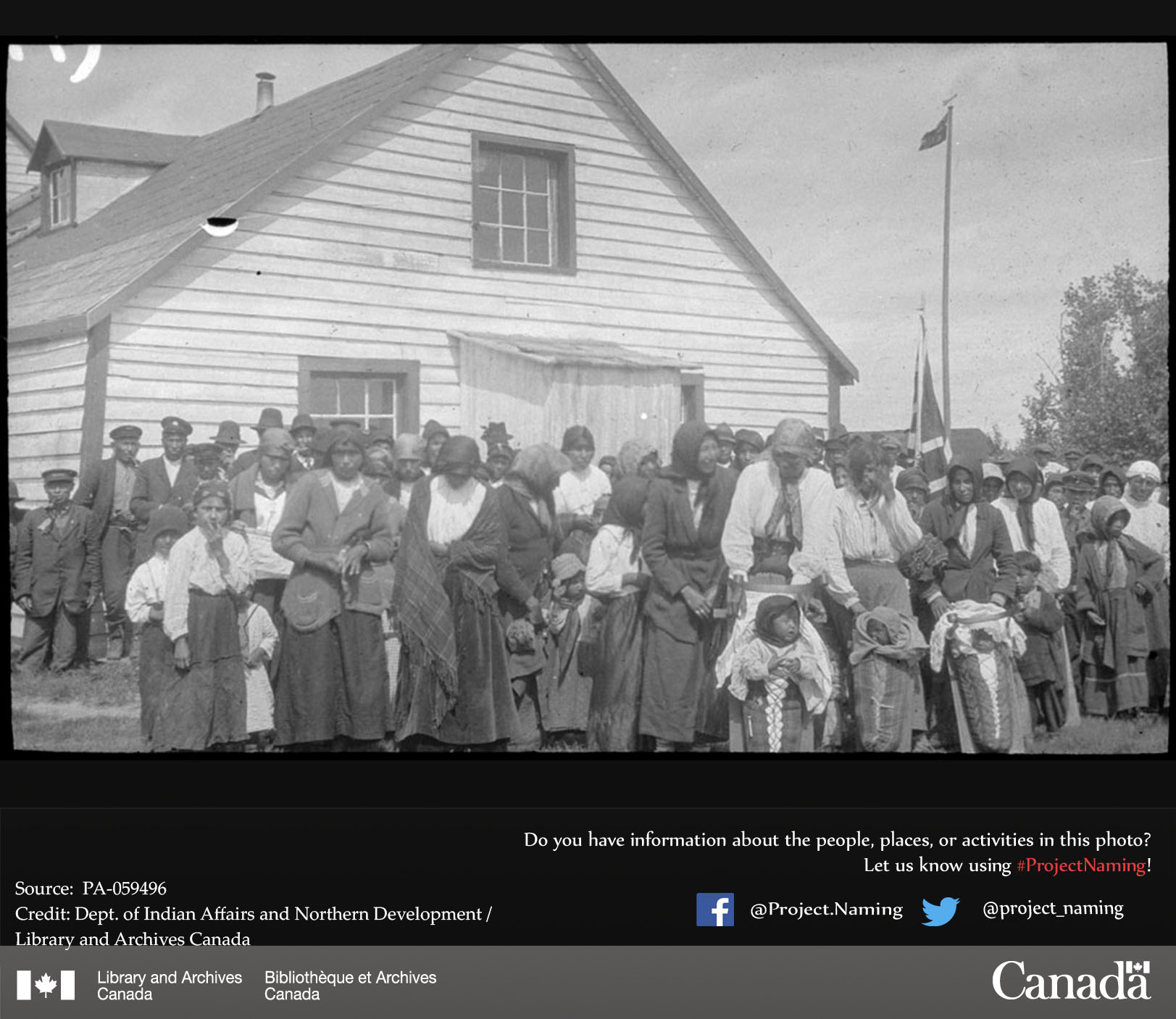
Large group of people standing in front of a building.

Photo was posted during Project Naming’s “Finding Kin,” December 6, 2023. We know Annie was in Osnaburgh House in 1905 when this photo was taken. Could Annie be in this photo? Credit: Canada. Dept. of Indian Affairs and Northern Development / Library and Archives Canada / a059496-v8.

Tanya knew nothing of where Annie or her children had gone after 1905, but she did know where Annie had spent the last eight years of her life and where she is buried in an unmarked grave. I shared Tanya’s search with Elizabeth Montour, LAC Archivist in the Government Archives Division. Within 24 hours, Elizabeth had found Annie’s grandson, Private Peter Rupert Chappise, who fought and died in the First World War (WW1). As I had worked on the massive digitization project to make available the files for everyone who fought for Canada in WW1, I searched Peter’s name and found his file. That file referenced Peter’s brother’s son, Flying Officer Richard Robert Chappise, who died in action in the Second World War. Since LAC has digitized all of the files from soldiers killed in action, I found Richard’s file. I sent all of this information to Tanya, who was thrilled. It felt so satisfying to work with Elizabeth to uncover part of Annie’s mystery. Teamwork!

In a future blog, I will explain more of the process of our teamwork and the usefulness of LAC’s documentary heritage collection. Tanya’s newest book, The Knowing, makes the dream work as she details her many collaborations with people, including me, as she researched Annie’s story. It was published on August 27, 2024. On September 30, 2024, the National Day for Truth and Reconciliation, Tanya will be talking about her search for Annie in depth at an event hosted by LAC and organized by Ottawa Public Library and the Ottawa Writers Festival. I’m looking forward to hearing the story of Tanya’s search and what she found.

More to come.


Ellen Bond is a Project Manager with the Online Content team at Library and Archives Canada.

Advice for genealogy newbies

Version française

Are you new to researching your family tree? Not sure how to start exploring your roots? We are here to help! Visit our new How to begin your genealogy research page to discover:

Hopefully, you will find this to be an enjoyable hobby, or maybe it will become a passion for lifelong learning about Canada, Canadian history, and beyond.

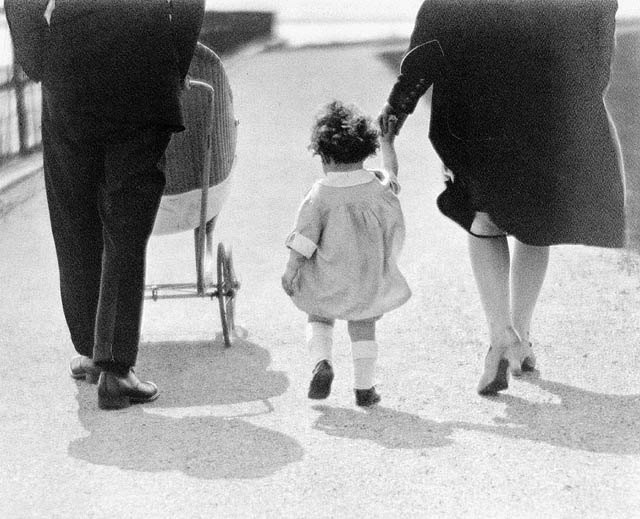
Black-and-white photograph featuring three people walking from behind. A man on the left pushes a stroller, while a small child in the centre holds the hand of a woman on the right.

“The Family,” Toronto, Ontario, ca. 1928. Photographer: John Pearson Morris. Library and Archives Canada/PA-126728

Continue learning from our Genealogy and family history pages. These resources are frequently updated, so be sure to check back often. Feeling more adventurous? Explore our A to Z tools and guides covering a wide range of topics related to Canada.

If you get stuck with your genealogy searches or need advice, use our handy online form to Ask genealogy a question.

Happy ancestor hunting!

Naming Indigenous Canadians

This article contains historical language and content that some may consider offensive, such as language used to refer to racial, ethnic and cultural groups. Please see our historical language advisory for more information.

When doing historical research of any kind, researchers have to choose a variety of search words. They hope that by using the correct word they can locate and use both primary and secondary sources. Choosing the right search terms is a challenge at the best of times, but the challenges involved in finding Indigenous content are particularly significant. Many search words reflect historical biases and misunderstandings. Over time, names or terms change entirely while spellings are altered to suit the period, location and circumstances.

And the terms are still changing.

There is little evidence that, as knowledge keepers, First Nations, Métis or Inuit were involved in the historical creation and development of the documents found at Library and Archives Canada (LAC). However, the individuals or institutions that created the documents left a strong imprint on them that is coloured by the why, when and where of their creation.

The language and imagery used in the past, however problematic, remain in the database descriptions. Terms such as “squaw,” “half-breed,” “massacre,” “uncivilized” and “victory” should be used with careful consideration and in an appropriate context.

A watercolour showing a woman wearing a red dress with a blanket wrapped around her head and shoulders. She is wearing snowshoes and looking off to the left. Behind in the distance is the silhouette of a church with a mountain behind it.

Indian squaw in her Sunday best with Montréal in the distance painted by Francis George Coleridge, 1866 (MIKAN 2836790)

A lithographic print showing a group of nine people, likely a family, including a baby, and three children sitting in front a tepee. One person is standing up and holding a rifle and two Métis men are smoking pipes.

Indian tepee and rebel Half Breed [Métis], 1885 (MIKAN 2933963)

A watercolour showing three figures standing by a body of water. From left to right: a woman smoking a pipe with a baby on her back , a man wearing leggings, a long blue jacket and a Métis sash holding a rifle in his right hand, and another woman with a shawl wrapped around her head and body wearing a blue dress underneath.

A half-cast [Métis] and his two wives (MIKAN 2835810)

Equally problematic is material that has less than perfect descriptions. These are not always helpful. Little detail is forthcoming when terms such as “native type” and “peau rouge” (red skin) are used. At the same time, the majority of individuals depicted in the images in Library and Archive Canada’s collections were never identified. Many archival descriptions relating to events or activities are absent or have dated information (e.g. place names, band names or terminology). Alternatively, information is based on original inscriptions and captions found in the records, and hence reflects the biases and attitudes of non-Indigenous society at the time.

The sheer number of these type of descriptions makes searching for a particular document or photograph a formidable task.

LAC does modify the descriptions in its collection. While ensuring the integrity of the original description, LAC strives to add clarity to incomplete data and modify inappropriate language when examples come to our attention. We never alter an original record or image, only the description that was created for it.

A black-and-white photograph of an Inuit man wearing a shirt and suspenders and looking directly at the photographer.

[Close-up portrait of a man wearing suspenders, Chesterfield Inlet (Igluligaarjuk), Nunavut]. Original Title: Native type, Chesterfield Inlet, N.W.T., July, 1926 (MIKAN 3379826)

So many lockers, so little time

When visiting Library and Archives Canada (LAC) in Ottawa at 395 Wellington to do research, you may be asked more than once if you need a locker. Let’s explore why and where this might be the case. First off, when you arrive, the Commissionaire at the security desk on the ground floor will ask you if you need a locker to store your personal items, such as your jacket or coat, hat, large bag, or umbrella. As you can understand, none of these items is allowed in the reference or consultation rooms in order to keep the collection safe from damage or loss. These personal storage lockers are located on the ground floor, and are for day use only. You must leave the key to your locker with the security desk when leaving the building, both at the end of the day and for any reason during the day, even if you plan to come back.

The next locker you might require is located on the third floor. Here there are three types of lockers for temporarily storing archival, published, or restricted items. They are loaned out for up to a month at a time and may be renewed as required. The first type of locker is the one most commonly used for open archival material. You must ask the consultation staff to assign you one of these lockers, and you can request up to a maximum of three at a time. You can either request the locker(s) when requesting your material in advance or if you are planning on coming in person to do your research during or outside of service hours. Keys for these lockers are also kept with the security desk on the ground floor and must be returned daily or when leaving the building. The same applies for the second type of locker, a smaller one for when you only require a small space to temporarily store published items you have requested.

The third type of locker is the restricted one, for those researchers who have access to restricted (code 32) material. The same procedures apply for requesting this type of locker, but please note that keys are not issued automatically. The Commissionaire stationed in the lobby of the third floor must verify the researcher’s access to the restricted locker(s) before access can be granted.

Lastly, here are the most important things to remember when you are assigned any of the lockers located on the third floor:

  • Use lockers for LAC material only—no personal items please
  • Do not keep self-serve/archival microfilm in the lockers
  • Be aware that the expiry dates of lockers and items often differ
  • Make sure to renew your locker and archival items to ensure that the items are not sent back before you have completed your work
  • Note that overdue items may be removed and returned to storage even if the locker is not expired
  • Renew lockers or items after hours by contacting consultationtext@bac-lac.gc.ca. Be sure to provide all the details

How to make the most of your reference appointment

Reference librarians and archivists at Library and Archives Canada (LAC) are happy to assist you by:

• showing you how to make the best use of our research tools
• directing you toward suggested resources

You may wish to take a proactive approach to your research project before making a reference appointment. Being better prepared in the following ways will allow you to maximize your time with a LAC professional.

Have you laid the groundwork using sources near you?

Local municipal and university libraries provide a wealth of resources to researchers. These resources are an important first stop for anyone embarking on a historical research project.

Read everything you can about your subject. Books and journal articles provide important background and context for your research project. Verifying the bibliographies and source citations of such published items can often help identity additional research resources, which may or may not be held at LAC.

Take notes! When consulting any source, be sure to take well-organized notes and to fully transcribe all references. For published sources, you will need to have the complete title, the author’s name, and the place and date of publication. For archival sources, be sure to note the name of the archives that holds the records, the collection name, collection code, box or volume number, file titles and dates. Bring these references to your appointment at LAC along with the tools necessary for taking additional notes.

Have you done a preliminary search with our online tools?

Our Academic Researchers page can help you set the stage. If you are unfamiliar with what an archive is, we recommend our guide on Using Archives and our blog post Discover Finding Aids!

Remember that not everything we have is available online.

Do you have the right archive or library?

LAC holds a wealth of archival material of national and federal significance relating to Canadian history. However, we do not hold everything. Provinces, universities, counties, cities, corporations and social organizations all maintain their own unique archival and library collections. Depending on your topic, these may prove to be not only the most relevant but possibly the only resources available to you.

For example, information relating to land grants, local land titles and lot history is generally held at the provincial level. If you are interested in the history of a local arts festival or business, then the city archives or local historical society will likely be the best resource to consult. Please note that in the case of corporations and social organizations, their unique historical records may not be open for public research. In the case of some unique provincial resources, a fee for use may be required.

For the scientific research and innovation community, the Canada Institute for Scientific and Technical Information, which is the national science library at National Research Council Canada, represents a valuable online resource.

Did you know that not everything is available online?

In an age when more and more information is available on the Internet, it is easy to assume that if you can’t find what you’re looking for online, it probably doesn’t exist. But this may not always be the case. For instance, at Library and Archives Canada (LAC), we have a vast collection of historical material. Yet most of this collection predates the digital era, which means that it just doesn’t exist in digital format.

It also means that not everything at LAC is indexed or discoverable online, and that you may not find something described in our online tools even though we have it.

So, if, after starting your research, using our major online tools, you cannot find what you are looking for, but suspect it is in LAC’s collection, make sure to ask us about it. Our knowledgeable reference librarians and archivists can help identify tools and resources to guide you in your research.

Stay tuned for our upcoming blog post on preliminary research and preparing for your reference appointment.

Summary of comments received in French up to September 30th, 2013

  • A user asked how to obtain the recording of an interview done in 1975 at the University of Moncton. LAC suggested to consult the Film, Video and Sound database. LAC also has recordings that are not described at the item level. For those, research needs to be done on premises to consult finding aids.

The Top Five Things You Need to Know Before You Visit

Are you visiting Ottawa to do some research at Library and Archives Canada? Before you arrive, there are five things you need to know:

1. All researchers need a user card

You can register for a user card in two ways, either in person at the registration desk or online by submitting the User Card Registration Form. Present your photo ID at the registration desk to retrieve your user card.

You must read and agree to the terms and conditions in the User Agreement before you can obtain the user card.

2. There is a difference between service hours and opening hours

Our service points, including the registration desk, are only open during service hours when staff is on site and ready to help you. The building is accessible during opening hours, but staff is unavailable. These hours are posted on the Visit Us section of our website and in the building.

3. Order your research material in advance

At least five business days before your visit, order up to ten items of archival material by using our online Material Retrieval (Onsite Consultation) Form. You may order up to five items of published materials the same way as above, or place your order by telephone at 613-996-5115 or 1-866-578-7777 (toll-free in Canada and the US) by selecting option 8 in the automated menu.

4. Book your reference appointment, if necessary

We are applying a new approach to service delivery. This means that no appointment is necessary for basic orientation and genealogy services, which are available from 10 a.m. to 3 p.m., Monday to Friday. However, you must book an appointment if you need to consult our reference experts or genealogy specialists.  See the Contact Us section of our website for more information.

5. Where to start your online search

There are a variety of databases to choose from, so we encourage you to watch this 90-second video tutorial to help you determine “How to Begin your Search Online.”

Questions or comments? We would love to hear from you!

Summary of comments received in French up to September 30th, 2013

  • LAC added that there is no need to make an appointment for basic assistance for genealogical research. Staff is available from 10 AM to 3 PM, Monday to Friday. However, you must book an appointment if you want to consult with staff before or after those hours.