The life of Rifleman Sulo W. Alanen

Version française

By Ariane Gauthier

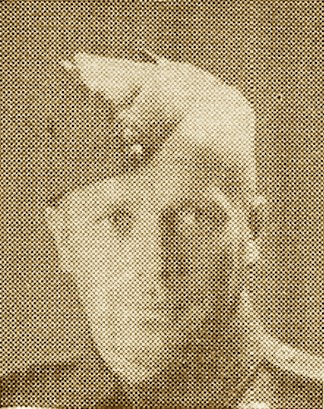
Sepia-coloured photograph of Sulo W. Alanen when he was about 30 years old, featured in a Finnish newspaper announcing his death.

Photo of Sulo W. Alanen as it appeared in a Finnish newspaper announcing his death. (Source: Canadian Virtual War Memorial)

The story of Sulo W. Alanen begins in the northern Ontarian village of Nolalu, a small settlement outside of Thunder Bay that emerged largely due to the arrival of Finnish settlers in the region. These settlers were likely drawn to the thriving lumber industry, the opportunities for farming, and the convenience of the railway passing through Nolalu.

Matti Alanen, originally from Jurva, Finland, was one of these immigrants who braved the journey to Canada in 1904, inspired by the promise of a better life. Like many of his compatriots, he settled in Nolalu, a growing Finnish community established just four years earlier. Here, he found familiarity in an unfamiliar land, with a supportive network of fellow Finns. Matti embraced farming as his livelihood. Hilma Lehtiniemi, originally from Ikaalinen, Finland, followed her family to Canada in 1908. After arriving in Nolalu, she met and married Matti, likely around 1910, as suggested by Sulo’s service file, which mentions their marriage in April 1910 in Port Arthur, Ontario.

Sulo, the couple’s third son and child, was born May 13, 1914, in Silver Mountain, Ontario, a mining settlement near Nolalu. The Alanen family’s farmstead appears to have been located between these two communities, as their place of residence alternates between Silver Mountain and Nolalu in Sulo’s service file.
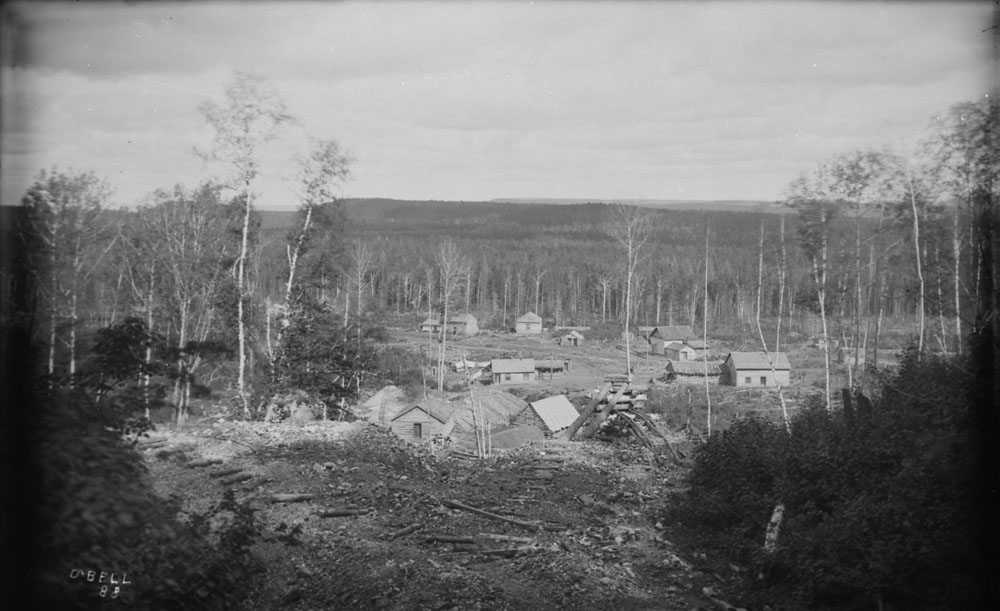
Black-and-white photograph from 1888 of the Silver Mountain mining settlement, showcasing the forest expanse and rural landscape.

Silver Mountain mining settlement, 1888. (Source: a045569)

Sulo was the middle child among five siblings. The 1931 Census provides insight into his upbringing, indicating that Finnish was his first language. This is unsurprising, given that Nolalu was a Finnish community where most settlers shared this cultural heritage. Census entries for neighbouring households confirm this pattern: nearly all family heads were originally from Finland and spoke Finnish as their first language.

Section of the 1931 Census for Nolalu, listing members of the Alanen family, their age, gender, and place of birth.

A screenshot of the 1931 Census featuring the Alanen family. Sulo’s name can be seen on line 42 of the 5th page. (Source: e011639213)

English came later for Sulo and his siblings, likely as a result of simply living in Canada, as none of them attended school or learned how to write. Much of Sulo’s childhood was spent working on the family farm. In adulthood, he continued working on his father’s farm until his enlistment for the Second World War. His service file also mentions that he occasionally worked as a bushman for extra income.

Sulo was forced to serve at the 102 Canadian Basic Training Camp in Fort William under the National Resources Mobilization Act (NRMA), enacted in 1941 by the King government as a compromise to avoid full conscription. The NRMA mandated that able-bodied men contribute to Canada’s defence and national security. After serving for 30 days under this program, Sulo made the pivotal decision to enlist voluntarily on May 4, 1943.

Sulo’s enlistment in the Canadian Army aligned with the critical Allied preparations for the D-Day landings, planned for the summer of 1944. From his initial training at Camp Shilo in Manitoba to boarding a ship bound for England, his focus was singular: preparing for the storming of Juno Beach.

Sulo’s ship arrived in England on April 11, 1944—just two months before Operation Overlord. On April 27, he was assigned to the Royal Winnipeg Rifles, specifically to the 2nd Canadian Base Reinforcement Group. This designation indicates that Sulo was not initially slated to participate in the first assault wave. Instead, as a part of C Company, he was positioned to join the Royal Winnipeg Rifles after they had pierced the Atlantic Wall.

The Royal Winnipeg Rifles’ war diary tells us what D-Day was like for Sulo and his comrades. The troops were informed at 9 p.m. the evening before that Operation Overlord was on, and all were fairly enthusiastic. The diary states: “There was an air of expectancy and sense of adventure on all craft this night, the eve of the day we had trained for so hard and long in England.”

The long day began at 4 a.m. with tea and a cold snack. The weather was cloudy and the sea was heavy. At 5:15 a.m., landing crafts were lowered from the motor vessel Llangibby Castle, still about 15 kilometres from the coast. At 6:55 a.m., the Royal Navy and air support began bombarding the coastline of France. The landing crafts arrived on shore around 7:49 a.m. with B and D companies landing first. As the war diary grimly notes: “The bombardment having failed to kill a single German or silence one weapon, these coys had to storm their positions “cold”—and did so without hesitation.”

A and C companies landed later around 9 a.m. C Company disembarked on the Mike and Love sectors of Juno Beach, where the beach and surrounding dunes were still under heavy mortar fire. Pinned down for about two hours, the soldiers eventually regrouped and, alongside A Company, pushed forward towards their objective, Banville, encountering several pockets of resistance en route but overcoming each one until just south of Banville, where the enemy had dug in on commanding ground.
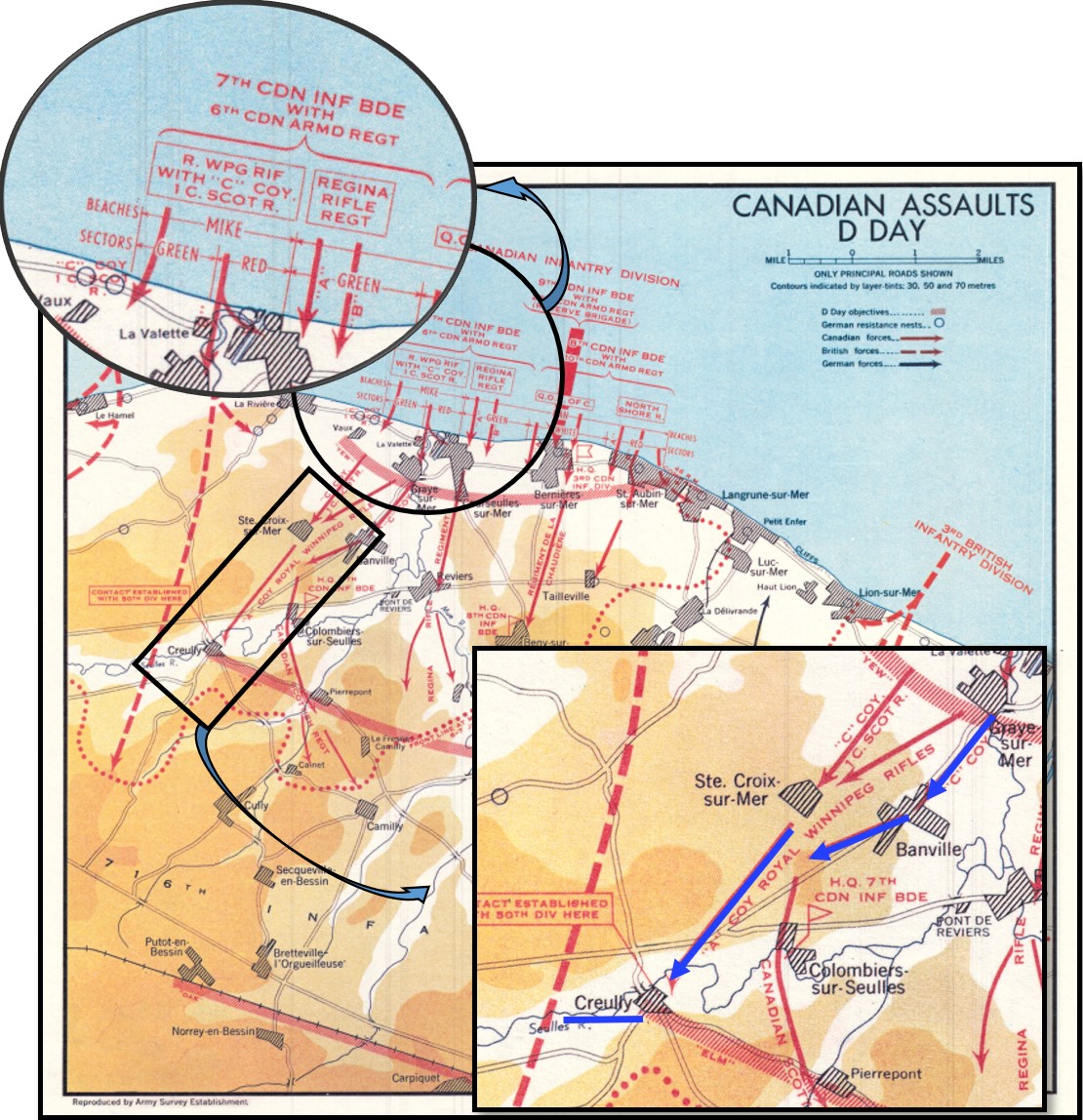
Map of Juno Beach showing the 3rd Canadian Infantry Division’s movements on D-Day. Highlights show the landing sector and path of the Royal Winnipeg Rifles’ C Company.

Map of Juno Beach showing the 3rd Canadian Infantry Division’s movements on D-Day. (Source: e999922605-u)

The first day of the Battle of Normandy brought surviving members of the Royal Winnipeg Rifles to Creully by 5 p.m., completing phase II of Operation Overlord. Little rest was had, especially for C Company, which faced an enemy patrol attack at 2 a.m. The soldiers repelled the assault and captured 19 German prisoners, allowing for a brief respite until 6:15 a.m., when they were ordered to advance once more. Their next objective was the OAK Line at Putot-en-Bessin.

This event set the tone for the Royal Winnipeg Rifles’ grueling experience in the aftermath of D-Day as they encountered some of the most ferocious and obstinate resistance by German forces.
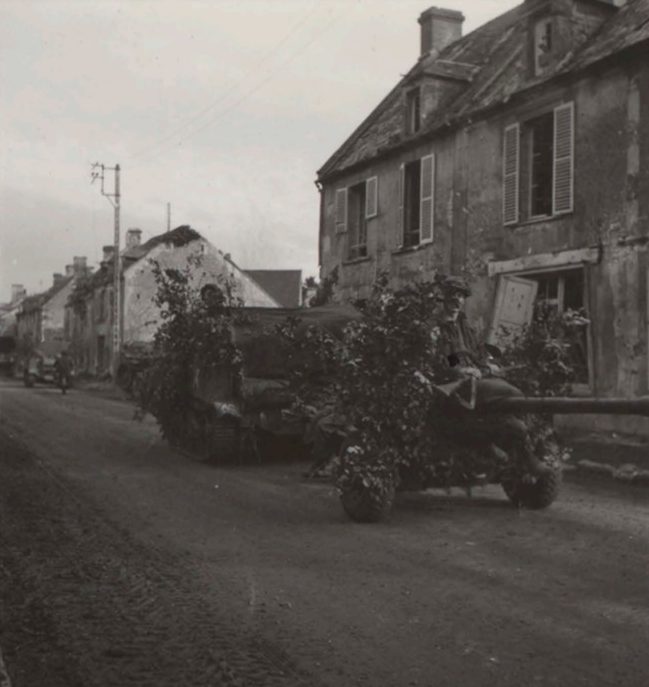
Photograph by military photographer Lt. Bell showing Canadian artillery camouflaged with foliage, Carpiquet, France, July 4, 1944.

Army Numerical 35899-36430—Northwest Europe—Album 75 of 110. (Source: e011192295)

By July 5, the Royal Winnipeg Rifles had painstakingly made it to the village of Marcelet, where they engaged in the battle for Carpiquet. While Sulo’s service file does not delve into the specifics of the injuries that ended his life on that day, the war diary tells us his regiment was subjected to enemy shelling and strafing from the air during the whole day. In this chaos, Sulo was either struck by shrapnel or collapsing buildings. Initially, he couldn’t be found and was reported missing, but when the battle calmed just enough by July 5, his body was discovered, and he was officially reported killed in action.

Like so many Canadians who gave their lives during D-Day and the battle of Normandy, Sulo W. Alanen rests at the Beny-sur-Mer Canadian War Cemetery in Calvados, France. He is buried in plot XV. G. 16, where his name liveth for evermore.

For more reading on this subject:


Ariane Gauthier is a reference archivist in the Access and Services Branch at Library and Archives Canada.

The Kapuskasing Internment Camp

Version française

By Ariane Gauthier

We make surprising connections throughout our lives. Things we thought were confined to our work or social circles unexpectedly surface in other areas. For me, several long drives with my husband to Northern Ontario led me to learn more about the Kapuskasing internment camp. Few people know that there were internment camps in Canada during both world wars. And even fewer know that these camps were not all for prisoners of war—many detained Canadian civilians of so-called “enemy” nationality.

The Kapuskasing camp was active from the start of the First World War in 1914 until 1920. It mainly held Ukrainian civilians. They were sentenced to forced labour, including constructing buildings and clearing several hectares of surrounding forests so the government could establish an experimental farm.

Black-and-white photograph of the Kapuskasing internment camp in July 1916. The image features a row of wooden huts with rows of prisoners and camp guards lined up in front.

The Kapuskasing internment camp. (e011196906)

My work as a reference archivist has allowed me to delve deeper into the resources of Library and Archives Canada to learn more about this grim period in Canadian history. During my research, I came across the documents of William Doskoch, born on April 5, 1893, in Laza, Galicia, a territory of the Austro‑Hungarian Empire that is now part of Ukraine.

In 1910, at the age of 17, William Doskoch joined his brother in Canada to work in the coal mines in Nanaimo, British Columbia. While he was in Vancouver in 1915, he was arrested, as he was considered an enemy alien. He was interned in several camps: first at Morrissey, then at Mara Lake, and later at Vernon, before finally being transferred to Kapuskasing. It was from there that he was released five years later, on January 9, 1920.

The William Doskoch fonds is rich in resources that help us understand internment camps from an internee’s perspective. While it contains information on several camps, I was mainly interested in William’s notes about Kapuskasing. According to his writings, the conditions were similar to those at Vernon: mistreatment of prisoners, random executions, many cases of tuberculosis, and inadequate internment conditions for the cold weather.

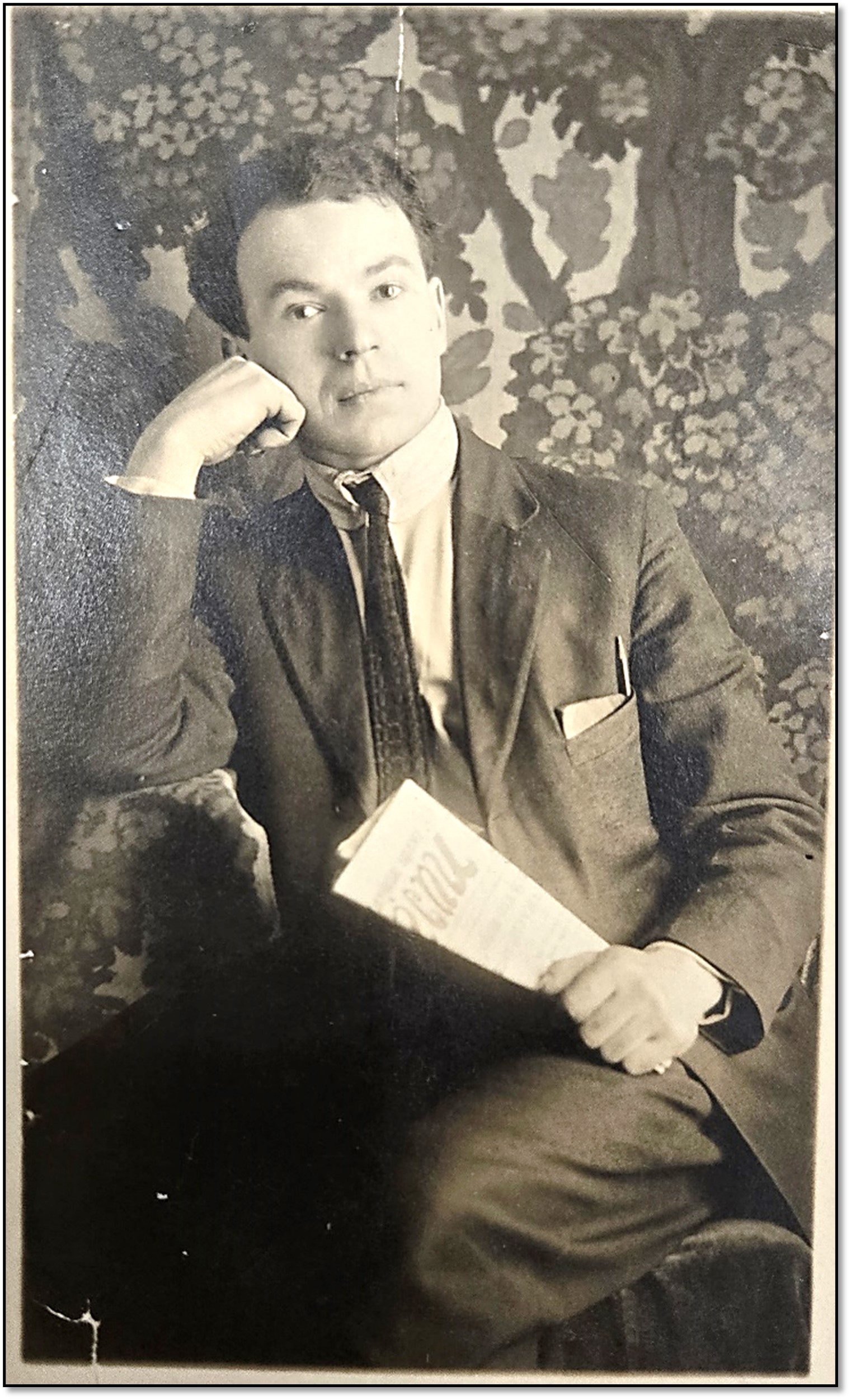
Studio portrait of a seated man. He is holding a newspaper.

Portrait of William Doskoch. (MIKAN 107187)

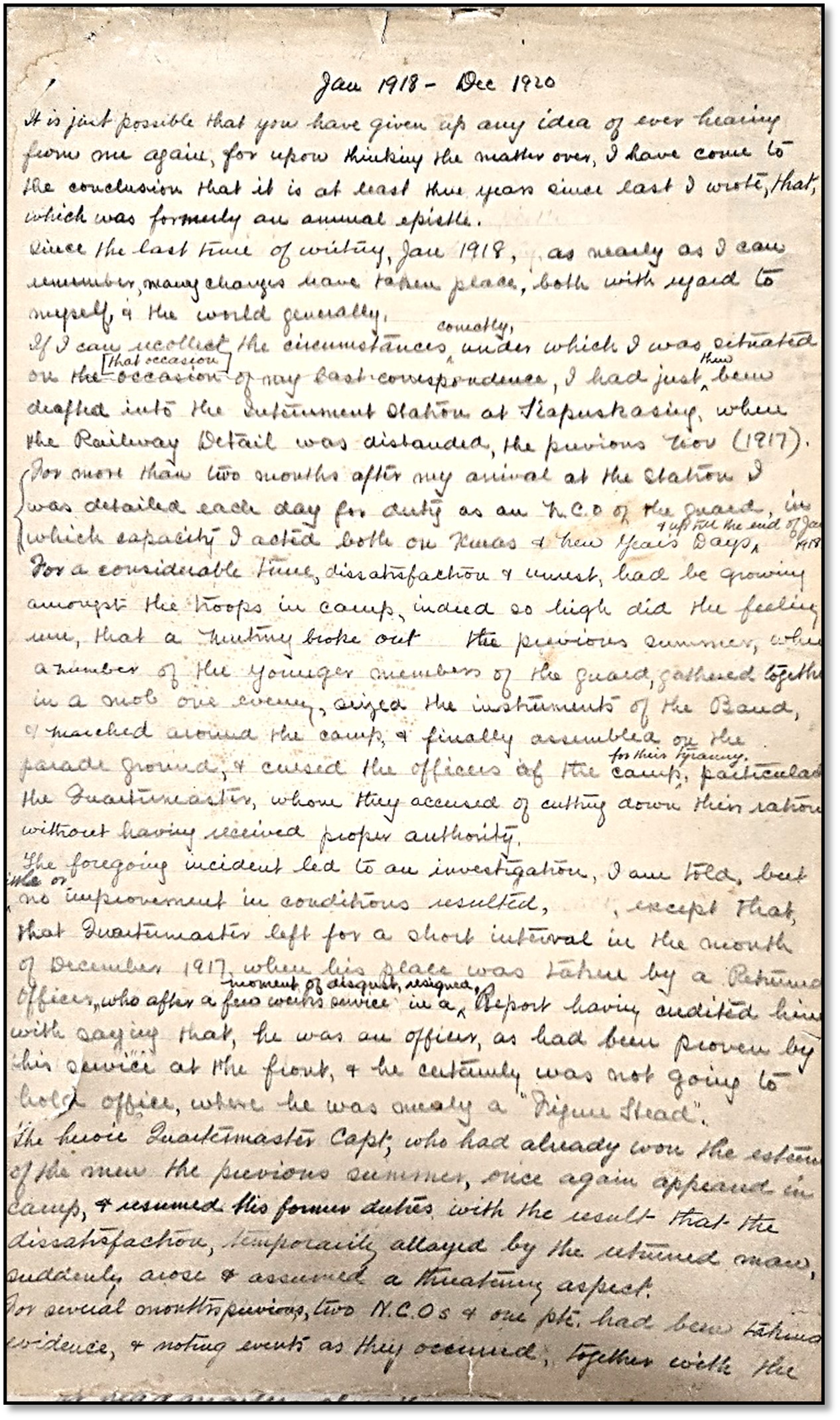
I also found a letter written by George Macoun, a guard at the Kapuskasing camp, detailing events that occurred there between November 1917 and the summer of 1919. Although of lesser magnitude than the William Doskoch fonds, the letter provides us with a rare glimpse into the experience of an internment camp guard.

First page of a letter written by hand.

Letter from George Macoun, a guard at the Kapuskasing internment camp. (MIKAN 102082)

Originally from Ireland, George Macoun immigrated to Canada, where he joined the militia in February 1915. This is how he became involved in the operations at the Kapuskasing internment camp. He wrote this letter after the war ended, following his dismissal as a guard. Reminiscent of a memoir, he recalls the significant experiences of his time in Kapuskasing, including the conflicts and tensions among the guards due to abuses of power. He recounts the following:

“One little incident took place in March 1918, which aroused the wrath of the company generally against this commander owing to the manner in which the case was brought up being considered, according to military custom, absolutely irregular. One evening, whilst an entertainment was being held in the recreation room about the last week of Feb 1918 a certain corporal, one of the most popular men of the guard had the misfortune to get drunk and a disturbance during the night, not only in his own room but also in one of the other rooms. This information was conveyed to the popular O.C. [officer commanding] by some weak about two weeks later, when a charge was at once laid against the corporal.”

The Department of the Secretary of State of Canada fonds also contains a wealth of information. Notably, it includes a sub‑series entitled Custodian of Enemy Property and Internment Operations records, covering the period from 1914 to 1951 (R174-59-6-E, RG6-H-1). During both world wars, the Secretary of State was responsible for, among other things, matters arising from internment operations. However, some activities, such as those related to the management of properties confiscated by the State from internees, were eventually transferred to other departments over the years. The fonds still contains documentation on the certificates of release from internment camps and on the administration of the camps. Boxes 760 to 765 inclusively hold documents concerning the operations of the Kapuskasing camp.

Because there’s a lot of information, I will only focus on a few interesting elements for Kapuskasing. For example:

  • According to correspondence from the director of internment operations, the experimental farm built by the prisoners at Kapuskasing was completed in early December 1917.
  • According to statistics from December 1918, the camp housed the following prisoners: 607 Germans, 371 Austrians, 7 Turks, 5 Bulgarians, and 6 classified as “other.” A note suggests that the term “other” was used for prisoners of war, but it is not clear.
  • Several letters written by prisoners to their family members were censored. This is the case for the letters that Adolf Hundt sent to his wife. Discouraged by the extent of censorship, he gave up writing to her, leading his wife to worry about his health.

This blog post gives you an overview of the information available about the Kapuskasing camp in the Library and Archives Canada collection. This rich resource offers valuable insights into this troubling chapter of Canadian history. To support further research, we have created a guide on internment camps in Canada during the two world wars, which was very helpful to me in writing this blog post.

To consult the guide, follow this link:


Ariane Gauthier is a reference archivist in the Access and Services Branch at Library and Archives Canada.
Black Porter Perspectives: Giving Voice to Rail Service During and After the Second World War

Version française

By Stacey Zembrzycki

This four-part Black Porter Perspectives blog series is inspired by a striking and haunting set of images found within the Department of National Defence (DND) accession 1967-052. These photographs provide a window into service to country through various vantage points during and after the Second World War, revealing the intersections of class, race and duty.

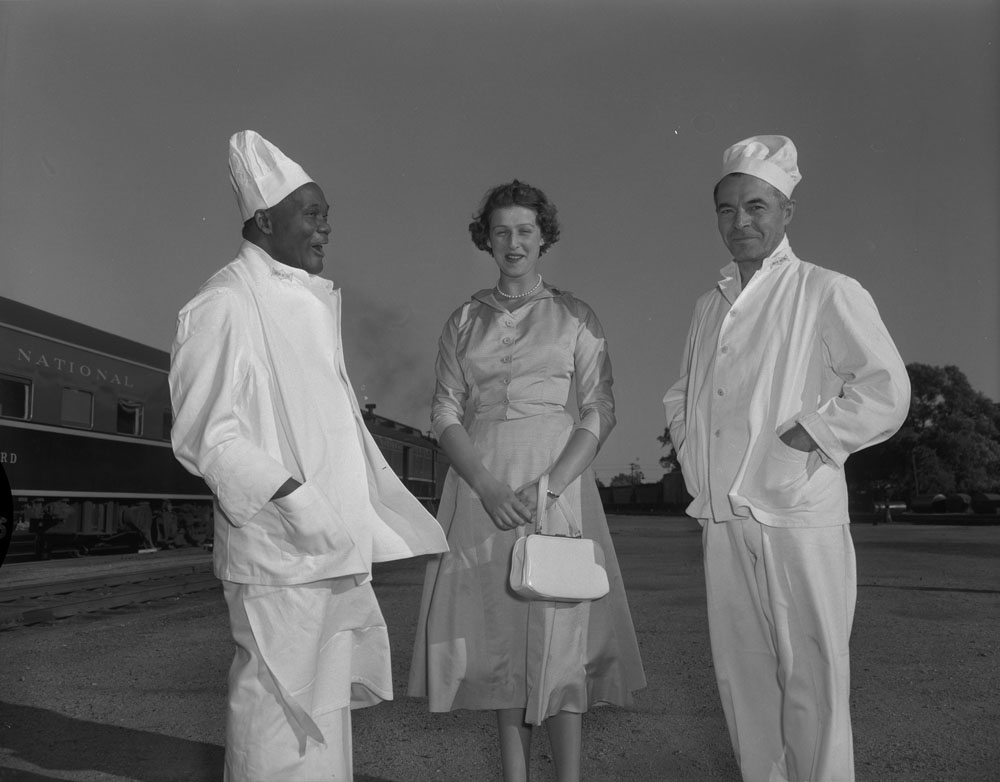
A white woman standing between a black man on the left and a white man on the right.

Princess Alexandra represents the British Crown on Canadian soil during her Royal Tour in 1954. (e011871943)

Volunteer, and in some cases, conscripted servicemen departing for and returning from battle offer us a glimpse into the realities of preparing for war, deploying to distant fronts, and returning home again.

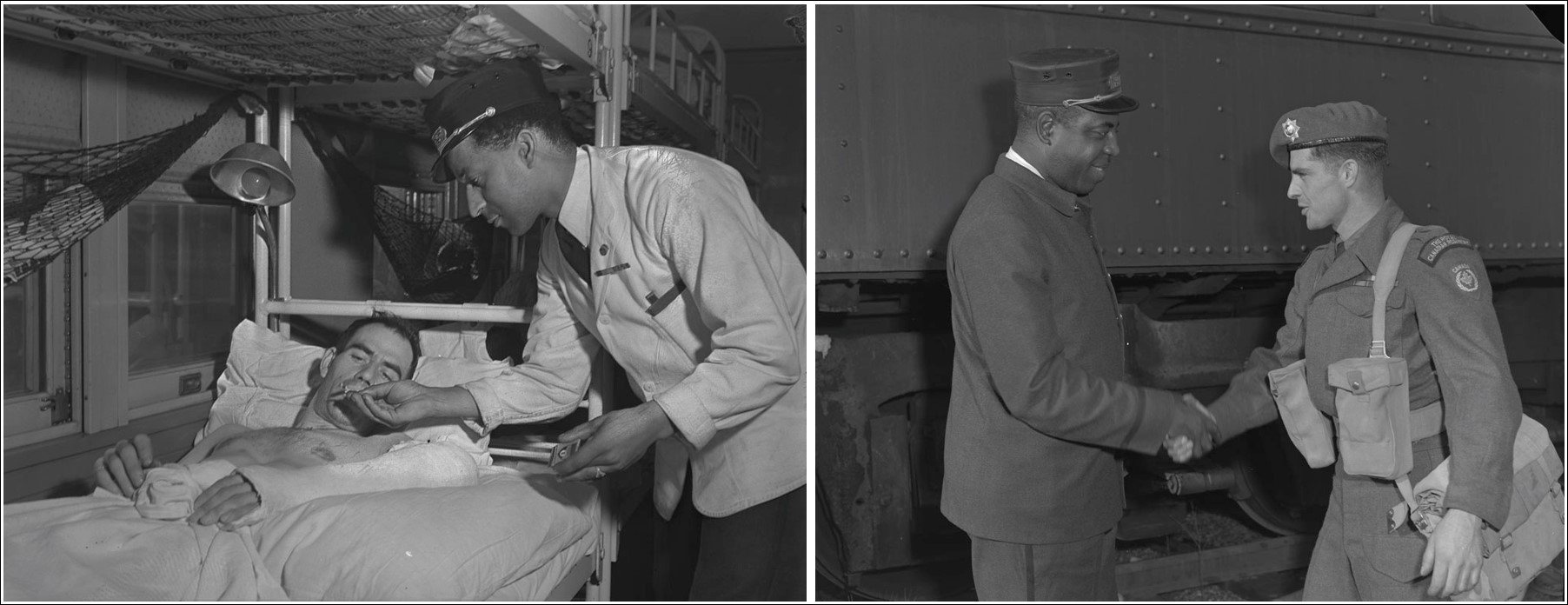
Side-by-side photographs of a Black sleeping car porter lighting a cigarette for an injured white soldier lying in a bed on a train, and of a Black sleeping car porter shaking hands with a white soldier.

Image on left: A sleeping car porter and an injured soldier on the Lady Nelson hospital train. Image on right: Porter Jim Jones of Calgary shakes hands with Private Harry Adams, a Halifax member of the Royal Canadian Regiment, as Canadian Army Special Force units arrive at Fort Lewis, Washington, for brigade-strength training. (e011871940 and e011871942)

Black men, often identified as train staff in the image descriptions, appear in every photograph—serving as the unifying thread in these historical moments. Their essential work, whether as cooks or sleeping car porters, made train travel possible, luxurious even, in times of war and peace. While this labour has often been silenced and overlooked in our national narratives, it is undeniably present in these images.

How can we begin to piece together the experiences that are captured in these images? One way is to turn to the Stanley G. Grizzle collection, particularly the interviews he conducted in 1986 and 1987 with former Canadian National (CN) and Canadian Pacific Railway (CPR) sleeping car porters. Grizzle sought to document the exploitative company culture Black men endured up to the mid-twentieth century and the long and complex struggle that ultimately led to their unionization. At the same time, he also made space for his narrators to recount memorable stories from their time on the rails. These recollections, if listened to closely, allow us to begin piecing together a narrative that enables us to better contextualize some of these DND images. Like the past, however, these moments remain fleeting and fragmentary, with much lost to history.

Five interview clips from Grizzle’s collection provide insight into what portering looked like during the Second World War. While these exchanges provide few details about the images above, they offer glimpses into porters’ working conditions and the added responsibilities they shouldered during wartime. Let’s listen to what these conversational tangents reveal about their experiences:

You can read the transcript from this sound clip here. (ISN 417383, File 1, 34:30)

You can read the transcript from this sound clip here. (ISN 417397, File 2, 9:26)

You can read the transcript from this sound clip here. (ISN 417379, File 1, 17:18)

You can read the transcript from this sound clip here. (ISN 417379, File 1, 5:56)

You can read the transcript from this sound clip here. (ISN 417386, File 1, 32:12)

The experiences of the men, the people they served, and their feelings about the additional duties thrust upon them as a result of the Second World War offer valuable insights that help humanize the role of portering. For George Forray, the demands of wartime rail service provided financial security, allowing him—and many others—to secure full-time employment during this turbulent period. Bill Overton, while recounting the hard-fought union gains he helped achieve, shared a story of being overwhelmed by 83 hungry Air Force cadets needing lunch. While there were white off-duty staff members on the train at the time, he explained the challenges of asking for their assistance. Through his account, we gain a deeper understanding of the intricacies and misunderstandings surrounding overtime pay during this era and the racialized structures that governed and divided rail workers.

In one of the clearest and most concise wartime stories in Grizzle’s collection, an unknown narrator recounts—despite audible breaks in the sound recording—details of transporting German prisoners of war. While he describes the sleeping cars’ physical environment and the meals served, much is left to the imagination, leaving gaps about how porters perceived this service and the potential dangers they faced. These insights are largely lost to history. Eddie Green builds on this discussion while speaking about the evolution of train technology in the early twentieth century. The reintroduction of outdated train cars to meet wartime demands posed significant challenges and physical dangers for porters, who had to navigate these risks while managing increased passenger loads. The stress would have been tremendous.

In many ways, the final interview clip brings the narrative full circle. In it, Joseph Morris Sealy reflects on how the high demand for wartime rail service paved the way for significant union gains. Government-backed wage increases served as a crucial starting point for negotiating the first collective agreement between the International Brotherhood of Sleeping Car Porters and the CPR in 1945. There was no going back to the way things were before the war. The uninterrupted movement of people and goods by rail had proven essential to sustaining a stable and functioning economy. Porters, fully aware of the critical role they played, fought to ensure they were treated fairly and justly compensated.

While piecing together the contextual information behind the images included above may not be possible, these accompanying narratives contain enough information to reveal what may have been happening before and after photographers captured these moments in time. They give a voice to the experiences of porters, shedding light on the complexities of their work during and after the Second World War. Yet, as with all historical sources, this oral and photographic evidence underscores the challenges of reconstructing the past—we must work with the fragments available to us. Despite their limitations, these sources compel us to fundamentally rethink our national narrative and the pivotal role of Black labour within it.

Additional Resources


Stacey Zembrzycki is an award-winning oral and public historian of immigrant, ethnic, refugee, and racialized experiences. She is a faculty member in the Department of History and Classics at Dawson College.

Black Porter Perspectives: Hospital Ships and Hospital Trains

Version française

By Jeff Noakes

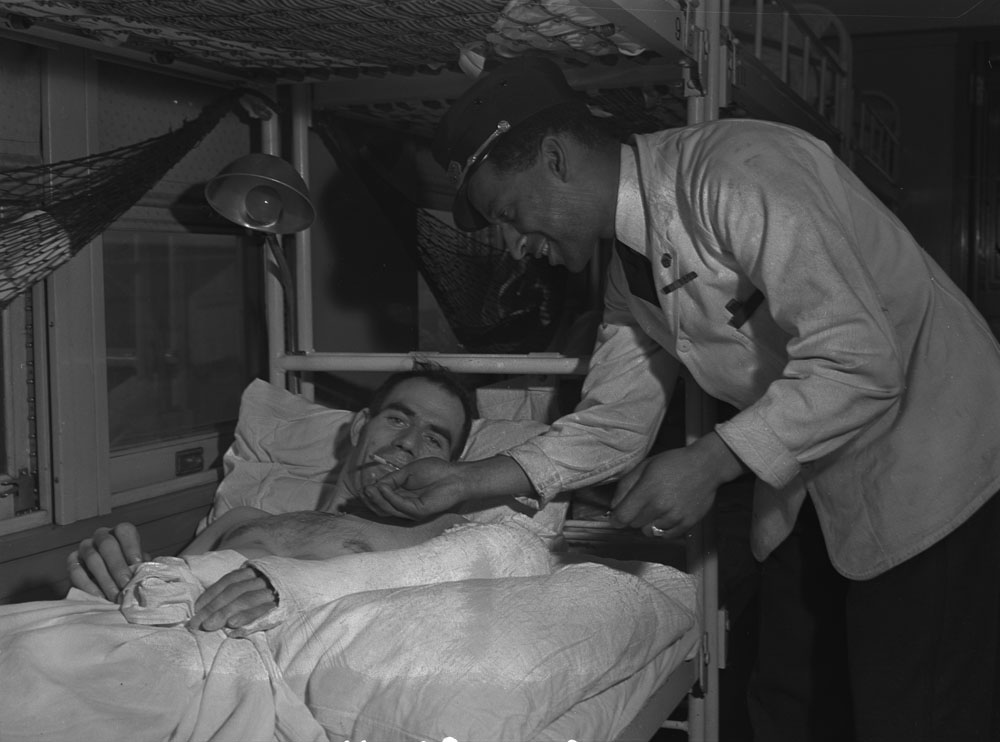
Black-and-white photograph of a porter (on the right, with white jacket and dark cap) leaning over to light the cigarette of a patient lying in the bed on the left.

Porter Jean-Napoléon Maurice (right) leans over to light the cigarette of Private Clarence Towne, a patient on a hospital train, August 20, 1944. (e011871941)

The image above comes from a series of photographs of Black sleeping car porters from during and after the Second World War. This series documents service to country through various vantage points. It also forces us to ponder the backstories to the images. Who appears in these photographs? Why were they taken? Why are they significant? And what stories can they help us uncover?

The date and original cataloguing provide enough information to look further into parts of some of these stories. As a photograph taken for public consumption, this image soon appeared in Canadian newspapers, which identified the two men appearing in the image: Porter Jean-Napoléon Maurice and Private Clarence Towne. Newspaper captions also provided some additional information about both men, noting that Maurice had served with the Royal 22e Régiment and had been wounded in Italy, while Towne had been wounded in fighting at Caen, in Normandy. Not mentioned in some instances is Maurice’s earlier service with Les Fusiliers Mont-Royal, including his participation in the Dieppe Raid.

While Maurice’s military service is explicitly mentioned in the newspaper caption, it is also conveyed through his uniform. Visible on his white jacket are medal ribbons, along with the shield-shaped General Service Badge that he was entitled to wear because of his military service. Both would have been readily recognized by many viewers at the time. Towne’s service, and his wounds, are clearly depicted by his left arm, encased in a plaster cast. In at least one newspaper, the photograph was retouched to make the white cast more clearly visible against the bedsheets.

The photograph was very likely intended as part of a wider publicity campaign relating to hospital trains. Maurice was one of four Canadian Pacific Railway (CPR) porters who were veterans, had been wounded in service and were chosen to work on such trains. Stories about these four men—along with Maurice, they were identified in newspapers as Randolph Winslow, Sam Morgan and James E. Thompson—their military service and their work as porters, including the photograph seen above, appeared in late August 1944.

The date and original caption also furnish enough information to conduct further research into records held by Library and Archives Canada (LAC). While there was no “Lady Nelson Hospital Train,” one of Canada’s Second World War hospital ships was the Lady Nelson. Originally a civilian ocean liner, in 1942 the ship was sunk in the harbour at Castries, Saint Lucia, by a German submarine. After being salvaged, the Lady Nelson was converted into a hospital ship for transporting wounded, injured and sick military personnel; it would later be used to repatriate other military personnel and their dependents. Its voyages included trips from ports in the United Kingdom to Halifax, Nova Scotia. From there, hospital trains, using equipment provided by both the Canadian National Railway (CNR) and the CPR, transported patients to destinations across the country. The photograph, therefore, depicts a scene aboard a hospital car in one of these trains, carrying patients from the Lady Nelson.

During the Second World War, responsibility for many aspects of these operations fell to the Department of National Defence’s Directorate of Movements. Its records form part of the Department of National Defence fonds at LAC [R112-386-6-E, RG24-C-24]. This substantial collection covers the movement of hundreds of thousands of military personnel to and from Canada, as well as the transportation of cargo and military equipment. It also includes extensive records relating to the movement to Canada of military dependents, including war brides and their children, during and after the war. The records, which were microfilmed around 1950, are now available on digitized microfilm at Canadiana by the Canadian Research Knowledge Network.

Advisory: these records are in English only and can include medical information that some people may find disturbing, offensive or potentially harmful, including historical language used to refer to medical diagnoses. The records can also contain other historical language and content that may be considered offensive or potentially harmful, such as language used to refer to racial, ethnic and cultural groups. The items in the collections, their content and descriptions reflect the period in which they were created and the views of their creators.

These records include files relating to the movements of hospital ships and the personnel they repatriated, as well as the planning and operation of the hospital trains and other means of transportation that brought these patients to points across Canada and in Newfoundland. In some cases, these voyages extended even further. This included the repatriation of Americans serving in the Canadian military, as well as members of Allied militaries whose lengthy homeward journeys took them through this country.

Since the cataloguing information notes that this photograph was taken on August 20, 1944, it suggests a connection with an arrival by the Lady Nelson a few days before. A search of the LAC catalogue turns up a Directorate of Movements file [RG24-C-24-a, Microfilm reel number: C-5714, File number: HQS 63-303-713] for such an event on August 18, although the ship may in fact have docked just before midnight on August 17. As a result, the photograph offers an entry point into what the records of this specific voyage contain. It also provides an opportunity to discuss how these sorts of records can be useful, as well as some of their inherent limitations, especially with respect to the experiences of sleeping car porters on these hospital trains.

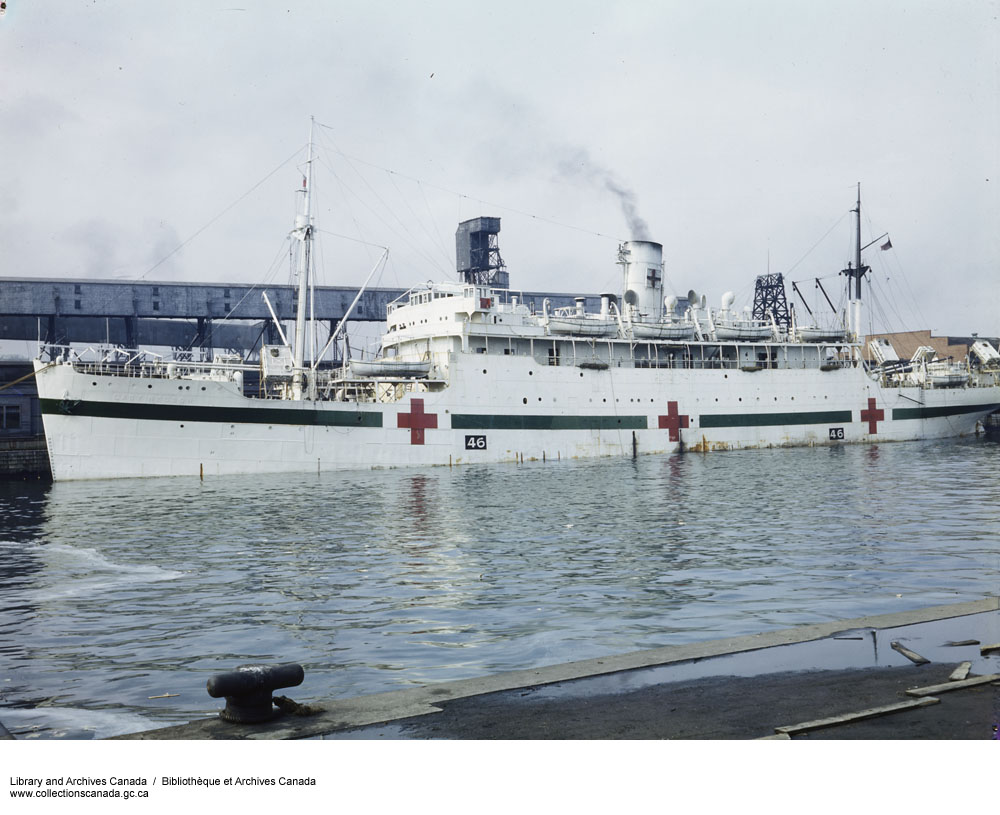
Colour photograph of a hospital ship with a white hull and superstructure and a single funnel, with grey port buildings in the background. A green stripe with three red crosses runs horizontally along the ship’s hull. The number 46 is painted in black rectangles below the green stripe.

The Canadian hospital ship Lady Nelson in Halifax, Nova Scotia. (e010778743)

This particular file’s hundreds of pages of messages, letters, memos and lists of repatriated personnel provide a general outline of these events. When the Lady Nelson left Liverpool shortly before midnight on August 8, 1944, it was carrying a total of 507 personnel to Halifax for medical reasons. Nearly all were members of the Canadian military, with some 90 percent from the Canadian Army. The ship was also transporting two Newfoundlanders who had served in Britain’s Royal Navy, as well as one Royal New Zealand Air Force officer on his lengthy way home via Canada. Two patients died during the trip and were buried at sea: Private George Alfred Maguire on August 11 and Captain Theodore Albert Miller on August 15. Their service files, digitized and available through LAC’s catalogue, help provide some details of their final voyages.

The file for this trip also reflects a number of broader stories, in particular the way that wounded, injured and sick military personnel were being returned to Canada from overseas. In mid-August 1944, this capacity was about 500 at a time aboard the Lady Nelson. The following month, a second Canadian hospital ship, the Letitia, entered service, with the ability to transport around 750 patients. At that point, some 1,000 or more wounded, injured and sick could be repatriated every month across the North Atlantic to Canada.

The need for this augmented capacity speaks to the growing number of repatriations arising from increased combat activity overseas following the D-Day landings on June 6, 1944, and the subsequent campaign in Normandy. The casualties from this fighting added to the ongoing toll of the land campaign in Italy and the war at sea and in the air; a mid-August memorandum refers to a “back log” of casualties in the United Kingdom awaiting repatriation to Canada. The records also make it clear that in addition to those whose wounds, both physical and psychological, were suffered in battle, the patients included those being repatriated for non-combat injuries and for illnesses of various sorts.

The focus of the Directorate of Movements for these voyages was on the personnel returning home, including identifying their medical requirements during their travels and at their destinations. The records consequently provide details of personnel down to the individual level, with lists of those being transported to various locations across Canada, their medical status and their care needs, as well as information about their next of kin.

The records also detail the provision of services to help make these voyages happen, but generally do not discuss those who did this work. Hospital train crews and staff provided by the railways, including porters, do not appear as individuals. While there was one porter assigned to each hospital car in addition to medical staff, as well as porters in other passenger and sleeper cars that made up the trains, the porters themselves and their experiences do not truly speak in these documents. They appear briefly and anonymously in the files as requirements for the hospital trains and indirectly in comments that are made about the train staff and crews more generally. As part of a service being provided by the railways, the porters were an operational requirement, who the military wrote about and recorded in the same way that the remainder of the personnel operating the trains were described.

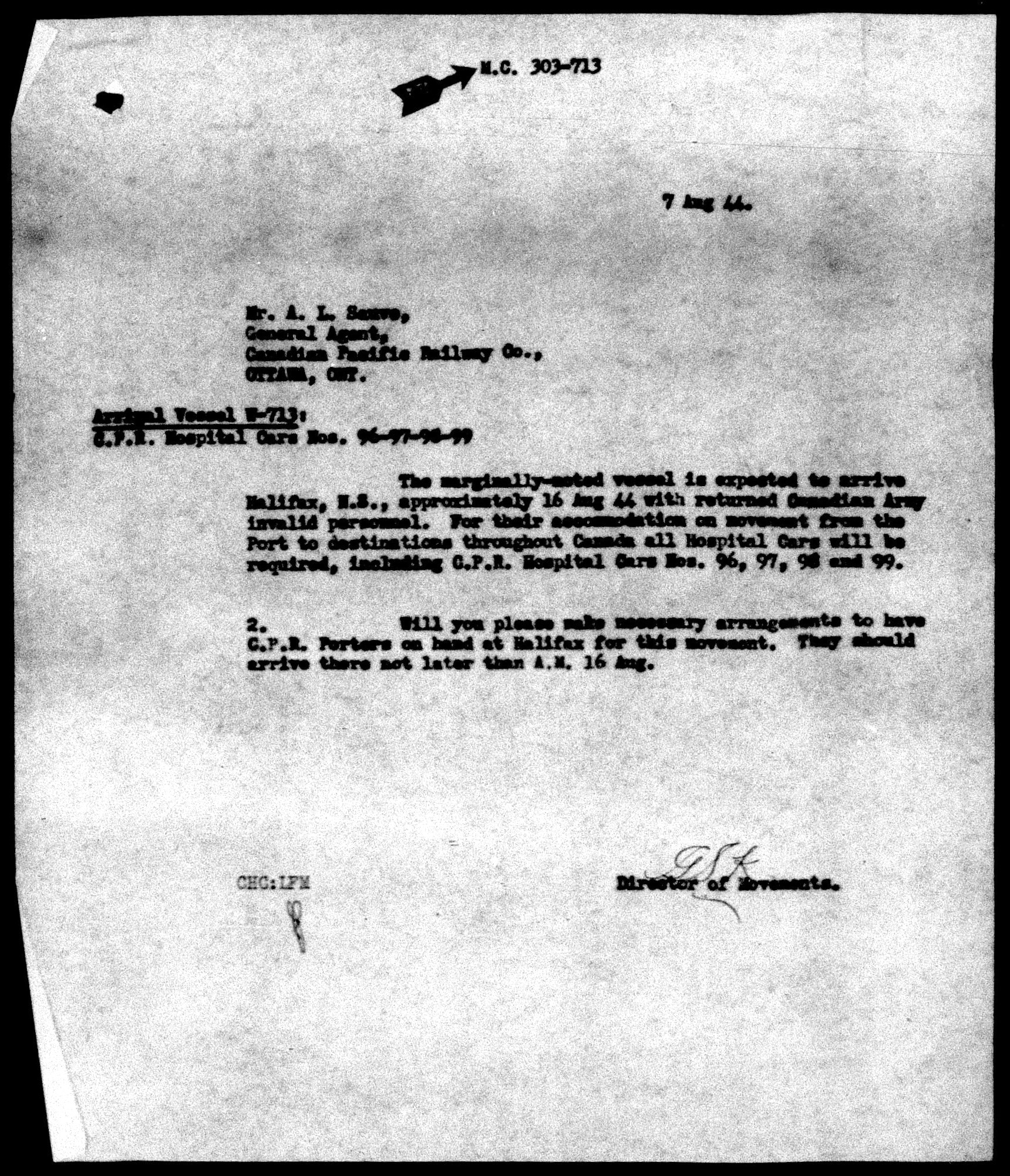
In the roughly four hundred pages of documents relating to this voyage of the Lady Nelson and the hospital train in Canada, there is only one clear and unambiguous mention of porters. A letter from the Directorate of Movements to the Canadian Pacific Railway in early August 1944 alerted the company to the anticipated arrival of the Lady Nelson on or around August 16. In addition to noting that hospital cars would be required for the movement of patients, the letter also requested that porters be on hand for the train. Four CPR hospital cars were identified, each of which required a porter. Given the railway’s decision to provide hospital car porters who had been wounded during their military service, this would have meant Jean-Napoléon Maurice and his three comrades.

Typed letter from the Director of Movements.

This letter from the Directorate of Movements to the Canadian Pacific Railway Company is the only clear and direct reference to porters in the Directorate of Movements file relating to the arrival of the Lady Nelson in mid-August 1944. (MIKAN 5210694, oocihm.lac_reel_c5714.1878)

Transcript for the letter above:

M.C. 303-713

7 Aug 44.

Mr. A.L. Sauve,
General Agent,
Canadian Pacific Railway Co.,
OTTAWA, ONT.

Arrival Vessel W-713:
C.P.R. Hospital Cars Nos. 96-97-98-99

The marginally-noted vessel is expected to arrive Halifax, N.S., approximately 16 Aug 44 with returned Canadian Army invalid personnel. For their accommodation on movement from the Port to destinations throughout Canada all Hospital Cars will be required, including C.P.R. Hospital Cars Nos. 96, 97, 98 and 99.

2. Will you please make necessary arrangements to have C.P.R. Porters on hand at Halifax for this movement. They should arrive there not later than A.M. 16 Aug.

[Signature]
Director of Movements.

CHC:LFM

Directorate of Movements records are more forthcoming about Clarence Towne. They note that he had served with the North Nova Scotia Highlanders and had been wounded in the left elbow and arm by German machine gun fire. Assigned to one of the beds in hospital car 98, he was travelling home to his wife Jane in St. Catharines, Ontario. Towne might have been chosen as a representative patient because, while he was travelling in a hospital car, his wounds would not have been graphic, disfiguring or unsettling for viewers on the home front. The same could not be said for some of the other personnel being repatriated. Towne’s injuries were safely and indirectly depicted by the cast encasing his left arm. Unlike some of the other patients aboard the train, they were also physical and the direct result of combat, rather than being psychological or the result of accident or illness, which may also have played a role in his selection.

In addition to serving as an entry point for unpacking individual stories using a variety of sources, this photograph makes visible the wider history of the essential service of porters in the functioning of hospital trains during and immediately after the Second World War. At the time of its creation, it also likely served other functions. By showing Jean-Napoléon Maurice lighting Clarence Towne’s cigarette, it may have been intended to build on and reinforce popular perceptions and depictions of Black railway porters, the nature of their jobs and their racial and social status, especially how these were manifested through their role in serving travellers.

The photograph also incidentally serves as a reminder of the prevalence of tobacco and smoking in the 1940s. Among their many features, the specially modified hospital cars were equipped with an ashtray for each of the patient beds—something that would be unbelievable today. By depicting personal interactions such as the lighting of a cigarette, the scene was likewise meant to show the attention being paid to military patients. Images such as this provided an opportunity for the Canadian military and government to demonstrate the care being provided to those being repatriated, an important consideration given that the hospital trains and their passengers were a powerful home front manifestation of the increasing human costs of the Second World War.

Additional Resources


Jeff Noakes is Historian, Second World War, at the Canadian War Museum.

Black Porter Perspectives: Bringing Thomas Nash, a Canadian National Railway Porter, Back to Life

Version française

By Andrew Elliott

In the first post of the Black Porter Perspectives series, Rebecca Murray highlighted a wartime photograph that identified a railway sleeping car porter: Jim Jones of Calgary. In the Canadian National (CN) fonds, with which I work, it is worth noting that finding a porter’s name is rare. This collection (RG30/R231), one of Library and Archives Canada’s (LAC) largest private acquisitions, should logically contain a plethora of records about porters due to their central role in railway service. Sadly, until recently, this has not been the case. A basic keyword search for “porter” often yielded few, if any, results. I am working hard to correct this situation.

Over the last few months, my work has involved sifting through backlogged material relating to the CN Passenger Services Department. I recently found a collection of files from the late 1960s documenting employees who worked for the CN Sleeping, Dining, and Passenger Car Department. These files cover a range of issues, including accidents, insurance claims, thefts of company property, and retirements, as well as provide insight into the lives of cooks, waiters, stewards, and porters. Among these, I discovered an important and interesting personnel file for a Black porter named Mr. Thomas Nash. His file stood out due to his remarkable 42-year career, spanning from his hiring on June 23, 1927, to his retirement in August 1969. This documentation sheds light on who Nash was and offers a deeper understanding of what portering looked like for him and other Black men during this period.

Who was Mr. Thomas Nash?

Nash’s personnel file is rich with details, allowing us to begin to piece together his biography. Raised by his adoptive parents in Antigonish, Nova Scotia, Nash later moved to Montréal, where he worked as a CN porter. The path to learning this information is particularly interesting.

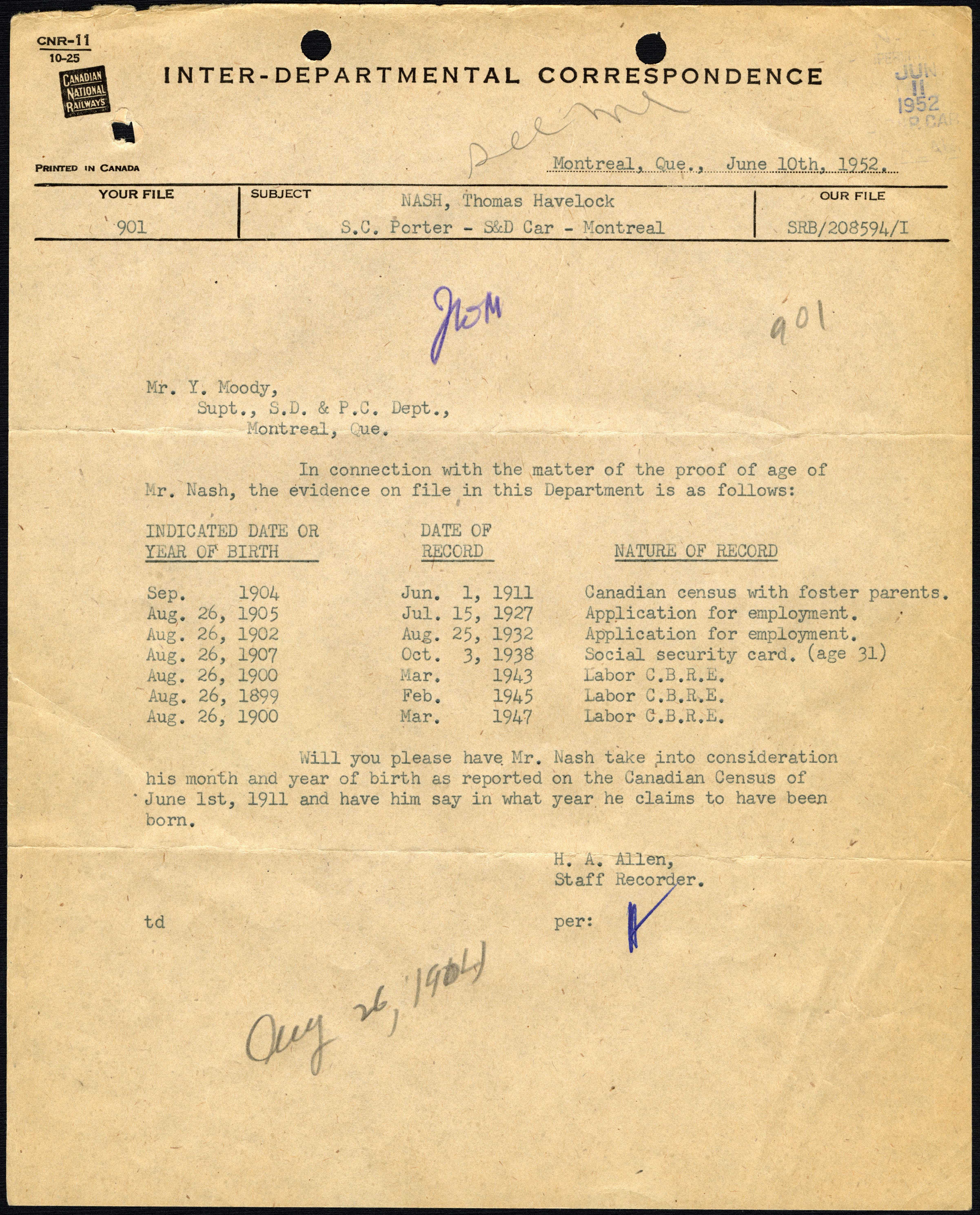
In the late 1940s, CN’s Staff Record Bureau began seeking Nash’s birth date to determine his retirement eligibility. Like many Black citizens in Canada and the United States, Nash faced challenges with recordkeeping, which were compounded by his adoption. He offered several possible birth years, including 1899, 1900, 1902, 1904, 1905, and 1907, which further complicated the Bureau’s task.

Page showing possible birth dates for a CN porter.

Documentation from the CN Staff Record Bureau detailing various possible birth dates for Thomas Nash, dated June 10, 1952. (MIKAN 6480775)

Due to Nash’s inability to provide accurate information about his birth, the CN Bureau contacted the principal of St. Ninian School in Antigonish, Nova Scotia, which Nash had attended as a youth. This inquiry in 1952 proved unsuccessful. The following year, the CN Bureau contacted the Dominion Bureau of Statistics, which confirmed that Nash had actually been born on August 26, 1904. The 1911 Census further revealed that Nash lived with his adoptive parents in Antigonish, a detail that is recorded in his personnel file. Interestingly, while his personnel file does not address the matter explicitly, Nash’s last name appears to have changed between his youth and his move to Montréal. As a child, he went by the surname “Ash,” which later became “Nash” before he began his job with the CN. Was this a recording error? Determining his correct birth details led to Nash’s eligibility for the CN Pension Plan, which went into effect on January 1, 1935.

In addition to learning a little bit about his early life, we also see that upon relocating to Montréal, Nash became part of the city’s tight-knit Black community, living in what was then known as the St. Antoine District. This is unsurprising given the racial segregation in housing and the community’s proximity to the train station.

While his early years in Montréal are undocumented in his personnel file, we see that Nash resided at 729 Seigneurs Street in the 1950s and early 1960s. A 1968 letter he wrote to the CN Staff Record Bureau reveals that he had married and later resided with his wife at 2458 Coursol Street, just a few streets over from his former residence.

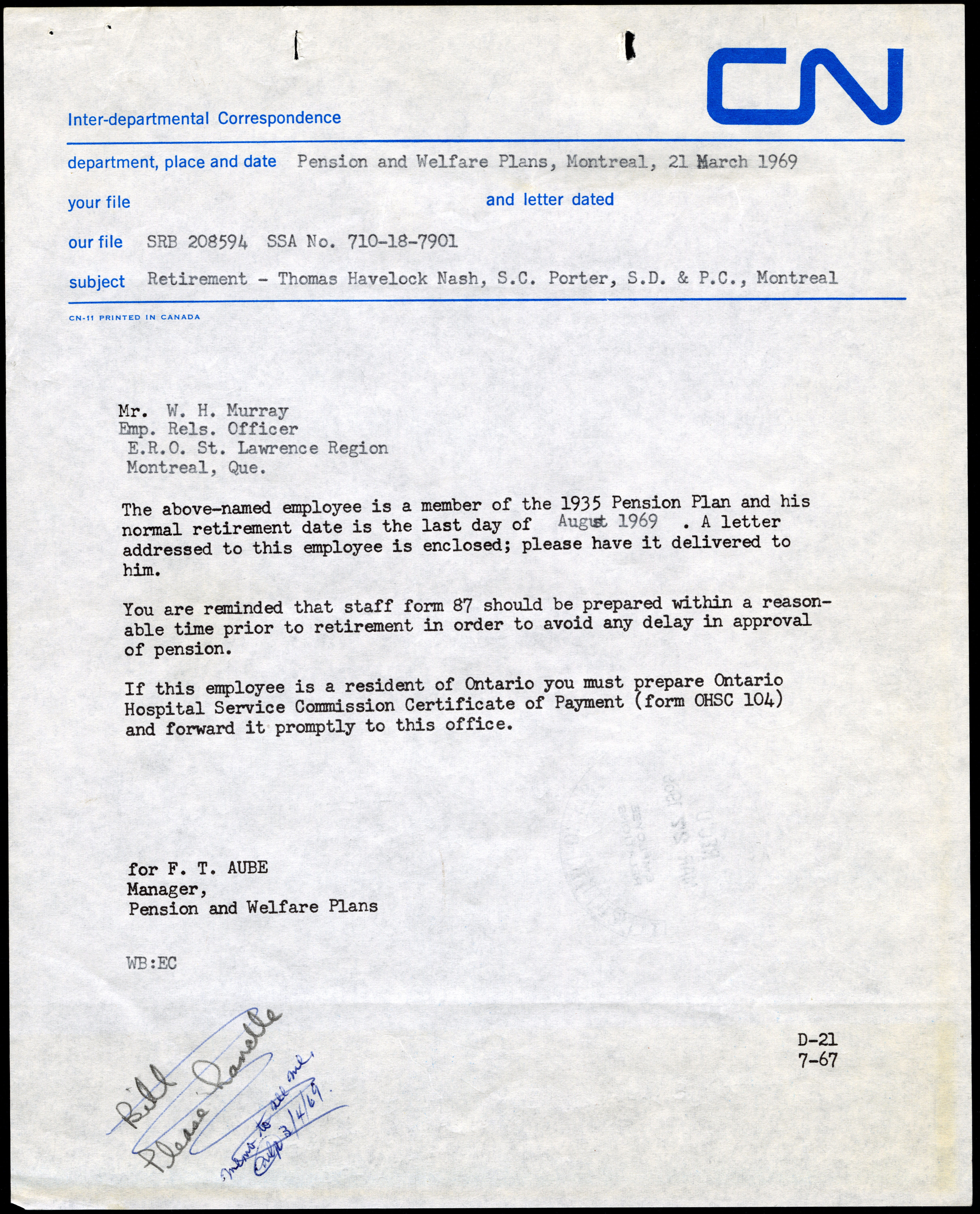
Nearly every household in the St. Antoine District had ties to portering. This profession was deeply respected, as evidenced by a community ritual honouring retiring porters: family, friends, colleagues, and bosses gathered at the train station to welcome these men home from their final runs. The Black Worker, the Brotherhood of the Sleeping Car Porters’ union newsletter, often documented these special moments. Nash undoubtedly experienced such recognition when he retired in 1969.

Letter from CN’s Human Resources Department outlining details relating to a CN porter’s upcoming retirement in August 1969.

Letter detailing Thomas Nash’s upcoming retirement in August 1969. (MIKAN 6480775)

The rights and experiences of porters

Nash’s career began in 1927, a pivotal year for both CN and its employees. That year, CN and its union, the Canadian Brotherhood of Railway Employees (CBRE), created a segregated system dividing employees into two groups. Group 1 included dining car employees and sleeping car conductors (white men), while Group 2 consisted of sleeping car porters. These separate collective agreements restricted seniority and promotion opportunities within each group, effectively locking Black workers into portering and barring them from advancing within CN’s ranks.

Nash would have quickly realized that upward mobility was impossible for him. Dr. Steven High helps us contextualize Nash’s experience, noting that porters in the 1920s and 1930s worked very long hours with a fixed monthly salary, regardless of the actual number of hours worked. On average, porters were allowed just three hours of sleep per day while in transit. Needless to say, their working conditions were difficult and highly exploitative. Unfortunately, Nash’s early years on the job, including his contributions during the Second World War, are undocumented in his personnel file—a troubling omission given the essential nature of his work.

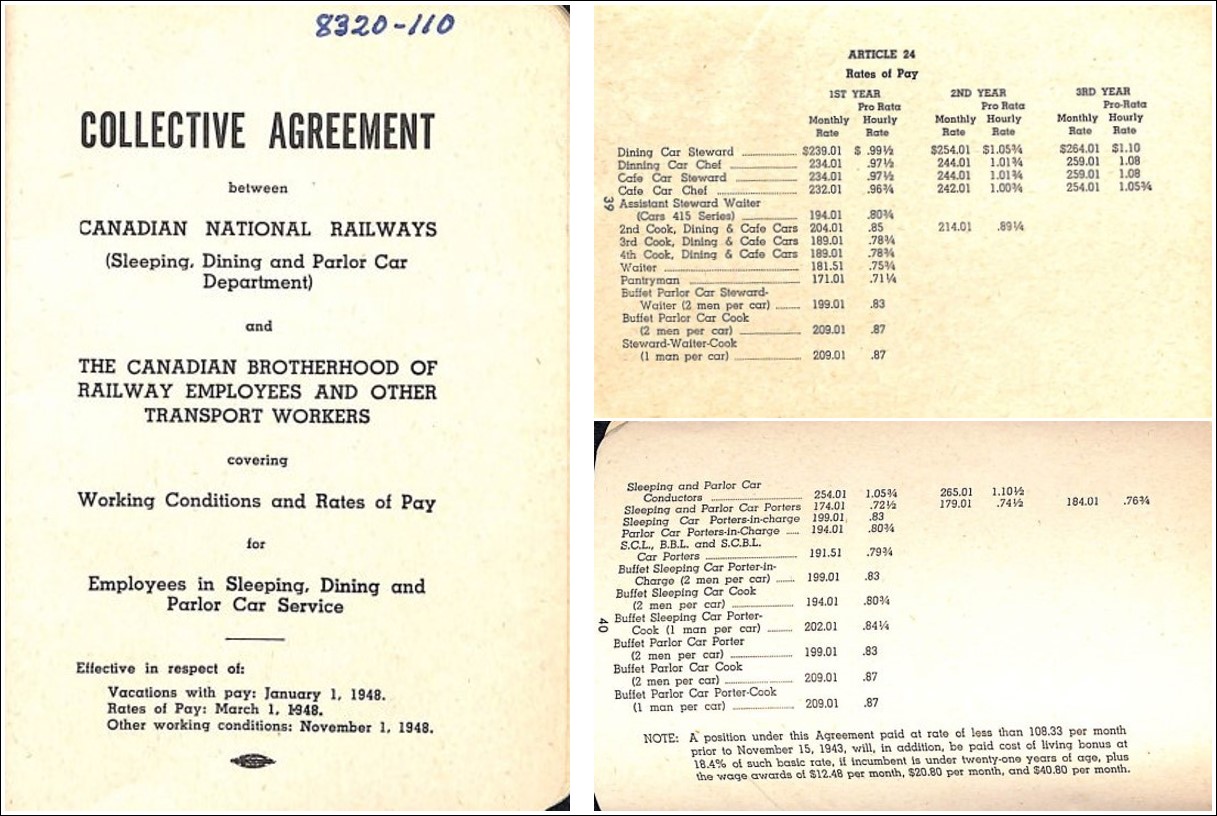
Despite their invisibility in these records, Black porters began agitating for improved conditions. In 1945, Canadian Pacific Railway sleeping car porters successfully negotiated a new collective agreement that including better wages, vacation time, and reduced hours. These union gains, however, did not extend to CN employees who remained bound by CBRE’s more restrictive agreement. The agreement featured below, dated 1948, shows that all porters remained among the lowest-paid employees, second only to pantrymen, with monthly salaries ranging between $174 to $209. Also, unlike some of the other occupations listed, porters’ salaries would not increase in years two or three. In truth, these men saw little improvement to their working conditions until 1964, when the Canadian Brotherhood of Railway, Transport and General Workers came into existence, ending occupational colour barriers and creating a combined seniority list.

(For more information about the long fight for porters’ rights, listen to “Porter Talk: The Long Fight for Porters’ Rights.”)

Cover page of the CBRE Collective Agreement along with details of employee wages.

Pages from the 1948 CBRE Collective Agreement, covering working conditions and rates of pay for employees in sleeping, dining, and parlour car service. (MIKAN 1559408)

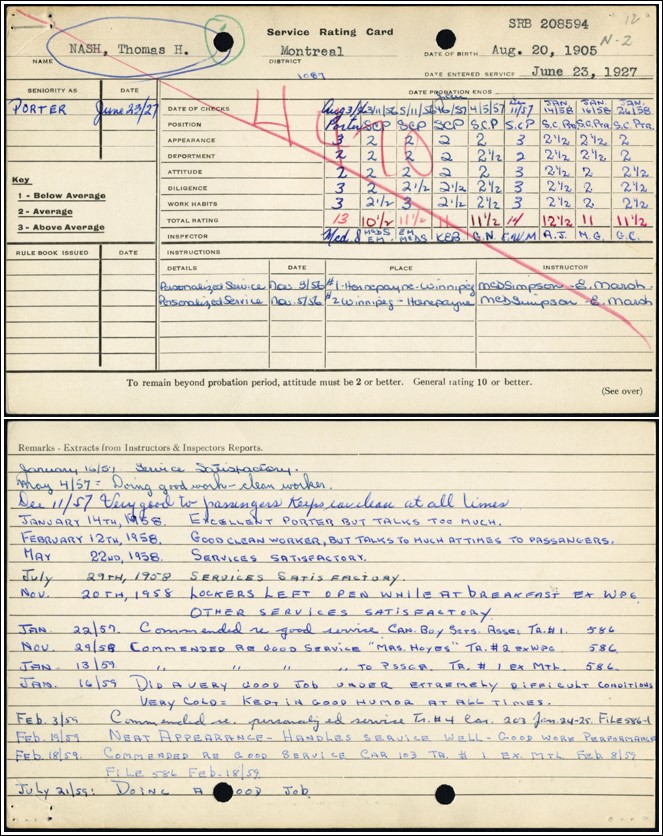
A cursory engagement with the CN fonds might obscure the contribution of porters, but Thomas Nash’s personnel file provides valuable insight into the nature of their work. His employee service rating card, in particular, emphasized the stresses inherent in portering. This card was designed to document and rank the quality of service provided, a reminder that Nash and his colleagues were under constant scrutiny—whether by CN staff or passengers. It is interesting to point out that even minor infractions could result in demerit points, colloquially known as “brownies.” Accumulating 60 demerit points led to automatic termination without the possibility of appeal. Remarkably, Nash’s record stands out: in his 42-year career, he never incurred a single demerit point. The comment card below showcases a passenger’s remark from 1958, providing a vivid anecdote and serving as a testament to Nash’s exceptional service: “Excellent Porter but talks too much.” While seemingly contradictory, this remark sheds light on Nash’s engaging personality and unwavering commitment to his duties.

Cards displaying employee rating numbers and comments on Thomas Nash’s service performance.

Front and back of Thomas Nash’s employee service rating card. (MIKAN 6480775)

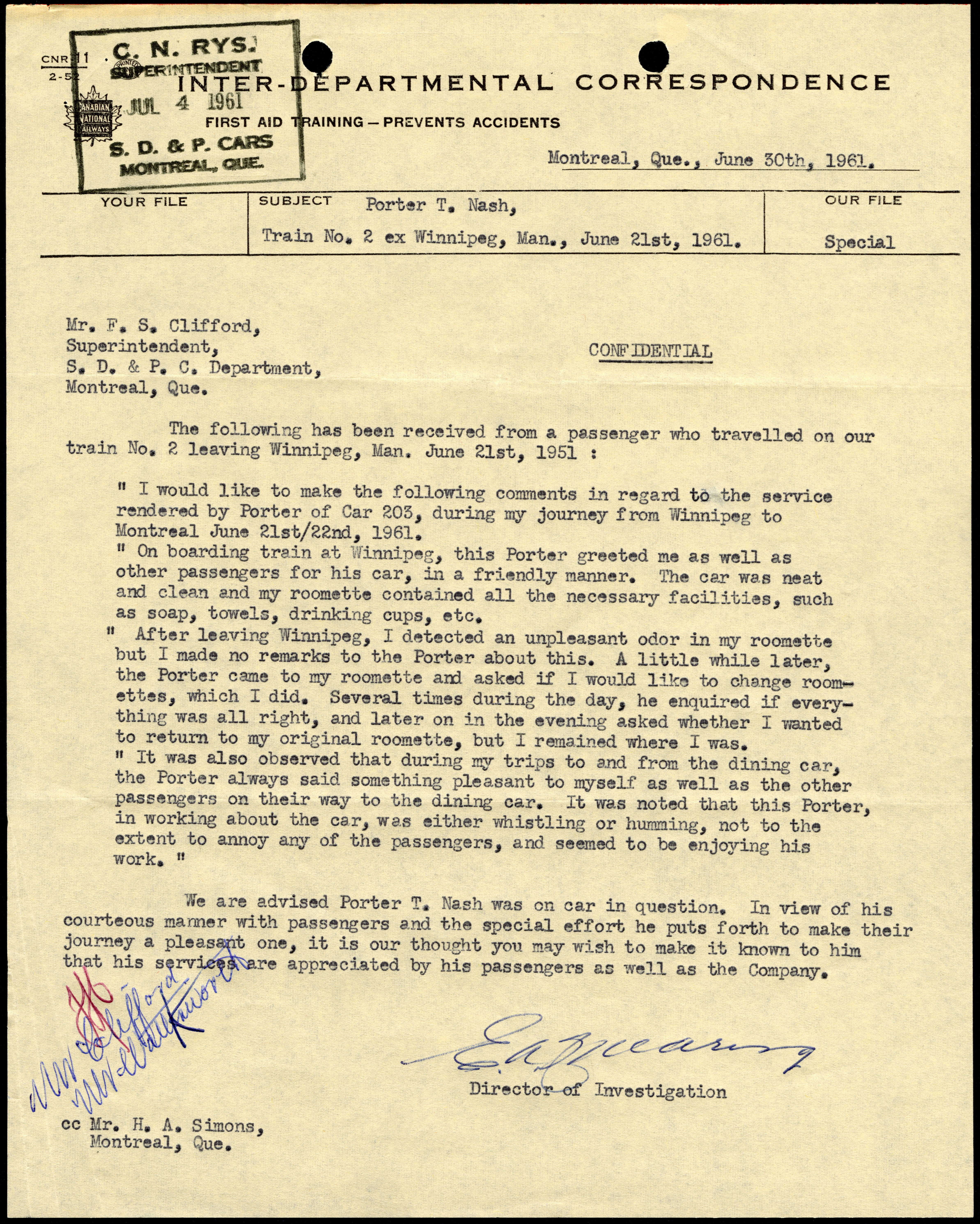
In 1961, another passenger went further, commending Nash for his service:

Typewritten letter detailing a passenger’s compliments on the service provided by CN porter Thomas Nash.

Letter documenting a passenger’s commendation of CN porter Thomas Nash for service excellence, 1961. (MIKAN 6480775)

Making porters’ service visible

My team remains committed to uncovering more information about the lives porters led and the experiences they had on the rails. Since last year, we have uploaded over 21 000 service files related to employees who worked for CN and its predecessor companies—including records for 1 066 porters—to the series entitled Employees’ provident fund service record cards. Slowly but surely, we are uncovering records within the CN fonds that shed light on the invaluable contributions of porters, making their essential service visible. In many ways, this work allows us to honour their legacy and bring their stories back to life, contributing to a new understanding of their profound impact in shaping modern Canada.


Andrew Elliott is an archivist in the Archives Branch at Library and Archives Canada.

Black Porter Perspectives: Through the Lens of Military Records

Version française

By Rebecca Murray

Library and Archives Canada (LAC) holds over 30 million images in various formats, including born digital images, negatives and photographic prints. A single archival photograph can tell us much about the fashion, weather, technology, customs and culture of an era! Yet, much of these secondary, but important, themes found in imagery are often ignored in the archival description process, with more attention given to the primary subjects or those captured by the photographer’s gaze. The popular saying “a picture is worth 1000 words” rings true every time I look at an image from the holdings. Even in this relatively simple image of two figures with little to no visible background, there is a wealth of detail and history to explore. What can the uniforms worn by the two men tell us? If there was a building or landscape in the background, what could we learn about where this image was taken?

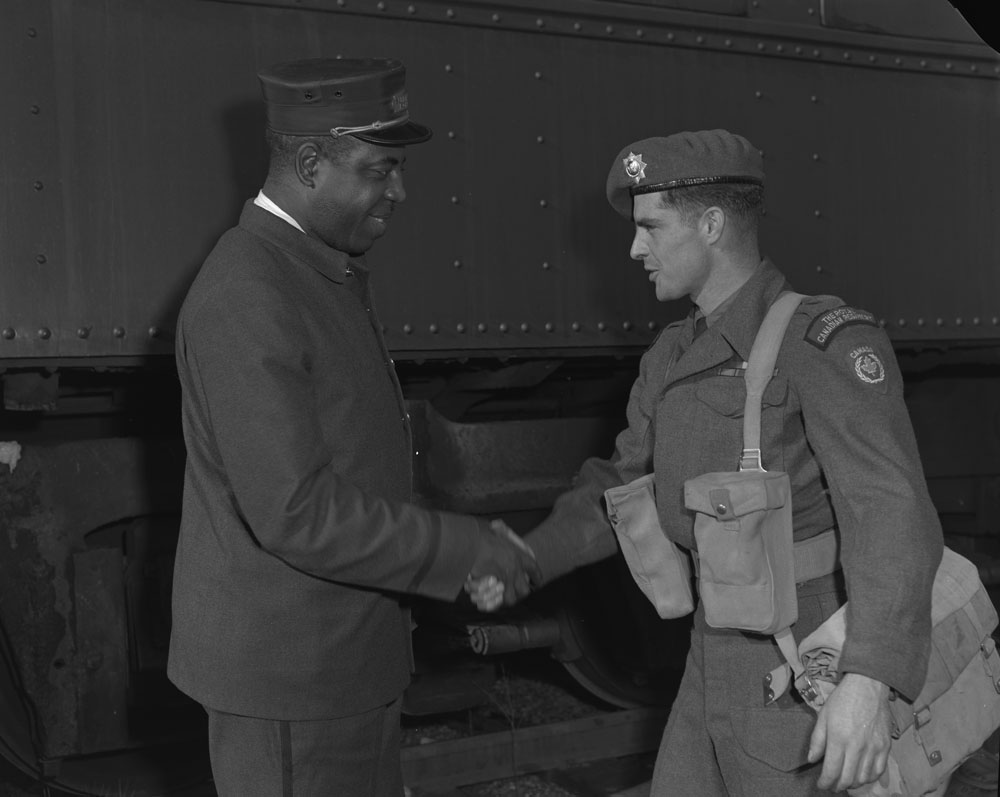
Photograph of a sleeping car porter (on the left) shaking hands with a soldier (on the right).

1967-052, item Z-6244-4 “Arrival of RCRs at Fort Lewis: Units of the Canadian Army Special Force having completed their move to Fort Lewis, Wash., will shortly commence training at brigade strength. Among the recent arrivals with the Royal Canadian Regiment was one of many Halifax men serving with the Special Force. He is Pte. Harry Adams, above, seen being wished “Best of luck” by Porter Jim Jones of Calgary. (e011871942)

I first came across this image while reviewing others from the Department of National Defence (DND) accession 1967-052 for servicewomen, none of whom are pictured here. Though my main focus was the depiction of servicewomen, a minority group in these photographs, there are many other secondary or non-traditional narratives that are reflected in visual records, including those of sleeping car porters. Despite holding a degree in Canadian history, I had only recently been introduced to these men and their experiences through various books, including Genevieve Graham’s Bluebird and Suzette Mayr’s The sleeping car porter.

If you were to come to LAC looking for photographs of railway porters, you likely wouldn’t start in the DND photographs. Instead, you’d be drawn to those found in the Department of Transport (RG12) or the Canadian National Railways (RG30) fonds archives. In this instance, neither the porters nor the railway (nor the War in Korea) are mentioned in the description of the “Z prefix – CA” sub-sub-series. This is not entirely surprising, as it’s a large set of photographs — approximately 7 500 images — covering several decades worth of events, including the Second World War. Fewer than 15% of the images in this sub-sub-series are described at the item (photograph) level in the database, but most are described to varying levels of detail in digitized finding aids (item lists) that are attached to the sub-sub-series level description. The full caption for image Z-6244-4, which is available only on the original envelope and must be ordered for in-person consultation, mentions the presence of the porter and — surprisingly to this researcher — identifies him by name: Porter Jim Jones of Calgary. This is a stark contrast to most of the other images identified as part of my research. I wondered why this photograph had been so well described relative to others. Without a complete listing of captions and photographer’s notes, there is only so much we can infer from the limited data that we do have.

Coming across these images and working to pair them with their full descriptions, especially when they include the names of individuals and other identifiers, is an opportunity to press pause on one’s research intentions. The relatively hidden history in these images merits well more than a thousand-word description.

We call this process reparative description: the remediation of practices or data that have excluded, silenced or mischaracterized people or histories in archival records. Whether on a large scale or one photograph at a time, this is an ongoing process. So, when I came across these images of porters and other Black railway staff from the Second World War era, I kept notes and shared them with my colleagues who were working on the Discover Library and Archives podcast, Voices Revealed: “Porter Talk.” We were then able to work with other colleagues who are interested in this period, the presence of porters in the DND photographs and their representation in the collection as a whole.

Keep an eye out for the next piece in this series.


Rebecca Murray is a Literary Programs Advisor in the Outreach and Engagement Branch at Library and Archives Canada.
My Dear Friend: Letters from Normandy to our Canadian Soldiers

Version française

By Ariane Gauthier

As part of my work as a reference archivist at Library and Archives Canada (LAC), I often find myself delving into the many documents in the Second World War collection. Many people around the world are interested in the history of Canadians in this conflict and, more specifically, in the experiences of our soldiers. What I find even more fascinating is how the quest begins for the researchers I am lucky enough to work with. The starting point is often a personal story, passed down in a family or a small community: “I found out that my mother served in the Royal Canadian Air Force” or “I heard that my village hid a Canadian spy during the Second World War.” This is enough to fuel the fire of researchers, who then dig to find evidence or fill in these stories with new details.

My colleagues and I participate in this quest on an ad hoc basis, mainly to facilitate access to documents from LAC’s vast collection. When circumstances allow, we delve into the information in these documents in search of relevant details that can help researchers piece together the story they seek to understand.

That is how I found three letters from Normandy addressed to our Canadian soldiers. Unfortunately, the context of the letters, including the identity of the recipient, remains a mystery. I found these letters in a file from Royal Canadian Air Force headquarters (Reference: R112, RG24-G-3-1-a, BAN number: 2017-00032-9, Box number: 30, File number: 181.009 (D0624)). This file documents the experiences of Canadian soldiers who were captured and interned in prison camps during the Second World War. It also contains transcripts of interviews about the soldiers’ experiences.

In this case, the three letters are not linked to specific interviews and are included in this file as loose sheets. There is no correspondence explaining why they were placed in this file. Nor is it known whether these were letters addressed to soldiers who had been taken prisoner during the war. The information in these letters is truly the only information we have. In reality, though it may not seem like much, these three letters tell us a great deal about the experience of soldiers in Normandy and of the French, especially the risks faced by those who resisted the Germans.

Here are the letters in question:

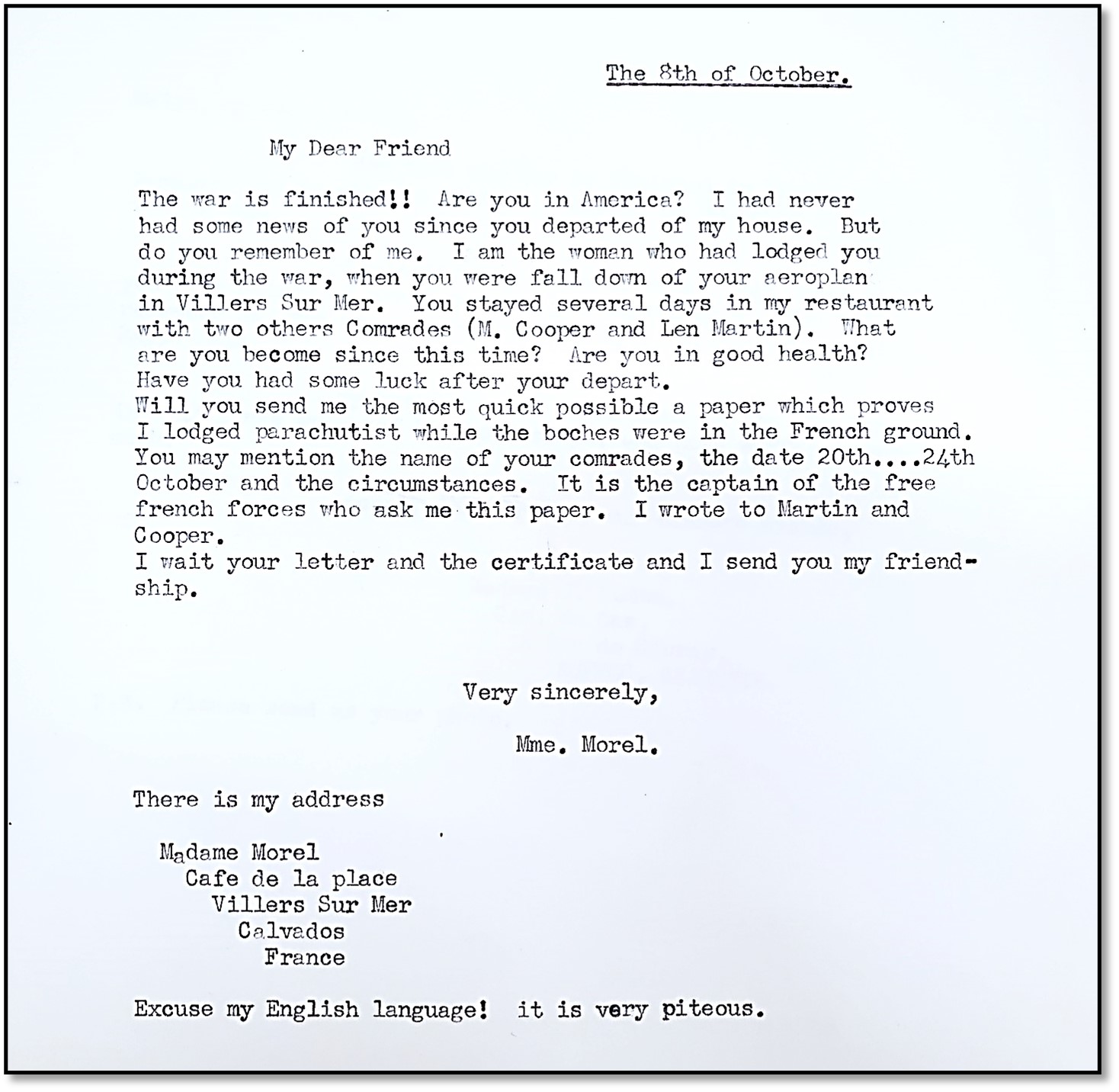
Letter to a Canadian soldier from Mrs. Morel, written on October 8. The year is not indicated on the letter. We only know that it was written and sent once the war was over.

Letter to a Canadian soldier from Mrs. Morel, dated October 8 (MIKAN 5034948)

In this first letter, we discover part of the story of Mrs. Morel, who apparently sheltered one of our soldiers after he jumped from a plane near Villers-sur-Mer. We learn that this soldier was a paratrooper and that he had taken refuge in Mrs. Morel’s restaurant with two of his fellow soldiers, M. Cooper and Len Martin, while the village was still under German occupation.

Letter written by Mrs. J. Cottu, expressing her desire to receive news of the soldier she sheltered in November 1943.

Letter to a Canadian soldier from Mrs. J. Cottu (MIKAN 5034948)

This second letter gives us a glimpse into the story of Mrs. J. Cottu and could possibly be related to that of the paratrooper mentioned in Mrs. Morel’s letter. Without more specific information, it is difficult to confirm this hypothesis, but the second letter refers to a Sergeant Martin (possibly Len Martin?) and places his departure in November. Mrs. Morel stated that she had taken in the soldier at the end of October, without specifying the year, so everything could fit together chronologically.

Mrs. J. Cottu mentions having housed three soldiers in her house in Ruffec in November 1943: the recipient of the letter, Sergeant Martin and Captain Ralph Palm. Although this story seems to have gone well, she said that she was arrested by the Gestapo in 1944 because of her husband’s activities. The seriousness of the situation is clear from this confession: “I was arrested by the Gestapo, and have suffered very much.”

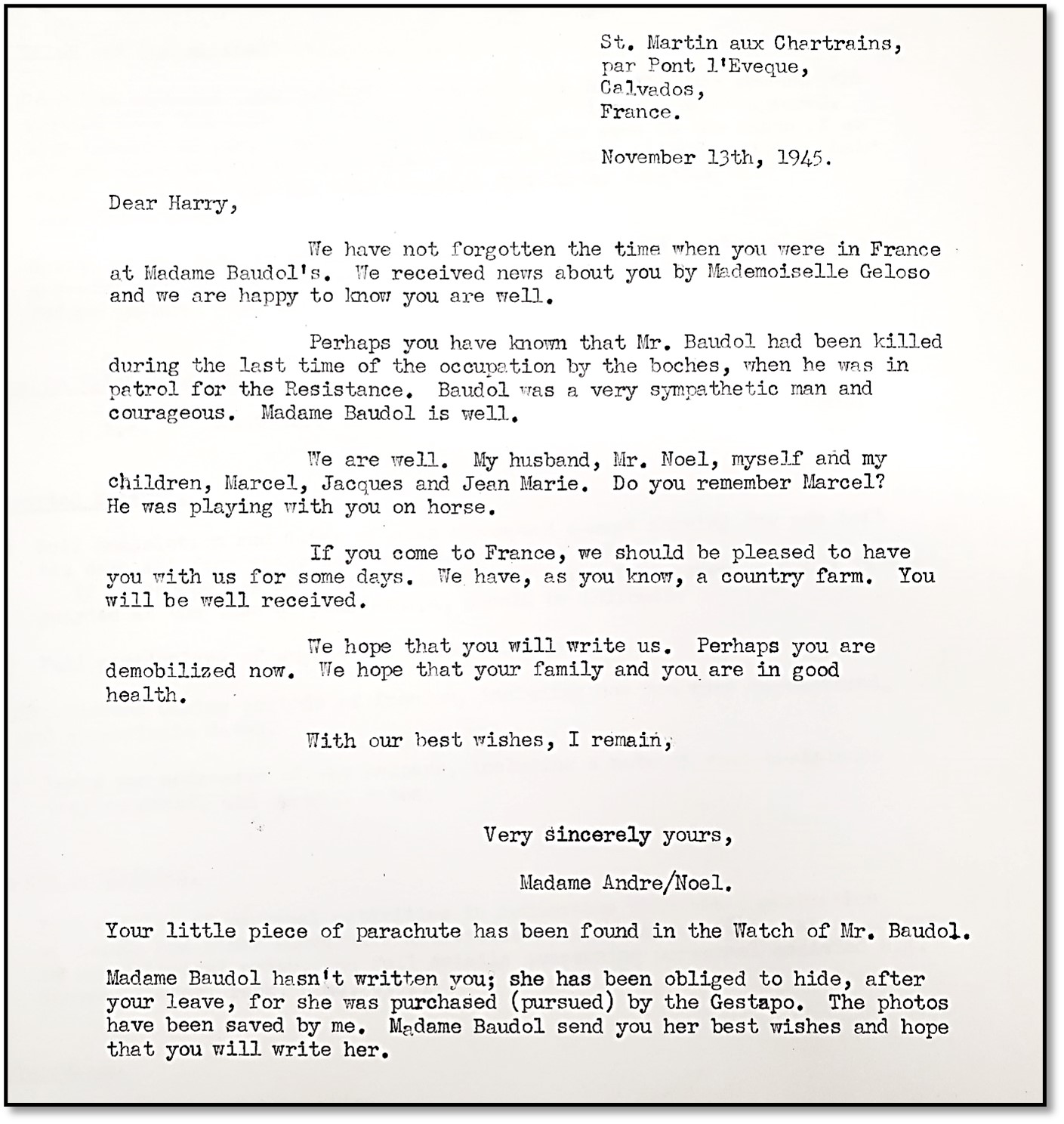
Letter written by Mrs. Noel to check on Harry and give him news about the French people he met during his stay in Saint-Martin-aux-Chartrains.

Letter to Harry from Mrs. Andre Noel, dated November 13, 1945. (MIKAN 5034948)

In this third letter, Mrs. Noel clearly illustrates the dangers that members of the Resistance faced. She bears the burden of announcing the death of Mr. Baudol, a member of the Resistance, who was killed while on patrol. She also shows us the strong bonds that Harry seems to have formed with the residents of Saint-Martin-aux-Chartrains. Although this letter expresses suffering, grief and fear, it also highlights the bravery and sacrifice of three families who came to the aid of a Canadian soldier.


Ariane Gauthier is a reference archivist with the Access and Services Branch at Library and Archives Canada.
Guide to DIY personal military displays

Version française

By Sacha Mathew

Did you know that you can easily make your own military heritage display by using the tools and digitized records found on the Library and Archives Canada website? Using the display we presented at a recent event as an example, I’ll show you step-by-step how you can make your very own display at home or at school.

Library and Archives Canada held a hugely successful Open House event in May, welcoming more than 3000 visitors to our Gatineau facilities and allowing them to enjoy an opportunity to view treasures in our vaults.

This small display of photographs and textual documents from our military collection was very popular. It had a personal touch, and many visitors asked us how we selected the records to display.

Overhead view of glass display case containing military photos and textual documents.

Military display used during LAC Open House event. Image courtesy of Alex Comber, archivist.

Your display can easily be tailored to present a person, an anniversary or a specific military unit. In our case, we wanted to highlight the 100th anniversary of the Royal Canadian Air Force (RCAF) taking place this year. That was our starting point.

Next, we needed to narrow our focus to make it easier to tell a story. Records give facts, but they don’t tell a story — that’s where interpreting the records comes in. Since the event was in Gatineau, we thought the public would be interested in exploring the personal stories of servicemen from the local area. We started by choosing the 425 “Alouette” Squadron, an RCAF unit. This is a French-Canadian bomber squadron established at the outbreak of the Second World War. By researching the 425 Squadron personnel roster and cross-referencing it with a list of RCAF casualties provided by the RCAF Association, we were able to find two local airmen: one from Montreal and the other from Ottawa.

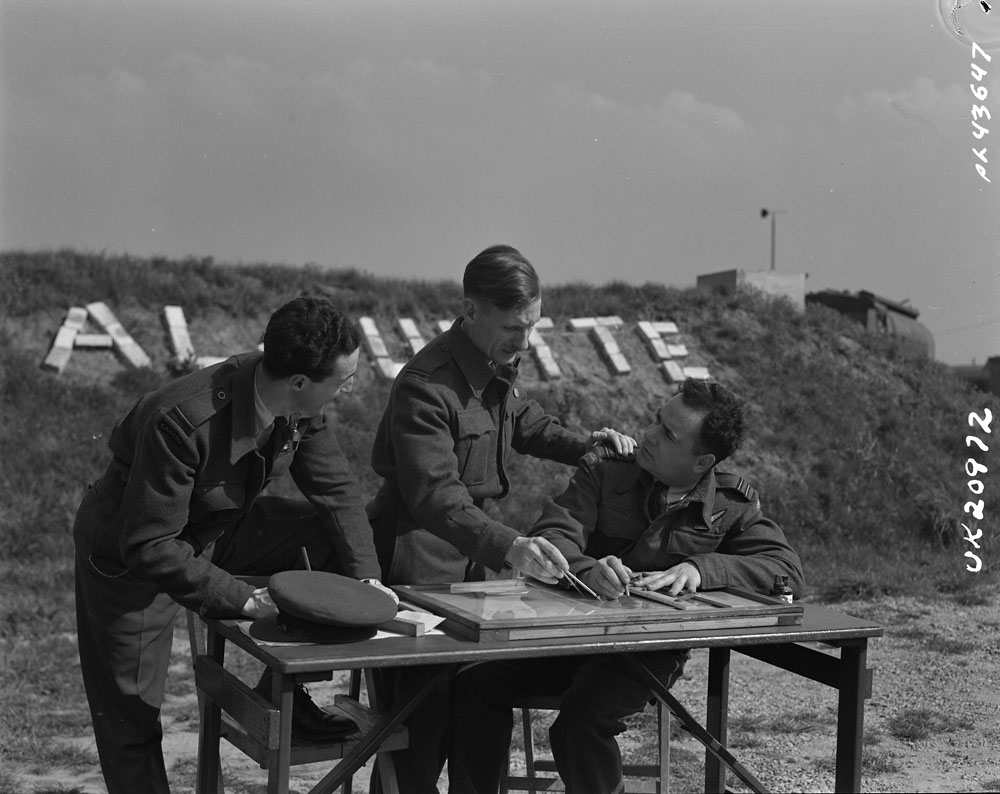
By an English airstrip, three Air Force officers planning while looking over a table with maps.

Pilot Officer J.W.L. Tessier; Pilot Officer J.A. Longmuir, DFC (Distinguished Flying Cross) of the Royal Air Force, attached to the Alouette squadron as Bomber Section Training Officer; and Flight Lieutenant Claude Bourassa, DFC, Commander of the French-Canadian squadron’s bomber section. 425 Squadron. 24 April 1945, PL-43647, e011160173.

For our display, we looked for specific individuals to feature in our display, which can also be done for local service members from your community or school. Choosing an individual is even easier if you are making a display for a family member, since you may already have someone in mind.

Once you’ve chosen an individual, you may look for their military personnel file. This file provides a tremendous amount of information and includes personal details (ever wonder what your great-grandfather’s address was in 1914?). The file can be easily found on the LAC website. However, it should be noted that not all records are open to the public and available online. All personnel files for the First World War are open and have been digitized (First World War Personnel Records), but only “War Dead” files are available online for the Second World War. “War Dead” refers to members that died during the war (Second World War Service Files – War Dead). Other Second World War and post-Second World War service files can still be obtained, but they must be requested through an Access to Information and Privacy request (Records you may request).

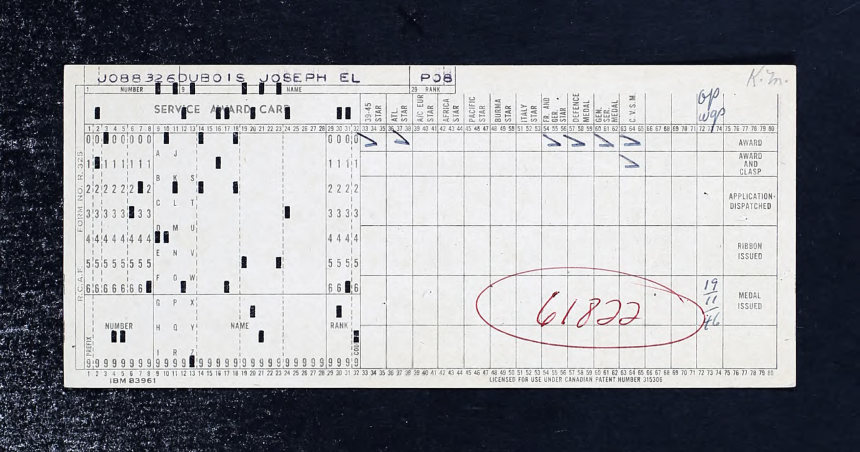
Now that you have the service file, you can decide what you want to display. For our display, we were limited by the size of the display case. If you have more space, you can pick as many documents as you like. You’ll find a variety of documents in the service file. For our airman, Pilot Officer (PO) J. Dubois, we selected a few documents that we found interesting: a letter of recommendation from his employer (T. Eaton & Co), his attestation papers, his medal card, his pay book, official correspondence with his parents in French and the report on his death. You can scroll through and read the digitized service file, then choose what you’d like to feature. Please remember to cite your sources, including reference numbers for archival documents.

As mentioned, interpreting the records you find can help you tell a story rather than just display your research. In the case of PO Dubois, we looked to his squadron records from the day he died, and we were able to better understand the circumstances of his final flight. Each of the three services has an official unit journal of their daily actions. They are called “War Diaries” for the Army, “Ship’s Logs” for the Navy and “Operations Record Books” for the RCAF. The personnel file gives you biographical information, and the unit journal gives you the context. The journal allows you to understand how the individual fits into the unit’s operations. You would interpret the documents by examining them together, giving you a much broader picture. That picture is the story, which you could write up or present orally.

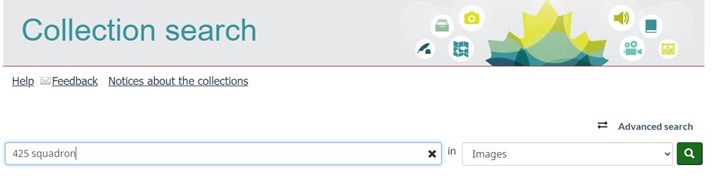
The only thing remaining is to add some photos to make the display more visually compelling. You may find the member’s photo in the service file, but this is not common for files from the World Wars. To find photos, I suggest setting Collection Search to “Images”. Here you can search by the unit designation and choose a few photos that are appropriate to the time frame that you are looking at. For our display, we easily found a few photos of 425 Squadron in England during the 1940s. Like the textual documents, it is important to give accurate photo credits for any photographs used in your display.

A screen capture from the LAC website showing the search bar set to “Images”.

Collection Search, LAC website.

By using the tools and resources from LAC’s online collection, you can make your own custom display for an individual or for a unit. It’s your choice how you’d like to present your display: you can print copies of documents and photos to make a framed display or scrapbook, or you can make a digital presentation. Making a display is an excellent way to connect with ancestors by learning about their lives, and it allows people to explore Canadian military heritage in a personal way. It is also an excellent research exercise and would prove a wonderful Remembrance Day project for young students.


Sacha Mathew is an archivist in the Government Archives Division at Library and Archives Canada.

First on the Lakes: HMCS Griffon

Version française

By Dylan Roy

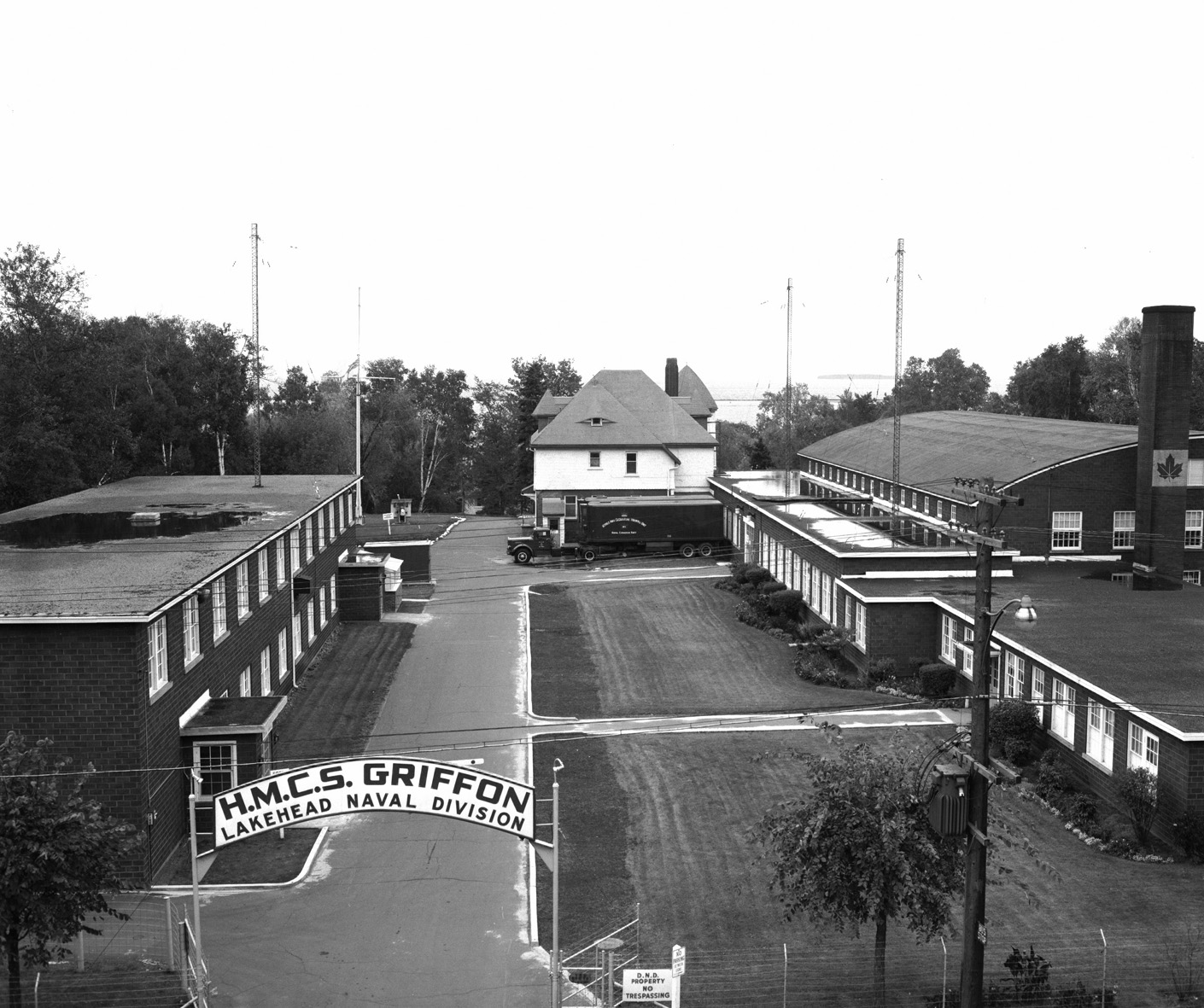
Sometimes you come across a record that doesn’t necessarily make sense at first glance. This was my experience when I first looked at the archival description of the series HMCS Griffon. HMCS stands for “His/Her Majesty’s Canadian Ship” (you can find this and other military abbreviations used in service files on Library and Archives Canada’s website—this page is a wonderful tool for those not familiar with military abbreviations). Therefore, it shouldn’t be a surprise that I assumed these files were about a ship.

But lo and behold, me mateys, upon consulting the files I discovered that the “ship” turned out to be a facility in Port Arthur (now Thunder Bay).

Black-and-white photograph of two long buildings facing each other, separated by a street. At the far end of the street, a truck is passing in front of a house-like building.

Photo of HMCS Griffon. Source: Government of Canada, National Security and Defence, Ships’ Histories: HMCS Griffon. Credit: Courtesy of The Royal Canadian Navy.

As the series relates, “[a] vacant garage was leased by naval reservists at the beginning of the Second World War, and, with the establishment of a policy of commissioning all ‘stone frigates,’ the garage became HMCS Griffon in 1941.” This led me down a rabbit hole of secondary sources to learn about stone frigates.

A stone frigate, to put it simply, is a naval vessel established on land. The British first employed this informal term: to bypass legal obligations that prevented them from ruling “over land,” they decided to commission the island Diamond Rock as a ship during one of their many wars with the French. This is a good way of understanding HMCS Griffon and its seemingly confusing title.

Badge in the form of a ring with a crown on top, the word GRIFFON at the base of the crown, and a griffin (mythical creature) inside the ring facing left.

The official badge of HMCS Griffon. Source: Government of Canada, National Security and Defence, List of Extant Commissioned Ships: HMCS Griffon. Credit: Courtesy of Department of National Defence.

From the Ships’ Histories on the Canadian government’s National Security and Defence web page, I learned that HMCS Griffon’s creation was based on several factors, most notably its relationship with the Sea Cadet program and the influence of the shipping industry in the Great Lakes region. HMCS Griffon was commissioned in 1940 and moved to its current location in Thunder Bay in 1944. During the Second World War, HMCS Griffon guided newly recruited sailors eastward as they made their way out of the prairies, thus indicating the importance of the facility’s geographic location in Canada.

Once I read up on these facts, I could better contextualize the records we have in our archival collection at Library and Archives Canada—this just goes to show how secondary source work can help researchers gain a better understanding of archival records (primary sources).

As mentioned, the first record I stumbled upon concerning HMCS Griffon was its series-level archival description. Reading through the series, I learned that it only contained five file-level descriptions as well as a linked accession.

Save for the accession, all the files were open, so I decided to peruse their contents. As luck would have it, all the files are found in the same archival box, Volume 11469 (an archival box is equivalent to an archival volume).

With the volume ordered, I was able to delve into the archival treasures found therein, which I shall share below.

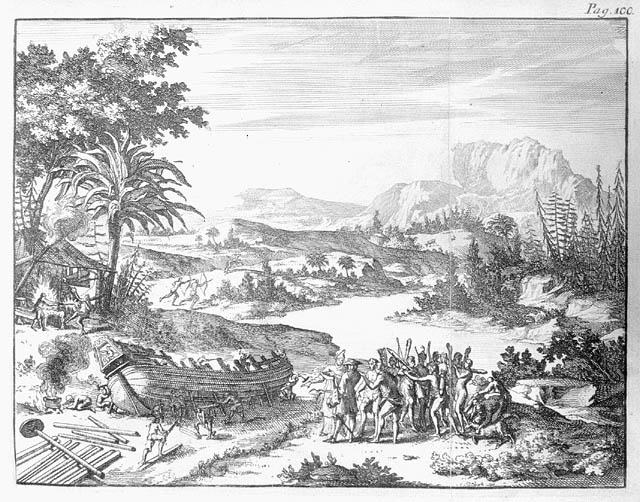
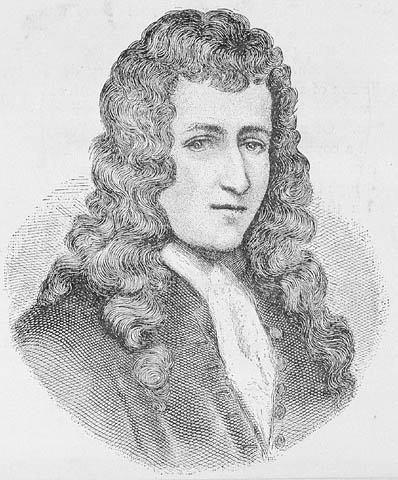
The first file, HMCS GRIFFON: Ceremonies and functions, Official opening of HMCS GRIFFON, is a good file to start with as it shares some interesting discussions on the opening of the facility in 1944 and on its namesake. HMCS Griffon was named after a ship dubbed Le Griffon, which was constructed by storied French explorer René-Robert Cavelier, Sieur de La Salle.

Print of people building a ship near a body of water surrounded by trees, with a mountain in the background.

The building of La Salle’s Le Griffon (c001225).

Black-and-white drawing of a man with long curly hair falling to his shoulders.

René-Robert Cavelier, Sieur de La Salle (c007802).

Le Griffon set sail in 1679 to take part in the burgeoning fur trade. Notably, it was the first full-sized sailing ship on the upper Great Lakes—this is the source of HMCS Griffon’s motto PRIMA IN LACUBUS (First on the Lakes). On its maiden voyage, Le Griffon set sail from an island near Green Bay, Wisconsin, and the ship was never seen again. This mystery intrigued many, including the commanding officer of HMCS Griffon, H.S.C. Wilson.

Wilson had received a bolt from a wreck, supposedly Le Griffon, that had been discovered in 1931 in the Mississagi Strait, near Manitoulin Island. Contrarily, a story surfaced about an Indigenous oral story of the real wreck of Le Griffon being close to Birch Island, near “Lescheneaux” or “Les Cheneaux.” C.H.J. Snider, of the Toronto Evening Telegram, returned a telegram to Wilson refuting the assertions of the latter wreck. This exchange shows the interest that some HMCS Griffon servicemen and women had in the history of their namesake. The location of the wreckage of Le Griffon remains a mystery to this day.

This exchange of telegrams was just part of the file. There were other notable entries, such as the invitation lists for the inauguration of HMCS Griffon and the various preparations made for the event.

Another fascinating file found in the series is HMCS GRIFFON: Reports of proceedings. Reports of proceedings are truly remarkable files as they demonstrate the day-to-day activities within a military establishment via various departments. For example, I was able to determine from the Sports Department that the popular sports at HMCS Griffon included basketball, volleyball and badminton. From a report in May 1955, I learned that baseball was less popular, as “[a]ttempts have been made to organize baseball games but insufficient interest was shown.”

Moreover, we can see the impact that marriage had on some servicewomen in a quote from a report posted by the Medical Department dated February 1955: “Wren Kingsley of the Medical Branch has been discharged following her recent marriage … Lt. Reta Pretrone was married this month resulting in absenteeism from several drills.”

These reports can shed light on both the operational management of the naval establishment as well as the more mundane happenings of HMCS Griffon.

As HMCS Griffon saw many men and women serve at the facility, accidents were bound to happen. The next excerpt, from the file HMCS GRIFFON: General information, RN personnel, shows us, in gruesome detail, a Board of Inquiry in 1945 about an unfortunate accident that occurred in the installation:

Board: What were you doing, that is, just what happened?

Answer: Machinist work, wood-cutting grooving some pieces of wood for boxes. It was a two inch mechanical saw and wood was brought across the bench and off about three feet from the side with about one foot space between the end of the wood and the wall. Most of the wood was wet, this piece was quite wet on the grain and dry on the end. As I was sawing this piece a young boy was trying to get around behind me, I turned my head to see that he did not shove me when at that moment the saw hit the dry end of the wood and it went through the wood very quickly taking my hand with it and cutting my fingers.

Following the inquiry, the board concluded:

It is the opinion of the board that Stoker BLACKMORE E suffered this accident while on leave and that it was not due to Naval Service. The Canadian Naval Authorities permit ratings to work whilst on leave thus alleviating the shortage of manpower. It is felt that this rating was justified in taking up this employment as it is his vocation in civilian life and the accident was primarily due not to inexperience on his part but to the fact that no guard or safety arrangements were supplied for this machine.

The Board of Inquiry process provides a glimpse into some of the practices that the Naval Service employed, such as employing a rating (a junior enlisted serviceman) instead of active servicemen when faced with shortages of manpower. It also illustrates some of the safety precautions, or lack thereof, on HMCS Griffon.

The files of HMCS Griffon series yielded some interesting facts about the stone frigate. Moreover, it gave me some broad and vivid descriptions of multiple events that transpired over time at the installation. It also shows how we can meld secondary sources with the primary sources themselves. All that said, HMCS Griffon will be remembered, in my mind, as the First on the Lakes.


Dylan Roy is a Reference Archivist in the Access and Services Branch at Library and Archives Canada.
Women in the War: the Royal Canadian Air Force at 100

Version française

By Rebecca Murray

Please note that many of the visuals for this article were taken from digitized microfiche; as such, the image quality varies, and individual item-level catalogue descriptions are not always available.

The Royal Canadian Air Force (RCAF) is celebrating 100 years in 2024. Library and Archives Canada (LAC) holds records from the RCAF’s earliest days through to the 21st century. From its role in Canadian aviation to operations abroad, the RCAF has an important place in Canadian military history. Other posts on this site address infrastructure like airports (specifically RCAF Fort St. John) and notable moments such as the Avro Canada CF-105 Arrow. This post will focus on the photographic holdings of the RCAF at LAC, specifically the Second World War–era photographs of servicewomen.

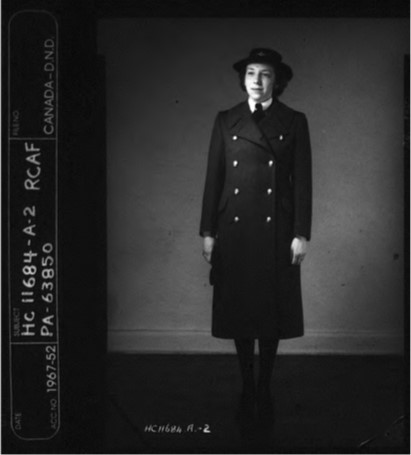
A uniformed woman stands against a blank wall.

HC 11684-A-2 “Great coat with hat and gloves,” 04/07/1941 (MIKAN 4532368).

Another colleague’s post outlines the history of the RCAF Women’s Division (RCAF-WD), so I won’t repeat it here, except to say that it was formed on July 2, 1941 (officially as the Canadian Women’s Auxiliary Air Force, changing its name by early 1942) and would eventually see more than 17,000 women serving within its ranks.

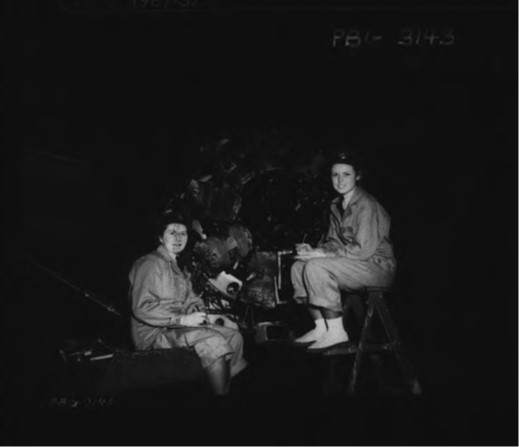
Two women wearing coveralls sit on either side of a propellor.

PBG-3143 “Women’s Division—Aero Engine Mech.,” 23/10/1942 (MIKAN 5271611).

The Department of National Defence fonds (RG24/R112) holds photographs of these women and documents their service during the Second World War era. Comprising over 500,000 photographs, this collection is a rich resource for anyone interested in the period as it includes photographs from both Canada and overseas. Over the past six years, I have been working closely with the photographs to find the servicewomen. Some of them are documented clearly and given centre stage in photographs. Others are found on the fringes, sometimes almost indistinguishable at first glance from their male counterparts in group photographs.

A seated uniformed man wearing glasses (left) looks towards a standing uniformed woman (right).

RE-1941-1 “Pay and Accounts Section (Crosswinds),” 25/09/1944 (MIKAN 4740938).

The occasion of the RCAF’s 100th birthday is a fitting moment to share the results of the work with this particular sub-series of photographs while highlighting the role that servicewomen played in the RCAF’s ranks during this period. Composed of 53 sub-sub-series of photographs, usually distinguished by location, the images vary widely—from aerial views of Canada to official portraits to post-war photographs of life and operations at European bases like North Luffenham and Station Grostenquin. The bread and butter of this sub-series, though, for most interested parties, is the imagery that documents the day-to-day operations and lives of servicemen and women during the Second World War, whether at home or abroad.

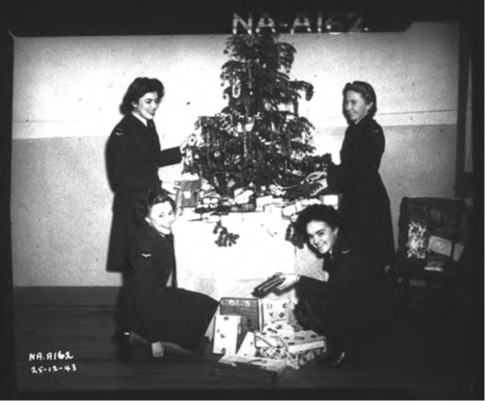
Four uniformed women stand and kneel around a Christmas tree positioned atop a table. Wrapped gifts appear on the floor and underneath the tree.

NA-A162 “WD’s Xmas tree & Xmas dance,” 25/12/1943 (MIKAN 4532479).

At over 160,000 distinct images, this sub-series is a treasure trove for any researcher with an interest in the period! Approximately 1,900 of those images (1%) are of servicewomen, both RCAF-WDs and nursing sisters who served in the RCAF. Servicewomen are best represented within this sub-series in photos from Ottawa, Rockcliffe or Headquarters, with strong representation from those taken at regional bases such as those in Newfoundland, Prince Edward Island and British Columbia.

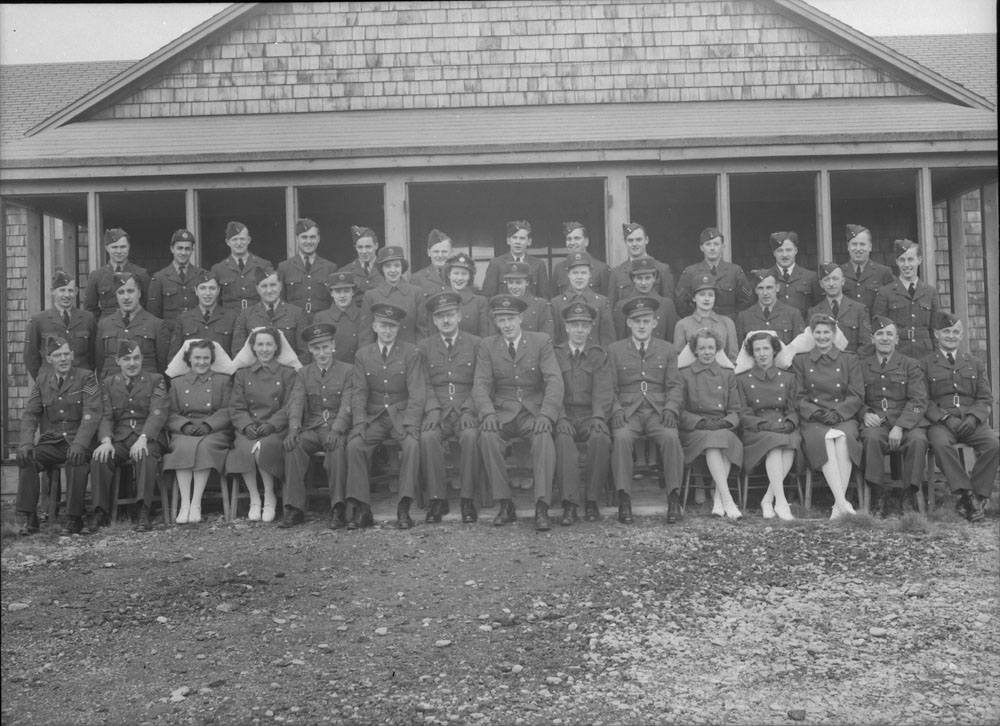
The photographic collection shows us the WDs (as they were known colloquially) at work and play. They are often shown in groups celebrating holidays or fun moments against the backdrop of a horrific war. Other images suggest levity (see images NA-A162 above and SS-230B below) but also show the serious work being done (see image PBG-3143 earlier in this post). Formal group photographs, such as the nursing sisters shown in G-1448 below, are very common. For many of the more remote or rural bases, especially in the earliest years of the war, nursing sisters are the only women present in the associated photographic records.

A formal group photo with 41 individuals, including 12 servicewomen, five of whom are wearing the distinctive white veil of a nursing sister. The group is organized in three rows; the front row is seated.

G-1448 “[Hospital staff, No. 1 Naval Air Gunnery School, R.N., Yarmouth, N.S.],” 05/01/1945 (a052262).

A group of fifteen women, mostly in civilian dress, engages in various leisure pursuits in what looks like a living room or lounge-like setting. Many appear to be engaged in needlecraft.

SS-230B “Sewing Circle (WD’s) Intelligence Officers,” 04/04/1943 (MIKAN 5285070).

Do you want to know more? Did your aunty or grandma serve in the RCAF-WD? Are you interested in knowing more about her service?

Check out LAC’s extensive resources and records related to the Second World War, including information on how to request military service files. Service files for Second World War—War Dead (1939–1947) are available via our online database.

Explore other photographic holdings at LAC, such as the PL prefix—Public Liaison Office sub-sub-series, a fabulous resource for RCAF photographs that sits, archive-wise, just outside of accession 1967-052 (the focus for this particular research project). Any researcher looking for a RCAF aunty or grandma (or grandpa!) in the archives should include these photographs in their search.

There’s more information about the RCAF’s Centennial on the official RCAF website.


Rebecca Murray is a Literary Programs Advisor in the Programs Division at Library and Archives Canada.