First World War Centenary: Honouring Canada’s Victoria Cross Recipients – Battle of Second Ypres

In the first week of April 1915, members of the 1st Canadian Division, including many of the earliest volunteers of the war, were moved north from Bethune, France to the active section of the line near Ypres, Belgium. A medieval Belgian city, Ypres was the scene of one of the war’s earliest and bloodiest battles in 1914 and had assumed great strategic importance. When the front stabilized in November 1914, the Allied lines bulged out around the city into the German line, forming a salient, surrounded on three sides by higher ground.

On April 22, 1915, in an effort to eliminate the salient, Germany became the first nation to use chemical weapons, releasing over 160 tons of chlorine gas across the Allied front. Members of the 1st Canadian Division, who had been in their trenches barely a week, found themselves desperately trying to defend a 6.5-kilometre gap in the Allied lines as the French division to their left crumbled in the face of Germany’s new weapon. The chlorine gas clung to the ground and filled the trenches, forcing the troops to climb out and into the path of heavy machine-gun and artillery fire.
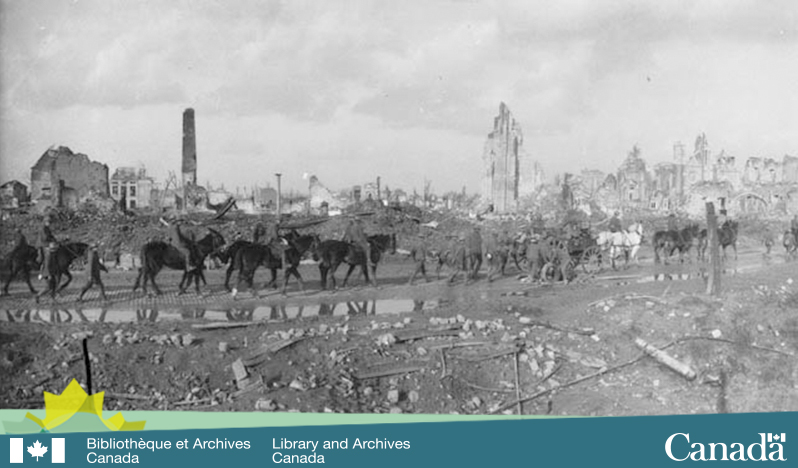
A black-and-white photograph showing a city completely destroyed by war. A column of troops, most on horseback, are travelling through it.

A scene of the destroyed city of Ypres, showing the Cathedral, Cloth Hall, and Canadian troops passing through, November 1917 (MIKAN 3194491)
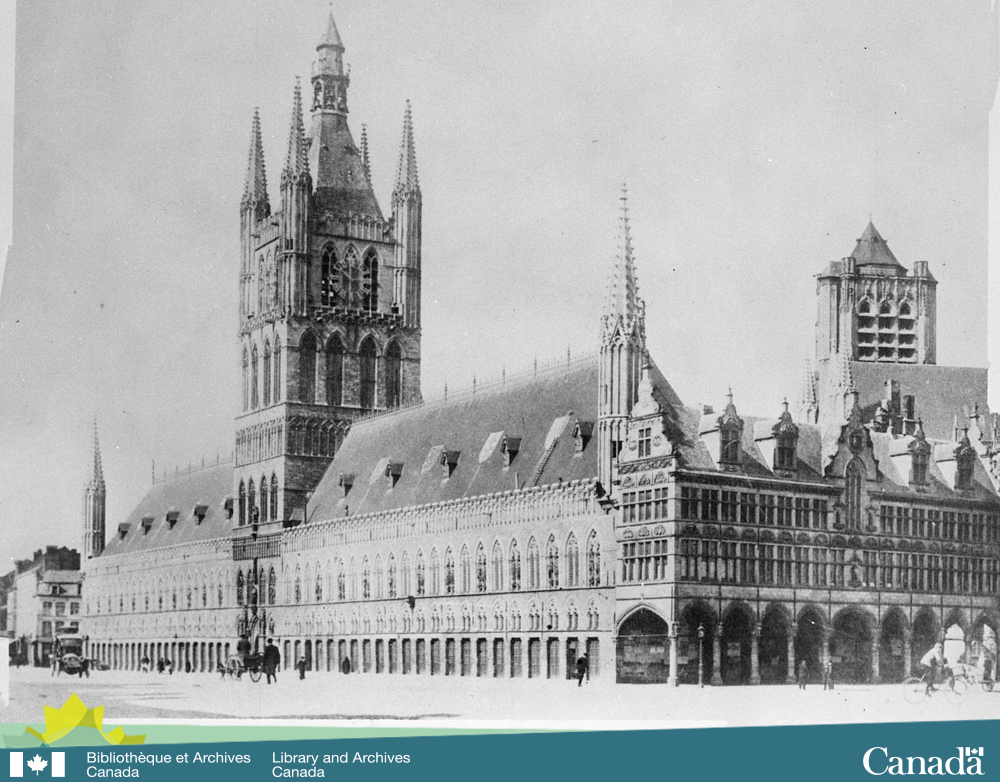
A black-and-white photograph of an ornate gothic building and other adjacent buildings.

The Cathedral and Cloth Hall in Ypres, before the Great War (MIKAN 3329077)

German troops moved forward but, having planned only a limited offensive and lacking adequate protection against their own chemical weapons, they were unable to exploit the break in the line. Throughout the night and the subsequent days, Canadian and British troops struggled to maintain the line. Canadians mounted a counterattack at Kitchener’s Wood (derived from Bois-de-Cuisinères) and endured the terrible fighting at St. Julian: their Canadian-made rifles jamming in the mud, and soldiers violently sick and gasping for air. Somehow, they managed to hold the line until reinforcements arrived on April 28. The losses were tremendous: 6,035 Canadians (or one in three soldiers) became casualties by the time the 1st Canadian Division was relieved. This toll among an army whose members had almost all been civilians just months prior.

At Second Ypres, the Canadians were initiated into the horrors of modern warfare, and from this moment on they would continue to develop into a highly respected formation in the Allied forces.

From April 23 to 25, as part of our series, First World War Centenary: Honouring Canada’s Victoria Cross Recipients, we will tell the stories of Lance-Corporal Frederick Fisher, Lieutenant Edward Donald Bellew, Company Sergeant-Major Frederick William Hall, and Captain Francis Alexander Caron Scrimger.

View the Flickr album – Canada at Ypres
First World War Centenary: Honouring Canada’s Victoria Cross recipients

As part of its commemoration of the centenary of the First World War, over the next three years we will profile each of Canada’s Victoria Cross recipients. Each profile will be published on the 100th anniversary of the day that the actions for which the recipient was awarded the Victoria Cross took place.

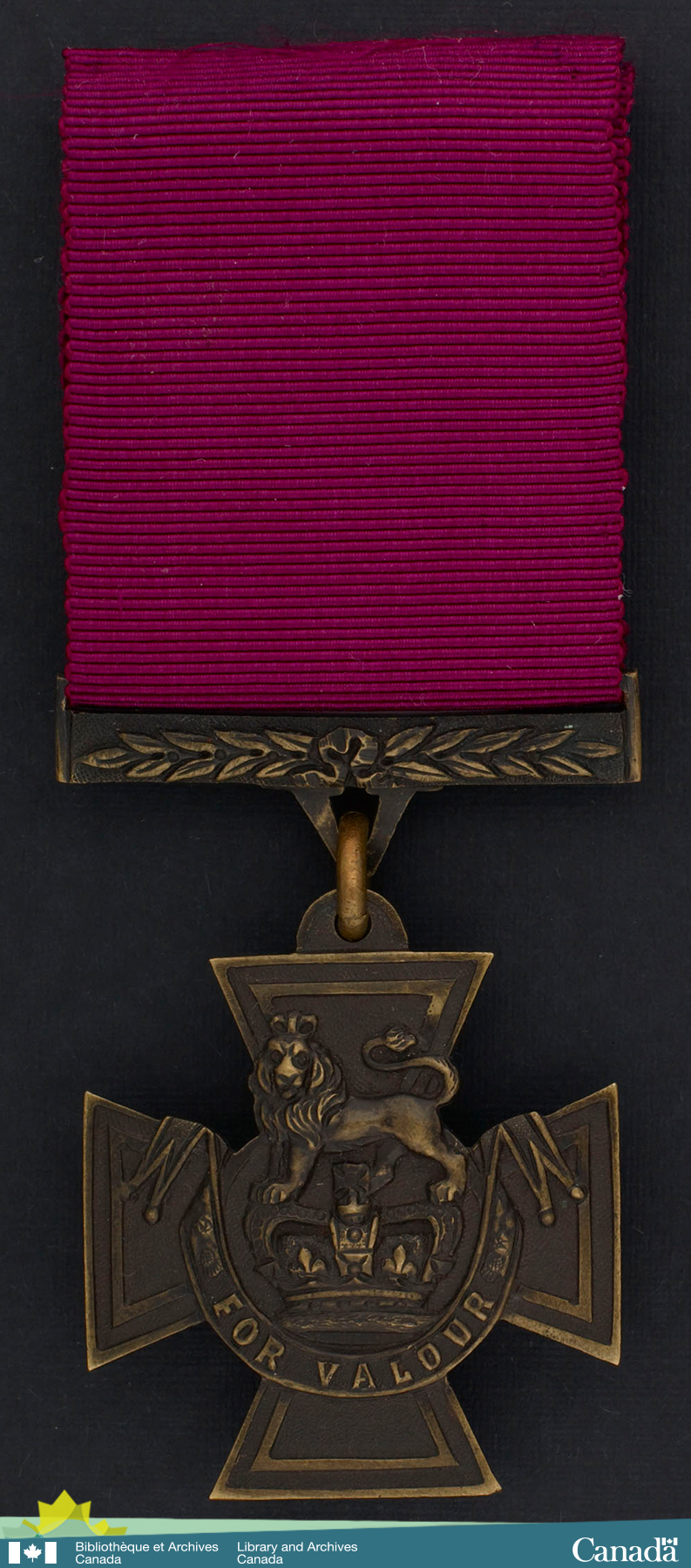
Colour photograph of a medal. Ribbon is crimson. Cross-shaped medal is bronze with a lion above a crown bearing the inscription For Valour on a scroll.

The Victoria Cross (MIKAN 3640361)

The Victoria Cross (VC) is the highest military decoration in the Commonwealth and takes precedence over all other medals, decorations and orders. A recognition of valour in the face of the enemy, the VC can be awarded to a person of any rank of military service and to civilians under military command. So far, 98 Canadians have been awarded the Victoria Cross, beginning with Alexander Roberts Dunn who in 1854 fought in the Battle of Balaclava in the Crimean War. The Victoria Crosses were awarded to 71 Canadian soldiers during the First World War, and 16 were awarded during the Second World War. The remaining VCs were awarded to Canadians for the Indian Rebellion of 1857 (in which William Hall of Nova Scotia became the first-ever black recipient of the VC) and the South African War (1899–1902).

In 1993, the Canadian Victoria Cross was adopted in place of the British VC. The medal is identical to the British VC but the inscription is in Latin—Pro Valore—a linguistic ancestor to both English and French. The Canadian Victoria Cross has yet to be awarded.

The profile series will also include links to photographs, service papers, war diaries, and other digitized artifacts in Library and Archives Canada’s collections that help to tell the stories of the Canadians who experienced the Great War on many fronts, including the home front, and whose actions and memories shape how contemporary Canadians remember and understand the first truly global conflict.

We will begin our First World War Victoria Cross profiles with Lance-Corporal Frederick Fisher.

120th birthday of William George Barker, Canadian flying ace and Victoria Cross recipient

November third marked the 120th anniversary of the birth of William George Barker, Canadian First World War flying ace and Victoria Cross recipient. One of Canada’s most renowned fighter pilots and the most decorated serviceman in the history of the British Commonwealth, Barker shot down 50 enemy aircraft during the First World War.

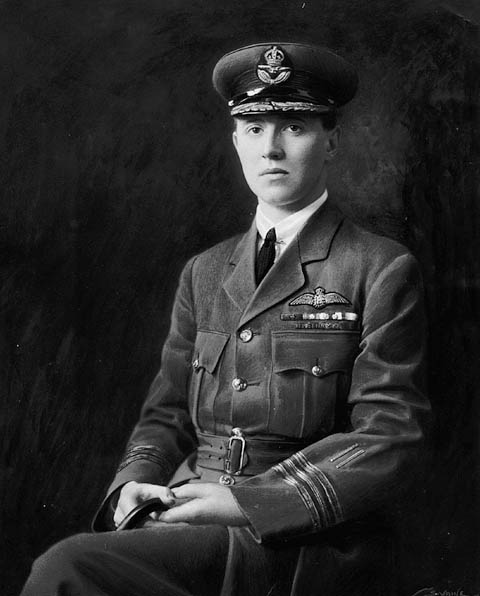
Major William G. Barker, 1918.

Major William G. Barker, 1918 (MIKAN 3623168)

Barker was born in Dauphin, Manitoba on November 3, 1894. He enlisted in the 1st Canadian Mounted Rifles in December 1914 and arrived in France in September 1915 where he served as a machine gunner. In early 1916, Barker transferred to 9 Squadron, Royal Flying Corps, and was commissioned as a second lieutenant. He transferred to 15 Squadron in July and shot down his first enemy aircraft from the rear of a B.E.2 aircraft. He was awarded the Military Cross in the concluding stages of the Battle of the Somme for spotting German troops massing for a counter-attack and calling down an artillery attack that broke up the 4,000-strong force. After an injury in August 1917, Barker served as a flight instructor in the UK but his ongoing requests for front-line service saw him join the 28 Squadron by the end of the year. Though unexceptional as a pilot, Barker exceled through his aggression in combat and highly accurate marksmanship, coupled with a tendency to ignore orders and fly unofficial patrols.

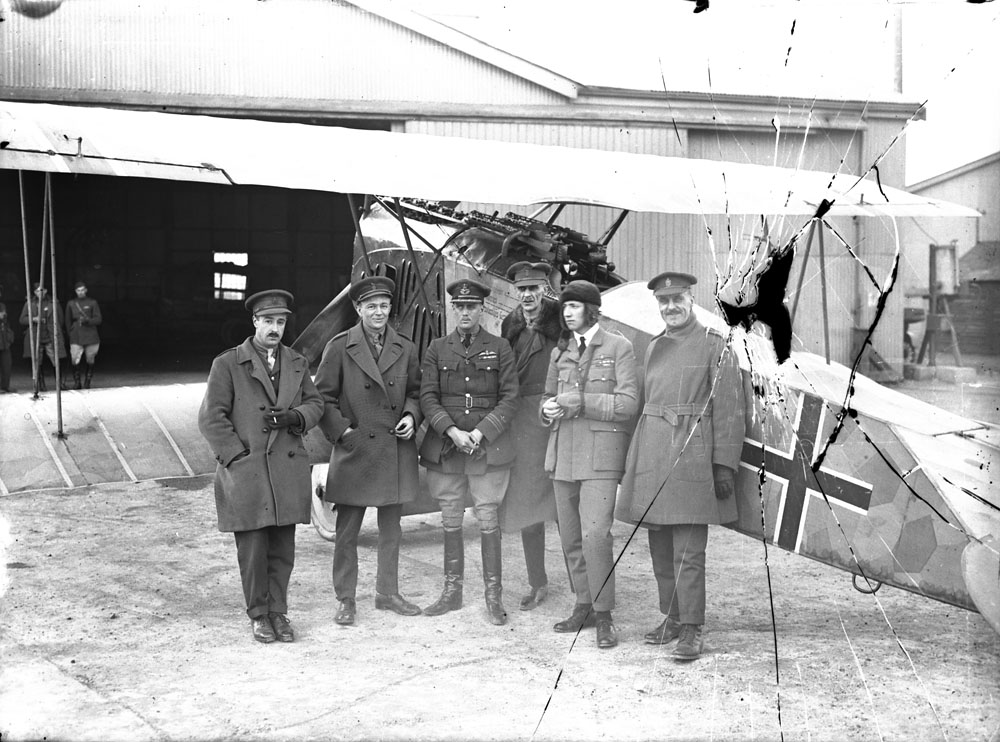
Major W. G. Barker, VC, (5th from left) with captured Fokker D.VII aircraft at Hounslow Aerodrome, April 1919.

Major W. G. Barker, VC, (5th from left) with captured Fokker D.VII aircraft at Hounslow Aerodrome, April 1919 (MIKAN 3523053)

On October 27, 1918, Barker was attached to 201 Squadron, Royal Air Force and flying a solo excursion over the Fôret de Mormal when he encountered a formation of Fokker D.VIIs from Jagdgruppe 12. In the ensuing battle, which took place immediately above the Canadian lines, Barker shot down four enemy aircraft before crash-landing inside Allied lines. Severely wounded, Barker had only recovered enough to walk the few paces at his Victoria Cross investiture ceremony at Buckingham Palace by March 1919.

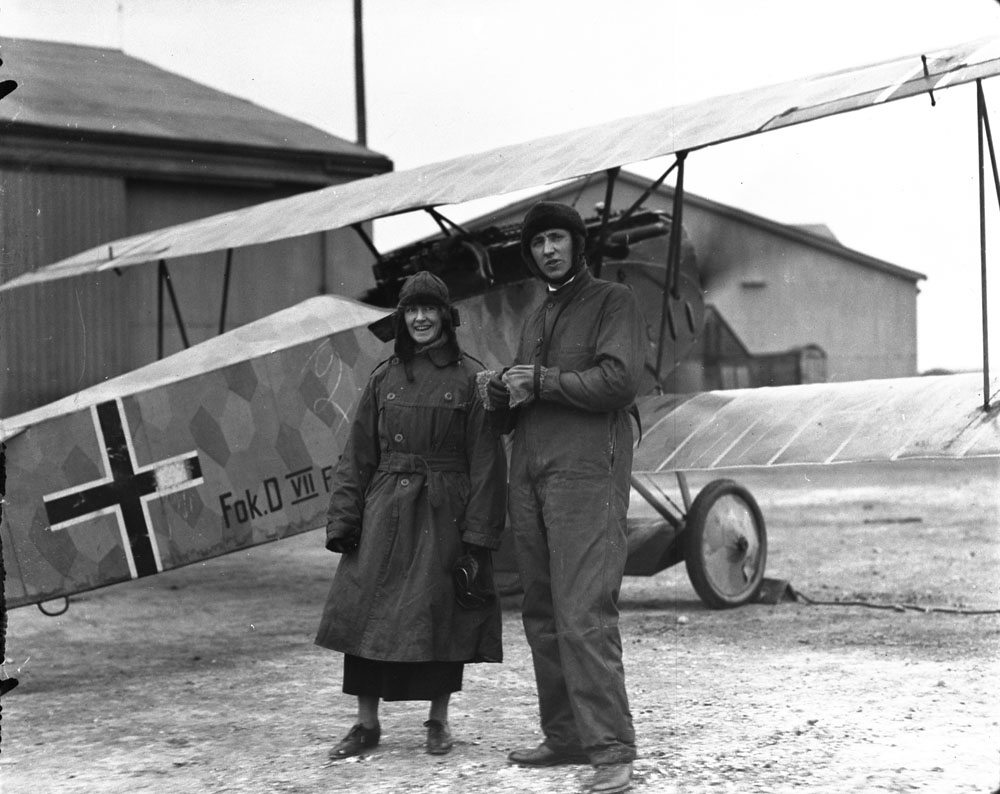
Major W. G. Barker, VC, with captured Fokker D.VII aircraft at Hounslow Aerodrome, April 1919

Major W. G. Barker, VC, with captured Fokker D.VII aircraft at Hounslow Aerodrome, April 1919 (MIKAN 3214719)

As the most decorated serviceman in the British Commonwealth, Barker is credited with one captured and two (seven shared) balloons destroyed, 33 (and two shared) aircraft destroyed, and five aircraft out-of-control.

Following the war, he and fellow flying ace William “Billy” Bishop formed Bishop-Barker Aeroplanes Limited. Barker joined the fledgling Canadian Air Force as Wing Commander in 1922 and was appointed Acting Director in 1924. He suffered the physical effects of his injuries throughout his post-war life.

He died on March 12, 1930, aged 35, when he lost control of his Fairchild KR-21 biplane trainer during a demonstration flight at Rockcliffe Air Station. His funeral was the largest national state event in Toronto’s history.
Library and Archives Canada holds the CEF service file for Major William George Barker.

To learn more about Canada’s military past, visit the Military Heritage pages.