For Canadians, the Battle of Vimy Ridge brings to mind the joint effort of all of the Canadian units that fought together for the first time to achieve victory. In a way, it was our very first national military victory, and, as such, a tremendous source of pride.
In spring 1917, Allied Command tasked Canadians with the difficult mission of taking Vimy Ridge and driving back the Germans, who had controlled it almost continuously since the beginning of the First World War.
![Barrage map [cartographic material]: [Vimy Ridge region, France]](https://thediscoverblog.com/wp-content/uploads/2013/04/blog-190-barrage-map.jpg?w=584&h=791)
Barrage map [cartographic material]: [Vimy Ridge region, France] (e000000540)
The Canadian officers spent weeks developing their tactical attack down to the last detail. The soldiers rehearsed their attack behind the lines using a model to represent the battlefield so they would be familiar with the terrain where they would be fighting. The role of the artillery was also meticulously planned in preparation for its famous “creeping barrage,” an artillery bombardment that pressed forward against the enemy at a timed pace as a curtain of fire ahead of the advancing troops.

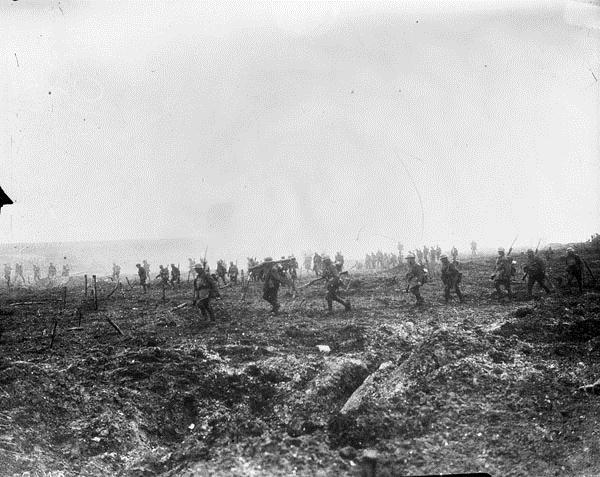
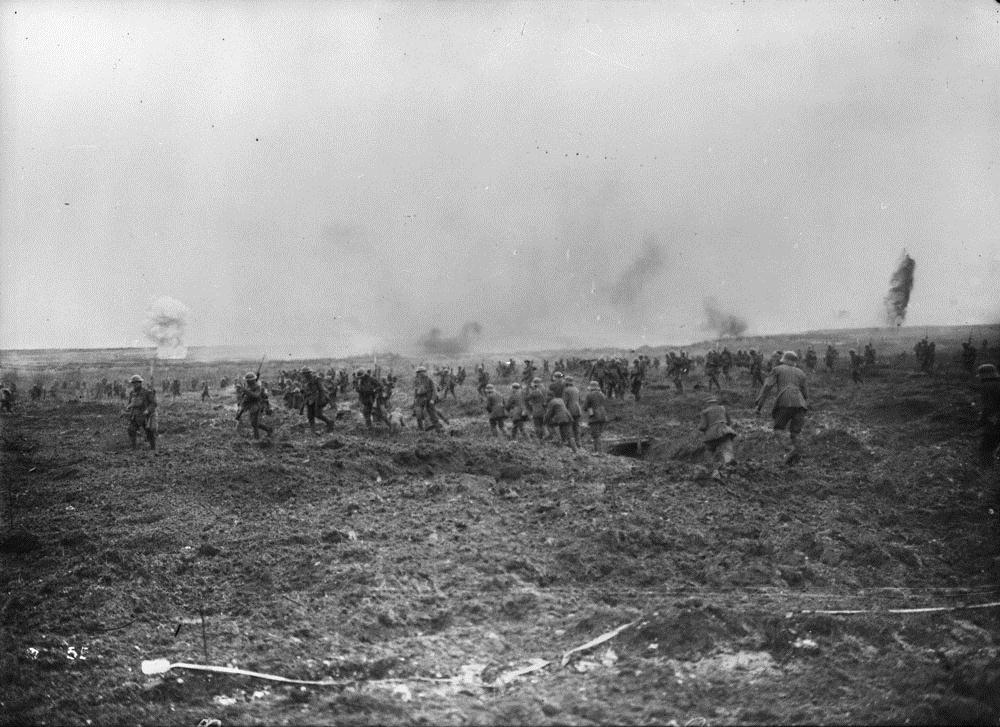
29th Infantry Battalion advancing into “No Man’s Land” through German barbed wire and heavy fire during the Battle of Vimy Ridge. (a001086)
The attack that ignited the Battle of Vimy Ridge was launched on Easter Monday, April 9, 1917, at 5:30 a.m. Four Canadian divisions overran the German positions, with three achieving their primary objectives in less than an hour. The highly-trained men were able to advance rapidly, thanks to the formidably effective heavy artillery fire. Nevertheless, the Germans offered fierce resistance: it took four days of heavy combat for the Canadians to finally seize full control of the famed Vimy Ridge.
The battle claimed the lives of 3,598 Canadian soldiers, with over 7,000 more wounded.

(W.W. I – 1914-1918) As the Canadians advanced, parties of Huns left their dug-outs, only too glad to surrender – Vimy Ridge. April 1917. (a001123)
Visit our Flickr album for more photographs.

 Over the next month, Library and Archives Canada and The National Archives of the United Kingdom will be shining a light on the role that the Canadian contingent played in the Battle of Vimy Ridge, as we commemorate the 100th anniversary of this First World War battle.
![Barrage map [cartographic material]: [Vimy Ridge region, France]](https://thediscoverblog.com/wp-content/uploads/2013/04/blog-190-barrage-map.jpg)
 Library and Archives Canada Blog