Version française
By Ellen Bond
In January 2020, the Canadian men’s team won the gold medal against Russia at the 2020 International Ice Hockey Federation (IIHF) World Junior Championship. It was a hard-fought competition with millions watching from all over the world. This is any Canadian hockey player’s dream: winning gold at an international championship and hearing your national anthem at the end of the game. Meanwhile, only a few days earlier, Team Canada played against the United States of America (USA) in the 2020 IIHF Ice Hockey U18 Women’s World Championship with, by comparison, almost no one watching.
Unlike basketball, which has different sized balls, and volleyball, which has different net heights, hockey is the same game for men and women. Yes, women play “non-contact” hockey, but the ice surface is the same, the puck size and weight are the same, and the nets are of equal height, width and depth. Both men and women began playing hockey in its infancy (men in early 1870s and women in 1890s). This begs the question: Why did men’s hockey continue to grow and develop, while women’s hockey had a great start but then failed to gain the same attention?
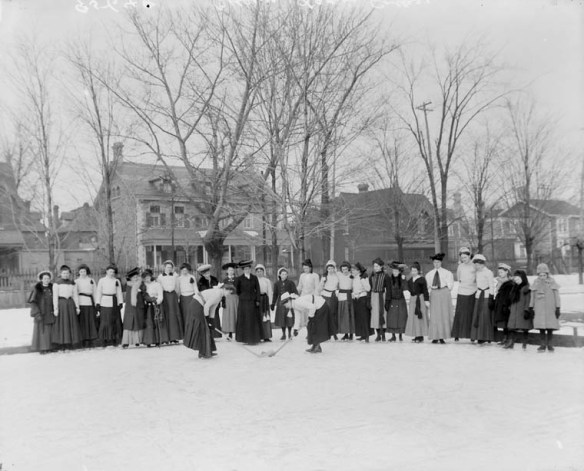
A group of women gather to play hockey in 1906, Ottawa, ON (PA-042256)
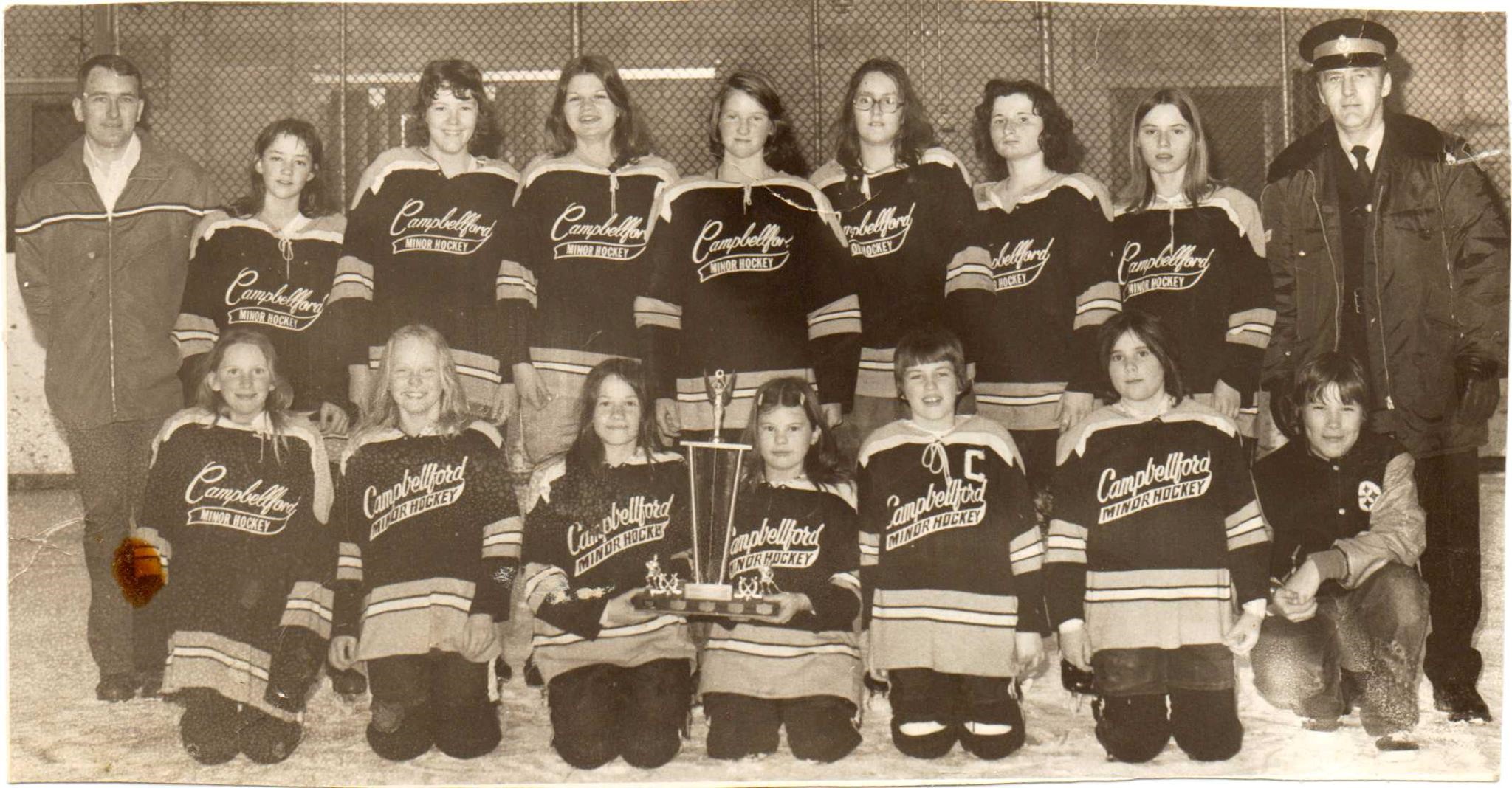
When I was young, all I wanted to do was play hockey. I remember watching my brother play with lots of other boys out on the ice. They would divide the ice up with long hoses across the blue lines to make up three smaller ice surfaces. I wanted to be out there, but girls were not allowed. That changed in the late 1970s when we moved to Campbellford, Ontario. One day in early fall, a man came to our door and asked my dad if he wanted to coach the girls’ hockey team. He said yes and, at the beginning of grade eight, I started playing organized hockey.

My championship team the first year I was allowed to play hockey. My dad is on the right and my brother is kneeling in front of him. I’m in the top row, third from the left. (Photo supplied by the author.)
This made me wonder: If women, like men, started to play hockey in the late 1800s, why wasn’t I allowed to play hockey prior to our move to Campbellford, when we had lived in a moderately large city?

“Queen of the Ice.” A woman stands on ice wearing figure skates and holding a hockey stick, 1903. (C-3192610)
The Ontario Women’s Hockey Association (OWHA) claims the first women’s hockey game took place in 1891 in Ottawa, Ontario. At this time, the University of Toronto (U of T), Queen’s University and McGill University had women’s hockey teams, but they had to compete behind closed doors. Men couldn’t watch and the only men allowed inside were the referees. In 1914, the first women’s provincial championship took place in Picton, Ontario. There were six teams involved, including some of the university teams. In 1921, U of T defeated McGill to win the first Canadian women’s university championship. These teams and others helped the game grow steadily but unevenly in the 1920s and 1930s.
Then women’s hockey just stopped growing. Maybe it was because hockey was “too rough for girls,” as Clarence Campbell, President of the National Hockey League, argued in 1946. Maybe it was because communities prohibited people from watching women play hockey. Maybe it was because of beliefs that watching women play hockey was too frivolous or that women took the game too seriously. Or maybe, as Wayne Norton suggests in his book Women on Ice: The Early Years of Women’s Hockey in Western Canada, it was because in 1923 the Canadian Amateur Hockey Association (CAHA) voted NOT to give women official recognition as hockey players. In their book, Too Many Men on the Ice: Women’s Hockey in North America, Joanna Avery and Julie Stevens propose that Canada’s participation in the Second World War led to the decline of women’s hockey. Many women took on factory jobs when the majority of men went to fight in the war, leaving them little time to play the game. Whatever the reason, for decades it was hard for women to play a beloved game and this meant that many girls and women never had the opportunity to play hockey.

Miss Eva Ault. When men headed to Europe in the First World War, women got their first chance to play professional hockey. Eva Ault became a fan favourite, but when the war ended so did the careers of the first female pros. (PA-043029)
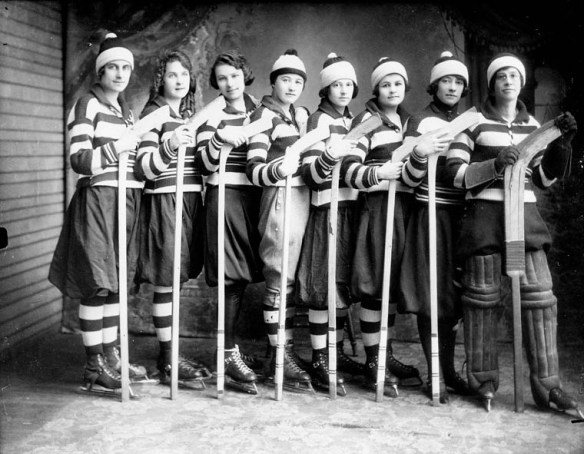
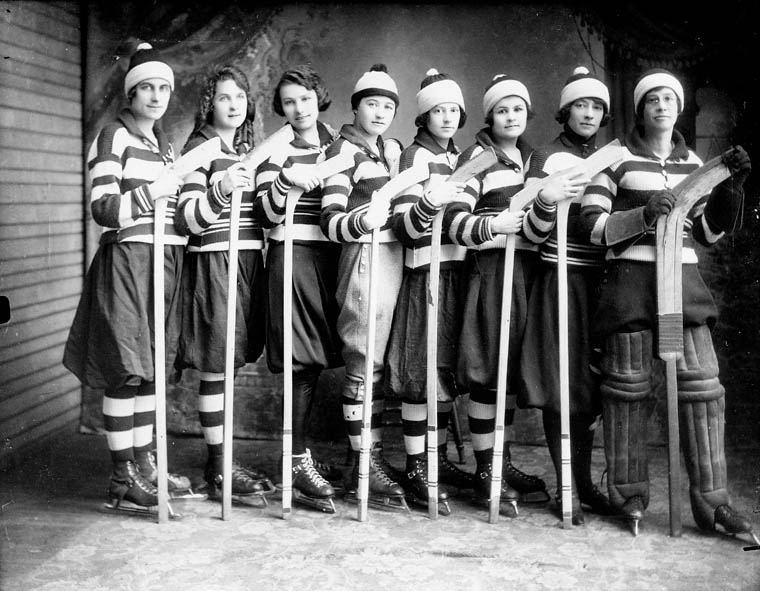
Women’s hockey team from Gore Bay on Manitoulin Island, Ontario, 1921. Names available in the record. (PA-074583)
I had the opportunity to play hockey from grades eight to thirteen, both in my community and at my high school in Peterborough, Ontario. I was also fortunate to have varsity teams to play on at McMaster and Queen’s universities. This was the closest I ever got to playing professional hockey. We were provided with equipment, ice time for practices and games, and transportation to all our games. At McMaster the entire budget for our team was less than the men’s team spent on sticks alone, but I had the chance to play varsity hockey for my university and to play with and against some of the best players in the world.
Two of those players were Margot (Verlaan) Page and Andria Hunter. Both of these athletes wore the Team Canada jersey at World Championships. I played with Margot for three years at McMaster. She was our captain and the best player out on the ice. At the time, this was the highest level of hockey Margot could play. She went on to play for Canada at the IIHF World Championships in 1987 (not sanctioned), 1990, 1992 and 1994. From 2000–2007 Margot coached Canada’s IIHF and Olympic women’s hockey teams. Margot is now Head Coach of the Brock Badgers Women’s Varsity Ice Hockey Team. Andria and I knew each other from living in Peterborough and because I was a counsellor at Camp Quin-Mo-Lac when she was a camper. Living in a small town, our paths crossed numerous times. I asked Andria what it was like when she first played hockey. Here is her story, in her own words.
I first started playing hockey in 1976. At that time, it was not very common for females to play. I was fortunate to play in Peterborough when girls’ hockey was just taking off. There were many small towns that had no female hockey at all at that time. I played in a boy’s house league my first year, but after that I was always able to play girls’ hockey.
When I was a kid, it was always my dream to play university hockey, because that was the highest level at the time; there was no national team, and certainly no World Championship or Olympics. I was very fortunate that some major changes in women’s hockey happened at an ideal time for me. I went on to play university hockey in the USA on a hockey scholarship; I was one of the first international female players to receive a women’s hockey scholarship in the USA. I also had the opportunity to play for Team Canada in 1992 and in 1994! I have always thought that if I had been born just five years earlier, I may have missed these amazing experiences.
I played at the University of Toronto as a graduate student between 1990 and 1996. During these years, the program went through a tumultuous period of transition. In 1990, our team kept our equipment in a small locker and our games were only three fifteen-minute periods with one flood. Then, during the 1993–94 season (when I was away from U of T playing hockey in Switzerland), the women’s hockey program was almost cancelled. There was a big rally that helped to keep the program alive. When I returned from Switzerland the next year to play for U of T again, women’s hockey had been upgraded to a high-performance sport. We now had two-hour practices four days a week, and no longer had to keep our equipment in a storage locker!
I played in the National Women’s Hockey League (NWHL) when it was in its infancy. We had an enthusiastic owner when I played for the Mississauga Ice Bears who arranged for us to play at the Hershey Centre [now the Paramount Centre] and we even had our own dressing room there. Unfortunately, we just did not get enough fans to allow us to play in such an expensive venue so, after two seasons, the team moved to Oakville.
Since my retirement from the NWHL in 2001, women’s hockey has continued to grow. It is certainly much more socially acceptable for females to play [now] than it was when I was a kid. The skill level has increased, as players get more development opportunities. The quality of the coaching, the level of competition, and the amount of ice time at the grassroots level, are certainly contributing factors. The number of teams at the university level in both Canada and the USA and the amount of resources for these players has continued to increase as well. It is unfortunate that women’s hockey still struggles to attract fans and that there are limited professional opportunities for women’s hockey players today. Fortunately, there are an increasing number of employment opportunities for women in coaching positions.
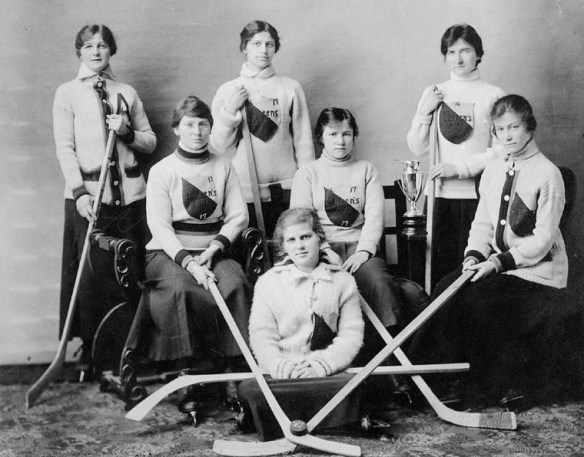
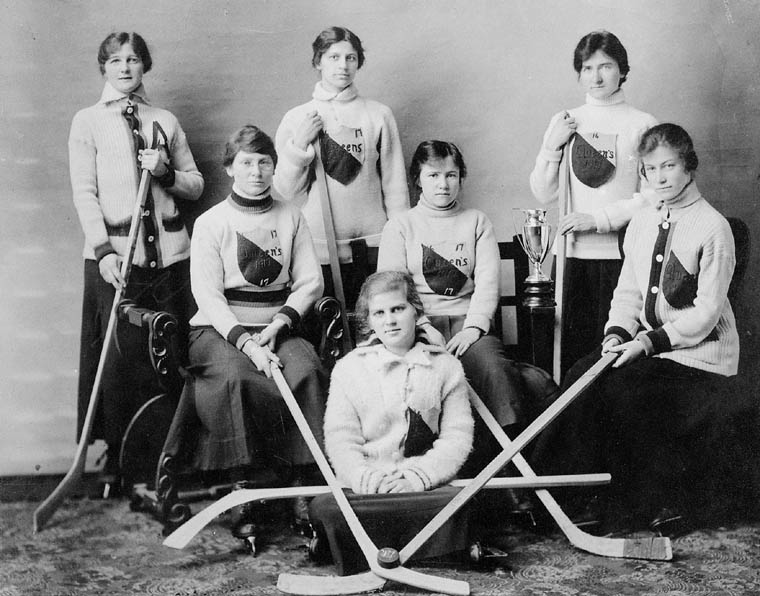
Team portrait of Queen’s University women’s hockey team, 1917. Some names are available in the record. (PA-127274)
Like Andria says, girls today have many opportunities to play hockey. Teams are available in many communities across Canada. Girls can aspire to play varsity hockey at many Canadian universities, to play in Division I of the National Collegiate Athletic Association (NCAA) in the United States, and to play in many European countries. They can dream about playing for their country at the Olympics and in the World Championships. Elite players from Canada and the USA played 3-on-3 games during the 2020 Honda NHL All-Star Weekend in St. Louis, Missouri, showing their skills to million of fans. As the game continues to grow, competition between countries will increase and maybe the NHL will offer a women’s professional league to play in. The future is bright for the young girls of today who yearn to play hockey. Margot, Andria and I gained many life lessons from playing hockey growing up and we are so excited for the girls of today and the opportunities that await them playing the great game of hockey.
Ellen Bond is a project assistant with the Online Content Team at Library and Archives Canada





 Library and Archives Canada Blog