The Jamaican Canadian Association and women’s involvement

By Christine Barrass

Founded 56 years ago, the Jamaican Canadian Association (JCA) was created by Jamaicans living in Toronto. It was 1962, and as Jamaica prepared for independence from the United Kingdom, this group decided to plan a celebratory dinner and dance. The event on August 6, Independence Day, was a roaring success. Discussions afterwards supported setting up an organization that could both help immigrants from Caribbean countries adapt to life in Toronto and advocate on behalf of Caribbean and African-Canadian citizens in the city. To this end, a Constitution Committee, made up of three men and three women, was established. On September 23, 1962, participants at a well-attended Organizational Meeting approved the JCA constitution and elected its first Executive Committee.

Dr. Vincent Conville, a long-time member of the association and its president from 1977 to 1978, wrote his PhD thesis on the JCA. In 2008, he donated the material that comprises the Jamaican Canadian Association fonds to Library and Archives Canada. This material contains transcripts of oral interviews he conducted with founding and prominent members of the group as well as copies of the JCA newsletter, In Focus. These interviews and newsletters include many frank and insightful opinions from women such as Amy Nelson, Kamala-Jean Gopie and Erma Collins.

Unusual for its time, the JCA had more female than male members. These women were a diverse group of university students, nurses and domestic workers who joined the association with a shared desire to help others in the Caribbean community in Toronto and across Canada. Women in the JCA played a varied role that changed over time. Despite their numbers, women acted largely behind the scenes rather than in leadership positions during the JCA’s first decades. They organized fundraisers, created committees and supported the association’s goal of providing much-needed social services. In an interview conducted by Dr. Conville, one of the founding members of the JCA, Amy Nelson, acknowledged the inequality in the organization, viewing it as a product of the times: men were simply found in leadership roles more often, whether in the JCA or in society at large.
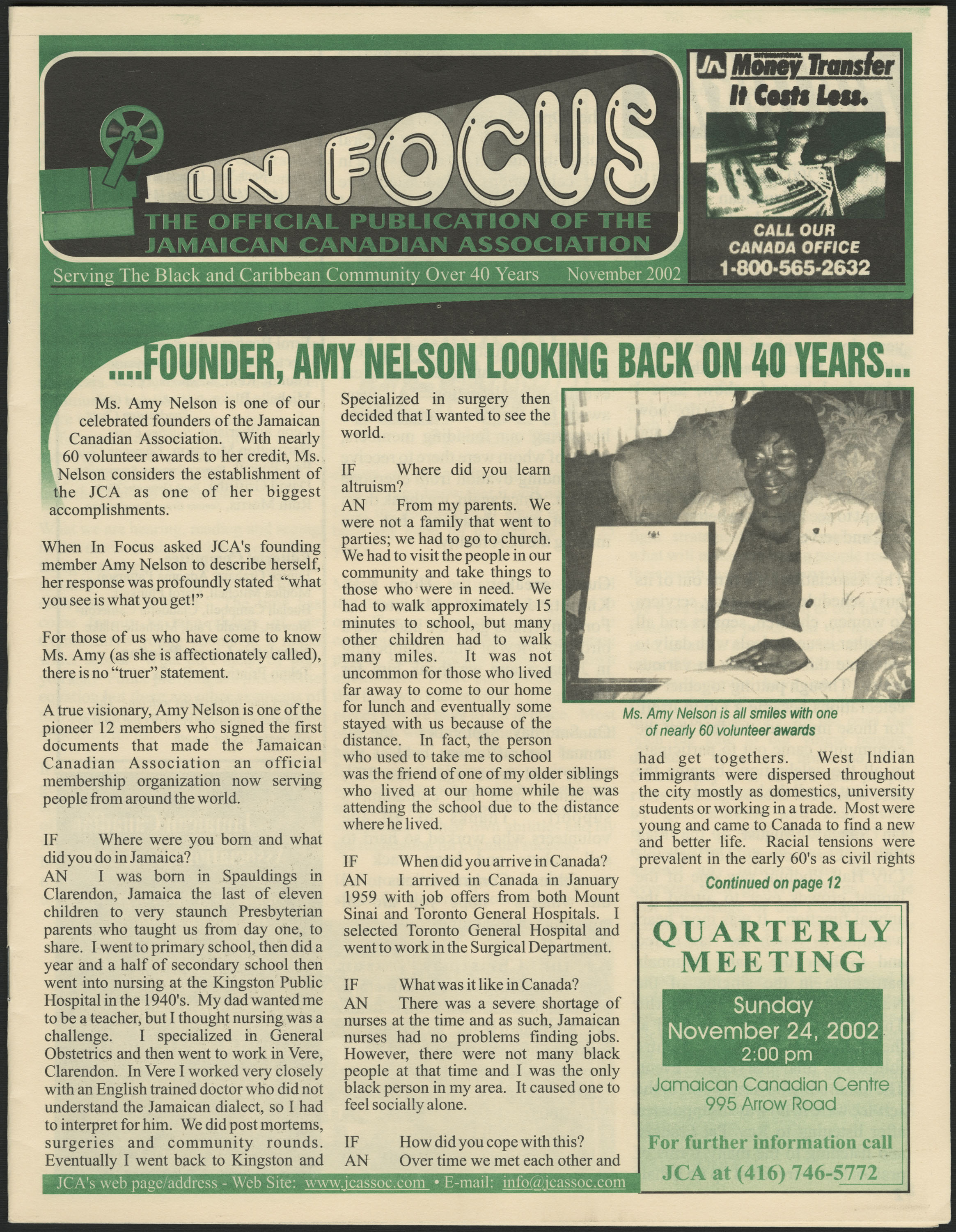
The front page of a black-and-green printed newsletter. The main headline reads: “….founder, Amy Nelson looking back on 40 years…”

In Focus newsletter, dated November 2002 (e011218459)

One woman who managed to become a leader in the JCA was Kamala-Jean Gopie (formerly Jean Gammage). Joining the association in 1974, she quickly became a very active member. In 1975, she took on the role of Executive Secretary, and from 1978 to 1980 she served as the first female president of the JCA. Despite her leadership roles, however, she recalled in an In Focus interview that attending an award ceremony as a guest rather than as an organizer was a novel experience!
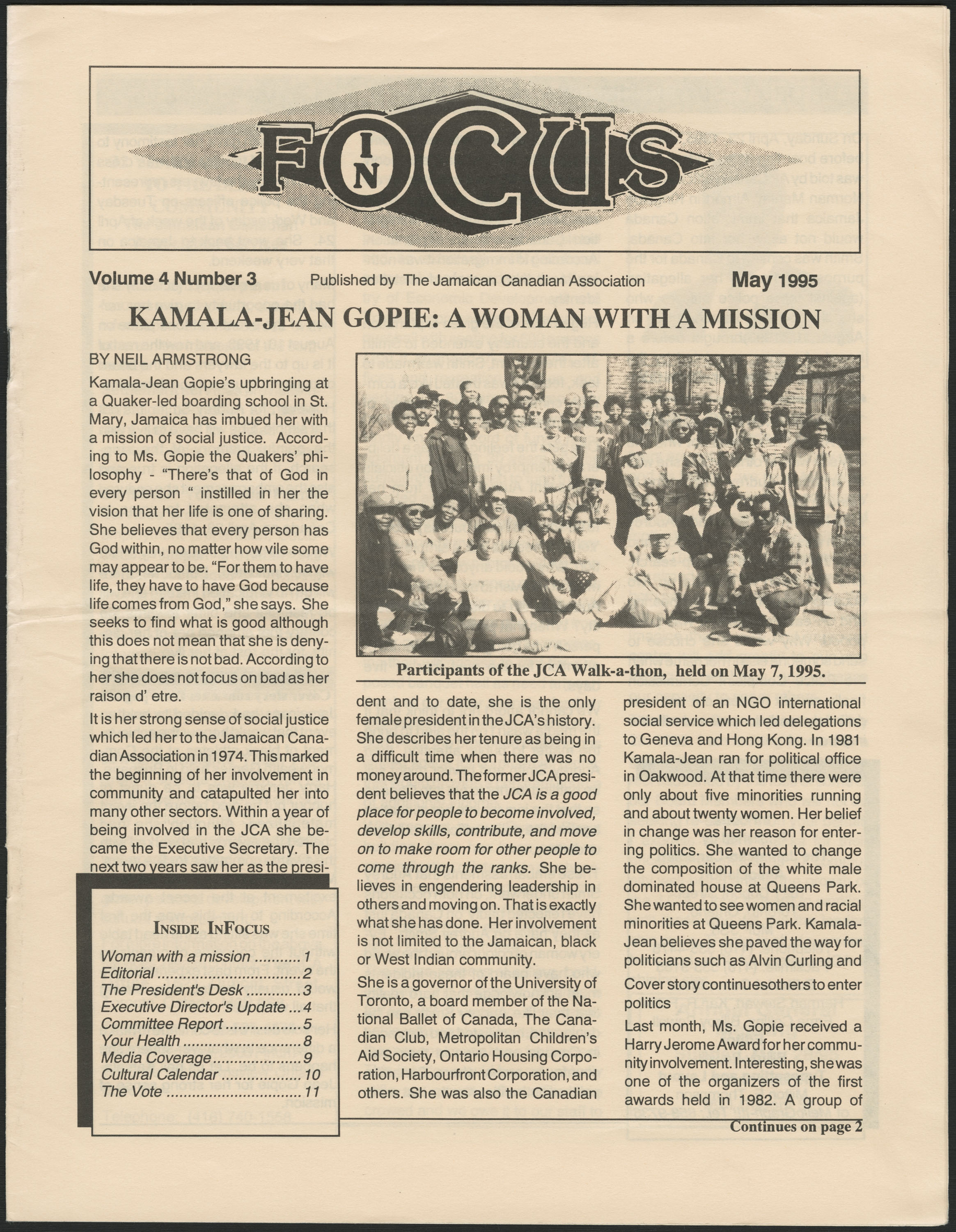
The front page of a printed newsletter. The headline reads: “Kamala-Jean Gopie: A woman with a mission.

In Focus newsletter, Volume 4, Number 3, dated May 1995 (e011218458)

The unique contributions by women in the JCA led to the creation of what was initially the Women’s Auxiliary, later resurrected as the Women’s Committee. Formed in the early 1970s, the Auxiliary focused on using women’s backgrounds as health care workers to support some of the JCA’s activities. In its second incarnation as the Women’s Committee, the focus changed. Erma Collins, the first female Vice-President of the association, and Pam Powell, a former Board member, recalled that this committee filled gaps in programming for the female membership. The committee addressed pressing issues such as women’s health care, including organizing a health fair in Ontario for Black women, in 1993. The committee subsequently broadened its focus to address other issues of gender equality as well.
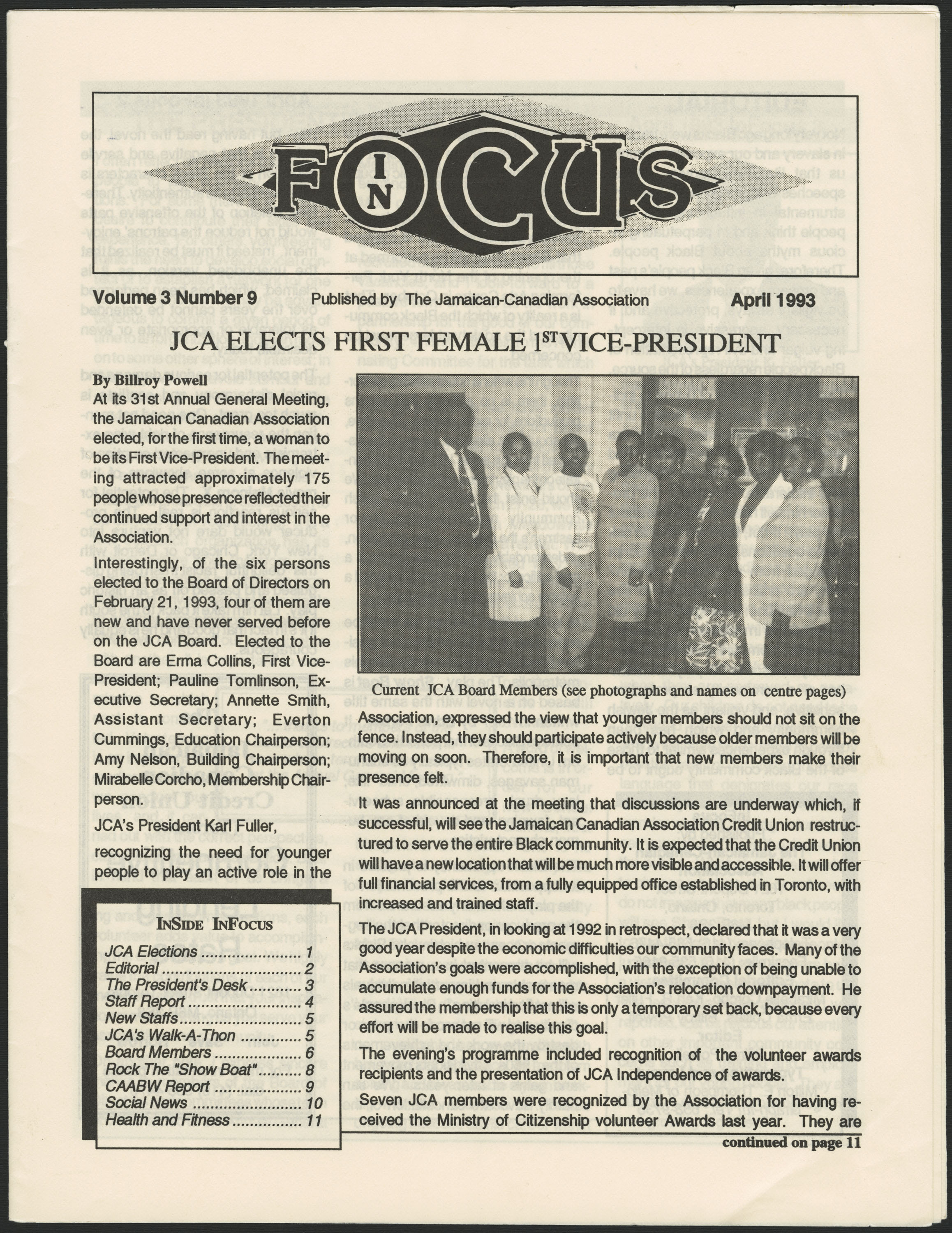
The front page of a printed newsletter. The main headline reads: “JCA elects first female 1st Vice-President.”

In Focus newsletter, Volume 3, Number 9, dated April 1993 (e011218457)

The Women’s Committee proudly continues to this day!


Christine Barrass is a senior archivist in the Social Life and Culture Private Archives Division of the Archives Branch at Library and Archives Canada.
Unemployment insurance revenue stamps and the Danny Leong collection

By James Bone

The Canadian government studied and established the first building blocks of our current social safety net in the early 1940s, during the Second World War. The government was looking to avoid or abate a repetition of Canada’s experience of increased unemployment when soldiers returned from the First World War, especially in manufacturing with the end of wartime production and the resulting lower demand. One of the ideas that it seized upon was unemployment insurance: a mandatory program to which both employees and employers would contribute based on a given employee’s wages; if the job was lost, that person would have some guarantee of a continued income for a specified period. The legislation establishing the program received royal assent in August 1940 and took effect on July 1, 1941. While unemployment insurance has been modified and reformed since then, the essence remains the same under the present Employment Insurance program.

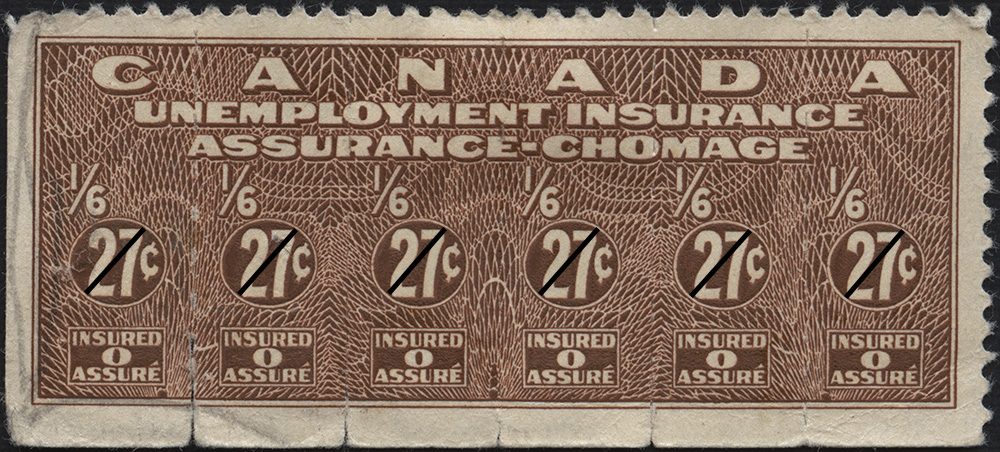
A colour photograph of a red-brown stamp with the following text: Canada. Unemployment Insurance. Assurance-Chomage. 1/6 27¢. Insured 0 Assuré.

An uncancelled 27-cent unemployment insurance stamp from 1941 (MIKAN 4933817)

A colour photograph of a green unemployment insurance stamp.

A 51-cent unemployment insurance stamp from 1941 (MIKAN 4933828)

At the time, of course, there was no computer-based record keeping, and a means had to be devised to show not only that payments for contributions had been made but also that a given employee was entitled to coverage. The most common method of proving that taxes or fees had been paid for government services during the late 19th and early 20th centuries was through the use of revenue stamps. Similar to postage stamps, revenue stamps specify the amount of money paid to purchase the stamp and the tax or fee that they were created to pay for. When used, revenue stamps were cancelled by an official to indicate that their value had been used for the intended purpose. Unemployment insurance stamps were available for purchase at post offices, and employers were required to withhold a set proportion of an employee’s wage, while also making their own contributions, to purchase these stamps. The stamps would then be affixed to booklets, generally kept with the human resources or management unit of a company, and then submitted annually to the local Unemployment Insurance Commission office. Each employee would have a booklet every year held by each employer for whom he or she worked. To ensure that the wages withheld were going toward the purchase of unemployment insurance stamps, employees were permitted by law to inspect their booklets twice a month.

A colour photograph of a page from a used unemployment insurance booklet with seven attached unemployment insurance stamps, dated May, June and July 1949.

A used Unemployment Insurance Commission booket from May to July 1949 (MIKAN 4937508)

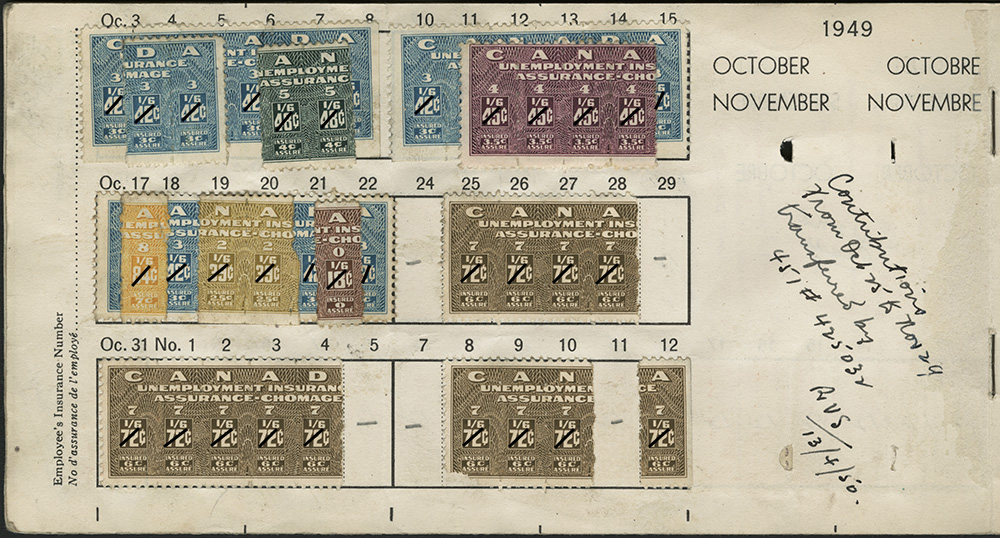
A colour photograph of a page from a used unemployment insurance booklet with several attached unemployment insurance stamps, dated October and November 1949. The stamps are very colourful, and there is a handwritten note with a date and initials.

Caption: A used Unemployment Insurance Commission booklet from October and November 1949 (MIKAN 4937509)

At the launch of the unemployment insurance program, many forms of employment were not eligible for coverage. These included agriculture, fishing, forestry and logging, hunting and trapping, air and water transportation services, medicine, nursing, teaching, military, police, and civil services. Over time, more forms of employment were made eligible for coverage. Most notably, in 1957 employment in the fishing industry was covered, providing a much-needed income guarantee to people in the newly confederated province of Newfoundland and throughout the Maritimes. At first, existing stamps were overprinted with the image of a fish to indicate their intended use in the fishing industry. In later years, fishing unemployment insurance stamps were issued without an overprint.

A colour photograph of a block of 50 specimen red unemployment insurance stamps.

Unemployment insurance stamps from 1959 (MIKAN 4933286)

Among the various types of revenue stamps used by federal and provincial governments, unemployment insurance stamps are relatively scarce. This is because under the program’s legislative act and regulations, it was illegal to sell unused stamps, and only an employer or an employer’s human resources designate could be in lawful possession of unused stamps. Further, most of the booklets and used stamps submitted to the Unemployment Insurance Commission as well as most of the unused stamps were intentionally destroyed after their designated five years of retention. Also, unsold stamps were returned from post offices to the Unemployment Insurance Commission for destruction once they were no longer eligible to be sold, which happened when changes to unemployment insurance premiums required stamps to be issued in new denominations.

The Danny Leong collection

It is thus fortunate that Library and Archives Canada was able to acquire the Danny Leong Unemployment Insurance Stamp collection (R15771), which includes more than 11,000 stamps, unemployment insurance booklets from all the years of their use, and other associated materials. Both Danny Leong and his widow, Violet Anne Leong, were employees of the Unemployment Insurance Commission in British Columbia. Through this employment, Danny Leong was able to collect specimens of the stamps and booklets that were no longer needed for business use, training or reference in the office.

Most of the stamps in this collection are pre-cancelled specimens, printed by the Canadian Bank Note Company in Ottawa and forwarded to the Unemployment Insurance Commission as examples of stamps to be issued and sold at post offices. The collection also includes specimen and used insurance booklets, possibly retained for training purposes. The most curious item is a singular engraved die proof dated March 1959. This unique proof is for a never-issued agriculture unemployment insurance stamp—as mentioned above, agriculture was not covered by unemployment insurance during this period. Evidently, consideration was given to including agricultural work in the program, and this consideration was serious enough to have involved having a stamp for that purpose designed and engraved. In discussion of this item, Yves Baril attributed the work as most likely that of the Canadian Bank Note Company’s letter engraver Donald Mitchell, while the design appears to be that of Harvey Prosser, with supervision by John Francis Mash.

A colour photograph of a die proof of an orange agriculture stamp.

Unissued agriculture unemployment insurance stamp die proof, from March 12, 1959 (MIKAN 4933808)

The use of revenue stamps and unemployment insurance booklets to record payments for insurance continued until the early 1970s. Thereafter, the program was reformed with computerized records and the first issuing of Record of Employment forms, which are still in use. Most importantly, the 1971 reform of the Unemployment Insurance Act made coverage almost universal regardless of industry. The final issue of unemployment insurance stamps, printed in 1968, went mostly unused, with only a few used examples having ever been found by collectors. Of interest to both those who study philately and labour history in Canada, the Danny Leong Unemployment Insurance Stamp collection is available for consultation at Library and Archives Canada. For further reading on Canadian revenue stamps, including unemployment insurance stamps, Edward Zaluski’s Canada Revenues is an outstanding resource.

A colour photograph of a sheet of gold unemployment insurance stamps overprinted with SPECIMEN.

A sheet of unused unemployment insurance stamps from 1948 (MIKAN 4933742)


James Bone is an archivist in the Social Life and Culture Private Archives Division of the Archives Branch at Library and Archives Canada.

Images of Recordings for Children: 78rpm discs, 1918-1962 now on Flickr

These colourful, playful discs represent some of Canada’s earliest recordings for children. Some were simply recordings of nursery rhymes or well-known tunes in English and French.

A colour image of a record label for the Canadian Music Corp., Ltd. Side 2 depicts an outline of Canada with the name Dominion overlaying it. The recording title listed is “Ma mère m'envoit-au marché” followed by the artists Hélène Baillaregion – vocals, and Gilbert Lacombe – guitare.

“Ma mère m’envoit-au marché, Side 2” [Ma_Mere.jpg]

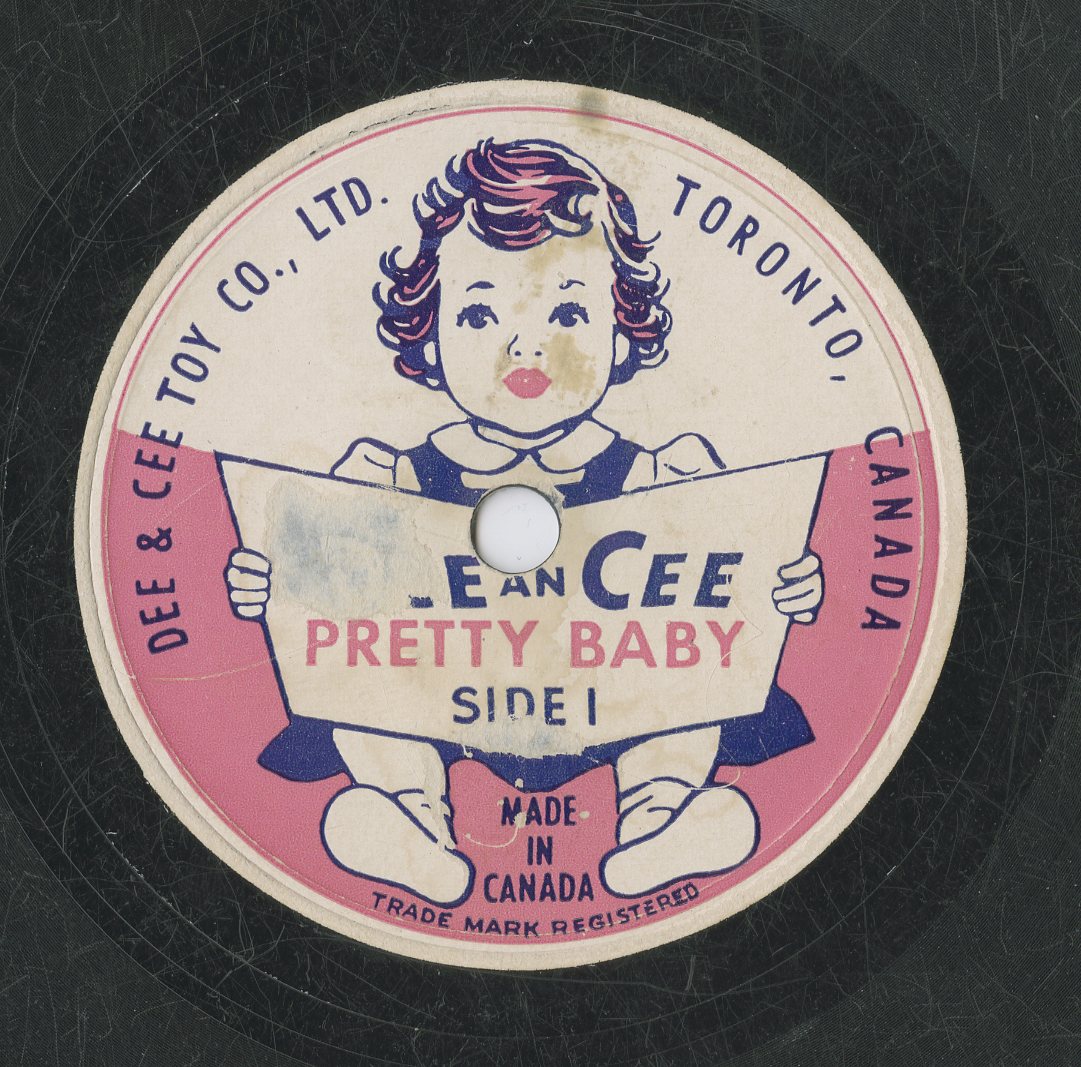
Some of the discs would have come as part of a package of items. The Dee & Cee Company was a doll manufacturer, rather than a record company, that produced the “Pretty Baby” discs. Dee & Cee presumably included the discs with the sale of some of their dolls, probably as an attempt to increase sales.

A colour image of a record label for the Dee & Cee Toy Company, Ltd. Side 1 depicts a small girl sitting and holding an open book. The company name and the recording title “Pretty Baby” are on the book cover.

Pretty baby, Side 1 [Pretty_Baby_1.jpg]

These beautiful labels captured the attention and entertained many children in the early 20th century when they were released.

Visit the Flickr album now!

How archives can protect human rights

By R.L. Gabrielle Nishiguchi

When asked to name one of Canada’s fundamental democratic institutions, how many people would immediately say “Library and Archives Canada”? Yet, a nation’s archives preserves in perpetuity the evidence of how we are governed.

From the story of Japanese Canadian Redress, we can  learn how records held by Library and Archives Canada (LAC)—combined with crucial citizen activism making use of these records—have contributed to holding the federal government accountable for now universally condemned actions.

From silence to a movement

When the Second World War ended, devastated survivors buried their trauma out of necessity in order to focus on rebuilding their lives. Silence enveloped the Japanese Canadian community.

However, in the late 1970s and early 80s, at small, private, social gatherings where survivors felt safe to share their wartime experiences, a grassroots redress movement was born.

The Redress Agreement states that between 1941 and 1949, “Canadians of Japanese ancestry, the majority of whom were citizens, suffered unprecedented actions taken by the Government of Canada against their community.” These actions were disenfranchisement, detention in internment camps, confiscation and sale of private and community property, deportation, and restriction of movement, which continued until 1949. These actions were taken by the Government of Canada, influenced by discriminatory attitudes against an entire community based solely on the racial origin of its members.

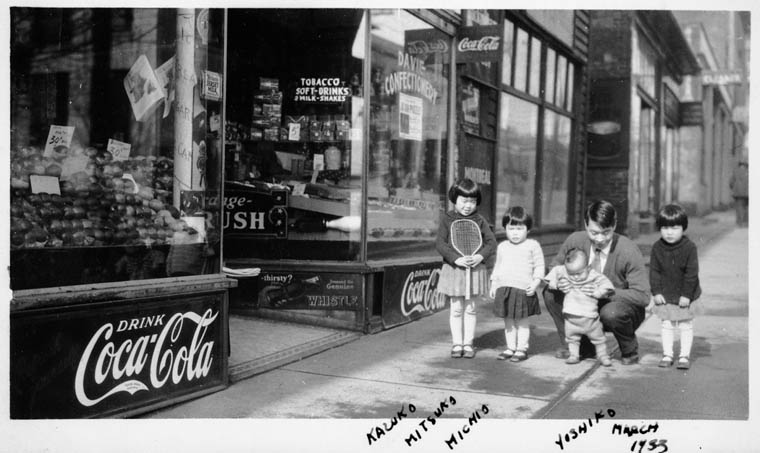
A black-and-white photograph showing a Japanese-Canadian man, who is crouching, and four children in front of a store.

Sutekichi Miyagawa and his four children, Kazuko, Mitsuko, Michio and Yoshiko, in front of his grocery store, the Davie Confectionary, Vancouver, BC, March 1933 (a103544)

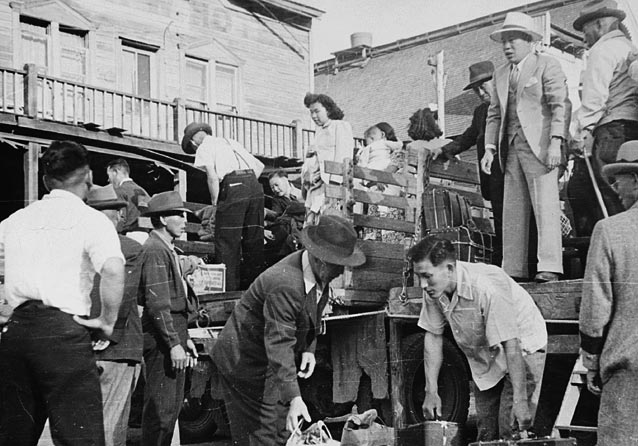
A black-and-white photograph showing twelve Japanese Canadians unloading a truck.

Arrival of Japanese Canadian internees at Slocan City, BC, 1942. Credit: Tak Toyata (c047396)

Citizen activism and declassified government documents

In 1981, Ann Gomer Sunahara researched newly declassified Government of Canada records made accessible by the then Public Archives of Canada. Sunahara’s book The Politics of Racism documented the virtually unquestioned, destructive decision-making with respect to the Japanese Canadian community of Prime Minister Mackenzie King, his Cabinet, and certain influential civil servants.

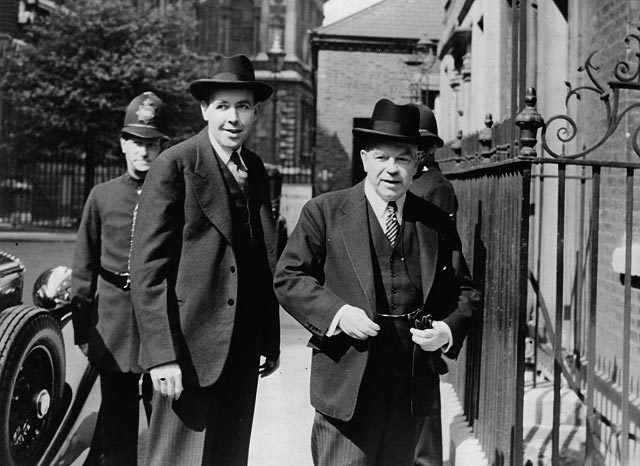
A black-and-white photograph of two men standing near a tall, iron gate. A London bobby (police officer) is visible behind them.

Rt. Hon. W.L. Mackenzie King (right) and Mr. Norman Robertson (left) attending the Commonwealth Prime Ministers’ Conference, London, England, May 1, 1944. It was during this time period that Norman Robertson, Under Secretary of State for External Affairs, and his special assistant Gordon Robertson (no relation) developed the plan which resulted in the deportation of 3,964 Japanese Canadians to Japan in 1946. (c015134)

The National Association of Japanese Canadians (NAJC), which came to represent the views of the community concerning redress, astutely recognized the critical importance of having access to government documents of the 1940s, which could serve as primary evidence of government wrongdoing.

On December 4, 1984, The New Canadian, a Japanese Canadian newspaper, reported that the NAJC had “spent months digging through government archives” to produce a report entitled Democracy Betrayed. The report’s executive summary stated: “The government claimed that the denial of the civil and human rights [of Japanese Canadians] was necessary because of security. [G]overnment documents show this claim to be completely false.”

Citizen activism and the records of the Office of the Custodian of Enemy Property

In 1942, all Japanese Canadians over the age of 15 were forced by the government to declare their financial assets to a representative from the federal Office of the Custodian of Enemy Property. Custodian “JP” forms containing a detailed listing of internee property formed the nucleus of 17,135 Japanese Canadian case files.

To further negotiations with the Canadian government to obtain an agreement, the NAJC needed a credible, verifiable estimate of the economic losses suffered by the Japanese Canadians. On May 16, 1985, the NAJC announced that the accounting firm Price Waterhouse had agreed to undertake such a study, which would culminate in the publication of Economic Losses of Japanese Canadians after 1941: a study.

Sampling Custodian records in 1985

A team of Ottawa researchers, primarily from the Japanese Canadian community, was engaged by Bob Elton of Price Waterhouse to statistically sample 15,630 surviving Custodian case files, held by the then Public Archives of Canada. These government case files contained personal information that was protected under the Privacy Act (RSC, 1985, cP-21). However, under 8(2)j of the Act, the files were made accessible to the team for what the Act deems “research and statistical purposes.”

On September 20, 1985, the Ottawa Citizen newspaper reported Art Miki, then president of the NAJC, saying that the “Custodian (case) files are the most valuable raw material for the economic loss study because they meticulously document each transaction whether it was the sale of a farm, or a fish[ing] boat, a house or a car.”

A black-and-white, head-and-shoulder photograph of Art Miki.

Art Miki, educator, human rights activist, and president of the National Association of Japanese Canadians (NAJC) from 1984 to 1992. Miki was chief strategist and negotiator during the Redress Campaign, which culminated on September 22, 1988, with the signing of the Japanese Canadian Redress Agreement between the NAJC and the Government of Canada. In 1991 he received the Order of Canada. Photographer Andrew Danson (e010944697)

Citizen activism: Molly and Akira Watanabe

In the final sampling, 1,482 case files were reviewed. It was grueling, painstaking work. Some researchers were unable to continue because of nausea and eyestrain induced by hours spent pouring over microform  images, some of very poor quality.

A superlative example of citizen activism is the dedication of Ottawa researchers Akira Watanabe, Chairman of the Ottawa Redress Committee, and his wife Molly. With several hundred files still unsampled, dwindling numbers of researchers and only four weeks remaining to do the work, the Watanabes went to Public Archives Canada after work for twenty evenings. Molly Watanabe died in 2007.

On May 8, 1986, the study was released to the public. Price Waterhouse estimated economic losses for the Japanese Canadian community at $443 million (in 1986 dollars).

Archival records alone do not protect human rights

Documents sitting in a cardboard box on a shelf, or microfilm sitting in cannister drawers, cannot protect human rights—people do. Japanese Canadian Redress showed Canadians that it takes dedicated activism to locate and use archival records.

Archival government and private records from the 1940s preserved by LAC and used by citizen activists were critical in building the Japanese Canadian case for Redress. By preserving the records that hold our government accountable in the face of injustice, LAC continues to be one of our country’s key fundamental democratic institutions.


R.L. Gabrielle Nishiguchi is an archivist in the Society, Employment, Indigenous and Governmental Affairs Section, Government Archives Division, at Library and Archives Canada.

Sergeant William Merrifield, VC

By Ashley Dunk

In Library and Archives Canada’s Victoria Cross blog series, we profile Canada’s Victoria Cross recipients on the 100th anniversary of the day they performed heroically in battle, for which they were awarded the Victoria Cross. Today, we remember Sergeant William Merrifield and his gallant actions near Abancourt, France, on October 1, 1918.

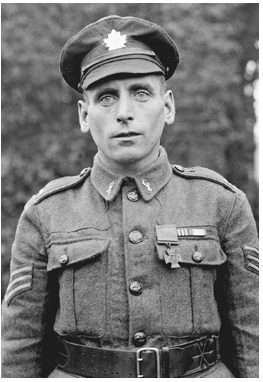
A black-and-white photograph of a soldier in uniform.

Sergeant William Merrifield, VC, undated. Source: National Defence and the Canadian Forces

Born in Brentwood, Essex, England, on October 9, 1890, Merrifield was a firefighter before the outbreak of the First World War. He enlisted on September 23, 1914, at Valcartier, Quebec, joining the 2nd Battalion (Canadian Mounted Rifles) of the Canadian Expeditionary Force. In 1917, he joined the 4th Canadian Infantry Battalion. For his bravery in November 1917 during the Battle of Passchendaele, Merrifield received the Military Medal.

As September 1918 drew to a close, the Battle of Canal du Nord in France was also near its end. The Canadians stationed around the battlefield were engaged in regular patrols and reconnaissance missions. Allied artillery, including 6-inch guns and 60-pounders, fired continually, but the shells often fell short of their targets in the German trenches. In one instance, the Allies accidentally shelled and destroyed one of their own Lewis guns and caused casualties among their own soldiers. The Germans stubbornly defended their trenches, making the Canadians’ objective of breaking through the lines very difficult.

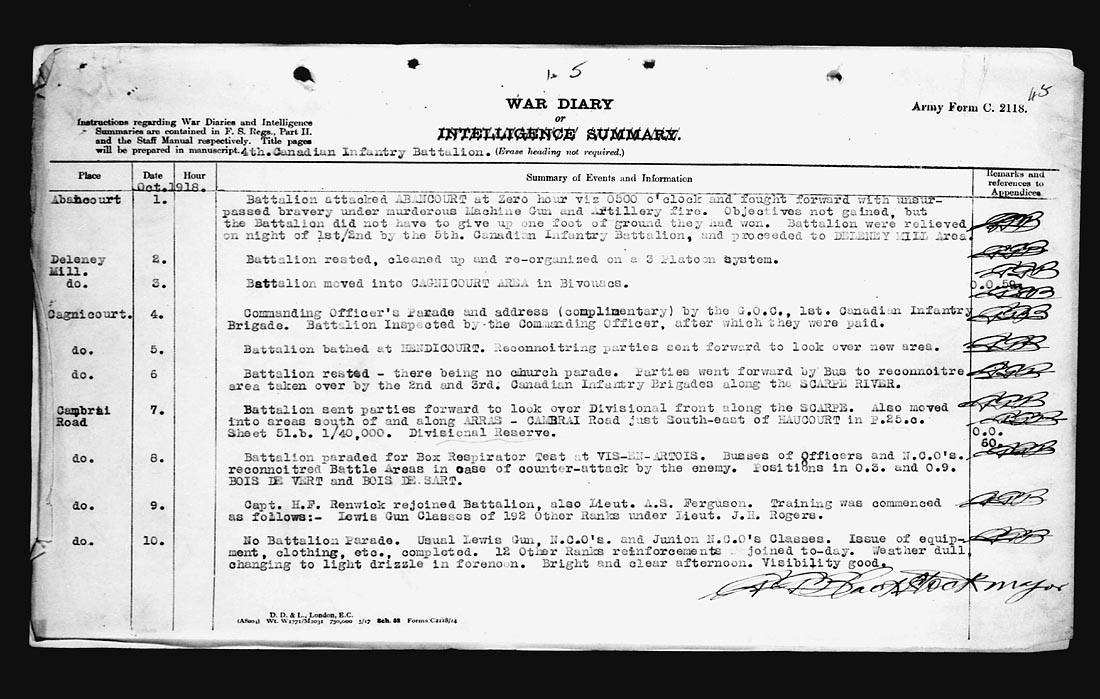
On October 1, 1918, near Abancourt, Merrifield and his men were under fire from two enemy machine-gun posts. Unable to advance further because of the German guns, Merrifield decided to attack both posts single-handedly to eliminate them. Dashing from shell hole to shell hole, he killed the enemy soldiers in the first post and sustained wounds during the assault. In spite of his injuries, he pressed on to the second post, killing its occupants with a hand grenade. He remained in battle and continued to lead his platoon until he was severely wounded.

A black-and-white copy of a typed textual record, with handwritten signatures down the right side of the page.

War Diaries, 4th Canadian Infantry Battalion, describing some events from October 1, 1918, page 4 (e001078521)

Merrifield survived the remainder of the war and was discharged on April 24, 1919, in general demobilization. He moved to Sault Ste. Marie, Ontario. He died in Toronto on August 8, 1943.

A public elementary school in Sault Ste. Marie was named after Merrifield; William Merrifield V.C. Public School in the Algoma District School Board was open from 1946 until June 2015. And Merrifield Outdoor Rink is located at the corner of Henrietta Avenue and Patrick Street in Sault Ste. Marie.

As well, the 56th Field Artillery Regiment in Brantford, Ontario, dedicated its armoury (Sergeant William Merrifield VC Armoury) to his memory.

Merrifield’s Victoria Cross was donated to the Canadian War Museum in Ottawa.

Library and Archives Canada holds the digitized service file of Sergeant William Merrifield.

Want to experience life during a time of war?

The War Diaries of the 4th Canadian Infantry Battalion are open for you to transcribe, tag, translate and describe their contents. Every addition to a record becomes new metadata, searchable within 24 hours, helping Library and Archives Canada’s records become more “discoverable” day after day. Visit the blog article explaining how you can give a hand to history!

Ashley Dunk is a project assistant in the Online Content Division of the Public Services Branch at Library and Archives Canada.