A new chapter for our blog!

Version française

The Library and Archives Canada (LAC) Blog is starting a new chapter. After nearly 15 years and over a thousand blog posts on this site, we are preparing to launch a new storytelling space on the LAC website.

This upcoming space will feature an intuitive, user-friendly design that makes it easier to discover and connect with the diverse stories of people who have lived in Canada. Our goal is to ensure that these narratives reflect the richness of Canadian experiences and resonate with communities across the country.

As we focus on building this new initiative, blog activity will be paused. We look forward to welcoming you back in winter 2026 with a refreshed and inviting online storytelling platform.

In the meantime, we welcome your ideas. If you have a suggestion for a story, contact us at histoire-story@bac-lac.gc.ca.

We encourage you to stay subscribed to this blog for now and to stay tuned for the launch of our new storytelling section.

Thank you for your dedicated readership and support.

Traces Left Behind: Notes of a Parks Canada Surveyor from the 1950s

Version française

By Laura M. Smith

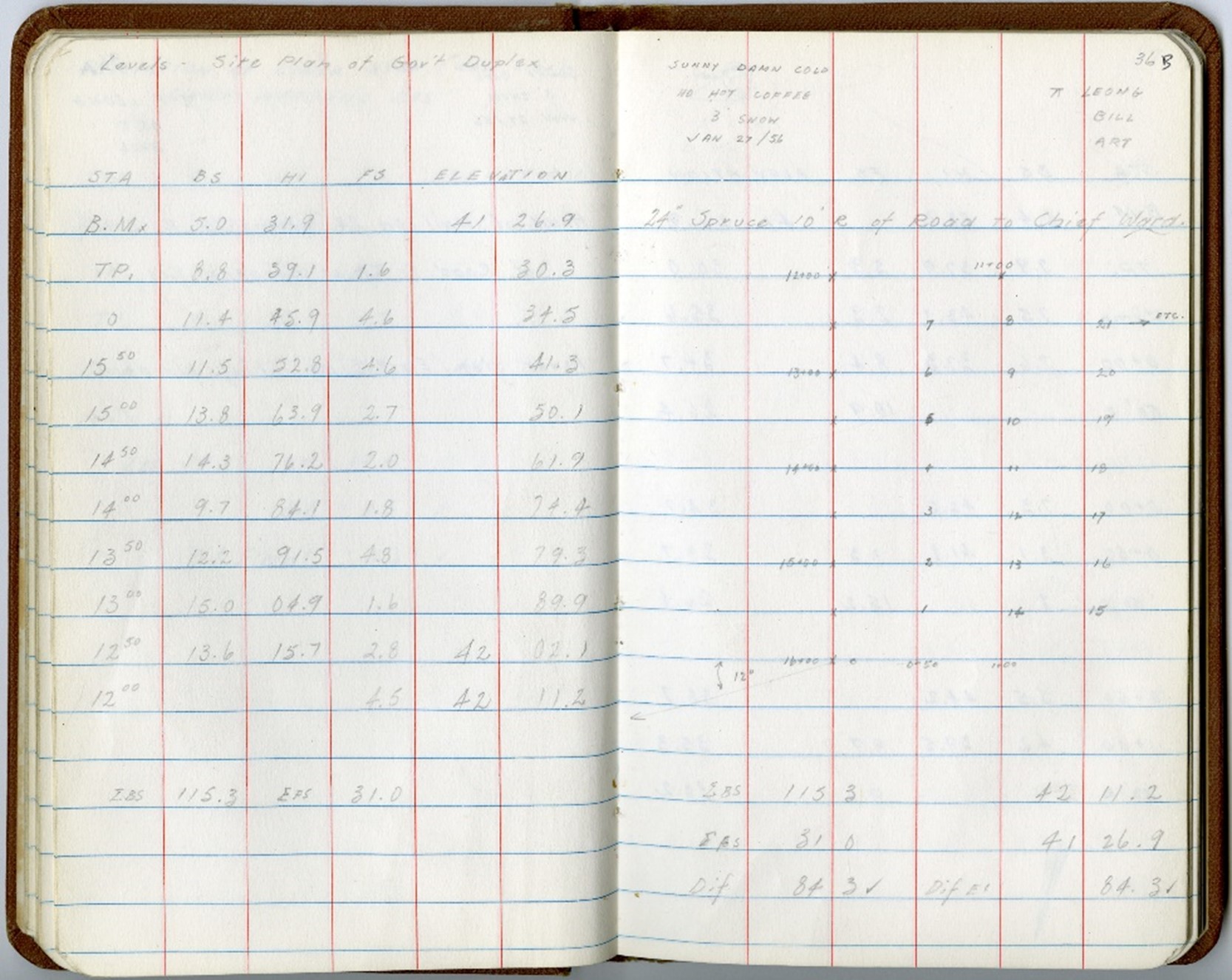
Within the walls of Library and Archives Canada’s Winnipeg facility, we find an accession from Parks Canada containing numerous field notebooks used by its employees. These notebooks contain measurements, calculations, technical drawings and notes on field conditions, all neatly inscribed from various surveying projects in the national parks. These small, utilitarian hardcover books are simple in design but rich with empirical data on park infrastructure, and they would become useful to researchers studying a diverse range of topics. Despite the uniformity of these field books, one of these items, titled Misc Surveys Winter ’56 stands out from the rest. It contains not only the meticulously recorded field data, but also an enriching detail that we find upon closer examination: marginalia from a Parks Canada employee that captures details of field life.

Most of the marginalia, text and images are mixed in with the standard information found on the pages and could potentially be missed at first glance. For example, a daily weather reading, commonly found in these notebooks, is recorded here with atypical candour and commentary: “SUNNY DAMN COLD – NO HOT COFFEE – 3” OF SNOW  – JAN. 27/1956.” These descriptive additions change the tone from a generic logbook to that of a personal journal or a letter. However, they are subtle enough to be missed at first glance and reward a viewer who is reading closely.

Page with handwritten note: SUNNY DAMN COLD. NO HOT COFFEE. 3” SNOW JAN. 27/56

Page 36B of Misc Surveys Winter ’56 field book. (MIKAN 48775)

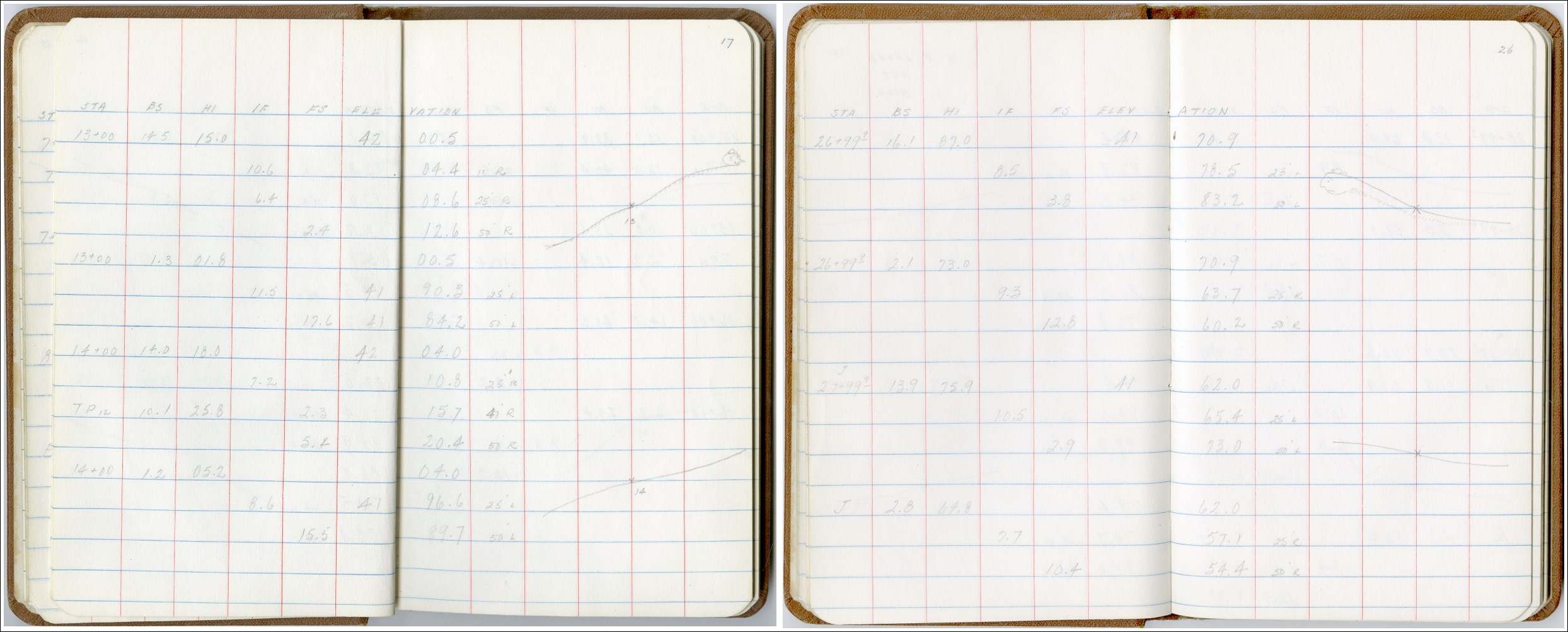
Technical drawings are commonly found in these field books to record topographic features like the elevation of a riverbed or the slope of a hill. Here the author has decorated these diagrams with silly cartoonish faces.

Two pages with handwriting and hand made drawings.

Details from page 17 and page 26. (MIKAN 48775)

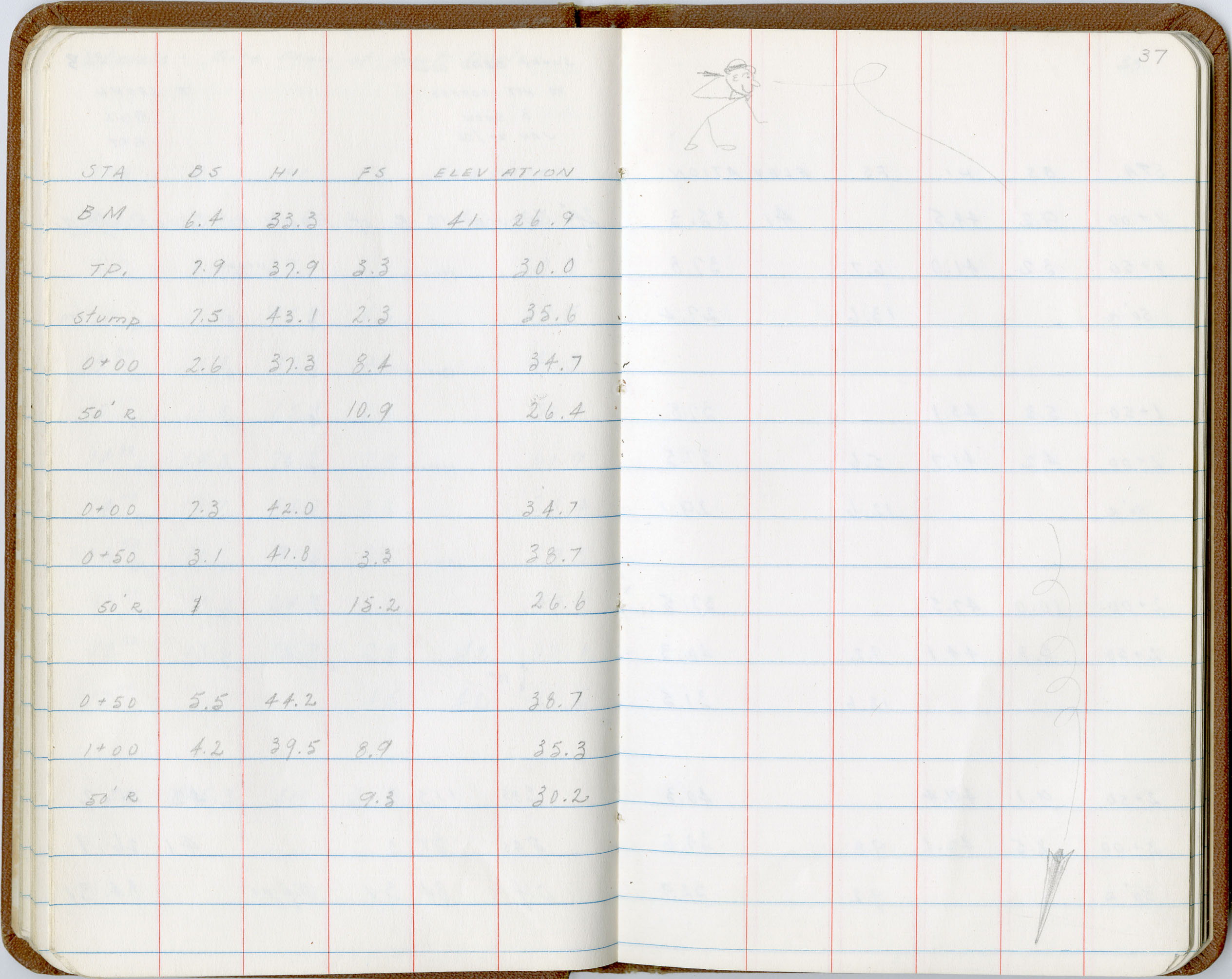
The simple doodles captured in this volume seem to be spontaneous ideas, emerging either from boredom or sudden creative flashes but always maintaining a certain cheeky “made you look” sensibility and a lighthearted tone. In the next example, a rudimentary figure in profile is depicted at the top of the page throwing a paper airplane that swoops and glides to the bottom of the page. These imaginative images create an atmosphere of silliness and draws in the reader, leaving them to wonder what will be found next when they flip the page.

Page with handwriting and doodles.

Page 37 of Misc Surveys Winter ’56 field book. (MIKAN 48775)

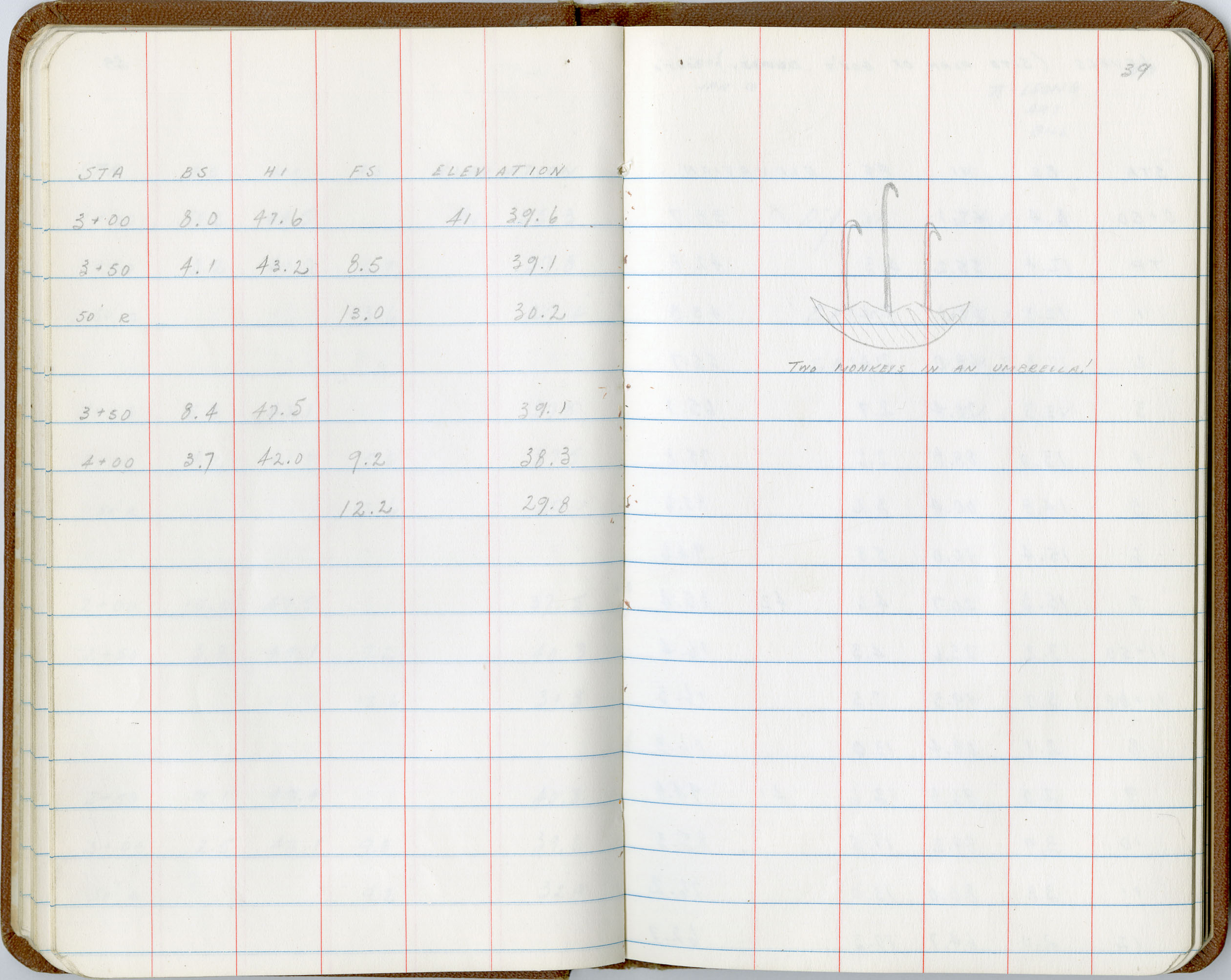
The creator’s personal sense of humour is also clearly articulated in these entries. For instance, we find a line drawing of an overturned umbrella with three handles, that appears with the following caption “Two monkeys in an umbrella!”.

Page with a drawing of an umbrella and a handwritten note that says, “Two monkeys in an umbrella!”

Page 39 of Misc Surveys Winter ’56 field book. (MIKAN 48775)

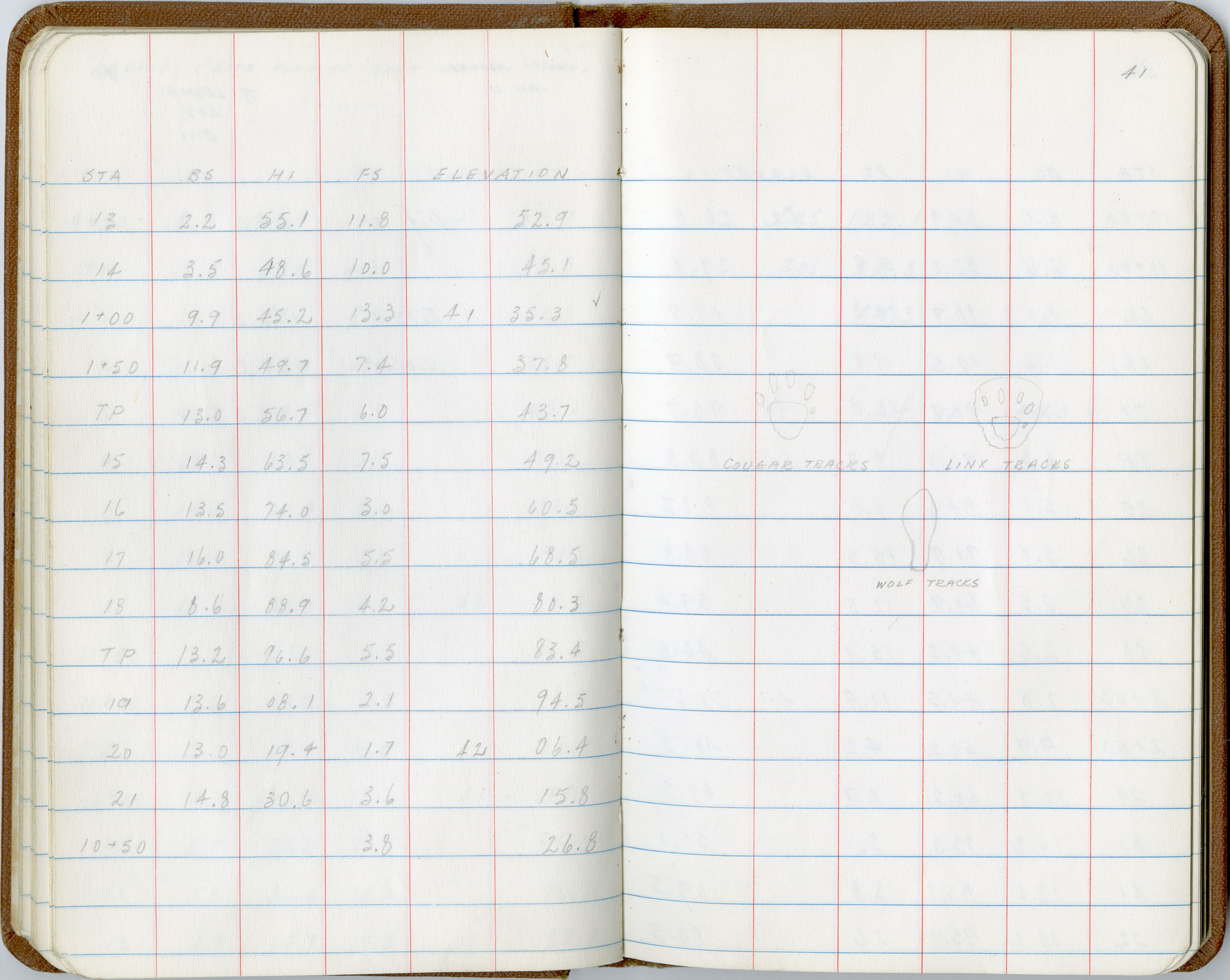
An observational quality can be detected in many of these annotations representing the environment of the creator at that time. One drawing records animal tracks that the author presumably observed in the park. On another page, the Parks Canada employee sketches the logo from a pack of Matinee filter tipped cigarettes, a makeshift still life placed between measurements of elevations. These doodles seemingly capture a quiet moment, a period of inactivity, maybe a few spare minutes spent on a break. From a close reading of this book, we continue to learn more details about this individual and the type of work they performed.

Page with a drawing of animal tracks.

Page 41 of Misc Surveys Winter ’56 field book. (MIKAN 48775)

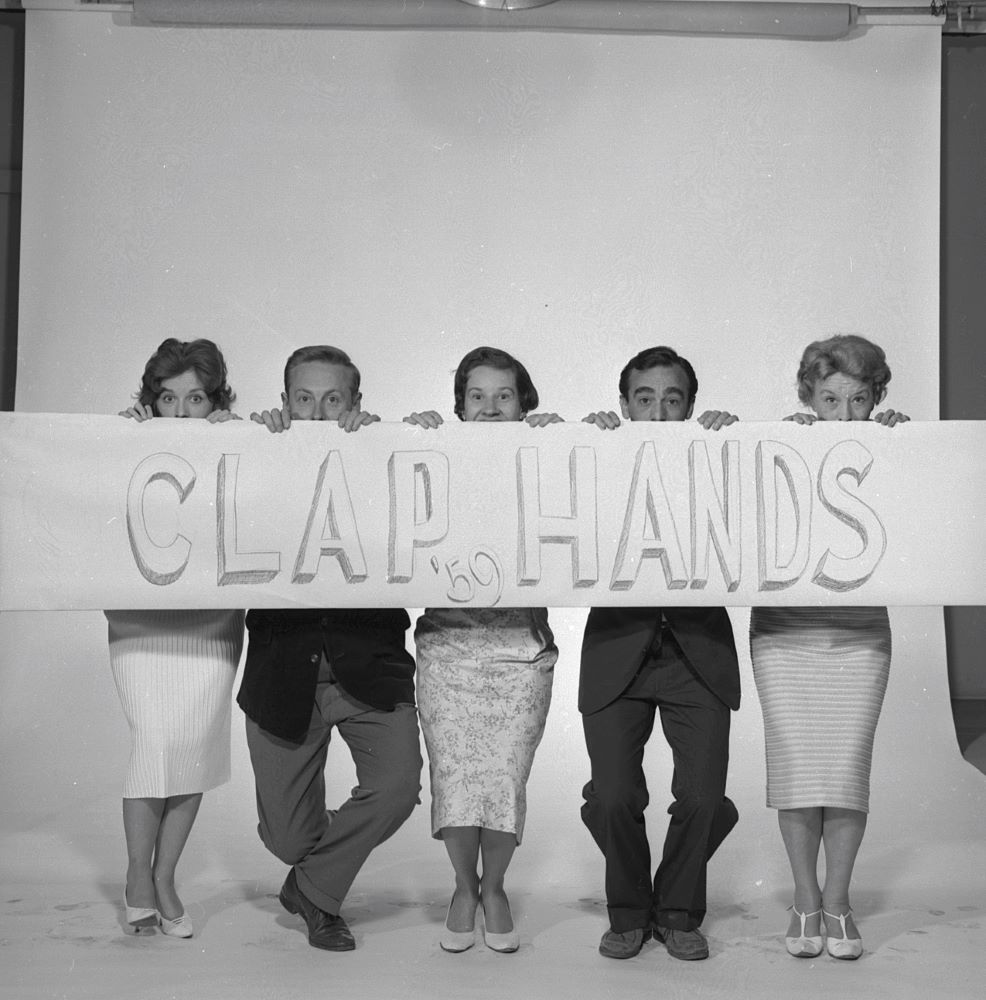
Another illustration found in this field book references a pop cultural image which circulated widely in the post-WWII era, mainly in the form of graffiti. The origins of this analog meme are disputed, but it is best known as “Kilroy” or “Kilroy Was Here” because the image was often accompanied by this phrase. The iconography associated with Kilroy is a bald man with a long nose, peering from behind a wall. In Library and Archives Canada’s collections, we hold a black and white negative of a photograph from a 1959 University of Toronto publication, the Clap Hands Revue, that depicts a group of people striking a Kilroy Was Here pose. While no longer as commonplace, the popularity and reach of the Kilroy image at the time of our field book were extensive.

Image of five people taking a Kilroy Was Here pose gripping a banner with the words CLAP HANDS in front of them.

One of the photos taken for the Clap Hands Revue 1959, Hart House, University of Toronto R11224-1856-3-E, Box number: 6354, File number: Assignment 5916-1. Library and Archives Canada/e010745731. Credit: Walter Curtin.

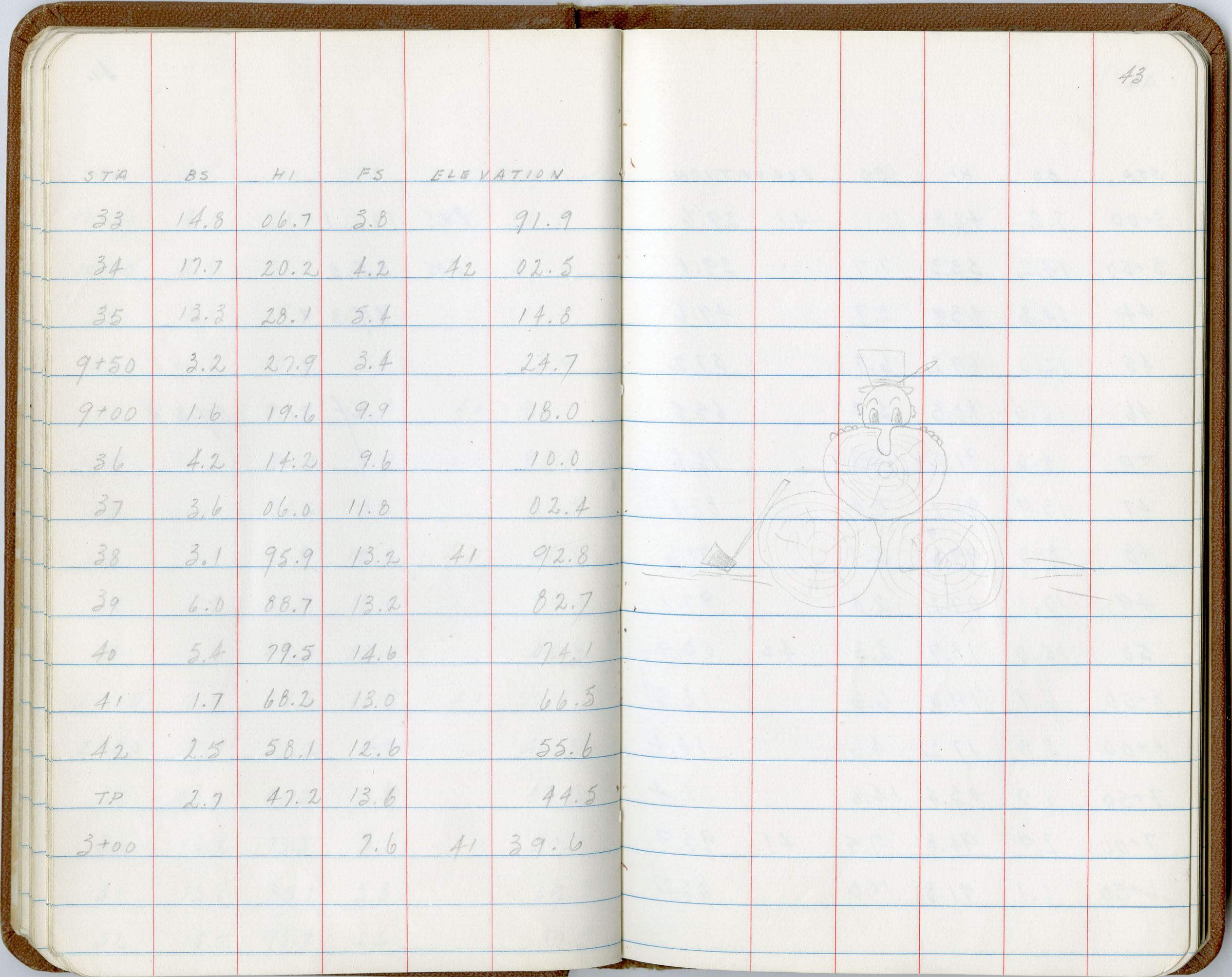
The fact that a Kilroy image appears in this book is quite interesting. It links this record to what is happening in mainstream visual culture. The image’s origin as graffiti art has obvious appeal to someone who is creating their own marginalia and is a clear source of inspiration to the author. This version presents the figure peering from behind a pile of logs next to a wood-cutting axe, which adds some Parks Canada flare and ties this Kilroy to the surveyor’s present location in Yoho National Park. It is an interesting case study of how popular images can evolve over time.

Page with a drawing of a person behind three wood logs and an axe.

Page 43 of Misc Surveys Winter ’56 field book. (MIKAN 48775)

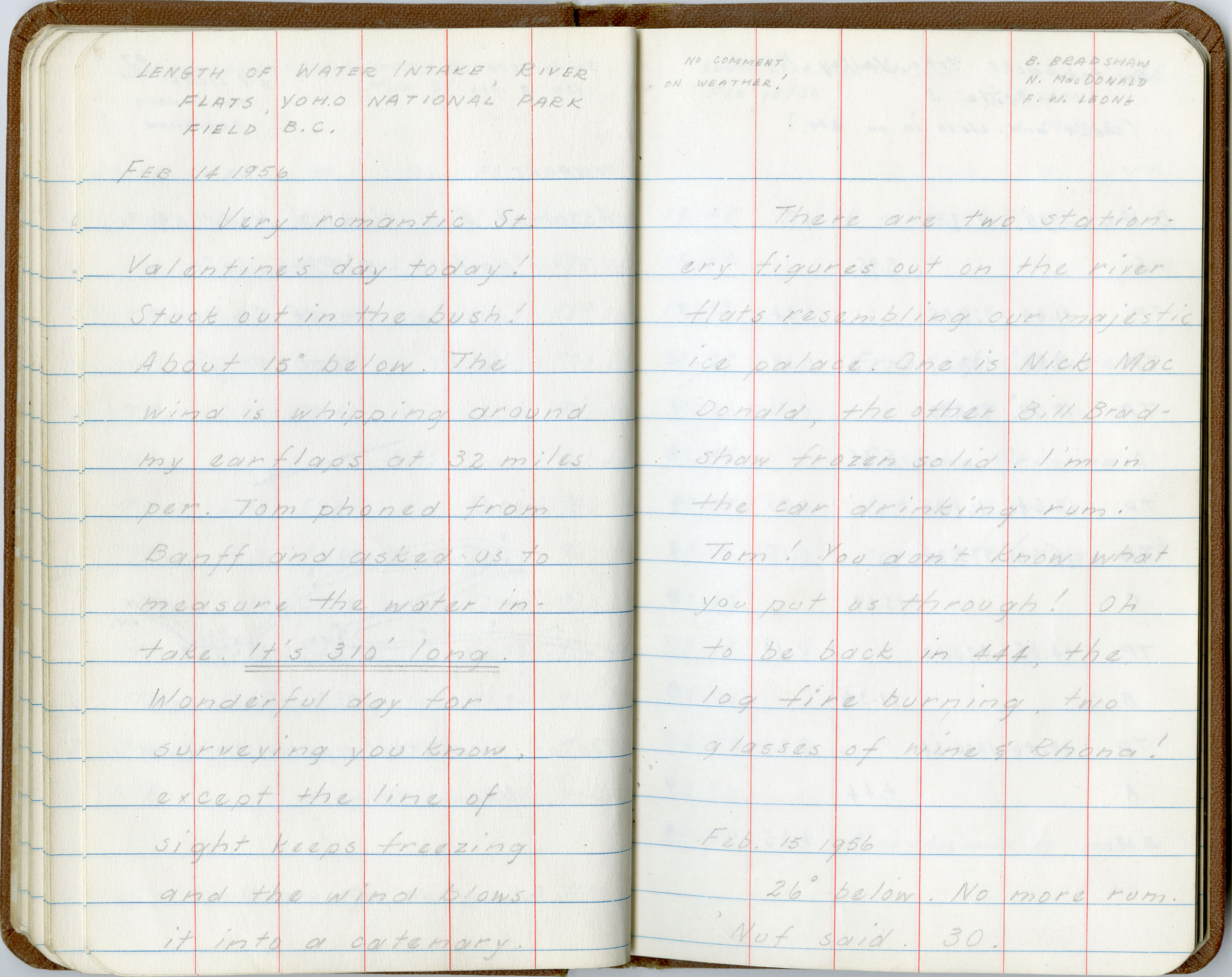
While most of the annotations and marginalia found in this field book are relatively discreet and simply inserted between routine information, there is one exception. Diverging from other entries, the author writes two journal style entries that conspicuously take up two full pages of the book but remain unpaginated, indicating they were never a part of the official record.

Image of text.

Unpaginated entry in Misc Surveys Winter ’56 field book. (MIKAN 48775)

These notes are equally humorous and wonderfully descriptive. They transport a contemporary reader to this exact time and place; you can almost hear the wind howling! “February 14, 1956. Very romantic St. Valentine’s day today! Stuck out in the bush! About 15 degrees below. The wind is whipping around my earflaps at 32 miles per. Tom phoned from Banff and asked us to measure the water intake. It’s 310’ long. Wonderful day for surveying you know, except the line of sight keeps freezing and the wind blows it into a catenary. There are two stationery figures out on the river flats resembling our majestic ice palace. One is Nick MacDonald, the other Bill Bradshaw frozen solid. I’m in the car drinking rum. Tom! You don’t know what you put us through! Oh to be back in 444, the log fire burning, two glasses of wine & Rhona! February 15, 1956. 26 degrees below. No more rum. ‘Nuf said.”

While these journal entries match the playful tone found throughout the field book, this text reveals more about the creator’s motivations. It becomes evident that the purpose of the field book was not transitory; it was intended to be kept and referenced later by others. Therefore, these comments and jokes were meant to be discovered, left to be found. This shifts our understanding of the marginalia from personal to public. The notes and drawings deposited into this book are meant to entertain. Certainly, the author did not envision this field book to be read by a wide audience or to have any longevity, but we are fortunate to get to enjoy it too. This record provides us with a rare perspective into someone’s lived experience. While we do not know the author personally, their point of view comes across strongly in their humorous antics and friendly demeanour. By providing the reader with a glimpse into the conditions of the work of a surveyor in the 1950s, the marginalia found in this field book enrich the text and change its significance as a social record.


Laura M. Smith works at the Winnipeg Regional Office of Library and Archives Canada.

The life of Rifleman Sulo W. Alanen

Version française

By Ariane Gauthier

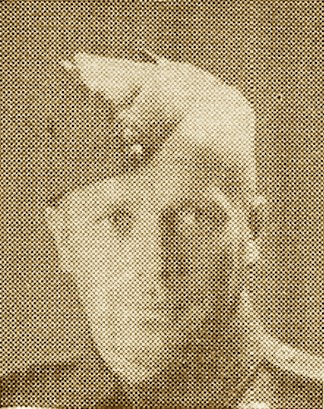
Sepia-coloured photograph of Sulo W. Alanen when he was about 30 years old, featured in a Finnish newspaper announcing his death.

Photo of Sulo W. Alanen as it appeared in a Finnish newspaper announcing his death. (Source: Canadian Virtual War Memorial)

The story of Sulo W. Alanen begins in the northern Ontarian village of Nolalu, a small settlement outside of Thunder Bay that emerged largely due to the arrival of Finnish settlers in the region. These settlers were likely drawn to the thriving lumber industry, the opportunities for farming, and the convenience of the railway passing through Nolalu.

Matti Alanen, originally from Jurva, Finland, was one of these immigrants who braved the journey to Canada in 1904, inspired by the promise of a better life. Like many of his compatriots, he settled in Nolalu, a growing Finnish community established just four years earlier. Here, he found familiarity in an unfamiliar land, with a supportive network of fellow Finns. Matti embraced farming as his livelihood. Hilma Lehtiniemi, originally from Ikaalinen, Finland, followed her family to Canada in 1908. After arriving in Nolalu, she met and married Matti, likely around 1910, as suggested by Sulo’s service file, which mentions their marriage in April 1910 in Port Arthur, Ontario.

Sulo, the couple’s third son and child, was born May 13, 1914, in Silver Mountain, Ontario, a mining settlement near Nolalu. The Alanen family’s farmstead appears to have been located between these two communities, as their place of residence alternates between Silver Mountain and Nolalu in Sulo’s service file.

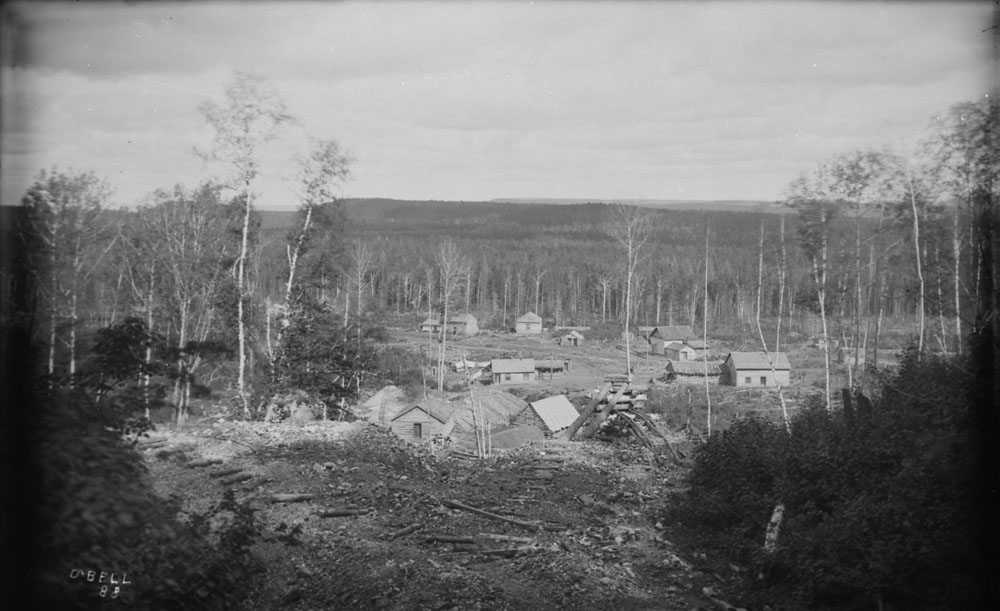
Black-and-white photograph from 1888 of the Silver Mountain mining settlement, showcasing the forest expanse and rural landscape.

Silver Mountain mining settlement, 1888. (Source: a045569)

Sulo was the middle child among five siblings. The 1931 Census provides insight into his upbringing, indicating that Finnish was his first language. This is unsurprising, given that Nolalu was a Finnish community where most settlers shared this cultural heritage. Census entries for neighbouring households confirm this pattern: nearly all family heads were originally from Finland and spoke Finnish as their first language.

Section of the 1931 Census for Nolalu, listing members of the Alanen family, their age, gender, and place of birth.

A screenshot of the 1931 Census featuring the Alanen family. Sulo’s name can be seen on line 42 of the 5th page. (Source: e011639213)

English came later for Sulo and his siblings, likely as a result of simply living in Canada, as none of them attended school or learned how to write. Much of Sulo’s childhood was spent working on the family farm. In adulthood, he continued working on his father’s farm until his enlistment for the Second World War. His service file also mentions that he occasionally worked as a bushman for extra income.

Sulo was forced to serve at the 102 Canadian Basic Training Camp in Fort William under the National Resources Mobilization Act (NRMA), enacted in 1941 by the King government as a compromise to avoid full conscription. The NRMA mandated that able-bodied men contribute to Canada’s defence and national security. After serving for 30 days under this program, Sulo made the pivotal decision to enlist voluntarily on May 4, 1943.

Sulo’s enlistment in the Canadian Army aligned with the critical Allied preparations for the D-Day landings, planned for the summer of 1944. From his initial training at Camp Shilo in Manitoba to boarding a ship bound for England, his focus was singular: preparing for the storming of Juno Beach.

Sulo’s ship arrived in England on April 11, 1944—just two months before Operation Overlord. On April 27, he was assigned to the Royal Winnipeg Rifles, specifically to the 2nd Canadian Base Reinforcement Group. This designation indicates that Sulo was not initially slated to participate in the first assault wave. Instead, as a part of C Company, he was positioned to join the Royal Winnipeg Rifles after they had pierced the Atlantic Wall.

The Royal Winnipeg Rifles’ war diary tells us what D-Day was like for Sulo and his comrades. The troops were informed at 9 p.m. the evening before that Operation Overlord was on, and all were fairly enthusiastic. The diary states: “There was an air of expectancy and sense of adventure on all craft this night, the eve of the day we had trained for so hard and long in England.”

The long day began at 4 a.m. with tea and a cold snack. The weather was cloudy and the sea was heavy. At 5:15 a.m., landing crafts were lowered from the motor vessel Llangibby Castle, still about 15 kilometres from the coast. At 6:55 a.m., the Royal Navy and air support began bombarding the coastline of France. The landing crafts arrived on shore around 7:49 a.m. with B and D companies landing first. As the war diary grimly notes: “The bombardment having failed to kill a single German or silence one weapon, these coys had to storm their positions “cold”—and did so without hesitation.”

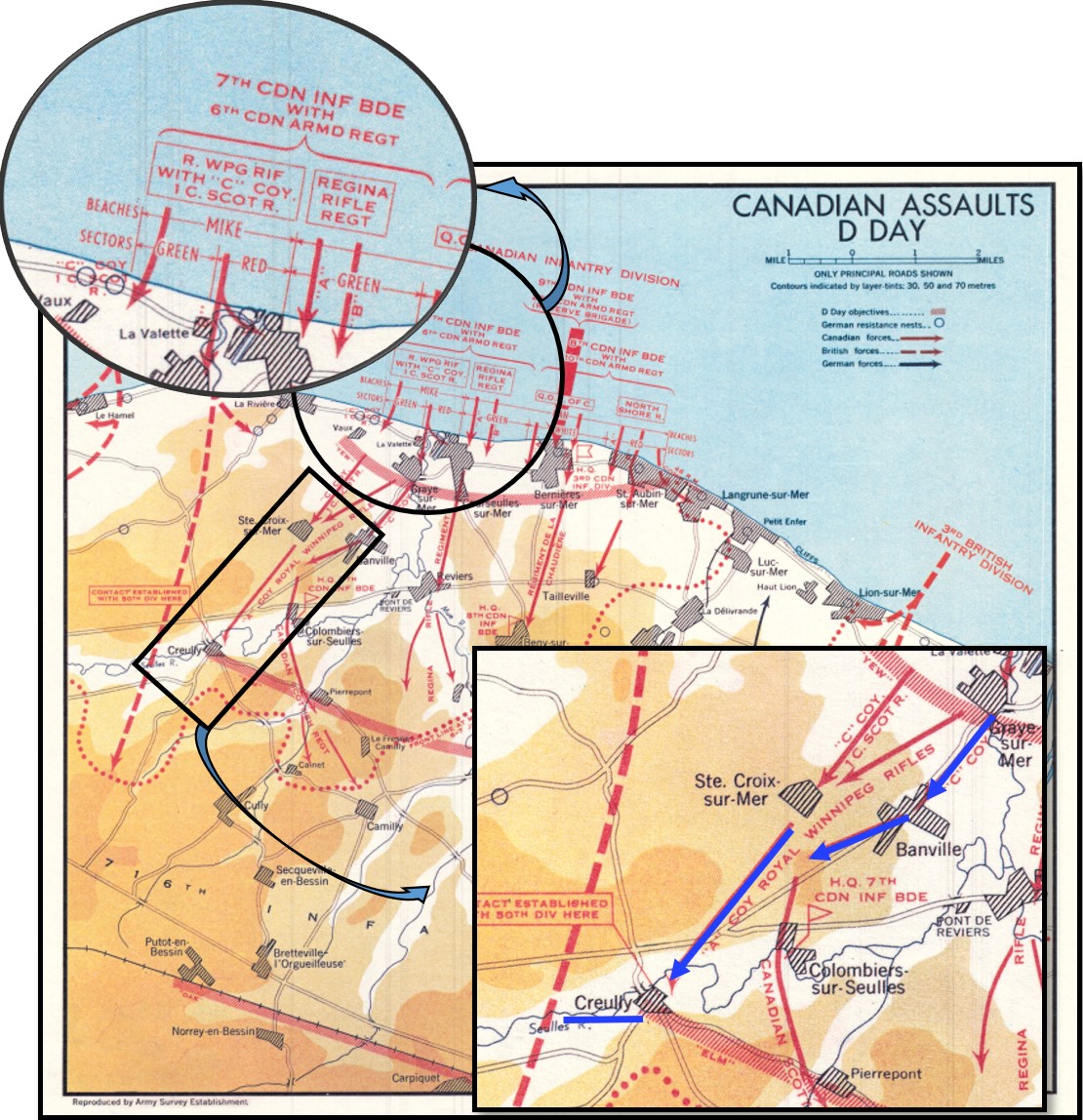
A and C companies landed later around 9 a.m. C Company disembarked on the Mike and Love sectors of Juno Beach, where the beach and surrounding dunes were still under heavy mortar fire. Pinned down for about two hours, the soldiers eventually regrouped and, alongside A Company, pushed forward towards their objective, Banville, encountering several pockets of resistance en route but overcoming each one until just south of Banville, where the enemy had dug in on commanding ground.

Map of Juno Beach showing the 3rd Canadian Infantry Division’s movements on D-Day. Highlights show the landing sector and path of the Royal Winnipeg Rifles’ C Company.

Map of Juno Beach showing the 3rd Canadian Infantry Division’s movements on D-Day. (Source: e999922605-u)

The first day of the Battle of Normandy brought surviving members of the Royal Winnipeg Rifles to Creully by 5 p.m., completing phase II of Operation Overlord. Little rest was had, especially for C Company, which faced an enemy patrol attack at 2 a.m. The soldiers repelled the assault and captured 19 German prisoners, allowing for a brief respite until 6:15 a.m., when they were ordered to advance once more. Their next objective was the OAK Line at Putot-en-Bessin.

This event set the tone for the Royal Winnipeg Rifles’ grueling experience in the aftermath of D-Day as they encountered some of the most ferocious and obstinate resistance by German forces.

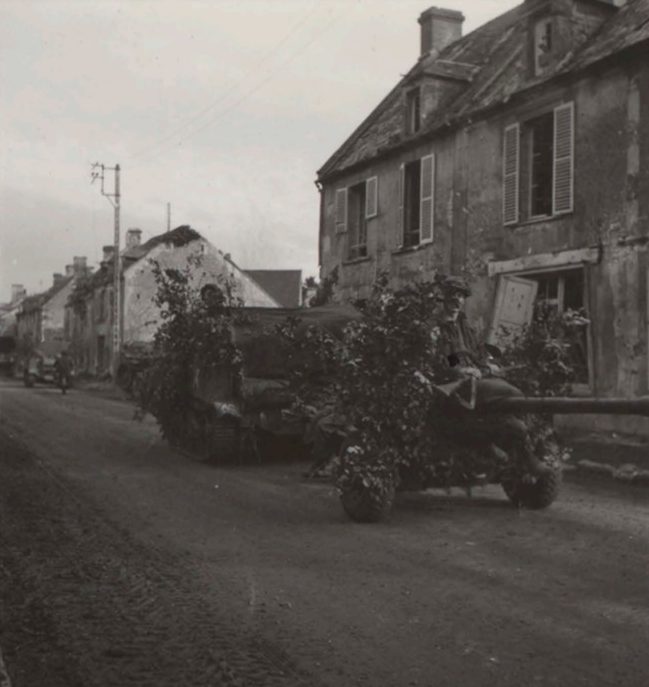
Photograph by military photographer Lt. Bell showing Canadian artillery camouflaged with foliage, Carpiquet, France, July 4, 1944.

Army Numerical 35899-36430—Northwest Europe—Album 75 of 110. (Source: e011192295)

By July 5, the Royal Winnipeg Rifles had painstakingly made it to the village of Marcelet, where they engaged in the battle for Carpiquet. While Sulo’s service file does not delve into the specifics of the injuries that ended his life on that day, the war diary tells us his regiment was subjected to enemy shelling and strafing from the air during the whole day. In this chaos, Sulo was either struck by shrapnel or collapsing buildings. Initially, he couldn’t be found and was reported missing, but when the battle calmed just enough by July 5, his body was discovered, and he was officially reported killed in action.

Like so many Canadians who gave their lives during D-Day and the battle of Normandy, Sulo W. Alanen rests at the Beny-sur-Mer Canadian War Cemetery in Calvados, France. He is buried in plot XV. G. 16, where his name liveth for evermore.

For more reading on this subject:


Ariane Gauthier is a reference archivist in the Access and Services Branch at Library and Archives Canada.

“I want to ride my bicycle!”: Cycling in the Canadian Expeditionary Force during the First World War

Version française

By Dylan Roy

“Get on your bike and ride,” my mother often told me in my youth when I would ask for a lift somewhere. Although I would sometimes begrudge her for forcing me to stay active (being the indolent child that I was), looking back, I am glad that I biked to the places I needed to go in my teenage years. Biking provided not only exercise, but also a form of agency and sorely needed sociability.

On reflection, cycling is a virtually ubiquitous phenomenon wherever people live. It came to me as a surprise that even the Canadian military used cycling. I just didn’t think of the reasons why they would. To me, it seemed like a far-fetched thing and an activity in which only civilians partook. However, the Canadian military has implemented the use of cyclists within its ranks throughout much of its history.

This series will focus on the military units who used bicycles as one of their primary duties during their service. The first entry into this series will focus explicitly on the divisions that served during the First World War. So, strap on your helmet and start peddling down the road of the following paragraphs to learn more about the brave bikers who served in our military during the Great War.

Dozens of soldiers standing at attention while holding bicycles for a panoramic photograph.

Panoramic photograph of the 2nd Division Cycle Corps, Canadian Expeditionary Force. (e010932293)

Before starting, it is important to highlight that Library and Archives Canada (LAC) offers a wide variety of resources to find information concerning the cyclist divisions, companies and Corps that took part in the First World War. One of the handiest is the Guide to Sources Relating to Units of the Canadian Expeditionary Force: Cyclists. This guide can inform a researcher about many aspects of the cyclist units. However, be warned: there are some transcription errors mentioned in the preface to the guides on the Sources Relating to Units of the Canadian Expeditionary Force page. They are, nonetheless, valuable tools for research.

Outside of LAC, the Official History of the Canadian Army in the First World War: Canadian Expeditionary Force, 1914-1919 is another secondary source that can provide important information concerning the cycling units.

With that out of the way, what did the cyclist units actually do during the war? The Canadian Encyclopedia provides this succinct summary of the cyclist units: “In WWI young men with the cycling urge were encouraged to join the Canadian Corps Cyclists’ Battalion. Over 1000 men eventually did so, their duties ranging from message delivery and map reading to reconnaissance and actual combat.”

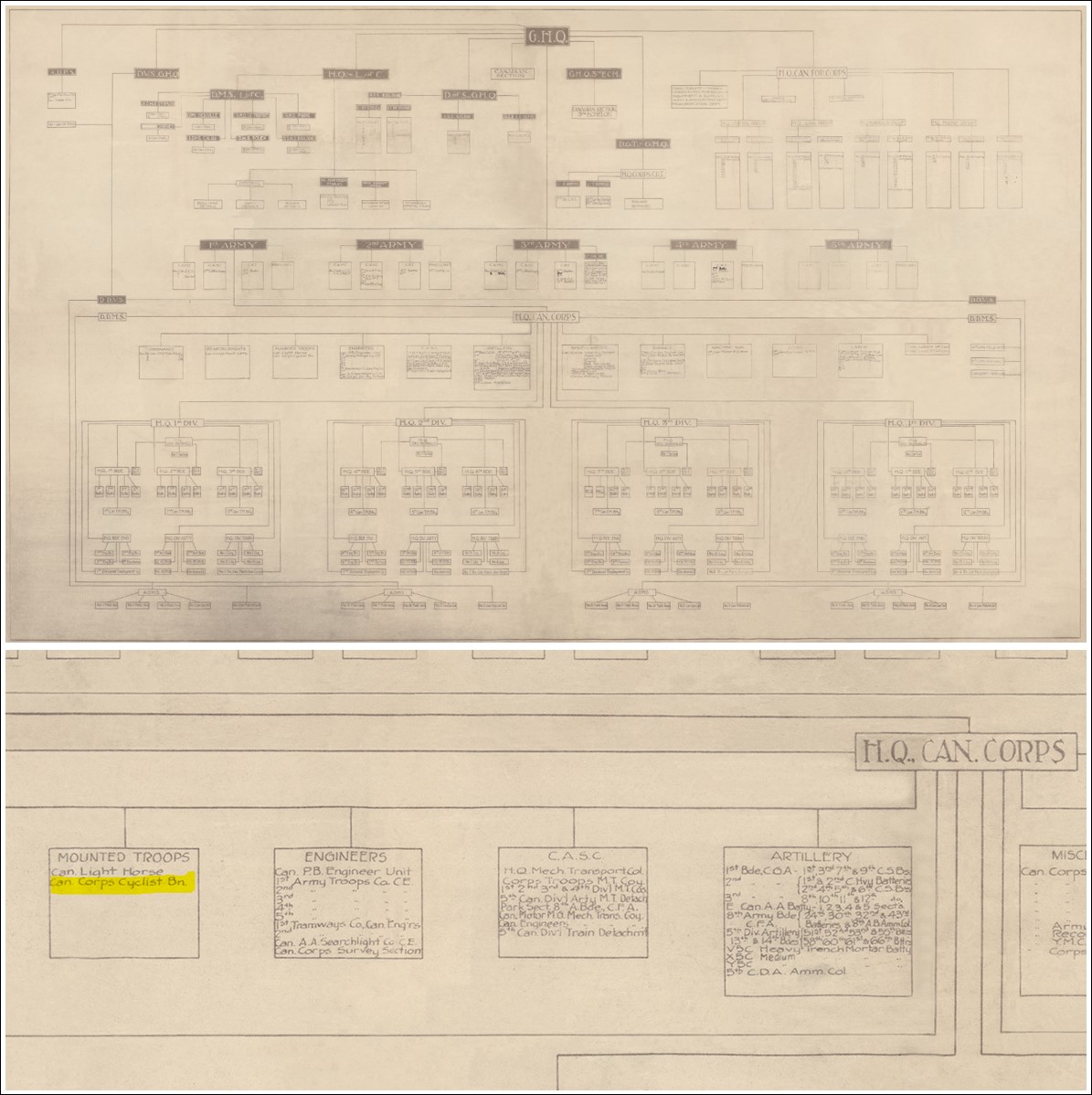
Moreover, since our troops were equipped with bicycles, it meant that they were relatively mobile compared to infantry units. They were therefore considered “mounted” and, in fact, fell under the same umbrella as the Canadian Light Horse regiment. When they said “get off your high horse,” the cyclist units took it very seriously. You can see where the cyclists fell in the military hierarchy with the 1918 Canadian Expeditionary Force (CEF) organization chart below:

Two screenshots of a chart made for the organization of the Canadian Expeditionary Force (CEF) in 1918. The first chart outlines the hierarchy of the CEF during 1918 via chains of command. The second screenshot is from the same chart but highlights where the Canadian Corps Cyclist Battalion falls within the hierarchy.

Two screenshots of the 1918 Canadian Expeditionary Force organization chart. Full chart is displayed on top and the section which highlights the Canadian Corps Cyclist Battalion below. (Government of Canada website)

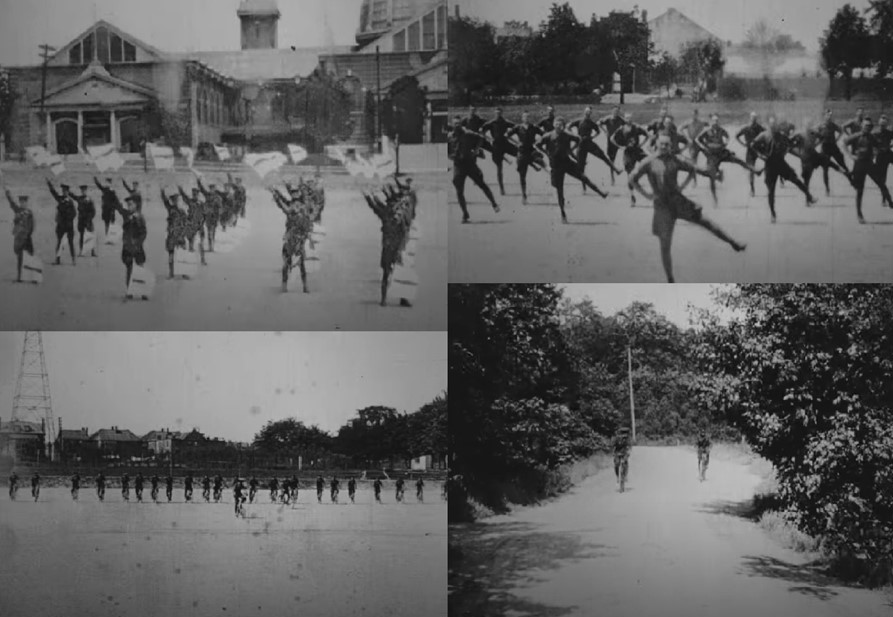
Although the cycling units were actively involved in the war, they first needed to be trained. LAC has a variety of videos on YouTube focusing on the Canadian military, including one that features some of the training aspect of the cyclist units titled The Divisional Cyclists : A Glimpse of a Day’s Training (1916).

The video demonstrates the importance of many topics, such as the more mundane aspects of military life (like laundry), while also shedding light on more crucial elements of training, such as drills, signalling and reconnaissance.

Four scenes from the film The Divisional Cyclists : A Glimpse of a Day's Training (1916). Top left features men in synchronization performing signalling drills with flags. Top right shows soldiers performing light aerobic exercises. Bottom left shows soldiers biking in unitary fashion along one another. Bottom right includes two men biking in a reconnaissance drill in a forest.

Four scenes from the video The Divisional Cyclists : A Glimpse of a Day’s Training (1916) demonstrating signalling, drill and reconnaissance training initiatives. (ISN 285582)

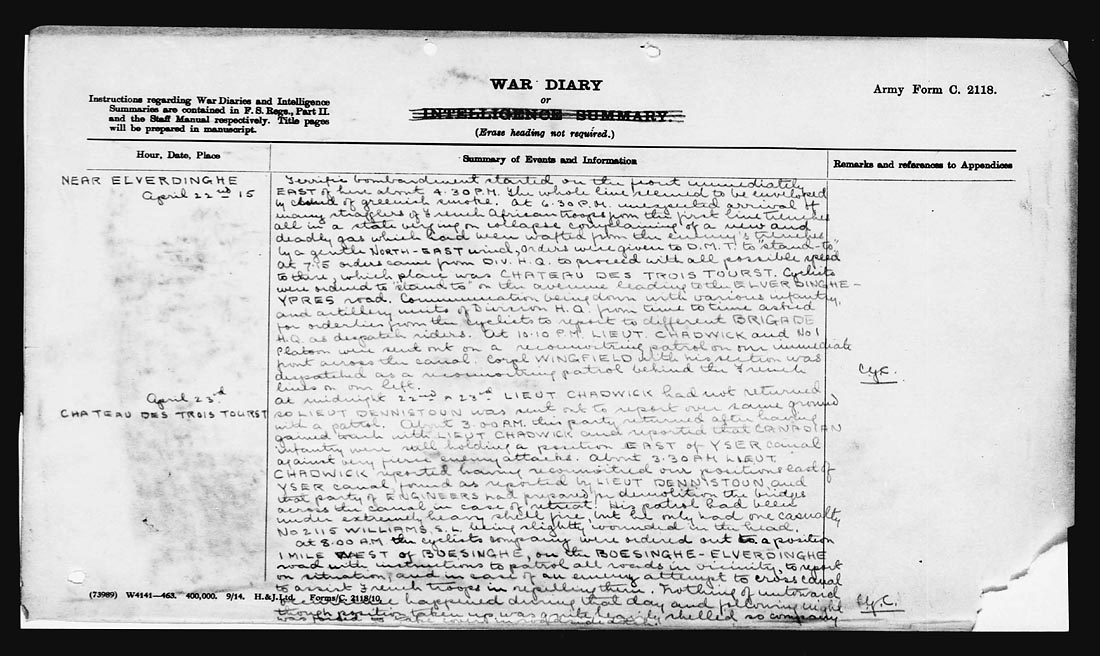
Once the cycling units had completed their training, they could partake directly in the war efforts. Our hardworking biking men-at-arms were no strangers to conflict, and they were part of some of the most notable battles of the First World War such as Ypres and Vimy. The following entry below from a war diary by the 1st Canadian Divisional Cyclist Company covers the horrific aspects of the battle of Ypres and how the division was involved on April 22nd, 1915, near Elverdinghe:

Terrific bombardment started on the front immediately EAST of here about 4:30 P.M. The whole line appeared to be enveloped by cloud of greenish smoke. At 6:30 P.M. requested arrival of many stragglers of the South African troops from the first line trenches all in a state nearing on collapse complaining of a new and deadly gas which had been wafted from the enemy’s trenches by a gentle NORTH-EAST wind, orders were given to D.M.T. to “stand-to.” At 7:15 orders came from DIV. H.Q. to proceed with all possible speed to there, which place was CHATEAU DES TROIS TOURST. Cyclists were ordered to “stand to” on the avenue leading to the ELVERDINGHE – YPRES road. Communication being down with various infantry, and artillery units of Division H.Q. from time to time asked for orderlies from the cyclists to report to different BRIGADE H.Q. as despatch riders. At 10:10 P.M. LIEUT. CHADWICK and No 1 Platoon were sent on a reconnoitering patrol on our immediate front across the canal. Corpl WINGFIELD with his section was despatched as a reconnoitering patrol behind the trench lines on our left.


Screenshot of the war diary that was shared directly above.

Screenshot of War diaries – 1st Canadian Divisional Cyclist Company / Journal de guerre – 1re Compagnie divisionnaire canadienne de cyclistes. (e001131804, image 53)

The entry highlights the chaos of war and the hardships that many men suffered on that fateful day in April 1915. It also shares some of the more haunting aspects of the First World War, such as the use of gas described as green clouds of smoke. Additionally, it provides insight into some of the main tasks accomplished by the cyclists including communication, acting as despatches and reconnaissance.

The cyclist divisions continued to expand during the war and, as highlighted earlier, an entire battalion was eventually formed called the Canadian Corps Cyclist Battalion. At LAC, there is an entire sub-series devoted to this battalion that shares further information in the Biography/Administrative history section on how it was formed and eventually disbanded. It reads:

The Canadian Corps Cyclist Battalion was organized at Abeele in May 1916 under the command of Major A. McMillan, and was formed by amalgamating the 1st, 2nd, and 3rd Canadian Divisional Cyclist Companies. The battalion was demobilized at Toronto in April 1919 and was disbanded by General Order 208 of 15 November 1920. In Canada Cyclist Companies advertised for recruits “possessing more than average intelligence and a high standard of education.” (MIKAN 182377)

By viewing the lower-level descriptions from this sub-series, one can see records that pertain to the battalion. The sub-series includes a variety of topics such as a training syllabus of the reserve cyclist company and statements by Canadian prisoners of war (among others).

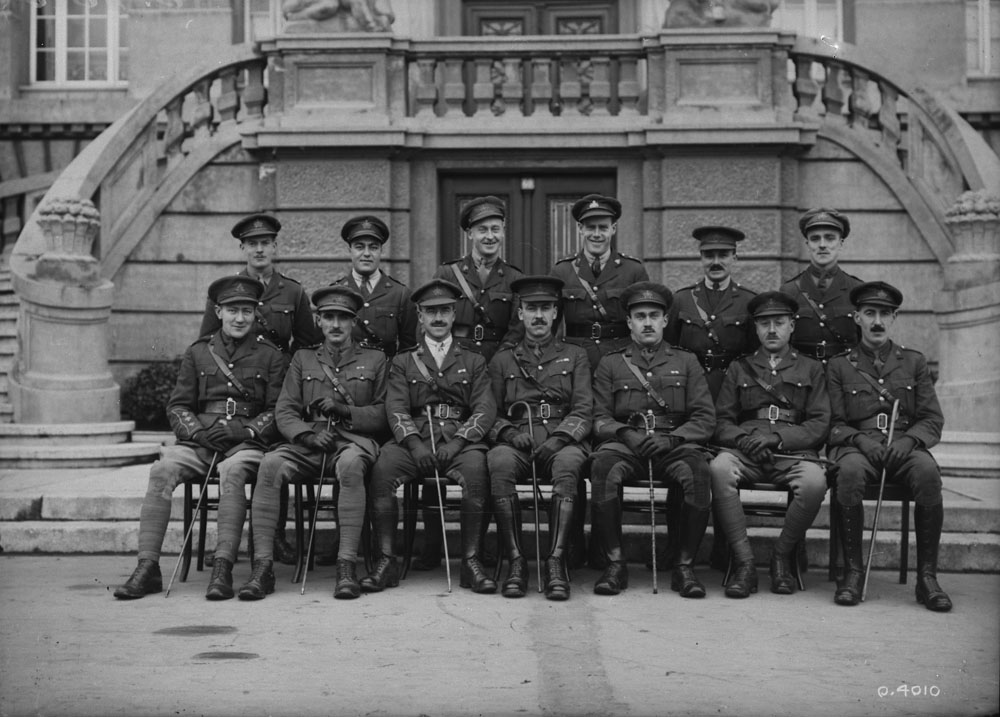
A black and white photograph of thirteen officers in uniform who served the Canadian Corps Cyclist Battalion taken in January 1919. Seven men sit on chairs in front of six men standing behind them.

Photograph of officers in the Canadian Corps Cyclist Battalion from January 1919. (PA-003928)

The Canadian cyclist units were no slouches, and they had a definitive impact on the war effort by facilitating reconnaissance, communication, signalling and direct combat. It is impressive to think that these men, who used very archaic forms of bicycles were able to tread the perilous terrain of Europe during the First World War to accomplish their duties while I, using a much better modern bike, complain about having to bike up a small hill on my way to work. It shows how much determination and bravery the men within the cyclist units of the Canadian military exerted during the First World War.

Additional Sources


Dylan Roy is a reference archivist in the Access and Services Branch at Library and Archives Canada.

Vimy Memorial visit: fact or fiction (now a trilogy)

Version française

By Rebecca Murray

In 2022, I wrote about researching my great-grandfather’s attendance at the 1936 unveiling of the Vimy Memorial. A year later, I shared another instalment, and now, I’m back with what feels like the conclusion to this journey through my family history.

We left off with the exciting discovery that Thomas C. Phillips had indeed been at or very near the Vimy Memorial in July 1936. However, we were still missing a key piece of the puzzle—how exactly did he get there and back home again?

Given the era, it’s likely that Thomas travelled by passenger ship. Family documents tell us that he sailed to France on the SS Alaunia and I confirmed online that this ship left Montréal on July 20, 1936—a tight, but feasible window for him to make it to the unveiling on July 26. So, this is where we pick it back up!

I turned my attention to passenger lists and related records, hoping to trace Thomas’s journey. My first stop—because I have learned that a problem shared is a problem halved AND I know how smart my colleagues are—was the Genealogy Desk! I spoke with one of my colleagues (you can do this too!), who advised me that post-1935 passenger lists are under the custody of Immigration, Refugees and Citizenship Canada and are accessible through Access to Information requests. Pre-1935 records, however, are organized into various datasets that are searchable on the Library and Archives Canada (LAC) website using a variety of keywords such as “passenger,” “immigration,” and “border.”

I hummed and hawed over this—those of you who love research will understand that handing over the reins to someone else wasn’t my first choice. Not wanting to rely entirely on others, I approached the research from a new angle. Which angle you ask? Well, I went all the way to the other side of the ocean! Instead of looking for arrival records, I decided to look for departures (or, Thomas’s return trip)! This led me to the National Archives of the United Kingdom and their digitized records on Findmypast, where I discovered not one, but two passengers named Thomas Phillips who sailed to Montréal in the summer of 1936. Another big thank you to my colleagues at the Genealogy Desk, whose expertise proved invaluable in this stage of the research.

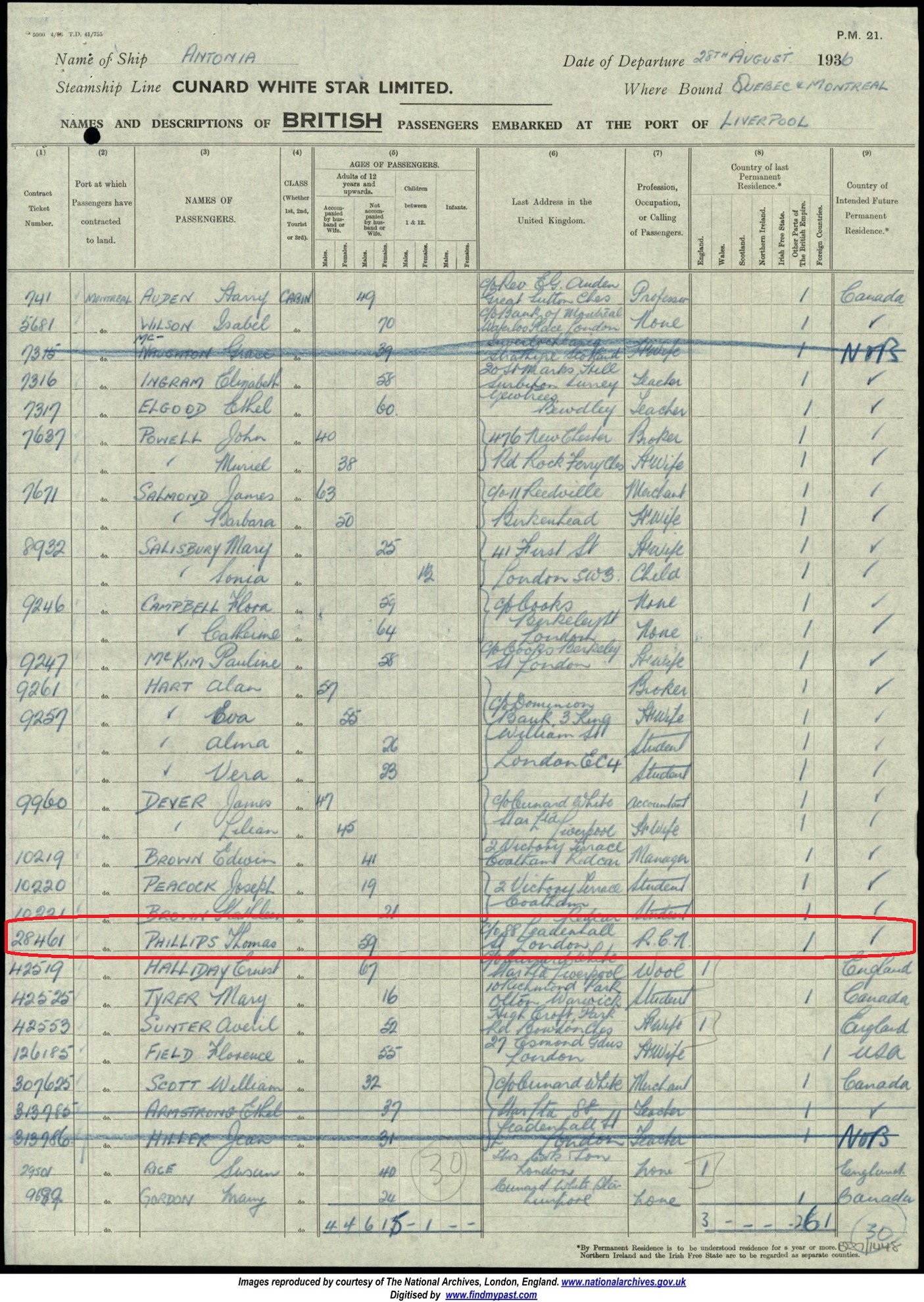
I reviewed the search results knowing that I should look for a departure date in the late summer and use Thomas’s birth year (1877) as an additional filter. I quickly found the relevant record: a passenger list for the SS Antonia, a Cunard ship built in the 1920s. Spotting Thomas’s name felt like one of those moments in the Reference Room where you want to fist pump and high-five someone—except, when you’re working remotely, all you get is a side-eye from the dog for interrupting his nap.

The form tells us a lot about the voyage and about Thomas. The SS Antonia departed Liverpool on August 28, 1936, bound for Quebec City and Montréal, Quebec. While most of the passenger data is standard, I found it neat to see column 8 or “Country of Last Permanent Residence,” which offers a breakdown of regions across the United Kingdom as well as options for “Other Parts of the British Empire” and “Foreign Countries.” Unsurprisingly, most of the passengers heading to Quebec on this voyage are listed as from “Other Parts of the British Empire”—perhaps other Canadian pilgrims who, like Thomas, had been in France the previous month for the unveiling of the Vimy Memorial.

Page from the passenger list of the SS Antonia, featuring the name of Thomas Phillips circled in red.

Passenger list for Cunard White Star Line’s SS Antonia with a departure date of August 28, 1936, from Liverpool, England. Information about Thomas Phillips is circled in red. Source: National Archives of the United Kingdom.

We also learn that Thomas’s last address in the United Kingdom was “c/o 88 Leadenhall St, London.” Naturally, my curiosity led me to investigate what was located at 88 Leadenhall Street in 1936. A quick Internet search revealed it was Cunard House, an eight-story building that housed the business offices of Cunard Line and its affiliated companies. Further digging suggested that it wasn’t uncommon for travellers by sea to use a “care of” (c/o) address, likely for ease of correspondence during their journey.

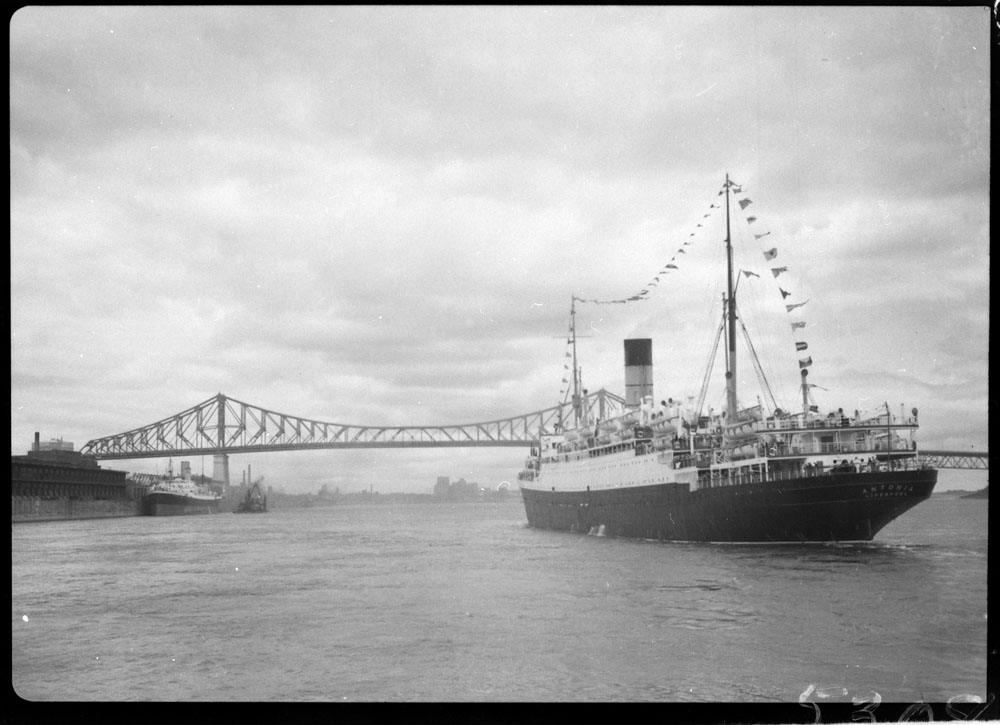
With this new information in hand, I turned to LAC’s archives to explore what else I could find about the SS Antonia and Thomas’s voyage. Archival holdings at LAC provide a rich narrative of the SS Antonia—from her early days as a passenger liner to her later role as a troop transporter during the Second World War. But of most interest to this researcher are the records related to the Vimy Pilgrimage! LAC even holds footage of the SS Antonia, as well as this beautiful photograph of her Europe-bound voyage earlier that summer.

A black-and-white photograph showing the SS Antonia, a two-toned passenger ship, moving across the water. In the background, the Jacques-Cartier Bridge and several docked ships can be seen.

Members of the Vimy Pilgrimage aboard the SS Antonia, departing from Montréal, Quebec, 1936. Source: Clifford M. Johnston/Library and Archives Canada/PA-056952.

I even scoured Montréal newspapers from early September to see if Thomas’s return was noted in the shipping news. While the Antonia’s arrival was documented, my great-grandfather didn’t make the papers. And so, this brings me to the conclusion of my research—sometimes the hardest part of archival work is knowing when you’re done.

I’ve delved into the original question of why my great-grandfather attended the unveiling of the Vimy Memorial, and along the way, uncovered answers to how he made the journey there and back. The research brought both exciting discoveries and inevitable disappointments—common in any archival exploration. Along with new insights, I’ve gained valuable research skills, which is always a welcome bonus. And far from feeling discouraged, I’m more eager than ever to tackle the next family history mystery. Bring it on!


Rebecca Murray is a Literary Programs Advisor in the Outreach and Engagement Branch at Library and Archives Canada.

The Kapuskasing Internment Camp

Version française

By Ariane Gauthier

We make surprising connections throughout our lives. Things we thought were confined to our work or social circles unexpectedly surface in other areas. For me, several long drives with my husband to Northern Ontario led me to learn more about the Kapuskasing internment camp. Few people know that there were internment camps in Canada during both world wars. And even fewer know that these camps were not all for prisoners of war—many detained Canadian civilians of so-called “enemy” nationality.

The Kapuskasing camp was active from the start of the First World War in 1914 until 1920. It mainly held Ukrainian civilians. They were sentenced to forced labour, including constructing buildings and clearing several hectares of surrounding forests so the government could establish an experimental farm.

Black-and-white photograph of the Kapuskasing internment camp in July 1916. The image features a row of wooden huts with rows of prisoners and camp guards lined up in front.

The Kapuskasing internment camp. (e011196906)

My work as a reference archivist has allowed me to delve deeper into the resources of Library and Archives Canada to learn more about this grim period in Canadian history. During my research, I came across the documents of William Doskoch, born on April 5, 1893, in Laza, Galicia, a territory of the Austro‑Hungarian Empire that is now part of Ukraine.

In 1910, at the age of 17, William Doskoch joined his brother in Canada to work in the coal mines in Nanaimo, British Columbia. While he was in Vancouver in 1915, he was arrested, as he was considered an enemy alien. He was interned in several camps: first at Morrissey, then at Mara Lake, and later at Vernon, before finally being transferred to Kapuskasing. It was from there that he was released five years later, on January 9, 1920.

The William Doskoch fonds is rich in resources that help us understand internment camps from an internee’s perspective. While it contains information on several camps, I was mainly interested in William’s notes about Kapuskasing. According to his writings, the conditions were similar to those at Vernon: mistreatment of prisoners, random executions, many cases of tuberculosis, and inadequate internment conditions for the cold weather.

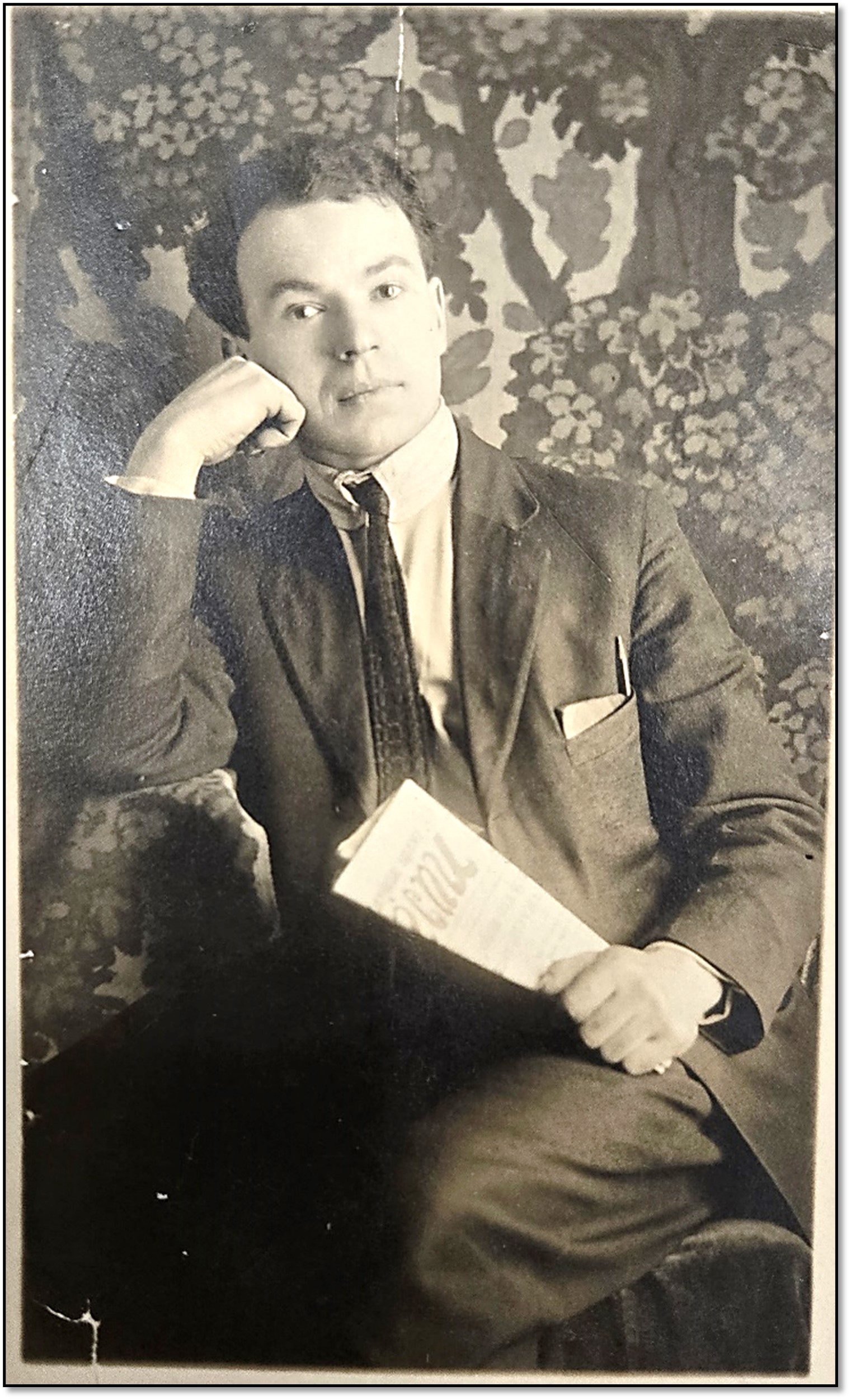
Studio portrait of a seated man. He is holding a newspaper.

Portrait of William Doskoch. (MIKAN 107187)

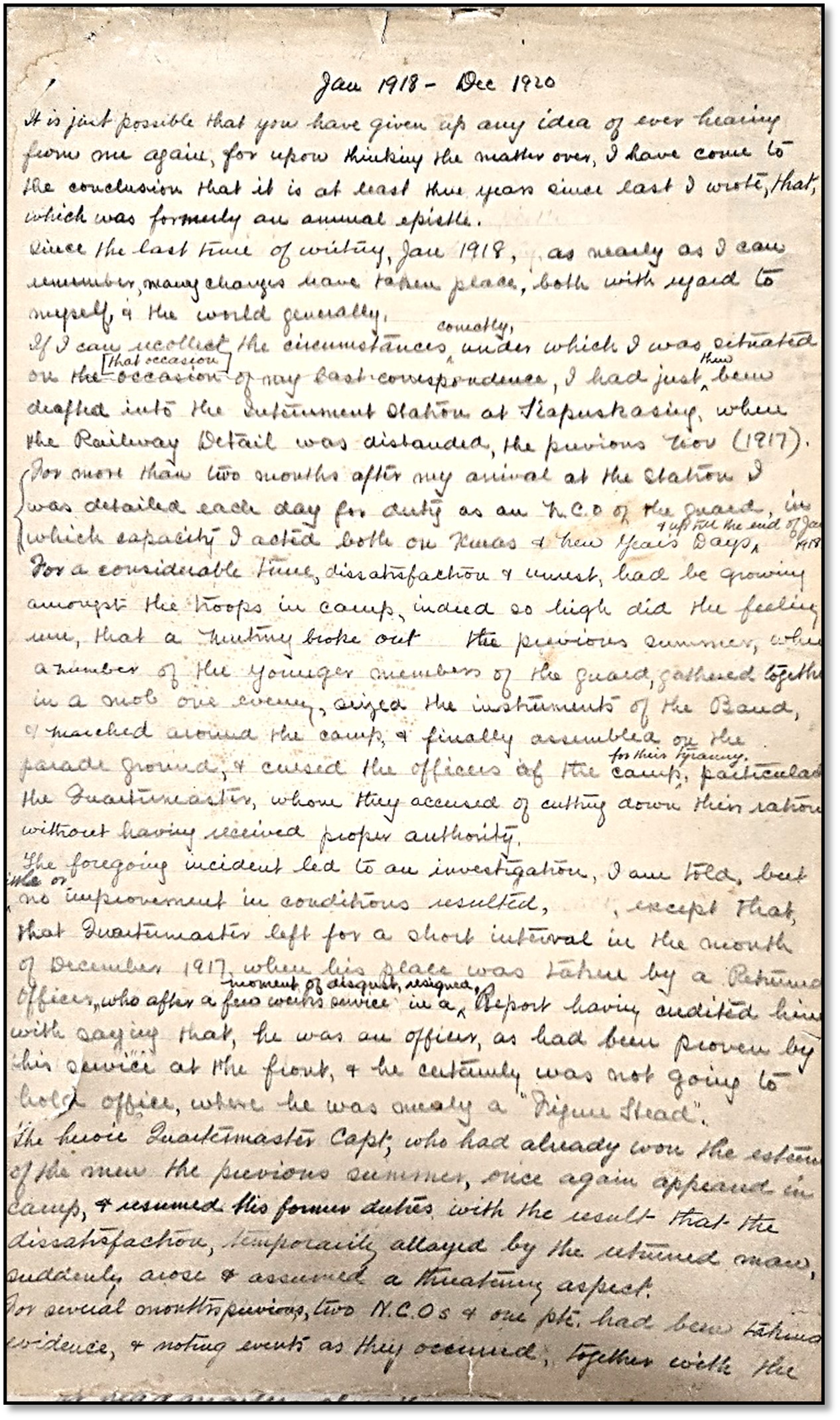
I also found a letter written by George Macoun, a guard at the Kapuskasing camp, detailing events that occurred there between November 1917 and the summer of 1919. Although of lesser magnitude than the William Doskoch fonds, the letter provides us with a rare glimpse into the experience of an internment camp guard.

First page of a letter written by hand.

Letter from George Macoun, a guard at the Kapuskasing internment camp. (MIKAN 102082)

Originally from Ireland, George Macoun immigrated to Canada, where he joined the militia in February 1915. This is how he became involved in the operations at the Kapuskasing internment camp. He wrote this letter after the war ended, following his dismissal as a guard. Reminiscent of a memoir, he recalls the significant experiences of his time in Kapuskasing, including the conflicts and tensions among the guards due to abuses of power. He recounts the following:

“One little incident took place in March 1918, which aroused the wrath of the company generally against this commander owing to the manner in which the case was brought up being considered, according to military custom, absolutely irregular. One evening, whilst an entertainment was being held in the recreation room about the last week of Feb 1918 a certain corporal, one of the most popular men of the guard had the misfortune to get drunk and a disturbance during the night, not only in his own room but also in one of the other rooms. This information was conveyed to the popular O.C. [officer commanding] by some weak about two weeks later, when a charge was at once laid against the corporal.”

The Department of the Secretary of State of Canada fonds also contains a wealth of information. Notably, it includes a sub‑series entitled Custodian of Enemy Property and Internment Operations records, covering the period from 1914 to 1951 (R174-59-6-E, RG6-H-1). During both world wars, the Secretary of State was responsible for, among other things, matters arising from internment operations. However, some activities, such as those related to the management of properties confiscated by the State from internees, were eventually transferred to other departments over the years. The fonds still contains documentation on the certificates of release from internment camps and on the administration of the camps. Boxes 760 to 765 inclusively hold documents concerning the operations of the Kapuskasing camp.

Because there’s a lot of information, I will only focus on a few interesting elements for Kapuskasing. For example:

  • According to correspondence from the director of internment operations, the experimental farm built by the prisoners at Kapuskasing was completed in early December 1917.
  • According to statistics from December 1918, the camp housed the following prisoners: 607 Germans, 371 Austrians, 7 Turks, 5 Bulgarians, and 6 classified as “other.” A note suggests that the term “other” was used for prisoners of war, but it is not clear.
  • Several letters written by prisoners to their family members were censored. This is the case for the letters that Adolf Hundt sent to his wife. Discouraged by the extent of censorship, he gave up writing to her, leading his wife to worry about his health.

This blog post gives you an overview of the information available about the Kapuskasing camp in the Library and Archives Canada collection. This rich resource offers valuable insights into this troubling chapter of Canadian history. To support further research, we have created a guide on internment camps in Canada during the two world wars, which was very helpful to me in writing this blog post.

To consult the guide, follow this link:


Ariane Gauthier is a reference archivist in the Access and Services Branch at Library and Archives Canada.

Oliver Hockenhull’s Multimedia Scenarios

Version française

By Brian Virostek

This article contains historical language and content that may upset some readers, including an illustration of a public hanging. For more information, please consult our historical language advisory.

What goes through the mind of an experimental filmmaker as they grapple with issues of control, resistance, and—crucially—how to capture all that on film in a way that stimulates their audience to engage in the reflection?

What kind of archival materials could we expect to shed light on a film that never had a script, and whose director eschewed conventional methods? It was this curiosity that led me to ask media artist Oliver Hockenhull if he had any images or documentation he might consider donating alongside his films Determinations (1988, updated for 2022) and Exiles (1991). He responded by generously donating a small but fascinating assortment of materials that provide a glimpse into his creative process.

For Determinations, a key item is a copy of Hockenhull’s grant application to the Canada Council of the Arts. It offers a detailed description of the film’s subject and themes, allowing us to gauge the artist’s deep commitment to the project and understand his creative approach.

A government form filled out by typewriter.

Page one of Hockenhull’s grant application for Determinations. (MIKAN 6523363)

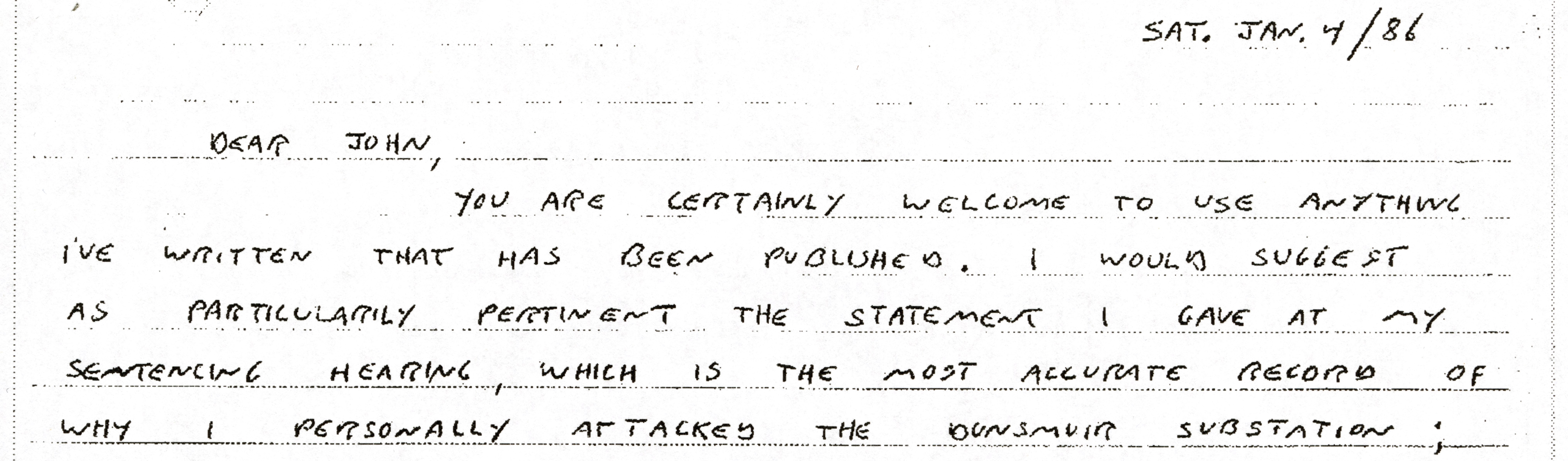
The application also sheds light on the film’s polyvalent collage form. Hockenhull draws from multiple facets of his experience, conscious that the act of making this film will itself be a process of understanding. By this point, he had attended the trials of Direct Action (also known as The Squamish Five) and had written to each of the members. We can see that he isn’t satisfied to watch the news. He feels compelled to be personally present and open to dialogue. The film retains the quality of a frank correspondence.

The first few lines of a handwritten letter.

Letter to John Oliver Hockenhull written on January 4, 1986, by Doug Stewart. (MIKAN 6523363)

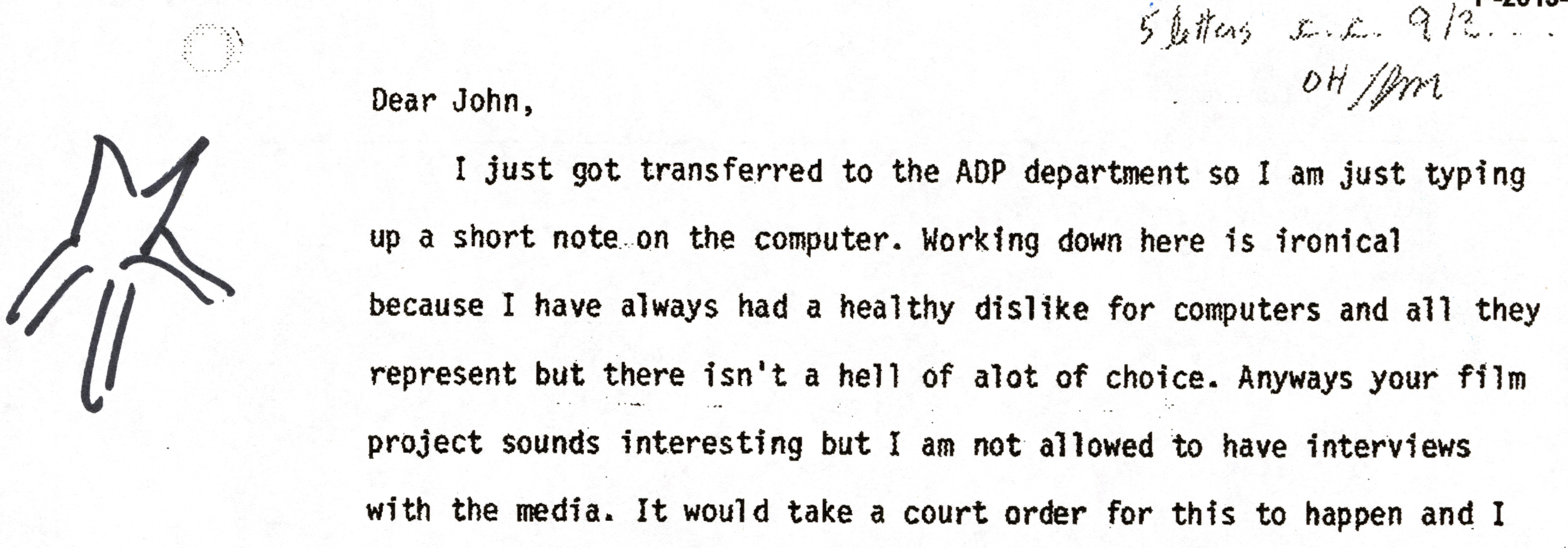
In the next letter, a scribbled five-pointed star stands out. It appears to be five As joined at the base. It’s unclear when this symbol was added to the letter.

Typed letter with a hand-drawn star at the top-left side.

Letter to John Oliver Hockenhull signed by Ann Hansen. (MIKAN 6523363)

One last detail stands out in the grant proposal: the document appears to have been obtained through a Privacy Act request—a process that allows individuals to request access to the personal information held about them by the Government of Canada. True to the subject of his film Determinations, Oliver Hockenhull has pried and leveraged the inner workings of a system and invited us to share in his investigation.

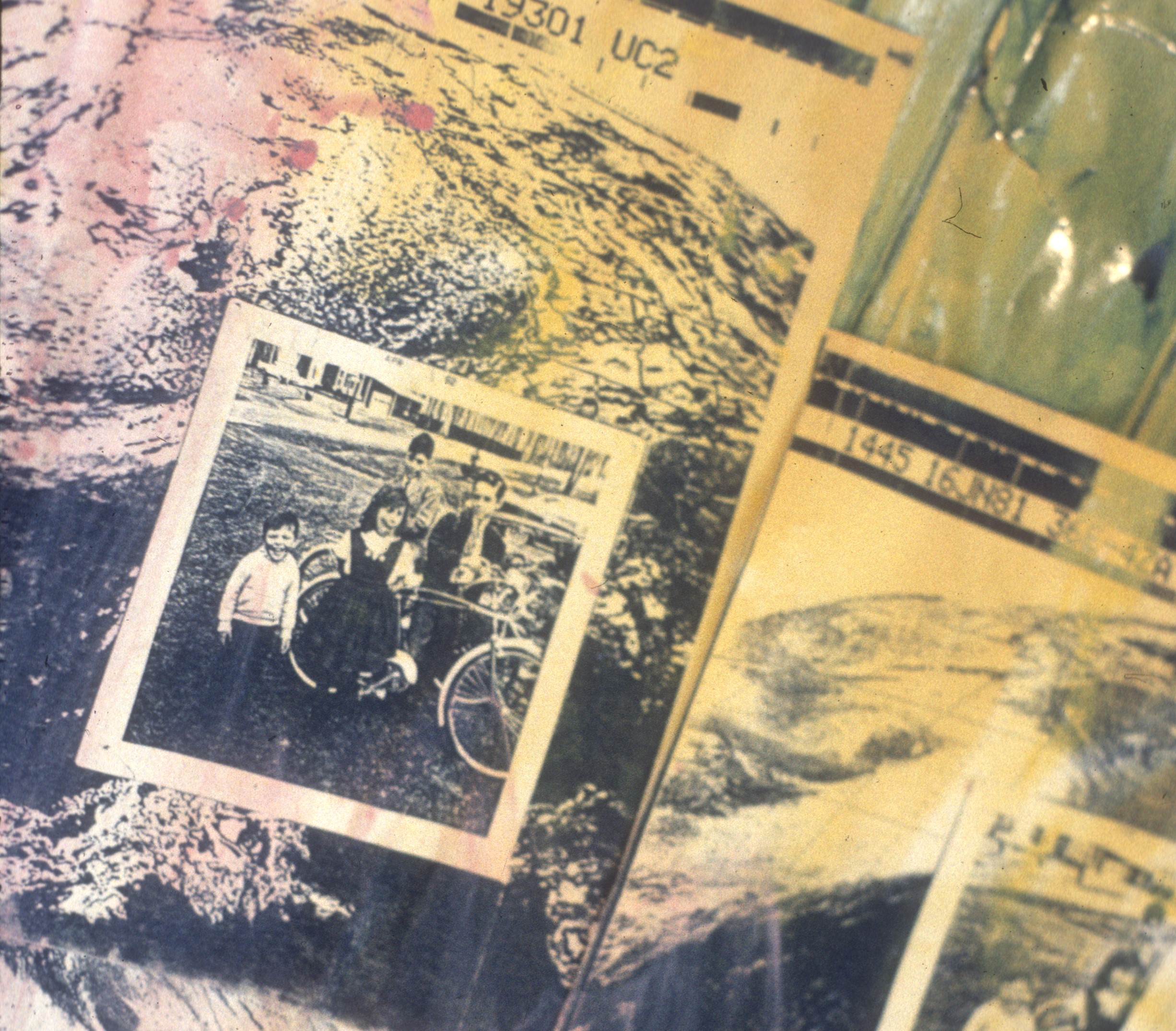
Photographs and slides in this archival fonds show that the film’s conception unfolded not in a word processor, but in an artist studio. Advertisements for weapons and photographs are pasted to the walls, collaged, combined and painted over. We see here the meeting of the personal in the family photo and of the technically mediated with the details from the fax machine.

Copies of a family photo and a fax document collaged with coloured varnish.

A collage created on the walls of the artist studio where part of the film Determinations was shot. (MIKAN 6523363)

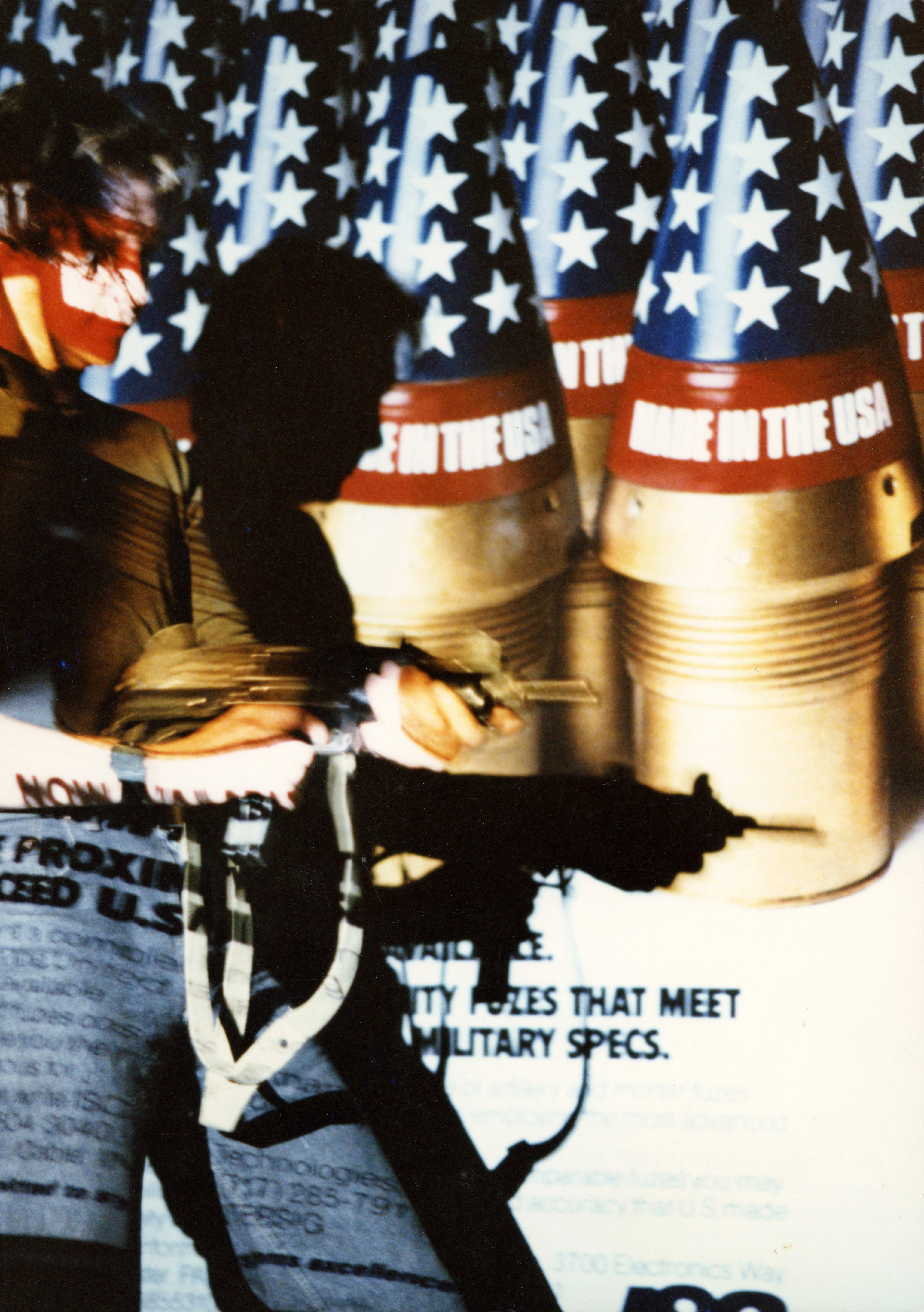
Along with visual artists, we can see that dancers and actors are now part of the studio and are becoming part of the collage. In the image below, an advertisement for weapons has been copied onto a slide and projected into the studio on top of the actor.

A person holds a gun in the foreground, while an advertisement for weapons—featuring warheads adorned with stars and stripes—fills the background.

An example of multimedia collage from Determinations: printed media, projection, and performance. (MIKAN 6523363)

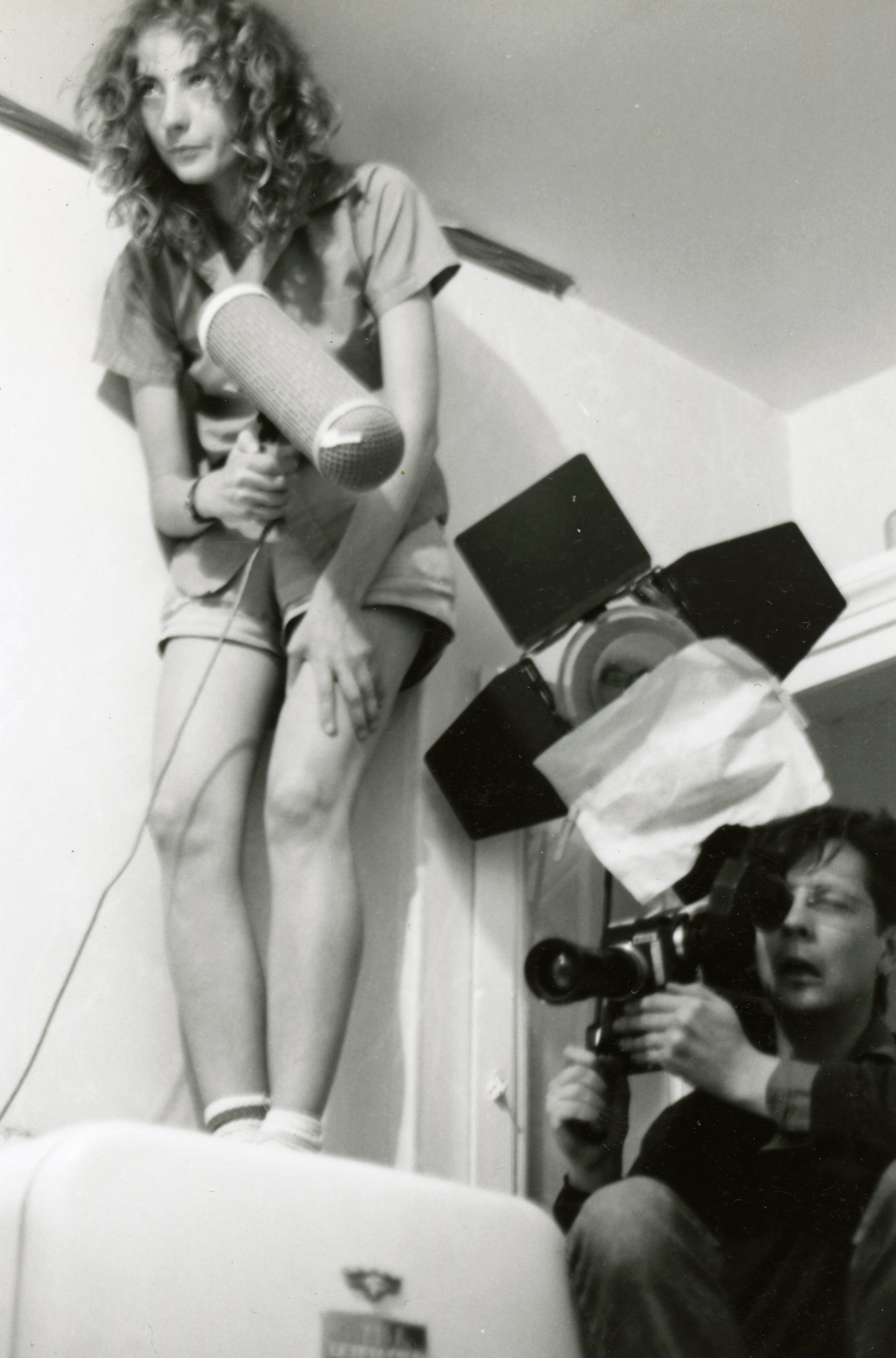
In the next photograph, we see the camera operator and the sound recordist working in close quarters. For this kitchen scene, the director chose to use a lived-in space even though it was small and cramped. There wasn’t enough room to fit both actors in the frame or even to shoot from two angles in a traditional shot-counter-shot. Instead, the director opted to frame the conversation using split-screen, capturing both characters within the same physical space but in separate visual fields. It’s another example of the filmmaker imposing material constraints on himself while confronting his characters with tough questions. Each solution contributes to the mosaic of understanding.

Woman on top of a fridge holding a microphone and a man holding a camera, with a spotlight behind them.

Filming Determinations. (MIKAN 6523363)

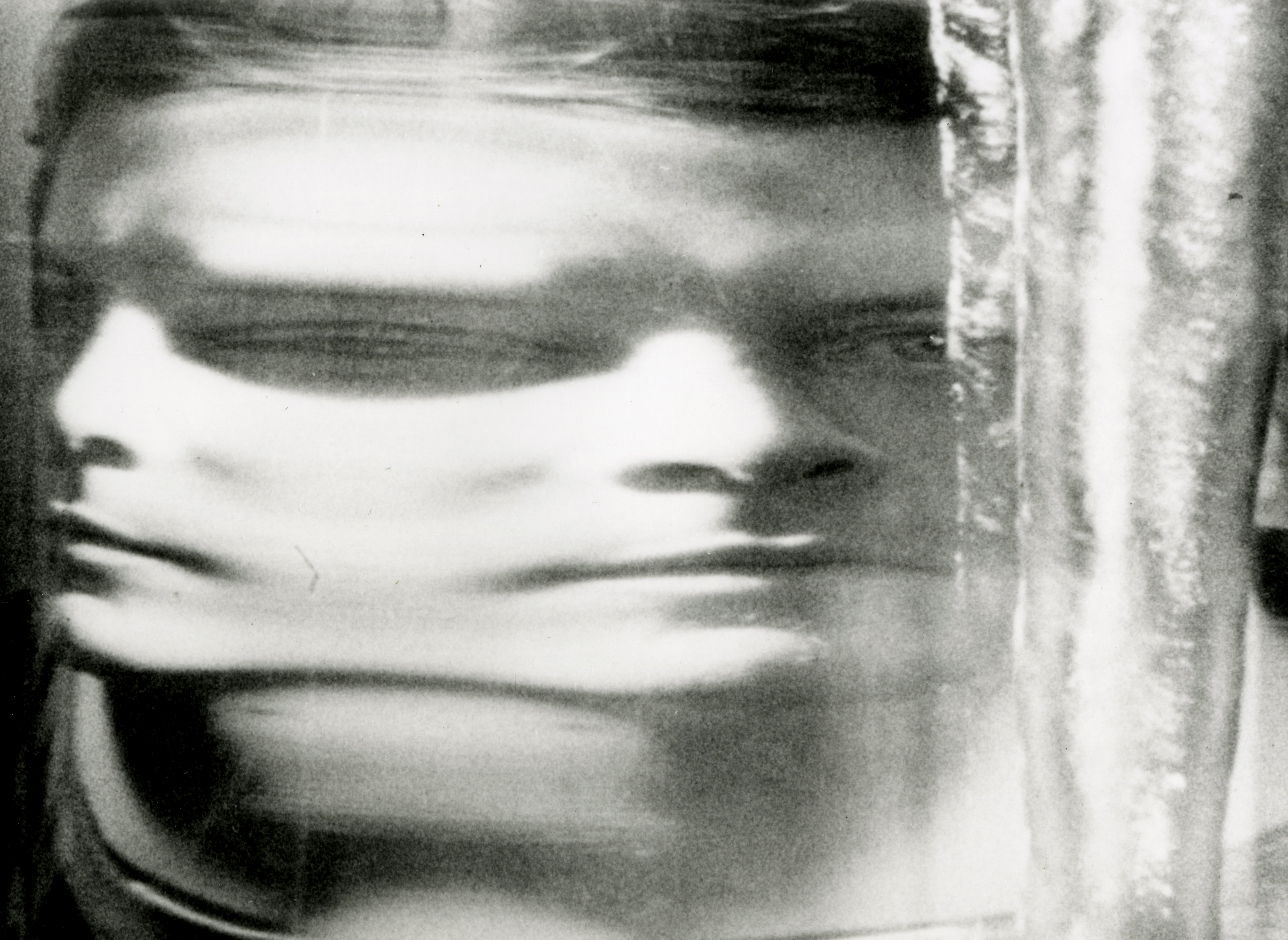
Here, working in a sculptural and painterly way, Hockenhull distorts the image of a character’s face in a carnival mirror. Through his persistent exploration of his theme through a variety of plastic and performance media, the director lands at a single frame that will represent the film in photographs and press releases: a person torn in two, with a third eye gazing into a mediated state.

Image of a man’s face that is distorted.

A person torn in two, with a third eye gazing into a mediated state. (MIKAN 6523363)

Library and Archives Canada has a copy of both the original 1988 version of Determinations and Hockenhull’s 2022 version, which features music by Gerry Hannah, a former member of the Squamish Five.

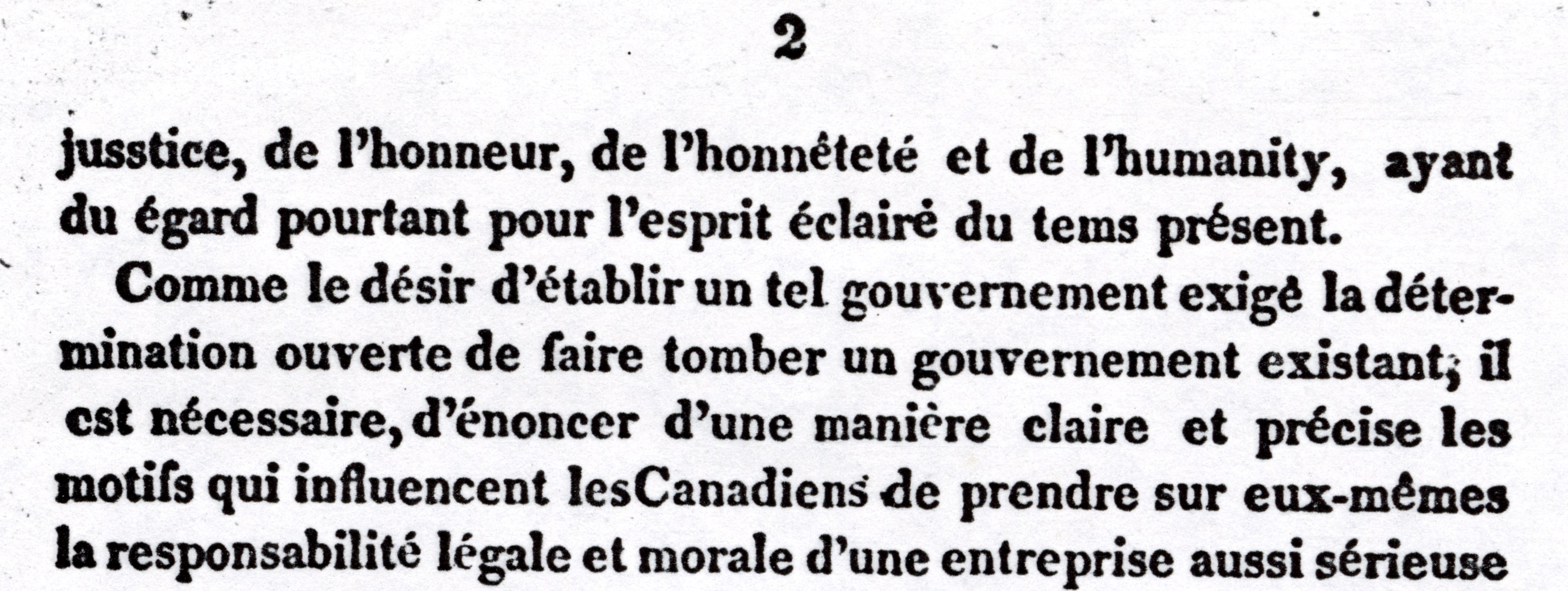
For his next film, Exiles, Oliver Hockenhull began his research at Library and Archives Canada, drawing on the published version of Journal d’un patriote exilé en Australie, 1839-1845, by François-Maurice Lepailleur, along with related texts and illustrations. The reproductions he requested fuelled his creative process.

Typed text.

Text from Journal d’un patriote exilé en Australie, 1839-1845, by François-Maurice Lepailleur. (MIKAN 6523364)

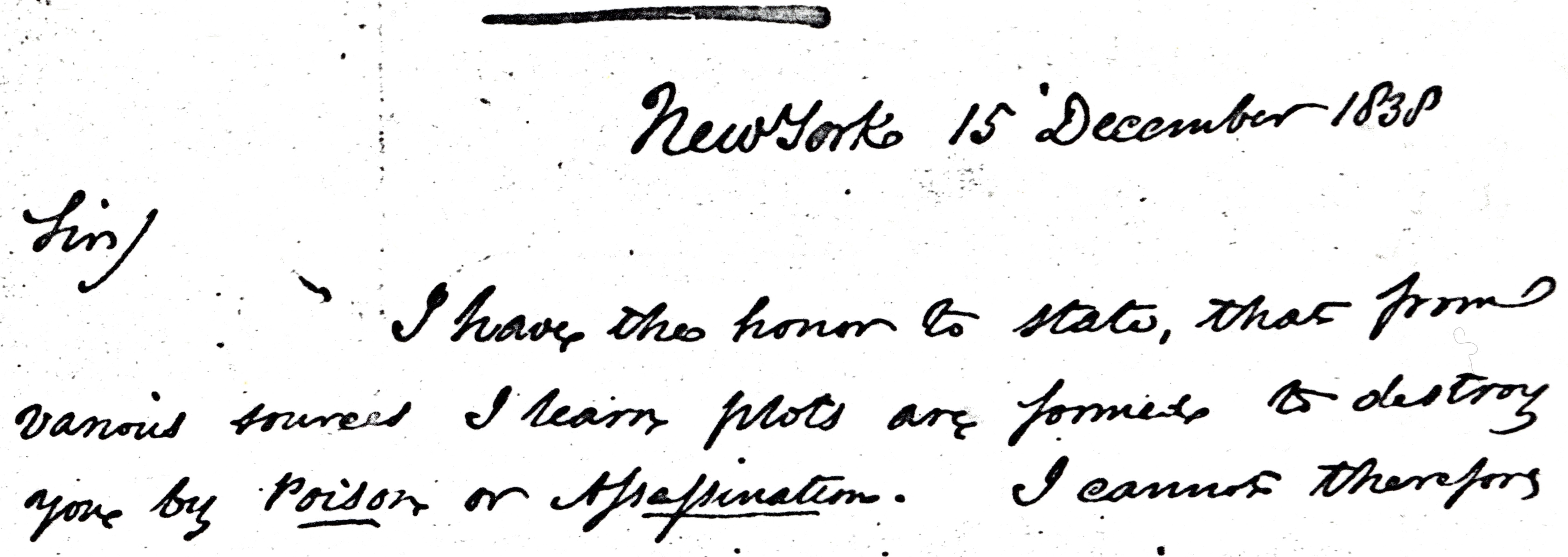
From the revolutionary idealism of the previous text, we move to correspondence of colonial officials immersed in a world of intrigue and violence warning that “plots are formed to destroy you by poison or assassination.”

Handwritten letter.

Letter addressed to Lieutenant General Jim John Colborne, written in New York on December 15, 1838. (MIKAN 6523364)

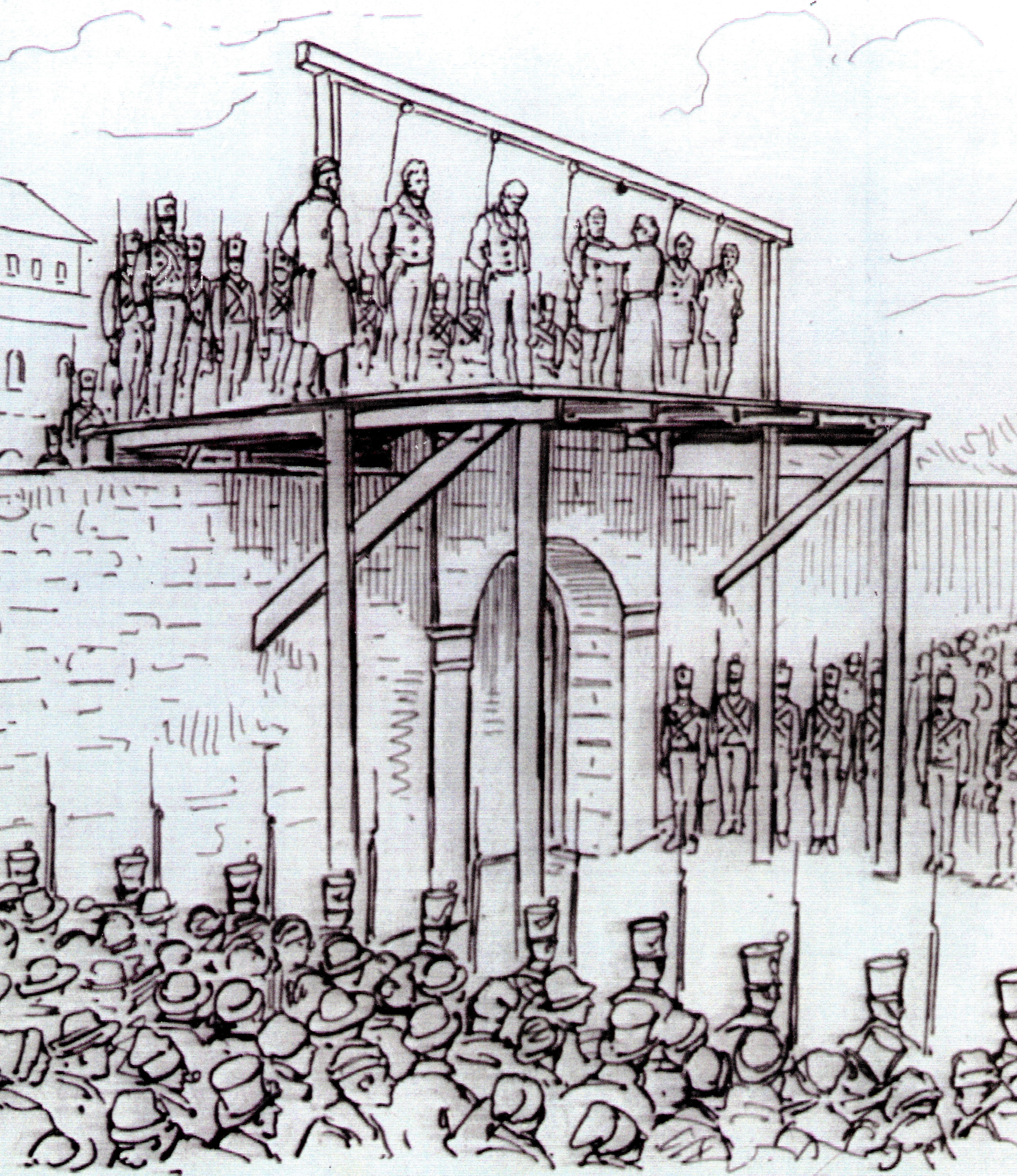
The director’s research reveals that revolutionary Patriotes such as Lepailleur faced a different kind of violence, as illustrated in the image below. The Patriotes-au-Pied-du-Courant prison, visible in the background, is now a small museum in Montréal well worth a visit.

Drawing by Henri Julien depicting an execution in front of a prison in Montréal.

A sense of violent oppression permeates the film, conveyed symbolically rather than depicted literally. (MIKAN 6523364)

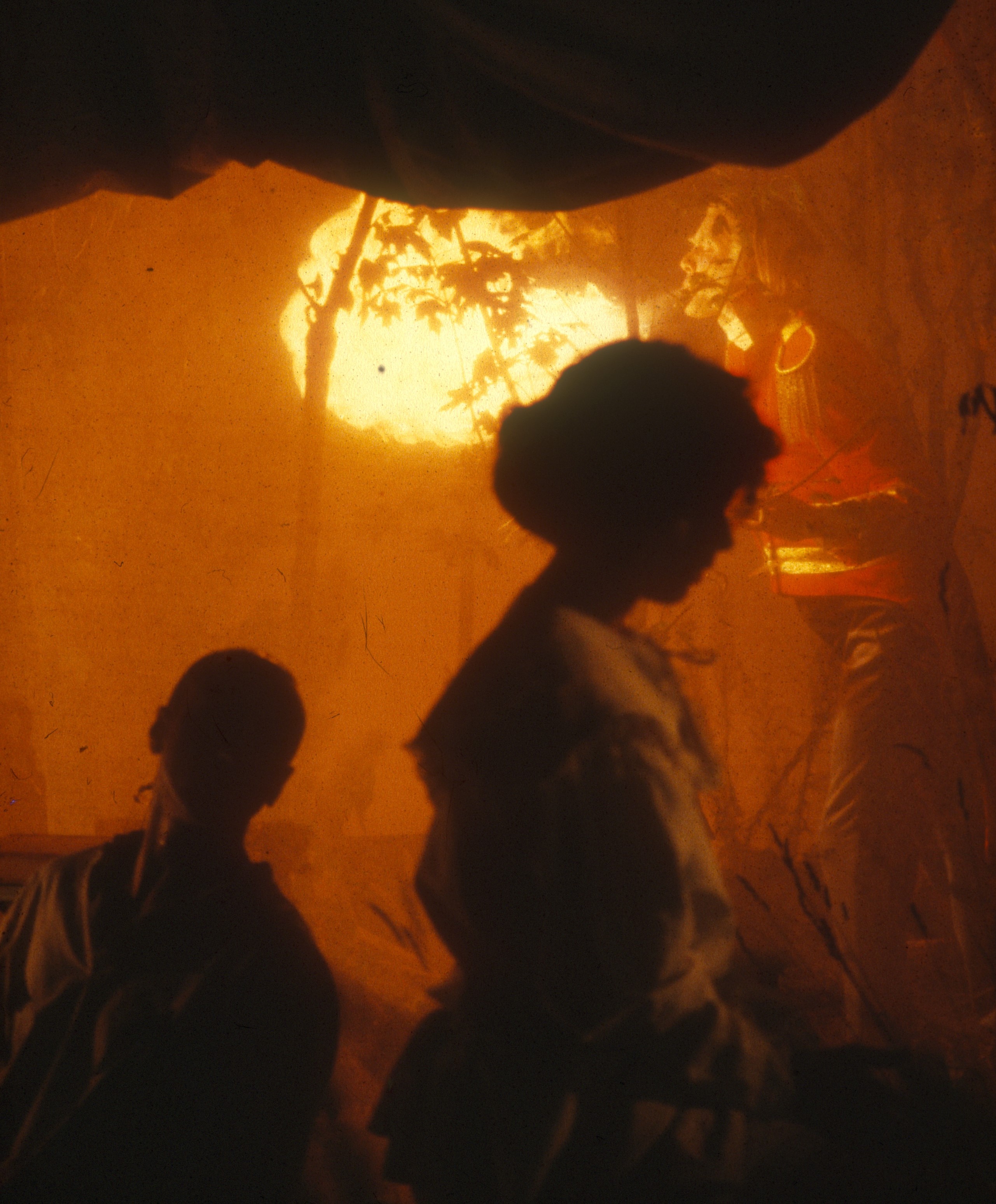
As in his previous film, Determinations, Hockenhull seeks an authentic voice, turning to journals and correspondence to tell his story. The longer, more fluid writing and illustrations are reflected in the production, not only in the costumes and locations, but also in a more sumptuous and composed mise-en-scène. From one of the several slides of set photography:

Two silhouetted figures in front of a curtain, illuminated in orange-red hues by a fireball breathed by a circus performer in the background.

Theatrical mise-en-scène from Exiles, featuring non-diegetic elements such as a circus performer in the background. (MIKAN 6523364)


The following image shows a collage of Polaroid film stills with timecodes, assembled by Hockenhull. In the images of Lepailleur seated in the chair, you can see an old map of Australia in the background. As with his earlier work on Determinations, the director collected visual material during his research phase, copied the images to slides, and projected them into the scene. But there is refinement here: in keeping with the mise-en-scène, the image is integrated using front projection—a special effects technique that allows the projected images to fill the backdrop seamlessly without obscuring the actors.

A grid of six images—five featuring various people and one displaying the years “1837” and “1838.” Each image has a timecode in the bottom-right corner.

Collage of Polaroid film stills created by Oliver Hockenhull. (MIKAN 6523364)

An expression of history as split seconds, like a storyboard after the fact, composed of Polaroid impressions and cropped illustrations. Here, the filmmaker connects these discrete events, letting their edges touch, building these blocks back into a world.


Brian Virostek is an Archivist in the Archives and Published Heritage Branch at Library and Archives Canada.

Pineapple-cheese salad from the 1950s

Version française

Cooking with Library and Archives Canada banner

By Ariane Gauthier

The 1950s were a decisive decade for consumerism in the western world, particularly in the Americas. Economic growth, technological advancements and mass media have a central role in shaping a consumer-oriented culture that emerged in the post-war period. This transformation laid the foundations for the modern consumer society and the global economy that would continue to evolve in the following decades.

In the 1950s, the rise of canned food in the United States marked a key change in American food culture and, by extension, Canadian food culture. As more and more women entered the labour market and busy family schedules became the norm, canned products like vegetables, soups and meats offered a quick and reliable solution for meal preparation. This boom was fuelled by advances in food preservation technologies, which made canned products affordable and accessible to the average household. With the added benefit of a long shelf life, these products have helped redefine home cooking, making it simpler and more efficient, while meeting consumers’ growing appetite for convenient products.

It is in this historical context that Kraft Foods Limited published the 40 Famous Menus from O.K. Economy & Shop-rite booklet, from which comes the recipe of this blog post.

The cover of 40 Famous Menus from O.K. Economy & Shop-rite. It shows images of certain dishes prepared according to the recipes in the booklet.

40 Famous Menus from O.K. Economy & Shop-rite. (OCLC 1006679567)

The booklet includes a multitude of recipes showcasing various Kraft products, but I was mainly interested in aspic or gelatin-based recipes. What fascinated me, among other things, was that the primary goal of many recipes with gelatin was not so much to be appetizing, but rather to be impressive. Originally, gelatin recipes were primarily intended to showcase the beauty of the molds that could be obtained and the aesthetic art of arranging raw vegetables in them. In the 1950s, things changed a bit; there was a desire to eat aspic for its taste, but the idea of impressing remained, as we can see with the recipe I chose.

The recipe includes images of the cooking steps on the right and a menu suggestion at the top of the page.

Recipe for pineapple-cheese salad. (OCLC 1006679567)

The ingredients attest to a sincere desire to create a tasty dish. In theory, the flavours should blend well. The only somewhat suspicious intruder is the grated cheddar cheese. That said, we notice, in the penultimate sentence of the first step, the desire to impress that I mentioned earlier: Add to lime jelly, then pour a small amount (enough to make a thin layer on the bottom) into a 6-cup star mold, or other fancy-shaped mold.”

The detail regarding the mold style betrays, to some extent, the intention to create something impressive.

On that note, I embarked on making this recipe, hoping to have found something that would be tasty.

The ingredients are canned crushed pineapple, a package of lime jello powder, a brick of cream cheese and a block of cheddar cheese.

The ingredients for the pineapple-cheese salad recipe, with the mold. (Photo by Ariane Gauthier)

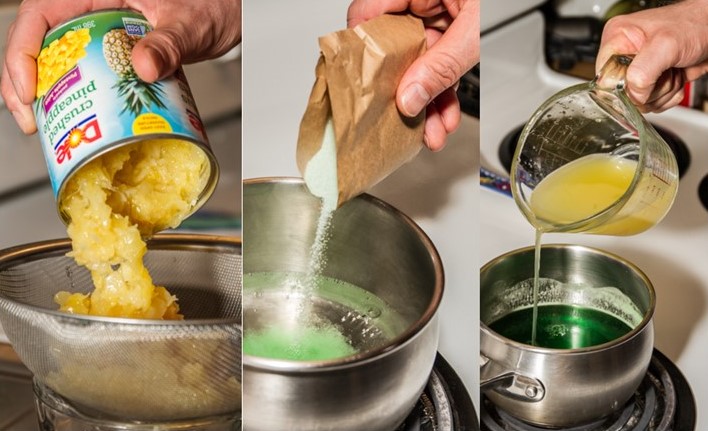
Once the ingredients are gathered, the recipe comes together quite quickly. To start, you had to dissolve the lime jello in a cup of hot water, then mix it with the pineapple juice and pour a thin layer of the liquid into the mold. Once done, the mold had to be left in the refrigerator so that the jello solidifies a little.

Start by draining the crushed pineapples to extract the juice. Then, mix the packet of jello powder in a cup of hot water and add the reserved juice.

The first step of the recipe, preparing the lime jelly. (Photos by Ariane Gauthier)

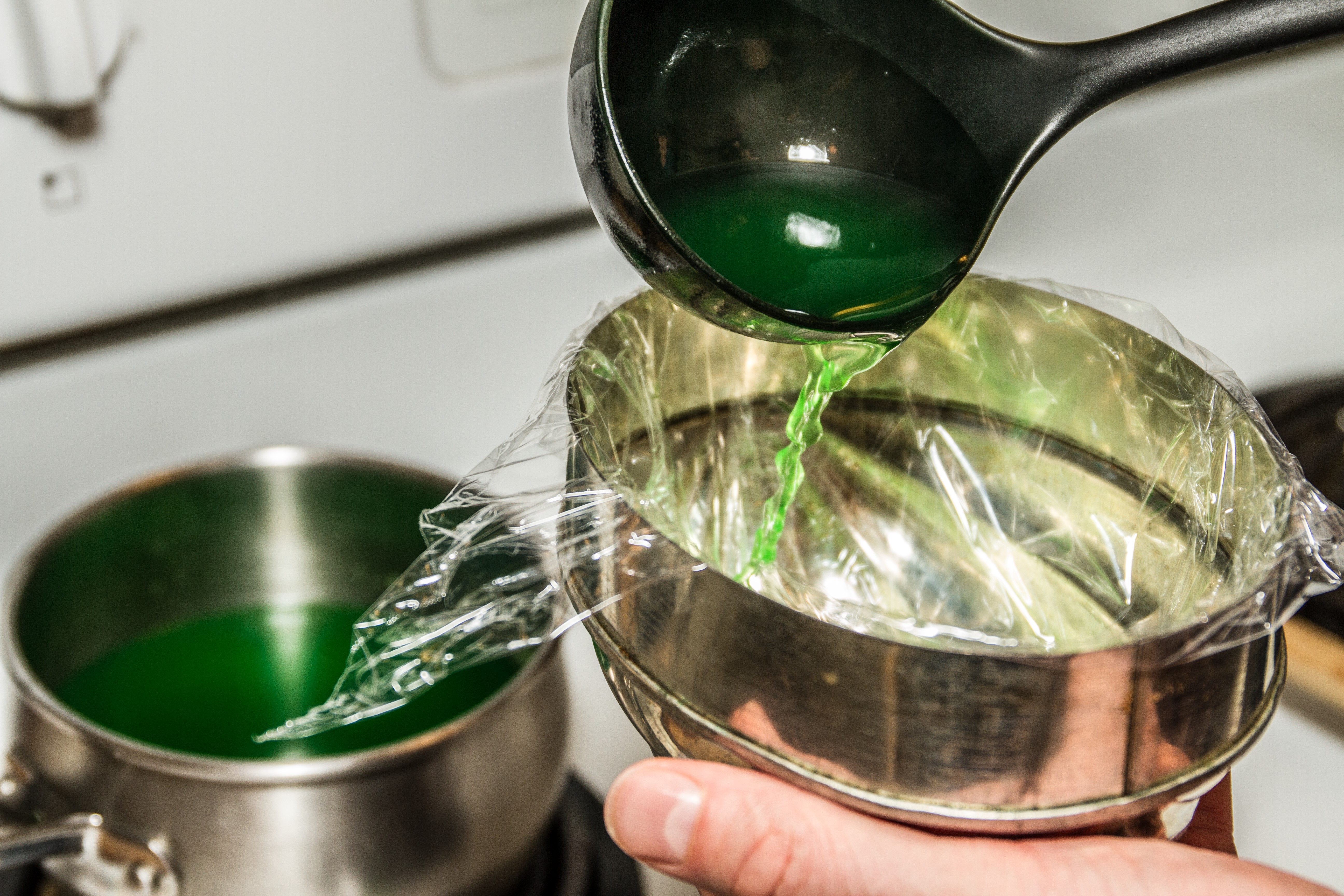
Once the first step is completed, you need to pour a thin layer of liquid jello into the mold and let it solidify in the refrigerator.

Pour in a ladle of the first layer of jello into the mold. (Photo by Ariane Gauthier)

In the meantime, I moved on to the next step. I combined the remaining liquid jello mixture with the lime and pineapple juice with the cream cheese. I blended it all until it was smooth, then I put the bowl in the refrigerator for about 30 minutes.

Combine the remaining jello-juice mixture with the cream cheese. Once completely incorporated, leave it in its bowl and put it in the fridge to thicken.

The second step of the pineapple-cheese salad recipe. (Photos by Ariane Gauthier)

This made it possible to thicken the liquid and incorporate the crushed pineapples and grated cheddar cheese evenly.  Afterwards, this mixture was added to the mold and left to rest in the fridge for a few hours.

Once the mixture has thickened, you need to add the pineapple and grated cheddar before placing everything in the mold.

The fourth step of the pineapple-cheese salad recipe. (Photos by Ariane Gauthier)

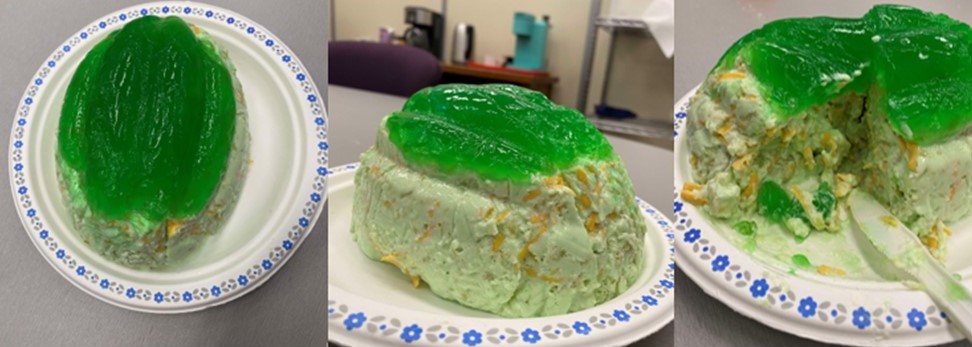
The next day, I brought the finished product to work and had the pleasure of unveiling the dish to my colleagues. Here is the result:

Pineapple-cheese salad in three steps.

Pineapple-cheese salad. (Photos by Mélanie Gauthier)

The moment the mold was flipped onto a plate, the reveal was met with the sound of worried, and even a little disgusted, “oohs” and “aahs.” I don’t know why, but I expected the final product to be more yellowish than green. I took the first bite in front of my colleagues and was able to encourage another person to try the so-called “salad.” His comment perfectly captured my own impressions. He said, “it is the unholy trinity: disgusting temperature, texture, and taste.”

In the end, only five of us dared to try the dish. The others simply endured the intense smell of cream cheese and the wretched experience of cutting through the gelatin.

This is the first recipe that I do not recommend you try. However, despite this failure, I still believe that it is possible to create a delicious jelly or aspic recipe.

Feel free to share your creations in the comments or by using the hashtag #CookingWithLAC and tagging our social media: FacebookInstagramX (Twitter)YouTubeFlickr and LinkedIn.

Additional resources


Recipe – Pineapple-cheese salad

1 packet of lime-flavoured powdered jelly
1 cup of hot water
1 cup of crushed canned pineapple
1 8 oz package of Philadelphia Cream Cheese
1 8 oz package of Cracker Barrel Old Cheddar Cheese
Curly endive or lettuce

  1. Dissolve the lime jelly powder in hot water. Drain the pineapple; measure the juice and add cold water to obtain 1 cup. Add to the lime jelly, then pour a small amount (enough to make a thin layer at the bottom) into a 6-cup star-shaped mold, or any other fancy-shaped mold. Leave to cool in the refrigerator.
  2. Meanwhile, soften the cream cheese. Gradually add the remaining jelly mixture to the cream cheese, stirring until smooth. Refrigerate until the mixture thickens slightly.
  3. Grate the Cracker Barrel brand cheddar cheese.
  4. Add the grated cheese and crushed pineapple to the slightly thickened cream cheese mixture. Pour over the firm jelly layer in the mold. Let cool in the refrigerator until the jelly is firm.
  5. Unmold onto a serving dish. Garnish with curly endive or lettuce.

Serves 6 portions.


Ariane Gauthier is a reference archivist in the Access and Services Branch at Library and Archives Canada

Federal Indian Day Schools: Education under the Indian Act—what did this mean for Métis Nation and Inuit children?

Version française

By William Benoit and Alyssa White

This article contains historical language and content that may be considered offensive, such as language used to refer to racial, ethnic and cultural groups. Please see our historical language advisory for more information.

The federal government, in cooperation with the Roman Catholic, Anglican, United and Presbyterian churches, operated nearly 700 Federal Indian Day Schools (Day Schools) across the country, in every province and territory except for Newfoundland and Labrador. They operated from the 1860s to the 1990s. Unlike Indian Residential Schools, Day Schools were only operated during the day. However, their purpose was like that of their residential counterparts: to assimilate First Nations, Inuit and Métis Nation children into white society and by extension erase their Indigenous languages and cultures.
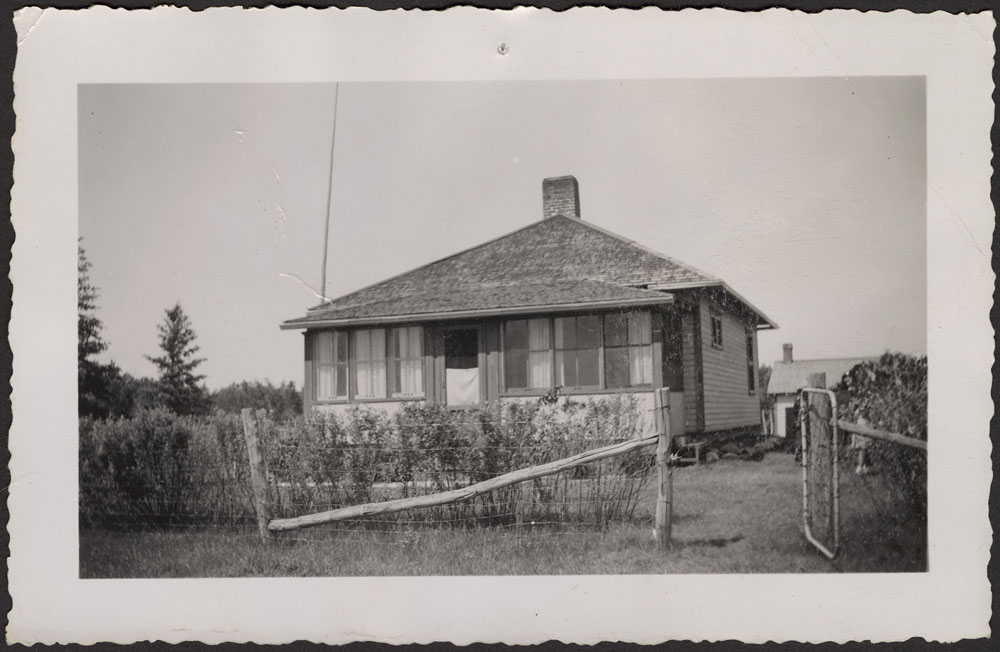
Black-and-white photograph of a white-frame bungalow with a hip roof located behind a wire fence with wooden posts and an opened metal gate.

Fishing Lake Day School, near Wadena, Saskatchewan, ca. 1948. (e011080261)

Many Indigenous students who attended Day Schools faced verbal, physical and sexual abuse during their time in that system. In addition, communities were not given a say in the curriculum or how the schools were run. It was not until the 1970s, 1980s and 1990s—when the federal government started transferring control of Day Schools to the First Nations and Inuit they ostensibly served—that these communities had any management over what and how their children were taught.

Crown-Indigenous Relations and Northern Affairs Canada estimates that between 180,000 and 210,000 individuals attended a Federal Day School between 1923 and 1994, based on historical departmental enrolment data and actuarial expertise. The system did not impact all First Nations, Inuit and Métis Nation in the same fashion. The largest percentage of students was First Nations, with Inuit and Métis Nation students representing smaller percentages. Each group had a unique relationship with the federal government – including whether or not the government would acknowledge the Métis or Inuit as being part of their educational or financial responsibility – and distinctive difficulties and problems were created not just in the educational services the government purported to provide to Canada’s Indigenous Peoples, but also in the care and consistency with which they kept their records.

This article will discuss the impact of the Federal Day Schools upon Métis Nation and Inuit communities, as their experiences were different and often less documented than those of First Nations.

Métis Nation children at Federal Indian Day Schools: numbers are not determinable

Did Métis Nation children attend Federal Indian Day Schools across Canada? The answer is yes, though determining the number of identifiable Métis students is practically impossible. But one can safely assume that Métis and non-Status Indian students residing in the catchment areas of Federal Indian Day Schools may have attended those schools. This is particularly probable if there was no provincial or church-run school in the vicinity for those children to attend.

The federal government has focused its attention on individuals who fall under the Indian Act. Historically, it speaks most of those who have Indian Status and less of those whom it identifies as Métis and non-Status Indian. This glib observation is key to any discussion of Métis attendance at Federal Indian Day Schools. It speaks to historical Métis access to education, health programs and other government services. Métis and non-Status individuals have been subjected to what has been referred to as a “jurisdictional wasteland” and “tug-of-war,” since both the federal and provincial governments have denied responsibility for, and legislative authority over, these peoples.

The Indian Act

One must also consider the larger discussion of status as defined by the Indian Act and how it impacts the self-identity of Indigenous peoples.

Under the Indian Act, Status Indians are wards of the Canadian federal government, a paternalistic legal relationship that illustrates the historical imperial notion that Indigenous peoples are like children, requiring control and direction to bring them into more “civilized” colonial ways of life. Federal Indian Day Schools, like Indian Residential Schools, were the federal government’s response to its need to control and direct its wards.

The Indian Act applies only to Status Indians and has not historically recognized Métis and Inuit. As a result, Métis and Inuit have not had Indian status and the rights conferred by this status, despite being Indigenous and participating in Canadian nation-building.

History and context surrounding the identification of Métis Nation children

Accurate attendance numbers of non-Status Indians (First Nations), Métis and Inuit are dependent on whether the federal government acknowledged its legal responsibility to legislate on issues related to them. For Inuit, the government’s legal obligation is usually considered to begin in 1939, following the Supreme Court decision in Reference as to whether “Indians” includes “Eskimo” (1). For Métis and non-Status Indians, the date is 2016, when the Supreme Court ruled that they should also legally be considered “Indians” under the Constitution Act (2).

Federal government records reflect the sad fact that little, or no data was collected when there was no legal obligation to serve these communities. Consequently, Federal Day School records created between the 1860s and the 1990s do not clearly identify Métis and non-Status students. A similar point could be made for Inuit prior to 1939. Unfortunately, this means that government records do not provide a clear understanding of the numbers of Métis children who attended Federal Indian Day Schools.

Inuit children at Federal Indian Day Schools: taken far from family and home

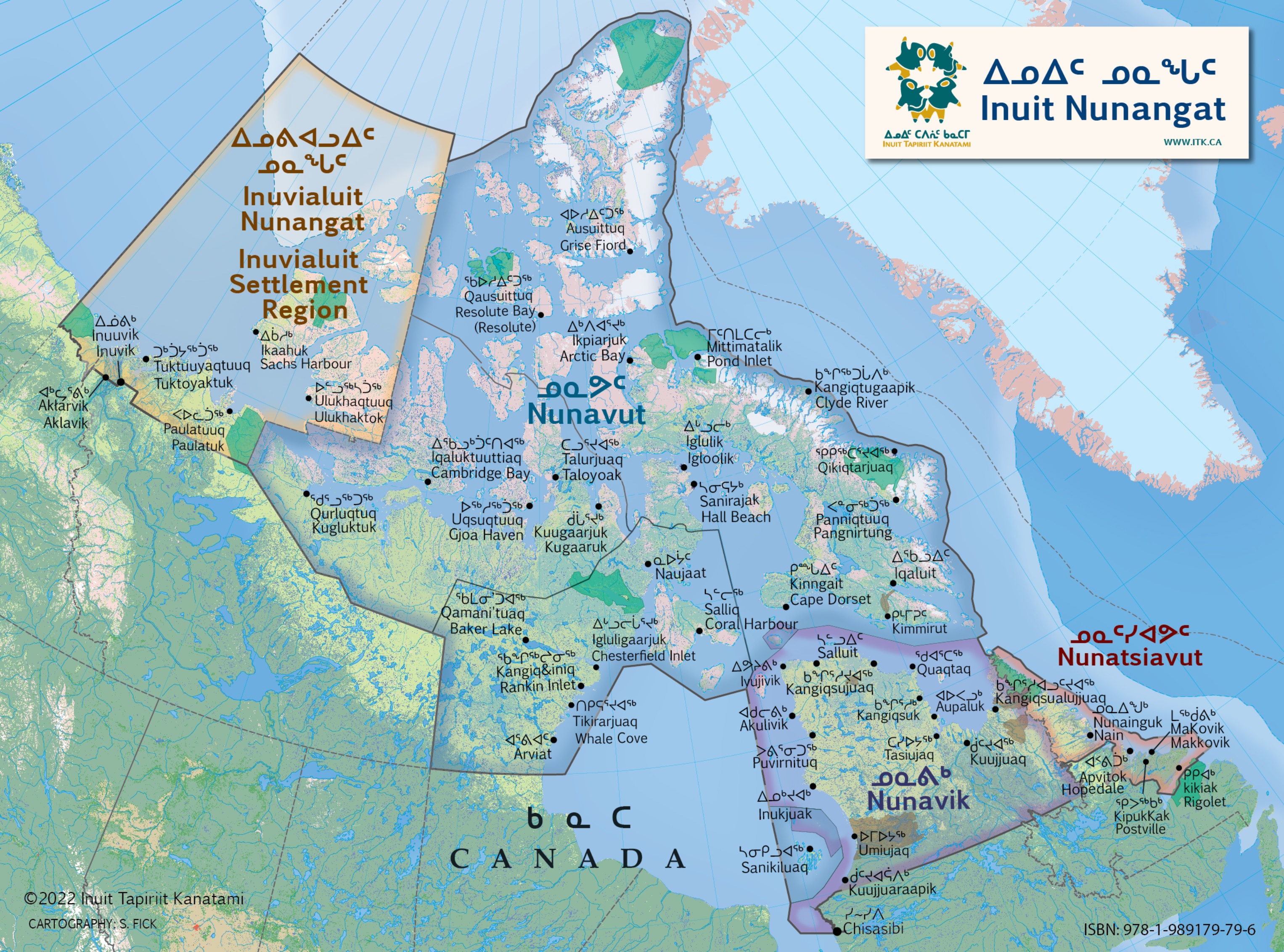
Today, four regions make up Inuit Nunangat: the Inuvialuit Settlement Region (northern Northwest Territories), Nunavut, Nunavik (northern Quebec) and Nunatsiavut (northern Labrador). While the earliest Federal Day Schools in southern Canada were opened in the early 1860s, the opening of schools in Nunavut did not occur until the late 1940s through mid 1950s.

Graphic image of a map. The land mass is light green and the areas showing water are blue. The community names are written in Inuktitut syllabics, followed by the Inuit name and the English name.

Map of Inuit Nunangat (Inuit homeland). Courtesy of Inuit Tapiriit Kanatami.

Some of the closest school options for Inuit children would have been at Old Crow Village (Yukon), Fort Simpson (Northwest Territories), Churchill (Manitoba), Fort Severn (Ontario) and Fort George (Quebec), but these schools were not necessarily permanent. It was not uncommon for remote Day Schools to close periodically for years.

In contrast to Indian Residential Schools (or Federal Hostels), which housed students on site and away from their families and homes, Day Schools were built so that students would be able to return home after their school day and not be required to travel extended distances to live elsewhere for months at a time. The catch to this was that Day Schools were typically only built on or near First Nation communities, with little consideration of Inuit communities and students until the 1940s.

Although Day Schools were intended to prevent separation and alienation, Inuit children would end up being taken, sometimes suddenly and without warning for extended distances to live elsewhere to attend a Day School. The schools were often located in areas with completely different climates, ecosystems, social cultures and languages, with unrecognizable plants or animals. Shock would be too gentle a word to describe the sense of alienation those children must have felt on arrival.

This picture below, by all appearances, shows a happy moment caught on film: two smiling boys enjoying a day out with their families to see an airplane in the hamlet of Iglulik. What this photograph does not show is what happened minutes later, when the boys were put onto the plane and taken 800 kilometres away to Sir Joseph Bernier Federal Day School in Igluligaarjuk (Chesterfield Inlet) without any prior knowledge of what was about to happen. (3)
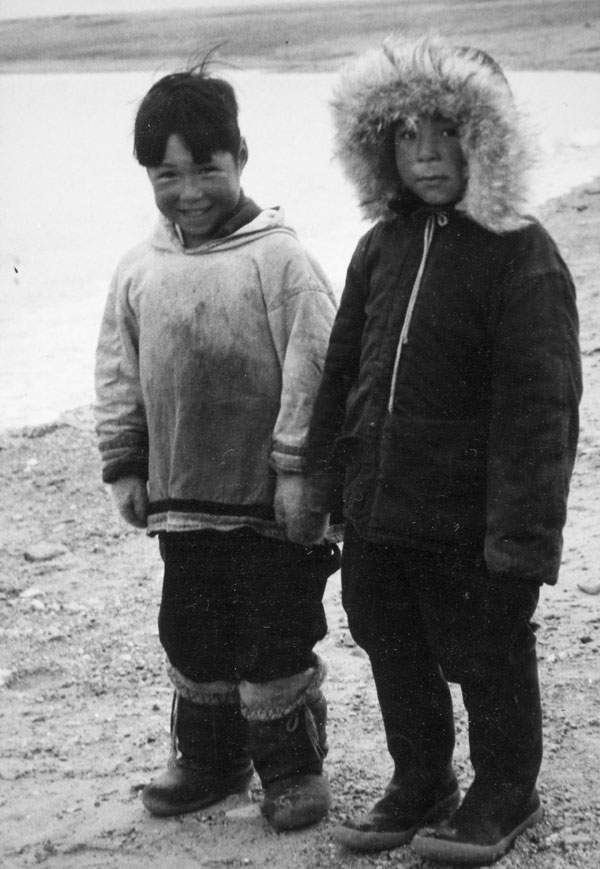
Black-and-white photograph of two boys standing on a shoreline looking at the camera.

Kutik (Richard Immaroitok) and Louis Tapadjuk (right), Iglulik, Nunavut, 1958. (e004923422)

Considering that school attendance was compulsory by the 1920s, one can imagine the compounded stress and fear experienced by Inuit families when it came to federal control of their children’s education.

Day Schools in the North were not large facilities, commonly consisting of one to three classrooms and a teacherage, facilitating anywhere from eight to two dozen students at a time depending on location and local population. Once a school was full, any additional children in the area would have been sent further south and west until room could be found for them.
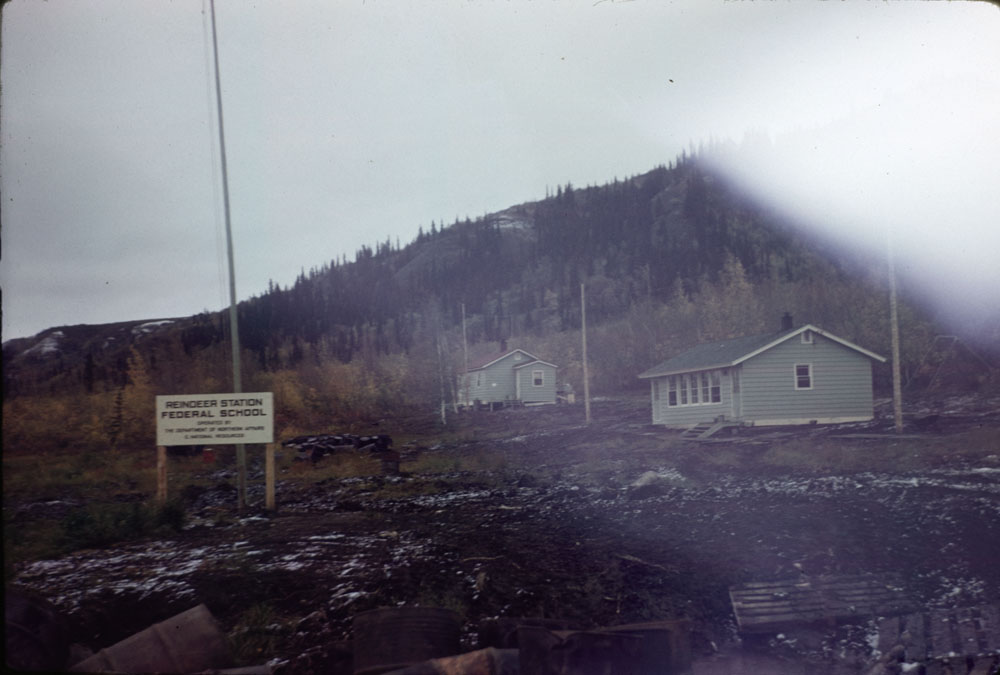
Colour photograph of two one-story frame buildings painted pale green located on a rocky foreground with a large tree-covered hill in the background. There is a white sign with black lettering mounted on wood posts on the left side.

Reindeer Station Day School, Qunngilaaq, Northwest Territories, between 1950 and 1960. (e011864959)

Children who did not have access to a local Day School were sent to residential, boarding or foster homes in communities ranging anywhere from hundreds to thousands of kilometres away from their families and everything that was familiar to them. They would be handed over to the care and keeping of total strangers, in places that would have been entirely strange to them, that they were not free to leave. Visits from family were not guaranteed due to travel costs and time. This meant that Inuit students were separated from their families not just for months but occasionally for years at a time.

Between the 1940s and 1980s, more schools were built across the country, including locations in the far North, such as those serving the remote communities on the southern shore of Ellesmere Island and Resolute Bay in Nunavut.

To give a better idea of the spread and demographics of Day Schools in Canada and the struggles of remote communities, of the 699 Day Schools on record, a total of 75 were opened across the combined land masses of the Yukon, Northwest Territories, Nunavut and northern Quebec. Only seven of those existed prior to the 1940s (in the Yukon and Northwest Territories), with the other 68 being built between 1940 and 1969.

The Day Schools Project

The Day Schools Project (DSP) is identifying, describing, digitizing and making accessible government records that include information pertaining to Federal Indian Day Schools. The project’s goal is to prepare these files and documents for public access.

The records being digitized include nominal rolls from various schools across Canada as well as information regarding foster homes, boarding homes, hostels, transfer requests and authorizations, adoption records and school discharge records. These can be used to trace the trail of schools and homes that many Indigenous children passed through.

It is important to note that most of the Day Schools records are restricted by law but can still be accessed according to access to information and privacy legislation. The DSP is trying to build foundations to make access to records as easy as possible. This includes identifying ways to make current procedures and resources easier for people to understand and navigate, for example, by adding detailed information to the archival records. To learn more about accessing records digitized by the DSP, see the Day Schools Project: Overview and the Day Schools Project: Research Guide.

Besides making information more accessible to Indigenous communities, Day School records can be accessed by the public, many of whom were never taught about these histories and as a result never truly understood the scope of the scars they have left behind.

Ultimately, First Nations, Inuit and the Métis Nation need access to the histories for healing, finding closure and continuing the work of building towards their futures. The general Canadian public needs access to these histories to better understand the realities of how this country was formed and to support a future that is and does better for all its people.

The road to reconciliation is long, but the key to progress is in access to information and public education. Indigenous data sovereignty and community access to documents remain some of the greatest hurdles still to overcome.

Additional resources (Library and Archives Canada)

External resources

References

  1. Reference as to whether “Indians” includes “Eskimo,”1939 CanLII 22, [1939] SCR 104 is a decision by the Supreme Court of Canada regarding the constitutional status of Inuit in Canada. The case concerned section 91(24) of the Constitution Act, 1867, then the British North America Act, 1867, which assigns jurisdiction over “Indians, and Lands reserved for the Indians” to the federal government. The Supreme Court found that for the purposes of section 91(24), Inuit should be considered Indians.
  2. Daniels v. Canada (Indian Affairs and Northern Development), 2016 SCC 12, [2016] 1 SCR 99 is a decision by the Supreme Court of Canada regarding the constitutional status of Métis and non-Status Indians in Canada. The Métis Nation and non-Status Indians are also “Indians” under s. 91(24). The Supreme Court of Canada ruled in Daniels v. Canada that the federal government, rather than provincial governments, holds the legal responsibility to legislate on issues related to Métis and non-Status Indians. Section 91(24) of the Constitution Act, 1867 concerns the federal government’s exclusive legislative powers.
    Note: Recognition as Indians (First Nation individuals) under this section of law is not the same as Indian status, which is defined by the Indian Act. Therefore, the Daniels decision does not grant Indian status to Métis or non-Status peoples. However, the ruling could result in new discussions, negotiations and possible litigation with the federal government over land claims and access to education, health programs and other government services.
  3. Greenhorn, Beth. “The Story behind Project Naming at Library and Archives Canada.” In Atiquput: Inuit Oral History and Project Naming, edited by Carol Payne, Beth Greenhorn, Deborah Kigjugalik Webster and Christina Williamson, 70-71. Montreal and Kingston: McGill-Queen’s University Press, 2022.

William Benoit is the Indigenous Advisor on the Day Schools Project.
Alyssa White is an Archival Assistant on the Day Schools Project.

Understanding Day School Records at Library and Archives Canada

Version française

By Marc St. Dennis

This article contains historical language and content that may be considered offensive, such as language used to refer to racial, ethnic and cultural groups. Please see our historical language advisory for more information.

The Day Schools Project at Library and Archives Canada aims to identify, digitize, and describe records related to the federal Indian Day Schools (hereafter Day Schools) system, making them more accessible for survivors, their families, and researchers. Many First Nations, Inuit, and Métis Nation children attended these schools, which were part of a broader system of colonial assimilation policies. The first federally funded Day Schools were established in the 1870s, with the last closing or transferring to community control in the early 2000s. The Day Schools Project began in 2022 and is set to conclude in 2026.

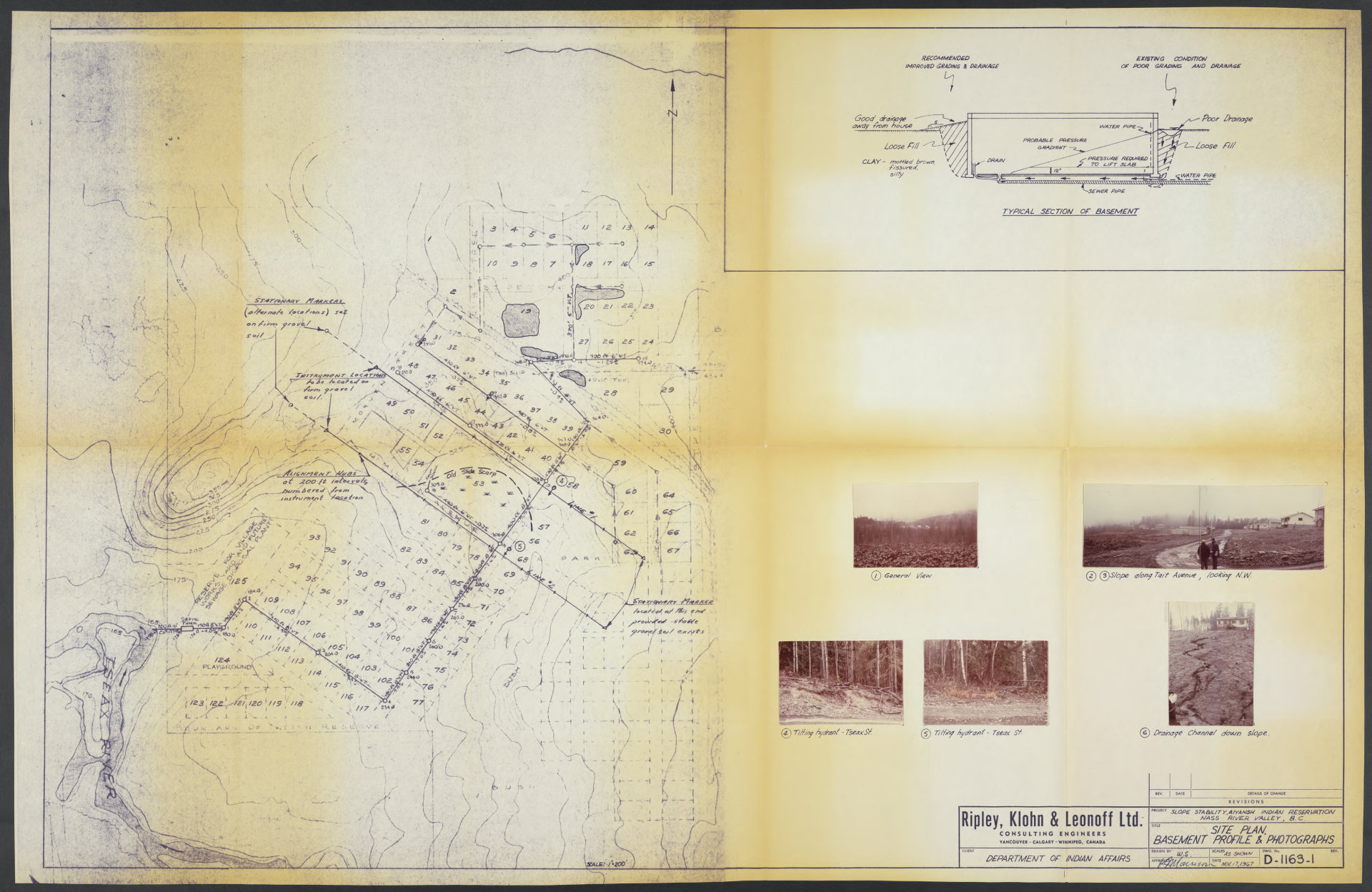
A site map and technical plan with five black-and-white photographs on discoloured yellow paper.

Site and technical plans and photographs of Aiyansh Day School, near Terrace, British Columbia, 1967, RG22, box number 10, file number 2909. (e011814153)

As an archivist working on this project, I spend my days digging through historical records—some fascinating, some routine, and some that carry the weight of the past. If you’ve ever wondered what kinds of documents are tucked away in these files, you’re in the right place.

Researching Day Schools can feel a bit like detective work. You open a file hoping for a clear answer, but instead find administrative reports, financial records, health records, and maybe even a surprise or two—like a hand-drawn school layout sketch on the back of an old memo. The key to understanding these records is knowing what types of documents exist and what they can tell us.

Uncovering Injustices in the Records

While some records may seem routine, they often reveal deeper injustices. Day Schools were part of a system that sought to assimilate First Nations, Inuit, and Métis Nation children, often through harsh discipline, inadequate resources, and a disregard for students’ well-being. Unlike Residential Schools, Day School students returned home (parental or other) in the evenings, but this did not mean they were spared from mistreatment, neglect, or abuse.

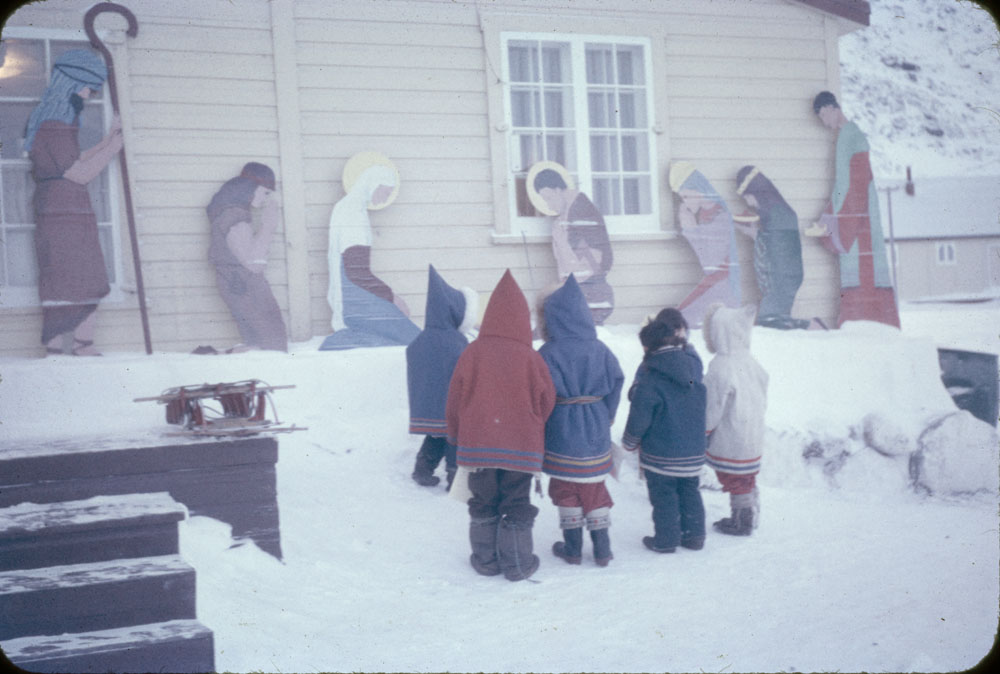
Colour photograph of six children standing in the snow, wearing red, white, or blue parkas, with their backs to the viewer as they look at a wooden nativity scene leaning against a framed building.

Inuit children in front of a nativity scene, Pangnirtung Day School, Nunavut, between 1950 and 1960, Joseph Vincent Jacobson and family fonds. (e011864991)

Many former students recall physical, emotional, and even sexual abuse at these schools. Some files contain evidence of these injustices, including complaints made by parents, records of punishments, or internal reports on misconduct. However, it’s important to recognize that records often reflect the institutional bias of school staff and the federal government. School administrators, teachers, and government agents were more likely to document disciplinary actions in ways that justified their own behaviours rather than acknowledging harm done to students. Reports may downplay or dismiss allegations of abuse, and language in official records often reflects the prejudices of the time, portraying Indigenous students as problematic or difficult rather than victims of systemic mistreatment.

Similarly, events and policies described in these records may be framed in a way that serves the interests of the government rather than reflecting the true experiences of students. For example, improvements in school conditions may be presented as sufficient responses to systemic neglect, even when students continued to face serious hardships. Researchers must approach these documents critically, understanding that what is written on paper does not always align with the lived realities of those who attended these schools. Context is essential—by reading between the lines, cross-referencing sources, and centring survivor testimonies, we can gain a more accurate picture of the injustices that took place.

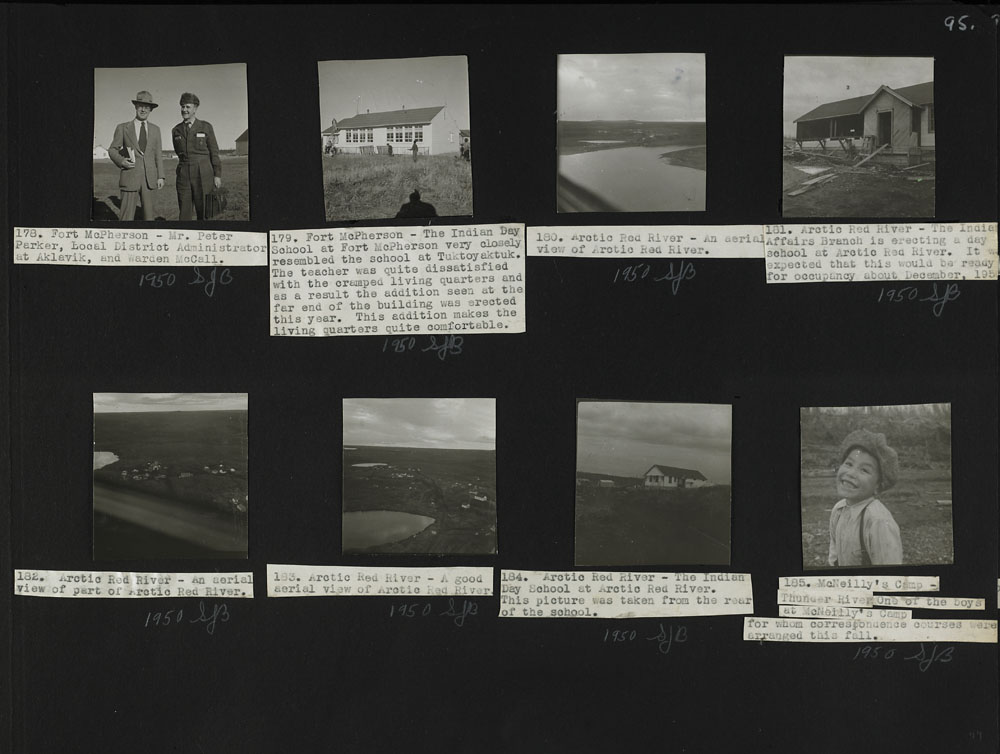
Black album page with eight black-and-white photographs mounted on two rows with typewritten descriptions on white paper below each one.

Photographs taken at Tetl’it Zheh (formerly known as Fort McPherson) and Tsiigehtchic (formerly known as Arctic Red River), and in the vicinity of Thunder River, Northwest Territories, the former Department of Indian Affairs, R216, RG85, volume 14980, album 37, page 95. (e010983667)

What’s in the Records

The records we work with come from government departments, school administrators, and other officials involved in the operation of the Day Schools system across Canada. These files provide a detailed picture of what these schools were like, who attended them, how they were run, and the challenges that students faced.

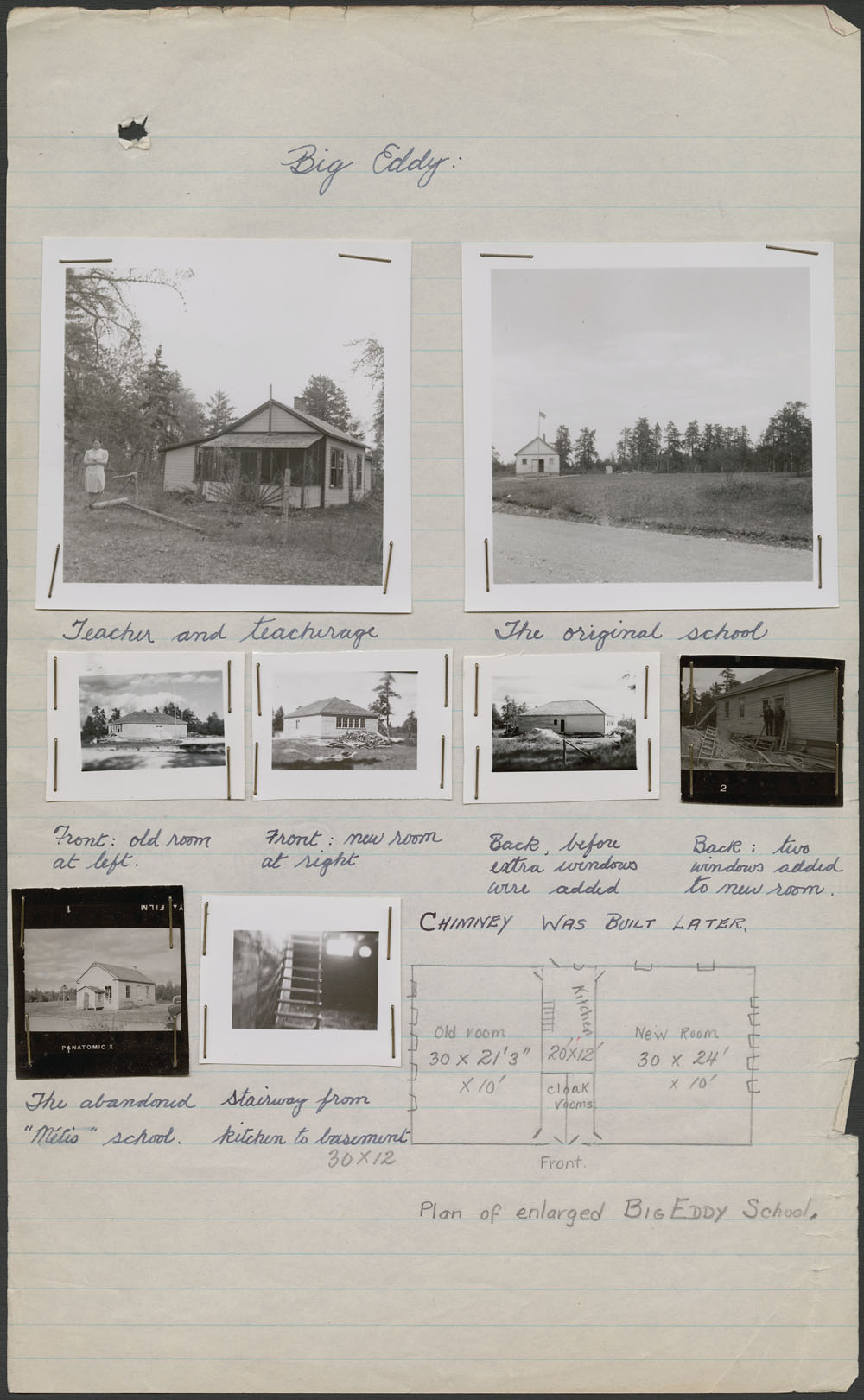
Cream coloured sheet of paper with blue lines with seven black-and-white photographs mounted on three rows, and a hand-drawn architectural plan on the third row. Below each photograph is a handwritten caption in blue ink.

Big Eddy Day School, The Pas, Manitoba, ca. summer 1947, the former Department of Indian and Northern Affairs. (e011078102)

The documents left behind tell a complex story of daily life in these schools. Attendance reports and lesson plans provide glimpses into the classroom, while report cards reflect both student progress and the biases of the system. Medical reports and sanitation records reveal the often-poor conditions children endured, and financial ledgers expose how resources were allocated—or withheld—impacting the quality of education and care.

Letters and memos paint a picture of strained relationships between school staff, government officials, and families. Agreements between governments and school operators illustrate the shifting responsibilities and lack of accountability, while resignation letters hint at the high turnover of teachers. Maintenance reports document deteriorating buildings, and truancy records show how students were monitored and disciplined—often harshly.

Please keep in mind that individual student files might not contain all these types of records.

Together, these records provide crucial context for understanding the experiences of First Nations, Inuit, and Métis Nation students at these schools, uncovering both the daily realities and the broader systemic injustices they faced.

How These Records Support Truth and Reconciliation

Understanding what happened in Day Schools is crucial to reconciliation. Survivors have shared their experiences, and historical records provide documented evidence that supports their truths. These files are essential for several reasons:

  • Legal claims: Survivors who made claims under the Federal Indian Day Schools Settlement Agreement used these records to help verify their attendance at a specific school or provide supporting documentation for their experiences.
  • Family history: Descendants of Day School students can use these records to learn more about their relatives’ education and experiences.
  • Academic research: Scholars and historians studying the impact of these schools on Indigenous communities rely on these records to uncover policies, funding disparities, and systemic mistreatment.
  • Public awareness: Making these records accessible ensures that Canada does not forget this painful chapter of its history and helps promote broader understanding and accountability.

If you’re researching Day Schools—whether for family history, legal claims, or academic work—these records can be invaluable. But archival research requires patience. Documents might be incomplete, handwritten notes can be hard to decipher, and government jargon is… well, let’s just say it’s not always user-friendly.

That’s where we come in. The Day Schools Project team at Library and Archives Canada is working hard to describe these files to make them more accessible. Due to privacy laws, we cannot include names of students or school staff in descriptions. However, when files do contain names, we add a note to inform researchers. The descriptions include names of schools, communities, the types of documents contained in the file, and whether there are photographs, drawings, maps, or plans. This information is fully searchable. Most importantly, we want researchers to understand what’s in these records and how to navigate them.

So, if you find yourself knee-deep in correspondence about school boiler repairs, don’t worry—you’re on the right track.

Additional Resources (Library and Archives Canada)

External Resources


Marc St. Dennis worked as an archivist on the Day Schools Project at Library and Archives Canada from January 2024 to March 2025.