New to Chinese Canadian genealogy: C.I.44 records of registration

Version française

By June Chow

July 1, 2023, marks 100 years since the Chinese Immigration Act, 1923, commonly known as the Chinese Exclusion Act, was passed into law. Library and Archives Canada (LAC) has recently opened and digitized records arising from the Act’s mandatory registration of “every person of Chinese origin or descent in Canada.”

The first Chinese people arrived in Canada as artisans in 1788. From 1858 to 1885, a significant number of Chinese labourers came to complete the Canadian Pacific Railway across British Columbia. The Canadian government’s restrictions on Chinese immigration began thereafter with passage of the Chinese Immigration Act, 1885. Until its repeal in 1947, this legislation underwent many amendments to discourage immigration from China. Early amendments in 1900 and 1903 increased the amount of the Chinese head tax as a financial barrier. The last amendment, in 1923, banned all further Chinese immigration. In this blog post, I will refer to the Chinese Immigration Act, 1923 as the Chinese Exclusion Act, or simply “the Act.”

Newly opened Chinese immigration records: C.I.44

LAC’s holdings include extensive Chinese immigration records from this important period for Chinese Canadian genealogy. These include ledgers and forms on the registration and identification of Chinese people upon entry, and on their movements in and out of the country.

Of special interest is the recent opening of previously restricted C.I.44 forms created through section 18 of the Chinese Exclusion Act. It required “every person of Chinese origin or descent in Canada” to register with an immigration, customs or Royal Canadian Mounted Police authority within 12 months of the passing into law of the Act on July 1, 1923.

Section 18 was translated into Chinese and posted as a 69 cm by 123 cm (approximately 2 ft. by 4 ft.) public notice with a list of registrars across Canada. Those who failed to comply with registration were “liable to a fine not exceeding five hundred dollars, or to imprisonment for a period not exceeding twelve months, or to both.”
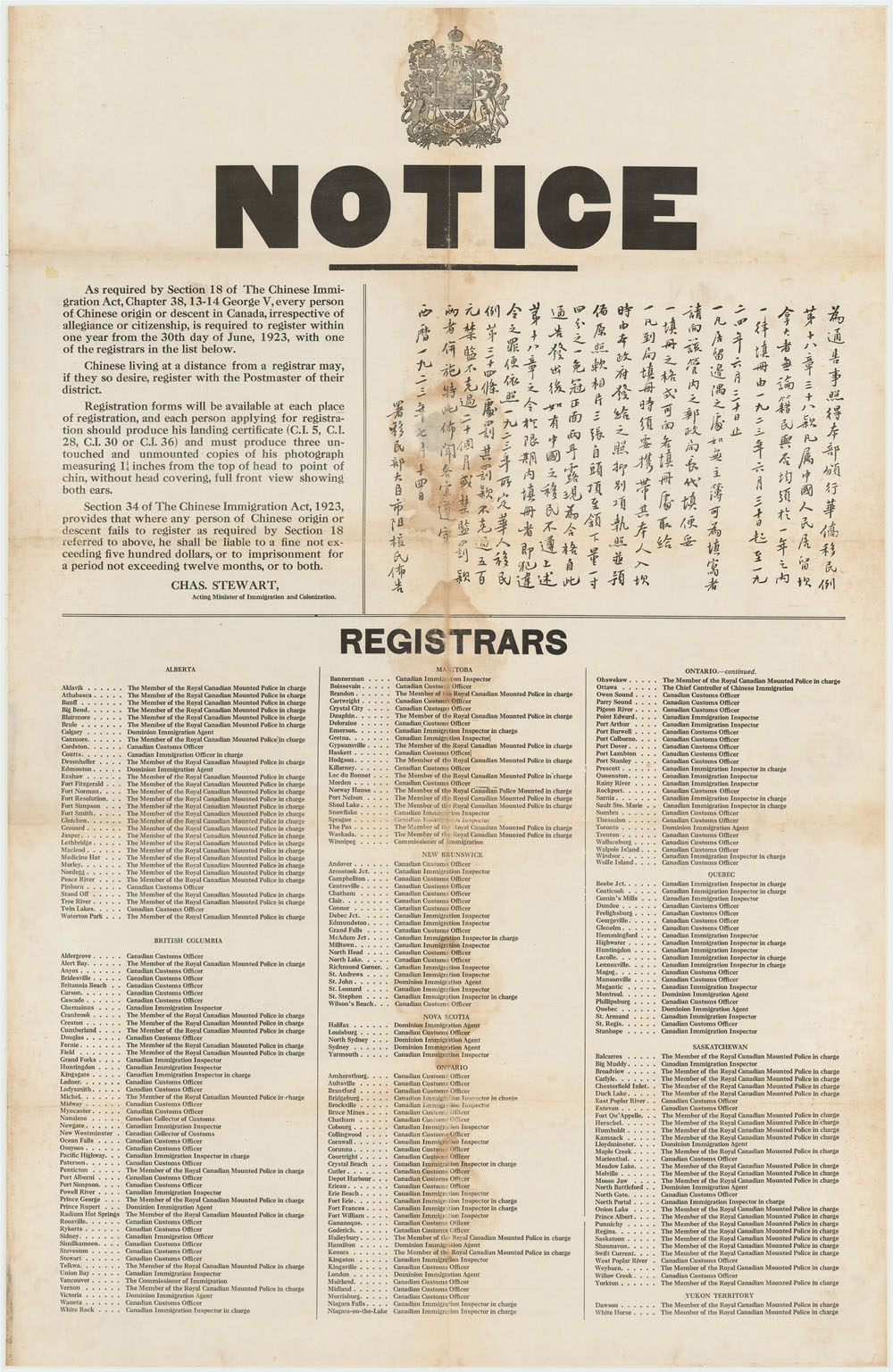
A poster typeset in English with handwritten Chinese text. The word “NOTICE” appears in large, bold, capitalized letters across the top under the Royal Coat of Arms of Canada.

Poster on Chinese immigration giving public notice of section 18 of the Chinese Exclusion Act and its registration requirement (e010833850)

Each registration was documented in a one-page form numbered “44” in the government’s Chinese Immigration (C.I.) recordkeeping series. By the one-year registration deadline of June 30, 1924, over 56,000 Chinese people living in Canada were registered, each recorded by a C.I.44 form. A further 1,500 Chinese people who were absent from Canada registered upon their authorized return. The last form was completed in 1946, a year before the Act was repealed.

The C.I.44 form is a significant addition to Chinese Canadian genealogy resources. It records an ancestor’s name and known alias(es), address, occupation, age, marital status, and the name and address of their spouse and/or children in Canada, and it includes a photograph.

For those of Chinese origin (born in China), the form consolidates information on the individual’s entry into Canada. This includes their place of birth (village/city and district/province in China), original port of admission, conveyance (ship), original date of arrival, amount of head tax paid, and serial number of C.I. landing or replacement certificate in their possession (C.I.5, 28, 30 or 36). This information is otherwise dispersed in LAC collections, across Chinese immigration records and passenger lists.

The form also recorded the individual’s height, any facial marks and physical peculiarities, remarks made by the immigration official, and any existing file numbers.
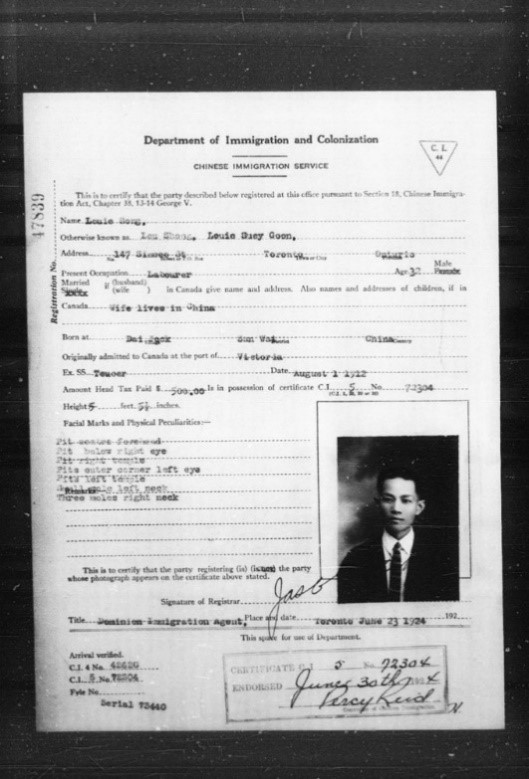
A black-and-white typeset form with typewritten text and handwritten authorizations. The form includes a portrait photograph of a man dressed in a tie, collared shirt and jacket.

C.I.44 form of Louie Song, 1924; RG76-D-2, Reel T-16181, Image 01453

Those born in Canada of Chinese descent were identified by the government as “native-born,” and a number of sections of the C.I.44 form did not apply to them. These individuals were predominantly minor children in the registration year. Their birthdate, details of birth registration and names of parents in Canada often appear as remarks.
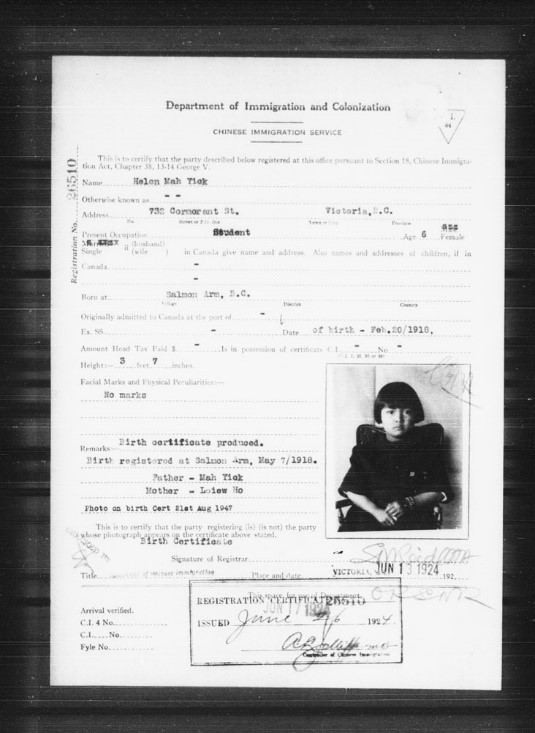
A black-and-white typeset form with typewritten text and handwritten authorizations. The form includes a portrait photograph of a young girl sitting in a chair.

C.I.44 form of Helen Mah Yick, 1924; RG76-D-2, Reel T-16174, Image 00690

Access and search C.I.44 records

The C.I.44 records are an important resource for Chinese Canadian genealogy and research on Chinese Canadian history. Each C.I.44 form records where in Canada an ancestor had settled, what work they were doing and their family structure. Often they were using an English or Anglicized name (alias) to fit into Canadian society; their photograph shows how they were grooming and dressing themselves in the Western style.

As a result, these records document settlement patterns of Chinese people in Canada. Taken together, they provide a comprehensive snapshot of the Chinese Canadian community as it entered its darkest period, defined as the 24 years that the Chinese Exclusion Act was in force.

Search these records if your ancestor was:

  • Chinese (immigrant or native-born) AND EITHER
  • living in Canada in 1923/1924 OR
  • living abroad in 1923/1924 and legally returned to Canada before 1947

The C.I.44 records consist of 29 digitized microfilm reels with the C.I.44 forms and a corresponding index card system. They can be searched manually or as indexed by FamilySearch and Ancestry.

Additional resources


June Chow is Community Archivist for The Paper Trail to the 1923 Chinese Exclusion Act, a community-based commemoration that spans a public exhibition, a community-based archival collection and the engagement of public archives. The Paper Trail team initiated the opening of these records through an access to information request in 2021. June subsequently spent time at LAC on their access as a Master of Archival Studies student in the University of British Columbia School of Information prior to her recent graduation. She is now also working as a Special Collections Archivist with the Chinese Canadian Archive at the Toronto Public Library.
Soundscapes of the Stanley Grizzle Interview Collection

By Stacey Zembrzycki

This article contains historical language and content that some may consider offensive, such as language used to refer to racial, ethnic and cultural groups. Please see our historical language advisory for more information.

It is rare, when listening to oral history interviews, for the soundscape, the noises that one hears in the background, to be just as interesting and important as the stories being shared by interviewees. Practitioners today are trained to conduct interviews in quiet spaces, limiting noise so that every word spoken is clear and easy to understand. The crispness of each voice matters since it determines the life an interview will have among future listeners and within multimedia projects.

The Stanley Grizzle Interview Collection is fascinating because it flies in the face of this orthodoxy. When Stanley Grizzle travelled throughout the country documenting the stories of Canadian Pacific Railway (CPR) sleeping car porters, their fight to unionize and create the Brotherhood of Sleeping Car Porters (BSCP), and the important role of the women who served on the BSCP’s Ladies’ Auxiliary, he did so as an insider. A twenty-year CPR veteran, Stanley Grizzle conducted interviews that revolved around a clearly defined set of questions, which were replicated in each encounter. There were also, however, conversations among friends, many of whom Grizzle had worked with either on the railroad or during his time as a labour leader. Moving from home to home with a tape recorder that he started and stopped at will and at the request of interviewees, Grizzle instantly swept listeners into his world, where the formalities of the typical interview were cast aside, informal banter transpired, and drinks – complete with clinking ice cubes – were stirred in the background.

Grizzle’s insider knowledge both helped and hindered his ability to document the history of the BSCP. In most cases, he was immediately recognized as a “Brother.” Gaining trust was not difficult given the existence of prior relationships. As a result, many of the men tended to get right to the heart of what it meant to be a porter during the first part of the twentieth century. “Porter talk,” as Melvin Crump called it, allows listeners to see this world through the eyes of each porter with whom Grizzle met. It is an intimate look into a world that has now been lost. Viewing the job of a porter through this Black lens reveals how the men, and the women who supported them, thought about their everyday lives and viewed others. Ultimately, it also demonstrates the varied ways that they understood and negotiated societal inequality.

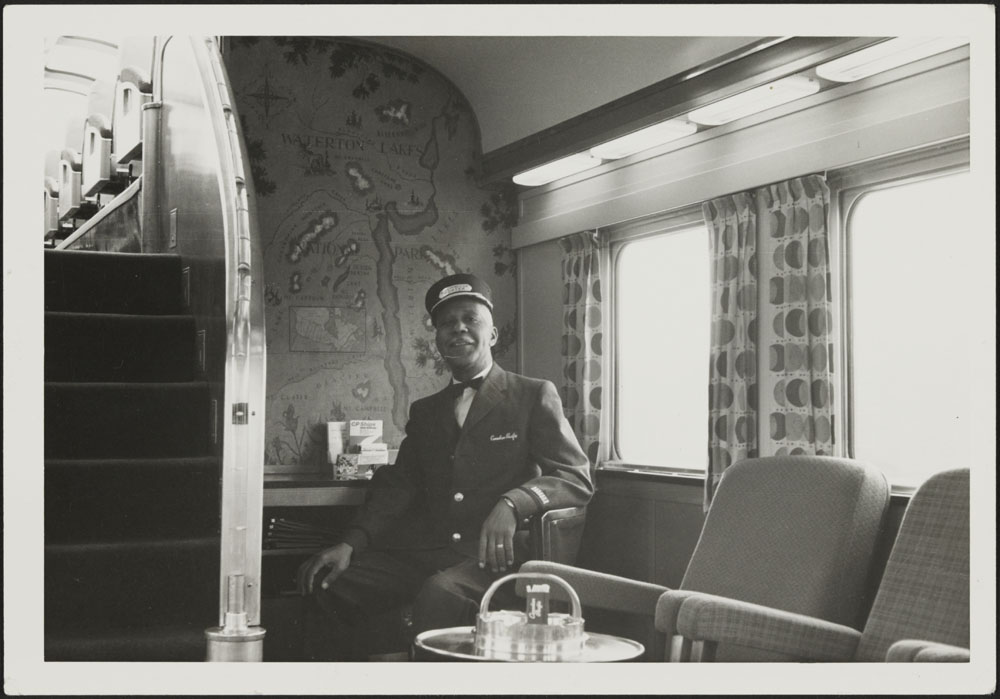
Canadian Pacific Railway sleeping car porter sitting in a train wagon.

Albert Budd, C.P.R., S.C. Porter, 1940s–1960s (e011781984)

Unfortunately, being an insider was not always beneficial. Given Grizzle’s own experiences, and his quest to document the history of the BSCP’s formation and of the men and women who made it possible, there were many missed opportunities along the way. In addition to Grizzle’s inclination to correct interviewees, stories pertaining to the fight for civil rights in the United States, experiences of migration, and some of the more problematic—and even controversial—issues that porters faced on the railroad are limited and, at times, absent from the record. The point was not to glorify porters’ diverse experiences, but there was a careful dance being done by those who recognized that reputations were at stake and the power that the company still wielded, despite the existence of the union, was real. In addition to these considerations, stories that should have been given space to be told were cut short given Grizzle’s objectives. Listeners hear the tape recorder stop and then restart at different stages in the life narratives being recounted. There is never any explanation. Listeners are left to try to listen for what was omitted, silenced, or simply lost to the past.

Nevertheless, along with these aspects of the interview, listeners are presented with wonderful opportunities to hear the ways that various sounds cut across these narratives and give us a way into a deeper understanding of who these interviewees were. Interviewees’ voices reveal the varied countries from which they descended. Heavy accents from America’s Deep South as well as those from a host of Caribbean nations tell us about lives lived elsewhere and the struggle of migrant labourers, who were often highly educated, to make a better life in Canada.

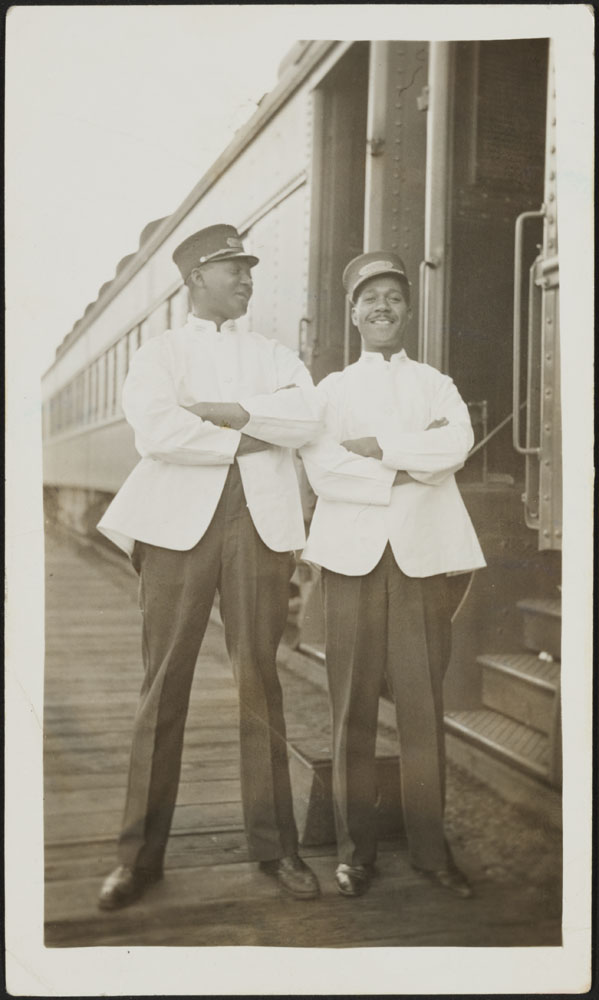
Two Canadian Pacific Railway sleeping car porters standing next to a train.

Left to right, Smitty from Montreal and Albert Budd (e011781983)

Everyday soundscapes also loom large. Radios and televisions wail alongside birds chirping in the background and children playing in neighbouring rooms. The banging of pots and pans reveals the presence of women in nearby kitchens, likely preparing a meal for their esteemed guest. The stomping of feet above the heads of Grizzle and his interviewees alongside the flushing of toilets speak to the substandard tenement housing from which some porters, then retired, were never able to escape.

We hear disability, too, when some stories are relayed. Heavy coughing and wheezing from smoking and its second-hand effects, as well as from years spent on the railcars, which picked up heavy amounts of pollutants through open windows, tell us about interviewees’ life choices in addition to the heavy toll this work took on their bodies. Men spoke of the disability pensions they collected as a result of the damage done to their backs by years of heavy lifting. On more than one occasion, Grizzle and his interviewees seem to be sitting in creaky wooden chairs, rocking back and forth, on creaky wooden floors, as the stories flow. One wonders whether the chairs speak to class, and the ability to own fancier furniture, or to disability, and the need for structure and support for aching bodies.

Group of Canadian Pacific Railway sleeping car porters gathered around a table.

C.P.R. porters, L–R Phil Witt, Jack Davis (e011781985)

The beauty of oral history is being able to listen to a story and take in the surroundings in which it is being created. It helps us process and make sense of the past. The Grizzle Interview Collection speaks to the complexity of understanding history as well as the importance of listening to the soundscapes in which everyday lives were captured and preserved for future listeners.

Additional resources

  • Oral History Off the Record: Toward an Ethnography of Practice, by Anna Sheftel and Stacey Zembrzycki (OCLC 841187000)

Stacey Zembrzycki is an award-winning oral and public historian of immigrant, ethnic and refugee experiences. She is currently doing research for Library and Archives Canada.

Creation of Census Search

By Julia Barkhouse

We all love the Census. It’s the number one genealogical resource for finding ancestors because it gives reliable information on every Canadian, where they lived, how old they were, whether they worked, and other useful tidbits. It provides a snapshot of our population at a given time and place.

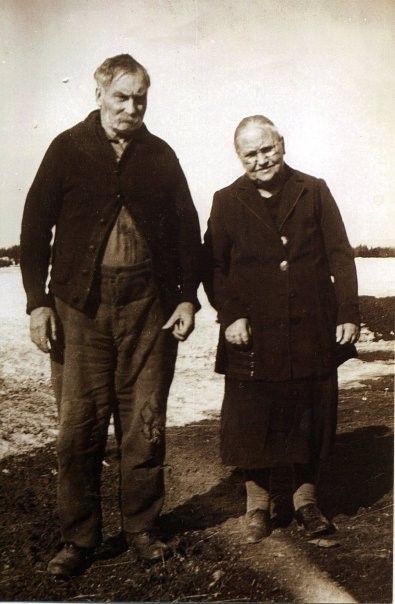
I love the Census for making it possible to track the movements of my great-grandfather, Henry D. Barkhouse. He was the inspiration for the recent work that my team, the Digital Access Agile Team, did to consolidate and release Census Search Beta in November 2022.

I want to take you through my journey in researching Henry D.’s life in the Census. He was born in 1864 and died in 1947 in Nova Scotia. My father never knew him, as he passed before my father was born. A very tall man, he married my great-grandmother, Samantha Udora (Dora) Butler, in 1899 in Scots Bay, Nova Scotia. They had eight children. He was a farmer, and his homestead has been passed down in my family to the present day. Other than this basic information, I know very little about him.

Photo of Henry D. Barkhouse and Samantha Udora (Dora) Butler at their homestead.

Henry D. Barkhouse (1864–1947) and Samantha Udora (Dora) Butler at the Barkhouse homestead in Scots Bay, Nova Scotia (c. 1930–1947). Image courtesy of the author, Julia Barkhouse.

Before starting my research, I record the information that I know about Henry D.:

  • Last name: Barkhouse
  • First name: Henry D.
  • Gender: Male
  • Dates: 1864–1947
  • Occupation: Farmer
  • Province: Nova Scotia (I didn’t know the district or sub-district)

Armed with this information, I expect to find Henry D. in the censuses from 1871 to 1921. The 1931 and 1941 censuses are not yet available.

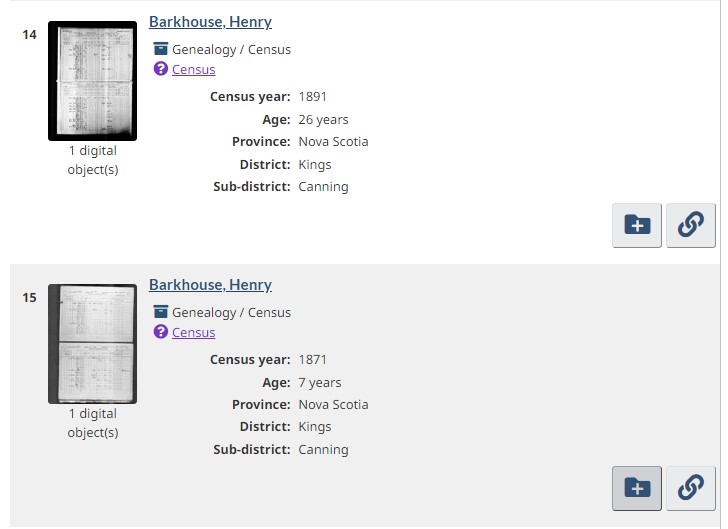
The research journey begins, and I find him in the 1871 Census.

A page from the 1871 Census of Canada featuring Henry Barkhouse’s information.

Page of Census of Canada, 1871 (Item Number: 3150873)

With the first hit, I learn more about him. The census record confirms that he was born in 1864 and that he was seven at the time of the Census in 1871. Now, I can fill in the gaps with the district and sub-district names for Scots Bay. I also learn his religion. I can view the image and get more information about his education and whether he had any infirmities. I can also connect to his parents (James and Rebecca) and his brothers and sisters. Now, I have more information that I can use to find him in other censuses, and I can update my family tree.

At this point, I realize that I have to replicate this search in other Census of Canada databases. I decide to perform the same search in the 1881, 1891, 1901, 1911 and 1921 censuses. Performing the same search five more times will be long and (dare I say) frustrating.

Inspiration strikes: What if I could consolidate all the censuses into one master database of census records? This would allow me to use the same search parameters, search Henry D.’s name once, and get all the hits from all Census databases. I could view the results from 1871 to 1921 on one screen and use our built-in tools to save these results to MyResearch in order to come back to them later. This would shorten the time it takes to do research on each ancestor.

This idea required some quality thinking. Each census is slightly different. While it appears that all censuses capture similar information, the early ones (before Confederation) differ greatly from those conducted after 1867. As well, there were censuses of individual provinces (Ontario and Manitoba) and the Prairie Provinces (formerly “the Territories”). The search raised a number of questions, the biggest of which was: What happens when you put that amount of data in one database?

Conducting the search was a daunting task. Library and Archives Canada has 17 Canadian censuses comprising almost 44 million names. Each name is a record in our database. The search started with a detailed analysis of each census to compare and contrast the data captured in our databases. In this analysis, my team came up with a workplan and identified several improvements or questions to address after the launch. Our first release is Census Search Beta, which combines the 17 Census databases into a single interface. We call it “Beta” to indicate that our product is nearly complete and is being improved every two weeks. Our acceptance criteria before releasing the Beta product to the public were the following:

  • A search interface with all the fields currently available in our standalone databases plus a few more based on feedback from our clients (for example, gender, ethnic origin, place of birth, religion, occupation);
  • Search results with filters for province, census year, district and sub-district;
  • An item display that shows the digital object in our harmonized viewer and the full list of available fields (such as name, gender, age).

Once the censuses were migrated and available in Census Search, we were able to improve the overall search experience for our clients. Now, you can zoom the images with our harmonized viewer or view in fullscreen. You can also download and export your search results in a variety of formats (HTML, XML, CSV or JSON). You can save records to MyResearch and come back to them later. You can add transcriptions or comments to Co-Lab to tag or translate the images. You can suggest a correction to a record and help us improve the Census data.

Screenshot of Census Search with Julia Barkhouse’s great-grandfather’s information by first name, last name, and province limited to Nova Scotia.

Screenshot of Census Search (Library and Archives Canada website)

The first release for Census Search was a considerable task, and we are very happy with our achievement. We also have a blueprint for improvements moving forward. Following our initial launch, we have a number of questions and issues that we want to investigate and for which we want to come up with viable solutions. You will see these released as improvements to Census Search as we move out of the Beta phase. The purpose of this work is to:

  • bundle the images so users can navigate to the next page and view persons or families who may have been enumerated at the bottom of one page and whose information is continued on the next;
  • program the search interface to adjust itself with greyed-out text or pop-up messages for instances where not all censuses have data for all fields (for example, ethnic origin, place of birth, religion)
  • track the geographical changes to the country over time. Once the data was put together, we wanted to track the changes to provinces, territories, districts and sub-districts;
  • find a way to isolate one person and connect this person in each census, or to connect a person and their relationships to other people;
  • add any additional schedules (for example, agricultural schedules) to Census Search, and identify whether a person has additional information there;
  • clean up the data, and create historical data dictionaries that contextualize the terms used at the time (for example, “ethnicity”);
  • sort the search results to group together people by census year or in alphabetical order (ascending or descending).

As for my great-grandfather? Now, when I search for Henry D. in Census Search, I get his results from 1871 to 1921. I can save them to a list in MyResearch and come back to them to trace other family members as well. As we add more enhancements to Census Search, I will be able to page through the Census and view his family if they are enumerated over two pages. I will be able to see whether Henry D. has an entry in the agricultural schedules, since he was a farmer. I might learn how large his farm was and whether he kept chickens, pigs or cows.

Screenshot of Census Search results saved in MyResearch.

Screenshot of Census Search results saved in MyResearch (Library and Archives Canada website)

Creating Census Search has been a journey, and we have only just begun. As you can see, we have many enhancements and features coming to make the experience more enjoyable for you, our clients. Consolidating 17 datasets into one database was only the first step. We hope you will join us as we develop this free resource for you. You can send us your feedback via our email. You can also sign up for a 10-minute feedback session with us.


Julia Barkhouse has worked at Library and Archives Canada in data quality, database management and administration for the last 14 years. She is currently the Collections Data Analyst on the Digital Access Agile Team.

Cradleboards: keeping babies safe and portable

On the left, Tatânga Mânî [Chief Walking Buffalo] [George McLean] is in his traditional First Nation regalia on a horse. In the centre, Iggi and a girl engage in a “kunik,” a traditional greeting in Inuit culture. On the right, Maxime Marion, a Métis guide, holds a rifle. In the background, there is a map of Upper and Lower Canada, and text from the Red River Settlement collection.

This blog is part of our Nations to Nations: Indigenous Voices at Library and Archives Canada series. To read this blog post in Kanien’keha, visit the e-book.

Nations to Nations: Indigenous Voices at Library and Archives Canada is free of charge and can be downloaded from Apple Books (iBooks format) or from LAC’s website (EPUB format). An online version can be viewed on a desktop, tablet or mobile web browser without requiring a plug-in.

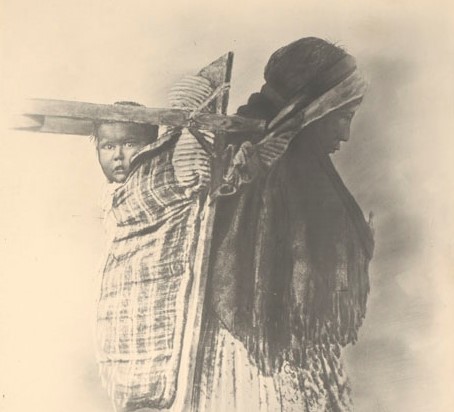
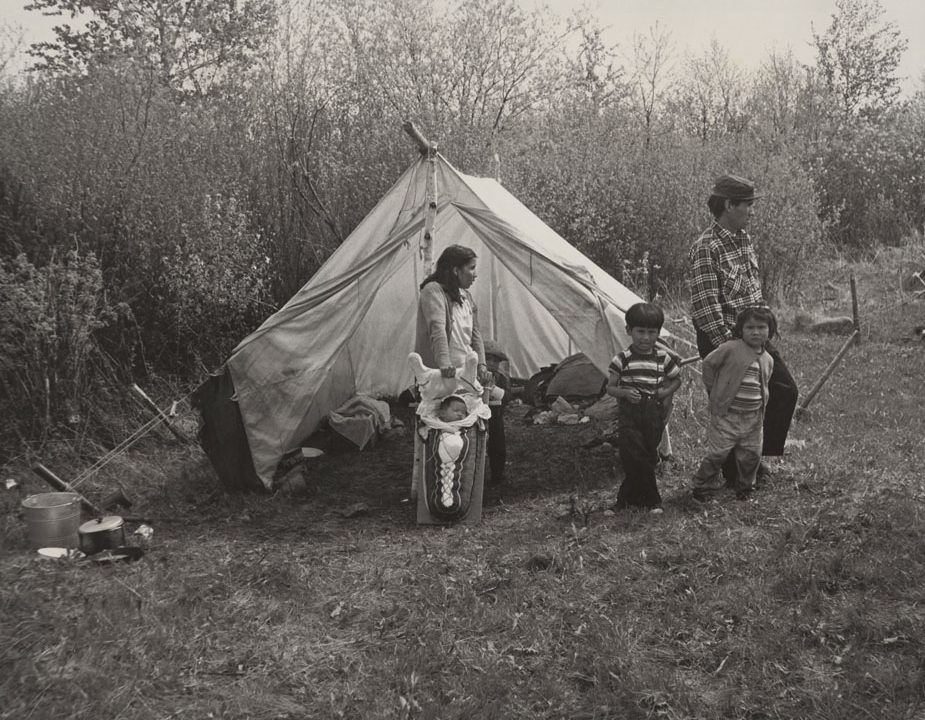
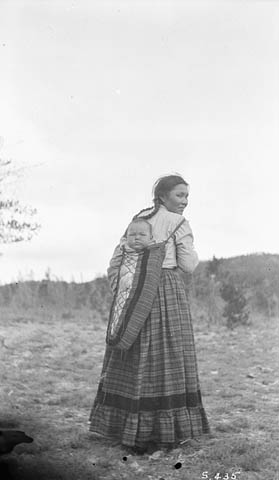
First Nations and Métis Nation communities used cradleboards to secure and carry infants. While the style and form varied between nations, cradleboards were typically made from thin pieces of wood to which a baby was firmly swaddled in a piece of fabric and secured with ties. Cradleboards provided parents with a safe way to carry their children during travel and allowed them use of their hands while working.

First Nation woman with a baby on a cradleboard on her back.

First Nation woman carrying a baby on a cradleboard with a tumpline (e011303100-006)

To learn more about images of cradleboards in the collections at Library and Archives Canada, we invite you to read Kanien’keha:ka author Elizabeth Kawenaa Montour’s blog article “First Nations cradleboards: understanding their significance and versatility” and her essay “First Nations cradleboards: an enduring heritage.”

First Nation family with a baby secured onto a cradleboard in front of a tent near Lac Seul in Ontario.

Mary Ann Trout-Carpenter and her husband George Carpenter with their children. The baby in the cradleboard is either Melvin or Donna. James is standing behind his mother, George is in the centre, and Marianne is standing in front of her father. Lac Seul First Nation, Ontario. (e008300467)

The essay is featured in Nations to Nations: Indigenous Voices at Library and Archives Canada, a multilingual and interactive e-book. This e-book features 28 unique essays written by Elizabeth Kawenaa Montour and other First Nations, Inuit and Métis Nation staff. It is presented mostly in the Indigenous languages spoken by the people represented in each essay, and accompanied by English and French versions. The authors are Indigenous archivists, curators and advisors who have a personal connection to the collection items that they chose for their essays. Their essays show the diversity of the histories, languages and cultures of Indigenous peoples.

First Nation woman with a baby on a cradleboard on her back.

First Nation woman carrying a baby on a cradleboard, unknown location, 1918 (a017973)

“Cradleboard” in some Indigenous languages

    • Anishnaabeg: tiginaaganan
    • Oji-cree: tikinagan (also spelled tiginaagan, tikkanaagan or tikanagan)
    • Kanien’kéha: kahrhon
    • Michif: tikinagan
    • Mi’kmaq: migjowajij alapilaqan
    • Ojibwe: dikinaagan
    • Plains Cree (nêhiyawêwin): askotaskopison

Additional resources

  • Cradleboards, Library and Archives Canada’s Flickr album

Census 1931, a peek into digitization

Version française

By Melissa Beckett and François Deslauriers

A glimpse into the microfilm room

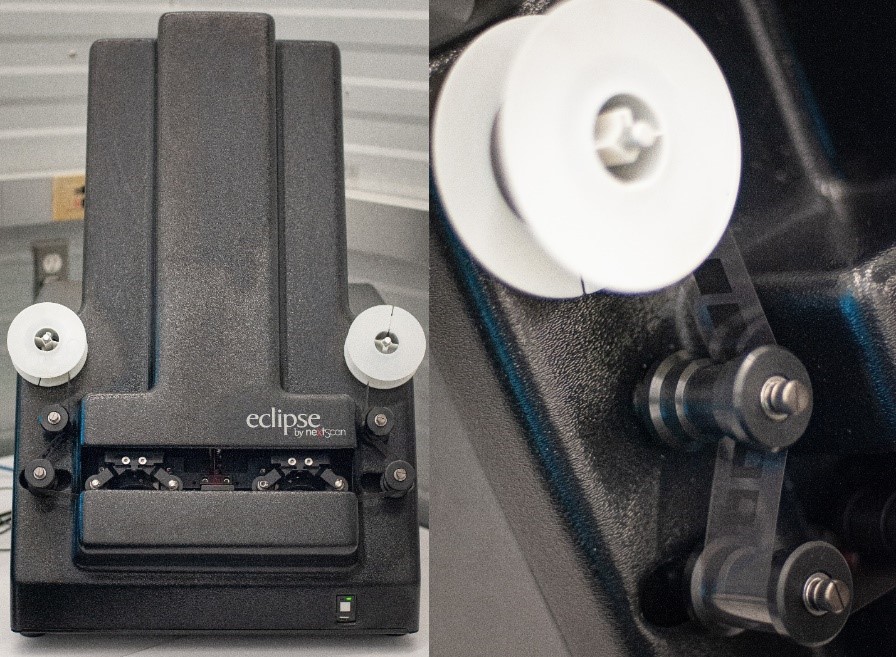
Two photographs of the Eclipse Rollfilm scanner by nextScan; on the left, a view showing the full scanner, and on the right, a close-up of the reel with some film threading past two of the rollers.

The Eclipse Rollfilm scanner by nextScan. Credit: François Deslauriers

In a dimly lit room, two imaging specialists sit in opposite corners. Each stares at their screen, where a series of images is constantly flowing from one side to the other. The rhythmic mechanical sounds of the microfilm scanners are occasionally interrupted by the high-pitched whine of the rewind, and a clunk as the last of the film winds back around its reel. With white-gloved hands, a specialist removes the reel from her scanner and places it back into its round metallic canister, which she returns to its archival box. She removes the next canister and slices around the taped edge with a pocket knife. She takes out the reel and mounts it on the scanner, winding the film around a series of rollers and then onto another plastic reel.

Meanwhile, the other specialist has stopped the process on his scanner. He needs to readjust some settings because the images in this section of the reel are much brighter than the earlier ones. He adjusts the exposure values in the software until he is satisfied with the appearance of the images in the preview window. The specialist scans a short section of film and opens it in the auditing software to double-check. He views one of the documents at full size, examining it closely. He then rewinds the film to the beginning, starting the scanning process all over again.

The project

For the Census 1931 project, the Digitization Services team digitized 187 microfilm reels, for a total of 234,678 images. At this time, by law, the reels were still subject to statistical secrecy, and a security procedure/protocol had to be followed. Only “deemed employees” who had taken the Statistics Canada Oath or Affirmation of Office and Secrecy were authorized to view the material. Reels were kept locked in a secure room, and all digitization was performed completely off-line.

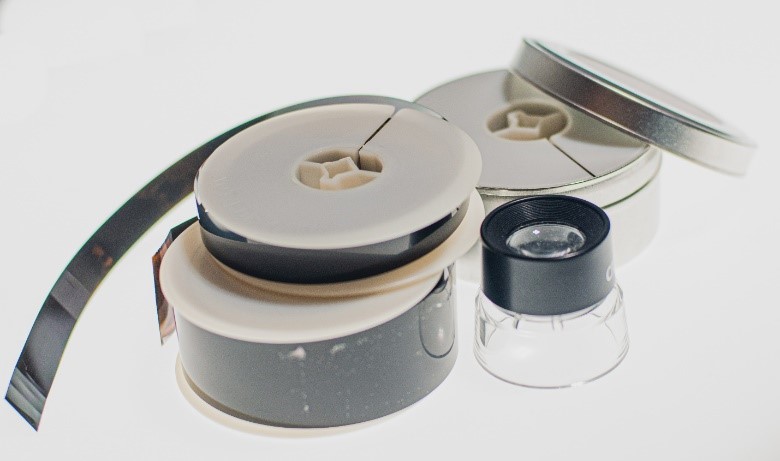
The Census 1931 microfilm reels contain about 1200 images of census documents on each reel of 35-mm black-and-white polyester film. The imaging specialist digitizes from the print master, a copy of the archival master reel, in order to prevent any deterioration of the original.

Microfilm is an effective means of preserving information for long periods of time (reels can last for 500 years). Microfilm stores vast quantities of information in a small amount of space and supports preservation of the documents contained by removing the necessity of handling them. Digitizing microfilm reels provides another level of preservation as well as of accessibility to the public, who are then able to view the images from anywhere with an Internet connection.

The scanning process

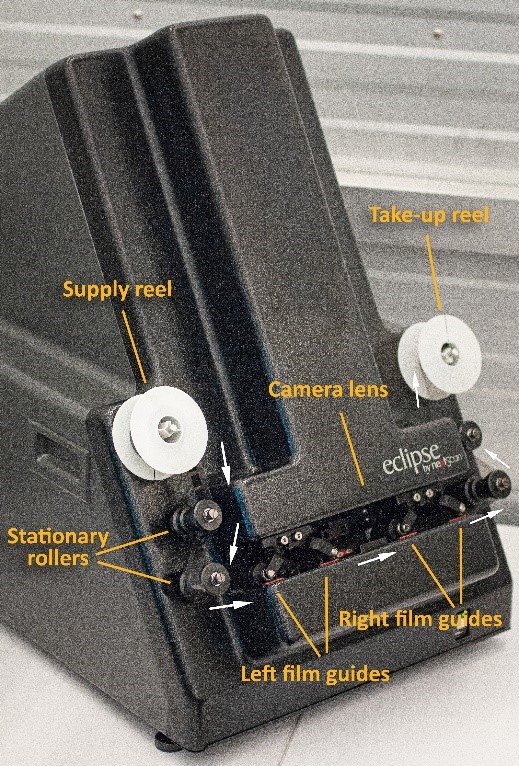
A photograph of the Eclipse Rollfilm scanner by nextScan, with labelled supply reel, stationary rollers, film guides, camera lens and take-up reel.

The Eclipse Rollfilm scanner by nextScan, with main components labelled. Credit: François Deslauriers

For this project, the digitization of the 1931 Census was performed with the use of the Eclipse Rollfilm scanner by nextScan, a dedicated microfilm scanner designed to digitize both 16-mm and 35-mm reels, in conjunction with an off-network computer. Film is threaded from the supply reel past stationary rollers and film guides to a take-up reel. The pinch rollers lower to hold the film in place on the film guides, automatically adjusting the tension of the film. The film is guided past a macro lens and digital sensor above, while lit from below through the film emulsion by a strip of red light. The reel is digitized as one long, uncompressed, grey-scale image file, referred to as a ribbon.

The imaging specialist handles the film using cotton gloves, being careful to touch the edges only. With the NextStarPLUS® Capture software, the reduction ratio (which is noted on the film and allows images to be reproduced at a 1:1 ratio) must be set, in addition to the resolution, film type (16-mm or 35-mm) and polarity (negative or positive). Before scanning, the specialist must also ensure that the exposure of the images is correct and that the lens is focused so the image is sharp.

With a live view on the screen, the specialist makes adjustments to the exposure and the focus. The specialist may zoom in on a focusing chart, as well as on the manufacturer’s information, printed along the edge of the film at regular intervals. The appearance of scratches or dust on the film can also be useful for determining sharpness. While the documents can be used to focus, this is only reliable if they were originally photographed with perfect sharpness.

A preview window during scanning allows the specialist to see when it is necessary to readjust settings over the course of scanning. When the documents were initially photographed, there may have been changes in lighting and exposure settings over the course of the reel. This results in some images appearing brighter or darker. The goal in digitizing each reel is to ensure that most of the documents will be legible, since adjustments in tonal values can only be made for the entire length of the film and not for each individual document.

After scanning is complete, the specialist rewinds the film and returns the reel to its canister.

A photograph of a 16-mm microfilm reel stacked on top of a 35-mm microfilm reel, next to a loupe, in front of a 35-mm microfilm reel in its canister.

16-mm and 35-mm microfilm reels. Credit: François Deslauriers

The auditing process

After scanning the reels, the imaging specialist uses the NextStarPLUS® Auditor software to process the ribbons (the long image files associated with each reel). The software is used to detect and select each individual document within the ribbon so that they can be exported as separate image files. According to its detection settings, the software generates coloured rectangles around the documents. The specialist scrolls past rows of documents to select those that were not detected by the software and to adjust any rectangles that do not contain the whole document. On a second scroll through, a blackout setting changes the contents of the rectangles to black. This leaves any unselected white parts visible, making it easier to spot anything that may have been missed on the first pass, for additional quality control.

Each digitized document in the census is assigned an e-number, a unique identifying number used in this project to sort the images by place.

The images were initially exported as 10-megabyte TIFF files. TIFF is a “lossless” file format, meaning that there is no image compression. For the purposes of the project, JPEG derivatives (a “lossy” file format that requires less storage space and is more accessible) were created to aid in matching the digitized images to the census geographic districts and sub-districts, as well as for external partners working in artificial intelligence (AI). Information Technology created a script to efficiently turn the TIFF files into JPEGs.

Yesterday and tomorrow

Working in digitization at Library and Archives Canada means constantly improving processes and exploring new techniques and technology, to create the best-quality images possible. The 1931 Census was no different. As imaging specialists, we have been glad to play a small part in keeping Canada’s history alive and making it accessible to the public.


Melissa Beckett is an acting Imaging Specialist in the Digitization Services Division at Library and Archives Canada.

François Deslauriers is an acting Manager of Reprography in the Digitization Services Division at Library and Archives Canada.

Chinese Canadian Genealogy: General Registers and C.I.9 certificates

Version française

By Valerie Casbourn

This article contains historical language and content that some may consider offensive, such as language used to refer to racial, ethnic or cultural groups. Please see our historical language advisory for more information.

Chinese Canadian genealogy research can draw on many different historical records and resources. Two important sets of records are the General Registers of Chinese Immigration and Chinese Immigration (C.I.) 9 certificates. These records can provide a wealth of genealogical information, and they can be searched in Library and Archives Canada’s Immigrants from China, 1885–1949 database. The help page includes descriptions of these records and others indexed in the database and instructions for searching.

These records were created because of the Chinese Immigration Act of 1885. This discriminatory legislation was passed by the federal government to restrict immigration from China to Canada. It was the first law in Canada to restrict immigration on the basis of ethnic origin. The legislation required the registration of everyone who immigrated from China to Canada. It also imposed a duty of $50, known as the head tax, to be paid by each Chinese immigrant arriving in Canada, with some exceptions. The amount was increased to $100 in 1900 and then to $500 in 1903. The legislation was later replaced by the Chinese Immigration Act of 1923, which abolished the head tax but almost completely stopped Chinese immigration to Canada. It was not repealed until 1947.

A complex record-keeping system of registers and C.I. certificates was established in 1885, and more certificates were added in subsequent years. This system was gradually phased out between 1947 and 1953, after the Chinese Immigration Act was repealed.

General Registers of Chinese Immigration

The General Registers of Chinese Immigration were maintained by the office of the Chief Controller of Chinese Immigration, located in Ottawa. The registers were intended to record every Chinese person who immigrated to Canada between 1885 and 1949. There are also entries for some individuals who arrived as early as 1860. The registers are in rough chronological order, based on the date of arrival.

The entries in the register can tell you when each individual immigrated to Canada, their age at the time, their place of birth in China, their occupation and the details of their arrival. The General Registers are also a record of payment of the head tax and show the amount paid by each person (if applicable) and any landing certificates issued.

The most well known of these certificates is the C.I.5, also known as the “head tax certificate.” The C.I.5 was issued to confirm payment of the head tax, and most were retained by the individuals who received them. The first version of the C.I.5 was introduced in 1885, and it was issued until 1912 when it was replaced by a new version that included a photograph of the individual.

Black-and-white page from the General Register of Chinese Immigration. The page shows a table with 25 rows of handwritten entries for individuals who arrived in Canada in May 1899.

General Register of Chinese Immigration, RG76, Volume 700 (e006066717)
This page shows entries for people who arrived in Canada in 1899.

The fourth line on the General Register page pictured above is the entry for Jung Hang, who arrived in Vancouver, B.C., in May 1899 on the ship S.S. Empress of India. Passenger lists also record people arriving in Canada by ship, but there are no passenger lists for arrivals in British Columbia before 1905. If you are researching someone who immigrated from China before that date, you may find details of their arrival in the General Register.

Jung Hang’s entry in the General Register says that he was 25 years old when he arrived in 1899, which means he was born in approximately 1874. His place of birth is recorded as Ling Chung, Senway, China.

The register entry also shows that C.I.5 certificate no. 23333 was issued to Jung Hang and that he paid the required duty fee of $50, which was the amount of the head tax at the time.

Chinese Immigration 9 certificates

Between 1885 and 1947, every Chinese person in Canada was required to register with immigration authorities before leaving the country temporarily. The practice continued for several years after the repeal of the Chinese Immigration Act, not ending until 1953. The C.I.9 certificates were outward registration records that documented each person’s departure and return and also included personal details valuable for genealogy. The C.I.9 certificates from Vancouver and Victoria contain, with some exceptions, the certificates issued between 1910 and 1953. The C.I.9 certificates on microfilm reels T-6038 to T-6052 are indexed in the Immigrants from China, 1885-1949 database. These reels contain C.I.9 certificates issued at the ports of Vancouver and Victoria between 1910 and 1920 to individuals who were born abroad and between 1913 and 1952 to individuals born in Canada.

In addition to details about travel, the certificates include the individual’s name (and a second version of their name, if applicable) and their age and place of birth. They also list the person’s occupation and place of residence in Canada. For those who immigrated to Canada, the certificates list the year they first arrived in Canada. There is also a photograph of the individual and their signature in Chinese characters.

Black-and-white copy of a C.I.9 with typewritten text and handwritten annotations and signatures. There is a photograph of a young girl, her signature in Chinese characters and a stamp from the port of Vancouver, B.C.

C.I.9 certificate no. 146 issued for Wong Yat Shun, 1919, RG76, Microfilm reel T-6052 (e008280743)

This C.I. 9 certificate was issued for Wong Yat Shun on April 30, 1919, and shows that she was sailing from Vancouver to Hong Kong on the ship S.S. Empress of Asia, departing on May 1, 1919. The section at the bottom of the page has a stamp from the port of Vancouver, B.C., that shows she returned on July 19, 1920, on the S.S. Empress of Russia.

The personal details included in the certificate tell us that Wong Yat Shun was born in 1907 in Ladner, B.C., and that she was 12 years old and still lived in Ladner when the certificate was issued.

More resources for Chinese Canadian genealogy

Consult our Chinese Canadians page for more resources for genealogy and family history research, including census records, immigration records, citizenship and naturalization records and published sources.


Valerie Casbourn is an archivist at the Halifax office of Library and Archives Canada.

A stone across the pond

Version française

By Forrest Pass

Canada has plenty of rocks of our own, but a British stone has long captured the imagination of people on this side of the Atlantic. If you watched the coverage of the coronation of King Charles III, you might have caught a glimpse of it. Known variously as the Coronation Stone, the Stone of Scone, and the Stone of Destiny, the unassuming oblong block of red sandstone enclosed in a wooden throne has been a central feature of British coronation rituals for almost a thousand years.

The Coronation Stone originated in Scotland, where monarchs were crowned upon it for hundreds of years. Although folklore associates the Stone with the legendary High Kings of Ireland and even with the “Stone of Jacob” in the biblical Book of Genesis, geological analysis suggests that it was quarried near Scone, around Perth in eastern Scotland. The forces of King Edward I of England took the Stone as war booty in 1296, and for 700 years it remained at Westminster Abbey, a fixture of English and later British coronations. In 1996, it returned to Scotland, where Edinburgh Castle is now the Stone’s permanent home. However, the 66 cm by 41 cm by 28 cm rock, which weighs 152 kg, travelled temporarily to London this month for the latest coronation.

Drawing of the Coronation Chair and Stone.

Drawing of the Coronation Chair and Stone by celebrated Canadian historical illustrator C.W. Jefferys, about 1929. Library and Archives Canada holds this original drawing, which Jefferys prepared for a school history textbook, Britain’s History, by University of Toronto historian George M. Wrong (e011408968-001)

Although the Coronation Stone has never travelled to Canada, Canada and Canadians have played a part in its story. In 1939, Paul de Labillière, the Dean of Westminster Abbey, where the Stone was kept from 1296 until 1996, quietly hid the Stone in the Abbey’s crypt, to protect it from desecration in the event of a feared Nazi invasion. He drew a map of its exact hiding place and sent the sole copy to Ottawa, where it remained under lock and key at the Bank of Canada. After the war, our predecessor, the Public Archives of Canada, acquired the map. It is now part of Unexpected! Surprising Treasures From Library and Archives Canada, our exhibition at the Canadian Museum of History until November 26, 2023.

Map showing the wartime hiding place of the Coronation Stone in the crypt beneath Westminster Abbey’s Islip Chapel.

Dean Paul de Labillière’s map showing the wartime hiding place of the Coronation Stone in the crypt beneath Westminster Abbey’s Islip Chapel. This map was kept in a sealed envelope locked in a Bank of Canada vault during the Second World War. It was supposed to be released only to the Prime Minister of Canada, the British High Commissioner or the Dean of Westminster Abbey (e011309358)

De Labillière could not have predicted that the greatest “threat” to the Coronation Stone would be a domestic one. On Christmas Day 1950, young Scottish nationalists “liberated” the Stone from Westminster Abbey and transported it to Arbroath Abbey in eastern Scotland, a symbolic site for their movement. It took four months before police recovered the Stone and returned it to Westminster.

Two years after the Coronation Stone heist, a young woman from Cape Breton Island made a pilgrimage to Arbroath Abbey and met with the original conspirators. She admired their devotion to the cause of Scottish independence, even if she thought that their revolutionary plotting was mere bravado. “No doubt, if I had been born in Scotland, I would have been a passionate Scottish nationalist like [Coronation Stone liberator] Ian Hamilton,” Flora MacDonald wrote of the meeting in her memoirs. “Instead, I am convinced it was my Scottish blood and temperament that made me a passionate Canadian nationalist.” MacDonald would channel that love of Canada into politics; in 1979, she became the first woman to serve as Secretary of State for External Affairs. Her remarkable life and career are documented in the extensive Flora MacDonald fonds at Library and Archives Canada, which includes a diary of her first trip to Scotland.

Flora MacDonald was not the first Canadian to travel to the United Kingdom in search of the Coronation Stone’s meaning. In 1921, Edward Odlum, an eccentric Vancouverite, went to London to examine the Stone’s composition. Odlum was a believer in British Israelism, the theory that Britons are the literal, genetic descendants of the Lost Tribes of Israel. At best, British Israelism relied on shaky pseudoscience; at worst, it promoted antisemitism and white supremacy. Odlum, who had some geological training, hoped to link the Coronation Stone to the Middle East, and thus support the British-Israelite case.

Odlum enlisted high-level help for his peculiar project. Sir George Halsey Perley, the Canadian High Commissioner in London, convinced the Dean of Westminster Abbey to give Odlum privileged access to the Stone. Odlum’s letters to his son, the journalist, soldier and future diplomat Victor Wentworth Odlum, describe his examination of the Stone with a magnifying glass and “a specially prepared large electric light.” This study complete, he dashed off to Jerusalem to look for similar rocks in the Holy Land. Professional geological analysis of the Stone confirms that it originated in Scotland, but claims that Odlum had “proven” its Middle Eastern origin still circulate in obscure corners of the Internet.

Letter with the header “The British Israel Association of Canada,” written by Edward Odlum to his son, Victor Wentworth Odlum.

In this letter to his son, Victor Wentworth Odlum, Edward Odlum describes the assistance rendered by Canadian High Commissioner Sir George Halsey Perley in securing access to the Coronation Stone (MIKAN 118465)

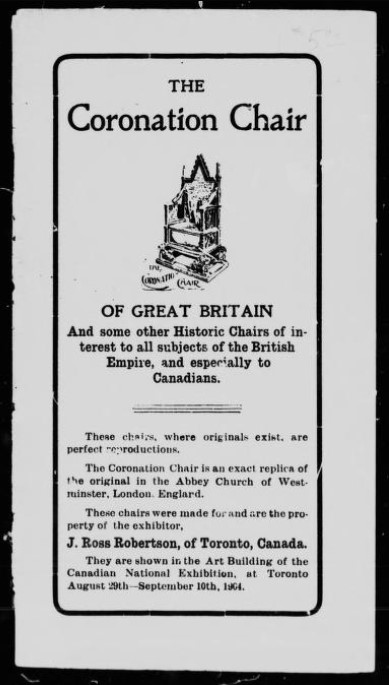
As travelling overseas to view the Coronation Chair and Stone was not possible for most Canadians, two benefactors commissioned replicas for display closer to home. John Ross Robertson, a Toronto-based journalist and Canadiana collector, exhibited his replica, alongside other historical chairs, at the Canadian National Exhibition in 1904. Robertson boasted in the exhibition catalogue that the reproduction was so good that “if placed beside the original it would be impossible to tell it from the genuine chair.”

A page from a catalogue featuring a drawing of the Coronation Chair of Great Britain.

The catalogue for John Ross Robertson’s 1904 exhibition of historic chairs, which featured his replica of the Coronation Chair and Stone (OCLC 62994338)

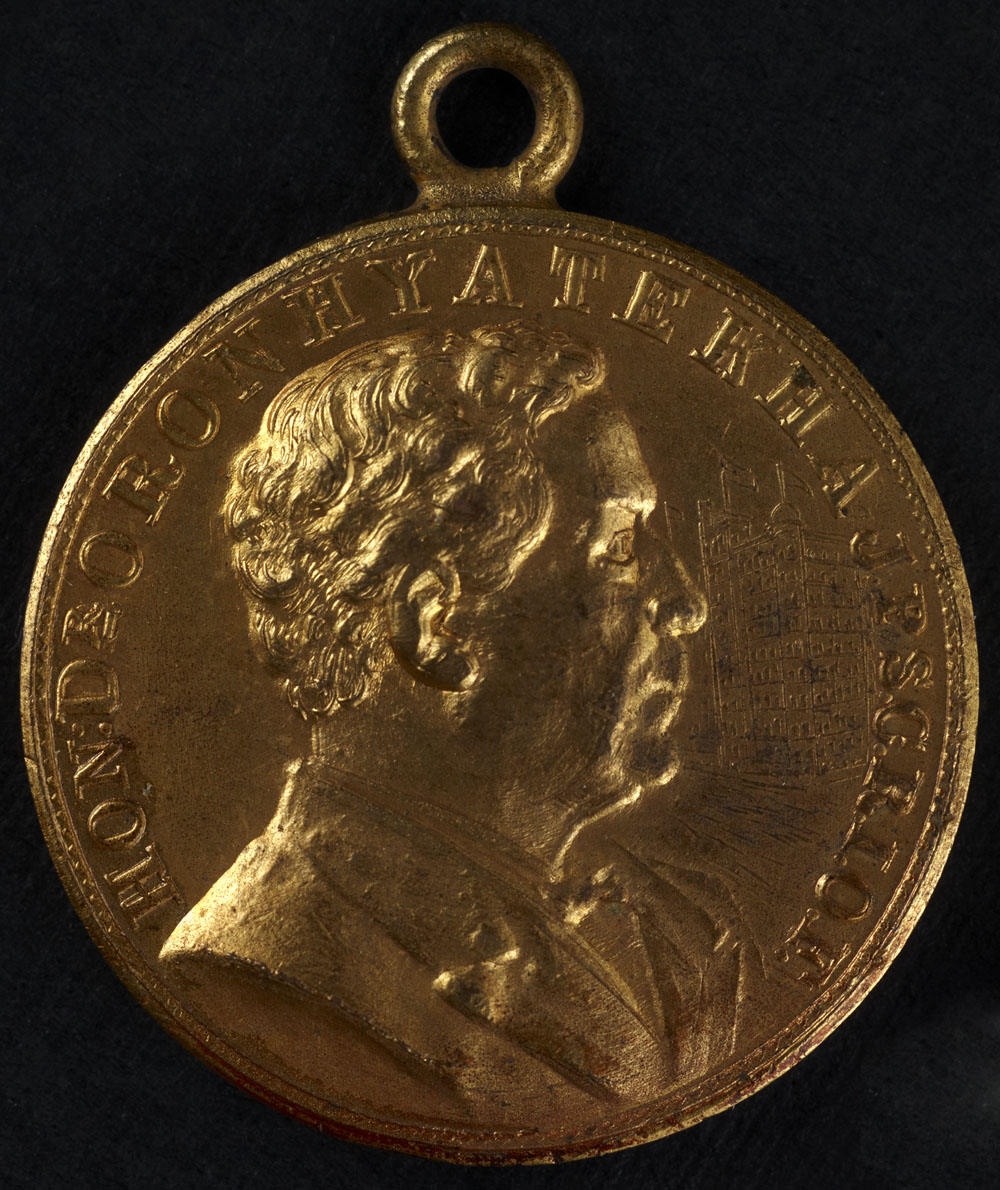
A second replica of the Coronation Chair made its way to Ontario at the same time as Robertson’s. Its owner was Dr. Oronhyatekha, the famous Kanienʼkehá꞉ka (Mohawk) physician, who had a long-standing connection with the Royal Family. In 1860, as a young man, Oronhyatekha had addressed the visiting Prince of Wales on behalf of the Haudenosaunee Confederacy and emphasized the importance of the living treaty relationship. Decades later, in 1902, Oronhyatekha travelled to London to attend the coronation of his old acquaintance as King Edward VII. He later joked that his replica of the Coronation Chair was a spare given to him by the Royal Family. According to Keith Jamieson and Michelle A. Hamilton, authors of Dr. Oronhyatekha: Security, Justice, and Equality, the Coronation Chair represented for Oronhyatekha the special relationship between the Crown and First Nations.

Medallion of a right-side profile of Dr. Oronhyatekha including an image of the Temple Building in Toronto.

A 1904 medallion of Dr. Oronhyatekha featuring, to the right of his nose, an image of the Temple Building, headquarters of the Independent Order of Foresters, which Oronhyatekha headed. The Temple Building, Toronto’s first skyscraper, also housed Oronhyatekha’s historical collection, including his replica of the Coronation Chair and Stone (e011086464)

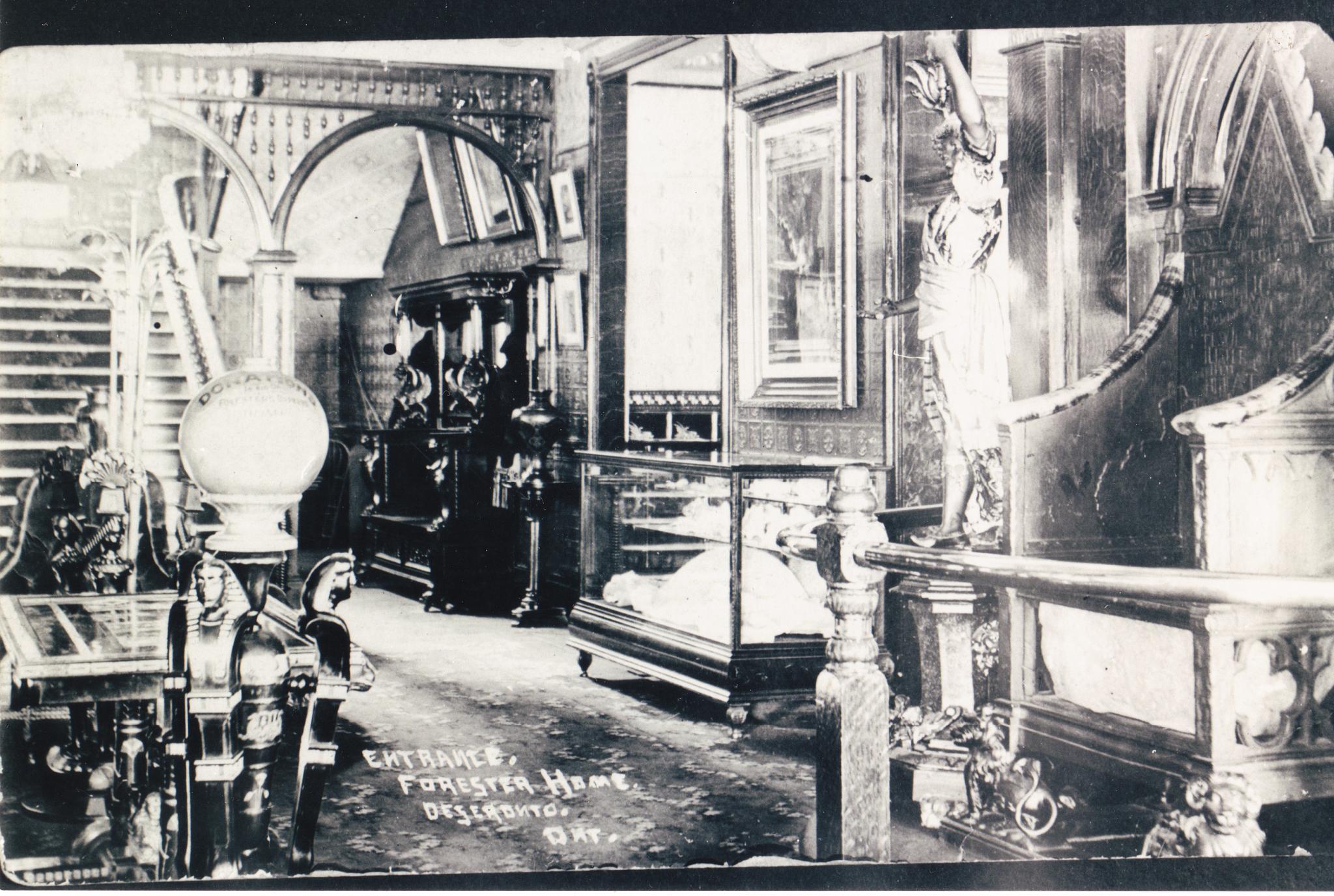
Photo of Dr. Oronhyatekha’s replica of the Coronation Chair and Stone on display at the Foresters’ Home.

Dr. Oronhyatekha’s replica of the Coronation Chair and Stone on display at the Foresters’ Home, an orphanage in Deseronto, Ontario, before it was moved to the Foresters’ Temple Building in Toronto (Town of Deseronto Archives via Flickr)

Canadians from a variety of backgrounds have given the Coronation Stone new meanings that the Scottish quarrymen who hewed it would never have predicted. Perhaps the Stone’s very modesty explains its appeal. Amid the colour and finery of other coronation regalia, it seems extraordinarily ordinary, and in its simplicity lies its flexibility. In Canada, where bedrock is seldom far from the surface, people have embraced this ancient British artifact, reimagining a seemingly simple stone as a compelling emblem of history, identity and sovereignty.


Forrest Pass is a curator with the Exhibitions team at Library and Archives Canada.

Why we are excited about the 1931 Census

By Sara Chatfield

Welcome to Library and Archives Canada’s blog series on the 1931 Census! This was the seventh census in Canadian history. The release of the 1931 Census records is an excellent opportunity to learn more about ourselves as a country. The lives of over 10 million people who were living in Canada in 1931 will be unveiled very soon. By law, personal information in a census cannot be made public until 92 years after the census was completed. We have been waiting a long time for this, and the date of the release is fast approaching.

A typed page with the words “Dominion Bureau of Statistics” and “Canada” written at the top, a crest, and a stamp with an x over it.

The cover page of the official publication of the Seventh Census of Canada, 1931 (OCLC 796971519)

There are quite a few steps that must be completed to provide the 234,678 images of the 1931 Census online. These are briefly mentioned in Preparing the 1931 Census. This blog series will fill in some of the blanks and help in bringing the census to life. It will answer questions about how the census was compiled, the questions that were asked, how we are making it available, and other topics that will widen our collective appreciation of just how important censuses are to present and future generations.

Census returns are extremely valuable research tools for genealogists, historians, scholars and all Canadians who want to explore the past. The original purpose of the census was to help determine parliamentary representation based on population. But censuses are so much more than that! These documents provide information about the makeup of Canada, the history of Canadian families and societal changes that were happening at the time.

A census entry for a household is a snapshot into Canadians’ lives in that era. Each page tells two stories. First, it tells the story of a family: their names, ages, religion and other elements of their identity. Second, the entry gives the context of their story within Canada: their neighbours, home, occupation, employment status and community. The 1931 Census delves into not only where people lived, but also how: in homes with extended families, within their immigrant communities, in rooming houses, and in institutions.

A map of Canada showing different-sized black dots.

A map from the administrative report of the Seventh Census of Canada, 1931 (OCLC 1007482727)

Even if you have not been bitten by the genealogy bug, the 1931 Census can still be of interest. You can learn more about your city or province, such as the industries or patterns of employment in given areas. Census returns can even help researchers to find more information about particular communities. They can give us hints about who lived at an address and when, and provide some information about their circumstances, including whether they spoke English or French, could read and write, or went to school. The 1931 Census also asked a new question: “Has this family a radio?” This will be fascinating to those who are interested in the emergence of telecommunications in Canada. It is also a measure of how quickly and broadly information could be disseminated. You can witness the early days of a new form of popular culture on the rise. Exciting, right?

We suspect that there will be many prominent Canadians in this census. But we will not know for sure until we have the completed index. Later this year, when the index is released, you will be able to search by name for people such as labour union activist and citizenship judge Stanley Grizzle, Kanien’kehá:ka activist Mary Two-Axe Earley, actors William Shatner and Gordon Pinsent, artist Pauline Julien, singer La Bolduc, painter Kazuo Nakamura, and Black activist Viola Desmond. You may be able to learn more about their early lives!

Join us in our journey to learn what Canadian households looked like on Monday, June 1, 1931!

And stay tuned for upcoming blog posts about this significant census release.


Sara Chatfield is a project manager in the Client Services division at Library and Archives Canada.

The Ladies’ Auxiliary of the Brotherhood of Sleeping Car Porters

By Stacey Zembrzycki

This article contains historical language and content that some may consider offensive, such as language used to refer to racial, ethnic and cultural groups. Please see our historical language advisory for more information.

Stanley Grizzle, citizenship judge, politician, civil servant, labour union activist, and porter of twenty years, travelled across the country in the late 1980s documenting the experiences of Canadian Pacific Railway (CPR) sleeping car porters and their struggle to unionize. His questions about the creation of the Brotherhood of Sleeping Car Porters (BSCP) always went hand in hand with those that documented the important role played by Black women in the BSCP’s Ladies’ Auxiliary.

Ten members of the Toronto Pullman Division’s Ladies Auxiliary posing for a photo.

Ladies Auxiliary, Toronto Pullman Division, Brotherhood of Sleeping Car Porters (e011181016)

While documenting the male “stalwarts,” as he called them, Grizzle was careful to ask about the mothers, sisters, wives, and daughters, who often lingered in this movement’s background, as well as in the background during these recorded sessions. The Stanley Grizzle Interview Collection thereby provides important gendered and generational perspectives into the forces that made unionization possible in Black communities across Canada. It also shows how involvement in the BSCP and its Ladies’ Auxiliary tended to serve as starting points for community mobilization around a broad array of issues and training grounds for community leaders.

Union leaders, inspired by A. Philip Randolph, an American labour unionist and civil rights activist as well as the organizer of the BSCP in the United States, recognized early on that women had integral roles to play in founding and sustaining this union movement. As Essex Silas Richard “Dick” Bellamy recalled:

I shall never forget when Brother Randolph came to Calgary, and Brother Benny Smith, he says, “There is no organization [that] will ever be successful unless the ladies are permitted into that organization.” And I have never forgotten, and I don’t believe you can find very many organizations [where] the ladies are…are not affiliated with the men in these various organizations. They seem to be able to give the men, uh-uh, a little more incentive to…in, in order to help them out. (Interview 417401)

Frank Collins succinctly echoed this sentiment: “…[You] had to have the women behind you before you had a strong union because, if you didn’t have them working with you, you were nowhere.” (Interview 417402)

Women’s solidarity was deeply rooted in the realities of the job. Being a porter required men to be on the road for as long as a month at a time. In their absence, porters’ wives, mothers, sisters, and daughters played principal roles, moving throughout their Black communities to encourage and promote the creation of the BSCP among both men and women, actively recruit and “card” porters at their local train stations and in their churches and community organizations, and, once the union was created, collect union joining fees and dues. Like other women, Velma Coward King, who was active in the Montreal BSCP Ladies’ Auxiliary, recognized the challenges of unionizing these men early on, noting that long stints away from home meant the men could not regularly attend meetings. Given that “[it] was the woman who was the back, uh, backbone in the house of the family,” they needed to step in. This was the only way forward, as she made clear, recognizing that: “Once you had a union to represent you and to speak for you, they knew that they couldn’t treat you as dirt.” (Interview 417383)

The power inherent in this aspect of the collection lies in its ability to tell the story of how upward mobility manifested out of unionization and women’s efforts to make that possible. The collective agreements that resulted from community solidarity led to improved working conditions and higher salaries, which, in turn, gave families the ability to move to suburbs, where they purchased homes. It also meant that there was money left over to help send children to university. Most importantly, as the Winnipeg BSCP’s Ladies’ Auxiliary first President Helen Bailey surmised: “I think men then became to even feel respect for themselves because then they had, uh, they were making a worthwhile living for their families.” (Interview 417400)

Poster advertising the tenth anniversary dance of the Toronto Division of The Brotherhood of Sleeping Car Porters and their Ladies Auxiliary.

Poster for a tenth anniversary dance organized by The Brotherhood of Sleeping Car Porters and their Ladies Auxiliary (e011536972)

The important generational thread that winds through these interviews clearly explains how BSCP Ladies’ Auxiliaries across the country brought women of all ages together to both organize and ultimately fundraise money through various community events, which included teas, socials, and dances. This money helped move union leaders across the country, giving the BSCP strength; funded travel to national and international conventions, giving Canadian labour leaders a voice in the movement; and supplemented education through scholarship funds.

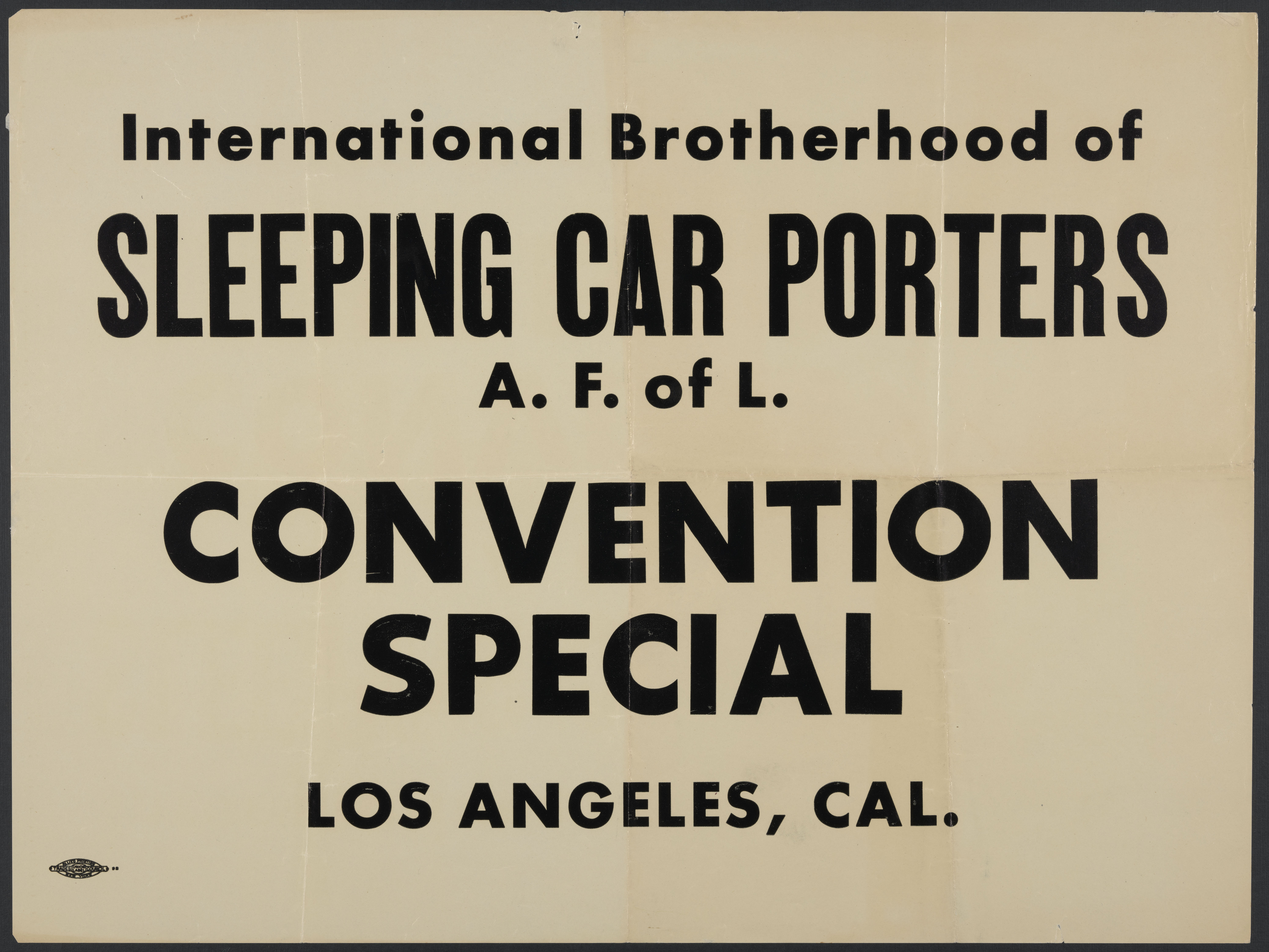
Poster for the International Brotherhood of Sleeping Car Porters’ Convention Special in Los Angeles, California.

International Brotherhood of Sleeping Car Porters poster for a Convention Special in Los Angeles, California (e011536973)

Breaking the generational reality of portering, wherein fathers and their sons were forced into this profession because of the absence of other employment opportunities, was never far from the minds of the women who were involved in the BSCP’s Ladies’ Auxiliaries. Women’s involvement also gave some, like Ivy Lawrence Mayniar/Maynier, glimpses into the systemic racism and discriminatory labour practices that were integral to Black experiences in Canada. In speaking about her father’s career as a porter and her drive to seek out higher education as a result of it, Mayniar shared a powerful memory from while she was a student at McGill University:

[…] I was then going to, to the university. And then I walked down to the…to work at the library for a while. And I walked down to the, uh, uh, station and looked for Dad’s car. And I remember one night, it was bitter. […] It was a bitter night. And I, I, I myself was just so upset about this. And…but I wanted to go down ’cause I knew Daddy was going on standby. He was standing out. And I went down, went to the station, went and looked down the track for Dad. And there he was standing outside. Dad was a short man and this, you know, tight little person. And I looked down there to catch his eye. And there he was standing with snow on top of his cap, and his shoulders pushed…pulled together like this, and the wind was going down that line there, just brutally. It was just awful. And he was just standing there, and, uh…and the snow piled up on him. And, uh, I went and I sat down in the concourse outside from where…from where the trains left…And I just sat on a bench and cried. I’ll never forget that. (Interview 417387)

Mayniar became the first Black woman to graduate from the University of Toronto Law School, but she went on to study in England, where she was called to the bar at the Inns of Court, because she recognized the limitations she would continue to face in Canada as a person of colour. She practiced law in Trinidad and Tobago, where she spent the remainder of her career fighting against the racism and discrimination that she saw exemplified in her father on that cold, wintry day at Windsor Station.

The interviews conducted by Grizzle not only document the history of the fight to unionize CPR sleeping car porters, but also speak to a history that is bound up in the advancement of Black families and their communities throughout Canada. There could not be one without the other. When listening to the voices of these men and women, one hears the power inherent in women’s collective actions, how ever small, and the pride these wives, mothers, sisters, and daughters had in knowing that they effected change on the ground for the men in their lives as well as their children and themselves. When Grizzle asked Evelyn Braxton whether the “Ladies’ Auxiliary lived up to the expectations, uh, of, uh, giving the Brothers the, the maximum support that they, uh, looked forward to,” she wholeheartedly declared: “Oh, they certainly did. The Ladies’ Auxiliary was the support of the Brotherhood men.” (Interview 417386) Women were not only the backbone of their families: they held up their communities and the generations that followed.

Additional resources:

  • My Name’s Not George: The Story of the Brotherhood of Sleeping Car Porters in Canada: Personal Reminiscences of Stanley G. Grizzle, by Stanley G. Grizzle with John Cooper (OCLC 883975589)
  • Deindustrializing Montreal: Entangled Histories of Race, Residence, and Class, Chapter 3: The Black City below the Hill, by Steven High (OCLC 1274199219)
  • North of the Color Line: Migration and Black Resistance in Canada, 1870–1955, by Sarah-Jane Mathieu (OCLC 607975641)

Stacey Zembrzycki is an award-winning oral and public historian of immigrant, ethnic and refugee experiences. She is currently doing research for Library and Archives Canada.

Hiding in Plain Sight and the Métis Nation: How did it all start?

Banner for the Hiding in Plain Sight exhibitionBy Beth Greenhorn and William Benoit

When we began our research on a possible Métis exhibition in 2014, we had no idea what it would explore or how, what content we could uncover, or what the public’s perception would be. Prior to this, Library and Archives Canada (LAC) had not created an exhibition that focused on Métis Nation citizens, culture and history. When building an exhibition, we often wonder if our labour will be well received. Will the project have longevity or be a momentary flash in time?

While we knew that we wanted to highlight Métis records in the holdings at LAC, we quickly learned that even for us as LAC staff, these records were difficult to find. In the fall of 2014, a keyword search for “Métis” in art, photographic, cartographic and stamp records yielded fewer than 100 documents. We found it hard to believe that LAC holdings contained so few items related to the Métis. The issue had to be about the search terms historically used by archives to describe the Métis. Or the images depicting Métis individuals, activities and communities were described incorrectly. In spite of these obstacles, we were up for the challenge!

Work on the exhibition ramped up in 2015. We curated it in partnership with the Manitoba Métis Federation (MMF) and the Métis National Council (MNC). Their assistance and knowledge in curating this exhibition were invaluable in its success.

Between 2014 and 2016, we reviewed and updated over 1,800 records by adding “Métis” to the titles or descriptive notes, to make these documents more accessible and to better reflect the diverse voices of the collections at LAC. In addition to improving access to existing records, LAC digitized over 300 new photographic items pertaining to Métis history, many of which were featured in the exhibition. The strategies that we developed to uncover Métis content in the collections at LAC—using historical Métis communities and looking for indications of Métis material culture—offered the perfect title for the exhibition. The content we were searching for was “hiding in plain sight” all along; we just needed to uncover it.

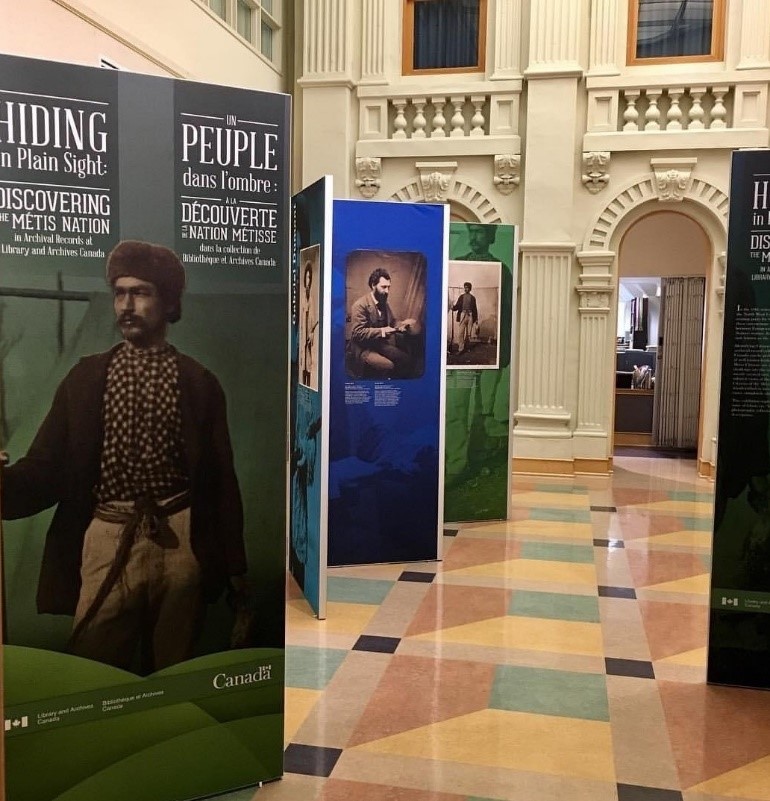
Hiding in Plain Sight opened in February 2016 in LAC’s main building at 395 Wellington Street in Ottawa. We organized the exhibition into two themes: known portraits of Métis citizens, and artwork and photographs portraying visual clues to Métis culture.

The exhibition became bigger than we had ever imagined. In February 2017, it was adapted for an international audience when Hiding in Plain Sight: The Métis Nation was displayed at the UNESCO headquarters in Paris, France. Through the enthusiasm and financial support of the MMF, the MNC and the Government of Canada, Hiding in Plain Sight was transformed into a travelling exhibition of digital reproductions. Since opening at the Centre du patrimoine in Saint-Boniface, Manitoba, in June 2017, the exhibition has travelled to 15 communities in Manitoba, Saskatchewan, Alberta and British Columbia.

Colour photograph of an exhibition space showing large vertical panels with photographs and texts.

Installation of Hiding in Plain Sight at the Centre du patrimoine in Saint-Boniface, Manitoba, in June 2017. Photo: Library and Archives Canada

Hiding in Plain Sight was shown at the Red Deer Museum and Art Gallery in Alberta from December 2018 to March 2019. Memories and treasures generously shared by local Métis citizens from their personal collections both personalized the exhibition and complemented the reproductions of artwork and photographs held at LAC.

The exhibition is currently on display at the Swift Current Museum in Saskatchewan. We are delighted by its popularity, and in particular that Métis Nation citizens living outside Ottawa have access to documentary heritage material about their history. It is also important that the general public has the opportunity to learn about the Métis and their rich history and culture in a manner that is accurate and appropriate.

Paving the way to greater access to Indigenous-related records

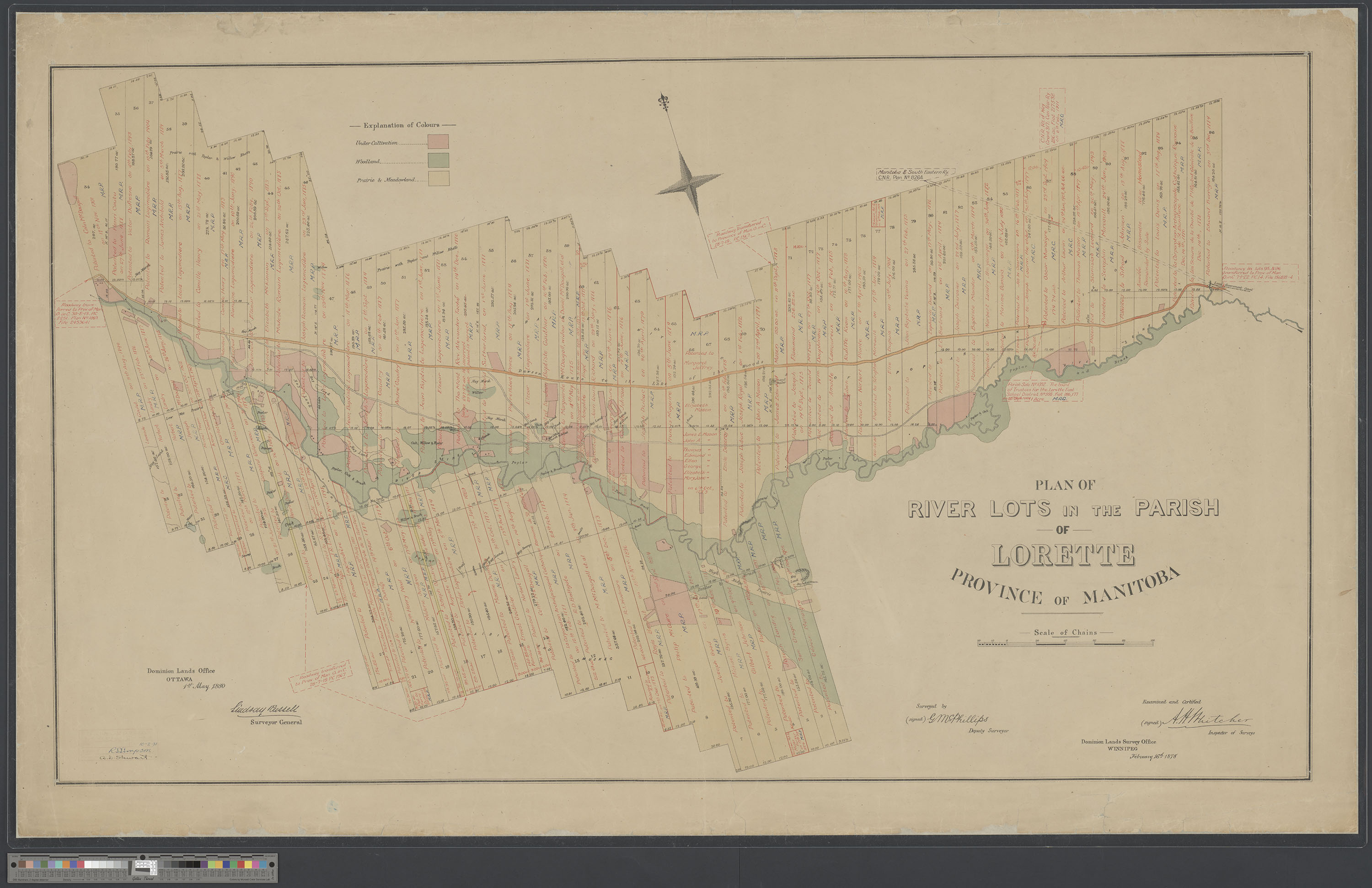
Whereas Hiding in Plain Sight focuses on art and photographic collections, LAC has increased the amount of digitized content related to the Métis Nation. From 2018 to 2021, the We Are Here: Sharing Stories (WAHSS) initiative digitized nearly 600,000 records from all media pertaining to First Nations, Inuit and the Métis Nation in Canada. More than half of these records relate to the Métis Nation. The WAHSS team incorporated the names of places, communities and individuals, along with cultural terms, into descriptions to more accurately represent the records and make it easier to find relevant documents. Among the records digitized were thousands of Métis Scrip and Red River lot maps, including this 1880 plan showing the Parish of Lorette, Manitoba.

A map in colour showing numbered farming lots along a river, with the names of individuals.

Plan of river lots in the Parish of Lorette, Manitoba, 1880 (e0011213853)

In 2021, LAC published Nations to Nations: Indigenous Voices at Library and Archives Canada. This multilingual and interactive e-book features 28 essays written by First Nations, Inuit and Métis Nation colleagues at LAC. Nine essays focus on the Métis Nation, presenting audio recordings in Heritage Michif of select images. Nations to Nations is free of charge and downloadable from Apple Books (iBooks format) or from the LAC website (EPUB format). An online version can be viewed on a desktop, tablet or mobile web browser without requiring a plug-in.

The second WAHSS initiative that began in 2022 continues to digitize records related to First Nations, Inuit and the Métis Nation. Significantly, the current WAHSS team is building on the reparative work we started in 2014 by finding and modifying archival record descriptions through a decolonizing lens.

To learn more about Hiding in Plain Sight, you can read the blog article written in 2016, when the exhibition opened in Ottawa.

To learn more about LAC’s commitment to playing a significant role in reconciliation, you can read LAC’s Indigenous Heritage Action Plan.

Additional resources related to the Métis Nation


Beth Greenhorn is a settler living on the unceded, traditional territory of the Kitigan Zibi Anishinabeg and the Algonquins of Pikwakanagan. She is a Senior Project Manager in the Outreach and Engagement Branch at Library and Archives Canada.

 William Benoit is Red River Métis. He grew up in the historic Métis community of St. Norbert, Manitoba. He has a background in Canadian history and Indigenous genealogy. He is an Advisor, Internal Indigenous Engagement, in the Outreach and Engagement Branch at Library and Archives Canada.