Molly Lamb Bobak: Canada’s first female Canadian war artist

May 24, 2015 marks the 70th anniversary of Molly Lamb Bobak’s appointment as Canada’s first female war artist during the Second World War.

In 1942, Molly Lamb Bobak was fresh out of art school in Vancouver. The talented young painter promptly joined the Canadian Women’s Army Corps (CWAC) as a draughtswoman—dreaming of one day becoming an official war artist. She worked serving in canteens before being sent on basic training in Alberta, eventually being promoted in 1945 to Lieutenant in the Canadian Army Historical Section.
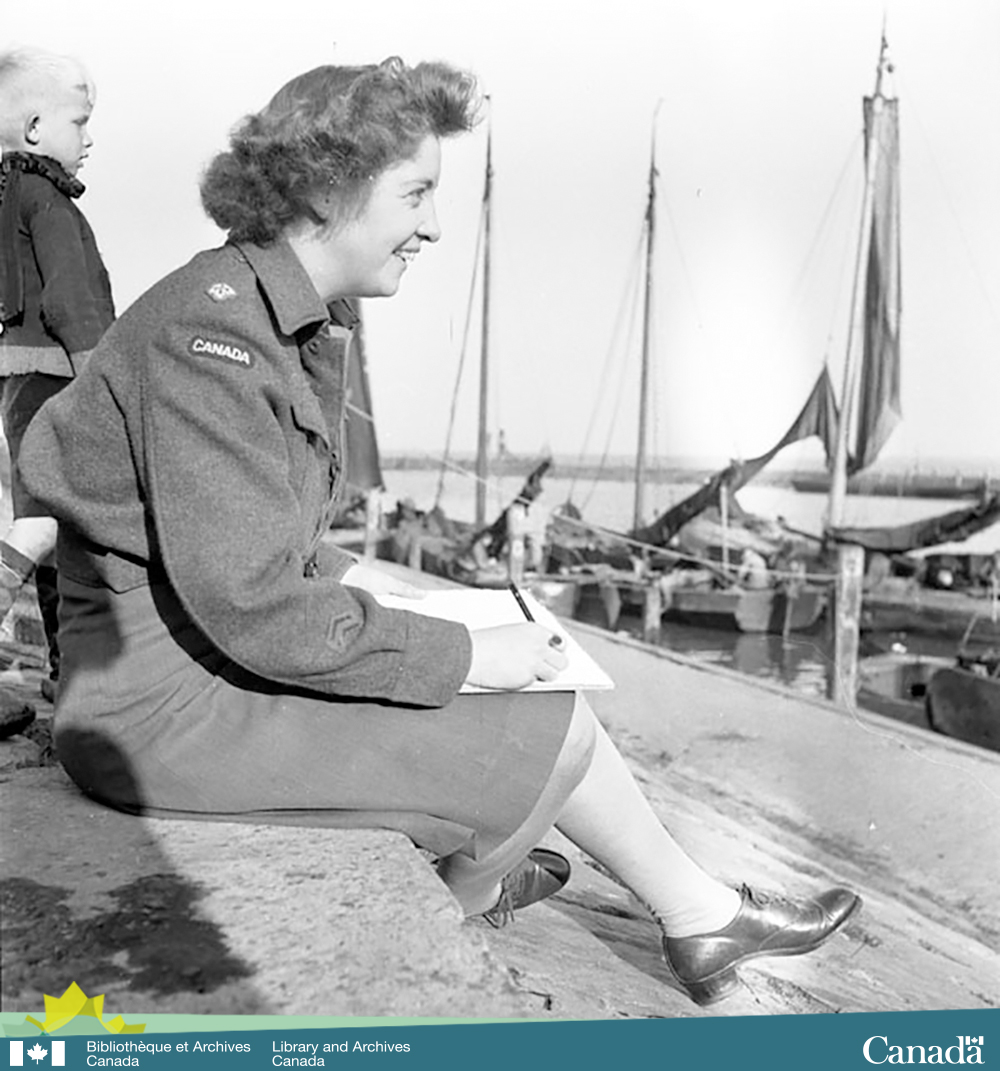
Black-and-white photograph taken from the side showing a smiling woman in uniform sitting on a pier with a drawing tablet and pencil in hand. In the background, there is a young blond child and sailboats docked nearby.

War artist Lieutenant Molly Lamb, Canadian Women’s Army Corps, sketching at Volendam, Netherlands, September 1945 (MIKAN 3217951)

Shortly after enlisting, Lamb Bobak began writing a unique diary that provides an invaluable record of the CWAC’s role in the war effort. Titled simply W110278, after her service number, it is a personal and insightful, handwritten account of the everyday events of army life, accompanied by her drawings. Dating from November 1942 to June 1945, the diary contains 147 folios and almost 50 single sheet sketches that are found interleaved among its pages.

The diary’s first page captures the humorous tone and unique approach of the diary. Written as a pseudo newspaper, with the pages resembling big-city broadsheets, the first headline reads “Girl Takes Drastic Step! ‘You’re in the Army now’ as medical test okayed.”

What follows are handwritten news bulletins with amusing anecdotes and vibrant illustrations that reveal women’s experiences in Second World War army life and form part of a personal daily record of Lamb Bobak’s time in the CWAC.

Three years after enlisting, Moly Lamb Bobak achieved her ultimate goal when she was appointed as Canada’s first female official war artist and was sent overseas, after the ceasefire, where she painted in England, the Netherlands, Belgium and Germany.

To celebrate the 70th anniversary of Molly Lamb Bobak’s appointment as the country’s first female official war artist, Library and Archives has digitized her entire Second World War diary in colour, making this national treasure available online.

Related resources

Self-portraits by women artists in Library and Archives Canada’s collection

Until the beginning of the last century, official self-portraits by women artists were rare, compared to those created by men. This was, in large part, because few women worked and were recognized as professional artists during the early periods. But it is also because many self-representations created by women were in non-traditional formats—hidden within amateur sketchbooks, or private diaries… even stitched or sewn.

A few of Library and Archives Canada’s (LAC) most interesting sketched and painted examples are currently on display as part of The Artist Herself: Self-Portraits by Canadian Historical Women Artists, a new exhibition co-curated by Alicia Boutilier of the Agnes Etherington Art Centre and Tobi Bruce of the Art Gallery of Hamilton.

The exhibition deliberately expands the traditional definition of ‘self-portrait’; most of the works it showcases would not have been considered self-portraits at the time they were created.

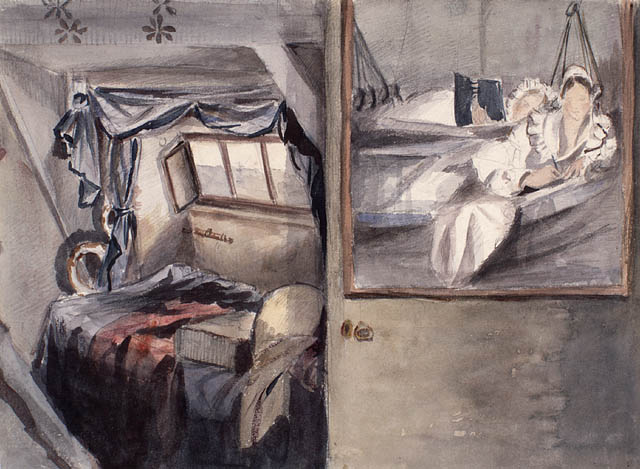
It includes this page from the private sketchbook of Katherine Jane (Janie) Ellice (1813–1864), an accomplished amateur artist and wife of an official with the North West (fur trading) Company. Ellice used the reflection from a mirror on the wall of her ship’s cabin to capture a quick, and very private, image of herself aboard ship.

Watercolour sketch shows the artist and her sister, dressed in nightwear, reclining in a bunk of their ship’s cabin.

Mrs. Ellice and Miss Balfour reflected in the looking glass of their cabin on board the H.M.S. Hastings (MIKAN 2836908)

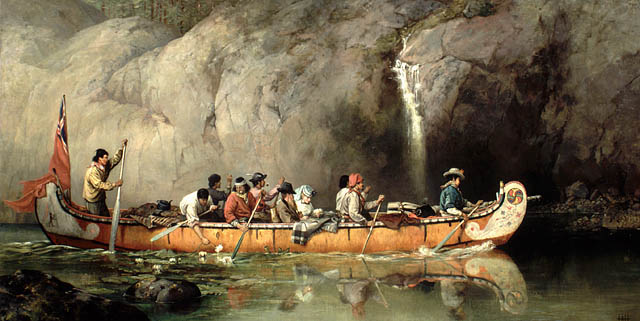
It also includes Canoe Manned by Voyageurs Passing a Waterfall, by Frances Anne Hopkins (1838–1919), another ‘fur-trade wife’—but one who would develop something of a professional artist career. Hopkins’ enormous voyageur-themed canvases often include representations of herself that seem almost incidental. It’s believed that she appears, in this painting, as a passenger in the canoe:

Painting shows a group of fur trade workers steering a Hudson’s Bay Company canoe past a small waterfall; the artist and her husband may be passengers seated in the middle of the canoe.

Canoe manned by voyageurs passing a waterfall (MIKAN 2894475)

These are only a few examples, from LAC’s collection, of historical self-portraits made by women. It’s worth noting that the collection also includes many others, both historical—and modern.

The Artist in her Museum was created by contemporary Métis artist Rosalie Favell in 2005.

Colour digital print shows the artist, full-length, and flanked by a mammoth, a beaver, and an artist’s palette. She draws aside a red curtain to reveal a gallery of mounted black-and-white photographs.

The Artist in her Museum, 2005. © Rosalie Favell (MIKAN 3930728)

Favell used digital technology to manipulate an iconic American self-portrait from the 19th century. By putting her own image in place of the original sitter, Favell appropriated a classic work, assigning new meanings within an older convention.

Modern self-portraits, like Favell’s, compare intriguingly with the historical self-representations showcased in The Artist Herself. Today’s more relaxed and expanded definitions of portraiture allow contemporary artists to successfully play within the genre. They also allows us to look back, with fresh eyes, on the self-representations created by women in the past.

Visit the exhibition in Kingston between May 2 and August 9, 2015. Stay tuned for further dates as the exhibition tours nationally, before closing in Hamilton during the summer of 2016.

The William Redver Stark sketchbooks: impressions and paper

In this part of the sketchbook examination, we are exploring two additional facets of page mapping. The first part will look at impressions left from the artist’s instruments on the drawing paper; the second will examine the paper and the bookbinding techniques in the sketchbooks.

Tool impressions

When an artist is drawing or sketching, his or her tools frequently leave deep impressions on the pages. These are great visual indicators that help to reposition out-of-order pages. The indentations on the paper surface appear as a repetitive pattern of a mark from one page to the next.

Colour photograph showing a sketchbook that has some deeply indented impressions on one of the pages.

Artist’s pencil impression; view from the verso of the drawing.

Other examples of impressions left on a paper surface are the binding materials used by the bookbinder. For example, after a text block is sewn, the bookbinder will apply an adhesive on the spine. He or she may apply too much adhesive, which then oozes through some of the sewing holes, forming a drop of glue inside the central folio. Upon drying and hardening, the drop can make an impression onto the adjacent sheet of paper.

Colour photograph showing the inside of a folio; the glue drop is clearly visible with the corresponding impression on the other page.

Glue residue in the binding structure that overflowed into the central folio leaving a mirror impression.

The sewing tapes and threads used in a binding can also leave impressions on the pages. The sewing tapes are glued underneath the paper of the inside covers. They often leave a repeating mirror impression of the tape, which helps determine the order of pages near the front or the back of a sketchbook. The sewing thread impressions found on detached pages also provide a good clue as to which sheets of paper are located in the centre folio of a section.

Colour photograph showing the detached spine of a sketchbook. The impression of the sewing tape is clearly visible on both the board paper and on the first page of the folio.

Detail of the sewing tape located under the board paper and the impression left on the adjacent page.

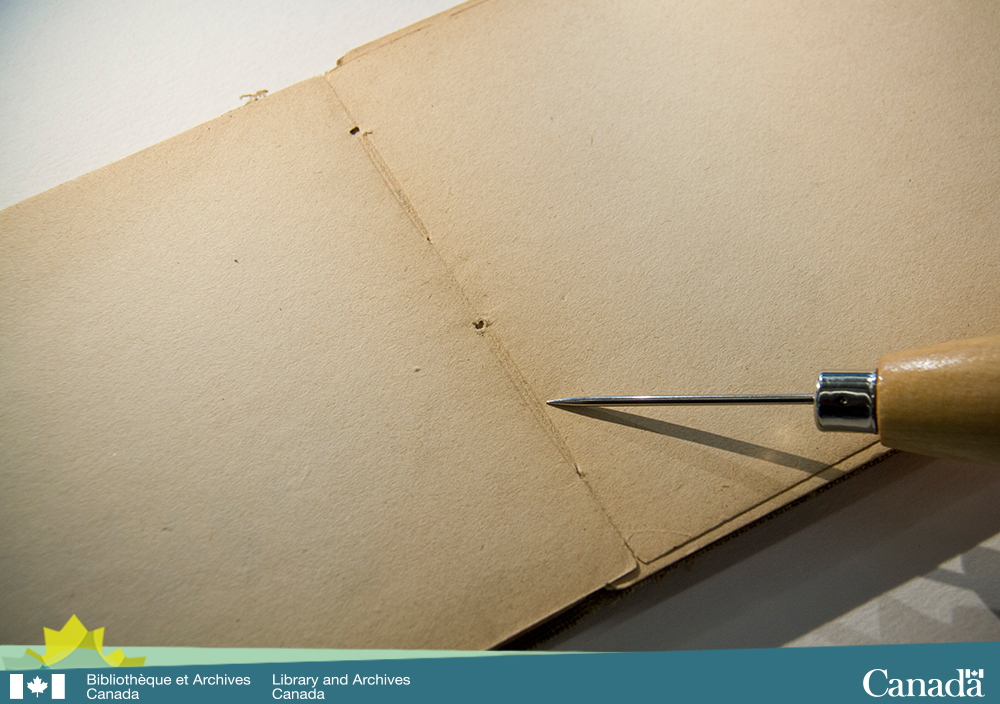
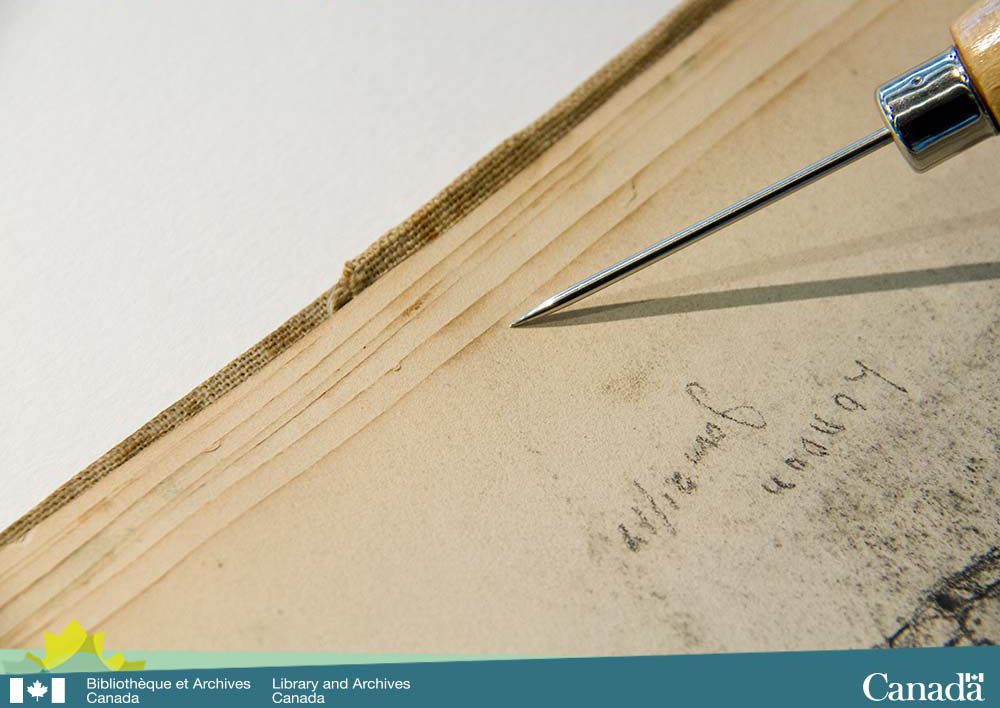
Colour photograph showing an open sketchbook lying flat on a table. An awl points to the sewing thread marks on the paper.

Visible transfer of the sewing thread mark onto the paper.

Page and paper analysis

A number of the Stark sketchbooks have soft, gradual convex and concave warping that extends across or along the edges of pages. This cockling happens when sketchbooks are in a high humidity environment. Here, the humidity causes a permanent distortion of the pages.

One of the sketchbooks was distorted along the edges of three sections. The undulating edges matched each other perfectly only when the pages were placed in the correct position. This gave us the verification needed for proper orientation and sequencing of the pages.

Colour photograph showing a sketchbook from the top; the bottom sections are clearly warped and distorted while the top ones are perfectly flat.

An example of cockling and undulation from the first to the third sections of the sketchbook and none in the last two sections.

Binding techniques

Paper can also reveal other clues to determine page order. One way to confirm page order is to look closely at the binding techniques, which leave very useful evidence.

When pages are first folded into sections, groups of three to eight sheets of paper are folded together. The folio on the inside of the section naturally has a sharper fold than each subsequent folio in the section. The folds become less sharp and incrementally wider as the number of folios per section increases. An examination of the fold of each half or complete folio can help determine the likely location within the sections: first, or centre of folio, second, third, fourth position, etc. An exact measurement of each page confirms the position as well.

Rounding and backing is another binding technique that provides an indication of page sequence. The technique is usually accomplished by using a hammer to shape a previously sewn and glued spine. Rounding and backing results in a slight bend of the sections close to the spine; the sections near the front of the book bend slightly toward the front; the central sections are fairly straight; and the sections near the back of the book bend slightly toward the back. Rounding and backing was clearly visible in the Stark sketchbooks and thus a helpful indication of the sequence of sections and pages.

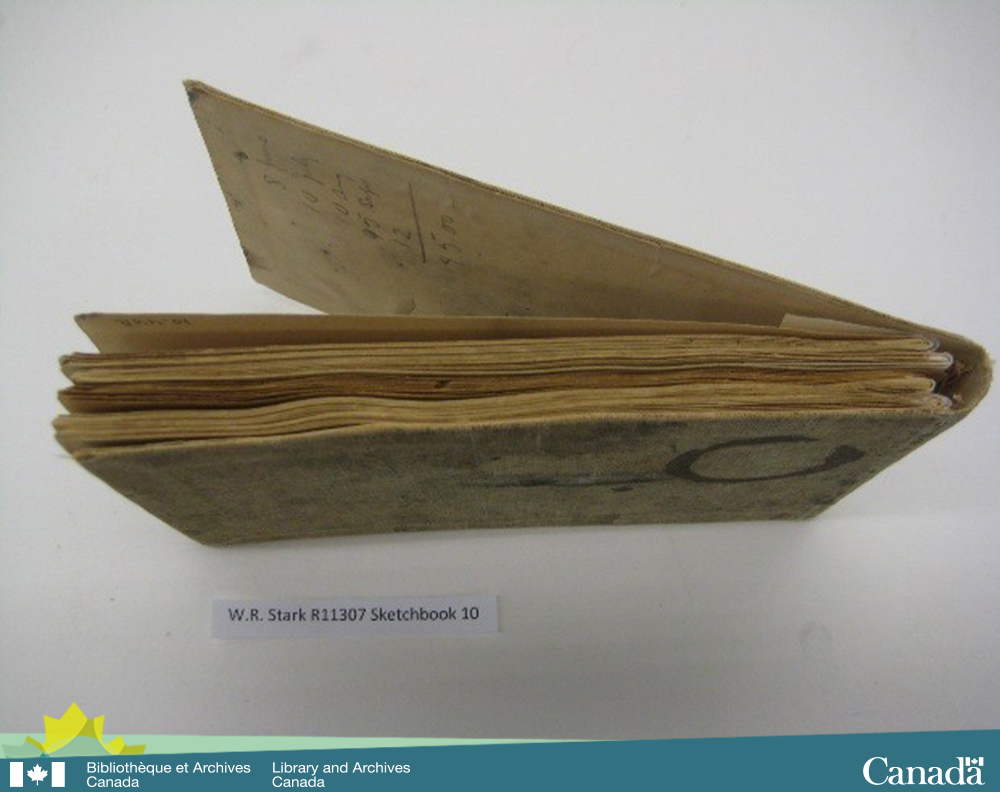
Colour photograph showing an angled view of a sketchbook that highlights the curving produced by the bookbinding technique.

View of the slight bend of the section near the front of the text block showing the effects of the binding technique that can help determine the right page order.

In our next instalment on page mapping, we will look at the dates that are scattered throughout the sketchbooks and how they match up with other sources of information at Library and Archives Canada.

Visit our Flickr or Facebook albums to view more images of the conservation examination.

Newly discovered Robert Hood watercolours help tell Canada’s Arctic history

On April 16, 1821, midshipman Robert Hood made the last entry in his journal. A 24-year-old British Royal Navy petty officer under the command of Captain John Franklin, Hood participated in an expedition to chart the Coppermine River as part of the search for the Northwest Passage. Hood’s final journal entry ended his descriptions of the daily activities as the group of British sailors, Canadian voyageurs, Indigenous guides and interpreters trekked from York Factory to Cumberland House and then on to Fort Enterprise and the Coppermine River. Although the journal entries discontinued, Hood continued to note weather conditions and navigational data in other expedition volumes, and to produce at least one more visual record.

Library and Archives Canada (LAC) is pleased to announce the recent purchase of four watercolours from a Hood family descendant.

Portraits of the Esquimeaux Interpreters from Churchill Employed by the North Land Expedition is likely the final surviving work of Robert Hood. Completed in May 1821, the watercolour depicts Tattannoeuck (Augustus) and Hoeootoerock (Junius).

Watercolour portraits of two young Inuit men wearing western-style clothing. One is captioned Augustus and the other, Junius.

Portraits of the Esquimaux Interpreters from Churchill Employed by the North Land Expedition, May 1821 (MIKAN 4730700)

Three other watercolours were acquired that were painted during the previous year while the expedition wintered at Cumberland House.

In January 1820, he drew a mink as it dipped a paw into the water along a rocky shore and a cross fox just as it caught a mouse in the snow.

Watercolour of a mink on a riverside dipping one of its paws into the water.

Mink, January 20, 1820 (MIKAN 4730702)

Watercolour of a fox having caught a mouse in a snowy landscape.

Cross fox catching a mouse, January 26, 1820 (MIKAN 4730703)

Two months later, Hood set out on a trek to the Pasquia Hills where he encountered a group of Cree. Invited into their tent, he recorded with extraordinary detail this watercolour, The Interior of a Southern Indian Tent [original title]. This image would be the basis of the print, Interior of a Cree Tent, which appeared in Captain John Franklin’s account, Narrative of a Journey to the Shores of the Polar Sea in the Years 1819, 20, 21 and 22.

Watercolour showing the interior of a tent. Seven people are sitting around a fire. One is a mother with a child in a cradleboard. Pelts or meat are drying on a cross beam and a pot of food is over the fire. There is a musket and a bow and arrows leaning on the side of the tent. One person is eating and another is smoking a pipe while the others appear to be listening intently.

Interior of a Southern Indian Tent [original title] (MIKAN 4730705)

Unfortunately Robert Hood would not live to see his paintings published in Franklin’s account. Plagued by horrendous weather and insufficient supplies, the expedition resorted to eating lichens to survive. By early October 1821, it was clear that Robert Hood had become too weak from hunger to continue the journey. He was left behind with two British participants, while the others set off for Fort Enterprise in search of food and supplies. One of the voyageurs, Michel Terohaute, changed his mind and left Franklin’s group, returning to the Hood camp. On October 23, 1821, while the two other men were out searching for food, Terohaute shot and killed Robert Hood. Captain John Franklin managed to retrieve Hood’s journal and watercolours, which were given to Hood’s sister and distributed among her grandchildren. LAC was fortunate to acquire these four previously unknown watercolours which document a key expedition in Canada’s Arctic history.

Related resources


The William Redver Stark sketchbooks: stains and losses

In this next article on examining these sketchbooks closely, we are looking at paper stains and losses. In this context, a stain is a discoloration of the paper fibre, while a loss is when an area of the paper is physically detached or missing.

Envision W.R. Stark tucking a sketchbook in his army bag or coat pocket in all kinds of weather or situations. As Stark was not an official war artist, he likely sketched in his spare time or when he was on leave. Through his sketchbooks we can follow him on a visit to the London Zoo, a stroll in the countryside or along the seacoast. His images typically depict daily life, people and landscapes.

These sketchbooks show many signs of physical deterioration because of Stark’s handling and shuffling of them during his war service, as well as the intervening 75 years between the end of the war and their acquisition. As you can imagine, being out on the front in terrible living conditions, water damage would be an important factor. Water not only warps the paper, but it can also leave a tideline. This happens when a liquid deposits dissolved materials such as dust, colouring matter and the like at the edge of the liquid, leaving behind a discrete line when the paper dries that is often darker than the remainder of the stain.

Tidelines found on two or more sequential pages are one of the many visual indicators used to determine the original order of the sketchbook pages.

Colour photograph of the inner spine of a book showing the darker line of a water stain

Detail of a tideline water stain with a darker perimeter along the spine.

Some oily or greasy marks and ink drops are also noted along the edges of the pages. These marks are often seen in an offset pattern that repeats itself from one leaf to the next in a decreasing or increasing fashion. These are also great clues for repositioning out-of-order leaves within a sketchbook.

Colour photograph of one side of an open book with its pages fanned out and a pointing device showing the oily stain that is repeated along the edge of each page

Oily stain found along the edges of multiple pages.

Colour photograph of a sketchbook taken from above showing the ink stains along the page edges

Ink stains showing the repeating pattern along the edges.

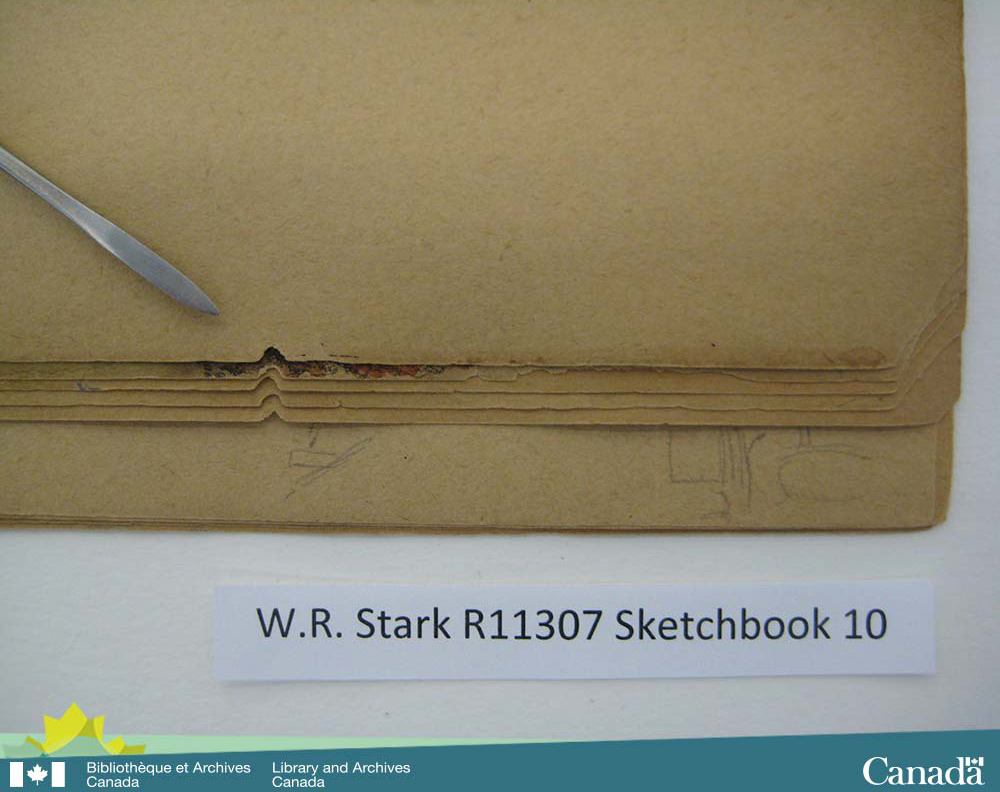
Other visual indicators that are helpful in this detective work are a repetitive pattern of paper loss along an edge. For example, several pages have been torn or indented in the same area.

Colour photograph of a sketchbook showing the repetitive, triangular-shaped area of paper that is missing from multiple pages.

An example of a repetitive pattern of paper loss along the edges of the sketchbook pages.

Visit our Flickr album on the conservation of the sketchbooks to see more photographs of this detective work. You can also view the previous articles in the Conservation series on the blog, Facebook and Twitter.

Frederick Bourchier Taylor

Canadian artist Frederick Bourchier Taylor (1906–1987), was a man of many interests and many talents. He was born in Ottawa and mostly raised there; living briefly in London, England from 1916 to 1918 after his father was transferred there during the First World War. Upon returning to Ottawa, he graduated from Lisgar Collegiate in 1918. He became a student of McGill University in 1925 after his parents asserted that he must complete university before embarking on any sort of artistic career. While at McGill, Taylor studied architecture and developed a keen interest in skiing and boxing. As a testament to Taylor’s many talents, in 1927 he was awarded McGill’s Anglin Norcross Prize for drawing, and also became the university’s heavyweight boxing champion.

After graduating in 1930, Taylor studied, exhibited and worked in Britain as well as Canada, finally settling in Montreal by 1937. During this period, he earned a living by teaching drawing at the McGill School of Architecture and painting portraits.

After war broke out in 1939, Taylor began an unsuccessful lobbying campaign in an attempt to get the Canadian Government to put into place an officially sanctioned war-art program. Undeterred by the Government’s refusal, Taylor used his artistic talent as well as family connections (his brother was Canadian businessman and millionaire E.P. Taylor) to gain access to and document Canadian Pacific Railway′s Angus Shops in Montreal, along with several Canadian shipyards and other Canadian war industry factories.

During this period, Taylor was able to paint over 200 works that document the diverse, strenuous, and often unrecognized or under-appreciated work done by Canada’s factory workers. Library and Archives Canada has some of these works in its art collection. These paintings consist of 19 small-sized studies along with eight larger finished works documenting factory workers in the fur and garment industry of Montreal during the 1940s. In these works, Taylor has used a muted palette of industrial greens, browns and greys. Taylor has demonstrated an extraordinary ability to capture not only the industrial atmosphere and harsh fluorescent factory lighting, but also the intense look of concentration on the faces of the workers.

Taylor continued his artistic career after the War, exhibiting and participating in shows mostly in Quebec and Ontario. In 1960, he moved to Mexico where he tried his hand at sculpture and silk screening. Frederick Taylor died by suicide in Mexico, in 1987.

Resources

“The Complete Set”: Some fascinating examples in Library and Archives Canada’s portrait collection

The Library and Archives Canada (LAC) holdings include one-of-a-kind historical artifacts that relate directly to specific portraits in the collection.

In some cases, items that were separated over the years were reunited at LAC. In others, LAC was fortunate to take over the custodianship of a carefully preserved ‘set.’ In all cases, these somewhat unexpected holdings provide invaluable context for better understanding the portraits they are associated with.

Copper plate image showing Captain George Cartwright checking his fox traps during the winter in Labrador. He wears snowshoes, carries a gun over one shoulder and has a dog on a leash, tethered to his belt.

Captain Cartwright visiting his fox traps (MIKAN 3986048)

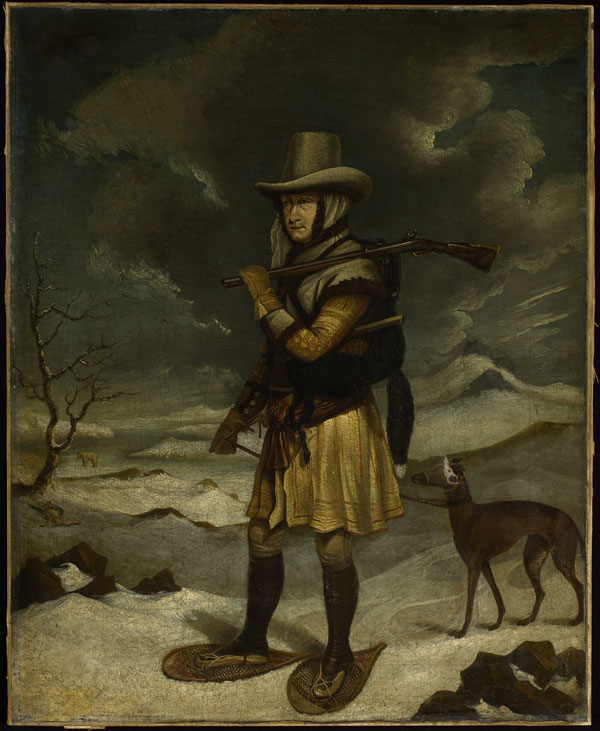
This copper plate, for example, was created as a means of ‘publishing’ the evocative oil portrait of Captain George Cartwright (1739–1819), a retired army officer who set up trade as a trapper and fur trader in Labrador.

Oil painting showing Captain George Cartwright checking his fox traps during the winter in Labrador. He wears snowshoes, carries a gun over one shoulder and has a dog on a leash, tethered to his belt.

Captain Cartwright visiting his fox traps (MIKAN 3964571)

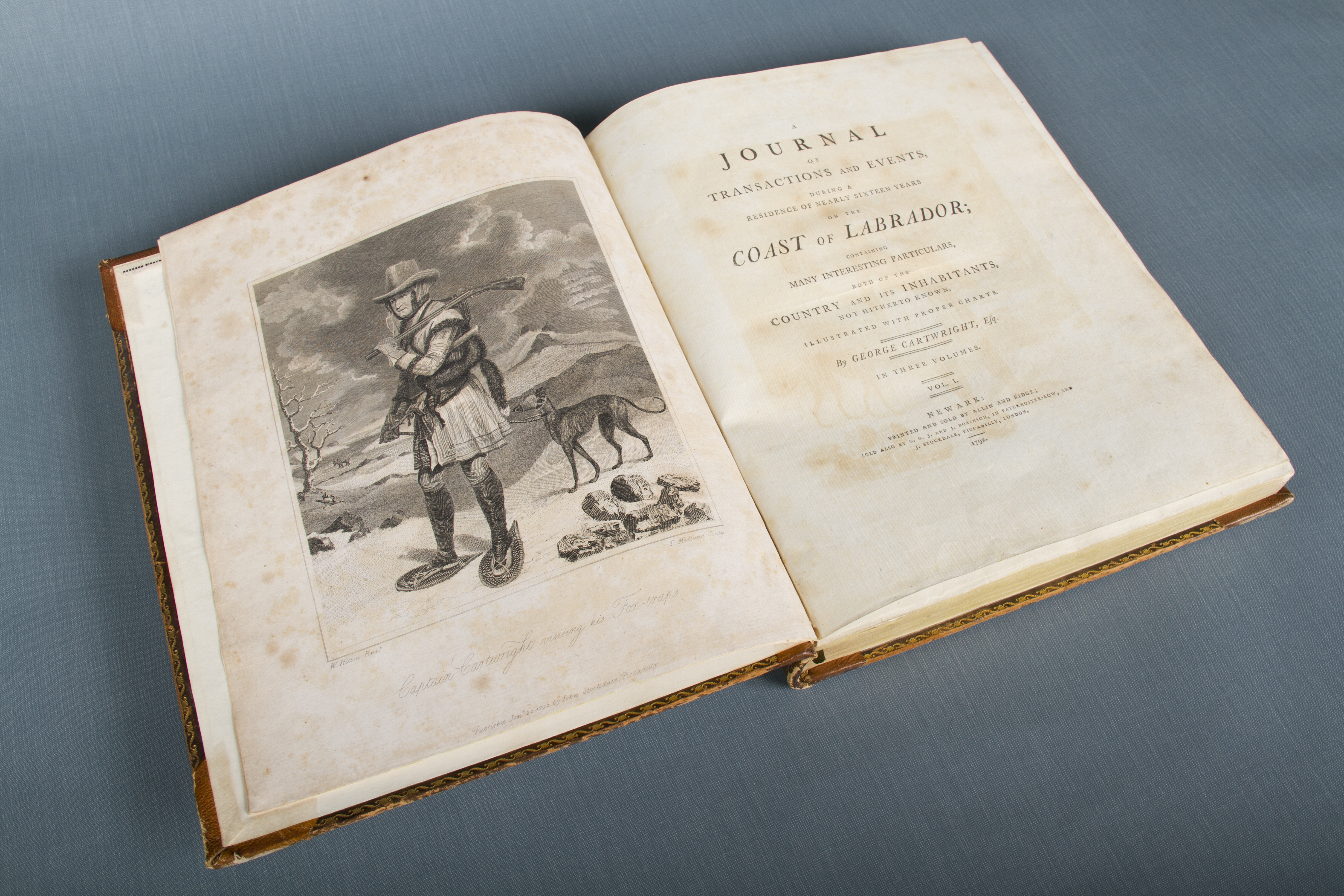
It illustrates one process that was used, before the development of photography, to “translate” paintings into a printable format, so that they could appear in books. The painted portrait was created specifically to provide a frontispiece image for Cartwright’s important Memoir, A journal of transactions and events, during a residence of nearly sixteen years on the coast of Labrador… (1792).

The same image as above, except in printed form, published in a first edition of the 1792 book.

Frontispiece from Captain George Cartwright’s Memoir (AMICUS 4728079)

Special Notes on the Frontispiece, compiled by Cartwright, underline the significance he attached to every one of the painting’s details. Like the Memoir, the painting reads like a primer for would-be adventurers—including innovative, Aboriginal-inspired solutions for survival, such as wearing snowshoes when checking traplines in winter.

Copper is a soft metal that allowed engravers to faithfully reproduce these details, as well as something of the feel of the original oil painting. Here, for example, the soft-edged atmospheric landscape of winter was created by protecting some areas of the plate with wax, while allowing acid to wash over other exposed areas.

It’s rare for any institution to hold a painting, its copper plate and a first-edition copy of the resulting book, but LAC’s collection includes all of these items.

Another example: LAC’s collection includes this pendant and earrings.

Colour photograph of two gold earrings with a stylized spiral pattern and a matching pendant.

Marie-Louise Aurélie Girard’s earrings and pendant (MIKAN 3994256)

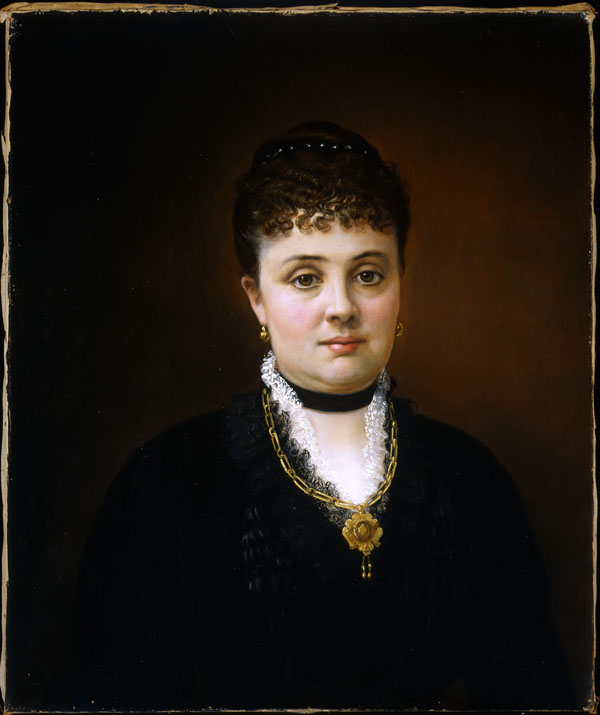
This was the actual jewellery that Marie-Louise Aurélie Girard (ca. 1868–?) wore when she sat to have her portrait painted by the distinguished Montreal artist, Alfred Boisseau (1823–1901):

Oil painting showing a woman in a black dress looking straight at the viewer. She is wearing the same pendant and earrings as shown in the previous photograph.

Marie-Louise Aurélie Girard (MIKAN 3993116)

These precious items remind us of the human process behind historical portrait painting. Prominent and wealthy sitters would often deliberate over which items to wear or include in a portrait, not only for sentimental reasons, but also to convey social status. In this case, the sitter was the wife of a former Premier of Manitoba.

Dora de Pédery-Hunt

“Medals are my favourite form of expression,” Dora de Pédery-Hunt once said. “They are like short poems.” You may not know who Dora de Pédery-Hunt is, but chances are, at one time or another or even now, you have an example of her work in your possession.

Black-and-white photograph of a woman holding a ceramic model of a medal and looking at it intently.

Portrait of Dora de Pédery-Hunt working on a medal (MIKAN 2267060)

Dora de Pédery-Hunt (1913–2008), was a Hungarian-born sculptor and medalist. After graduating with a master’s diploma in sculpture from the Royal Academy of Applied Arts in Budapest in 1943, she came to Canada by way of Germany in 1948. In Hungary, she had studied bronze and plaster casting along with stone and wood carving. After arriving in Canada, however, her need for regular work to support herself and her family was paramount. Setting aside her artistic aspirations for a short while, Dora took work as a housekeeper. In due time, Dora was introduced to sculptors Frances Loring and Florence Wyle (often called the first women of Canadian sculpture) by her Canadian immigration sponsor Major Thomas S. Chutter. Realizing her talent, Loring and Wyle helped Dora acquire a job teaching sculpture. Now free to devote most of her time to her art, Dora de Pédery-Hunt flourished.

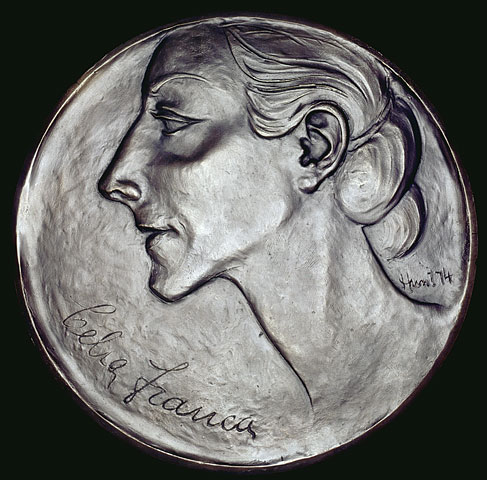
Photograph of a bronze medal showing the profile of a woman and the inscription “Celia Franca” along the bottom left.

Medal with a portrait of Celia Franca in profile (MIKAN 3704296)

Throughout the 1950s Dora received several private and public commissions. An entry Dora placed in the Canadian National Exhibition show caught the eye of Alan Jarvis, then director of the National Gallery of Canada. Through his support, Dora obtained a grant from the Canada Council enabling her to study and hone her talents in Europe for the next six months. Upon returning to Canada, Dora used the experience she gained abroad to begin working on larger scale projects, creating religious iconography such as ornate tabernacles and Stations of the Cross. At the same time, she continued to create smaller objects including many commemorative, award and portrait medals.

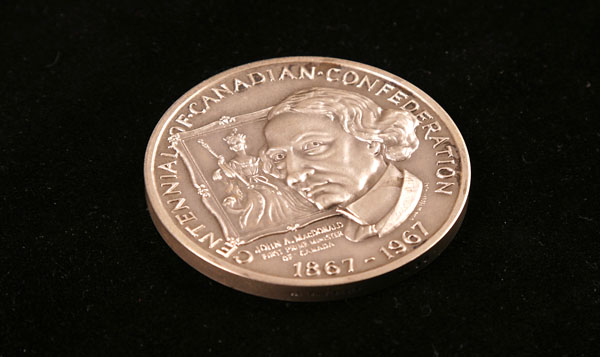
Colour photograph showing a a coin with the image of John A. Macdonald on it with a portrait of a queen behind it.

Coin commemorating the 100th anniversary of the Canadian Confederation: 1867-1967 (MIKAN 3637375)
© The Royal Trust Company. Reproduced with the permission of The Royal Trust Company.

From teaching at a small vocational college, Dora would eventually become a faculty member of the Ontario College of Art. Throughout her industrious career she received several national and international awards and accolades including the Order of Canada.

Photograph of a bronze medal showing a stylized image of a person sitting down, inscribed with the words “Canada” along the top edge and “expo 67” on the bottom right.

Commemorative medal of Montreal’s Expo 67 (MIKAN 2834429).

And what about that example of Dora de Pédery-Hunt’s artwork you most probably have in your possession? That would be the profile of Queen Elizabeth II minted on late 20th century Canadian coins.

Photograph of the face of a Canadian quarter showing the profile of Queen Elizabeth II.

Profile of Queen Elizabeth II on a Canadian quarter.

Explore the Dora de Pédery-Hunt fonds.

Library and Archives Canada releases sixteenth podcast episode, William Hind: Illustrating Canada from Sea to Sea

Library and Archives Canada (LAC) is releasing its latest podcast episode, William Hind: Illustrating Canada from Sea to Sea.

Retired Collections Manager of Artworks Gilbert Gignac and Art Archivist Mary Margaret Johnston-Miller, both from LAC, join us to discuss William Hind, an artist who played a key role in the development of art in Canadian society. We explore who William Hind was, his unique contributions to art in Canada, and what is included in LAC’s William Hind Collection.

Subscribe to our podcast episodes using RSS or iTunes, or just tune in at Podcast–Discover Library and Archives Canada: Your History, Your Documentary Heritage.

For more information, please contact us at podcasts@bac-lac.gc.ca.

Images from William Hind’s Sketchbooks Now on Flickr 

In 1862, artist William Hind joined the Overlanders, a group of gold seekers who crossed the Prairies in search of gold in the Fraser and Cariboo regions. During the trip, Hind produced a sketchbook documenting the group’s travels and some of the difficulties they faced along the undeveloped trails of the West.