Where art and history meet: exhibitions of historical photographs at the National Gallery of Canada

What happens when the practical also has a poetic side?

In recent months, visitors to the National Gallery of Canada have had a chance to explore the answer to this question. A series of small exhibitions of historical photographs, drawn from Library and Archives Canada’s collection, considers the aesthetic, as well as the documentary properties of images created “on-the-job” by 19th-century surveyors, public servants and engineers.
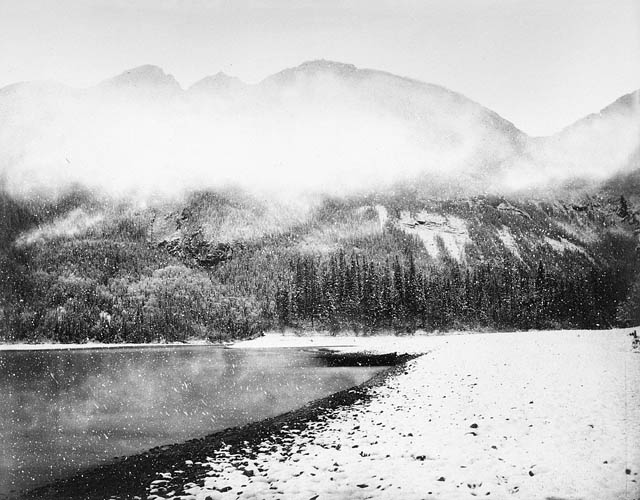
In the heart of the Rocky Mountains: A snowstorm, by Charles Horetzky

In the heart of the Rocky Mountains: A snowstorm, by Charles Horetzky (Source: MIKAN 3264251, e011067226)

At first glance, this beautiful photograph, which was part of the past exhibition Early Exploration Photographs in Canada, seem to be exactly as labelled — a view of the Peace River in British Columbia, as it appeared during a snowstorm in October 1872. It turns out, however, that Charles Horetzky, official photographer with Sir Sandford Fleming’s Canadian Pacific Railway survey team, deliberately enhanced its dramatic effect: paint splatters were added to the image in order to create the effect of non-existent snow.

The current exhibition, Paul-Émile Miot: Early Photographs of Newfoundland, on view until February 2, 2014, includes this portrait from the 1800s, by French naval officer Paul-Émile Miot.

Mi’kmaq man, by Paul-Émile Miot

Mi’kmaq man, by Paul-Émile Miot (Source: MIKAN: 3535989, e011076347)

It was taken while surveying and mapping the coastal areas of Newfoundland — at the time, France maintained a commercial fishing interest in these waters. Though Miot was capturing the earliest known photographs of members of the Mi’kmaq Nation, the extravagant pose of his subject suggests 19th-century European romanticism.

So-called inaccuracies or created effects in 19th-century documentary photographs do not negate the worth of these images as records of past events. If anything, they add fascinating nuances of meaning to these items, as artifacts.

We invite you to stay tuned for the next exhibition, on Arctic exploration photography, opening on February 7, 2014.
About Face: Library and Archives Canada portrait exhibition at Queen’s Park

Three original works of art and over 30 high-quality reproductions from the Library and Archives Canada (LAC) portrait collection are on display in the Lieutenant Governor’s Suite at Queen’s Park in Toronto until March 31, 2014. The portraits are part of About Face: Celebrated Ontarians Then and Now, an exhibition developed by the Office of the Lieutenant Governor of Ontario in collaboration with LAC. These historical and modern portraits represent men and women from a wide range of cultural backgrounds and walks of life, who helped shape the Ontario of today.

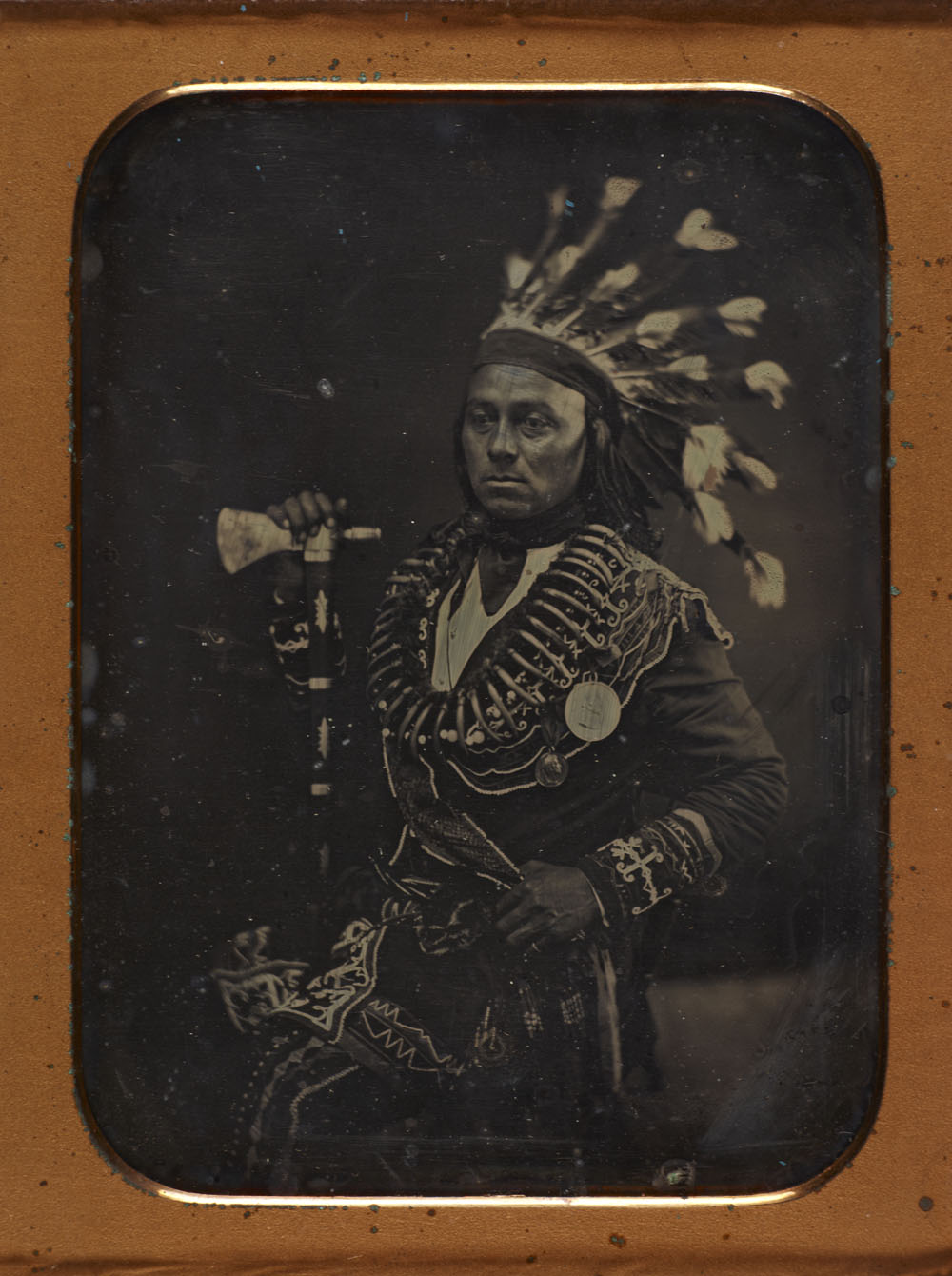
This rare portrait of Maun-gua-daus, for example, is one of the earliest photographs of an Indigenous person in LAC’s collection. A member of the Ojibway nation, Maun-gua-daus was educated by Methodist missionaries and served as a mission worker and interpreter in Upper Canada (now Ontario). From 1845 to 1848, he took part in a tour of England, France and Belgium, demonstrating the ritual, dance and sport found in Ojibway culture. This photograph was probably taken during that tour, in about 1846. It was made using the daguerreotype process, the first method widely used for producing photographic images.

Maun-gua-daus (or Maun-gwa-daus), alias George Henry, original chief of the Ojibway nation of Credit (Upper Canada)

Maun-gua-daus (or Maun-gwa-daus), alias George Henry, original chief of the Ojibway nation of Credit (Upper Canada) (Source: MIKAN 3198805)

An iconic portrait of figure skater Barbara Ann Scott was taken in 1946 by another notable Ontarian, Yousuf Karsh. At the time, the young lady from Ottawa was a Canadian national champion, but had yet to win a European championship and a world figure-skating title. Scott became “Canada’s sweetheart” and Olympic gold-medal champion in 1948, at the age of 19. In this photograph, Karsh frames the skater’s youthful face in what appears to be a saintly halo.

Barbara Ann Scott

Barbara Ann Scott (Source: MIKAN 3192044)

Come see for yourself! Contact the Office of the Lieutenant Governor of Ontario, Queen’s Park to arrange a viewing of the exhibition.

The “ghost” Colonel…and other “spooky” portraits in Library and Archives Canada’s collection

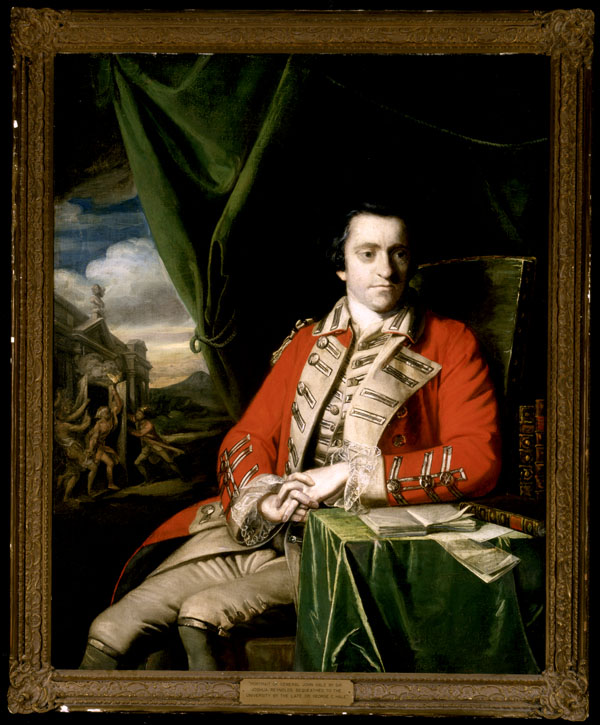
One of the most beautiful and rare oil paintings in Library and Archives Canada’s collection is this portrait of Colonel John Hale (1728–1806). After returning to England as a hero of the Battle of the Plains of Abraham (1759), Hale had this portrait painted by Sir Joshua Reynolds (1723–1792), a famous portrait artist, who is also renowned for his experiments with paint materials and for his stubborn attitude towards the use of one particular colour.

Portrait of Colonel John Hale, circa 1763-1764.

Portrait of Colonel John Hale, circa 1763-1764. Source

In the portrait, the lapels of Hale’s uniform are edged in black in honour of the death of General James Wolfe (1727–1759), a reminder of the most recent and significant battle in Colonel Hale’s career. The unusually pale colour of Hale’s face and hands fits well with this serious subject matter. It also seems appropriate for a portrait of a man who lived a long time ago — as modern viewers might expect, Hale appears to be a ghost out of the past.

But Hale’s otherworldly appearance is really a complete accident. To create a flesh colour for faces and hands, Reynolds mixed white pigment with carmine, a dark red pigment made from crushed South American beetles. Unfortunately, early carmine was “fugitive” — it disappeared quickly when exposed to light. This is especially true when, as in this portrait, carmine is mixed with white. White is a colour pigment that is less able to protect carmine from light exposure. Carmine fades away, and white is the main colour that remains behind.

Even within Reynolds’ lifetime, the pale faces in many of his early portraits were noticed. Yet Reynolds is famous for refusing to use vermilion, the more stable but less natural shade of red. He is said to have responded to the suggestion by looking at his own hand and saying: “I can see no vermilion in flesh.”

For more “spooky” portraits, visit our Flickr album.

Library and Archives Canada Announces the Opening of Two Exhibitions

Library and Archives Canada continues to display the richness and diversity of its collections with the opening of two exhibitions.

In Saskatchewan, the Mendel Art Gallery in Saskatoon is hosting the I Know You by Heart: Portrait Miniatures exhibition until June 2, 2013. The exhibition highlights the intimate, personal nature of portrait miniatures, and the reasons that such images are commissioned and created. Find out more about the conservation of these portraits on Library and Archives Canada’s YouTube video.

In Quebec, the Canadian Museum of Civilization in Gatineau is presenting the exhibition Double Take: Portraits of Intriguing Canadians until October 14, 2013. Discover portraits of Canadians who have left—and are still leaving—their mark on our country and our culture. Tune in to Library and Archives Canada’s podcast for an overview of the featured works and the stories behind them.

By presenting exhibitions such as these, Library and Archives Canada is able to make original works of documentary heritage accessible in galleries, museums and other community venues to Canadians across the country.

Keep following this blog to stay informed about upcoming events.

Library and Archives Canada’s Travelling Exhibitions

Library and Archives Canada (LAC) is on the road! With four travelling exhibitions on display in different venues across Canada, including one in the
National Capital Region, LAC is showcasing the richness and diversity of its collections. This is an excellent example of LAC’s commitment to making the
country’s heritage and history accessible to all Canadians—regardless of where they live.

The Art Gallery of Greater Victoria, in British Columbia, is hosting the exhibition Beyond Likeness: Contemporary Works from Library and Archives Canada until January 6, 2013. Through the works of 23 contemporary artists, the exhibition explores the evolving concept of portraiture from more traditional representations of likeness to works that challenge the conventions of the genre.

The New Brunswick Museum in Saint John is presenting the exhibition I Know You by Heart: Portrait Miniatures until December 31, 2012. Showcasing 35 recently restored portraits, the exhibition highlights the intimate, personal nature of portrait miniatures, and the reasons that such images are commissioned, created and carried. In March 2013, the exhibition will make its way to the Mendel Art Gallery in Saskatoon.
Find out more about the conservation of these portraits in LAC’s YouTube video.

The McMichael Art Gallery in Kleinburg, Ontario, is showcasing LAC’s most recent exhibition Double Take: Portraits of Intriguing Canadians until January 20, 2013.Double Take presents 50 Canadians who have left—and are leaving—their mark on our country and our culture. Tune in to LAC’s podcast for an overview of the featured works and the stories behind them.

Finally, the exhibition Faces of 1812 is on display at the Canadian War Museum in Ottawa until January 6, 2013. A commemorative exhibition, Faces of 1812 presents some of the men and women who experienced the War of 1812. LAC’s curatorial YouTube video and Faces of 1812 podcast will introduce you to the selected
works that document this significant historical event.

Keep following this blog to find out where these exhibitions will travel next. It could be your hometown!

Questions or comments? We would love to hear from you!

The Canadian Coast Guard celebrates its 50th anniversary – Part II

In a previous blog, we invited you to discover some archival holdings to mark the 50th anniversary of the Canadian Coast Guard (CCG), including photographs, as well as government and political records. In this blog, Library and Archives Canada (LAC) encourages you to explore holdings containing CCG caricatures, audiovisual records and publications.

Caricatures

Audiovisual Records

There are many films and interviews on the CCG. It would be nearly impossible to list them all here, but the following are a few examples that may pique your curiosity.

Visit our film, video and sound recording database for more audiovisual records.

Publications

LAC has a vast collection of publications! Here are some books on the CCG that may interest you:

For more publications, visit AMICUS.

If you wish to search the records on-site at LAC, please order them at least five business days before your visit. You may order them online by using our Request for Retrieval of Documents form or by calling 613-996-5115 or  1-866-578-7777 (toll free) and selecting option 8 in the automated menu.

Questions or comments? We would love to hear from you!

Summary of comments received in French up to September 30th, 2013

  • LAC added the following resources: Usque ad mare: a history of the Canadian Coast Guard and marine services by Thomas E. Appleton. (AMICUS 612170) and The Canadian Coast Guard, 1962-2002 by Charles D. Maginley (AMICUS 28388186).

Patrolling the French Shore with Louis Koenig

Newfoundland in the summer, completely inaccessible because of its winged garrison. Library and Archives Canada. (Source)

Did you know that thanks to the collection of Library and Archives Canada (LAC) it is possible to patrol the French Shore of the island of Newfoundland with Lieutenant Louis Koenig and discover this particular area where the French had cod fishing rights for almost 200 years, because of two treaties signed between France and England? Accompany Koenig and the crew of the French frigate La Clorinde during a campaign that brought them to Newfoundland, Cape Breton Island and Saint-Pierre and Miquelon in 1885.

Recognized by the French Navy for his artistic talents, Koenig created the 145 drawings and watercolours, the hand-drawn maps and the logbook, which are found in the Louis Koenig fonds and Louis Koenig Collection. The illustrations, most of which were done on site, show the landscapes and military installations he observed, as well as daily activities on board La Clorinde. The maps give three views of the French Shore and include notes by the artist.The logbook, also written by Koenig, documents the voyage, the places visited and gives his candid impressions of his experiences; devoting particular attention to the mosquitoes, which were apparently delighted to welcome the French sailors! The collection also includes a small sketchbook containing an illustrated, much more personal, account of the voyage, full of humour and whimsy presented by Koenig as a gift to La Clorinde’s commander, Félix-Auguste Le Clerc. Koenig also wrote an article Le « French Shore » (souvenirs de campagne à Terre-Neuve) (The “French Shore”, Memoirs of a Newfoundland Campaign), embellished with his maps and illustrations and published in 1890 in the periodical Tour du monde.

To order published documents that are unavailable online, use our online Request for Retrieval of Documents, or call 613-996-5115, or toll-free 1-866-578-7777, to consult them in person at 395 Wellington Street in Ottawa.

Enjoy the discoveries and view the Flickr set of images from Koenig’s albums!

Questions or comments? We would love to hear from you!