Discover Canada’s Olympic and Sports History – Part II

Do the London Olympics inspire you to learn more about the history of the evolution of sports in Canada?  If so, a great place to begin your research is at Library and Archives Canada. We hold the records of the national bodies for the following sports:

You will also find more information in the Fitness and Amateur Sport Branch records of the former Department of National Health and Welfare (now Health Canada); this is the main source for learning about the federal government’s involvement in the area of sports. It includes over 40,000 photographs documenting the performance of Canadian athletes at national and international competitions (including the Olympics) during the 1960s and 1970s.

For more information on sports, please visit our other websites:

Please remember that not all of our material is available online; however, it is possible to order archival material through our online Request for Retrieval of Documents Form, or by telephone at 613-996-5115 or 1-866-578-7777 (toll-free).

Questions or comments? We would love to hear from you!

Discover Canada’s Olympic and Sports History – Part I

With the London Olympics well underway, it is fitting to remember the past Canadian accomplishments at the Games and to get acquainted with Canada’s relationship with sports throughout history.

For those interested in a visual history of Canada’s participation at the Olympic Games, Library and Archives Canada’s (LAC) Canadian Olympians database and web pages consist of more than 10,000 images of athletes from the 1904 St. Louis Olympics in the United States to the 2004 Olympics in Athens, Greece.

Some of the early important events in Canada’s Olympic history documented at LAC.

*For more information on George Hodgson and other athletes, visit Sporting Lives: Images of Canadian Athletes (archived site).

Please remember that not all of our material is available online; however, it is possible to order archival material through our online Request for Retrieval of Documents Form, or by telephone at 613-996-5115 or 1-866-578-7777 (toll-free).

For more photographs from past Olympics, visit our Images of summer sports and leisure activities Flickr set.

Enjoy the London Games!

Questions or comments? We would love to hear from you!
Discover the Access Codes for Archival Records at Library and Archives Canada – Part II

In our post “Discover the Access Codes for Archival Records“, we reviewed four of the most common access codes 90, 32, 10, and 18. However, there are other access codes that you may encounter while undertaking your research. They include access codes 96 and 99.

Restrictions vary (Code 96)

Access code 96 indicates that within a group of records there exists more than one type of access condition. For example, since the Department of Transportation fonds (RG12) contains records that are open (code 90) and others that are restricted (code 32), the fonds-level access condition are indicated by “restrictions vary” (code 96).

A sample record description in the Archives Search database displaying access code 96: RESTRICTIONS VARY.

Access code 96 can be applied to more than just fonds-level descriptions. It can also be linked to series, sub-series and accessions. However, it does not apply to individual volumes and files.

Remember

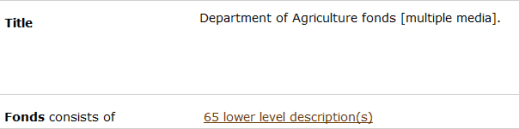
Access code 96 usually means that there are more specific descriptions available for the records you are researching. In some cases, these records can be accessed by simply clicking on the “lower level descriptions” link in the “Fonds consists of” section of a record description.

A sample record description in the Archives Search database displaying the FONDS CONSISTS OF ROW.

In other cases it will be necessary to consult a printed finding aid. To learn more, read our post Discover Finding Aids.

To be determined / closed pending processing (Code 99)

Access code 99 means that the access conditions for a group of records have yet to be determined. Usually this is because the records are being processed. In the following example, while the photographic material is open, the access conditions for the textual records have yet to be determined:

A sample record description in the Archives Search database displaying access code 99.

Open, no copying (Code 95)

Access code 95 indicates that the records are open and can be consulted, however, at the request of the donor, the records cannot be copied or reproduced.

A sample record description in the Archives Search database displaying access code 95.

Questions or comments? We would love to hear from you!

Looking for the Debates of the House of Commons (Hansard) online?

Are you searching for the Debates of the House of Commons, also known as Hansard? Depending on the dates you are looking for, a great place to start your research is online. However, only the very early years and the very recent years are available online; those in between are not.

Here is the breakdown:

1867–1900

The full texts of Hansard for the years 1867–1900 are available online through the Early Canadiana Online (ECO) website [http://eco.canadiana.ca/?usrlang=en]. While some of the content in ECO is only available to subscribers, the Debates of the House of Commons are available for free and do not require a subscription.

1901-1993

Hansard for the years 1901–1993 are not yet available online. Library and Archives Canada holds these years in print and in microform. Many university and public libraries hold print or microfilm/microfiche copies of Hansard. Please contact your library for more information. If you are a university or college student, check your school library website to see if there is a research guide for government or parliamentary publications, which can save you a lot of time.

Library and Archives Canada has participated in a project to digitize the full-text of Hansard for 1901-1993. When this digitized content is available online, we will post an announcement on this blog.

1994-Present

The full texts of Hansard from the 35th Parliament (January 1994 onwards) are accessible online from the Parliament of Canada website [www.parl.gc.ca]. Select “Parliamentary Business” (top left), then “In the House of Commons Chamber” (left column). Choose the Parliament and Session from the list on the left.

Tips

  • The Debates are always organized by Parliament and Session. A handy reference tool to find the Parliament and Session [www.parl.gc.ca/ParlInfo/Lists/Parliament.aspx?Language=E] that correspond to the dates you are looking for is available on the Parliament of Canada website.
  • The Debates have detailed indexes. In the early years, these indexes were in the same volume as the Debates. In the later years they were printed in a separate volume.

Questions or comments? We would love to hear from you!

The Top Five Things You Need to Know Before You Visit

Are you visiting Ottawa to do some research at Library and Archives Canada? Before you arrive, there are five things you need to know:

1. All researchers need a user card

You can register for a user card in two ways, either in person at the registration desk or online by submitting the User Card Registration Form. Present your photo ID at the registration desk to retrieve your user card.

You must read and agree to the terms and conditions in the User Agreement before you can obtain the user card.

2. There is a difference between service hours and opening hours

Our service points, including the registration desk, are only open during service hours when staff is on site and ready to help you. The building is accessible during opening hours, but staff is unavailable. These hours are posted on the Visit Us section of our website and in the building.

3. Order your research material in advance

At least five business days before your visit, order up to ten items of archival material by using our online Material Retrieval (Onsite Consultation) Form. You may order up to five items of published materials the same way as above, or place your order by telephone at 613-996-5115 or 1-866-578-7777 (toll-free in Canada and the US) by selecting option 8 in the automated menu.

4. Book your reference appointment, if necessary

We are applying a new approach to service delivery. This means that no appointment is necessary for basic orientation and genealogy services, which are available from 10 a.m. to 3 p.m., Monday to Friday. However, you must book an appointment if you need to consult our reference experts or genealogy specialists.  See the Contact Us section of our website for more information.

5. Where to start your online search

There are a variety of databases to choose from, so we encourage you to watch this 90-second video tutorial to help you determine “How to Begin your Search Online.”

Questions or comments? We would love to hear from you!

Summary of comments received in French up to September 30th, 2013

  • LAC added that there is no need to make an appointment for basic assistance for genealogical research. Staff is available from 10 AM to 3 PM, Monday to Friday. However, you must book an appointment if you want to consult with staff before or after those hours.

The School Files Series, 1879 -1953

Library and Archives Canada (LAC) holds records created by the federal government about the administration of residential schools.

The School Files Series (archival reference RG10-B-3-d) within the Indian and Inuit Affairs sous fonds contains records created from 1879 to 1953 about residential schools and day schools.

This series contains some records of the admission and discharge of students at residential schools, as well as files on the establishment of individual schools.

The School Files Series has been digitized and is available through the Microform Digitization section of the LAC website.

Our reference specialists recommend a list of which schools are mentioned in which volumes and reels of the series. This list can be found in the Search Help section of the digital version of the series. It will prove to be quite useful when navigating the School Files Series.

Additional Resources

  • For more information on how to search the Microform Digitization section, use the Search Help section.
  • View the description of this series in Archives Search for additional information.

Questions or comments? We would love to hear from you.

How to find out if a war diary from the Second World War is on microfilm

The article War Diaries: Discover what individuals or military units did during the war explores war diaries, their usefulness and how you can access them. Now, you may wonder: In what formats are they available?

Most First World War Army diaries have been digitized. As for Second World War diaries, some were microfilmed, but many are available in their original paper format only.

To find out if a war diary from the Second World War is available on microfilm, you must perform a search in the Archives Search database. After you have selected the relevant diary title, just refer to the Conditions of access section of the archival description.

For example, the war diaries of the 1st Armoured Car Regiment (Royal Canadian Dragoons) for September and October 1945 are accessible on microfilm reel T-12563.

Although some microfilm reel numbers are not entered in the Archives Search database, we have created a list of reel numbers that you can consult on-site at 395 Wellington Street, in Ottawa, or by contacting Reference Services.

Questions or comments? We would love to hear from you!

Lights, Camera, Action! Searching for Film, Video and Sound Recordings

If you’re looking for information about audiovisual recordings in the archival collection of Library and Archives Canada, use our Film, Video and Sound database, which contains details on individual audiovisual recordings that cannot be found in our Archives Search.

If you are looking for published audiovisual recordings, such as commercial film or television production, use Library Search.

Tips:

  • It is not yet possible to view the recordings online. Please see our blog post on How to Consult Material that IS Not Yet Available Online for details.
  • In the Film, Video and Sound database, the statement No consultation copies available indicates that a consultation copy must be made before you can consult or order a copy of the document. This will take approximately six weeks.

*Please consult our clarification regarding this article.

Questions or comments? We would love to hear from you!

Handle with Care: How to Handle Archival Boxes Properly

We have all carried a box or two in our lives. Some, we are more careful with, like our grandmother’s china. Others, like a box of winter clothes we are anxious to put away, may not require such care. Think of archival boxes as you would your grandmother’s precious china. The box of records you are given to consult may contain documents that are hundreds of years old and one of a kind. To help us continue to preserve and protect these documents, our consultation staff have prepared a quick list of Do’s and Don’ts to guide you in the proper care and handling of archival boxes and their contents:

Do’s

  • Hold the box with two hands, using one hand to support the bottom of the box.
  • Keep the box close to your body when transferring it from one surface to another. Bring the box to the consultation staff immediately if you suspect it contains mould.
  • Take one file at a time out of the box.
  • Close the lid once you have retrieved your file.
  • Make sure that the entire record rests on the surface of the table and that no part hangs over the edge.
  • Inform the consultation staff if you notice that the box is damaged. Staff will make arrangements to re-box it.
  • Use only pencils near archival documents.
  • Use the blue flags provided in the research areas to bookmark a page.
  • Use the carts provided to move a box from the table to the returns cart, to the lockers or back to consultation staff.

Don’ts

  • Place the container on the floor.
  • Rearrange the order of the documents in the file or the box.
  • Use hand lotion or hand sanitizer while handling the box or its contents.
  • Use metal clips or sticky notes on the documents.
  • Use the box handles, as this action could damage the box and the material inside.
  • Lean on the records.

If you have any questions while consulting archival documents, please feel free to ask the staff at the consultation desk who will gladly help you out.

Questions or comments? We would love to hear from you!

“Time Travel” Research Tools: Discover Canadian Mail Order Catalogues

Reference specialists at Library and Archives Canada often wish they had a time machine where they could just dial in a year and away they would go!  While this is just fanciful thinking, Library and Archives Canada’s online collection of Canadian Mail Order Catalogues is a “time travel” research tool. This site provides an opportunity to discover English and French mail order catalogues, from a number of different stores, from the 1880s to the 1970s.

These department store catalogues provide a detailed record of many aspects of everyday life over the last century.  They contain everything from household furnishings and furniture, to all manner of clothing and accessories, kitchenware, patent medicines, toys, tools, and sporting equipment.

These catalogues can be used to identify and date collectables and memorabilia; to price household items from a certain time period; to establish the approximate dates of photographs by studying fashion trends; or to research props, sets and costumes for theatre and film. The possibilities are endless.

Whether you browse the catalogues for research purposes or just for fun, we hope that you will enjoy the trip back in time.

Tip

You can navigate each catalogue page by page or search all the catalogues by keyword.  For example, the results of a search for the keyword “hockey” will include a wonderful image of hockey sweaters from the Eaton Automne et hiver 1950–1951 catalogue.

Tidbit

To convert catalogue prices into today’s dollars, the Bank of Canada’s Inflation Calculator [www.bankofcanada.ca/rates/related/inflation-calculator/] is a handy tool.

Questions or comments? We would love to hear from you!