Drawn from history: Canadian political figures in comics

By Meaghan Scanlon

Most of us are familiar with newspaper editorial cartoons. These one-panel gag comics often feature exaggerated and satirical images of politicians. But did you know that Canadian politicians have also appeared in web comics, graphic novels, and even Super Hero comics?

Kate Beaton’s web comic Hark! A Vagrant frequently features historical figures. Her strip “A History Debate” sees a collection of well-known individuals from Canadian history, including Sir John A. Macdonald, engaged in a discussion about what they can do to make Canadian history less boring. (Obviously, we don’t think it’s boring at all!)

A few Canadian political figures’ lives have been recounted in biographical graphic novels. Two examples are Louis Riel: A Comic-Strip Biography by Chester Brown and Hyena in Petticoats: The Story of Suffragette Nellie McClung by Willow Dawson. These biographies may take some liberties with their portrayals of events, but for the most part they are based in reality.

However, Canadian politicians have found themselves in some truly fantastical situations in the pages of Super Hero comics. You may have read recently that Prime Minister Justin Trudeau will appear in the pages of a Marvel comic book written by Canadian Chip Zdarsky. This is not the first time the world of comic book heroes has borrowed a character from Canada’s political sphere. In the first issue of New Triumph featuring Northguard, the titular hero uncovers a plot to kill Quebec Premier René Lévesque. Fortunately, Northguard arrives in time to save Lévesque’s life.

In issue No. 120 of The X-Men, Prime Minister Pierre Trudeau meets with James MacDonald Hudson, codename: Vindicator, of the Canadian Super Hero team Alpha Flight. Trudeau instructs Vindicator to capture the X-Men’s Canadian member, Wolverine, and bring him home to Canada. Canadian artist John Byrne drew the comic.

A large screen shows the X-Men fighting a giant robot. Prime Minister Pierre Trudeau stands in front of the screen along with Alpha Flight team leader Vindicator. Trudeau asks Vindicator to explain who the X-Men are. The words “The Uncanny X-Men” appear in large text at the top of the page. The story title is “Wanted: Wolverine! Dead or Alive!” The location of the scene is given as “The War Room of the Canadian Ministry of Defense – Ottowa [sic], Ontario, Canada …”

Pierre Trudeau gets a lesson on the X-Men from Alpha Flight’s team leader Vindicator in The X-Men no. 120, published by Marvel Comics, April 1979. (Reprinted in X-Men: Alpha Flight (AMICUS 44300363) © MARVEL

Perhaps the most unusual depiction of Canadian politicians in comics occurs in Angloman: Making the World Safe for Apostrophes! Angloman, the heroic champion of bilingualism, encounters a series of super-powered characters who might seem strikingly familiar to students of Canadian politics. Power Chin, for example, is a parody of Prime Minister Brian Mulroney, complete with the oversized chin that was Mulroney’s trademark feature for caricaturists. Pierre Trudeau appears as The Northern Magus, a mysterious caped figure with a rose in his lapel. The Northern Magus has incredible magical powers and only speaks in rhyme.

Sketches and textual descriptions of three characters – Poutinette, The Northern Magus, and Power Chin.

Character biographies for Poutinette, The Northern Magus and Power Chin from Angloman: Making the World Safe for Apostrophes! (AMICUS 14740760. © Mark Shainblum and Gabriel Morrissette. Reproduced with the permission of Signature Editions.) (AMICUS 14740760)

To learn more about comic book depictions of Canadian history as well as other Canadian comics, visit Library and Archives Canada’s exhibition Alter Ego: Comics and Canadian Identity. The exhibition runs at 395 Wellington St. in Ottawa until September 14th. Admission is free.

Additional resources


Meaghan Scanlon is the Special Collections Librarian in the Published Heritage Branch at Library and Archives Canada.

Alter Ego: Comics and Canadian Identity

By Meaghan Scanlon

The first Canadian comic book, Better Comics no. 1, was published 75 years ago by Vancouver’s Maple Leaf Publishing. Since that time, Canada has produced many talented comic book artists. Library and Archives Canada (LAC) presents a new exhibition of reproductions of these artists’ work. Entitled Alter Ego: Comics and Canadian Identity, the exhibition runs from May 12 to September 14 in the lobby of LAC’s main building at 395 Wellington St. in Ottawa.

Alter Ego takes three different approaches to the subject of comics and Canadian identity. The works featured are organized into three thematic groupings: “Collective Identity,” “Secret Identity,” and “Personal Identity.”

“Collective Identity” looks at the ways Canadian artists have engaged with national identity in their work. The Canadian identity is built through shared symbols and a shared history. Many Canadian comics, particularly in the superhero genre, have used the country’s national symbols to build patriotic feeling. There are also several comics about important figures and events from Canadian history. Through their depictions of distinctly Canadian stories, these comics help us consider what it means to be Canadian.

“Secret Identity” spotlights some of the Canadian artists who have found success outside Canada. From the earliest days of American comic books when Canadian Joe Shuster co-created Superman, Canadian artists have made significant contributions to international comics. Often, these artists’ work has little to do with their home country. To fit in with the wider world, they keep their Canadian origins hidden below the surface—like a superhero’s secret identity.

“Personal Identity” delves into Canada’s impact on the genre of autobiographical and realist comics. A number of Canadian cartoonists have drawn comics about “normal” characters—people who are more like Clark Kent than Superman. Dealing with issues such as family relationships, trauma and recovery, and sexual identity, these comics are highly personal. At the same time, their portrayal of circumstances that countless readers can relate to makes them universal.

The archetypal superhero, with his dual identity, is an extreme illustration of the idea that each of us is many things simultaneously. We define ourselves by our various qualities, and choose which side of ourselves to emphasize depending on our circumstances. Alter Ego examines some of the many perspectives on identity revealed through the work of Canadian comic artists. All of these perspectives work together to show that there is no single “Canadian identity,” but rather as many versions of the concept as there are Canadians.

Visit Alter Ego: Comics and Canadian Identity and see which parts of your unique version of Canadian identity are reflected in Canadian comics! See you at 395 Wellington St. starting May 12. Admission is free.

Additional resources


Meaghan Scanlon is the Special Collections Librarian in the Published Heritage Branch at Library and Archives Canada.
Drawn from Real Life: Hillborough Studio’s First Canadian Comic Book Heroes

By Meaghan Scanlon

In August 1941, a small Toronto-based comic book publisher called Hillborough Studio released the first issue of its first title, Triumph Adventure Comics. The series is an anthology, with each issue containing several one-page humour strips along with a few longer feature stories. These features showcase heroic characters like Cape Breton strongman Derek of Bras d’Or and Inuit demigoddess Nelvana of the Northern Lights.

The fact that these characters both have distinctly Canadian identities is no coincidence. The first issue of Triumph Adventure Comics includes a letter from the comic book’s editor to its readers, which notes that the stories in issue no. 1 “all have a Canadian background, which will delight you not only in this edition, but in the many issues to follow.” Who would produce these Canadian stories? Naturally, the editor says Hillborough employs “the best artists in Canada.”

The team of artists and writers behind Triumph Adventure Comics sometimes drew on real-life Canadians for inspiration. The creators of Derek of Bras d’Or based the character on Angus McAskill (sometimes spelled MacAskill), a Cape Bretoner famous for his incredible strength and gigantic stature. McAskill, who was almost eight feet tall, toured the world as a curiosity during the 1840s and 1850s.

A black-and-white photograph of two men standing: one is very tall and the other is very short.

Angus MacAskill and Tom Thumb. (MIKAN 3531760)

Continue reading

The Persons Case, 1929

The Persons Case is a historic part of women’s fight for political equality in Canada. The case is significant for establishing that interpretation of the Canadian Constitution is adaptable to the changing needs of society and for determining that “qualified persons” in the British North America Act, 1867 (BNA Act, now known as the Constitution Act, 1867) includes women. This decision paved the way in Canada by asserting women’s rights to be active in political life.

The events leading to the Persons Case began in 1916 when Emily F. Murphy was appointed as the first female police magistrate in the British Empire. Undermining her authority, lawyers challenged her position as illegal on the grounds that a woman was not considered to be a person under the BNA Act, and therefore she was unable to act as magistrate. Although the Provincial Court of Alberta would confirm Murphy’s appointment by declaring women as “persons,” this decision was not proclaimed federally.

Over the next 10 years, the federal government faced pressure from women’s groups to appoint a female senator. The government declared the appointment of a women impossible according to the BNA Act, which specified only “qualified persons” could hold a senate position. Turning to the law, Murphy found that under section 60 of the Supreme Court Act, five interested persons are allowed to petition the government for interpretation on a constitutional point.

Murphy enlisted the help of Henrietta Muir Edwards, Nellie Mooney McClung, Louise Crummy McKinney, and Irene Marryat

Parlby—now known as the “Famous Five”—who were engaged politically and championed equal rights for women.

A black-and-white photograph showing five women standing on either side of a man.


(Front row, L-R): Mrs. Muir Edwards, daughter-in-law of Henrietta Muir Edwards; Mrs. J.C. Kenwood, daughter of Judge Emily Murphy; Hon. Mackenzie King; Mrs. Nellie McClung. (Rear row, L-R): Senators Iva Campbell Fallis and Cairine Wilson. This photograph was taken at the unveiling of a plaque commemorating the five Alberta women whose efforts resulted in the Persons Case, which established the rights of women to hold public office in Canada. Photograph taken by Eugene M. Finn, National Film Board of Canada, June 11, 1938, Ottawa, Ontario. (MIKAN 3193154)

Continue reading

Hiding in Plain Sight: Discovering the Métis Nation in the Collection of Library and Archives Canada

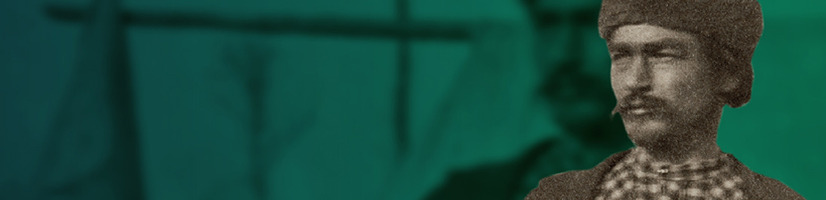
Banner for the Hiding in Plain Sight exhibitionBy Beth Greenhorn

This article contains historical language and content that some may consider offensive, such as language used to refer to racial, ethnic and cultural groups. Please see our historical language advisory for more information.

Who Are the Métis?

The Métis Nation emerged as a distinct people during the course of the 18th and 19th centuries. They are the second largest of the three Indigenous peoples of Canada and are the descendants of First Nations peoples and Europeans involved in the fur trade.

Métis communities are found widely in Manitoba, Saskatchewan, Alberta, and the Northwest Territories, with a smaller number in British Columbia, Ontario, Minnesota, Montana and North Dakota.

Library and Archives Canada (LAC) has a great variety of archival documents pertaining to the Métis Nation (including textual records, photographs, artwork, maps, stamps and sound recordings); however, finding these records can be a challenge.

Challenges in Researching Métis Content in the Art and Photographic Collections

While there are easily identifiable portraits of well-known leaders and politicians, including these portraits of Louis Riel and Gabriel Dumont, images depicting less famous Métis are difficult to find. Original titles betray historical weaknesses when it comes to describing Métis content.

In many cases, the Métis have gone unrecognized or were mistaken for European or First Nations groups—such as the people in this photograph entitled “Chippewa Indians with Red River Carts at Dufferin.”

Black and white photograph of a man, on the left, wearing European clothing and standing in front of a Red River cart, and a group of First Nations men, women and children wearing First Nations-style clothing and standing in front of another Red River cart, on the right.

Chippewa Indians with Red River Carts at [Fort] Dufferin, Manitoba, 1873 (e011156519)

Clad in blankets and wearing feathered headdresses and other hair ornaments, the group on the right appears to belong to the Chippewa (Ojibwe) First Nation, as the title indicates. In contrast, the man on the left is dressed in a European jacket and pants and wears a different style of hat. However, both the man and the group pose in front of Red River carts, which are unique to Métis culture. Given his different style of clothing, coupled with the carts, it is possible that the man was Métis.

In other cases, archival descriptions exemplify colonial views of the “other” culture. Penned over a century ago, the language is often outdated, and the terminology racist, by today’s standards.

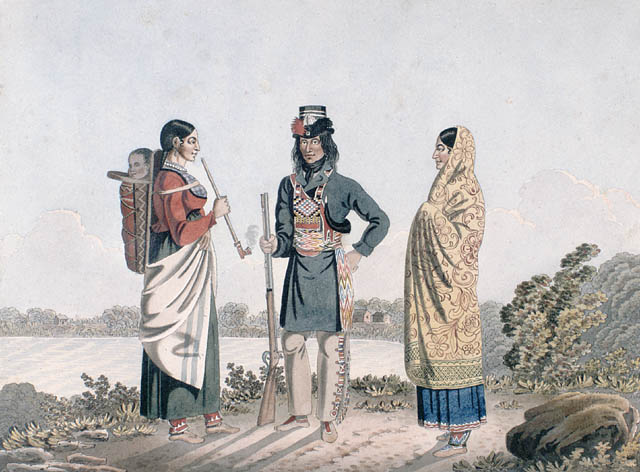
A watercolour landscape of a man, flanked by two women, standing in front of a body of water. The man is holding a rifle and the woman on the right is holding a long pipe and carrying an infant in a cradleboard on her back.

A halfcast [Métis] and His Two Wives, 1825-26 (e008299398)

Terms such as “halfcast,” “half-breed,” and “mixed breed” were widely used by the dominant society to describe members of the Métis Nation. This vocabulary is commonly found in older archival records.

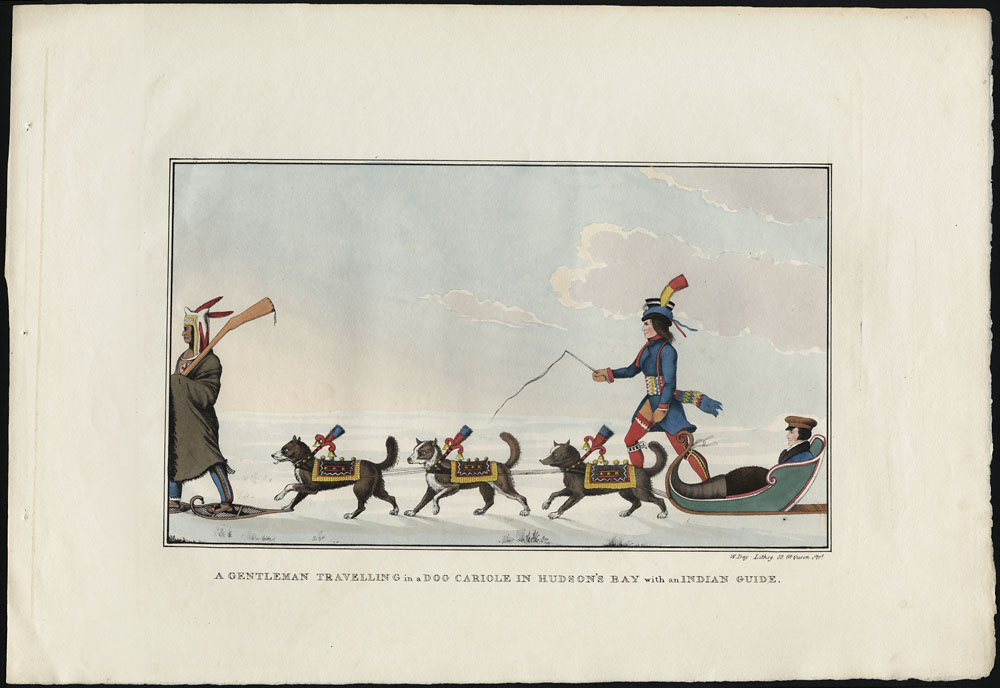
In other instances, descriptions of Métis were completely omitted, as is the case with this lithograph, entitled “A Gentleman travelling in a dog Cariole in Hudson’s Bay with an Indian Guide.”

A lithograph of a snowy landscape with a man seated in a cariole (sled) pulled by three dogs in colourful coats. A man wearing a blanket and snowshoes is on the left in front of the dogs. A man holding a whip and wearing clothing associated with Métis culture (a long blue jacket, red leggings and an embellished hat) walks on the right-hand side of the sled.

A Gentleman travelling in a dog Cariole in Hudson’s Bay with an Indian Guide, 1825 (e002291419)

Hiding in Plain Sight: Discovering the Métis in the Collection of Library and Archives Canada

In the fall of 2014, a keyword search for “Métis” in art, photographic, cartographic and stamp records yielded less than 100 documents. LAC has since updated and revised over 1,800 records by adding “Métis” to the titles or descriptive notes in order to make these documents more accessible. In addition to improving existing records, LAC has digitized over 300 new photographic items pertaining to Métis history.

The Hiding in Plain Sight: Discovering the Métis in the Collection of Library and Archives Canada exhibition presents a selection of reproductions of artwork and photographs with Métis content. LAC hopes that the images featured in this exhibition will provide a better understanding of the history of the Métis Nation and that the public will be encouraged to research LAC’s collection.

The exhibition ran from February 11 to April 22, 2016, in the lobby of Library and Archives Canada at 395 Wellington Street, Ottawa.

Additional resources


Beth Greenhorn is a settler living on the unceded, traditional territory of the Kitigan Zibi Anishinabeg and the Algonquins of Pikwakanagan. She is a Senior Project Manager in the Outreach and Engagement Branch at Library and Archives Canada.

Do I have the right to vote? Letters from women to the Canadian government, 1918-1919

Canadian women received the federal right to vote in three waves of legislation. It began with Prime Minister Robert Borden initiating the Military Voters Act of 1917, which enabled Canadian women on active service to vote. Borden also implemented the Wartime Elections Act that same year, which extended the vote to Canadian women who were related to men in the military forces. Lastly, on May 24, 1918, royal assent was given to a bill extending the vote to Canadian women who met the same qualifications as voting men. These quick and successive formative events caused confusion for the public.

The collection of Library and Archives Canada (LAC) holds various letters written by Canadian women that demonstrate the impact of the vote and include questions about their own personal eligibility to cast a ballot. Seeking information directly from the source, women wrote to Prime Minister Robert Borden and other government officials.

In a letter dated December 1919, Mrs. King of Colonsay, Saskatchewan inquired if she was eligible to vote as a Canadian citizen married to an American citizen. Her inquiry was forwarded to the Department of Justice, which replied that she should be eligible to vote based on her information and enclosed a copy of the Act. They also noted that her inquiry was not typically an affair for the Department.

The confusion between the Dominion Elections Act and the temporary wartime voting measures is evident in a letter dated February 17, 1919 from Mrs. Lillian Dill of Oshawa, Ontario. Mrs. Dill requested a copy of the Act in order to understand its impact and her eligibility to vote. Continue reading

Let Them Howl: 100 Years of Women’s Suffrage—An exhibition in Ottawa and Winnipeg

The year 2016 marks the 100th anniversary of women first winning the right to vote in Canada. On January 28—the date that Manitoba became the first province to pass women’s voting rights into law—Library and Archives Canada (LAC), in partnership with the Canadian Museum for Human Rights, will officially launch an outdoor exhibition titled Let Them Howl: 100 Years of Women’s Suffrage.

The exhibition will feature reproduction portraits of some of the women who fought for equality and the vote. Be sure to check out the exhibitions January 28 to February 15, 2016 on the Rideau Canal Skateway in Ottawa (presented in partnership with Winterlude) and February 12–21, 2016 at the Festival du Voyageur in Winnipeg.

The exhibition features reproduction portraits from LAC’s collection of historic figures like Nellie McClung and Agnes Mcphail to modern women who have broken gender barriers, such as Adrienne Clarkson and Beverley McLachlin.

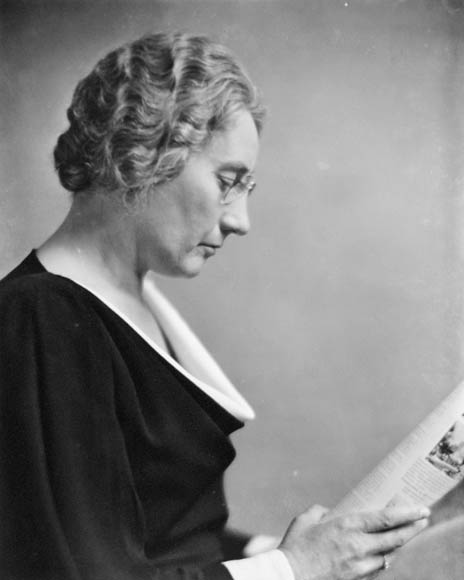
A black-and-white photograph of Agnes Macphail in profile, reading the paper.

Agnes Macphail by Yousuf Karsh, 1934 (MIKAN 3256551)

Continue reading

Temperance, social reform and the quest for women’s suffrage

At the beginning of the 19th century, many people considered that industrialization and urbanization were the source of society’s ills. This sparked the temperance movement, which advocated moderation or abstinence from alcohol because of its perceived detrimental influence on society.

Temperance societies, such as the Women’s Christian Temperance Union (WCTU), campaigned against alcoholism to protect the home and strengthen family life. In addition to temperance, they endorsed many social reforms including community welfare, education and women’s suffrage to combat inequities like poverty and child labour. WCTUs realized that in order to prompt social change women needed to be able to influence government policies, which meant gaining the right to vote.

The temperance movement got more women interested in participating in public life and actively engaging in political and social reform. Nellie McClung, who was instrumental in winning women the right to vote in Manitoba in 1916, began to get involved in politics with the WCTU.

A black-and-white photograph of a seated woman, right hand propping up her head, right elbow on a table, a book in her left hand. She is looking directly at the camera.

Nellie McLung by Jessop Cyril (MIKAN 3622978)

Continue reading

Hockey Marching as to War – the 228th Battalion

Library and Archives Canada (LAC) currently has an exhibition at 395 Wellington Street in Ottawa, which runs until January 22, 2016. Hockey Marching as to War engages viewers in the many stories of hockey players’ involvement in Canada’s First World War effort—from the men who enlisted and served overseas to the women who took up sticks at home.

A particularly fascinating story is the emergence of highly successful military hockey teams. In 1916, Winnipeg’s 61st Battalion won the prestigious Allan Cup—the senior amateur hockey championship—and Montreal’s 87th Battalion was good enough to play an exhibition game against Montreal professionals, including players from the Canadiens.

No military team was more famous than the 228th Battalion, whose history is there for all to see in LAC’s rich collection of government records. Known as the Northern Fusiliers, the 228th mustered in North Bay, Ontario, under the command of Lt.-Col. Archie Earchman, and was so successful recruiting talented hockey players that in the fall of 1916 it was invited to join the National Hockey Association (NHA), the main professional league and forerunner of the National Hockey League.

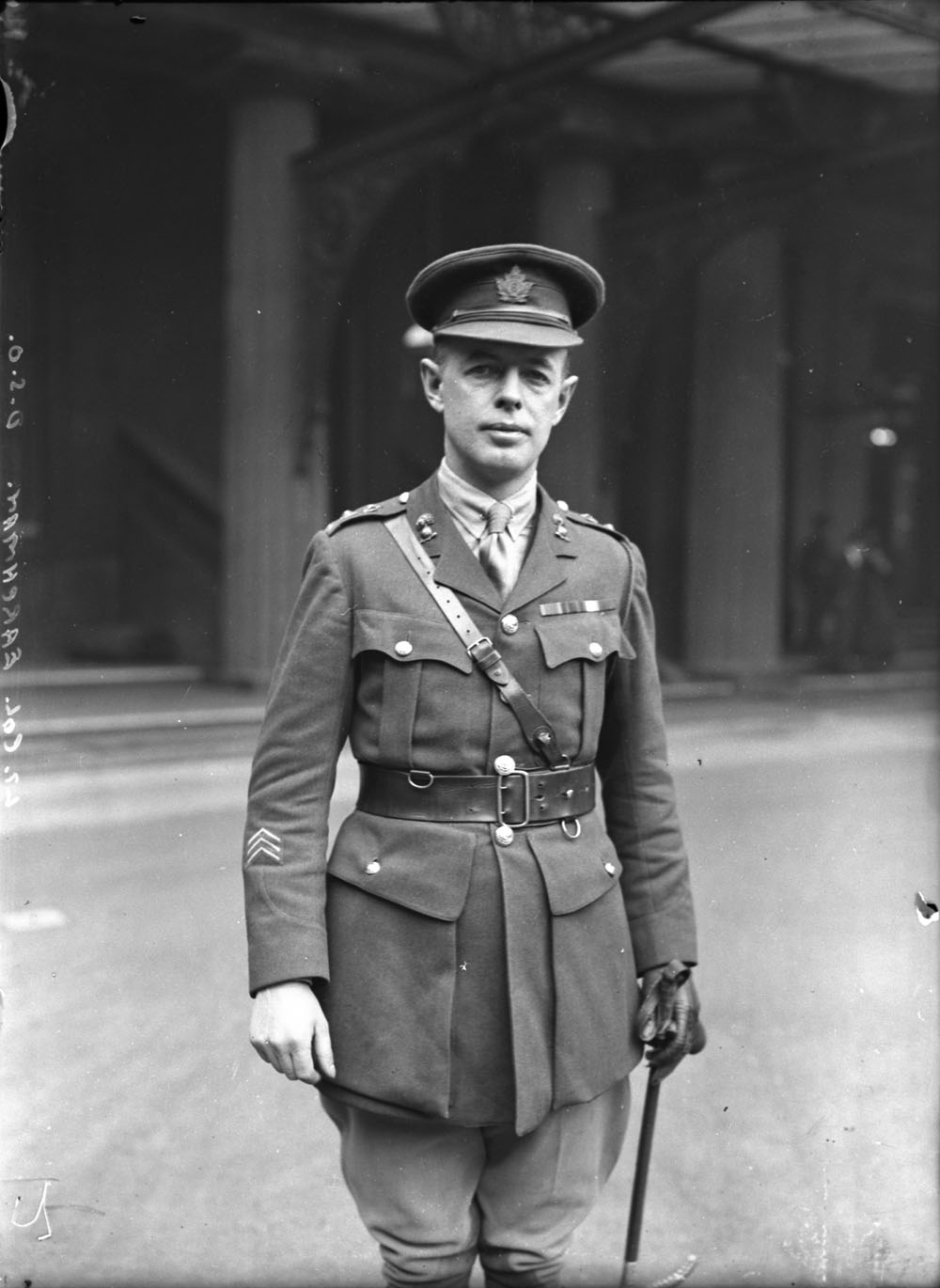
A black-and-white photograph of a man standing. He is wearing a uniform, a cap and a Sam Browne belt, and holding a baton.

Lieutenant Colonel Earchman, D.S.O., Toronto, Ontario, undated (MIKAN 3215233)

Continue reading

Mirrors with Memory: Daguerreotypes from Library and Archives Canada—an exhibition at the National Gallery of Canada

When the daguerreotype was invented in 1839, it was a revelation. The first photographic process to be made available to the public, daguerreotypes were shiny, reflective objects that delighted and astonished viewers by capturing the likenesses of friends and family with brilliant clarity. For the first time in history, portraits of loved ones could be recorded and shared or passed down to descendants. The impact of the daguerreotype and of photography on the lives of ordinary people was immense.

A hand-tinted daguerreotype portrait of a seated woman in a polka-dot dress.

Kate McDougall, ca. 1848 (MIKAN 3192966)

The science of capturing light on a photographic surface was co-developed in France by Louis-Jacques-Mandé Daguerre (1787–1851) and Joseph-Nicephore Niépce (1765–1833). Niépce died before practical success was achieved, and Daguerre went on to perfect the process. Highly polished silver-plated sheets of copper that were sensitized with iodine vapours and developed in mercury fumes, daguerreotypes created compelling, one-of-a-kind images with infinite detail.

A new exhibition at the National Gallery of Canada features examples of these special objects. While not rare, daguerreotypes are not often exhibited due to their susceptibility to light and environmental degradation. Drawn from the collection of Library and Archives Canada, the objects in this exhibition have undergone careful preservation and conservation treatment, and offer the viewer an extraordinary look at these unique photographs. Intimate, detailed and captivating, these objects—reflective by their very nature—are some of the earliest photographic glimpses of Canada in existence.

A daguerreotype photograph of a man (standing) and a woman sitting on the ground, among the destroyed remains of the brewery.

The Molson family brewery after the fire, Montréal, Quebec, 1858 (MIKAN 3192967)

The exhibition features street scenes as well portraits of both well-known and unknown personalities. Most likely taken in Europe in the late 1840s, the portrait of Maungwudaus, a member of the Anishnaabe Nation of the New Credit Mississauga, is one of the earliest photographic portraits of an Aboriginal person in the Library and Archives Canada collection. Maungwudaus grew up near what is now Kitchener-Waterloo, Ontario. Educated by Methodist missionaries, he later worked in mission outreach and as a translator and writer before finding acclaim as a performer in a “Wild West” show that he along with friends and family members, organized and travelled through parts of the U.S. and Europe. The troupe was celebrated in England and in France where Maungwudaus was presented with several medals by King Louis Philippe I.

Daguerreotype portrait of Maungwudaus wearing ceremonial dress including a feathered headdress and two medals.

Maungwudaus, ca. 1846 (MIKAN 3198805)

As one-of-a-kind objects designed to be stored in a closed case and looked at by one viewer at a time, daguerreotypes are intimate by nature. Some show the wear and tear expected of objects over a century old. Often, the names of the sitters or any other accompanying information has long since disappeared, making the exceptions even more special. One such example is the portrait of a group of merchants from Yarmouth, Nova Scotia, dated 1855. This daguerreotype had a small manuscript tucked inside at the back of the plate, which is signed by one of the sitters and lists all the members of the group, as well as the location of the sitting and the name of the daguerreotypist, Wellington Chase. In this portrait, among others, we can see Loran Ellis Baker, seated front row, centre. Twenty-four years old at the time of this portrait, Baker was one of Yarmouth’s most prominent businessmen and civic leaders, and a member of the Legislative Council of Nova Scotia from 1878 to 1900.

A velvet-lined case with a daguerreotype portrait of nine men: five seated in front, four standing.

Group of merchants from Yarmouth, Nova Scotia, 1855 (MIKAN 3622937)

Visit the exhibition at the National Gallery of Canada in Ottawa from September 4 to February 28, 2016.