Spotlight on theatre posters

Library and Archives Canada (LAC) has an extraordinary collection of posters promoting theatre in Canada from the 19th century to the present day. These posters are found in a wide variety of private and public archives and collections, including those of Vittorio, Theo Dimson, Guy Lalumière et Associés Inc., Normand Hudon and Robert Stacey.

Theatre posters also feature in the archives of such Canadian personalities as Marshall MacLuhan and Sydney Newman, and even in collections of old documents—for example, the theatre playbills printed on board the ships in the expedition in search of Sir John Franklin (around 1850-1853).

In addition, we must mention the archives of various theatre and stage artists and professionals (Gratien Gélinas, Jean Roberts and Marigold Charlesworth, John Hirsch and others), and of artistic and cultural institutions such as the National Arts Centre, Theatre Canada, the Magnetic North Theatre Festival, the Globe Theatre and the Stratford Festival.

But the real treasure trove of theatre posters can be found in the “Posters” series of the performing arts collection, which comprises about 750 posters and programs, and in the miscellaneous poster collection, which includes about 3,170 posters.

You might say that theatre posters play a starring role at LAC!

For sample posters, please see our Flickr album.

Questions or comments? We would love to hear from you!

Toys and Games in Canada

Photograph of a girl sitting on a mattress, holding a doll.

Girl with doll, Piper family. Source

The joyful holiday season is the perfect time to introduce you to the Library and Archives Canada collection of photographs related to games and toys.

Although toys and games have existed since the dawn of time, it was only in the 19th century that the ‟toy” really came into its own in Canada. It was also
during the Victorian era that toys and diversion were deemed beneficial to children, thereby kick-starting the mass production of playthings. At first,
toys mainly came from England, Germany and the United States, but between 1860 and 1915, some 20 Canadian companies began to manufacture them as well. They
were made of wood and generally mimicked miniature furniture, cars or horses.

The First World War slowed toy production in Europe, giving the Canadian toy industry the opportunity to flourish. New toys were produced, particularly
battleships and construction sets. This is also when manufacturers started using a wider variety of materials, which resulted in copper, tin, iron, lead,
and rubber toys. Plush dolls and animals, small lead soldiers, bugles and trumpets, rubber balls, hockey pucks and even humming tops could also be found.

In the 1940s, plastic was introduced in toy manufacturing; it was used to make rattles, beach toys, tractors, trucks and construction sets, as well as an
array of tools. In subsequent years, large multinational companies emerged and completely diversified the toy-making industry.

Various outdoor games, such as croquet and lawn bowling have become popular. Children also enjoy games of strength, string, and chance, which are featured
in our new Flickr album.

Questions or comments? We would love to hear from you!

Animals in War (1914–1918)

Colour poster depicting countryside combat, with a horse-drawn tank and soldiers fleeing from the cannonade.

During the First World War, the terrain on the front lines was often muddy and without paved roads, which made it difficult to use motor vehicles. This is why armies relied on a wide array of beasts of burden, including horses. These animals were used primarily by cavalry troops, but they also served to haul cannons, ammunition and food, as well as to pull non-motorized ambulances. Horses were ever-present in the theatre of operations.In September 1914, the first contingent of troops to leave Canada for England loaded up 7,636 horses! Although they belonged to the cavalry units, most of the horses were purchased by the Canadian government from private owners to meet army needs. Hundreds of thousands of additional horses were subsequently sent to the front lines. By the end of the war, the army had lost eight million horses in combat.

Other animals were also used by the army during the First World War. Mules, donkeys and cattle primarily transported materials, ammunition and food. In eastern regions, such as Egypt, camels were also used.

The terrain—continually bombarded in some areas or very mountainous in others—made it difficult to communicate, so winged or furry messengers were called
in. There were even special units responsible for maintaining a flock of carrier pigeons, ready to be sent with messages tied to their legs. Dogs were also used as messengers.

Colour sketch of a brown dog sitting.

Colour sketch of a brown dog sitting. Source

The Canadian Army had a Veterinary Corps at the time, with blacksmith and farrier units who all saw to the care of work animals. During the conflict, veterinary hospitals and mobile veterinary units were created behind the front lines to treat animals and make sure they were well fed.
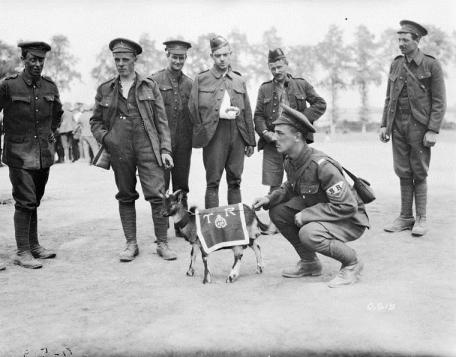
At all times, animals were alongside soldiers on the front as companions in misfortune. From the very beginning, military mascots have served to represent the group who adopted them. Even members of the Canadian Expeditionary Force had mascots during the First World War, as shown in the following image.

Group of soldiers around a goat wearing a cape with insignia.

Mascot of the 3rd Canadian Infantry Battalion, August 1916. Source

Visit our Flickr album for more photographs.

Questions or comments? We would love to hear from you!

Patrolling the French Shore with Louis Koenig

Newfoundland in the summer, completely inaccessible because of its winged garrison. Library and Archives Canada. (Source)

Did you know that thanks to the collection of Library and Archives Canada (LAC) it is possible to patrol the French Shore of the island of Newfoundland with Lieutenant Louis Koenig and discover this particular area where the French had cod fishing rights for almost 200 years, because of two treaties signed between France and England? Accompany Koenig and the crew of the French frigate La Clorinde during a campaign that brought them to Newfoundland, Cape Breton Island and Saint-Pierre and Miquelon in 1885.

Recognized by the French Navy for his artistic talents, Koenig created the 145 drawings and watercolours, the hand-drawn maps and the logbook, which are found in the Louis Koenig fonds and Louis Koenig Collection. The illustrations, most of which were done on site, show the landscapes and military installations he observed, as well as daily activities on board La Clorinde. The maps give three views of the French Shore and include notes by the artist.The logbook, also written by Koenig, documents the voyage, the places visited and gives his candid impressions of his experiences; devoting particular attention to the mosquitoes, which were apparently delighted to welcome the French sailors! The collection also includes a small sketchbook containing an illustrated, much more personal, account of the voyage, full of humour and whimsy presented by Koenig as a gift to La Clorinde’s commander, Félix-Auguste Le Clerc. Koenig also wrote an article Le « French Shore » (souvenirs de campagne à Terre-Neuve) (The “French Shore”, Memoirs of a Newfoundland Campaign), embellished with his maps and illustrations and published in 1890 in the periodical Tour du monde.

To order published documents that are unavailable online, use our online Request for Retrieval of Documents, or call 613-996-5115, or toll-free 1-866-578-7777, to consult them in person at 395 Wellington Street in Ottawa.

Enjoy the discoveries and view the Flickr set of images from Koenig’s albums!

Questions or comments? We would love to hear from you!
Celebrating the International Day of Peace – Part III: The Voice of Women fonds

In earlier posts to celebrate International Day of Peace, we discussed Julia Grace Wales and Thérèse Casgrain, two Canadian women who played key roles in the international peace movement. Today, we will conclude by discussing the Voice of Women fonds held at Library and Archives Canada (LAC).

Women in North America have long been active in trying to put an end to conflicts around the world. In the early 1960s, when the threat of nuclear war loomed over many nations, our own Canadian Voice of Women for Peace (VOW) was formed. Since then, the organization has been promoting peace and disarmament, particularly in the context of nuclear war.

VOW has organized unique activities to draw attention to its cause. In 1963, it collected and tested thousands of baby teeth from children across North America to demonstrate the fallout from the atmospheric testing of Strontium 90, a harmful radioactive isotope. During the Vietnam War, the Ontario VOW organized the Knitting Project for Vietnamese Children. Over a ten-year period, the group sent thousands of hand-knitted garments and other aid to the child victims of the war and their families.

Over time, VOW has expanded its focus to include human rights and civil liberties, preservation of the environment, as well as economic and political issues.

LAC’s Voice of Women fonds includes correspondence, reports and subject files about many campaigns for peace. Digitized photos are also presented in LAC’s Women and Peace Flickr set.

Please remember that not all of our material is available online. For more information, consult the article How to Consult Material that Is Not Yet Available Online.

Questions or comments? We would love to hear from you!