Did your ancestors come from China?

Do you ever wonder who your first Chinese ancestor was and when he or she left China and arrived in Canada? Are you curious about your family’s Chinese heritage?

If so, our website is a great place to begin your research. For instance, you will find a page specific to genealogical research for the Chinese people. It provides you with historical background information, archival and published material from our collection, as well as links to other websites and institutions. This page also contains a link to the Immigrants from China database which provides access to more than 98,000 references to Chinese immigrants who arrived in Canada.

If your ancestor came to Canada between 1865 and 1935, you might find his or her name on the passenger lists.

Questions or comments? We would love to hear from you!

The Home Children (part three) — Harold Mornington

The second article in this series of three explains how to find information about one of the British home children, Edward Brignall, who served in the Canadian Armed Forces during the First World War. This third article looks at another home child, Harold Mornington, who served in the British Army in the Second World War.

As with Edward Brignall, the process begins with a search of our main online resource on Home Children. Entering the family name Mornington and the given name Harold into the database yields a single reference; it indicates that Harold was 14 years old when he left Liverpool on March 11, 1932 aboard the SS Montclare, and arrived in Halifax on March 19, 1932. He was part of the last group of 36 children sent to Canada by the Barnardo agency.

The passenger lists from 1925 to 1935 have been digitized and can be consulted online. The digital image of the list of passengers aboard the SS Montclare can be examined as well, which confirms the information found in the home children database. It also contains other information, such as the name and address of Harold’s mother, Mrs. Mornington, who lived at 16 Orlando Street, in Caldmore, Walsall, England. More information about Harold Mornington’s family history can be found by contacting the Barnardo’s Family History Service.

Beginning in the 1920s, immigration inspectors drafted Juvenile Inspection Reports when conducting periodic evaluations of children brought to Canada by different agencies. These files are available only on microfilm. A search on reel T-15424 shows that between 1932 and 1936, Harold Mornington worked for five different employers in the Ontario districts of Durham, Brant, Oxford and Hastings.

A reference found on the site of the Commonwealth War Graves Commission reveals that sometime between 1936 and the beginning of the Second World War, Harold Mornington returned to England. He joined the British Army and died on May 23, 1941, while still a member of the Royal Artillery. He was the son of William Joseph and Elizabeth Mornington.

Lastly, Harold Mornington’s military service record is kept at The National Archives in the United Kingdom.

Questions or comments? We would love to hear from you!

Did your ancestors come from Scotland?

Do you ever wonder who your first Scottish ancestor was and when he or she left Scotland and arrived in Canada? Are you curious about your family’s Scottish heritage?

If so, our website is a great place to begin your research. For instance, you will find a page specific to genealogical research about Scots.

It provides you with historical background information, archival and published material from our collection, as well as links to other websites and institutions.

If your ancestor came to Canada between 1865 and 1935, you might find his or her name on passenger lists.

Questions or comments? We would love to hear from you!

Access to 15 Databases in One Stop!

Within the next few weeks, Library and Archives Canada (LAC) will begin to deploy a series of 15 databases on Canadian census returns. This will be the only website where free online nominal indexes can be accessed for census returns from 1825 to 1916, comprising more than 32 million records.

LAC will be offering:

  • new databases such as those for census returns from 1851 and 1861
  • nominal indexes (instead of geographical indexes) for census returns from 1901, 1906, 1911 and 1916
  • revamped and updated versions of the indexes for census returns from 1871, 1881 and 1891
  • and much more…

Stay tuned to learn when these databases will be available and be sure to visit our census page to discover these incredible resources for tracing your family history!

Questions or comments? We would love to hear from you!

Home Children (Part II)—Edward Brignall

Today’s article is on Edward Brignall, born in England on January 11, 1898; you will learn how to obtain information on him.

The first step is to search by entering the surname Brignall in our main online resource on home children. You will notice that no results are displayed; this could be explained by the fact that in those days many surnames were transcribed phonetically.

The next step is to use the wildcard character *. We suggest that you enter Brign* in the surname field.

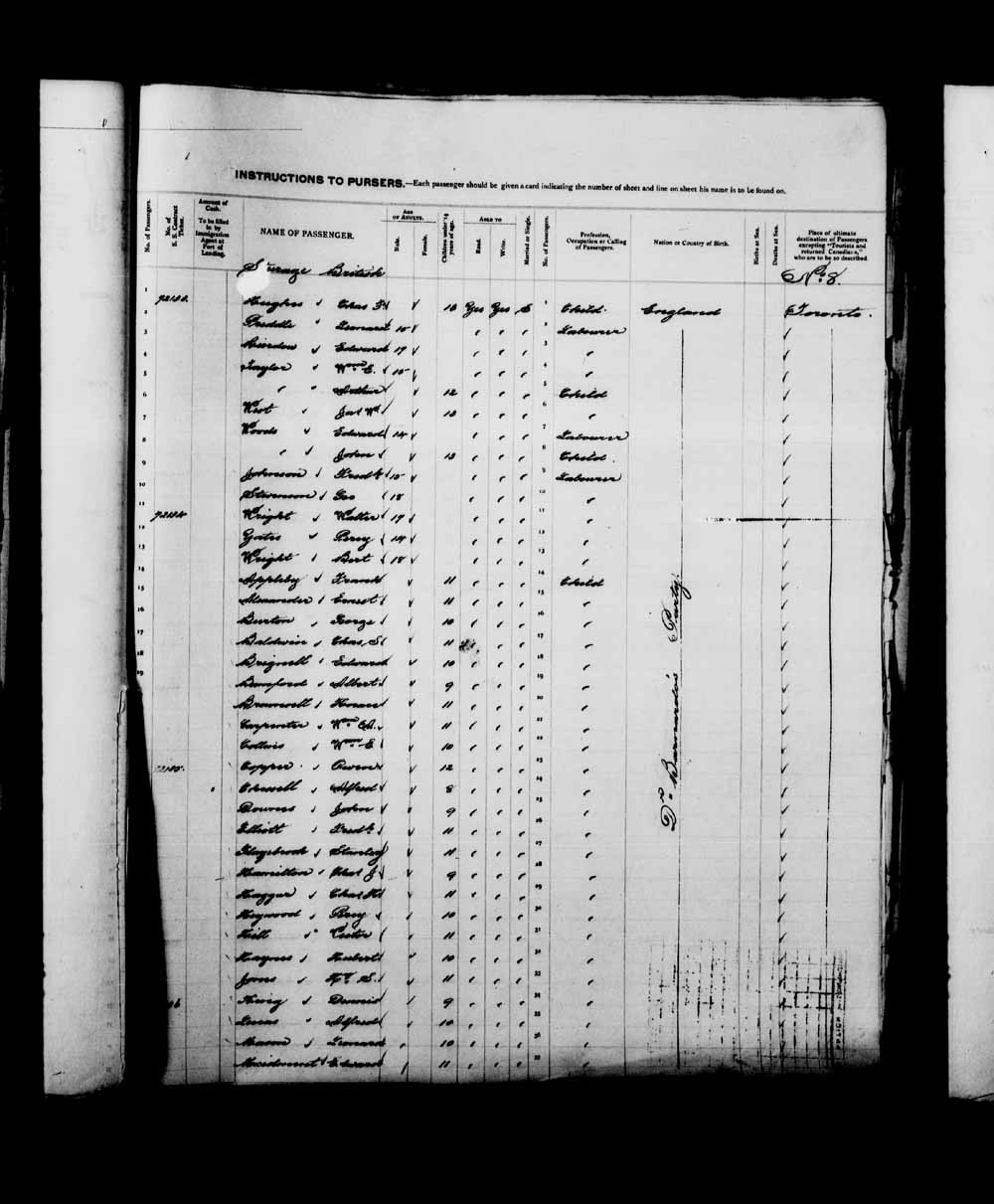
This search opens an item display for Edward Brignell, 10 years of age, who arrived in Canada on the SS Dominion on May 31, 1908, in the care of the Barnardo
charitable organization. Edward was part of a group of 109 girls and 219 boys. This information agrees with what we know.

The passenger lists from 1865 to 1922 have been digitized and you may consult them using our database Passenger Lists, 1865–1922. You may even examine a digitized image of the SS Dominion passenger list. Further information on Edward’s family background may be obtained by contacting the organization Barnardo’s Family History Service.

Several young English immigrants who settled in Canada served in the Canadian and British forces during both world wars; such is the case of Edward Brignall. To trace him, first search in our database Soldiers of the First World War. Just enter Brignall in
the surname field. This search generates five results, only one with the given name Edward:

Name: BRIGNALL, EDWARD
Regimental number(s): 922715
Reference: RG 150, Accession 1992-93/166, Box 1068 – 36
Date of Birth: 11/01/1898

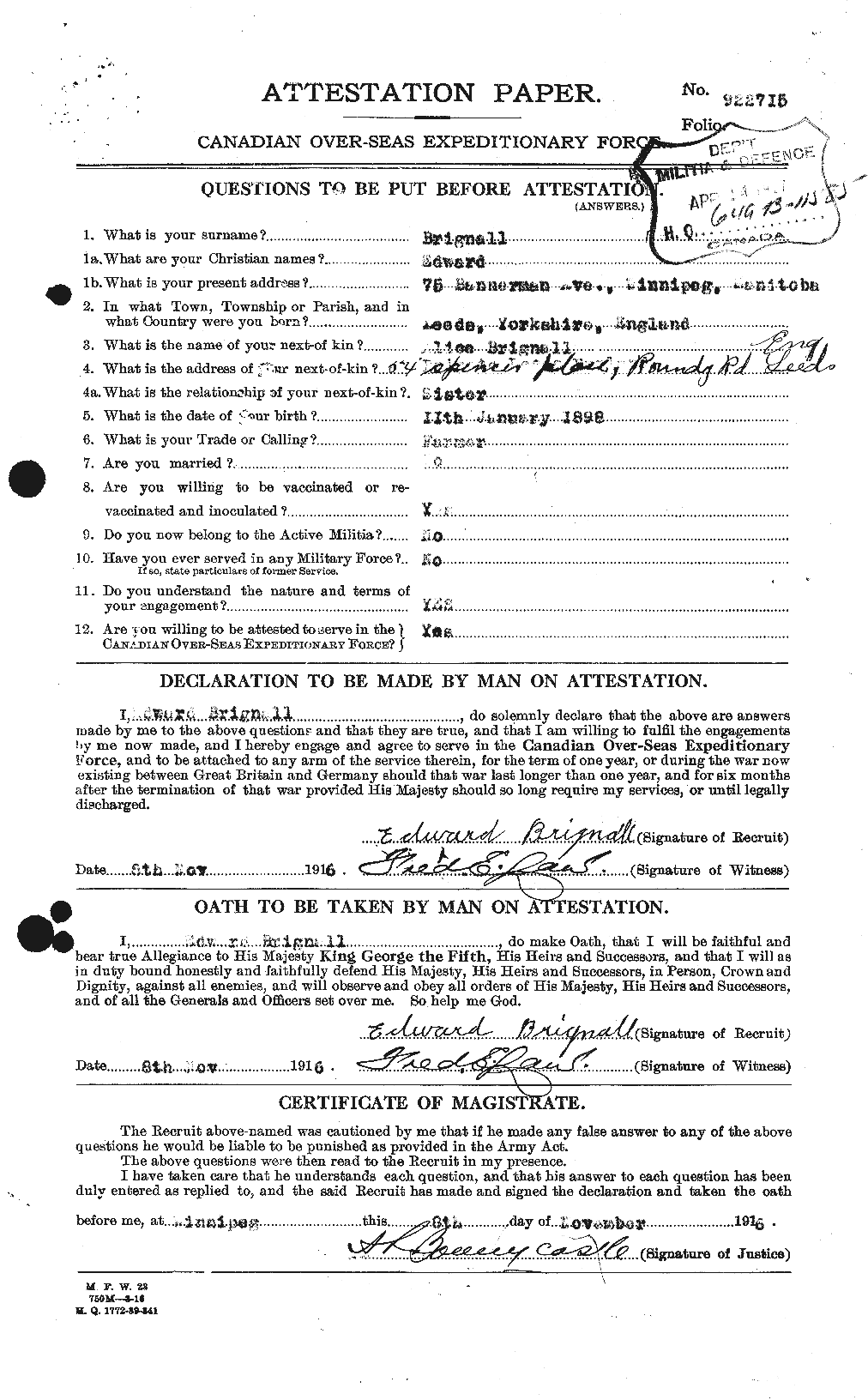
You may consult his attestation paper online to confirm his date of birth, find out
where he lived (i.e., 75 Bennerman Avenue, Winnipeg, Manitoba), and learn that his next of kin, his sister, Alice Brignall, resided in Leeds, England. By consulting his record, we learn that Edward died before leaving for Europe. Also available online are the death cards of First World War veterans; Edward’s shows that he died of pneumonia on January 23, 1917, at the Winnipeg General Hospital just a few months after he enlisted.

It is also possible to search the database of the Canadian Virtual War Memorial. There
we learn that Edward was the son of Edward and Dorothy Lever Brignall, of Leeds, England, and that he was buried at the Brookside Cemetery in Winnipeg, Manitoba.

Finally, remember to consult the first part of this series, entitled Home Children—Introduction.

Happy hunting!

Questions or comments?
We would love to hear from you!

Home Children—Introduction

The immigration of children from Great Britain accounts for a significant part of Canadian history. Between 1869 and the end of the 1930s, religious authorities and philanthropic organizations sent more than 100,000 poor, orphaned or abandoned children—better known as home children—to Canada, believing that they were offering them a better  chance for a healthy life. Many Canadians have an ancestor who experienced this often-misunderstood migration.

Anyone who came to Canada alone as a child was very likely one of the home children. Family members quite possibly obtained information on this from written documents or oral histories.

Library and Archives Canada has several genealogical records on home children, including passenger lists, correspondence, inspection report cards and various documents produced by different organizations that took part in the children’s transport and care.

Stay tuned for our upcoming series of articles on home children who later made their mark in Canada’s history, and on well-known people whose ancestors were home children. The series will help you discover our vast collection of genealogical resources that enable you to trace an ancestor who might have been one of the home children.

Questions or comments? We would love to hear from you!

From Enlistment to Burial Records Part II: The Canadian Forces in the Second World War

For many Canadians, Remembrance Day on November 11 is evocative of the selfless contribution of the Canadian Forces. The eleventh day of the eleventh month
brings to the forefront the memory of those who died while serving their country in the Armed Forces. Each year, Library and Archives Canada (LAC) receives countless queries about military services files of individuals who served after 1918 (including the Second World War).

Once again, our experts have put together some answers to many of the most frequently asked questions. Keep in mind that, in addition to consulting the content below, a great place to begin your research is on our Genealogy and Family History’s Military pages.

– Is the person still alive? When did he/she serve?

Access to personal information included in a person’s personnel file requires that his/her signed consent. If you served in the Canadian Forces, consult our Canadian Forces after 1918 section to find out how to request copies of your own service file.

Tip:

If the person is deceased, the date of death has an impact on what information is released.

If the individual died less than 20 years ago, limited information may be released to the immediate family. Proof of death and relationship must be provided.

There are no restrictions on access to information relating to an individual who has been deceased for more than 20 years. Proof of death is required.

Newspaper obituaries are a key tool in genealogy and help when researching military service files. Our online catalogue AMICUS can be searched to locate and borrow newspapers.

Consult our article “How to Find a Canadian Newspaper on Microfilm” for more
information.

If the person died while in service between 1939 and 1947, the service files are open to the public. References to those service files can be found in our Second World War Service Files: Canadian Armed Forces War Dead database.

Consult our article “How to Order Military Records from the Personnel Records Unit” to learn how to obtain a copy of these files.

– Beyond the service files:

Once you have a copy of the service file, some questions will be answered but other questions will arise: In what battles did the person serve? Where is he/she buried? Our previous article “From Enlistment to Burial Records Part I: The Canadian Expeditionary Force in the First World War” describes key sources that are equally relevant to post First World War research, such as War Diaries, Veterans Death Cards, and Medals, Honours and Awards databases.

– Even more places to look!

Finding aids such as The Guide to Sources Relating to Units of the Canadian Expeditionary Force and our article on “Published Histories: Discover what individuals or military units did during the war” contain a wealth of information on military activities.

Questions or comments? We would love to hear from you!

From Enlistment to Burial Records: The Canadian Expeditionary Force in the First World War

Each year, Library and Archives Canada (LAC) receives countless questions on how to locate military services files, such as:

  • How do I find out more about a soldier (or a nursing sister) in the Canadian Expeditionary Force (CEF)?
  • When and where did he enlist?
  • How old did the soldier say he was? (Many underage soldiers gave an earlier year of birth when they enlisted)

A great place to begin your research is on our Genealogy and Family History’s Military pages.

To help guide you through the process, our experts have put together the following explanations.

Attestation papers

Also known as “enlistment” documents, these records indicate the date and place of birth, the marital status and the name and address of the next of kin.

The Soldiers of the First World War database contains references to more than 600,000 people who served during that conflict. Most of the corresponding attestation (enlistment) papers can be viewed online, including those of the Nursing Sisters.

To learn more, consult our article “Canadians and the First World War: Discover our Collection”.

Service files

These records contain key documents such as record of service, casualty form, discharge certificate and medal card. It also provides the name or number of
the unit in which the individual served overseas.

Find more information in our articles “What You Will Find in a Canadian Military Service File” and “Understand the Abbreviations Commonly Found in Military Service Files”.

War diaries

The War Diaries are a daily account and historical record of a unit’s administration, operations and activities.

Consult the War Graves page for information on the burial location of a soldier who was killed in action.

If the soldier survived the war, the Veterans Death Cards give information such as the next of kin, burial location and date of death. The digitized images, which are in alphabetical order, can be navigated in sequential order.

For the soldier who was decorated, a nominal index to medal registers, citation cards and records of various military awards provides further information on many soldiers’ achievements.

Our article “War Diaries: Discover what individuals or military units did during the war” can also guide you with your research.

Published histories

For an easy-to-read overview of the unit’s activities, we recommend starting with “published histories.” These books are often called “regimental histories” and our article Published Histories: Discover what individuals or military units did during the war” will give you more information.

Thematic guides

The Guide to Sources Relating to Units of the Canadian Expeditionary Force
lists references to records and files that complement the research in First World War records. This thematic guide further describes the contribution of most units in the CEF.

Other past articles of interest this Remembrance Day:

Questions or comments? We would love to hear from you!

Did your ancestors come from Germany?

Do you want to know who your first German ancestor was and when he or she left Germany and arrived in Canada? Are you curious about your German origins?

If so, our website is a great place to begin your research. Here you will find a page dedicated to genealogical research on the Germans. This page provides you with historical information, archival documents and published material from the Library and Archives Canada collection, as well as links to other websites and institutions.

If your ancestor came to Canada between 1865 and 1935, you might find his or her name on the passenger lists.

Questions or comments? We would love to hear from you!

Take a summer road trip and discover your ancestors

Did you head out to visit your family this summer? Whether you were attending a family reunion, a wedding or an informal get-together, the time spent with
family may have started you thinking about your family history. Did you know that you can discover exciting facts and details about your family by visiting
the Genealogy and Family History pages of the Library and Archives Canada website?

If family history research is new to you, we’re here to help

Begin your search by looking up the following Web pages and use these helpful tips when preparing your quest in family history:

Next, gather the information that you already have in your possession. An attestation paper from the First World War, a marriage certificate, even family pictures can reveal
information about your ancestors.

Talk to your family members and ask questions such as the names of the children in your parents or grandparents families. Did they come to Canada as
immigrants? If so, from which country did they originate? Passenger lists and
their list name indexes can sometimes provide surprising details about a family arriving in Canada.

Now that you have the basics, what else do you need?

A copy of the records in your possession, some writing material (whether in the form of pen and paper or a laptop computer) and a digital camera, will
assist you in documenting your discoveries. Maps of the area where your ancestor was living are also useful in your family history research. For instance,
knowing precisely where your ancestor was living in 1911 or in 1916 (for example, in what county or district) will enable you to find him or her in the Census returns, which contain information such as the profession, date of birth and the siblings living in a given household.

Are you visiting relatives in Ottawa?

If so, visit our Genealogy Services room, located at 395 Wellington Street.
Ensure successful research by watching the video Orientation Services for Clients at 395 Wellington before you
arrive.

Happy research and discoveries!

Questions or comments? We would love to hear from you!