Lieutenant Frederick Maurice Watson Harvey, VC

The Discover Blog returns to the First World War Centenary: Honouring Canada’s Victoria Cross recipients series, in which we profile each of Canada’s Victoria Cross recipients on the 100th anniversary of the day that the actions for which they were awarded the Victoria Cross took place. Today we present the story of Lieutenant Frederick Maurice Watson Harvey, an Irish-born Canadian VC recipient from Medicine Hat, Alberta.

A black-and-white portrait of an officer wearing a Sam Brown belt and looking directly at the viewer.

Captain Frederick M. Harvey, V.C., undated (MIKAN 3216613)

Harvey, born in Athboy, County Meath, Ireland, was one of three Irish rugby union internationals to have been awarded the Victoria Cross, and the only one to have been awarded the medal during the First World War. He settled in Medicine Hat, Alberta, in 1908 and enlisted on May 18, 1916 with the 13th Regiment, Canadian Mounted Rifles, transferring to Lord Strathcona’s Horse (Royal Canadians) after arriving in France.

On March 27, 1917, Harvey’s troops advanced on the village of Guyencourt, France. As German machine gun fire inflicted heavy casualties, Harvey’s Victoria Cross citation recounts what occurred next:

At this critical moment, when the enemy showed no intention whatever of retiring and fire was still intense, Lt. Harvey, who was in command of the leading troop, ran forward well ahead of his men and dashed at the trench, still fully manned, jumped the wire, shot the machine gunner and captured the gun. His most courageous act undoubtedly had a decisive effect on the success of the operation (London Gazette, no.30122, June 8, 1917).

A black and white reproduction of a war diary entry showing the place, date, hour and a summary of events and information.

Extract from the Lord Strathcona’s Horse war diaries for March 27, 1917 (MIKAN 2004721)

Lieutenant Harvey was initially granted the Distinguished Service Order but was later awarded the Victoria Cross. He received the Military Cross for his role in the Lord Strathcona’s Horse advance on Moreuil Wood on March 30, 1918 and was also awarded the French Croix de Guerre.

Harvey remained with Lord Strathcona’s Horse and was promoted to Captain in 1923. He instructed in physical training at the Royal Military College of Canada from 1923 to 1927, was promoted to Lieutenant Colonel in 1938, and, in 1939, was made Brigadier General. Harvey served as Honorary Colonel in Lord Strathcona’s Horse from 1958 to 1966. He died in August 1980 at age 91.
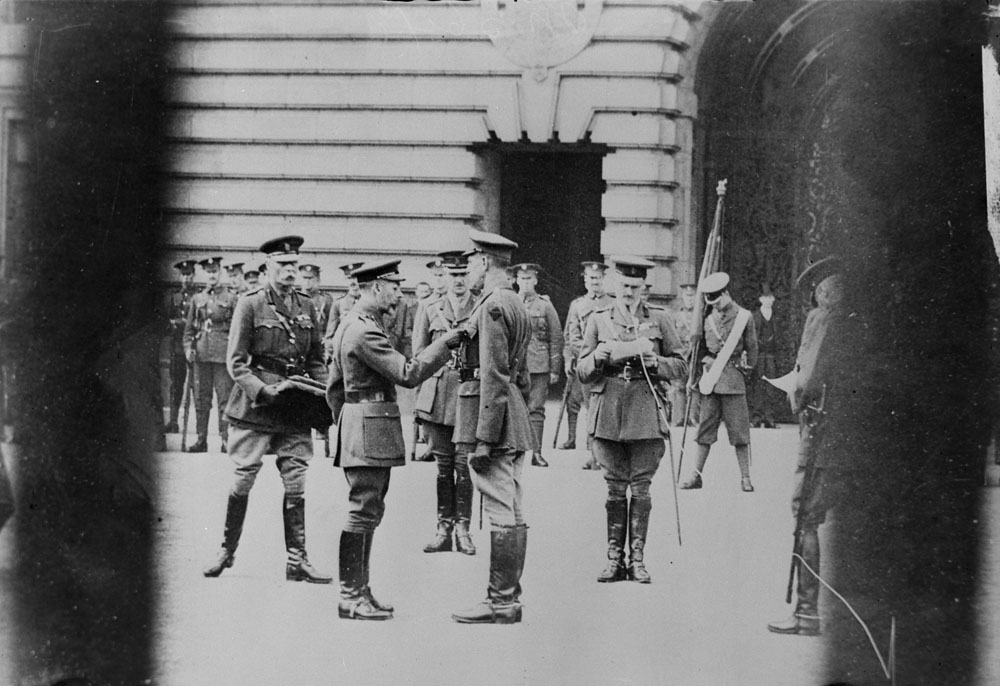
A black and white photograph of a man pining an award on another man’s pocket. Another man is reading the citation while a third man is carrying a case. In the background, rows of soldiers are standing at ease.

H.M. The King decorating Lieutenant Harvey L.S.H. with the Victoria Cross (MIKAN 3362384)

Library and Archives Canada holds the CEF service file for Lieutenant Frederick Maurice Watson Harvey.
Related Resources

Protecting Fort Anne – One of Canada’s First Parks

By Vasanthi Pendakur

Fort Anne National Historic Site in Annapolis Royal sits at the edge of the Annapolis and Allain Rivers in Nova Scotia. The park, established 100 years ago, is Canada’s first federally administered national historic site (Fort Howe in New Brunswick is the first historic site). This designation is thanks to the efforts of Annapolis Royal residents to protect the fort for future generations and the desire of the federal Parks Branch to create national parks.

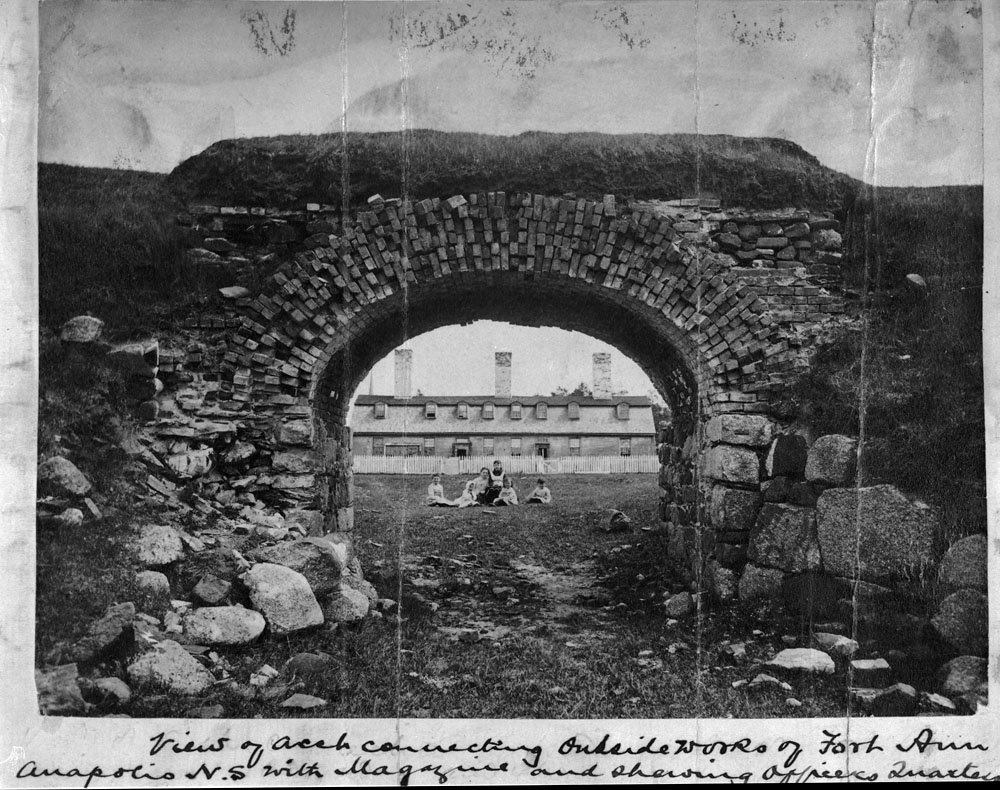
Black-and-white photograph of a stone archway and the view through it showing a large fenced building in the background with land in front. A woman and five children are pictured in the centre, seated on the ground.

View of arch connecting outside works of Fort Anne, Annapolis, N.S. with magazine and showing Officers’ Quarters in the distance (MIKAN 3305260)

Fort Anne is significant for its role in the French and British wars during the early settlement of Europeans. Both the French and the British gained control over the land at different times before the French built their fort at Port Royal in 1702. Pierre-Paul de Labat, an engineer and lieutenant in the French navy, designed the fort located at the edge of the Annapolis and Allain Rivers.

A map showing the location and shape of the Annapolis Royal area.

A general plan of Annapolis Royal surveyed by Capt. John Hamilton in 1753 (MIKAN 4128803)

Continue reading

Images of Canadian war artists now on Flickr

Canadian War Artists brings together the portraits of eighteen Canadian war artists who painted during the Second World War. These portraits, from the collections of Library and Archives Canada are accompanied by short biographies.

120th anniversary of the birth of Harold Anthony Oaks: pioneering Canadian aviator

Version française

By Laura Brown

Harold Anthony Oaks was one of 22,000 Canadians who served with the British flying services during the First World War. While many did not return home, Oaks survived the conflict and transitioned his wartime flying experience into a successful career as a bush pilot and award-winning aviator.

Oaks was born in Hespeler (now Cambridge), Ontario on November 12, 1896. A student when he enlisted in the Canadian Expeditionary Force (CEF) in October 1915, Oaks was soon sent to France and served in the 1st Canadian Divisional Signal Company, Canadian Engineers as a motorcycle dispatch rider. While overseas Oaks continued to study, spending some time on leave learning French and Spanish. Whether it was his bookish nature or that his father was a doctor, Oaks earned the nickname “Doc,” which stayed with him for life.

In the summer of 1917, Oaks left the CEF to join Britain’s Royal Flying Corps. Less than a year later, he had cemented his reputation as a skilled fighter pilot, serving in numerous battles with the 48 Squadron in France. Oaks received a Distinguished Flying Cross (DFC) for his efforts.

A black and white portrait showing a young man in uniform. He sits facing the camera and sports a slight smile.

Harold Anthony Oaks, ca. 1918. (MIKAN 3219517)

After returning to Canada, Doc Oaks attended the University of Toronto, where he obtained a degree in mining engineering in 1922. In the following years, he began numerous aviation ventures which focused on how planes could assist in prospecting in Canada’s north. In 1926, Oaks started Patricia Airways and Exploration Limited with a former Royal Flying Corps pilot, Tommy Thompson. The goal of the one-plane operation was to transport people, goods, and mail to remote mining areas in Northern Ontario. In its first year, the company transported 260 passengers, 14,000 pounds of freight and 3,000 pounds of mail.

A yellow, green and red postage stamp showing a frontal view of a Curtiss Lark airplane in flight with trees and water below. The words “Patricia Airways and Exploration Limited” appear above the plane and “Special Delivery, Sioux Lookout to Pine Ridge and Red Lake” appear below it. Bordering the stamp is a line design with maple leaf motif in each corner, accompanied by the word “Canada.” The words “Airmail” and “Red Lake” appear on the four sides of the stamp.

Postage Stamp, Patricia Airways and Exploration Limited, 1926. (MIKAN 3854727)

The success of his first air transport business prompted Oaks to expand. He went on to become the manager of Western Canada Airways and helped establish new flying routes in Northern Ontario, Manitoba, and Saskatchewan. In addition, Oaks spearheaded a number of engineering projects that revolutionized winter flying, including special skis for planes and a portable nose hangar, which enabled crews to work on aircraft even under frigid temperatures.

A black-and-white photograph showing a floatplane at the edge of a lake. Two figures stand on the floats near the propeller and a third figure stands on the shore to the right. A fourth figure, partially in view on the far right, looks at the plane.

Harold Anthony Oaks and associates with Fairchild KR-34C, Oaks Airways Limited, Jellicoe, Ontario, 1934. (MIKAN 3390361)

In 1927, Oaks became the first recipient of the Trans-Canada Trophy for “meritorious service in the advancement of aviation.” Throughout the years, he would continue to engage in new projects including the establishment of his own airline, Oaks Airways Limited. He died in 1968 at the age of 71.

Oaks’ career as a successful aviator stems from his flying experience in the First World War. However, in January 1917, well before Oaks became a famed pilot, he was one of thousands of soldiers facing the relentless damp, cold, and mud of the Western Front. At the time, he recorded in his diary that he longed “to see a bit of real Canadian winter.” Following the war, Oaks went on to spend hundreds of hours flying above snowy Canadian landscapes. Undoubtedly, he got his wish.

Related resources


Laura Brown is a Military Archivist in the Government Archives Division at Library and Archives Canada.

Launch of First World War personnel records database

We are pleased to announce an updated version of our “Service Files of the First World War, 1914-1918 – CEF” database. The new database, now called “Personnel Records of the First World War”, provides access to the service files of members of Canadian Expeditionary Force (CEF) along with records for other First World War personnel.

The new database includes records for the following groups:

Canadian Expeditionary Force

  • Imperial War Service Gratuities recipients
  • Non-Permanent Active Militia
  • Rejected CEF volunteers
  • Royal Newfoundland Regiment and Forestry Corps

Discover the Personnel Records of the First World War collection today!

And be sure to visit the First World War page of the Military Heritage section of our website for an overview of all our First World War records.

We wish to acknowledge the participation of the Provincial Archives Division of The Rooms corporation of Newfoundland and Labrador for access to its digitized personnel files.


Piper James Cleland Richardson, VC

By Emily Monks-Leeson

Today’s blog post for the series First World War Centenary: Honouring Canada’s Victoria Cross Recipients tells the story of Piper James Cleland Richardson, awarded the Victoria Cross (VC) for gallantry during the Battle of the Ancre Heights on October 8, 1916 at Regina Trench, Somme, France.

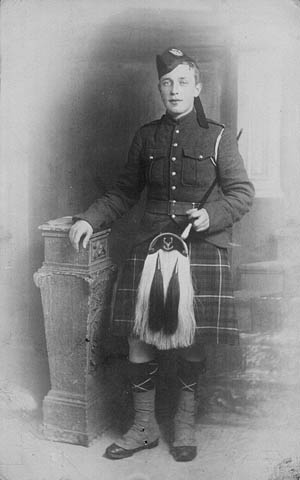
A black-and-white photograph of a young man wearing a kilt and sporran, holding a baton in his left hand and leaning on a sculptural shelf.

Piper James Cleland Richardson, VC, 16th Battalion, CEF. (MIKAN 3192331)

Born in Bellshill, Scotland, on November 25, 1895, Richardson immigrated to British Columbia where he served as a piper in the 72nd Seaforth Highlanders of Canada. In September 1914, he enlisted with the Canadian Expeditionary Force (CEF) and went overseas as part of a large Seaforth contingent of the 16th Battalion (Canadian Scottish).

On October 8, 1916, Richardson’s company was held up by uncut barbed wire and intense fire as they attacked German positions at Regina Trench. Richardson’s commander, Lieutenant-Colonel Cyrus Peck, later wrote of Richardson’s extraordinary courage. As the unit lay trapped in the shell holes of “no man’s land,” Richardson, a teenager who had played the company “over the top,” sought the commander’s permission to play his pipes again. In full view of the Germans, he marched up and down the wire entanglements playing his pipes where his fellow soldiers lay. His citation for the Victoria Cross states, “The effect was instantaneous. Inspired by his splendid example, the company rushed the wire with such fury and determination that the obstacle was overcome and the position captured” (London Gazette, no. 30967, October 22, 1918).

Amazingly, Richardson survived the attack and was detailed to take a wounded comrade and several prisoners of war to the rear. Realizing that he had left his bagpipes behind, he returned to recover them. Richardson was never again seen alive.

A black-and-white handwritten page describing the daily events leading up to the day of the action for which Piper James Cleland Richardson received the Victoria Cross.

War diary of the 16th Battalion for October 1–8, which describes the days leading up to the attack on Regina Ridge. (MIKAN 2034171)

The remains of James Cleland Richardson were located in 1920 and he is now buried in Adanac Military Cemetery near Albert, France. His bagpipes, long believed lost to the Somme mud, were identified in 2002 as being in the possession of Ardvreck Preparatory School in Scotland, part of a 1917 donation by British Army Chaplain Major Edward Yeld Bate. They are now on display at the British Columbia Legislature.

Black-and-white photograph of a young man in military uniform holding his bagpipes.

Piper James Cleland Richardson, VC, and bagpipes, 16th Canadian Infantry Battalion, CEF. (MIKAN 4922009)

Library and Archives Canada holds the CEF service file for Piper James Cleland Richardson. The James Richardson fonds contains his Victoria Cross certificate as well as an exercise book from his early schooling.


Emily Monks-Leeson is an archivist in Digital Operations at Library and Archives Canada.

Private John Chipman Kerr, VC

By Emily Monks-Leeson

As part of the First World War Centenary: Honouring Canada’s Victoria Cross recipients series, today we remember the life and military service of Canadian Victoria Cross recipient John Chipman “Chip” Kerr of Fox River, Nova Scotia.

A black-and-white photograph of two soldiers in uniform sitting on a bench. The man on the right is looking directly at the camera with a slight smile.

Private J.C. Kerr, VC, on the right. (MIKAN 3217379)

Prior to the war, Kerr worked as a lumberjack near Kootenay, British Columbia, and homesteaded in Spirit River, Alberta, with his brother, Charles Roland “Rollie” Kerr. When war was declared in 1914, the Kerr brothers, Chip and Rollie, went to Edmonton to enlist, leaving a note tacked to the door of their cabin that declared: “War is Hell, but what is homesteading?”

A black-and-white collage of three typewritten pages with the date September 15 in the margin and an hour-by-hour account of the actions taking place.

Account of the operations of the 49th Canadian Infantry Battalion from September 15–18, 1916. (MIKAN 1883261)

On September 16, 1916, Kerr was serving with the 49th Infantry Battalion of the Canadian Expeditionary Force (CEF) near Courcelette, France, not far from where Leo Clarke of the 2nd Battalion (Eastern Ontario Regiment) won the Victoria Cross the week before. Kerr’s actions on that day would earn him his own Victoria Cross. During a grenade attack carried out by his battalion, Kerr was the first bayonet man in a bombing party advancing on German positions. Recognizing that his unit’s bombs were running out, Kerr ran along the back ridge of the trench under heavy fire until he was close enough to the German troops to fire on them at point-blank range. Thinking they were surrounded, the German troops surrendered. Kerr’s citation in the London Gazette provides the details:

Sixty-two prisoners were taken and 250 yards of enemy trench captured. Before carrying out this very plucky act one of Private Kerr’s fingers had been blown off by a bomb. Later, with two other men, he escorted back the prisoners under fire, and then returned to report himself for duty before having his wound dressed. (London Gazette, No. 29802, October 26, 1916)

Chip Kerr survived the war, while his brother Rollie, also serving in the 49th Battalion, was killed in late December 1917. Kerr rejoined the army at the beginning of the Second World War, transferring to the Royal Canadian Air Force with the rank of Sergeant. He died in Port Moody, British Columbia, on February 19, 1963.

Mount Kerr, a 2,600-metre peak in Jasper National Park, is named after him, as is Chip Kerr Park in Port Moody, British Columbia.

Library and Archives Canada holds the CEF service file for Private John Chipman Kerr and his brother, Private Charles Roland Kerr.


Emily Monks-Leeson is an archivist in Digital Operations at Library and Archives Canada.

The Battle of Flers-Courcelette

By Alex Comber

Far from achieving their objectives, the Battles of the Somme, continuing into August 1916, had accomplished little, at enormous expenditure of lives and resources. The Battle of Flers-Courcelette, which took place September 15 to 22, 1916, was another attempt to achieve a decisive result on the Somme Front. Fighting as part of the British Reserve Army, the Canadian Corps, commanded by Sir Julian Byng, would contribute two of its infantry divisions to the left wing of a wider attack.

This was the first major offensive operation for the Canadians, and their first experience of the devastating human toll of combat in 1916. The battle began by a massive artillery bombardment of enemy positions, similar to the earlier Somme battles. This “creeping barrage” was better timed with the pace of advancing soldiers, and kept just ahead of them. Most enemy units did not have time to recover and prepare their defences before the Canadian infantry battalions were upon them.

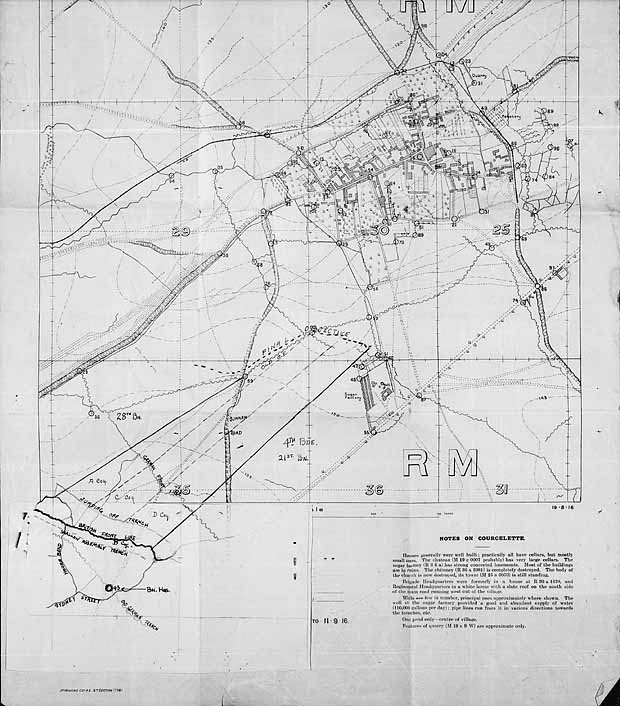
An image of a trench map, dated September 1916, showing the planned line of advance for the 27th Battalion near Courcelette, France.

This trench map, part of the War Diary of the 27th Battalion (City of Winnipeg), shows the planned lines of advance of this Battalion’s leading companies, from jumping-off trenches near Pozières (bottom left) toward the “final objective” just to the north of the sugar factory. Trench maps offer a wealth of detail, and this one shows the village of Courcelette at the top, and information about the other units that would advance on either flank of the 27th Battalion. (MIKAN 1883247)

Highlights of the successful advance of Canadian units included the capture of the village of Courcelette by Lt. Col. T.L. Tremblay’s 22nd Battalion (French Canadians) and the 25th Battalion (Nova Scotia Rifles) as well as the capture of the heavily fortified sugar factory east of the village by the 21st Battalion (Eastern Ontario). Elsewhere, the attack stalled, and hopes for a decisive success faded, as the Germans launched strong counterattacks or withdrew to fortified positions. Canadian units suffered approximately 24,000 wounded and killed soldiers during the operation.

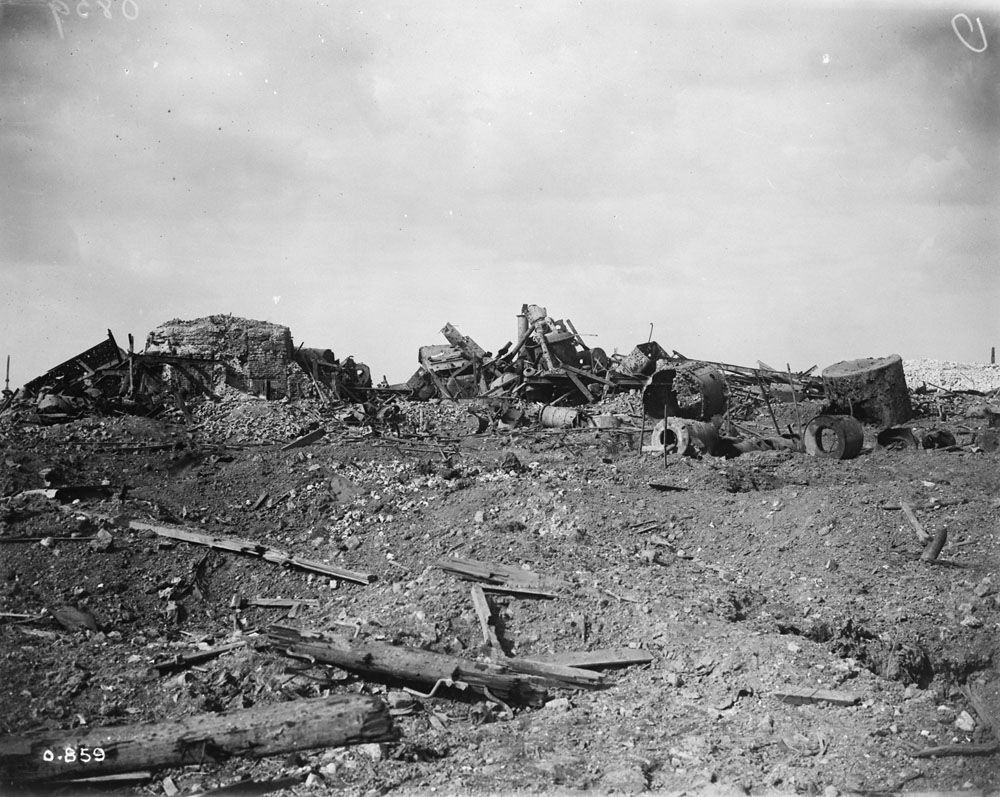
A black-and-white photograph of a ruined industrial building in a destroyed landscape.

This Canadian War Records Office official photograph of October 1916 shows the remnants of what was originally a sugar factory before the War following the bombardment and Canadian advance on the fortified German position. (MIKAN 3403776)

The first tanks, called “Land ships” appeared on the battlefields of Flers-Courcelette. They were slow, cumbersome, and mechanically unreliable, and most were put out of action or broke down before they could help the advancing soldiers. However, the few that remained operational destroyed fortified pillboxes and caused chaos in enemy lines. Lt. William Ivor-Castle, an official photographer working for the Canadian War Records Office, filmed tanks advancing to their starting positions, and these caused a sensation when published in England as the first photos of tanks “in combat.”

A black-and-white photograph of a British heavy tank advancing through a shell-cratered landscape.

This Mark 1 tank, named “Crème de Menthe,” was one of the most successful of those supporting the Canadian attack at Courcelette on September 15, 1916. Early tanks were painted with colourful “Solomon-style” camouflage. (MIKAN 3397296)


Alex Comber is a Military Archivist in the Government Archives Division at Library and Archives Canada.

Sergeant Leo Clarke, VC

By Emily Monks-Leeson

We continue our series First World War Centenary: Honouring Canada’s Victoria Cross recipients with the story of Sergeant Leo Clarke, Canada’s seventh First World War Victoria Cross recipient.

A black-and-white newspaper clipping of a photograph of a young man in uniform

Sergeant Leo Clarke, VC, died of wounds, c.1915-1916 (MIKAN 3214037)

Leo Clarke, born in Waterdown, Ontario, on December 1, 1892, was a surveyor for the Canadian National Railway. He enlisted in February of 1915 at Winnipeg with the 27th Battalion and transferred to the 2nd (Eastern Ontario Regiment) Battalion after arriving in England.

On September 9, 1916, Leo Clarke and the 2nd Battalion took part in an Allied assault on a network of German trenches stretching from Martinpuich to Courcelette in northern France. Clarke’s battalion was to capture a 50-yard area between Mouquet Farm, a Canadian-held position, and Courcelette. An Acting-Corporal at the time of the attack, Clarke led a party to clear the left flank of a German trench and create a “block” to fortify the Canadian position. The trench was heavily defended and, following bitter hand-to-hand combat, Clarke was the only member of his unit not killed or wounded. Alone he fought off a counter-attack of twenty German soldiers and officers.

A black-and-white handwritten page describing the day to day actions of the battalion.

War diary extract from the 2nd Canadian Infantry Battalion from September 1-9, 1916 describing the days leading up to and including the offensive (MIKAN 1883206)

Clarke’s citation from the London Gazette recounts that:

After most of his party had become casualties, he was building a “block” when about twenty of the enemy with two officers counter-attacked. He boldly advanced against them, emptied his revolver into them and afterwards two enemy rifles which he picked up in the trench.

One of the officers then attacked him with the bayonet, wounding him in the leg, but he shot him dead. The enemy then ran away, pursued by Acting Corporal Clarke, who shot four more and captured a fifth. Later he was ordered to the dressing-station, but returned next day to duty. (London Gazette, no. 29802, 26 October 1916).

Leo Clarke died in action a month later, on October 19, 1916. His Victoria Cross, posthumously awarded in the spring of 1917, was presented to his father by the Duke of Devonshire, Governor General of Canada, before a crowd of 30,000 gathered at Portage and Main in Winnipeg.

A black-and-white photograph of a group of soldiers in uniform in a field.

Bombing Platoon (2nd Battalion, Canadian Expeditionary Force) at Scottish Lines near Poperinghe not far from Ypres. This photo was taken by Henry Edward Knobel – an Official War Photographer – while the 2nd Battalion was out in rest billets after fighting at Sanctuary Woods, Maple Copse (Battles of the Somme). Leo Clarke, VC, is in the front row on the far right. June 16, 1916 (MIKAN 34005888)

Sergeant Leo Clarke lived on Pine Street in Winnipeg, Manitoba, as did two other Victoria Cross recipients: Frederick William Hall and Robert Shankland. Pine Street was renamed Valour Road in 1925 in honour of the three men.

Library and Archives Canada holds the service file for Sergeant Leo Clarke.


Emily Monks-Leeson is an archivist in Digital Operations at Library and Archives Canada.

First German submarine sunk by the Royal Canadian Navy

By Renaud Séguin

On September 10, 1941, off the coast of Greenland, the crews of two Royal Canadian Navy (RCN) corvettes, Her Majesty’s Canadian Ships (HMCS) Chambly and Moose Jaw, were able to locate and sink U-501 as the U-boat lay in wait to ambush Allied Convoy SC-42, sailing from Sydney, Nova Scotia, with supplies for Great Britain.

The two corvettes were to take part in training exercises at sea, so that their crews, largely made up of recruits, could become familiar with anti-submarine warfare. In the face of the growing threat from German submarines, the two vessels quickly ended their training to reinforce the Allied convoy.

Colour photograph of a Royal Canadian Navy corvette under way at top speed. Thick black smoke pours from a funnel. Number K145 is written in black on the grey vessel.

HMCS Arrowhead, a corvette of the same class (Flower) as HMCS Chambly and HMCS Moose Jaw (MIKAN 4821042).

An RCN expert in anti-submarine warfare, Commander James D. “Chummy” Prentice, Chambly’s captain and Senior Officer Corvettes, quickly decided that the best option would be to move ahead of the convoy to surprise any German submarines. The navigation skills of Mate A. F. Pickard made it possible for the two corvettes to reach the area identified by Prentice in less than six days.

At about 21:30, Chambly got an ASDIC (better known by its American name, “sonar”) contact. Quickly, Chambly’s crew began releasing five depth charges. Despite a few mistakes owing to inexperience, the first two charges caused enough damage to force the submarine to surface close to Moose Jaw.

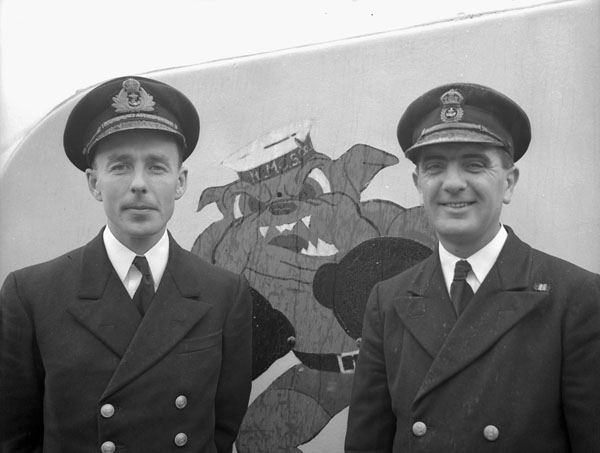
Black-and-white photograph, showing two men in naval uniform posing in front of the nose turret of their corvette. Between the two men, an image painted on the turret shows a bulldog standing on his hind legs, wearing a sailor hat and boxing gloves.

Mate A. F. Pickard and Chief Engine Room Artificer W. Spence, St. John’s, Newfoundland, 1942. The two men played key roles in the corvette HMCS Chambly’s sinking of the German submarine U-501 on September 10, 1941. (MIKAN 3576697)

Surprised by the appearance of the U-boat, the crew of Moose Jaw was unable to open fire immediately with either their rapid-fire naval gun or the machine guns. Lieutenant F. E. Grubb, commanding officer of Moose Jaw, rapidly gave the order to advance on and ram the submarine. Far from being a complete improvisation, this was a manoeuver often attempted by Canadian corvettes. At close range, it was the best option for sinking German U-boats which, at night, in rough seas, presented a small moving target.

Before the initial charge, Lieutenant Grubb was astonished to see the German captain abandon the submarine to leap onto Moose Jaw’s deck! However, it was only after being rammed by the corvette, under fire of its naval gun, that the U-boat halted.

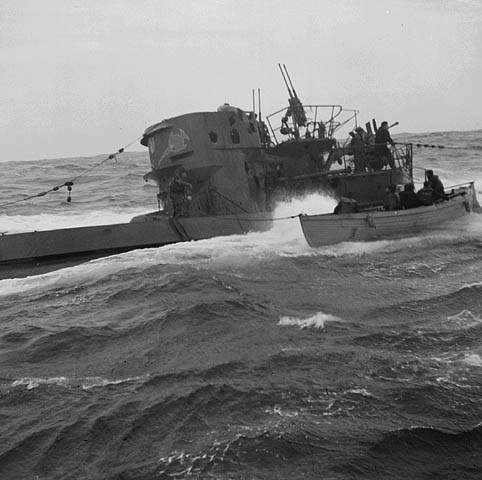
Black-and-white photograph showing a submarine and a whaler side by side. Members of the submarine’s crew can be seen on the bridge. The people in the whaler are seated.

A boarding party from HMCS Chilliwack in a whaler alongside German submarine U-744, March 6, 1944 (MIKAN 3623255).

A boarding party from Chambly, led by Lieutenant E. T. Simmons, attempted to take possession of the submarine. The attempt had to be abandoned, because the U-boat was sinking rapidly. One member of Chambly’s crew, William Irvin Brown, drowned during the operation. Like the more than 200 crew members of the 15 merchant ships in the SC-42 convoy sunk by German submarines, the Toronto native, father of a one-year-old daughter, gave his life to supply Great Britain and the armed forces protecting it. Many other Canadians also lost their lives during the Battle of the Atlantic.

Related resources


Renaud Séguin is a military archivist in the Government Archives Division at Library and Archives Canada.