Jeremiah “Jerry” Jones

This Black History Month, Library and Archives Canada highlights the service of Black Canadians during the First World War. While all Canadians were equally caught up in the patriotism of the early part of the war and the opportunities offered by military service, Black Canadians had difficulty enlisting due to the racism of the era. Although there was no official or explicitly stated policy of exclusion, the Canadian military left recruitment decisions to the discretion of individual commanding officers. Black Canadian volunteers along with those from other minority groups were left to enlist in whichever regiments would accept them. A special unit, the No. 2 Construction Battalion, was formed by members of the Black community in Nova Scotia. The battalion, whose members weren’t allowed to fight, dug trenches, repaired roads, and attracted hundreds of recruits from across Canada and even the United States.

A sepia-coloured photograph of a man in uniform wearing an officer’s belt and cap holding a baton in both hands across his upper thighs.

Jeremiah “Jerry” Jones, First World War private taken by an unknown photographer, from the personal collection of the Jones family (Wikipedia).

Among those Black Canadians who volunteered and served was Jeremiah “Jerry” Jones, a Nova Scotian soldier who enlisted with the 106th Battalion (Nova Scotia Rifles) in June 1916. Born in East Mountain, Nova Scotia on March 30, 1858, Jones was over 50 years old when he enlisted and lied about his age in order to join the army. Jones was sent overseas, where he transferred to the Royal Canadian Regiment and saw combat on the front lines in France, including the Battle of Vimy Ridge in April 1917. During the battle, with his unit pinned down by machine gun fire, Jones moved forward alone to attack the German gun emplacement. He reached the machine gun nest and threw a grenade that killed several German soldiers. The survivors surrendered to Jones, who had them carry the machine gun back to the Canadian lines and present it to his commanding officer. It is reported that Jones was recommended for a Distinguished Conduct Medal for his actions, though no record exists to show that he ever received the medal. In the decades following the war, the Truro Daily News and Senator Calvin Ruck highlighted Jones’ bravery and lobbied to have the Canadian government formally recognize his actions. Ruck in particular argued that the racist sentiment of the time had prevented Jones and other Black soldiers from being properly recognized for their heroism.
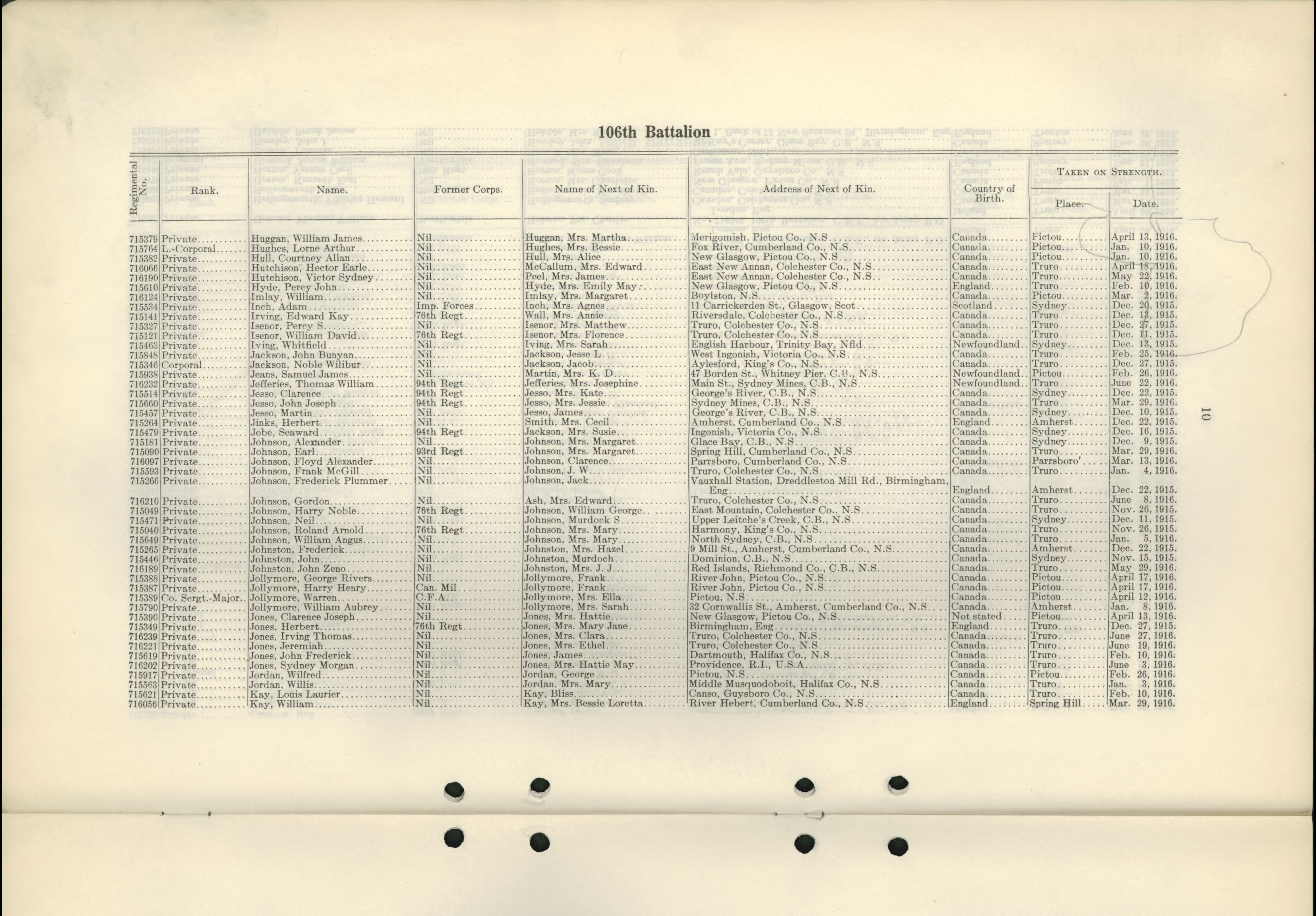
A nominal list showing the regimental number, rank, name, former corps, name of next of kin, address of next of kin, country of birth, and the place and date on which they were taken on strength.

Entry for Jeremiah Jones in the “Nominal Roll of Officers, Non-Commissioned Officers and Men” of the 106th Battalion (e011092698).

Jones was injured at the Battle of Vimy Ridge. He was formally discharged in Halifax in early 1918 after being found medically unfit. He died in November 1950. Jeremiah Jones was posthumously awarded the Canadian Forces Medallion for Distinguished Service on February 22, 2010.

The Carignan-Salières Regiment

The colony of New France was in a precarious situation when France’s King Louis XIV acceded to the throne in 1661. The population and safety of the colony were a priority for him. In order to increase the population, the first contingent of the Filles du roi (“King’s daughters”) was sent there in 1663. Two years later, in 1665, the Carignan-Salières Regiment disembarked in New France to ensure the safety of the colony and, more specifically, to deal with the Iroquois threat.

A pen and watercolour sketch depicting an officer in the Carignan-Salières Regiment in profile. He is holding a lance in his right hand and wearing a sheathed sword on his left hip.

Officer of the Carignan-Salières Regiment, 1666 (c010368k)

Continue reading

Hockey Marching as to War – the 228th Battalion

Library and Archives Canada (LAC) currently has an exhibition at 395 Wellington Street in Ottawa, which runs until January 22, 2016. Hockey Marching as to War engages viewers in the many stories of hockey players’ involvement in Canada’s First World War effort—from the men who enlisted and served overseas to the women who took up sticks at home.

A particularly fascinating story is the emergence of highly successful military hockey teams. In 1916, Winnipeg’s 61st Battalion won the prestigious Allan Cup—the senior amateur hockey championship—and Montreal’s 87th Battalion was good enough to play an exhibition game against Montreal professionals, including players from the Canadiens.

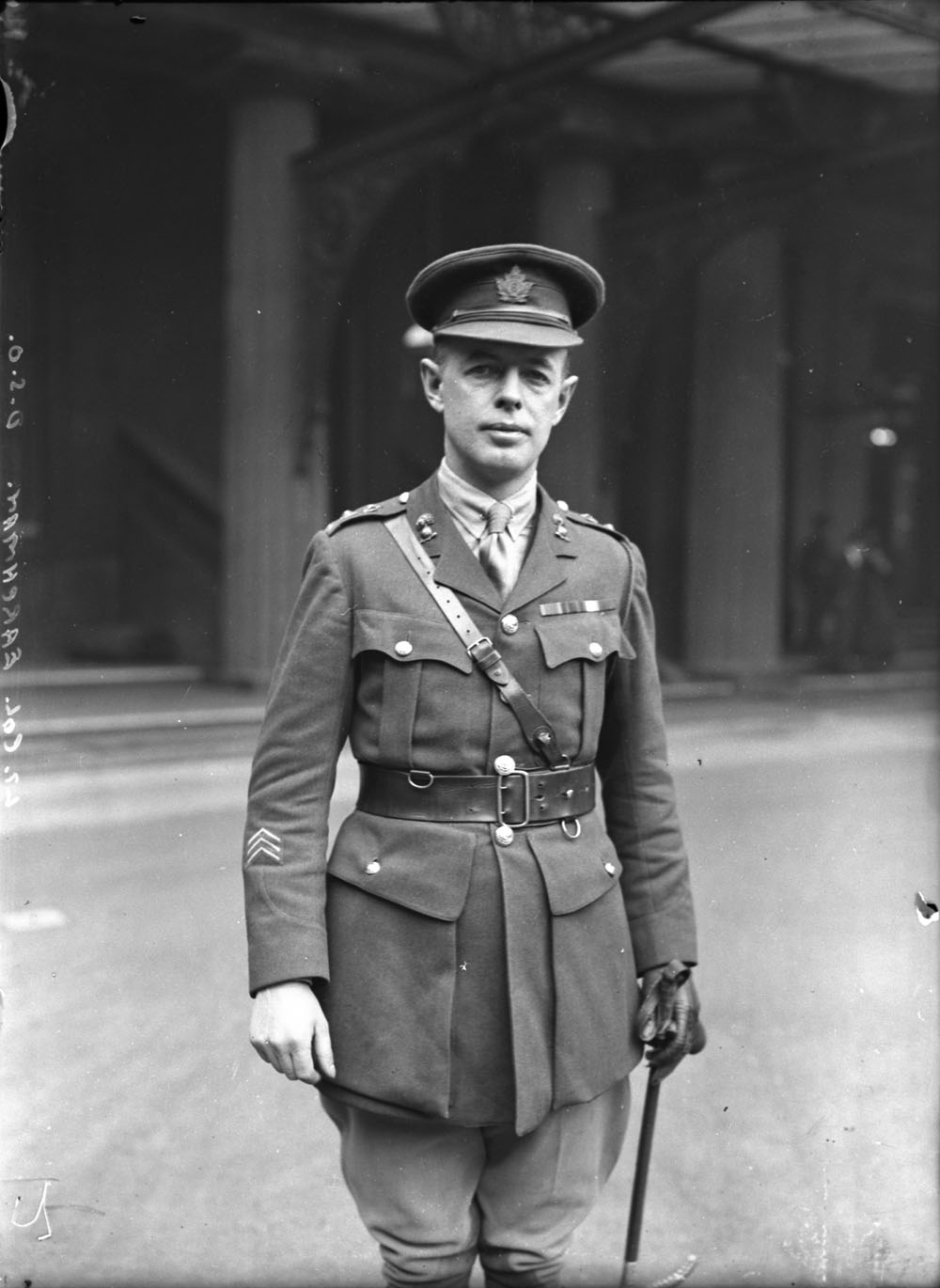
No military team was more famous than the 228th Battalion, whose history is there for all to see in LAC’s rich collection of government records. Known as the Northern Fusiliers, the 228th mustered in North Bay, Ontario, under the command of Lt.-Col. Archie Earchman, and was so successful recruiting talented hockey players that in the fall of 1916 it was invited to join the National Hockey Association (NHA), the main professional league and forerunner of the National Hockey League.

A black-and-white photograph of a man standing. He is wearing a uniform, a cap and a Sam Browne belt, and holding a baton.

Lieutenant Colonel Earchman, D.S.O., Toronto, Ontario, undated (MIKAN 3215233)

Continue reading

Frederick Horsman Varley (January 1881 – September 8, 1969)

The son of a commercial lithographer, Frederick Horsman Varley was born and raised in the steel town of Sheffield, England. Varley’s talent as an artist was recognized early when, at the age of 11, he was enrolled in the Sheffield School of Art. By the time Varley was 21, he had completed three years of fine arts study at the Académie Royale des Beaux-Arts in Antwerp, Belgium. Before immigrating to Canada in 1912, Varley had worked as a commercial artist in London, England, as well as an art teacher in his home town of Sheffield.

Black-and-white photograph showing a man standing up and holding a paint palette and brushes in one hand and looking a little to the side.

Frederick Horsman Varley, probably at the Vancouver School of Decorative & Applied Arts, ca. 1927 by photographer John Vanderpant (MIKAN 3509585)

Continue reading

Top three genealogy questions

This article contains historical language and content that some may consider offensive, such as language used to refer to racial, ethnic and cultural groups. Please see our historical language advisory for more information.

We receive many interesting questions from our clients at the Library and Archives Canada Genealogy desk. Here are the top three questions asked:

Question 1. My grandfather came to Canada between 1905 and 1914. How do I find his passenger list entry?

First, search the name on one of the indexes available online. Try different spellings and birthdate variations if your initial search is not successful.

If that doesn’t work, there are other documents that indicate the year of immigration. Try census returns or the 1940 National Registration File. If you know the city where your ancestor settled, you may be able to narrow down the year of immigration by seeing when they appear in a city directory.

You can also try searching for other family members that came to Canada with him. Maybe the passenger list entry of his wife, “Esmerelda Jenkins”, might be easier to find than “John Jenkins” (names are for example only).

Question 2. My mother said that we have Indigenous heritage somewhere in our family. How do I prove that?

Complete your family tree. Don’t focus too much on finding the Indigenous link at this point. Pay close attention to information given on the census returns, especially the 1901 census.

All census returns will indicate the location where your ancestor resided, such as the town, village, major city or federal Indian reserve. Some census returns list ethnic origin, such as French, Irish, Indian, “Half-Breed”, “Scotch-Breed”, Algonquin or Mohawk. They can also list colour (“W” for White and “R” for “Red”) and first language/mother tongue, which may help your search.

Many of these terms are now considered offensive and are no longer in use today. Do not fixate on or limit yourself to modern terminology—your ancestor may have been identified under any number of labels depending on the period, location and circumstances.

Question 3. My grandfather served in the Second World War, but never spoke about it. How do I find out what he did?

Your first step in finding out details about your grandfather’s war experience is to apply to the Personnel Records Department for information from his file by filling out our Application for Military Service Information form. After you receive the available information from his Second World War service file, you can continue your research at regimental museums and by reading published regimental histories (some of which may be available in our library collection).

If you have a question that you would like to ask us, please drop by the Genealogy desk at 395 Wellington Street, in Ottawa or email us using our Genealogy Assistance Request form.

Launch of “War of 1812” Database

Library and Archives Canada (LAC) is pleased to announce the launch of a new online database, War of 1812.

This online database allows you to access more than 45,000 references to names of people who were involved in the War of 1812. Names of Canadian men and women who served were taken from LAC’s unique and vast collection of records, including:

  • muster rolls
  • pay lists
  • claims
  • certificates of service
  • land grants
  • medal registers

Start searching the War of 1812 now!

Searching for the Service Files of Soldiers of the First World War

Database

You can find references to the service files of soldiers who served in the Canadian Expeditionary Force in our database Soldiers of the First World War: 1914–1918.

However, it is sometimes difficult to find a soldier for several reasons:

  • His given name or surname may be written in a variety of ways
    The information in the indexes is what was written in the archival records, which were often written by hand. There may also be an error in the database. The database search engine may find words with the same root. For example, “Worth*” will lead to a search for “Worth”, “Worthing” and “Worthington.”
  • Several soldiers had the same name
    To identify your soldier, you need to check the attestation papers (enlistment forms) because they contain personal information about him.
  • He gave an incorrect date of birth
    To be able to enlist in the army during the First World War, a recruit had to be between the ages of 18 and 45.

Continue reading

Born to Serve: Georges P. Vanier

Born in Montréal on April 23, 1888, Georges Vanier would feel the influence of his bilingual parents throughout his life. After graduating from high school, he attended Loyola College and then the Université Laval where he received a law degree in 1911. He started practicing law thereafter, although priesthood was also on his mind. It was the outbreak of the First World War however, that eventually grabbed his attention and he enlisted in the Canadian Army. He was a strong recruiter and played an important role in the creation of the French-Canadian 22nd Battalion. It was also during the war that he was injured and had to have his right leg amputated.

A black-and-white photograph showing a man smiling broadly in an officer’s uniform with cap.

Major Georges P. Vanier of the 22nd Battalion, June 1918 (MIKAN 3192070)

Continue reading

Multiple Contexts: Library and Archives Canada at the Canadian Museum of Immigration at Pier 21

Five pieces from the rich collection of Library and Archives Canada (LAC) are currently part of the new exhibition space at The Canadian Museum of Immigration at Pier 21 in Halifax, Nova Scotia. These objects including a commemorative medal, stamps, a map, and a land treaty will help illustrate the complex experience of immigration that continues to shape Canada’s past and present.

Attestation papers—informative documents from Canada’s history

One of the items from the Library and Archives collection included in the exhibition at Pier 21 is a document known as an attestation paper. An attestation paper was a form that recruits filled in and signed to show their willingness to serve overseas in the Canadian Expeditionary Force (CEF) in the First World War. Library and Archives Canada currently holds 620,000 attestation papers, all of which are digitized and available online.

A black-and-white image of a typed form describing Joseph Wilder’s personal and physical information. It is signed by him and witnessed by a medical officer.

Joseph Wilder’s attestation paper (MIKAN 46114, Box 10355-39, 312833)

The details these papers provide allow us to learn a lot about individual soldiers. For example, each form provides details about their physical appearance such as height, eye colour, and chest measurements. Recruits also had to state their “trade or calling” (job), place of birth, next of kin and present address, among other information. When trying to learn about individuals from the past who did not leave a lot (or any!) documentation behind, attestation papers can be incredibly helpful in piecing together histories.

Joseph Wilder—Medical Sergeant and pharmacist

The attestation paper included in the exhibition at Pier 21 belonged to a man named Joseph Wilder. From this document, we learn that he lived at 140 Alfred Avenue in Winnipeg, Manitoba, was born in Romania, and made his living as a druggist (pharmacist). The information about Joseph Wilder that can be found on his attestation paper is valuable to a number of interest groups such as his later descendants, members of Winnipeg’s local community, and Canada’s national history. It also complements the information available about Wilder in his two books Read All About It: Reminiscences of an Immigrant Newsboy and Lotions, Potions and Liniments Pure: A Look at the Drug Trade in Winnipeg in the 1900’s.

You can find out more information about the Soldiers of the First World War database and the large-scale digitization initiative to make these documents available online.

Propaganda: Second World War Approach

Wartime propaganda was not a 20th century invention. It has been around for many centuries in different formats. It was the advent of cheaper and quicker printing methods that made it possible to mass produce posters at the time of the Second World War. From recruitment, security and secrecy to patriotism, frugality and investments, there were posters created for every subject.

Recruitment posters, which until this point had been aimed solely at men, started to show signs of change as the war progressed. Although still often portrayed as fragile, women were becoming more and more important to the war effort. The pressure was on to enlist more men and women and the posters made it clear there was no excuse not to join.

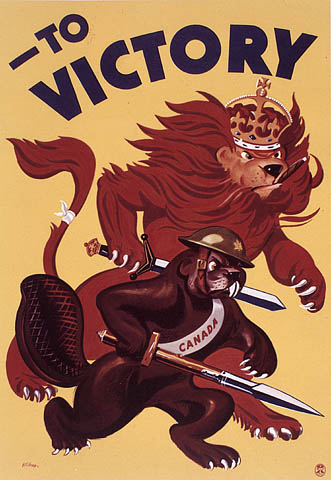
A colour poster showing a lion and beaver wielding swords and advancing menacingly.

War propaganda campaign: the beaver and the lion united against the enemy (MIKAN 2834354)

Another new element to propaganda during the Second World War was the concern about security and secrecy. There were growing fears that spies were always listening to conversations and that a small detail could lead to a big disaster for the troops. The posters started off fairly simple but as time progressed, they became more dramatic, often portraying a sinister-looking man in the background with large ears and a group of civilians or army men in the forefront having what seems like an innocuous conversation. The colours and graphics for these particular posters were often quite bold.

A colour poster showing two photographs overlaid with text. The top photo shows a café with people talking and a bystander listening to their conversation. The photo below shows a boat sinking.

“She Sails at Midnight…” Careless talk costs lives: propaganda for the security of Canada’s army (MIKAN 2834362)

The next phase was to target the men and women who were not able to enlist, to have them play a part in the war in a different way. They were called upon to work harder and produce more for the war effort. And when that was no longer enough, they were strongly encouraged to buy Victory Bonds to help fund the war. The tone of these posters evolved from the earlier tone of fear to something more hopeful—that by purchasing Victory Bonds, Canadians were ensuring a safe and happy future for their country.

A colour poster with a black-and-white photograph of a woman holding a bomb in her hands with the caption: “I’m making bombs and buying bonds!” Underneath the photograph in white letters on a red banner: “Buy Victory Bonds.”

Victory loan drive: “I’m Making Bombs and Buying Bonds!” (MIKAN 2846935)

Although there is no sure way of gauging the effectiveness of any of these campaigns, they remain an important piece of our history and a socio-economic, political look into the past.

Related links: