The Princess Patricia’s Canadian Light Infantry is one of three Permanent Force infantry regiments of the Canadian Army.
Images of Princess Patricia’s Canadian Light Infantry now on Flickr
5

The Princess Patricia’s Canadian Light Infantry is one of three Permanent Force infantry regiments of the Canadian Army.
Different approaches have been tried over the years for conserving sketchbooks or bound volumes. For a long time, the works were simply detached in order to remove the binding. Nowadays, the historical and archival value of the binding is widely recognized. Library and Archives Canada (LAC) is no exception in this regard, and conservation treatments are now designed to preserve the work in its entirety, including the binding.
In a previous article, we introduced you to the work of soldier William Redver Stark. The sketchbooks that are part of the William Redver Stark fonds were never repaired or preserved, and were beginning to show signs of wear:
The sketchbooks therefore are undergoing various conservation treatments, undertaken by a team of LAC’s highly specialized conservators in the field of book conservation and restoration. These conservators worked with the collection managers and archivists to respect the integrity of Stark’s work, and to give him his full moment of glory.
The drawings and watercolours in this collection are in very good condition. Some even look like they might have been completed only a few days ago. It should be noted that the sketchbooks remained closed for nearly a hundred years, and that the pages were rarely exposed to air or light. Thus, to study a Stark work is to travel through time, to see the work of an artist exactly as it was created a hundred years ago, during one of the most deadly and crucial wars of our time.
In sum, the restoration work done by LAC‘s conservation and restoration team will make it possible to stabilize the condition of the sketchbooks in order to ensure that they will withstand the ravages of time, and will allow future generations to have access to an important part of our history.


See Also:
Canada’s experience of the First World War was captured by officially commissioned artists such as A.Y. Jackson and David Milne from 1916 onwards through the Canadian War Memorials Fund. However, many other artists—amateur and professional—captured their experiences of the war while they were busy fighting, building roads, transporting goods or providing care to others, but still creating vivid imagery of the world around them.
The William Redver Stark fonds at Library and Archives Canada (LAC) is a rare illustrated record of one of these undeclared artists’ lives in the military. Through 14 sketchbooks of remarkably well-preserved drawings and watercolours, we discover the life of a soldier through his eyes, which were closer to the action than those of his official counterparts, and which provide a more spontaneous, intimate perception of how day-to-day activities may have looked.
In these sketchbooks, we find images of soldiers at work and at rest, captured German prisoners and artillery, landscapes through which battalions moved, and sights at the London Zoo where Stark went while on leave. The illustrations serve as a rich and indispensable complement to the artist’s military file, to his battalion’s history, and to our visual understanding of a serviceman’s experience during the First World War.
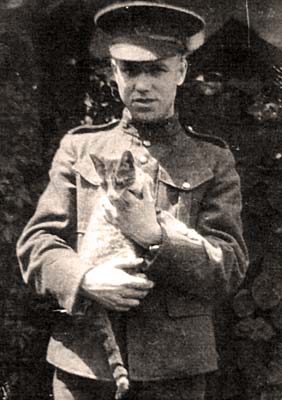
William Redver Stark with cat.
Courtesy of Veterans Affairs Canada.
The William Redver Stark fonds was donated to Library and Archives Canada in 2005 by his nephew, Douglas Mackenzie Davies and his family: his wife, Sheila Margaret Whittemore Davies, and their two sons, Kenneth Gordon Davies and Ian Whittemore Davies.
All 14 sketchbooks of the William Redver Stark fonds have been individually described and digitized, making it easier to search for themes or types of scenes. For example, you can search the fonds for all images that contain bridges or construction.
To search the sketchbooks, go to the Advanced search and in the drop-down menu under “Any of these words,” enter either the archival reference number (R11307) or the MIKAN number (616998). If you want to narrow down your search even more, enter a keyword such as “bridges” in the second box.
Be sure to read William Redver Stark: Restoring the Sketchbooks to learn more about the work done by LAC’s conservators to restore the sketchbooks.
It has been 90 years since Mary Riter Hamilton donated 180 of her oil paintings and dozens of her chalk, pastel and pencil drawings depicting the devastation in Europe after the First World War to the Public Archives of Canada (now Library and Archives Canada). These works by Riter Hamilton are not light-hearted. The subject matter deals almost exclusively with the destruction of war. They depict muddy trenches and blighted landscapes, graves and cemeteries, churches and towns ripped apart from shelling.

Memorial for the Second Canadian Division in a Mine Crater near Neuville St. Vaast (e011201067)
Mary Riter Hamilton was born in 1873 in Teeswater, Ontario and grew up in Clearwater, Manitoba where her family moved to farm. She married Charles W. Hamilton at the age of 18 and by the age of 23 was widowed. It was soon before the death of her husband that Mary began attending art classes in Toronto. Recognizing her talent, most of her European-trained teachers urged her to further her studies in Paris. Mary studied first in Germany then moved to Paris where she lived and studied for the next eight years. Mary returned to Manitoba for a year in 1906 then again for eight years in 1911. During these years, Mary’s work was exhibited in galleries in Montreal, Ottawa, Toronto, Winnipeg and Calgary.

The Sadness of the Somme (e011205200)
Always wanting to return to Europe, it was in 1919 while Mary was living and working on Canada’s west coast, that she was offered a commission by the Amputation Club of British Columbia to provide art work for The Gold Stripe, a veteran’s magazine. Mary left immediately, “ … to paint the scenes where so many of our gallant Canadians have fought and died.” For three years, Riter Hamilton worked tirelessly in post-war France and Belgium, painting battlefields including Vimy Ridge and the Somme, Ypres and Passchendaele. Conditions were harsh. She lived in make-shift shelters while enduring foul weather and meagre rations. She returned to Canada physically and emotionally spent. Refusing to sell her paintings, Riter Hamilton donated her work to the Public Archives of Canada. She died, poor and visually impaired, in 1954.
As the centenary of the First World War approaches, these works take on a renewed poignancy. Mary Riter Hamilton was never an official ‘war artist’ yet through her courage and talent and indomitable dedication, the sombre beauty and mournful tone of her collection serve as an enduring account of the ravages of war.

Trenches on the Somme (e011202180)
To learn more about Mary Riter Hamilton, to view more of her work, or to see what materials are contained in the LAC collection, visit:
Newfoundland was a Dominion of the British Empire when the First World War broke out. At the time, there was no formal military presence in Newfoundland, but the Government of Newfoundland went on a recruiting drive to provide a force for British service. Many Newfoundlanders also joined the war effort by joining the Canadian Expeditionary Force (CEF) in Canada.
After Newfoundland joined confederation in 1949, the personnel records for the Royal Newfoundland Regiment and the Newfoundland Forestry Corps were transferred to the Government of Canada as these individuals became eligible for veterans’ benefits. Later, the files were microfilmed by Library and Archives Canada (LAC) and FamilySearch. The originals remain in LAC’s holdings.
If you aren’t sure in which service your ancestor served or where he joined, you will need to look at both the CEF records using the Canadian soldiers of the First World War: 1914-1918 database for people from Newfoundland who enlisted in other parts of Canada and the general Archives Search for people who enlisted in Newfoundland regiments. For the latter group, enter the surname of the person, “Newfoundland” and RG38 in the keyword search. The results page will identify which microfilm reel you will need to order to consult the service record.
Meanwhile, the microfilms can be consulted onsite at LAC, through the Family History Centre or in the Newfoundland Provincial Archives at The Rooms in St. John’s. The latter has digitized some of the service files and these can be found in the Newfoundland Regiment and the Great War database.
LAC is presently digitizing all of the remaining 640,000 service files of the men and women who served in the First World War with the Canadian Expeditionary Force. The digitized service records will be made available on the website as they become available, but access restrictions may be in effect at times. Learn more about the digitization of the Canadian Expeditionary Forces Service Files by consulting the Fact Sheet: Digitization of Canadian Expeditionary Force Service Files.
When Canadian troops joined the action on the western front, there were no official military photographers. The front line was unsafe for commercial photographers, and officers and men were not allowed to use personal cameras. As a result, there are no official photographic records of Canadian participation in early battles, such as the Second Battle of Ypres, in April 1915.
The Canadian War Records Office, established in January 1916, immediately recognized the importance of photography, both for keeping a lasting documentary record of the war and for boosting morale. The first official Canadian war photographer was appointed in April 1916. That same year, the first of several immensely popular exhibitions of official Canadian war photographs was unveiled at the Grafton Galleries, in central London.
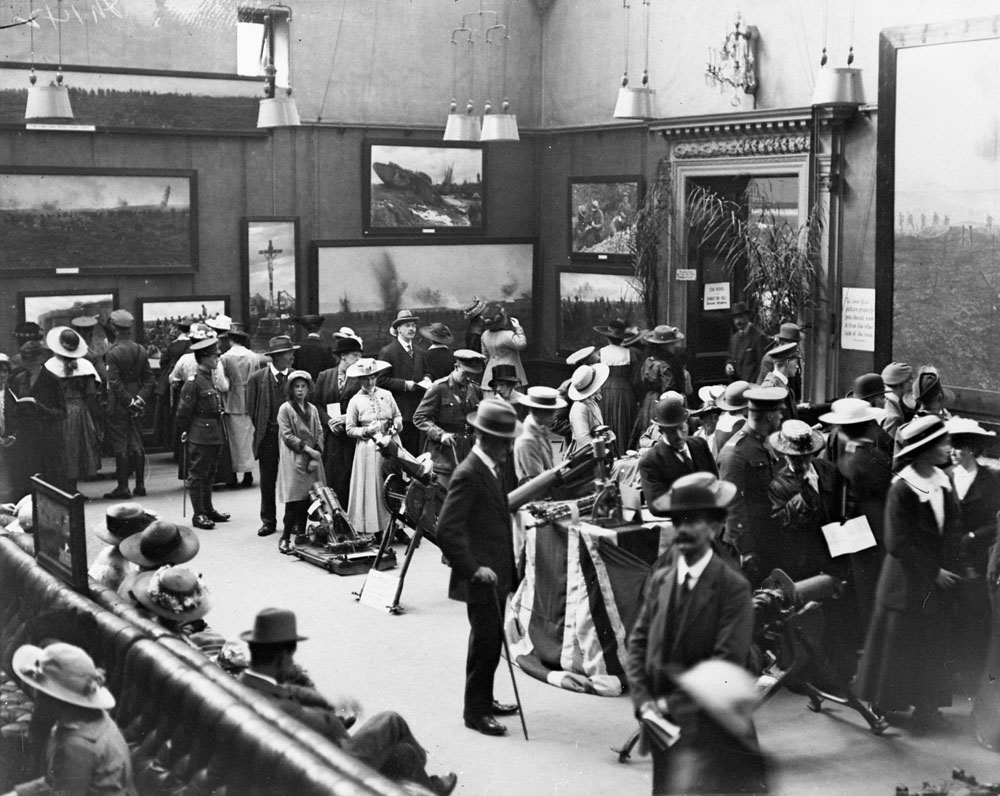
Princess Christian among others viewing images at the Second Exhibition of Canadian Battle Pictures, Grafton Galleries, London, July 1917 (MIKAN 3394829)
Today, Library and Archives Canada’s (LAC) holdings include most of the negatives created by Canada’s official war photographers, preserved in their original glass plate format. These are some of the most poignant, horrifying, and yet compelling images in LAC’s photography collection.
The Great War, the Persuasive Power of Photography, a new exhibition at the National Gallery of Canada, curated by Ann Thomas, incorporates many of these negatives in the near-exact recreation of one entire room from the second Grafton Galleries exhibition, held in 1917. The room, which is designed to put the modern viewer in the shoes of a viewer from 1917, features a dramatic to-scale reproduction of a photograph of the Battle of Vimy Ridge, called the largest photograph ever made during its time. It also includes a cropped version of this photograph of Canadian troops after the battle.
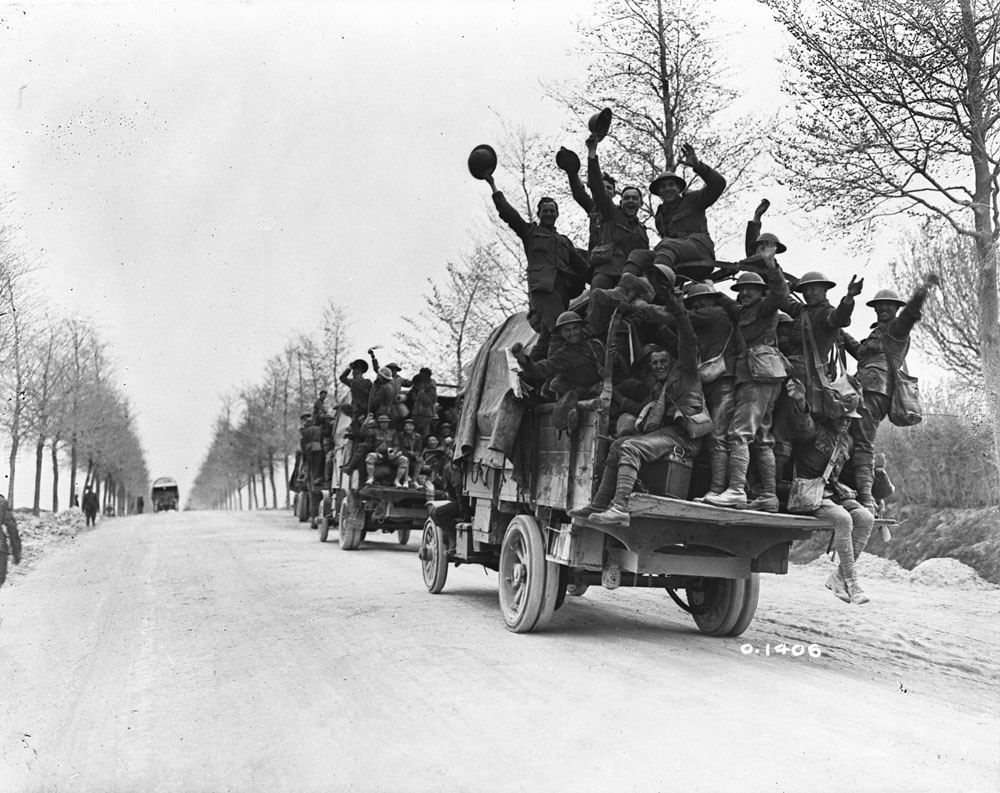
Canadian troops en route to destination for a rest period after taking part in the capture of Vimy Ridge (MIKAN 3521924)

View from inside the Grafton Galleries, London, at the Second Exhibition of Canadian Battle Pictures, July 1917 (MIKAN 3394834)
Canada’s official war photographers:
See other images reproduced for the room or visit the exhibition at the National Gallery of Canada from June 27 to November 16, 2014.
Did you know that Library and Archives Canada (LAC) has rare colour photographs from the Second World War? During that time period, colour film was a new and untested medium for most professional photographers. These images were captured on Kodak Kodachrome film by members of the Canadian Film and Photo Unit (CFPU) in the days and weeks following D-Day, on June 6, 1944.
The CFPU, formed in 1941, was under the command of Captain William Abell of Winnipeg and was staffed by enlisted Canadian men and women. Their goal was to capture images of Canadian military personnel in action, which would then be released by the Department of National Defence to various media outlets. Today these images provide an invaluable record, in living colour, of Canadian servicemen and servicewomen, as well as changing photographic technologies and techniques.
The images are part of a larger set of 1,200 digitized Second World War colour photographs that can be viewed through LAC’s online database. Included are photos of various subject matter, such as Canadian troops in England, France, Holland, Germany, Italy, and on bases and in training in Canada; portraits of notable military figures; the Canadian Women’s Army Corps; troop entertainment; hospital transport ships; and the Canadian role in liberation/occupation duties as photographed by CFPU member Ken Bell.
LAC’s complete digitized collection of colour images from the CFPU includes over 2,000 additional digitized colour images dating to 1961. To view them, consult the ZK prefix. To search within this collection, go to Advanced Archives Search and search using “ZK prefix” and the search term of your choice. An electronic finding aid for the ZK prefix sub-series is also attached to this record and can aid in locating specific images. To learn more about using finding aids in your research, read Discover Finding Aids – Part Two.
See also:
 Library and Archives Canada Blog