Your ancestors and the War of 1812

During the War of 1812, many French Canadians fought under the command of Charles-Michel d’Irumberry de Salaberry in the Canadian Voltigeurs, a light infantry unit. The Voltigeurs’ main battle exploit was the Battle of the Châteauguay, which was fought on October 26, 1813, when some 1,700 Canadians helped drive back more than 3,000 Americans, preventing a major attack on Montréal.

Here are a few avenues for research that will help you determine whether your ancestors were among the Voltigeurs:

Library and Archives Canada has many documents on military service, including documents related to the War of 1812. Drafted mainly in English, these include muster rolls and paylists, along with land claims and petitions scattered throughout the collection. However, there are no military service files for specific individuals, unlike what is available for the First World War.

The starting point for your research is to find a contract of service, which all Lower Canada militiamen had to sign before a notary. This was the case for Joseph Auclair (1794-1861), who took part in the Capture of Detroit and in the Battle of the Châteauguay. This document provides physical details and the name of the regiment and of the commanding officer. The Notarial Records blog article explains how to find this key document.

Certificate of enlistment of Joseph Auclair by Jean-Baptiste-René Hertel de Rouville, captain, Canadian Voltigeurs unit, drafted before the notary Charles Pratte, December 27, 1812, Bibliothèque et Archives nationales du Québec.

Certificate of enlistment of Joseph Auclair by Jean-Baptiste-René Hertel de Rouville, captain, Canadian Voltigeurs unit, drafted before the notary Charles Pratte, December 27, 1812, Bibliothèque et Archives nationales du Québec.

You can also find references to medals awarded to veterans of the War of 1812 in our Medals, Honours and Awards database. With a bit of patience, you will be able to locate the name of your ancestor on paylists, also called Nominal Rolls and Paylists. Many militiamen were also granted land. These grants, announced in The Quebec Gazette, were confirmed by land patents, which can be found in our Lower Canada Land Petitions database.

Lastly, to save you time, it is very important to read the search help pages carefully to find out how documents are organized.

Hidden Treasures – Winnie the bear

Discovering hidden treasures in our institution’s vast collection of archival material is one of the exciting benefits of researching at Library and Archives Canada (LAC). Recently, two previously undescribed photographs of the bear mascot Winnie, the famous Canadian inspiration for A.A. Milne’s Winnie-the-Pooh stories, were found and made available online.

A reference technician from LAC was searching for First World War photographs taken in March 1915 of the 15th Canadian Battalion in the trenches of Neuve-Chapelle, France. The technician consulted the usual sources (online database, onsite Finding Aids, and contact cards from the Department of National Defence photographic collection) and found a description of a possible and unexpected item in the personal collection of Horace Brown.

The photographs from this collection were retrieved from storage; some of them were very small and difficult to view. One seemed to be of a soldier wearing a very odd hat. Further investigation with the aid of a lighted magnifying glass revealed the “soldier” was actually a bear cub and the curious headgear was its ears! A second image of the bear cub was also identified in the collection. A bit of sleuth work revealed that Horace Brown, a member of the Canadian Expeditionary Force, had been stationed at Salisbury Plain, England during October and November 1914, at the same time as Lieutenant Harry Colebourn with his mascot, Winnie.

Although many photographs exist of the famous bear in the Manitoba Archives and private collections, these were the first ones to be identified in LAC’s holdings. The images may now be viewed by all Winnie the bear (and Winnie-the-Pooh) fans here and here on our website.

Harry Colebourn with Winnie the bear - Salisbury Plain.

Harry Colebourn with Winnie the bear – Salisbury Plain. (e011067493-v8)

Harry Colebourn with Winnie the bear - Salisbury Plain.

Harry Colebourn with Winnie the bear – Salisbury Plain. (e011067494-v8)

Sicilian Campaign (July and August 1943)

During the Second World War, Allied maritime traffic in the Mediterranean was under constant threat of Italian and German attack. In an effort to turn the tide, at the Casablanca Conference in January 1943, the Allies proposed an invasion of Sicily, code named “Operation Husky.”

Two Canadian soldiers on board a warship.

Canadian troops en route to Sicily. Source

After long months of preparation, Allied troops, made up of American, Canadian, British, French, Australian and South African units, landed in the night of July 9 to 10. The 1st Canadian Infantry Division and the 1st Canadian Army Tank Brigade were under the command of Major-General Guy Simonds. Canadian troops fought in difficult conditions, dealing with very hilly terrain and temperatures of over 40 degrees Celsius.

Six soldiers advancing past a tank on a narrow road. Three other soldiers are positioned on top of the tank.

Personnel of Princess Patricia’s Canadian Light Infantry advancing past a Sherman tank, Valguarnera, Italy, July 19, 1943. Source

From their landing point on the Sicilian beaches near Pachino, Canadian troops advanced toward the interior of the island, taking part in the battles at Grammichele, Piazza Armerina and Valguarnera. The towns of Leonforte and Assoro, situated in good strategic positions at the top of hills, put up a strong defence, but the Canadians prevailed in the end. A total of 562 Canadian soldiers lost their lives during this campaign.

The Sicily landing opened the way for the Allies to launch the Italian campaign a few weeks later.

Library and Archives Canada holds a large collection of military documents relating to Operation Husky and the Sicilian Campaign. Other examples can be accessed via the links below.

Discover also:

To view more photos, please visit our Flickr album.

The Korean War

In the wake of the Second World War, the Korean Peninsula was divided into two zones along the 38th parallel, with the North occupied by the Soviet Union and the South by the United States. Soon after the election of a northern communist government in 1948, open war broke out on June 25, 1950, when North Korean troops invaded the South.

Given the situation, the United Nations Security Council passed a resolution to approve sending troops to defend South Korea; a number of countries, including Canada, contributed by supplying armed forces.

The Royal 22e Regiment mortar platoon ready to fire, (left to right) Private Daniel Primeau, Private Raymond Romeo, and Private Julien Blondin, all of Montreal, Quebec.

The Royal 22e Regiment mortar platoon ready to fire, (left to right) Private Daniel Primeau, Private Raymond Romeo, and Private Julien Blondin, all of Montreal, Quebec. Source

More than 26,000 Canadian soldiers fought in the Korean War. They battled communist troops on the ground, while the Royal Canadian Navy—with eight warships—helped control the Korean coasts. The Royal Canadian Air Force did its part transporting troops and equipment. A few pilots saw combat at the controls of American fighter planes.

 Black-and-white photo of two Canadian snipers aiming at an unknown target..

Two snipers. Source

On July 27, 1953, an armistice agreement was signed at Panmunjom, bringing three years of fighting to an end.

In all, 516 Canadians lost their lives during this armed conflict. Their names are entered in The Books of Remembrance… The Korean War, exhibited at the Peace Tower in Ottawa and available online. These registers remind us of the important contribution and tremendous sacrifice of these Canadians.

The Library and Archives Canada collection contains many documents about this war, which marks the 60th anniversary of its armistice in 2013. Here are a few examples:

Part of the war diaries (War Diary, 1951) of the Commonwealth troops, including Canadian troops:

The war diary (1950–1951) of the advance party:

For more photos, visit our Flickr album.

For more information about ordering military service files, please read our blog article on this topic.

Reconnecting families through digitization

As part of Project Naming, a community engagement and photo identification project that aims to reconnect Inuit and their past, Library and Archives Canada (LAC) has undertaken the digitization of a series of photographs from the Indian and Northern Affairs Collection. These albums have been the starting point of a great story regarding a family from Nunavut.

In this collection, are a number of images of the Weetaltuk family taken during the summer of 1949 on the Cape Hope Islands in Nunavut. The original captions accompanying the photographs provided basic details. Fortunately, the database records for these images are now more complete after several family members contacted LAC to provide the names of relatives and other relevant information about these pictures. Most importantly, they were able to correct the Weetaltuk surname, as well as community names that had been incorrectly recorded. From the original captions, we knew that George Weetaltuk was a community leader, a skilled hunter and an expert boat builder. His family members explained the detailed process that George followed in creating his boats, as seen in this photograph of him with his son, William, and his adopted son, Simon Aodla, constructing an 11.58 metre (38-foot) boat.

Another record that the Weetaltuk family was able to correct was this group photograph taken in front of a log cabin. The caption states that this picture was taken on Cape Hope Islands. We now know that the picture was probably taken on nearby Charlton Island, James Bay, where for many years, George and his family resided while he was employed seasonally by the Hudson’s Bay Company. In addition to this information, the family was also able to identify five of the people in the photograph, and provide genealogical connections.

Weetaltuk family photograph. Back row: Adla (far left), married to William, George’s oldest son (2nd from left),  George Weetaltuk (centre) and his first wife, Ugugak (4th from left). Front row: George’s sons Alaku (far left) and Tommy (sitting on the ground). (PA-099605)

Weetaltuk family photograph. Back row: Adla (far left), married to William, George’s oldest son (2nd from left), George Weetaltuk (centre) and his first wife, Ugugak (4th from left). Front row: George’s sons Alaku (far left) and Tommy (sitting on the ground). (PA-099605) Source

In addition, another of George’s sons, Edward, was a member of the Princess Patricia’s Canadian Light Infantry. He was the first Canadian Inuk to serve in military combat with the Canadian Army during the Korean War. Following his 15 years of service, he began writing his life story. According to a news article, Edward (Eddy) Weetaltuk “wanted to show young Inuit that education was important and that Inuit can become anything they want and even become famous, if that’s what they want.” (Nunatsiaq Online, July 16, 2009)

Although Eddy started writing E9-422: Un Inuit, de la toundra à la guerre de Corée in 1974 (in French only), it was not published until 2009 only a few days before his death.

Through these family connections and dialogue with the community, our photographic collections are constantly improved and enriched for future generations.

For more information about Project Naming, read our Blog article, published on May 9, 2013, and listen to our Project Naming and Canada’s North podcast.

The Battle of the Atlantic (1940–1943)

Although the waters of the Atlantic witnessed many a naval battle throughout the Second World War, the longest and most important, the Battle of the Atlantic, reached its height between 1940 and 1943, pitting the Allies against the German navy and its formidable fleet of submarines, known as U-boats.

$90 Killed this U-BOAT! War savings stamps drive, 1943.

$90 Killed this U-BOAT! War savings stamps drive, 1943. Source

The Battle of the Atlantic’s crucial struggle was to protect the convoys of merchant ships against enemy German naval forces, which tried to block their way. Most of these convoys set out from North American ports and were bound for Great-Britain.

Convoy in the Bedford Basin, near Halifax, Nova Scotia, April 1, 1942.

Convoy in the Bedford Basin, near Halifax, Nova Scotia, April 1, 1942. Source

The Battle of the Atlantic saw U-boats penetrate deep into Canadian waters: the Royal Canadian Navy was actively involved in the battle, fighting fiercely to protect its merchant navy.

Freighter SS ROSE CASTLE, in convoy, torpedoed by U-boat, November 2, 1942, near Wabana, Newfoundland.

Freighter SS ROSE CASTLE, in convoy, torpedoed by U-boat, November 2, 1942, near Wabana, Newfoundland. Source

However, despite all efforts, enemy forces sunk over 70 merchant vessels, claiming the lives of over 1,600 Canadian crew members. Nevertheless, the Allies are considered to have prevailed in the Battle of the Atlantic since the Germans failed to stem the flow of merchant shipping convoys bound for Great Britain, which helped provide the supplies essential to the allied victory. Be sure to visit the Canadian War Museum for more information about this Second World War battle.

The Royal Canadian Navy’s contribution to this effort is well documented in the collection of Library and Archives Canada. Some suggestions and references for further research are provided below.

Since most convoys setting out from Canada departed from Halifax harbour, a large volume of records were produced by the Naval Control Service in Halifax. Documents available for consultation include the following:

Please visit our Flickr album for more photographs.

Battle of Vimy Ridge – April 9 to 12, 1917

For Canadians, the Battle of Vimy Ridge brings to mind the joint effort of all of the Canadian units that fought together for the first time to achieve victory. In a way, it was our very first national military victory, and, as such, a tremendous source of pride.

In spring 1917, Allied Command tasked Canadians with the difficult mission of taking Vimy Ridge and driving back the Germans, who had controlled it almost continuously since the beginning of the First World War.

Barrage map [cartographic material]: [Vimy Ridge region, France]

Barrage map [cartographic material]: [Vimy Ridge region, France] (e000000540)

The Canadian officers spent weeks developing their tactical attack down to the last detail. The soldiers rehearsed their attack behind the lines using a model to represent the battlefield so they would be familiar with the terrain where they would be fighting. The role of the artillery was also meticulously planned in preparation for its famous “creeping barrage,” an artillery bombardment that pressed forward against the enemy at a timed pace as a curtain of fire ahead of the advancing troops.

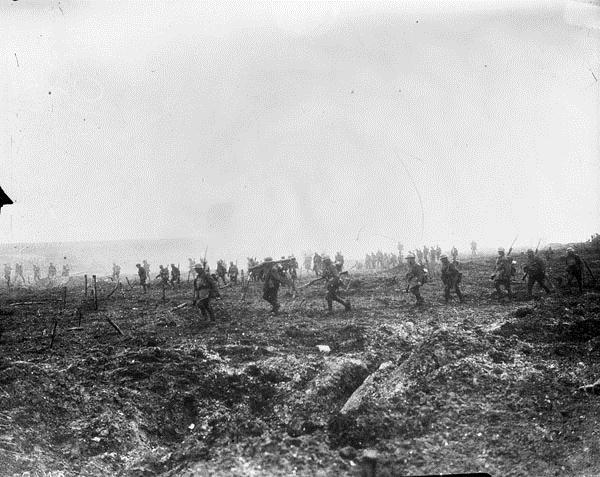
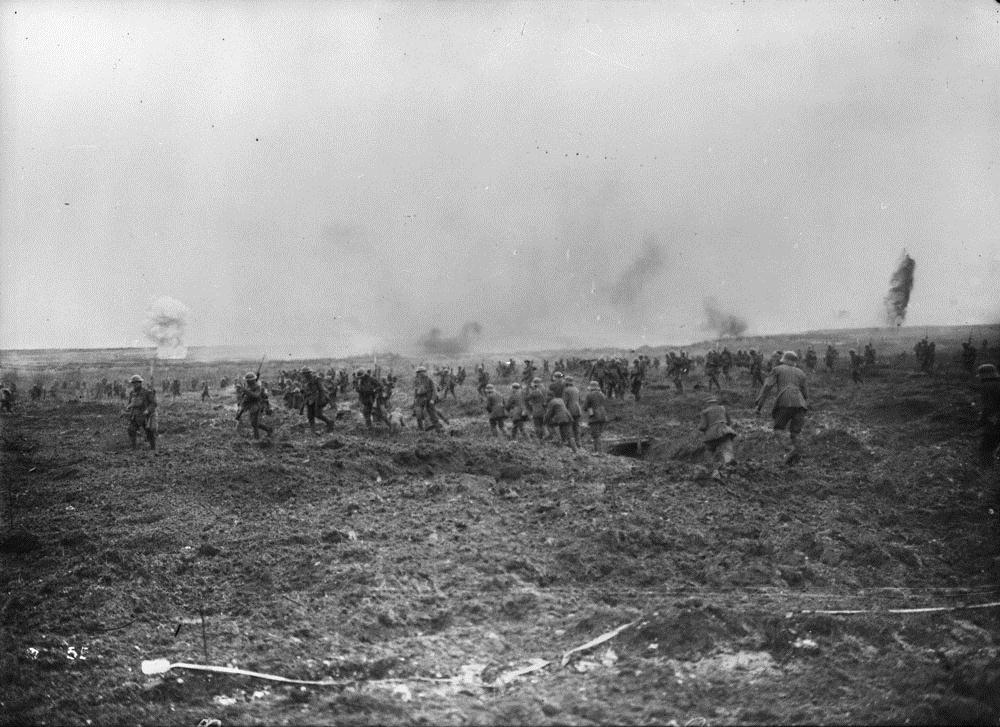
29th Infantry Battalion advancing into “No Man’s Land” through German barbed wire and heavy fire during the Battle of Vimy Ridge.

29th Infantry Battalion advancing into “No Man’s Land” through German barbed wire and heavy fire during the Battle of Vimy Ridge. (a001086)

The attack that ignited the Battle of Vimy Ridge was launched on Easter Monday, April 9, 1917, at 5:30 a.m. Four Canadian divisions overran the German positions, with three achieving their primary objectives in less than an hour. The highly-trained men were able to advance rapidly, thanks to the formidably effective heavy artillery fire. Nevertheless, the Germans offered fierce resistance: it took four days of heavy combat for the Canadians to finally seize full control of the famed Vimy Ridge.

The battle claimed the lives of 3,598 Canadian soldiers, with over 7,000 more wounded.

(W.W. I – 1914-1918) As the Canadians advanced, parties of Huns left their dug-outs, only too glad to surrender – Vimy Ridge. April 1917.

(W.W. I – 1914-1918) As the Canadians advanced, parties of Huns left their dug-outs, only too glad to surrender – Vimy Ridge. April 1917. (a001123)

Visit our Flickr album for more photographs.

Library and Archives Canada’s Travelling Exhibitions

Library and Archives Canada (LAC) is on the road! With four travelling exhibitions on display in different venues across Canada, including one in the
National Capital Region, LAC is showcasing the richness and diversity of its collections. This is an excellent example of LAC’s commitment to making the
country’s heritage and history accessible to all Canadians—regardless of where they live.

The Art Gallery of Greater Victoria, in British Columbia, is hosting the exhibition Beyond Likeness: Contemporary Works from Library and Archives Canada until January 6, 2013. Through the works of 23 contemporary artists, the exhibition explores the evolving concept of portraiture from more traditional representations of likeness to works that challenge the conventions of the genre.

The New Brunswick Museum in Saint John is presenting the exhibition I Know You by Heart: Portrait Miniatures until December 31, 2012. Showcasing 35 recently restored portraits, the exhibition highlights the intimate, personal nature of portrait miniatures, and the reasons that such images are commissioned, created and carried. In March 2013, the exhibition will make its way to the Mendel Art Gallery in Saskatoon.
Find out more about the conservation of these portraits in LAC’s YouTube video.

The McMichael Art Gallery in Kleinburg, Ontario, is showcasing LAC’s most recent exhibition Double Take: Portraits of Intriguing Canadians until January 20, 2013.Double Take presents 50 Canadians who have left—and are leaving—their mark on our country and our culture. Tune in to LAC’s podcast for an overview of the featured works and the stories behind them.

Finally, the exhibition Faces of 1812 is on display at the Canadian War Museum in Ottawa until January 6, 2013. A commemorative exhibition, Faces of 1812 presents some of the men and women who experienced the War of 1812. LAC’s curatorial YouTube video and Faces of 1812 podcast will introduce you to the selected
works that document this significant historical event.

Keep following this blog to find out where these exhibitions will travel next. It could be your hometown!

Questions or comments? We would love to hear from you!

From Enlistment to Burial Records Part II: The Canadian Forces in the Second World War

For many Canadians, Remembrance Day on November 11 is evocative of the selfless contribution of the Canadian Forces. The eleventh day of the eleventh month
brings to the forefront the memory of those who died while serving their country in the Armed Forces. Each year, Library and Archives Canada (LAC) receives countless queries about military services files of individuals who served after 1918 (including the Second World War).

Once again, our experts have put together some answers to many of the most frequently asked questions. Keep in mind that, in addition to consulting the content below, a great place to begin your research is on our Genealogy and Family History’s Military pages.

– Is the person still alive? When did he/she serve?

Access to personal information included in a person’s personnel file requires that his/her signed consent. If you served in the Canadian Forces, consult our Canadian Forces after 1918 section to find out how to request copies of your own service file.

Tip:

If the person is deceased, the date of death has an impact on what information is released.

If the individual died less than 20 years ago, limited information may be released to the immediate family. Proof of death and relationship must be provided.

There are no restrictions on access to information relating to an individual who has been deceased for more than 20 years. Proof of death is required.

Newspaper obituaries are a key tool in genealogy and help when researching military service files. Our online catalogue AMICUS can be searched to locate and borrow newspapers.

Consult our article “How to Find a Canadian Newspaper on Microfilm” for more
information.

If the person died while in service between 1939 and 1947, the service files are open to the public. References to those service files can be found in our Second World War Service Files: Canadian Armed Forces War Dead database.

Consult our article “How to Order Military Records from the Personnel Records Unit” to learn how to obtain a copy of these files.

– Beyond the service files:

Once you have a copy of the service file, some questions will be answered but other questions will arise: In what battles did the person serve? Where is he/she buried? Our previous article “From Enlistment to Burial Records Part I: The Canadian Expeditionary Force in the First World War” describes key sources that are equally relevant to post First World War research, such as War Diaries, Veterans Death Cards, and Medals, Honours and Awards databases.

– Even more places to look!

Finding aids such as The Guide to Sources Relating to Units of the Canadian Expeditionary Force and our article on “Published Histories: Discover what individuals or military units did during the war” contain a wealth of information on military activities.

Questions or comments? We would love to hear from you!