William Redver Stark, the Soldier and the Artist

Version française

Canada’s experience of the First World War was captured by officially commissioned artists such as A.Y. Jackson and David Milne from 1916 onwards through the Canadian War Memorials Fund. However, many other artists—amateur and professional—captured their experiences of the war while they were busy fighting, building roads, transporting goods or providing care to others, but still creating vivid imagery of the world around them.

The William Redver Stark fonds at Library and Archives Canada (LAC) is a rare illustrated record of one of these undeclared artists’ lives in the military. Through 14 sketchbooks of remarkably well-preserved drawings and watercolours, we discover the life of a soldier through his eyes, which were closer to the action than those of his official counterparts, and which provide a more spontaneous, intimate perception of how day-to-day activities may have looked.

In these sketchbooks, we find images of soldiers at work and at rest, captured German prisoners and artillery, landscapes through which battalions moved, and sights at the London Zoo where Stark went while on leave. The illustrations serve as a rich and indispensable complement to the artist’s military file, to his battalion’s history, and to our visual understanding of a serviceman’s experience during the First World War.
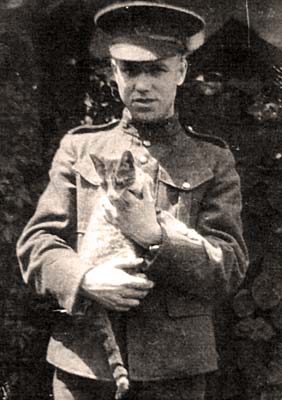
William Redver Stark with cat. Courtesy of Veterans Affairs Canada.

William Redver Stark with cat.
Courtesy of Veterans Affairs Canada.

The William Redver Stark fonds was donated to Library and Archives Canada in 2005 by his nephew, Douglas Mackenzie Davies and his family: his wife, Sheila Margaret Whittemore Davies, and their two sons, Kenneth Gordon Davies and Ian Whittemore Davies.

How to search the sketchbooks

All 14 sketchbooks of the William Redver Stark fonds have been individually described and digitized, making it easier to search for themes or types of scenes. For example, you can search the fonds for all images that contain bridges or construction.

To search the sketchbooks, go to the Advanced search and in the drop-down menu under “Any of these words,” enter either the archival reference number (R11307) or the MIKAN number (616998). If you want to narrow down your search even more, enter a keyword such as “bridges” in the second box.

Other related materials:

Be sure to read William Redver Stark: Restoring the Sketchbooks to learn more about the work done by LAC’s conservators to restore the sketchbooks.

What Is Heraldry?

Heraldry has been defined by the Royal Heraldry Society of Canada as the “…study, design, regulation and use of armorial bearings, commonly known as coats of arms.” The first example of heraldry in Canada occurred at Gaspé, on July 24, 1534, when Jacques Cartier raised a cross that bore the arms of Francis I, King of France.

More than 450 years later, on June 4, 1988, Canada’s Governor General was made head of the Canadian Heraldic Authority and was given the power to grant armorial bearings in Canada. The Authority’s mandate is to issue coats of arms, flags and badges to Canadians and to Canadian entities. Before 1988, Canadians wishing to obtain armorial bearings had to petition the College of Arms in London, England, or the Court of the Lord Lyon in Edinburgh, Scotland.

Molson coat of arms (MIKAN 2946047)

Molson coat of arms (MIKAN 2946047)

Learn more about heraldry from the following reference works:

  • A Canadian Heraldic Primer, written by Kevin Greaves and illustrated by Bruce Patterson and Gordon Macpherson (AMICUS 22962127)
  • Beddoe’s Canadian Heraldry, by Alan Beddoe (AMICUS 11514059)
  • Granting and Registering Armorial Bearings in Canada: Coats of Arms, Flags and Badges – Procedure Guide, by the Canadian Heraldic Authority (AMICUS 25541152)
  • Heraldry in Canada (AMICUS 120587)
  • Flagscan (AMICUS 6865457)

Library and Archives Canada holds the following fonds that pertain to this fascinating tradition:

Interested in knowing more about Canada’s emblems and symbols?

To learn more about Canada’s emblems and symbols, such as the beaver, the fleur-de-lys and the maple leaf, consult the Canadian Identity pages of the Canadian Heritage website.

Images of heraldry now on Flickr

Heraldry is a form of identification using emblems. It started in 12th-century Europe when knights painted their shields to identify themselves while wearing armour. These coats of arms displayed the individual’s identity on the battlefield. The administration and tracking of coats of arms eventually transitioned to monarchies. The granting of these heraldic identification became an honour or reward for individuals or groups.

The Canadian Heraldic Authority, overseen by the Governor General’s office, grants coats of arms to Canadians. Canada is the first Commonwealth country to patriate the practice of this heraldic authority.

View the heraldry images on Flickr.

Newspaper Collection website launched

Library and Archives Canada (LAC) is pleased to announce the release of a new version of its Newspaper Collection website. The website provides an overview of LAC’s newspaper collection, including a list of newspapers available on microfilm, an index to the Canadian newspapers in its collection and a sampling of online Canadian news resources available from third-party websites.

Highlights of the new version include links to other websites offering free online digitized copies of newspapers, direct links to the AMICUS descriptions, and other improvements that make the website easier to navigate.

Step back in time: Library and Archives Canada helps the National Gallery of Canada recreate a First World War exhibition experience

When Canadian troops joined the action on the western front, there were no official military photographers. The front line was unsafe for commercial photographers, and officers and men were not allowed to use personal cameras. As a result, there are no official photographic records of Canadian participation in early battles, such as the Second Battle of Ypres, in April 1915.

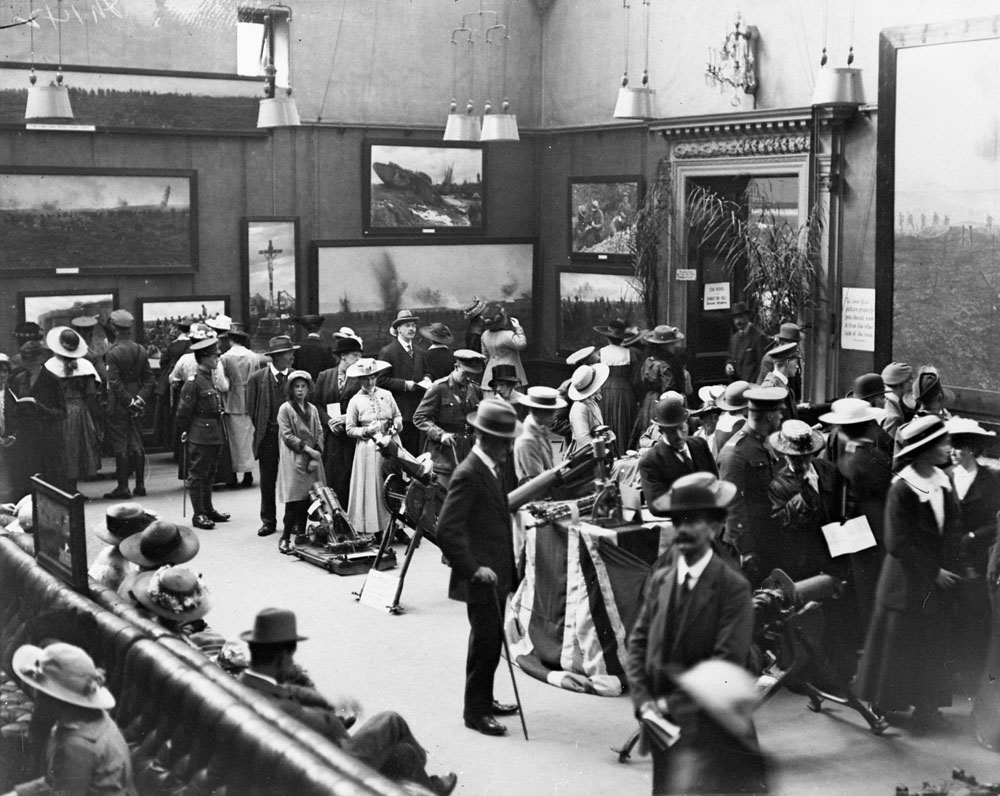
The Canadian War Records Office, established in January 1916, immediately recognized the importance of photography, both for keeping a lasting documentary record of the war and for boosting morale. The first official Canadian war photographer was appointed in April 1916. That same year, the first of several immensely popular exhibitions of official Canadian war photographs was unveiled at the Grafton Galleries, in central London.

Princess Christian among others viewing images at the Second Exhibition of Canadian Battle Pictures, Grafton Galleries, London, July 1917 (MIKAN 3394829)

Princess Christian among others viewing images at the Second Exhibition of Canadian Battle Pictures, Grafton Galleries, London, July 1917 (MIKAN 3394829)

Today, Library and Archives Canada’s (LAC) holdings include most of the negatives created by Canada’s official war photographers, preserved in their original glass plate format. These are some of the most poignant, horrifying, and yet compelling images in LAC’s photography collection.

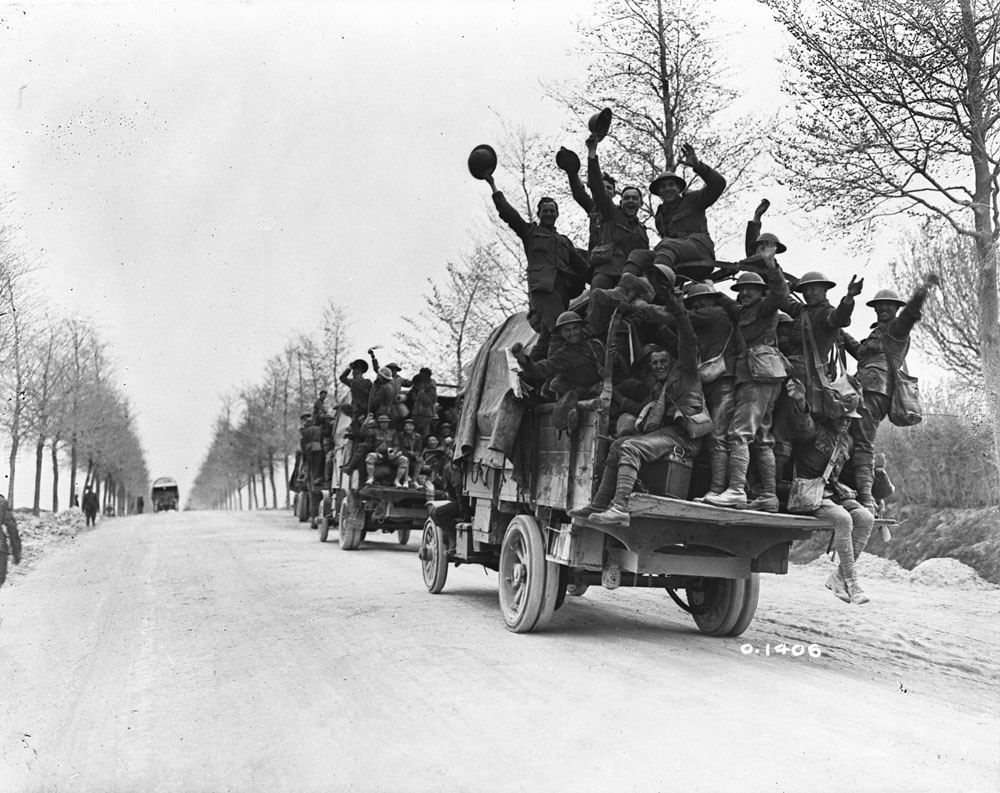
The Great War, the Persuasive Power of Photography, a new exhibition at the National Gallery of Canada, curated by Ann Thomas, incorporates many of these negatives in the near-exact recreation of one entire room from the second Grafton Galleries exhibition, held in 1917. The room, which is designed to put the modern viewer in the shoes of a viewer from 1917, features a dramatic to-scale reproduction of a photograph of the Battle of Vimy Ridge, called the largest photograph ever made during its time. It also includes a cropped version of this photograph of Canadian troops after the battle.

Canadian troops en route to destination for a rest period after taking part in the capture of Vimy Ridge (MIKAN 3521924)

Canadian troops en route to destination for a rest period after taking part in the capture of Vimy Ridge (MIKAN 3521924)

View from inside the Grafton Galleries, London, at the Second Exhibition of Canadian Battle Pictures, July 1917 (MIKAN 3394834)

View from inside the Grafton Galleries, London, at the Second Exhibition of Canadian Battle Pictures, July 1917 (MIKAN 3394834)

Canada’s official war photographers:

  • Captain Henry Edward Knobel (April 1916 to August 1916)
  • William Ivor Castle (August 1916 to June 1917)
  • William Rider-Rider (June 1917 to December 1918)

See other images reproduced for the room or visit the exhibition at the National Gallery of Canada from June 27 to November 16, 2014.

New Books in the Genealogy Services Collection at 395 Wellington

In our previous article, we discussed what you can do at 395 Wellington before your appointment. One of the suggestions was to head to the third floor where the Genealogy and Family History Room is located. There you will find reference works, finding aids, atlases, family histories, and ethnic and local histories—sources that are only the beginning in your exciting search for ancestors.

In this article, we are pleased to share a list of our recently acquired publications. The AMICUS link gives the call number where you will find the book in the stacks.

And if you’re just starting out in genealogy, you should check out our Genealogy and Family History pages.

Happy exploring!

Family Histories

L’ancêtre des familles Kirouac en Amérique, son épouse et leurs fils : synthèse d’une recherche généalogique effectuée de 1978 à 2013, by François Kirouac (AMICUS 42037458)

Barthélemy Verreau, premier Verreau en Nouvelle-France, by Jean-Marie Verreault (AMICUS 42159688)

Les 100 ans de Taschereau, by the Comité du 100e anniversaire de Taschereau (AMICUS 41969714)

Dictionnaire généalogique des familles Audet et Lapointe, 1663-2013, by the Association des descendants de Nicolas Audet dit Lapointe (AMICUS 42155162)

Généalogie de la famille Bournival, by Gilbert Bournival for the Regroupement des Bournival d’Amérique (AMICUS 42214888)

George Goodson Knowlton: His Ancestors and Descendants, by Doreen A. Smillie (AMICUS 42001478)

Hanrick / Handrick / Hendrick Family of County Wicklow, Ireland and West Québec, Canada, by Della Hendrick Dupuis (AMICUS 42445077)

Labossière : descendant, 1878-2006, by the Labossière Family Association (AMICUS 42095787)

Les mariages Dumas du Québec et des régions avoisinantes, by Michèle Dumas (AMICUS 42178843)

Munchinsky Family History, by George Muchinsky (AMICUS 40824981)

Ethnic and Local Histories

Aneroid and District, 100 Years, 1913-2013, by the Aneroid History Book Committee (AMICUS 42001472)

Beaver Tales from Castor & District, by the Castor and District History Book Committee (AMICUS 41170264)

Les filles du Roy (1663-1673) : Champlain, Batiscan, Sainte-Anne-de-la-Pérade, edited by Jean-Pierre Chartier (AMICUS 42039279)

Irish Palatine Pioneers in Upper Canada: Commemorating 300 Years, 1709-2009, by the Ontario Genealogical Society (AMICUS 40681965)

Municipal Records in Ontario: History and Guide, by Fraser Dunford (AMICUS 40681952)

Neubergthal: A Mennonite Street Village: A Sense of Place with Deep Roots, edited by Rose Hildebrand and Joyce Friesen (AMICUS 42247304)

Répertoire des mariages (1895-1986), baptêmes (1895-1986), sépultures (1895-2012), St-Jean-Baptiste de Cap-aux-Os : avec notes marginales, edited by Donat Fournier, Serge Ouellet, Élaine Réhel (AMICUS 42202061)

Victory and Beyond, by the Beechy History Book Committee (AMICUS 39465589)

A Tragic Voyage: 100 Years after the Sinking of the Empress of Ireland

Version française

On May 28, 1914, under the command of Captain Henry George Kendall, the Empress of Ireland set sail under clear skies from Québec City with 1,477 passengers and crew on board heading to Liverpool, England. The ship picked up mail at Rimouski and then continued on to the pilot station, Pointe-au-Père, where the pilot disembarked saying, “I don’t think you’ll run into much fog,” as he climbed down the rope ladder. What followed was a perfect storm of tragic events that resulted in the loss of 1,012 lives.

The R.M.S. Empress of Ireland

The R.M.S. Empress of Ireland. (e011537953)

The Fog

Shortly after 1:30 a.m. on May 29, Captain Kendall saw an approaching vessel, the Norwegian coal freighter Storstad. Almost immediately afterwards, a thick fog rolled in and Kendall ordered a full stop to allow the other ship to pass safely. The two ships communicated their sailing intentions. As the Storstad entered the fog bank, her First Officer later testified, there did not seem to be any possibility of a collision.

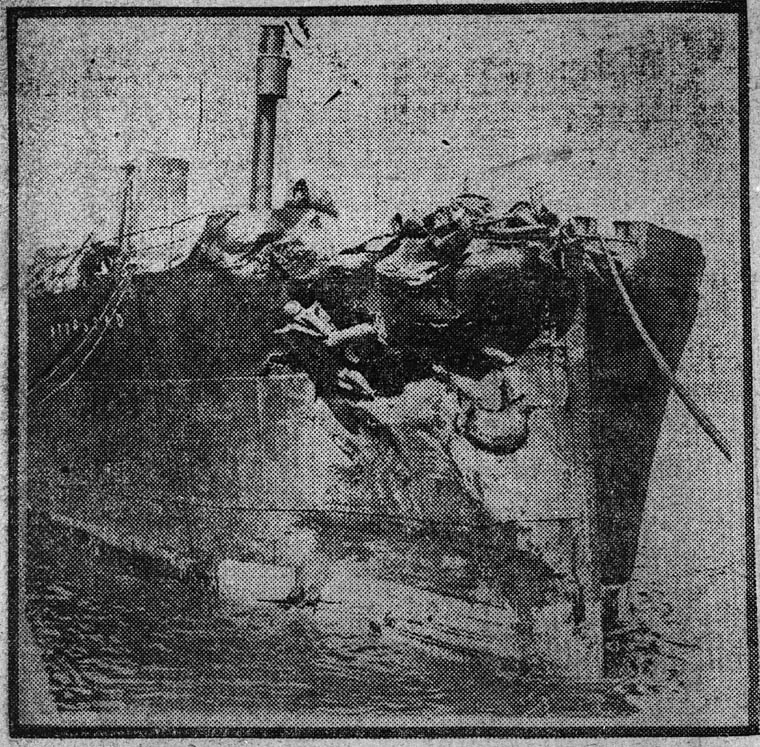
Just before 2:00 a.m., the fully loaded coal freighter emerged from the fog bearing down on them quickly. Captain Kendall franticly attempted to alert the Storstad, but it was too late—the Empress was violently struck mid-ship. The damage sustained was irreparable, the engine rooms quickly flooded leaving the ship powerless and unable to close the watertight doors of her bulkhead. As water continued to overwhelm the Empress, she lurched violently and alarms were sounded for the sleeping passengers to abandon ship.

SOS

A few hundred people reached the deck, but only four lifeboats were safely dropped before the ship capsized. Passengers and crew were thrown into the icy waters, and within minutes the Empress disappeared, finding her final resting place at the bottom of the St. Lawrence River.

The majority of the lives lost that night had been far below deck in third class. Of the 1,477 passengers and crew that had boarded the Empress of Ireland, a mere 473 survived.

The Storstad, following the collision with the Empress of Ireland.

The Storstad, following the collision with the Empress of Ireland. (c001945)

Tragedy and Blame

Heartbreak and finger-pointing followed the tragedy. Both ships’ crew members insisted they were not to blame for the accident. Editorials at the time claimed that if you believed either captains, both ships were at a standstill and miles apart. In the end, the inquiry found the Captain of the Storstad responsible for the collision.

The wreck of the Empress of Ireland rests on the floor of the St. Lawrence, 11 kilometres off Pointe-au-Père, Quebec, in 40 metres of water marked by a surface buoy. One hundred years later, the Empress of Ireland remains the largest Canadian maritime accident that occurred during peacetime.

For further research:

Discover also: