The Man Behind the Grey Cup

Although Albert Henry George Grey, 4th Earl Grey won’t be at this year’s 100th Grey Cup game and party, he would no doubt be proud of his legacy. Earl Grey, who served as Governor General of Canada from 1904 to 1911, commissioned and donated the trophy, which bears his name for posterity.

In the spirit of promoting Canadian sports and culture, Lord Grey first intended to donate a trophy for the senior amateur hockey championship in Canada. But Sir Hugh Andrew Montagu Allan beat him to it, and today the Allan Cup continues to serve that role. Not to be deterred from making a name for himself in Canadian sports, Lord Grey donated the Grey Cup as an annual award for the senior amateur football champions, in 1909.

Lord Grey only lived eight more years after donating the cup, dying in his home in Howick, England, in 1917. However, his contribution to Canadian football lives on and this year the Canadian Football League celebrates the 100th Grey Cup championship. Millions of Canadians will be watching the championship game on Sunday, November 25, either live in Toronto or on televisions across the country and around the world.

Library and Archives Canada (LAC) holds many resources relating to the history of the Grey Cup. To learn more about the life and activities of Grey himself, you can consult the Albert Henry George Grey, 4th Earl Grey fonds.

LAC is also pleased to feature footage of the first Grey Cup game in 1909 between two Toronto teams; the 1931 final; and the legendary “Mud Bowl” from 1950, on its YouTube channel.

There are many images in LAC’s holdings that show how the Grey Cup has become part of the Canadian consciousness, weaving its way into everything from federal and provincial politics to marital relations.

Don’t forget to browse LAC’s football Flickr set!

Questions or comments? We would love to hear from you!
A Behind-the-Scenes Look at LAC: Services for the Public Available in Ottawa

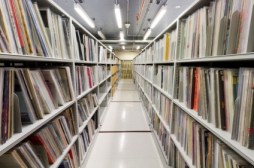
Colour photograph of stacks. There is an aisle down the middle with rows of books on either side.

Stacks of published material at Library and Archives Canada

Library and Archives Canada (LAC) has many buildings across Canada, two of which we introduced you to in A Behind-the-Scenes Look at LAC: The Preservation Centre in Gatineau and A Behind-the-Scenes Look at LAC: The Nitrate Film Preservation Facility.

Another LAC building, located at 395 Wellington Street in downtown Ottawa, is a popular destination for researchers who come regularly to consult the archival and published collections. This facility is home to collections management, public services, description and cataloguing, and administrative functions. There are countless stacks of published material housed on the various floors of the building; however, only the main lobby, and the second, third, and fifth floors are accessible to the public.

Public admission to the research rooms is restricted to registered researchers. Because of the vast amount of material in the collections, researchers must request what they need in advance of their visit so that LAC staff have sufficient time to retrieve it on their behalf.*

If you’re wondering why researchers themselves cannot browse the countless stacks of published material, it is for reasons of safety for both the researchers and the collections. In addition, the sheer volume of material makes it virtually impossible for someone to locate what they need without a good understanding of the collections and how they are organized.

Close to Parliament Hill and the Supreme Court of Canada, the 395 Wellington Street facility first opened its doors on June 20, 1967. It cost roughly $13 million to build and features granite and marble finishes, complete with golden mosaic pillars in the main lobby. The building showcases a variety of artwork, such as a sculpture of Italian poet Dante Alighieri by Angelo Biancini and a Henry Moore bronze sculpture entitled “Three Way Piece-Points,” located near the main marble stairwell. The Moore sculpture was presented by the British Government to the people of Canada, along with 10,000 books, to mark this country’s Centennial in 1967.

Glass-engraved panels by artist John Hutton, depicting five themes, can be seen throughout the building. They represent the written word, the spoken word, important writers, Apollo and the Muses, and the birth of Canada. You can also view them on our Facebook page!

A series of murals adorns the research rooms on the second floor. The Comfort Murals contain two works known as “Heritage” and “Legacy.” They were commissioned more than 25 years ago by Charles Fraser Comfort, a past Director of the National Gallery of Canada. The Pellan Murals are the work of Quebec artist Alfred Pellan, completed in 1968. Each of these abstract paintings features a kaleidoscope of colour presented in a collage-style interpretation. “The Alphabets” is displayed on the western wall, and “Knowledge” is displayed on the eastern wall.

The history of this Government of Canada building is recorded in the CBC Digital Archives soundtrack 1967: The National Library of Canada opens new HQ.

*Please note that our core services are offered from 9:00 a.m. to 5:00 p.m. Monday to Friday. To learn more about all of our services, please consult the previous article “What can you do at 395 Wellington Street before your appointment?

Questions or comments? We would love to hear from you!

The Canadian Coast Guard celebrates its 50th anniversary – Part II

In a previous blog, we invited you to discover some archival holdings to mark the 50th anniversary of the Canadian Coast Guard (CCG), including photographs, as well as government and political records. In this blog, Library and Archives Canada (LAC) encourages you to explore holdings containing CCG caricatures, audiovisual records and publications.

Caricatures

Audiovisual Records

There are many films and interviews on the CCG. It would be nearly impossible to list them all here, but the following are a few examples that may pique your curiosity.

Visit our film, video and sound recording database for more audiovisual records.

Publications

LAC has a vast collection of publications! Here are some books on the CCG that may interest you:

For more publications, visit AMICUS.

If you wish to search the records on-site at LAC, please order them at least five business days before your visit. You may order them online by using our Request for Retrieval of Documents form or by calling 613-996-5115 or  1-866-578-7777 (toll free) and selecting option 8 in the automated menu.

Questions or comments? We would love to hear from you!

Summary of comments received in French up to September 30th, 2013

  • LAC added the following resources: Usque ad mare: a history of the Canadian Coast Guard and marine services by Thomas E. Appleton. (AMICUS 612170) and The Canadian Coast Guard, 1962-2002 by Charles D. Maginley (AMICUS 28388186).

Queen Victoria’s Journals now available at 395 Wellington Street, Ottawa

At the age of 13, Queen Victoria became an avid journal writer when her mother gave her a diary to document an upcoming trip to Wales. Her last entry was written more than six decades later, on January 13, 1901, only nine days before her death.

This year, in honour of Queen Victoria’s birth (May 24, 1819) and the Diamond Jubilee of Queen Elizabeth II, all 141 journal volumes (comprised of 43,765 pages) have been digitized and are now available through a courtesy subscription obtained by Library and Archives  Canada (LAC), through The Royal Household, and with the assistance of ProQuest.

The project’s website says that “ As well as detailing household and family matters, the journals reflect affairs of state, describe meetings with statesmen and other eminent figures, and comment on the literature of the day. They represent a valuable primary source for scholars of nineteenth century British political and social history and for those working on gender and autobiographical writing.”

Not only have the diaries been digitized, they have been (and will continue to be) transcribed to allow for a keyword search. In fact, The Queen, as Head of State for Canada, did not leave us unmentioned. A keyword search for “canad*” (without the quotation marks) currently retrieves more than 150 results up to 1839!

As the project continues and more years are transcribed and become searchable, this resource will become more valuable.

To access the journals, use any of the public workstations located at 395 Wellington Street in Ottawa or our Wi-Fi connection and visit the website Queen Victoria’s Journals [http://www.queenvictoriasjournals.org/]. You may browse the journals by date or search for keywords.

Questions or comments? We would love to hear from you!

The Canadian Coast Guard celebrates its 50th anniversary- Part I

Black and white photograph of ship cutting a path for icebound vessel.

The CGS Stanley cutting a path for icebound vessels out of Bridgewater, Nova Scotia Source

Did you know that the Canadian Coast Guard (CCG)—which celebrates its 50th anniversary this  year—is heir to a long tradition originating in Canada’s East Coast? It is there that the first Canadian lighthouses and lifeboats were built during the
18th century.

Created in 1962 by the Honourable Leon Balcer, the then Minister of Transport, the CCG’s mission is to ensure safe and accessible waterways for Canadians. Library and Archives Canada (LAC) owns many archival records that document the activities of the CCG since its creation. Today, we invite you to discover some of these holdings, including photographs as well as government and political records.

Browse a few examples of digitized documents in the Archives Search Results page .

PHOTOGRAPHS

GOVERNMENT RECORDS

The Government fonds include textual records, technical drawings and boat plans.

POLITICAL RECORDS

LAC holds the archival fonds of former ministers of Transport, which contain records of the CCG. Here are two examples:

Please remember that not all of our material is available online. To learn more, consult our article How to Consult Material that Is Not Yet Available Online.

To view images, please visit our Flickr set.

Stay tuned for our next blog to discover more Canadian Coast Guard history, including caricatures, audiovisual records and publications.

Questions or comments? We would love to hear from you!

New Finding Aid Online: Non-Permanent Active Militia

Library and Archives Canada (LAC) is pleased to announce that a new finding aid for the Non-Permanent Active Militia, RG 9 II-B-7, is now available online. View the 8,800 lower level descriptions today!

During the First World War, units of the Non-Permanent Active Militia were called upon to perform a variety of military tasks in Canada, notably to guard strategic sites such as armouries, bridges and canals.

The files are arranged alphabetically and can include a variety of forms dealing with enlistment, medical and dental history, hospitalization, discipline, pay, discharge and subsequent correspondence relating to the individual’s eligibility for war service gratuities and other service-related issues. Attestation papers, which are completed at the time of enlistment, are present in a number of the files. They include the recruit’s name and address, next-of-kin, date and place of birth, occupation, previous military experience and distinguishing physical characteristics.

This sub-series also contains small quantities of exceptional files: for members of the permanent force, for members of the Canadian Expeditionary Force (CEF) prior to embarkation overseas, for members of Royal Flying Corps, and for nursing sisters and other members of the Canadian Army Medical Corps.

Although the outside dates for the records are 1908-1983, the vast majority were created during the period 1914-1919.

Want to learn more about how to use finding aids? Consult our articles “Discover Finding Aids!” and “ Discover Finding Aids – Part Two”.

Be alerted when we have added new finding aids online by subscribing to our RSS feed.

For more information on recent announcements at LAC, visit “News”.

Patrolling the French Shore with Louis Koenig

Newfoundland in the summer, completely inaccessible because of its winged garrison. Library and Archives Canada. (Source)

Did you know that thanks to the collection of Library and Archives Canada (LAC) it is possible to patrol the French Shore of the island of Newfoundland with Lieutenant Louis Koenig and discover this particular area where the French had cod fishing rights for almost 200 years, because of two treaties signed between France and England? Accompany Koenig and the crew of the French frigate La Clorinde during a campaign that brought them to Newfoundland, Cape Breton Island and Saint-Pierre and Miquelon in 1885.

Recognized by the French Navy for his artistic talents, Koenig created the 145 drawings and watercolours, the hand-drawn maps and the logbook, which are found in the Louis Koenig fonds and Louis Koenig Collection. The illustrations, most of which were done on site, show the landscapes and military installations he observed, as well as daily activities on board La Clorinde. The maps give three views of the French Shore and include notes by the artist.The logbook, also written by Koenig, documents the voyage, the places visited and gives his candid impressions of his experiences; devoting particular attention to the mosquitoes, which were apparently delighted to welcome the French sailors! The collection also includes a small sketchbook containing an illustrated, much more personal, account of the voyage, full of humour and whimsy presented by Koenig as a gift to La Clorinde’s commander, Félix-Auguste Le Clerc. Koenig also wrote an article Le « French Shore » (souvenirs de campagne à Terre-Neuve) (The “French Shore”, Memoirs of a Newfoundland Campaign), embellished with his maps and illustrations and published in 1890 in the periodical Tour du monde.

To order published documents that are unavailable online, use our online Request for Retrieval of Documents, or call 613-996-5115, or toll-free 1-866-578-7777, to consult them in person at 395 Wellington Street in Ottawa.

Enjoy the discoveries and view the Flickr set of images from Koenig’s albums!

Questions or comments? We would love to hear from you!

What can you do at 395 Wellington Street before your appointment?

Our registration staff is often asked the following question:

“I have just registered for a user card at the registration desk on the main level (which is open daily from 9:00 a.m. to 4:00 p.m., Monday to Friday) but before I begin my research, I need help. I see that the orientation and genealogy service desks open at 10:00 a.m. I have some time until then and I am wondering if there is anything I can do while I wait?”

There are several things you can do while waiting to speak to one of our experts.

PUBLIC ROOMS

You may begin your day in our public rooms, on the second and third levels at 395 Wellington Street, Ottawa. These rooms have computer stations and Wi-Fi, so you can begin browsing our website or others’ sites. You may also wish to visit the cafeteria on the 5th floor where you can watch television while you enjoy a snack.

Opening Hours for the Cafeteria are Monday to Friday, 7:00 a.m. to 3:00 p.m.

REFERENCE SERVICES

You can also browse our collection of photographs, or look through historical atlases, city directories and phone books in our Reference Services Room, located on the second level. Additionally, in our Reference Collection Room, you will find parliamentary proceedings (Hansard), journals from the House of Commons, session papers up to 1925, annual federal government reports up to 1930 and original, as well as revised, statutes.

Opening Hours for the Reference Services Room are Monday to Friday, 9:00 a.m. to 8:00 p.m., Saturday/Sunday, 10:00 a.m. to 2:00 p.m.*

GENEALOGY AND FAMILY HISTORY

If you are coming to Library and Archives Canada to research your family history, head up to the third level and visit our Genealogy and Family History Room. As you enter the room, there are several Info-pages that may be of interest. These provide useful information to help you begin your research.

  • The Info-page called Genealogy Services – Book Collection explains how the books are arranged in the room. You can find books that have
    indexes to church records, cemeteries and other records.
  • The Info-page called Websites for Genealogy Research directs you to our Genealogy and Family History website. You can use the public computers or your
    laptop to search our databases in Ancestry Search or other websites.

Beside each of the computers in the Genealogy and Family History Room, you will find a sign that explains how you can log in to http://www.ancestryinstitution.com/, the free library edition of the popular http://www.ancestry.ca/ website.

If you are a beginner, you will find a display with pedigree charts that you can use to start recording the names of your ancestors.

Opening Hours for the Genealogy and Family History Room are Monday to Friday, 8:00 a.m. to 11:00 p.m., Saturday/Sunday, 10:00 a.m. to 6:00 p.m.*

(*) Consult our website for more details about opening and service hours.

Visit LAC’s website to find more information.

Questions or comments? We would love to hear from you!

Celebrating the International Day of Peace – Part III: The Voice of Women fonds

In earlier posts to celebrate International Day of Peace, we discussed Julia Grace Wales and Thérèse Casgrain, two Canadian women who played key roles in the international peace movement. Today, we will conclude by discussing the Voice of Women fonds held at Library and Archives Canada (LAC).

Women in North America have long been active in trying to put an end to conflicts around the world. In the early 1960s, when the threat of nuclear war loomed over many nations, our own Canadian Voice of Women for Peace (VOW) was formed. Since then, the organization has been promoting peace and disarmament, particularly in the context of nuclear war.

VOW has organized unique activities to draw attention to its cause. In 1963, it collected and tested thousands of baby teeth from children across North America to demonstrate the fallout from the atmospheric testing of Strontium 90, a harmful radioactive isotope. During the Vietnam War, the Ontario VOW organized the Knitting Project for Vietnamese Children. Over a ten-year period, the group sent thousands of hand-knitted garments and other aid to the child victims of the war and their families.

Over time, VOW has expanded its focus to include human rights and civil liberties, preservation of the environment, as well as economic and political issues.

LAC’s Voice of Women fonds includes correspondence, reports and subject files about many campaigns for peace. Digitized photos are also presented in LAC’s Women and Peace Flickr set.

Please remember that not all of our material is available online. For more information, consult the article How to Consult Material that Is Not Yet Available Online.

Questions or comments? We would love to hear from you!

Celebrating the International Day of Peace – Part II: Thérèse Casgrain

Woman in a dress, standing in front of a stair case.

Thérèse Casgrain Source

Recently, to mark the International Day of Peace last September 21, we introduced you to Julia Grace Wales, champion for peace. Today, we present Thérèse Casgrain.

In the 1950s, Thérèse Casgrain became the first woman to be elected to the leadership of a political party in Canada. She was a fierce activist for women’s rights her entire life, and for two decades campaigned to obtain for Quebec women the right to vote in the provincial elections. Throughout her career, she also worked to correct many social injustices, to say nothing of the significant role she played in the promotion of peace. To that end, in 1961, she founded the Quebec chapter of the Voice of Women (Voix des femmes), an organization devoted to world peace—of which she became president the following year.

Thérèse Casgrain fonds

More can be learned about Thérèse Casgrain by consulting the speeches, memorabilia and digitized newspaper clippings (in French only) of the Thérèse Casgrain fonds, in which she talks about what motivated her: [TRANSLATION] “Long convinced that women can be a dynamic force in building peace, I resolved to establish, in February 1961, the Quebec branch of the Voice of Women. […] women of Ontario appealed to all women in our country to raise their voices against the tensions of a cold war and the imminent threat of a nuclear conflict.”

The fonds also comprises photographs, including many that are digitized. Not all the material in this fonds is digitized, but the titles of the various files may be consulted using our online research tool  [PDF].

Remember: Not all our material is digitized and accessible online. For more information, read our post How to Consult Material that Is Not Yet Available Online.

Questions or comments? We would love to hear from you!