Ottawa Winter Carnival, 1922 edition

Version française

“A Week Without Worry!”… “Mirth Will be King for Carnival Week.” These were some of the slogans used to describe the first Canadian National Winter Carnival—otherwise known as the Ottawa Winter Carnival—of 1922. This was no tame affair. Instead, for a week at the end of January and early February 1922, Ottawans partied—and even went foolishly wild.

Canadians were used to winter parties. Since the late 19th century, there had been somewhat more genteel winter carnivals, which featured ice forts, informal skating parties and hockey matches. During these, there was only the occasional leap into the absurd. An example is the February 1894 skating masquerade at Rideau Hall where Lord Aberdeen’s male staff dressed up as schoolgirls:
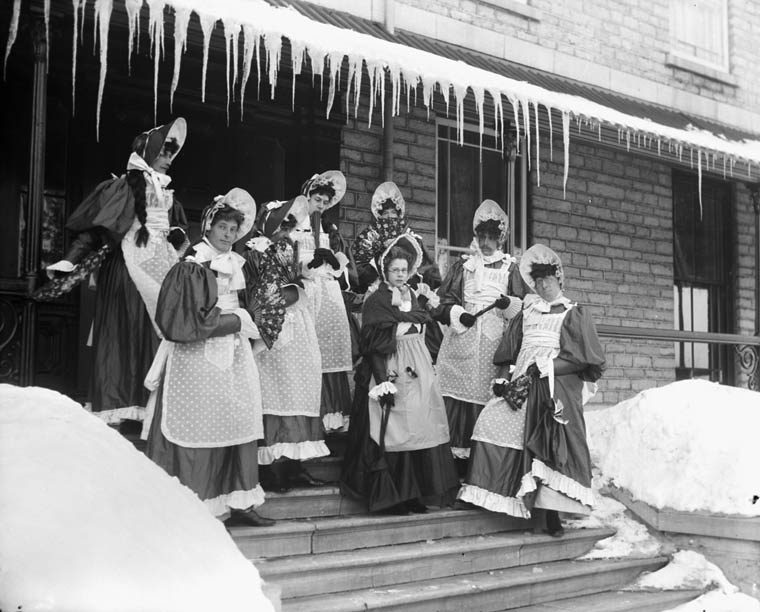
Black-and-white photograph showing eight people standing on a snowy staircase, holding decorative fans. They are all wearing similar costumes comprised of dresses, pinafores and bonnets. Close inspection reveals that some of them have mustaches and look somewhat masculine.

Lord Aberdeen’s staff dressed as schoolgirls for a masquerade skating party at Rideau Hall, called “Dame Marjorie School”. (MIKAN 3422882)

The 1922 Ottawa carnival was the brainchild of stock broker and mayor, Frank Plant. He organized everything within a matter of weeks. Lord Byng, the Governor General, was asked to open the festivities, which he did outside the Château Laurier on Saturday, January 28, 1922, with 10,000 people in attendance.
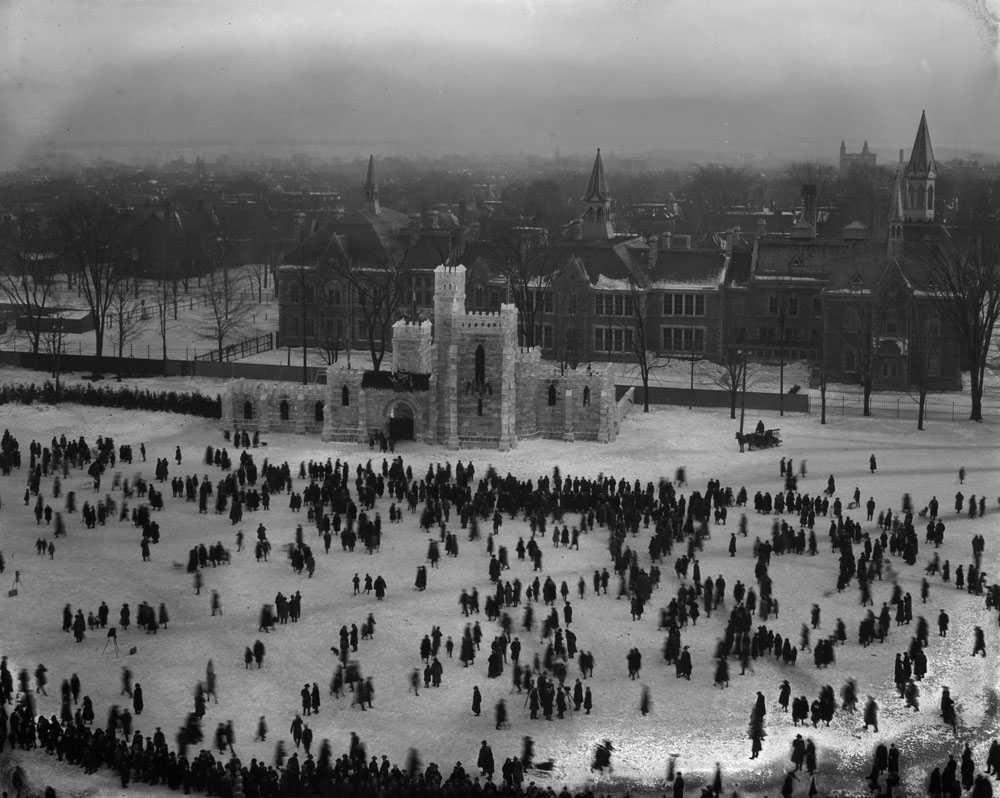
Black-and-white photograph of an ice castle taken from a very high vantage point. Crowds of people are milling about and the city fades into the distance.

Ice Palace at the Ottawa Winter Carnival. (MIKAN 3517932)

The carnival included the following activities:

  • torchlight snowshoe parades on downtown streets
  • a grand ball at the Château Laurier
  • hockey matches between the Ottawa Senators and the Montreal Canadiens
  • curling and boxing
  • nightly bean dinners in Lowertown
  • giant bonfires at Major’s Hill Park and at Connaught and Cartier Squares
  • ice castle climbing
  • midnight dances
  • horse-drawn passenger cutters that ferried people around the city
  • ski jumping off the cliffs at Rockcliffe Park

Although prohibition was in effect in the province of Ontario, alcohol was still legal in neighbouring Quebec. And with the exuberant party atmosphere, authorities turned a blind eye to the reveling hordes travelling back and forth across the river from Hull (now Gatineau) with bottles of booze.

There were three major attractions. The first was the 22-metre Ice Palace located at Cartier Square on Elgin Street.
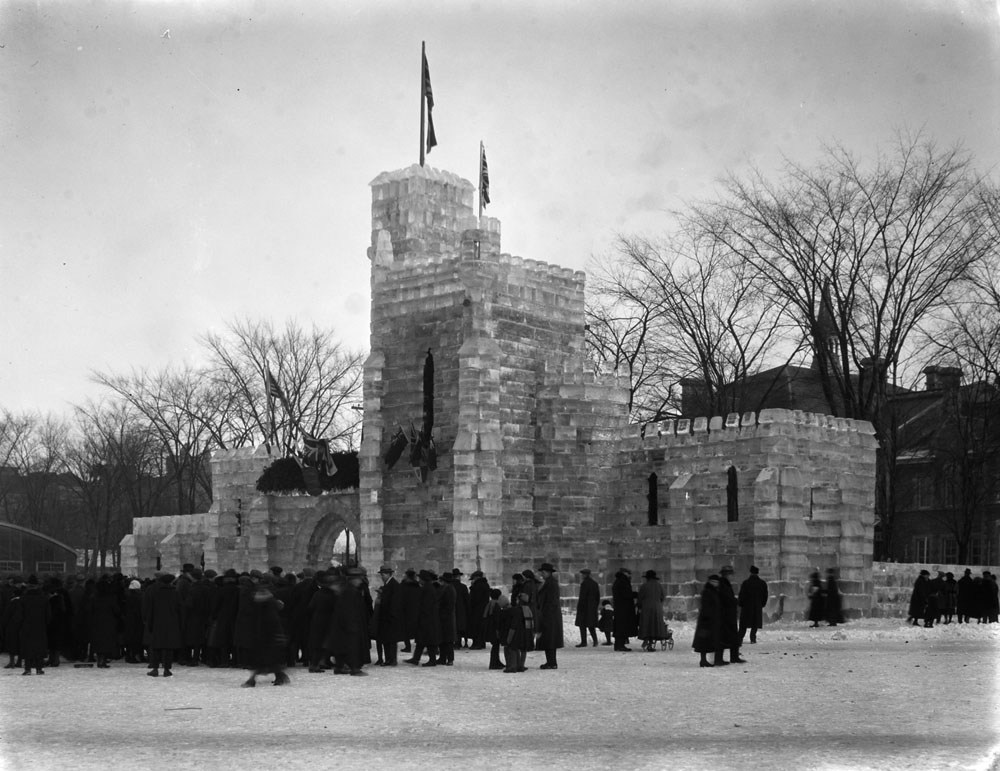
Black-and-white photograph showing many people standing, possibly queuing, around an ice castle.

The Ottawa Winter Carnival Ice Palace during the day. (MIKAN 3517934)
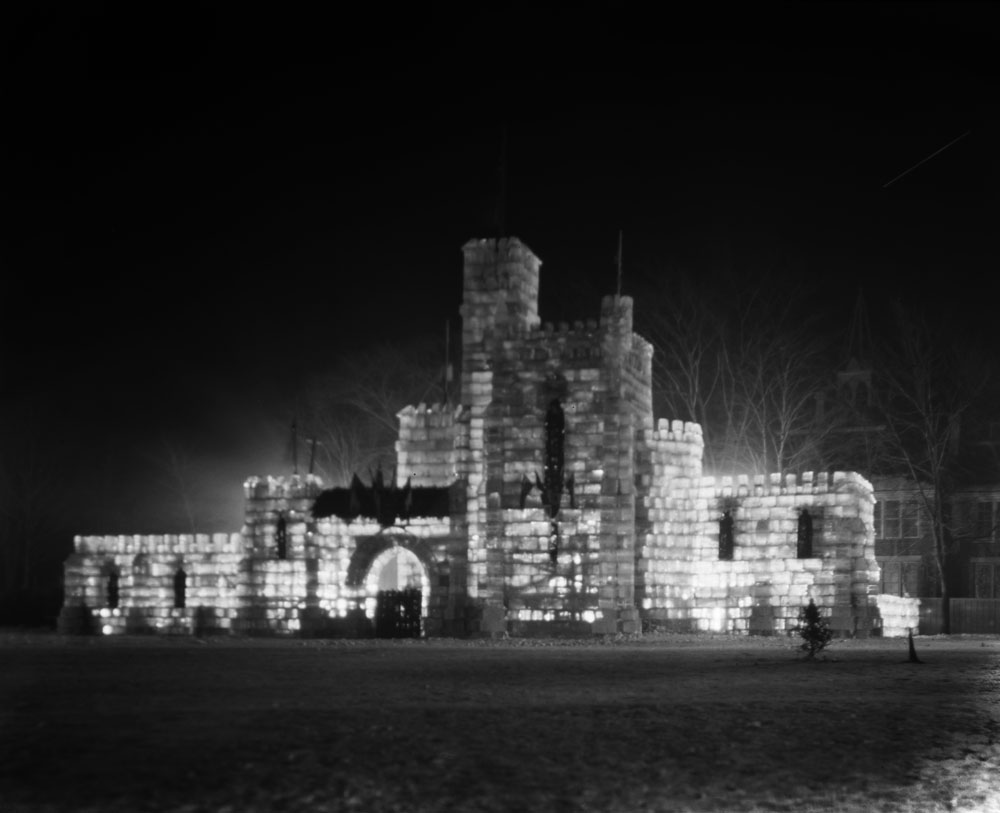
Black-and-white photograph showing an ice castle, brightly illuminated from the inside.

Ottawa Winter Carnival Ice Palace at night. (MIKAN 3517933)

The second attraction was the giant ice column that towered over Connaught Square (now Confederation Square, roughly where the National War Memorial is located) between Union Station, the old Post Office, and the Château Laurier.

Black-and-white photograph of an ice column topped with a crown. A man stands beside it.

Ice column in front of the old Post Office (presently the location of the National War Memorial), Ottawa Winter Carnival, Jan. and Feb., 1922. (MIKAN 3384979)

And the pièce-de-résistance—the ski and toboggan slide.

“Ride a mile for a dime” was the slogan attached to this breathtaking chute. Built out of ice blocks with deep tracks, it extended from the Château Laurier down to the Ottawa River following the side of the Rideau Locks. The departure gate looked like an innocent-enough rustic wooden construction covered in evergreens. But when you entered and looked down, this is what you saw:
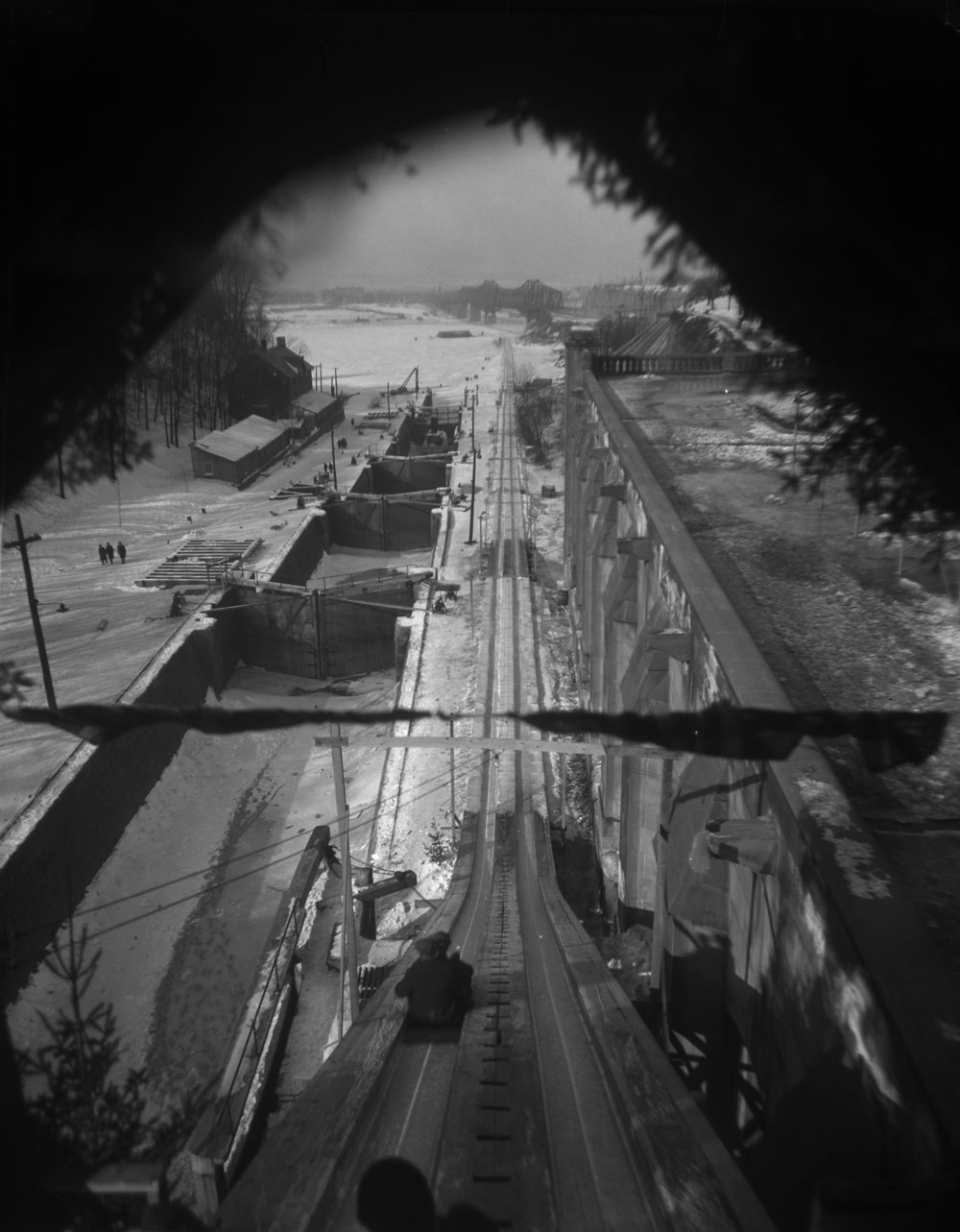
Black-and-white photograph of a view of the toboggan chute looking down towards the river and beside the Rideau Canal Lock. The track is very long and steep, and almost reaches the Alexandra Bridge in the distance.

Ski and toboggan chute for the Ottawa Winter Carnival. (MIKAN 3517935)

If you were brave enough to venture forward, the chute fell at a daring 45-degree angle which levelled out somewhat before being punctuated by a series of steep dips, rather like a roller coaster. (For more views, see the Flickr album). Lord Byng presided over the first toboggan ride, which held Mayor Plant, prominent businessman A.J. Major, and two others. Throughout the week, daredevil ski jumpers would conduct daily demonstrations on the slide. And the rest of the time, thrill seekers bravely took the plunge on toboggans, racing down and out onto the frozen expanse of the Ottawa River at speeds of over 100 kilometers an hour!

When the week was over, the first Canadian National Winter Carnival was declared a resounding success, with tens of thousands of revelers (the city’s population had only just reached 100,000). The present-day equivalent of the Canadian National Winter Carnival—Winterlude—now garners more than half a million visitors every year.

Photos of Residential Schools – Quebec and Atlantic Regions now on Flickr 

Discover a sampling of photos of the Residential Schools in Quebec and Atlantic regions. To view the complete set, visit our Web page Residential Schools Photos.

Photography of the First World War – Part II: Finding First World War Photos

Following on the first part of this series: The Canadian War Records Office, here are some strategies for locating photographs of the First World War produced by the Canadian War Records Office.

Browsing

You can browse the lower-level records by selecting the ‟sub-series” or ‟sub-sub-series consists of” hyperlinked entries. For example, trying this within the “O” prefix record yields “4134 lower level description(s)” (Note: records are being continually added so this number may change).

Browsing the “O” prefix Sub-sub-series.

Browsing the “O” prefix Sub-sub-series.

Choosing this strategy makes it possible to view the pictures by browsing through them sequentially. This works well if you’re not quite sure what you are searching for but want to have an idea of the way the pictures are described and the type of photographs that can be found in the collection.

Searching

A more robust strategy to locate specific photographs within each series is to use the advanced Archives Search function. You can search using the “O-?” (with the quotes) or the original accession number “1964-114,” and a name or keyword. Using quotes limits the search words to a specific order. Using the question mark (?) allows for an open-ended search. A similar use of the asterisk (*) allows a search that looks for the variants of a word, for example: nurs*: nursing, nurse, nurses.

Searching for nursing-related photographs in the “O” prefix series in Advanced Archives Search.

Searching for nursing-related photographs in the “O” prefix series in Advanced Archives Search.

If you are unsure which series will contain photographs that are of interest to you, try entering the accession number “1964-114” and a specific term, such as “Vimy” (349 results) or “bishop” (21 results).

The following image shows items for nurs*, resulting in nurse and nursing sisters.

Search results for the nurs* search.

Search results for the nurs* search.

Some of the search results may yield records that appear to be duplicates. This is because archivists often create bilingual records to make it easier for all Canadians to find items in the language of their choice. In the case of panoramas, duplication may come from multiple negatives for one finished photographic print, with each part of the negative having its own record.

Explore the Canadian War Records Office images, and discover the “official” photographic record of Canada’s involvement in the First World War.

Other related materials:

Photography of the First World War – Part I: The Canadian War Records Office

The year 2014 marks the centenary of the First World War. In preparation for this date, archivists at Library and Archives Canada (LAC) have been cleaning up the Official Canadian War Photographs Records. They have been made more accessible to Canadians by enhancing their descriptions through thematic organization in the online database. This has been part of a much larger project to organize and describe the entire Department of National Defence’s photograph collection at LAC to ensure that the records are accurate, complete and accessible to the public. When the war began in 1914, most photographers and journalists were ordered away from the front. The First Canadian Division entered the European war theatre the following year. Finally, in 1916, millionaire press baron Max Aitken was granted permission to start the Canadian War Records Office (CWRO) and it became Canada’s “eyewitness to war” sending reports home from the front. Soon, these reports were also accompanied by photographs and paintings.

In addition to acquiring photographs from various sources, over the course of the war the CWRO hired three photographers—Captain Henry Edward Knobel, William Ivor Castle and William Rider-Rider—to travel to France and photograph battles, life at the front, and other activities. These photographs can be accessed under the Canadian War Records Office and were organized and given prefixes by the CWRO such as:

The largest of these CWRO-created prefixes is the “O” prefix. It includes about 4705 images, which were taken between May 1916 and May 1919. We find some of the most famous Canadian images of the war in this series. It includes William Ivor Castle’s shots of “Going over the Top” and the “29th Battalion advancing over No Man’s Land during the Battle of Vimy Ridge.”

Black and white photograph showing soldiers climbing over a ridge.

Canadian troops ‟going over the top” during training course at a trench-mortar school. (MIKAN 3206096)

Both of these photographs were later found to be manipulations: the first being a photograph of a drill, and the latter being a composite of two images to add dead bodies and puffs of smoke.

Black and white composite photograph of soldiers advancing through a field of mud. There's puffs of smoke in the air and bodies in the foreground.

The 29th Infantry Battalion advancing over “No Man’s Land” through the German barbed wire and heavy fire during the Battle of Vimy Ridge (MIKAN 3192389)

The next part of this series will explain how to search for First World War photographs in the Canadian War Records Office collection.

Other related materials:

Taking It All In: The Photographic Panorama and Canadian Cities Exhibition at the National Gallery of Canada

Most of today’s digital cameras come with a simple, point-and-shoot mode for creating panoramic images.

But back in the days of film cameras, creating a panoramic photograph meant either spending hours in the darkroom, painstakingly stitching images together by overlapping exposures onto the finished photo paper or buying an expensive panoramic format camera.

Possibly members of the Benjamin Low family on a passenger steamer showing various types of cameras, including a panoramic camera, 1904.

Possibly members of the Benjamin Low family on a passenger steamer showing various types of cameras, including a panoramic camera, 1904 (MIKAN 3191854)

Continue reading

Capital City Portraits: Faces from the Topley Collection

One of the most popular collections at Library and Archives Canada is the William James Topley photograph collection, acquired in 1936. The Topley collection is comprised of over 150,000 glass plate and nitrate negatives, in addition to 68 studio proof albums, daily assignment logs and account books.

Dating from 1868 to 1923, the large collection illustrates the prolific career of Topley, a Montréal-area native, who began his solo career by opening a branch of the William Notman studio on Ottawa’s Wellington Street. Having worked in Montréal for a number of years as an apprentice to the well-known photographer, William James Topley, would eventually drop the Notman name and run his own studio from a series of Ottawa addresses, moving from Wellington Street to the corner of Metcalfe and Queen, and finally to two separate addresses on Sparks Street.

The photographs produced during Topley’s lengthy career serve as a fascinating visual reference to life in Ottawa, as well as other Canadian cities and towns. His images include street scenes documenting daily life, commissioned photographs of store fronts, Parliament Hill before, during, and after the 1916 fire, and perhaps most compelling, his portraits of citizens, both famous and otherwise.

By 1872, the Topley studio was attracting more than 2,300 sitters a year, including prime ministers, governors general, members of Ottawa’s high society, businessmen, and average citizens. He created his famous composite image of the first major Canadian fancy dress ball, hosted by the Earl of Dufferin and his wife, in 1876.

Many of Topley’s clients were the families of Ottawa’s movers and shakers. Being the capital city, it was common for relatives of politicians, land owners and lumber barons to make their way to Topley’s studio at some point, to sit for a portrait. In the early nineteenth century, it was still a somewhat prestigious event to have your portrait taken, and wives, children, and even pets were photographed at the studio, some of them multiple times over the years.

In viewing these wonderful portraits, it is fascinating to see the clothing, hairstyles, and expressions of Ottawa’s earlier citizens, and interesting to see the faces of people for whom some of Ottawa’s streets, parks and schools are named.

Miss Powell, 1870

Miss Powell, 1870 (MIKAN 3479280)

Miss E. Pattie and cat, 1873

Miss E. Pattie and cat, 1873 (MIKAN 3461227)

Mr. Brewer, 1875

Mr. Brewer, 1875 (MIKAN 3433630)

Miss Sparks and Miss Magee, 1889.

Miss Sparks and Miss Magee, 1889 (MIKAN 3448969)

Mrs. Bronson, 1869

Mrs. Bronson, 1869 (MIKAN 3478860)

Other local portait sitters

For further research

Images of Princess Patricia’s Canadian Light Infantry now on Flickr 

The Princess Patricia’s Canadian Light Infantry is one of three Permanent Force infantry regiments of the Canadian Army.

William James Topley’s Fancy Dress Ball Photographs

One of the most celebrated and well-known photographs by Ottawa photographer William James Topley (1845–1930) is his composite image of the first major Canadian fancy dress ball, hosted by the Earl of Dufferin and his wife on February 23, 1876. This composite, which was constructed in the months following the event by cutting out individual photographs and pasting them onto a painted backdrop of the Rideau Hall ballroom, recreates a moment from this prestigious social affair. Look closely and see if you can make out the different costumes…

Composite image of the Dufferin Grand Fancy Ball at Rideau Hall on February 23, 1876. The image was created in the months following the event, and was probably finished in May or June.

Composite image of the Dufferin Grand Fancy Ball at Rideau Hall on February 23, 1876. The image was created in the months following the event, and was probably finished in May or June. (Source: MIKAN 3260601)

The fancy dress ball was a private costumed event that grew in popularity over the course of the nineteenth century in Canada. Those who were invited to a fancy ball would often portray characters from history, literature, Shakespearean plays, mythology, legends, nursery rhymes, or fairy tales, or even ones from “exotic” lands. While guests at fancy balls were expected to conform to certain societal expectations, they could also exercise a few liberties.

For example, women were permitted to wear their hair loose and flowing at the ball (normally it would have been worn up). They could also dress in outfits that revealed more of their legs than a typical ball gown of the day. Miss Minnie Smart, who came dressed in uniform as a heroic “vivandière” for the Dufferin Grand Ball, is certainly revealing a fair amount of her stockings in this photographic portrait!

Miss Minnie Smart dressed as a “vivandière,” originally a type of female auxiliary in the French army who sold food and drink to the soldiers.

Miss Minnie Smart dressed as a “vivandière,” originally a type of female auxiliary in the French army who sold food and drink to the soldiers. (Source: MIKAN 3421162)

Many of the costumes that men wore required tight leggings. This undoubtedly resulted in a few of the guests feeling self-conscious about their bodies, which were normally hidden under conventional dark suits.

Mr. Newby dressed as a “Court Jester.” He wore this same costume again for a skating carnival that took place in 1881.

Mr. Newby dressed as a “Court Jester.” He wore this same costume again for a skating carnival that took place in 1881. (Source: MIKAN 3477362)

There were also those who dressed as characters from other lands. These individuals often acted out their roles in very stereotypical ways, and their costumes did not necessarily reflect the identity that they were appropriating. Mr. Waddell, who came dressed as a “Heathen Hindoo,” apparently had his face painted brown with iodine, leaving a stain that lasted for days after the event.

Mr. Waddell dressed as a “Heathen Hindoo.”

Mr. Waddell dressed as a “Heathen Hindoo.” (Source: MIKAN 3477518)

Not only do these photographs serve as entertaining records of the men and women who attended this exclusive event, but they are also important visual remnants of the past that reflect the social, political and economic contexts in which they were created.

For further research


Step back in time: Library and Archives Canada helps the National Gallery of Canada recreate a First World War exhibition experience

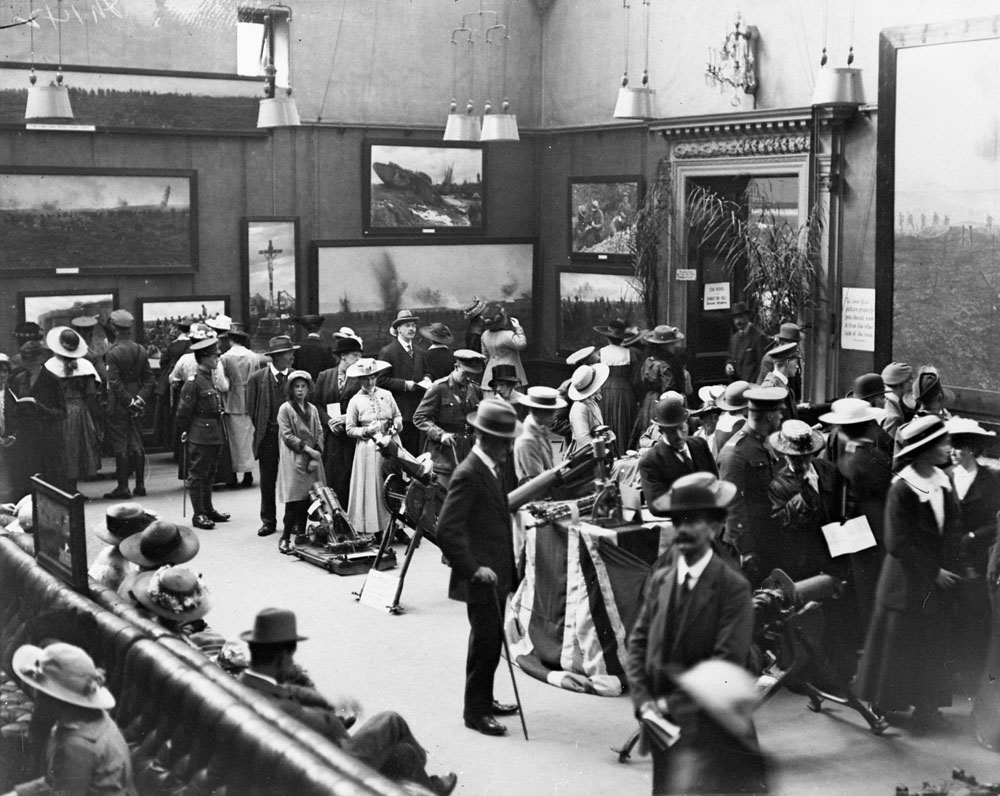
When Canadian troops joined the action on the western front, there were no official military photographers. The front line was unsafe for commercial photographers, and officers and men were not allowed to use personal cameras. As a result, there are no official photographic records of Canadian participation in early battles, such as the Second Battle of Ypres, in April 1915.

The Canadian War Records Office, established in January 1916, immediately recognized the importance of photography, both for keeping a lasting documentary record of the war and for boosting morale. The first official Canadian war photographer was appointed in April 1916. That same year, the first of several immensely popular exhibitions of official Canadian war photographs was unveiled at the Grafton Galleries, in central London.

Princess Christian among others viewing images at the Second Exhibition of Canadian Battle Pictures, Grafton Galleries, London, July 1917 (MIKAN 3394829)

Princess Christian among others viewing images at the Second Exhibition of Canadian Battle Pictures, Grafton Galleries, London, July 1917 (MIKAN 3394829)

Today, Library and Archives Canada’s (LAC) holdings include most of the negatives created by Canada’s official war photographers, preserved in their original glass plate format. These are some of the most poignant, horrifying, and yet compelling images in LAC’s photography collection.

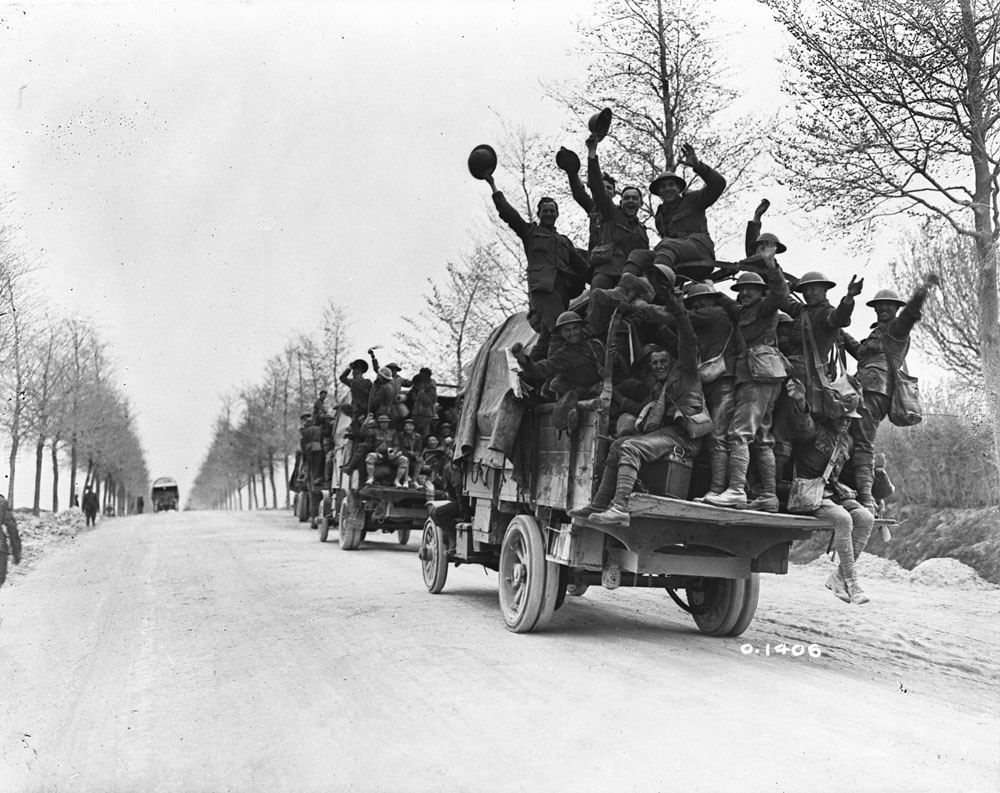
The Great War, the Persuasive Power of Photography, a new exhibition at the National Gallery of Canada, curated by Ann Thomas, incorporates many of these negatives in the near-exact recreation of one entire room from the second Grafton Galleries exhibition, held in 1917. The room, which is designed to put the modern viewer in the shoes of a viewer from 1917, features a dramatic to-scale reproduction of a photograph of the Battle of Vimy Ridge, called the largest photograph ever made during its time. It also includes a cropped version of this photograph of Canadian troops after the battle.

Canadian troops en route to destination for a rest period after taking part in the capture of Vimy Ridge (MIKAN 3521924)

Canadian troops en route to destination for a rest period after taking part in the capture of Vimy Ridge (MIKAN 3521924)

View from inside the Grafton Galleries, London, at the Second Exhibition of Canadian Battle Pictures, July 1917 (MIKAN 3394834)

View from inside the Grafton Galleries, London, at the Second Exhibition of Canadian Battle Pictures, July 1917 (MIKAN 3394834)

Canada’s official war photographers:

  • Captain Henry Edward Knobel (April 1916 to August 1916)
  • William Ivor Castle (August 1916 to June 1917)
  • William Rider-Rider (June 1917 to December 1918)

See other images reproduced for the room or visit the exhibition at the National Gallery of Canada from June 27 to November 16, 2014.

Find colour photos of Canadian Second World War soldiers

Did you know that Library and Archives Canada (LAC) has rare colour photographs from the Second World War? During that time period, colour film was a new and untested medium for most professional photographers. These images were captured on Kodak Kodachrome film by members of the Canadian Film and Photo Unit (CFPU) in the days and weeks following D-Day, on June 6, 1944.

The CFPU, formed in 1941, was under the command of Captain William Abell of Winnipeg and was staffed by enlisted Canadian men and women. Their goal was to capture images of Canadian military personnel in action, which would then be released by the Department of National Defence to various media outlets. Today these images provide an invaluable record, in living colour, of Canadian servicemen and servicewomen, as well as changing photographic technologies and techniques.

The images are part of a larger set of 1,200 digitized Second World War colour photographs that can be viewed through LAC’s online database. Included are photos of various subject matter, such as Canadian troops in England, France, Holland, Germany, Italy, and on bases and in training in Canada; portraits of notable military figures; the Canadian Women’s Army Corps; troop entertainment; hospital transport ships; and the Canadian role in liberation/occupation duties as photographed by CFPU member Ken Bell.

Search the collection

LAC’s complete digitized collection of colour images from the CFPU includes over 2,000 additional digitized colour images dating to 1961. To view them, consult the ZK prefix. To search within this collection, go to Advanced Archives Search and search using “ZK prefix” and the search term of your choice. An electronic finding aid for the ZK prefix sub-series is also attached to this record and can aid in locating specific images. To learn more about using finding aids in your research, read Discover Finding Aids – Part Two.

See also: