Open Data: Health and Welfare Canada Drug Studies

In the 1970s, Health and Welfare Canada sponsored several studies on the use of prescribed drugs, alcohol, and cannabis as well as drug-related deaths. Raw statistical data from four sets of surveys has recently been migrated into ASCII character-encoding scheme. Specialized software such as a spreadsheet or statistical tool is required to open, interpret and analyze the data. A codebook is provided that describes the file structure of the data and defines the variables contained in each field. If you are interested in any of the surveys listed below, they are now available on the Open Data portal.

Consumption of prescribed drugs in Canada 1977

In 1977, Health and Welfare Canada sponsored two studies relating to the use of prescribed drugs in Canada. Some of the main survey findings revealed:

  • Analgesics and antibiotics were found to be the most frequently used in the general population.
  • Anti-hypertensive and cardiac medications were used by elderly respondents.
  • Females were over-represented among users of sedatives and tranquilizers.

National surveys of alcohol consumption in Canada

The purpose of the Dialogue on Drinking Campaign was to increase public awareness of drinking behavior and encourage community involvement in programs directed toward alcohol-related problems. The campaign was carried out in phases using a variety of advertising mediums such as newspapers, magazines, radio and television broadcasts. This advertising was followed up by a series of surveys to investigate the public’s awareness of the Dialogue on Drinking Campaign itself and the drinking habits of Canadians. In 1976, one survey also collected data on the smoking habits of Canadians.

Use of cannabis by adult Canadians

In 1978, Health and Welfare Canada sponsored a survey of adults aged 18 and over. Respondents were interviewed on their use and frequency of use of marihuana and/or hashish. The study was undertaken to determine trends in cannabis use, identify populations at risk, assess social correlates of cannabis use, and formulate policy.

Drug related deaths in metropolitan Toronto

This data was collected in 1973 from the records of 18 full-time and part-time coroners from the Toronto area. The data was extracted from files which recorded alcohol- or drug-related deaths and includes the general drug category, specific drug, form of alcohol, name of solvents and poisons involved.

Go North, Sir!

In 1894, the Canadian government’s interest turned towards the Yukon. There were concerns about the influx of American citizens into the region as the new border was disputed in certain areas. In addition, there were mounting concerns over law and order, and the liquor trade among the resident miners.

Inspector Charles Constantine of the North West Mounted Police (NWMP) was dispatched to the Yukon to carry out law enforcement, border and tariff control, and to assess the policing needs of the territory. After four weeks of duty, Constantine returned south and submitted his report to the government recommending that a larger force of seasoned, robust and non-drinking constables between the ages of 22 and 32 years be sent to the Yukon to carry out border and law enforcement. It wasn’t until 1895 that a contingent of 20 constables under Inspector Constantine’s command finally set out from Regina towards the Alaskan border. They reached the town of Forty Mile and established Fort Constantine in July 1895. The year was marked by logging, enduring the elements and insects, and constructing their detachment building. Remarkably, crime during this time was rare.

Two black-and-white photos mounted on an album page depicting two groups of North West Mounted Police personnel outside in the snow

Fort Constantine detachment (now Forty Mile) on the Yukon River, 1895, the first North West Mounted Police group in the Yukon (MIKAN 3715394)

Things changed drastically in 1896. Gold was discovered near the Klondike River and news spread quickly. From a population of about 1,600 in the area, it swelled by tens of thousands by the summer of 1897 with prospectors, gamblers, speculators and those with criminal intent. A majority of these miners came from the United States. The NWMP commanded by Inspector Charles Constantine faced a challenge in policing the influx of miners streaming into the region from all directions. Customs posts were set up at the Chilkoot and White Pass summits and the collection of duties and tariffs began. Those miners with insufficient provisions to make it to Dawson City and survive the winter were turned back. By 1898, outnumbered, under-supplied and under-staffed, 51 NWMP members and 50 members of the Canadian militia maintained Canada’s sovereignty, and law and order at the border passes and in the mining areas in the Yukon.

Three North West Mounted Police constables in uniform standing at ease with clasped hands over the muzzles of their rifles.

North West Mounted Police in the Yukon, 1898–1899 (MIKAN 3379433)

The Klondike gold rush lasted into 1899 until gold was discovered in Alaska. The migration of fortune seekers turned their attention and travelled towards that state’s Nome region. However, the Klondike gold rush left an infrastructure of supply, support and governance that led to the continued development of the territory to such a great extent that the Yukon was made into a Canadian territory on June 13, 1898. The North West Mounted Police also stayed to maintain peace and order under their steady hands.

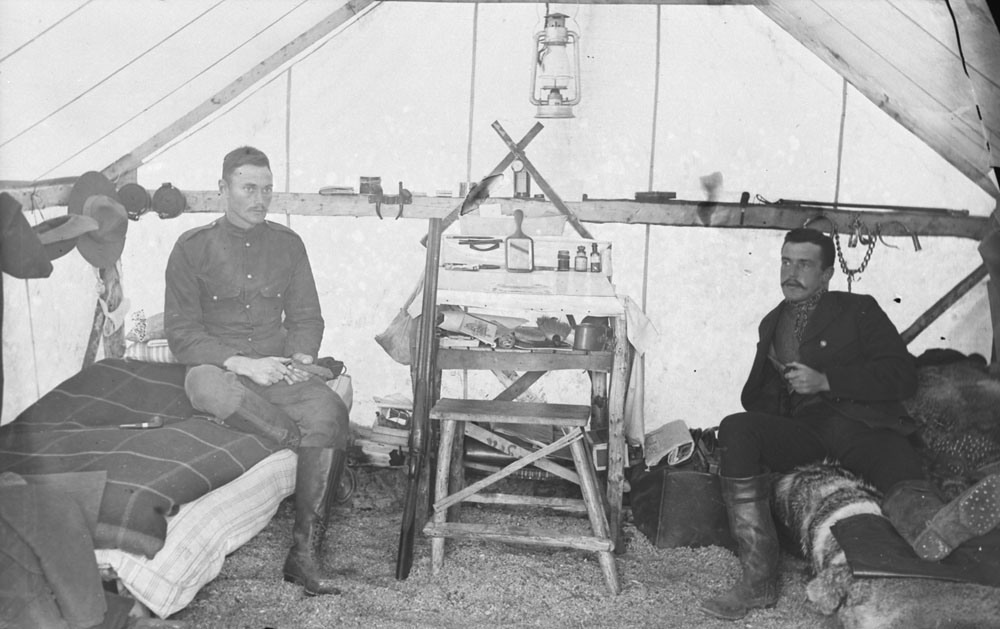
Black-and-white photograph of two men in North West Mounted Police uniform sitting on cots in a tent

North West Mounted Police in the Yukon, 1898–1910 (MIKAN 3407658)

A wide variety of documentation is available at Library and Archives Canada (LAC) related to the North West Mounted Police, the Klondike gold rush, and their time in the territory. You may start your initial research in Charles Constantine‘s fond using Archives Search. A general search using his name will provide further records from the Department of Justice.

Try searching with some of these keywords to get more records from the era:

Bennett Lake / Lake Bennett
Chilkoot Pass
Dawson City Yukon
Dyea
Forty Mile
Gold rush
Klondike River
Skagway
White Pass
Yukon River

Related sites

Jean Talon, Intendant of New France, 1665–1672

In the early 1660s, New France was facing many challenges. It had been weakened by 20 years of fighting against the Iroquois and the far-reaching powers of the governor. It was time to reorganize New France, and so Louis XIV, along with Jean-Baptiste Colbert, his minister responsible for the colonies, decided to take action. In 1663, New France became royal property. The governor’s powers were reduced, and the colony was reorganized administratively. An important role was given to the Intendant, as representative of the King, in the administration of justice, police and finances.

On March 23, 1665, Louis XIV appointed Jean Talon to the position of Intendant. Almost 40 years old at the time, Jean Talon had been educated by the Jesuits in Paris, and he had an excellent reputation as an administrator. He had held various administrative positions in the French military and had become the Intendant of the County of Hainaut in 1655.

Jean Talon held the position of Intendant from 1665 to 1668 and from 1670 to 1672, putting in place many initiatives that greatly improved conditions in the colony. First, he worked to increase the population by promoting immigration, encouraging and supporting large families, urging single people to marry, bringing over the filles du roi, motivating soldiers to settle in the colony after their military service, etc.

A watercolour of a domestic scene. A group of people are standing around a central character (Jean Talon). In the background we see a fireplace where a kettle is heating over an open fire, and a woman with a baby is seated next to it. An old man is sitting on a bench in the foreground.

Jean Talon visiting settlers, painted by Lawrence Batchelor in 1931 (c011925k)

Talon encouraged people to settle permanently by making it easier to access land, but also by forcing them to live on the land. Added to concession contracts were specific clauses requiring settlers to clear the land and “keep hearth and home” within 12 months, and prohibiting them from selling the land until there was a house built on it and two acres had been cleared.

Talon also oversaw the reorganization of the legal system; he reduced the number of trials by fostering accommodations, promoting out-of-court settlements and asking that cases at the first level be brought before him directly.

In terms of the economy, Talon was a visionary: he dreamed of factories in New France producing textiles, rope, tar, potash, soap, etc. He conducted mineral exploration around Trois-Rivières, a prelude to the Forges du Saint-Maurice in the 18th century, worked toward creating a network of alliances for the fur trade, and built a brewery in Quebec City to produce local beer. By the time he left, the face of New France had changed dramatically!

Library and Archives Canada holds copies of many historical documents written by Jean Talon, including his memoirs and observations on the state of the colony, correspondence, and the censuses held in 1666 and 1667.

The North-West Resistance

Version française

There are few historical events in our national story that solicit stronger opinions and create more debate than the disputes of 1870 and 1885 between the Métis in Western Canada and the Government of Canada. Various names refer to these two series of events, and their usage often reflects the loyalties, opinions and even biases of the user. Today, we see the application of such terms as rebellion, resistance, insurgency and disputes.

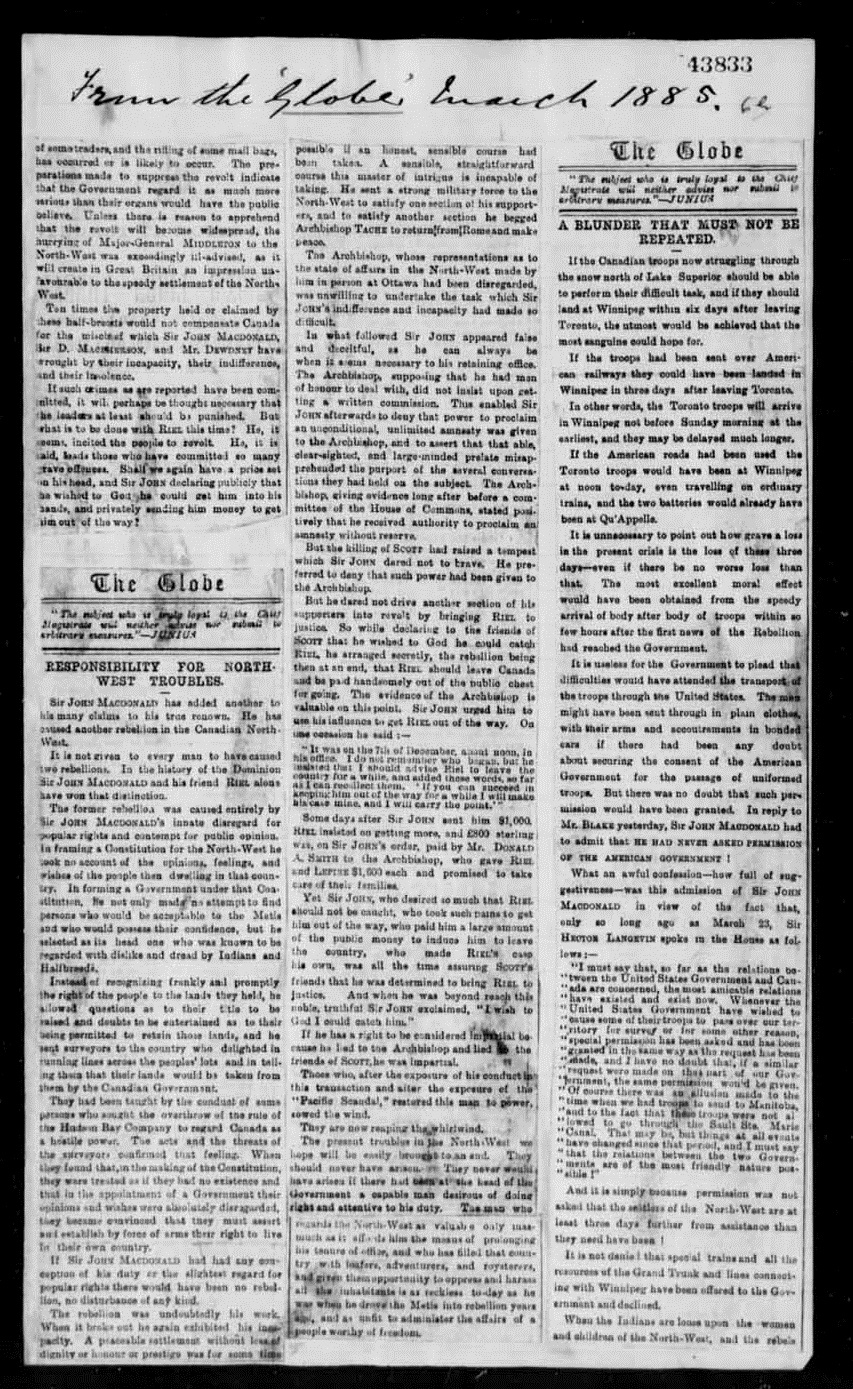
Arguably, the debate on the events of 1870 and 1885, Louis Riel, and the place of the Métis in our history and contemporary Canadian society has had an enduring effect on our national psyche. In March, 1885, an article published in The Globe of Toronto stated: “It is not given to every man to have caused two rebellions. In the history of the Dominion, Sir John Macdonald and his friend Riel alone have won that distinction.”

A black-and-white reproduction of a newspaper clipping from The Globe of Toronto in 1885. It is an article about the North-West Rebellion.

A newspaper clipping from The Globe of Toronto, 1885 (MIKAN 521291)

To put things into context, the 1870s saw the disappearance of the bison herds, pushing many First Nations peoples to near starvation. As for the Métis, the loss of the bison on which they also depended brought hardship that was further compounded by the end of the fur trade.

The Métis of the North-West Territories felt that the established North-West Council failed to represent their interests. They sought assurances from Ottawa that the titles to their river-lot homesteads and farms would be guaranteed in advance of any large-scale influx of settlers.

The Métis sent more than 70 petitions to Ottawa in an attempt to address these grievances, none of which were responded to. In the eyes of the Métis, the federal government was indifferent to any attempt to redress territorial grievances and protect occupant rights.

Frustrated white settlers newly arrived in the North-West Territories were also waiting for their property titles, as they were necessary for obtaining loans to improve their farms. At the same time, widespread dissatisfaction with the First Nations treaties and rampant poverty prompted Chief Big Bear, of the Plains Cree, to attempt to renegotiate the terms of the treaties. Hence, the First Nations issues and grievances were largely unrelated to those of the Métis and white settlers apart from their commonly held belief of a neglectful, distant and imperial Ottawa.

As a result, the Métis decided to resist any subsequent actions by the federal government. When Louis Riel organized an “illegal” provisional government, it incited Ottawa to assert its sovereignty in the North-West Territories.

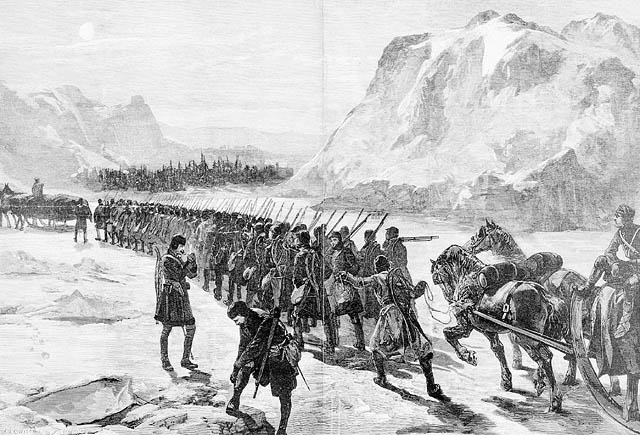
A black-and-white print taken from The Illustrated London News, 1885. The sketch shows a column of soldiers marching through a winter landscape.

The Resistance in the North-West Territories of Canada: Colonial troops marching over the ice of Nipigon Bay, Lake Superior, from The Illustrated London News, 1885 (MIKAN 2933970)

The North-West Resistance was a violent, five-month uprising against the Canadian government, fought mainly by Métis militants and their First Nations allies.

A pen-and-ink drawing over pencil depicting a wooded battle scene with the Métis behind a barricade firing against the approaching British army. The Métis are greatly outnumbered.

Battle of Batoche, 1885, by Charles William Jefferys (MIKAN 2835223)

With the Métis defeat at the Battle of Batoche (in present-day Saskatchewan), the North-West Resistance had essentially ended. For many, including Louis Riel and Chief Big Bear, the consequences were swift and direct.

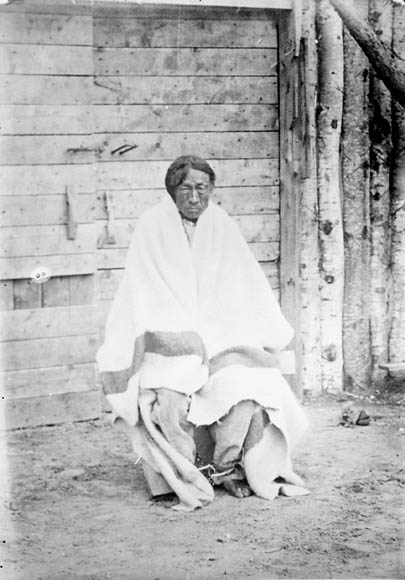
A black-and-white photograph of a man seated, wrapped in a blanket. He is looking directly at the viewer.

Chief Big Bear, 1886, by William Topley (MIKAN 3358338)

Métis and First Nations communities would suffer severe and lasting consequences from the events of 1885. In addition, relations between the French and the English and the Indigenous and non-Indigenous people of Canada would be set back for years to come.

Library and Archives Canada releases eighteenth podcast episode, “Canada’s Flag: The Maple Leaf Forever”

Library and Archives Canada (LAC) is releasing its latest podcast episode, Canada’s Flag: The Maple Leaf Forever.

Our flag, with its distinctive maple leaf and bold red-and-white colour scheme has become such a potent symbol for our country that it’s hard to believe it has only been around for 50 years. On February 15, 1965, the new flag flew for the first time on Parliament Hill for all to see, but unveiling the new design was anything but easy. In this episode, we speak to retired LAC archivist Glenn Wright about the history of the flag, and the controversy that almost kept it from coming into being.

Subscribe to our podcast episodes using RSS or iTunes, or just tune in at Podcast – Discover Library and Archives Canada: Your History, Your Documentary Heritage.

For more information, please contact us at podcasts@bac-lac.gc.ca.

Celebrating 50 years of Canada’s national flag!

Canada’s national flag celebrates its 50th anniversary! Approved by Parliament on December 15, 1964, the flag was proclaimed by Queen Elizabeth II to take effect on February 15, 1965.

Colour reproduction of the proclamation of the Canadian flag. It describes the proportions of the flag and states the dates when the flag will come into effect.

The Proclamation of the Canadian Flag (MIKAN 2909612)

The issue of selecting a representative and unique Canadian flag went through waves of debate following the First and Second World Wars, and in 1964 it became a hotly contested government priority for Lester B. Pearson’s Liberal minority government. Announced in May 1964, Pearson’s push to select a Canadian flag by December 1964 was criticized by the Progressive Conservative opposition, headed by John G. Diefenbaker, who wanted to take such a decision to a public plebiscite.

In September 1964, Tommy Douglas, leader of the New Democratic Party, suggested an all-party committee to select this nationally significant symbol through parliamentary consensus. The idea was endorsed by the government and the fifteen-member National Flag Committee was created, chaired by Member of Parliament John Matheson. After reviewing thousands of submissions, the solitary red maple leaf on a white square between two red borders was selected by the Committee as the unifying symbol for Canada. This submission was made by historian George F. Stanley who described the idea as simple, devoid of British and French national symbols, and easily recognizable as being Canadian.

The selection of the red maple leaf was then debated and voted on by Canada’s 26th Parliament. The passion surrounding the debate did not dissipate. By the time the final vote occurred in the House of Commons, the debate had lasted into the early hours of December 15th and it was two o’clock in the morning!

Library and Archives Canada (LAC) has digitized several of the public’s submissions to the National Flag Committee. Some of these proposals can be found on LAC’s Flickr website.

Do you want to know more about this moment in Canadian history? Check out the links below to investigate other parts of LAC’s flag holdings:

Here are some other links from the Internet relating to Canada’s flag debate:

Building a case for the Proclamation of the Constitution Act 

It was raining on Parliament Hill as Queen Elizabeth II and Prime Minister Pierre Elliot Trudeau signed the Proclamation of the Constitution Act on April 17, 1982. Marks left by the raindrops, as they smudged the ink, can still be seen as physical reminders of the rich history of the Act.

The Proclamation of the Constitution Act is a fundamental document for all Canadians as it symbolizes Canada’s journey from colony to independent country. Like many of history’s most valued documents, it has spent most of its time sealed in a vault for preservation reasons.

As with the display of all collection materials, a balance must be struck. Exhibiting materials involves exposing items to potentially damaging light, while not exhibiting means restricting access to the collection. The loan of the Proclamation of the Constitution Act to the new Canadian Museum of Human Rights in Winnipeg presented an exciting challenge to the Library and Archives Canada (LAC) Preventative Care and Conservation staff—to make the document accessible to Canadians.

So, what does it take to prepare one of Canada’s most significant documents for display?

Studies conducted in 2012 by the Canadian Conservation Institute concluded that the signature inks on the Act are extremely light sensitive. In an effort to prolong its life, the document is allowed only a limited number of display hours per year. LAC staff designed and created a state-of-the-art encasement and display case to protect the Act from harmful light, vandalism and theft.

First, the Act was housed in a custom case that allows the control of humidity, UV exposure, and oxygen levels which will help to further reduce deterioration of the document. A display case was then designed to help limit the total amount of light exposure during exhibition.

Conservators fitting the interior of the case with an an activated carbon cloth which filters the air, absorbing atmospheric pollutants.

Conservators fitting the interior of the case with an an activated carbon cloth which filters the air, absorbing atmospheric pollutants.

The display case incorporates a special layer of opaque black glass (which protects the document from 97% of visible light) but, at the press of a button, it can quickly become translucent as the document is illuminated. The whole system runs on a timer, controlling the length of time the document is visible and records the total exposure over an entire loan period. This will help LAC to monitor the amount of light exposure the Act receives over the course of its life.

This project enhances public access to our country’s heritage without compromising the long-term preservation of the Proclamation of the Constitution Act, and ensures that Canadians will be able to see this national treasure, including generations to come.

Visit the Canadian Museum of Human Rights in Winnipeg for this rare opportunity to see the Proclamation of the Constitution Act and other significant documents from LAC’s collections during the museum’s inaugural exhibitions.

The 200th Birthday of Sir George-Étienne Cartier, a Prominent Father of Confederation

Today marks the 200th birthday of one of Canada’s most important historical figures, Sir George-Étienne Cartier, a leading Father of Confederation. Cartier was born on September 6, 1814 in Sainte-Antoine-sur-Richelieu, Lower Canada. He studied law and started practising in 1835; however, politics soon became his passion. His entrance into the world of politics was anything but uneventful, as he played a role in the Lower Canadian Rebellion of 1837 and fought in the Battle of Saint-Denis. Cartier subsequently spent a year in exile in Vermont but pled for leniency and returned to Montreal in 1839.

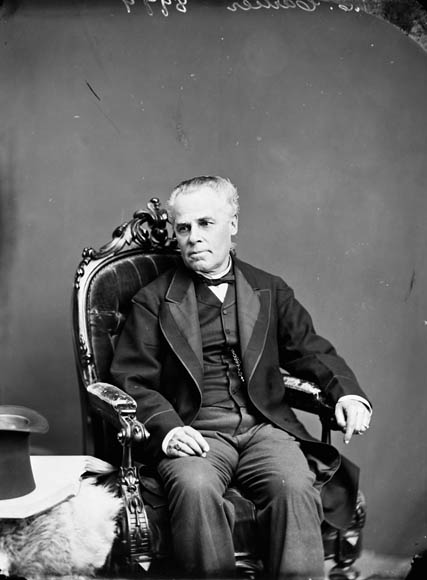
The Honourable Sir George-Étienne Cartier, Baronet

The Honourable Sir George-Étienne Cartier, Baronet (MIKAN 3476630)

In 1848 Cartier was elected to the Legislative Assembly of the Province of Canada and shortly after was appointed to Cabinet. From 1857 to 1862 he served as co-premier of the Province of Canada with Sir John A. Macdonald following his coalition with the Upper Canadian Conservatives. It was in this period that Macdonald and Cartier started working together and began to garner support for Confederation in an attempt to put an end to political instability.

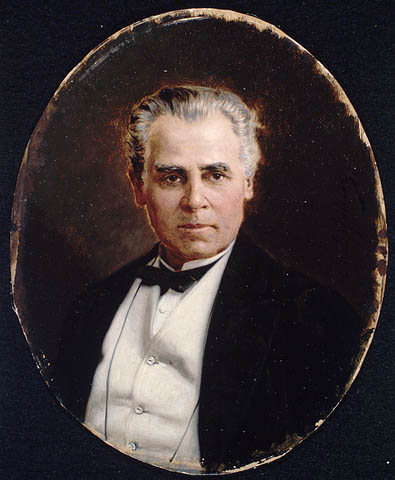
Sir George-Étienne Cartier

Sir George-Étienne Cartier (MIKAN 3213760)

Cartier played a pivotal role in gaining French-Canadian support for Confederation. He argued that francophone interests would be best preserved in a federation of provinces. When Confederation finally came about on July 1, 1867, John A. Macdonald became the first Prime Minister and Cartier the first Minister of Militia and Defence.

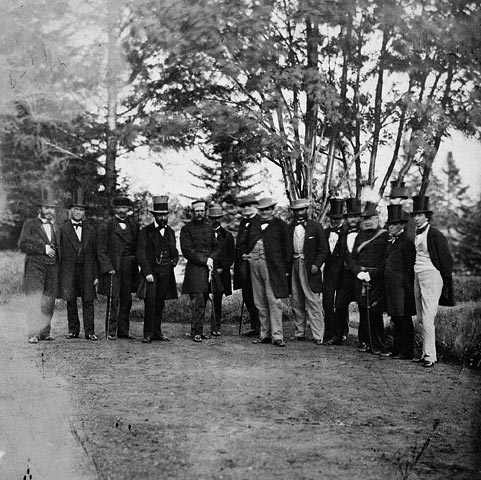
Shown among their peers are the Honourable Sir John A. Macdonald, the Honourable Sir George-Étienne Cartier and Lieutenant-Colonel John G. Irvine

Shown among their peers are the Honourable Sir John A. Macdonald, the Honourable Sir George-Étienne Cartier and Lieutenant-Colonel John G. Irvine (MIKAN 3192010)

Cartier passed away on May 20, 1873. His death deeply affected his close friend, John A. Macdonald, who proposed that a statue be erected in Cartier’s honour. It was sculpted by Louis-Philippe Hébert and unveiled in 1885. This was the first statue to be placed on Parliament Hill and it can still be seen today. Cartier left his mark on generations of Canadians. The centenary of his birthday in 1914 was marked by large celebrations and another monument was erected, this time in Montreal. Cartier’s Montreal home was designated a National Historic Site.

Sir George-Étienne Cartier

Sir George-Étienne Cartier (MIKAN 2837680)

While the majority of Cartier’s papers were destroyed, Library and Archives Canada does have several important records, including a family photo album, postcards, and some correspondence that took place during his period as Minister of Militia and Defence. We also have several letters written by Cartier to Macdonald, found in the Sir John A. Macdonald collection (archived).

To find out more about George-Étienne Cartier and his role in Confederation:

What Is Heraldry?

Heraldry has been defined by the Royal Heraldry Society of Canada as the “…study, design, regulation and use of armorial bearings, commonly known as coats of arms.” The first example of heraldry in Canada occurred at Gaspé, on July 24, 1534, when Jacques Cartier raised a cross that bore the arms of Francis I, King of France.

More than 450 years later, on June 4, 1988, Canada’s Governor General was made head of the Canadian Heraldic Authority and was given the power to grant armorial bearings in Canada. The Authority’s mandate is to issue coats of arms, flags and badges to Canadians and to Canadian entities. Before 1988, Canadians wishing to obtain armorial bearings had to petition the College of Arms in London, England, or the Court of the Lord Lyon in Edinburgh, Scotland.

Molson coat of arms (MIKAN 2946047)

Molson coat of arms (MIKAN 2946047)

Learn more about heraldry from the following reference works:

  • A Canadian Heraldic Primer, written by Kevin Greaves and illustrated by Bruce Patterson and Gordon Macpherson (AMICUS 22962127)
  • Beddoe’s Canadian Heraldry, by Alan Beddoe (AMICUS 11514059)
  • Granting and Registering Armorial Bearings in Canada: Coats of Arms, Flags and Badges – Procedure Guide, by the Canadian Heraldic Authority (AMICUS 25541152)
  • Heraldry in Canada (AMICUS 120587)
  • Flagscan (AMICUS 6865457)

Library and Archives Canada holds the following fonds that pertain to this fascinating tradition:

Interested in knowing more about Canada’s emblems and symbols?

To learn more about Canada’s emblems and symbols, such as the beaver, the fleur-de-lys and the maple leaf, consult the Canadian Identity pages of the Canadian Heritage website.

July 15, 1870: Manitoba joins Confederation

Library and Archives Canada Blog's avatarLibrary and Archives Canada Blog

Before becoming a province, Manitoba was the stage for many events and pivotal moments in Canada’s history. Pending the transfer of Rupert’s Land to Canada, the federal government sent survey crews led by Lieutenant Governor William McDougall to map the Red River area in 1869. The Métis became concerned about the redistribution of land to future settlers and the effect this would have on their own lands.

The Métis group’s leader, Louis Riel, declared that the survey was a menace and established a “National Committee” of which he became secretary and John Bruce president. On October 25, 1869, Louis Riel was ordered to appear in front of the Legislative Assembly of Assiniboia to explain himself. Riel indicated that the “National Committee” would prevent the entry of McDougall or any governors into Red River unless the union with Canada was based on negotiations with the local population.

In November, Riel…

View original post 303 more words