How to read AMICUS records—Part 2

Our previous article on this topic explained how to decode an AMICUS record for books, documents and reports (monographs). Today’s article provides you with tips on decoding an AMICUS record for journals, magazines, newspapers or any type of ongoing publication (serials).

To help you better understand, the numbers on the image correspond to the fields described in the article.
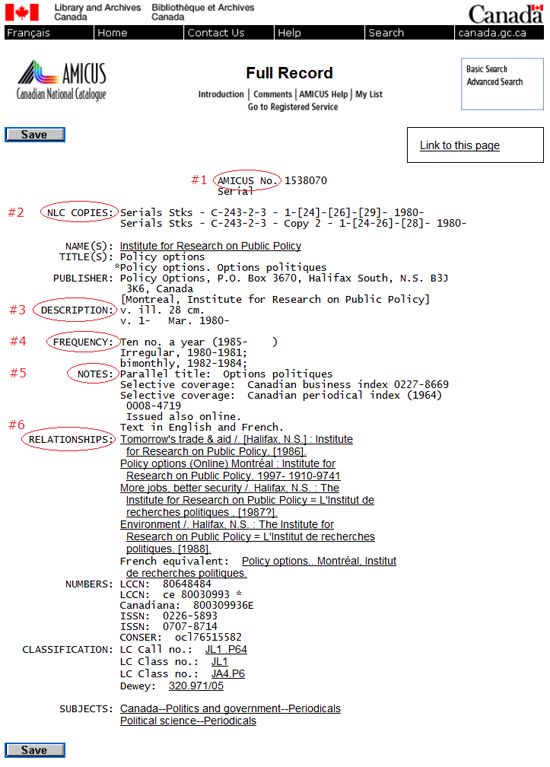
Screen capture of the AMICUS full record with corresponding fields (source: AN1538070)

1. AMICUS No.: Keep track of this number! You will need it to request issues of the serial, whether you place a request for retrieval before visiting Library and Archives Canada (LAC) or once you are on site.

2. NLC (National Library Collection) Copies: Provides key information on which issues of the serial record are available in our collection. It is essential to distinguish between the LAC holdings for the serial found in NLC Copies (No. 2) and the description of the publishing history of the serial found in the Description (No. 3). The complete run of a serial is sometimes unavailable at LAC or may be available in a microform version. If a microform version exists, it will be included as a link in Relationships (No. 6).

The following punctuation marks are used to describe serial holdings:
Punctuation Mark Meaning Example
Hyphen   An unbroken range of holdings v. 1-30 means the library has each issue of the serial from volumes 1 to 30 in its holdings.
Square brackets  [ ] Incomplete holdings [1950] means that holdings include some issues published in 1950.
Question mark  ? Uncertain holdings information v. 18-42? means that holdings may include volumes 18 to 42.
Slash  / A single physical item with two connected volumes v. 12/13 indicates that volumes 12 and 13 are contained in a single physical item.
Comma  , A gap in the holdings v. 1-3, 5 means the library has volumes 1 to 3 and 5 but not volume 4.
Semicolon  ; A publication break (not a gap) in the holdings v. 1-3; 5- indicates that after volume 3 the publisher jumped to 5 without publishing volume 4.

3. Description: Indicates when the serial began publication.

4. Frequency: Specifies how frequently the serial has been published over the years.

5. Notes: Offers additional information about the serial, such as where it has been indexed and its alternate titles.

6. Relationships: Provides links to related versions, for example, in other languages or in other formats, such as a journal available online or on microfilm. In this case, you will find a link to the online version of this journal held in our electronic collection.

Questions or comments? We would love to hear from you!
How to read AMICUS records—Part 1

Have you ever used our AMICUS library catalogue to try to find a book and were unsure about how to decode the information?

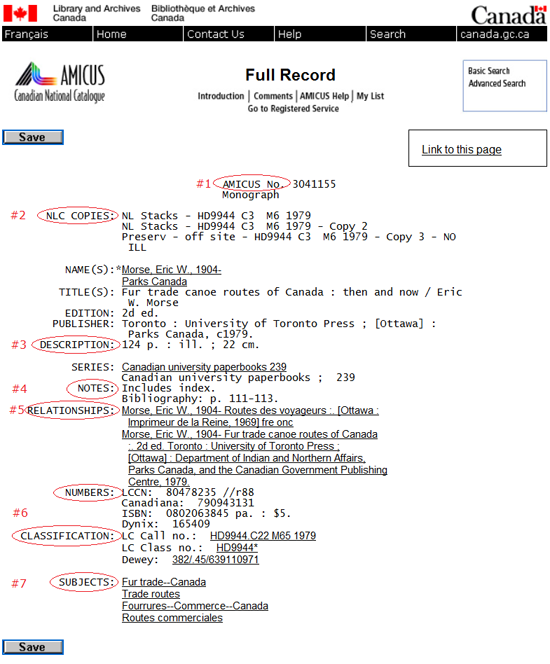
Here are tips on decoding an AMICUS record for books, reports or documents (monographs). To help you better understand, the numbers on the image correspond to the fields in the article.

Screen capture of the AMICUS full record with corresponding fields (source: AN 3041155)

1. AMICUS No.: Keep track of this number! You will need the AMICUS No., the name(s) of the author(s) and the title of the work to place a request for retrieval before visiting Library and Archives Canada (LAC) or once you are on site. Immediately below the AMICUS No., the type of record is specified; this tells you if the record is for a book, a report or a document (monograph), or a journal, a magazine, a newspaper or any type of ongoing publication (serial).

2. NLC (National Library Collection) Copies: Indicates the number of copies available at LAC. If you do not find NLC copies in the record, start your search over and make sure that you are searching the LAC catalogue only, not the entire database. As we are a closed stack library, the shelf location information is for internal purposes only and is not useful to you. Please note that preservation copies are presently unavailable.

3. Description: Tells you the number of pages and if the work contains illustrations or maps.

4: Notes: Provides additional information about the work, for example, other title information, additional information on the contents, whether it contains bibliographic references.

5. Relationships: Provides links to related versions of the work, for example, in other languages or in other formats, such as online or on microfiche.

6. Numbers and Classification: Generally of interest to other libraries only. The call numbers are suggestions for other libraries and are not LAC call numbers.

7. Subjects: Provides the standardized subject headings assigned to the work. Click on any subject heading to find additional materials on that topic.

Stay tuned for an upcoming article on how to read AMICUS records for journals, magazines, newspapers or any other type of ongoing publication (serials).

Questions or comments? We would love to hear from you!

Eight Heritage Films – Snapshots of Canadian Life – Now on YouTube

Library and Archives Canada (LAC) announces the release of eight heritage films on its YouTube channel. Canadians can now discover and enjoy with ease the following short films:

The films served as a successful method to inform and influence the public. They were used to achieve many goals, from enticing potential immigrants, to increasing industrial investment, to encouraging the public to embrace changes. Perhaps most interesting however, is what these films reveal about how Canadians pictured themselves in the early part of the 20th century.

As part of its ongoing commitment to providing Canadians with quick and easy access to their documentary heritage, LAC will release three more sets of films on its YouTube channel in the coming months. Stay tuned!

You can also find archived versions of the films on other media on the Virtual Silver Screen page.

The Korean War

In the wake of the Second World War, the Korean Peninsula was divided into two zones along the 38th parallel, with the North occupied by the Soviet Union and the South by the United States. Soon after the election of a northern communist government in 1948, open war broke out on June 25, 1950, when North Korean troops invaded the South.

Given the situation, the United Nations Security Council passed a resolution to approve sending troops to defend South Korea; a number of countries, including Canada, contributed by supplying armed forces.

The Royal 22e Regiment mortar platoon ready to fire, (left to right) Private Daniel Primeau, Private Raymond Romeo, and Private Julien Blondin, all of Montreal, Quebec.

The Royal 22e Regiment mortar platoon ready to fire, (left to right) Private Daniel Primeau, Private Raymond Romeo, and Private Julien Blondin, all of Montreal, Quebec. Source

More than 26,000 Canadian soldiers fought in the Korean War. They battled communist troops on the ground, while the Royal Canadian Navy—with eight warships—helped control the Korean coasts. The Royal Canadian Air Force did its part transporting troops and equipment. A few pilots saw combat at the controls of American fighter planes.

 Black-and-white photo of two Canadian snipers aiming at an unknown target..

Two snipers. Source

On July 27, 1953, an armistice agreement was signed at Panmunjom, bringing three years of fighting to an end.

In all, 516 Canadians lost their lives during this armed conflict. Their names are entered in The Books of Remembrance… The Korean War, exhibited at the Peace Tower in Ottawa and available online. These registers remind us of the important contribution and tremendous sacrifice of these Canadians.

The Library and Archives Canada collection contains many documents about this war, which marks the 60th anniversary of its armistice in 2013. Here are a few examples:

Part of the war diaries (War Diary, 1951) of the Commonwealth troops, including Canadian troops:

The war diary (1950–1951) of the advance party:

For more photos, visit our Flickr album.

For more information about ordering military service files, please read our blog article on this topic.

Reconnecting families through digitization

As part of Project Naming, a community engagement and photo identification project that aims to reconnect Inuit and their past, Library and Archives Canada (LAC) has undertaken the digitization of a series of photographs from the Indian and Northern Affairs Collection. These albums have been the starting point of a great story regarding a family from Nunavut.

In this collection, are a number of images of the Weetaltuk family taken during the summer of 1949 on the Cape Hope Islands in Nunavut. The original captions accompanying the photographs provided basic details. Fortunately, the database records for these images are now more complete after several family members contacted LAC to provide the names of relatives and other relevant information about these pictures. Most importantly, they were able to correct the Weetaltuk surname, as well as community names that had been incorrectly recorded. From the original captions, we knew that George Weetaltuk was a community leader, a skilled hunter and an expert boat builder. His family members explained the detailed process that George followed in creating his boats, as seen in this photograph of him with his son, William, and his adopted son, Simon Aodla, constructing an 11.58 metre (38-foot) boat.

Another record that the Weetaltuk family was able to correct was this group photograph taken in front of a log cabin. The caption states that this picture was taken on Cape Hope Islands. We now know that the picture was probably taken on nearby Charlton Island, James Bay, where for many years, George and his family resided while he was employed seasonally by the Hudson’s Bay Company. In addition to this information, the family was also able to identify five of the people in the photograph, and provide genealogical connections.

Weetaltuk family photograph. Back row: Adla (far left), married to William, George’s oldest son (2nd from left),  George Weetaltuk (centre) and his first wife, Ugugak (4th from left). Front row: George’s sons Alaku (far left) and Tommy (sitting on the ground). (PA-099605)

Weetaltuk family photograph. Back row: Adla (far left), married to William, George’s oldest son (2nd from left), George Weetaltuk (centre) and his first wife, Ugugak (4th from left). Front row: George’s sons Alaku (far left) and Tommy (sitting on the ground). (PA-099605) Source

In addition, another of George’s sons, Edward, was a member of the Princess Patricia’s Canadian Light Infantry. He was the first Canadian Inuk to serve in military combat with the Canadian Army during the Korean War. Following his 15 years of service, he began writing his life story. According to a news article, Edward (Eddy) Weetaltuk “wanted to show young Inuit that education was important and that Inuit can become anything they want and even become famous, if that’s what they want.” (Nunatsiaq Online, July 16, 2009)

Although Eddy started writing E9-422: Un Inuit, de la toundra à la guerre de Corée in 1974 (in French only), it was not published until 2009 only a few days before his death.

Through these family connections and dialogue with the community, our photographic collections are constantly improved and enriched for future generations.

For more information about Project Naming, read our Blog article, published on May 9, 2013, and listen to our Project Naming and Canada’s North podcast.

The Canadian Arctic Expedition—100th anniversary

At the beginning of the 20th century the Canadian government, led by Sir Robert Borden, wanted to strengthen Canada’s sovereignty in the Arctic, in response to the presence of the United States and Russia in the North. The Canadian Arctic Expedition was established by Order-in-Council 406, dated February 22, 1913, under the responsibility of the Ministry of Naval Services and other government bodies.

The expedition was comprised of two groups, each with its own objective: the Northern Party, led by Vilhjalmur Stefansson, was responsible for geographic exploration of the Arctic to ensure Canadian sovereignty in the western part, while the Southern Party, led by Dr. Rudolph M. Anderson, focused on scientific discovery.

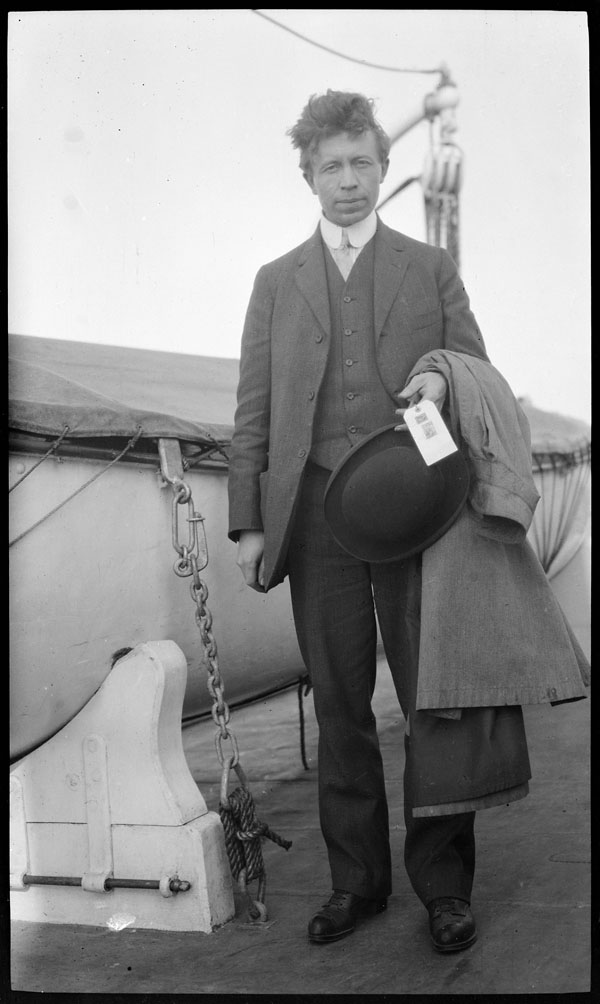
V. Stefansson on board the Karluk.

V. Stefansson on board the Karluk. Source

Rudolph Martin Anderson.

Rudolph Martin Anderson. Source

An expedition fraught with challenge

On June 17, 1913, the expedition set sail from Esquimalt Harbour in British Columbia aboard the Karluk headed for Herschel Island in the Beaufort Sea. In August, the ship became trapped in ice and drifted for over four months, eventually sinking in Siberia. The ship’s captain, Robert Bartlett, describes the final days of the voyage in his book Northward ho! The last voyage of the Karluk. Stefansson’s decision to leave the ship on September 19, 1913, to continue his exploration occurred in a climate of crisis. Stefansson’s departure remains a source of controversy and debate among historians.

The Karluk sails near Esquimalt Harbour.

The Karluk sails near Esquimalt Harbour. Source

To find out more

The following are some of the archival documents and government reports that constitute the information resources related to this expedition.

For consultation on-site at Library and Archives Canada:

Available online from Library and Archives Canada:

Other sources:

Please note that the majority of the documents are available in English only.

For more information, be sure to visit the virtual exhibition at the Canadian Museum of Civilization: Northern People, Northern Knowledge: The story of the Canadian Arctic Expedition 1913-1918.

Visit our Flickr album for more photographs.

Home Children (Part VI)—Mary Scott Pearson, ancestor of former Ontario Member of Provincial Parliament Jim Brownell

Today’s article features Mary Scott Pearson who was born in Scotland. Mary’s name appears in the Scottish Census of 1881. The entry indicates that she lived in Glasgow with her sister Maggie and their widowed mother, also named Mary. The two sisters became orphans when their mother died in 1888. The next census (1891) indicates that the sisters lived at the Girls Industrial School in Maryhill, in the County of Lanarkshire.

The Pearson sisters were separated in September 1891 when Mary boarded the SS Hibernian en route to Canada as part of a group of 20 young women recruited to work as domestic servants. The young Scottish women’s transportation and accommodations were arranged by Ms. E. Cameron, an Industrial School official.

As in previous articles, you must first consult our main home children online resource. Enter the surname Pearson and the given name Mary into this database and it will generate only one result for Mary Pearson, age 14, whose destination was Saint John, New Brunswick. The Fairknowe foster home, administered by a charitable organization known as Quarriers, was Mary Pearson’s first place of residence in Canada.

Ten years after her arrival, according to the Census of 1901, Mary was living in Prescott, Ontario, with the family of Patrick MacMillen. She married Curtis Brownell five years later, on March 21, 1906, in Cornwall, County of Stormont. The couple’s first son, Earl Kenneth, was born in September of the following year.

Mary Scott Pearson and Curtis Brownell raised their family in Cornwall, where they lived until the time of their deaths; Curtis died in 1931 and Mary died in 1945.

Jim Brownell, son of Earl Kenneth Brownell, honours his grandmother’s arrival in Canada

Her grandson, Jim, elected Member of the Legislative Assembly of Ontario in 2003, travelled to Scotland in 2009 when he visited the city of Glasgow, officially representing the Government of Ontario. The articles that appeared in the Cornwall daily newspaper, the Standard Freeholder, on September 23, 2009 and May 25, 2011, describe the journey of Mary S. Pearson and her sister Maggie, and Mr. Brownell’s work to foster a better understanding of the often little-known home children movement.

In 2011, as Member of Provincial Parliament for Stormont-Dundas-South Glengarry, Jim Brownell tabled Bill 185 in the Legislative Assembly of Ontario to have September 28 proclaimed “British Home Child Day.” The purpose of the bill, which received royal assent on June 1 of that year, was to honour his grandmother and his great-aunt Maggie, as well as the more than 100,000 British home children.

Don’t forget to read the previous articles in this series on home children and listen to our podcast!

Happy hunting and enjoy your discoveries!

How to make the most of your reference appointment

Reference librarians and archivists at Library and Archives Canada (LAC) are happy to assist you by:

• showing you how to make the best use of our research tools
• directing you toward suggested resources

You may wish to take a proactive approach to your research project before making a reference appointment. Being better prepared in the following ways will allow you to maximize your time with a LAC professional.

Have you laid the groundwork using sources near you?

Local municipal and university libraries provide a wealth of resources to researchers. These resources are an important first stop for anyone embarking on a historical research project.

Read everything you can about your subject. Books and journal articles provide important background and context for your research project. Verifying the bibliographies and source citations of such published items can often help identity additional research resources, which may or may not be held at LAC.

Take notes! When consulting any source, be sure to take well-organized notes and to fully transcribe all references. For published sources, you will need to have the complete title, the author’s name, and the place and date of publication. For archival sources, be sure to note the name of the archives that holds the records, the collection name, collection code, box or volume number, file titles and dates. Bring these references to your appointment at LAC along with the tools necessary for taking additional notes.

Have you done a preliminary search with our online tools?

Our Academic Researchers page can help you set the stage. If you are unfamiliar with what an archive is, we recommend our guide on Using Archives and our blog post Discover Finding Aids!

Remember that not everything we have is available online.

Do you have the right archive or library?

LAC holds a wealth of archival material of national and federal significance relating to Canadian history. However, we do not hold everything. Provinces, universities, counties, cities, corporations and social organizations all maintain their own unique archival and library collections. Depending on your topic, these may prove to be not only the most relevant but possibly the only resources available to you.

For example, information relating to land grants, local land titles and lot history is generally held at the provincial level. If you are interested in the history of a local arts festival or business, then the city archives or local historical society will likely be the best resource to consult. Please note that in the case of corporations and social organizations, their unique historical records may not be open for public research. In the case of some unique provincial resources, a fee for use may be required.

For the scientific research and innovation community, the Canada Institute for Scientific and Technical Information, which is the national science library at National Research Council Canada, represents a valuable online resource.

Immigration and Citizenship records at LAC: Did your ancestor arrive in Canada before 1865?

This article, the first of a series depicting Immigration and Citizenship sources, offers insight into pre-Confederation arrivals in Canada. Very few records compiled before 1865 still exist. Most surviving records, which are from various sources, have been indexed by name in databases.

Here are the key resources*:

The Immigrants to Canada database was compiled from documents such as immigration and land records and some private fonds, namely the Peter Robinson Papers. It provides access to more than 28,000 references to records held at Library and Archives Canada (LAC).

The Montreal Emigrant Society Passage Book (1832) database provides access to 1,945 references and digitized documents to people who received assistance from the Montreal Emigrant Society in 1832.

The Immigrants at Grosse-Île (1832-1937) database is the result of an agreement between Parks Canada and LAC. It contains more than 33,000 records spanning a 100-year time period. The references describe various events for immigrants arriving at the city of Québec and their time spent at the Grosse-Île Quarantine Station.

The Upper Canada and Canada West Naturalization Records (1828-1850) database gives references to the names of 2,967 persons naturalized in what is now the province of Ontario between 1828 and 1850. The 188 registers have been scanned and digitized images are accessible in this database.

The Citizenship Registration Records for the Montreal Circuit Court (1851-1945) database provides access to more than 8,000 references to the Citizenship Registration Records for the Montreal Circuit Court. The records have been digitized and linked to the database references.

If you think some of your “ancêtres” can be traced back to France, LAC holds a small number of lists from the French Regime (1717-1786).

Coming soon!

Stay tuned for the following related upcoming articles:

  • Validating your ancestor’s presence in Canada before 1865
  • Immigration sources from 1865 onwards (most of them in databases)
  • Border entries to Canada via the United States

*Note: Don’t forget that the Search Help page of a database is the best place to find out how the records are arranged.

Sir John Franklin Expedition

On May 19, 1845, HMS Erebus and HMS Terror left England under the command of Sir John Franklin in search of the Northwest Passage. This expedition was without a doubt a most ill-fated venture, as not a single member returned alive.

An iceberg, HMS Terror and some walruses near the entrance of Hudson Strait.

An iceberg, HMS Terror and some walruses near the entrance of Hudson Strait
Library and Archives Canada, Acc. No. 1979-49-1. Source

Major search efforts were launched to find the missing men, including three expeditions to the Arctic in spring 1848. Rewards were also offered in 1849 and 1850 for any information about Franklin’s expedition. These searches did produce results: in 1850, the first relics—the graves of three crewmen who died in 1846—were found at Beechey Island, west of Devon Island.

In July 1857, Lady Franklin also financed an expedition under the command of Francis McClintock aboard the ship Fox. On May 5, 1859, William Hobson, Lieutenant of the Fox, found a document placed beneath a cairn containing two messages. The first, written by Franklin on May 28, 1847, indicated that the crew of the two ships had spent the winter of 1845–46 off Beechey Island, and that all was well. The second message, dated April 25, 1848, indicated that the Erebus and Terror had been trapped in ice since September 1846, west of King William Island, and that 24 men had died, including Franklin on June 11, 1847.

In the wake of expeditions undertaken to find Franklin, numerous maps were drawn, including the Discoveries in the Arctic Sea, 1616-1927 and the Chart showing the vicinity of King William Island. These identified the sites Franklin visited, the places where his group wintered and the site in which his ships were abandoned. The second map also mentions the diverted courses the two wrecks may have followed.

Although we now know the fate of the members of this expedition, every attempt to find the wrecks of the Erebus and the Terror has been unsuccessful, despite the magnitude of the searches and modern technologies deployed.

For more information about the period prior to the expeditions:

For more information about the periods prior to and following the expeditions:

For more information about the period following the expeditions:

Publications, bibliographies and guides held at Library and Archives Canada:

Please visit our Flickr album for more photographs.