Library and Archives Canada Blog

This is the official blog of Library and Archives Canada (LAC).

Library and Archives Canada Blog

Canada and the German mercenaries of the American Revolution

By Anik Laflèche

If your last name is Schneider, Sigman, Henry, or André, or it has “von” in it, you may be of German descent.

In 1776, the Thirteen Colonies declared the United States of America to be independent from Great Britain. Many reasons were behind this declaration, including excessive taxation and lack of representation in Parliament. Civil war broke out in central North America, pitting George Washington against Benedict Arnold, and John Adams against Samuel Adams. This brutal civil war finally ended in 1783 when Great Britain accepted the independence of its old colonies. The United States would become a country and Great Britain would keep the northern colonies, now Canada. This started a massive wave of migration (almost 70,000 people including British citizens, First Nations and freed enslaved people) to what are now the provinces of Quebec, Ontario, New Brunswick, and Nova Scotia.

A colour reproduction of John David Kelly’s painting of a group of people, some building a house.

United Empire Loyalists Landing at the Site of the Present City of Saint John, New Brunswick, 1783 by John David Kelly, reproduced in Confederation Life’s 1935 calendar (e011154201)

While numerous families arrived during this massive wave of settlement, many Canadians are descendants of a smaller, less noticeable population migration that happened simultaneously—not First Nations, French, American or English immigrants, but surprisingly—German mercenaries, also known as Hessians.

Let us backtrack a bit in our story of American rebels and British Loyalists. From the late 1770s to the early 1780s, King George III of England, faced with war in the colonies, decided to hire 30,000 German soldiers (that is a German soldier for every 22 Québécois!) and ship them to the New World to combat the rebellious states. While many of these mercenary regiments were sent directly to the Thirteen Colonies to fight, some were deployed in Canada to protect the frontier, such as the Hesse-Hanau Regiment, which were active in the forts of Ontario and Quebec.
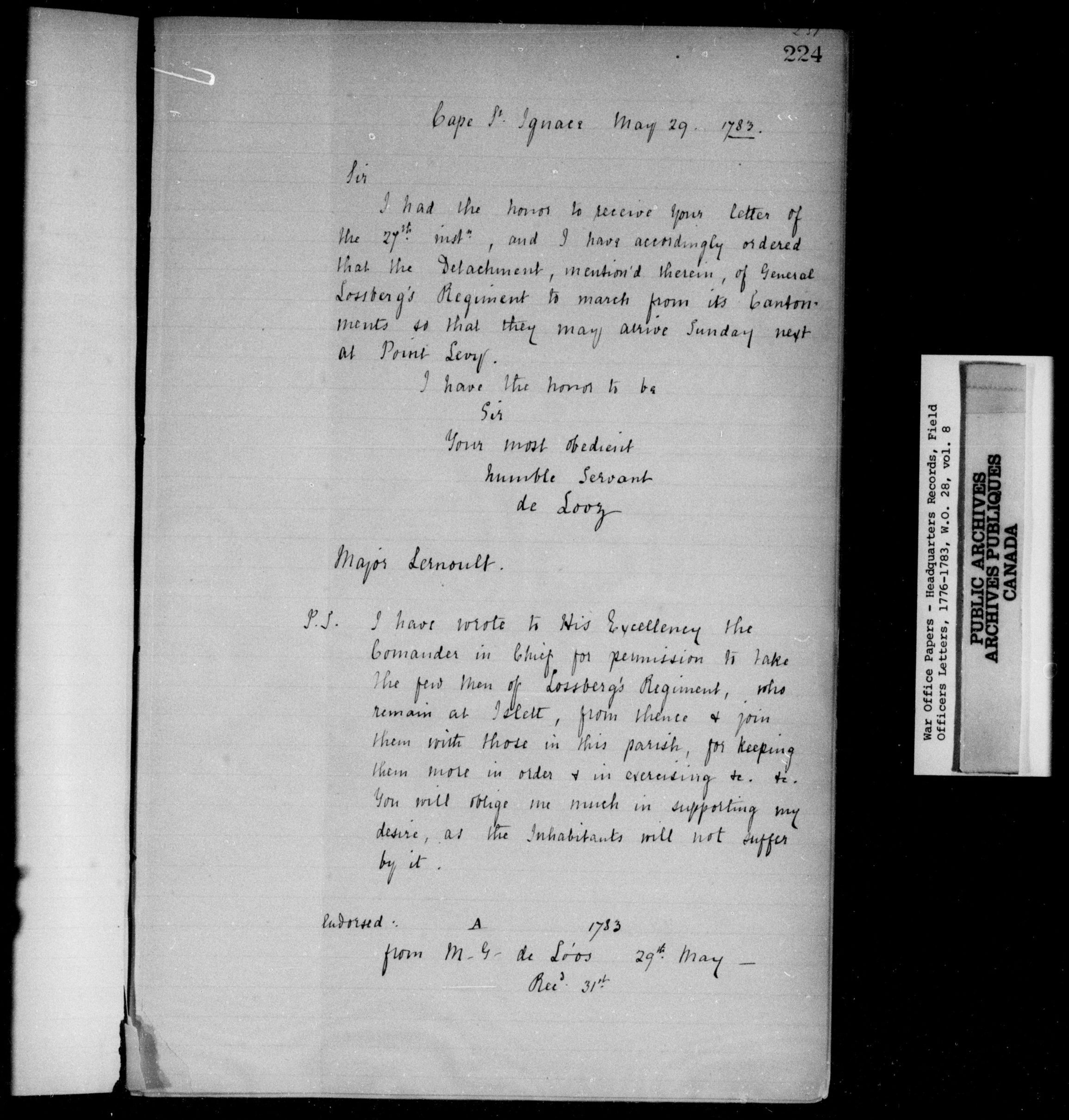
An image of handwritten orders and response for the Lossberg Regiment.

Transcription of a War Office letter from officer de Looz concerning the movement of the Lossberg regiment, 1783. (MG13 WO28, vol. 8, p. 224, microfilm C-10861)

Although the German mercenaries and Loyalists fought valiantly, the balance of power tipped in favour of the American patriots. After the war was over, the German mercenaries were offered a choice of returning home to Germany or settling in Canada. Many soldiers decided to stay in Canada, settling in Lower Canada, Upper Canada, and Nova Scotia—learning French or English, marrying local girls, and assimilating into the surrounding societies.

But how did so many Canadian families forget their German ancestors? Should it not be easy to pinpoint a German name in our family trees? Not necessarily as in the 18th and 19th centuries, spelling of names often changed throughout people’s lives. Spelling, especially when foreign words were concerned, was based on sounds, and thus varied greatly. In the case of the mercenaries, local French or English priests were the ones recording names for marriages, births and deaths. When they heard a German name, they often francized or anglicized them based on what they understood. Thus, Heinrich Kristof Sieckmann, a German mercenary born in Vlotho, Germany, who served in the Hesse-Kassel Regiment, became Henry Christopher Sigman and André Christophe Sicman. A few generations later and other phonetically similar variations started to appear such as Ciegman, Sicman, Sickman, Sigman, Sickamen, Silchman and even Tieckman. With this new spelling, Heinrich Sieckmann, now Henry Sigman, could easily have been mistaken for an English immigrant on paper.
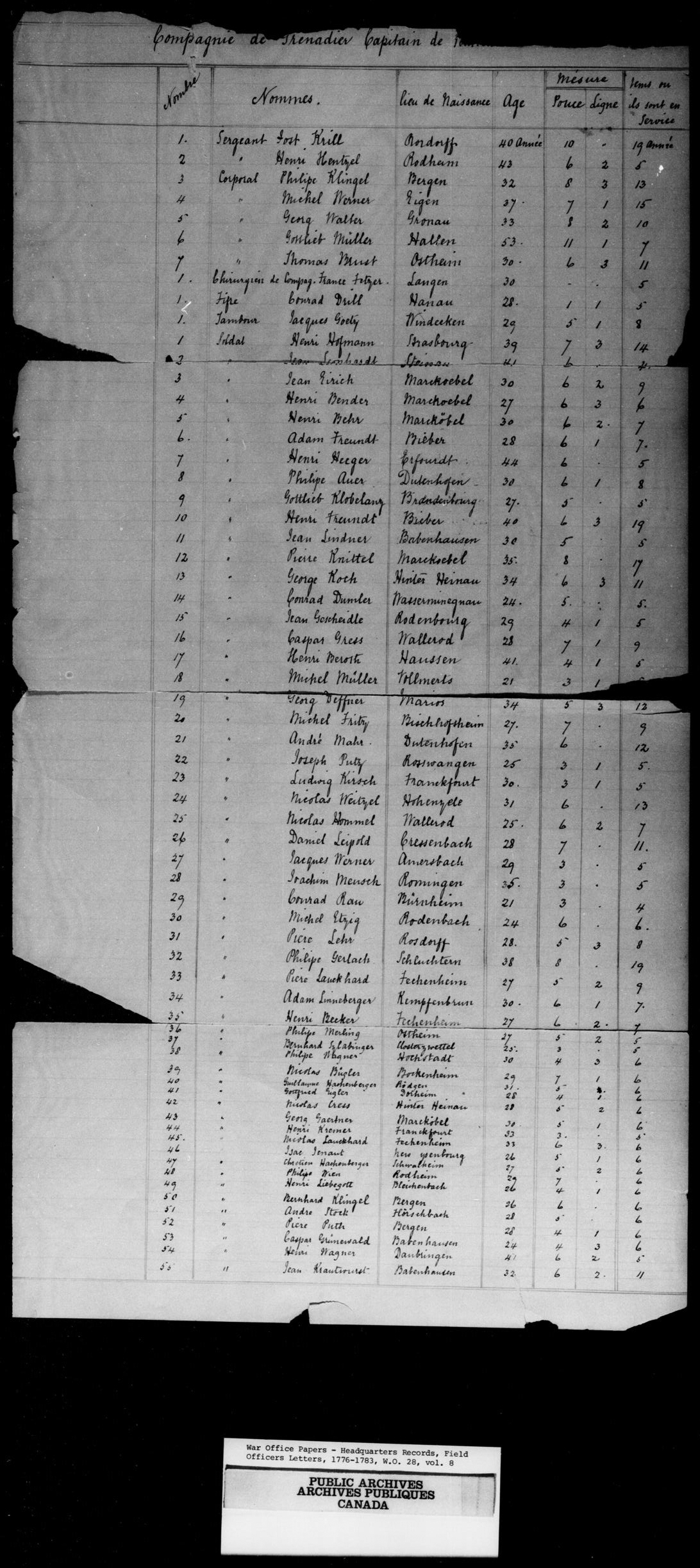
An image of a handwritten page enumerating the members of the 1st Hesse-Hanau Battalion.

War Office 28: nominal roll of the 1st Hesse-Hanau Battalion, January 1783 (MG13 WO28, vol. 8, p.205, microfilm C-10861)

So to the Henrys and Andrés (Heinrich), the Sigmans (Sieckmann) and the Schneiders—if this might be you or if you are simply curious to learn more about these German soldiers that popped up on the Netflix show Turn, come on over to Library and Archives Canada. Our collections have a surprisingly large number of archival sources concerning the German mercenaries who fought during the American Revolution. We have nominal rolls of different regiments in manuscript groups MG11 and MG13; letters written by German officers in the Haldimand papers (MG21); and orders, correspondence and journals in MG23. Many of the microfilm reels containing these documents are digitized and available to the public through Héritage. We also have published sources on our German ancestors, with historical analysis, lists of soldiers and short biographies, mostly located in our Genealogy section. To learn more about our holdings on German mercenaries, visit Immigration: German.


Anik Laflèche is a student project assistant in the Public Services Branch of Library and Archives Canada.

Images of Boxing now on Flickr

Boxing is the sport of fighting with padded, gloved fists in a square, roped-off ring under a set number of rounds and rules.

A black-and-white photograph of two boxers fighting on the deck of the SS Justicia, surrounded by the ship’s complement of soldiers.

Canadian troops aboard the SS Justicia, en route to Liverpool, England, watch a boxing match (MIKAN 3384735)

However, the first boxers in Canada did not use gloves. Bareknuckle fisticuffs were the norm during the early 19th century, with some bouts lasting 40 rounds. Outside of the military and a few men’s clubs, boxing was not sanctioned in the provinces of Canada, as the sport did not have a great reputation for fair play or honest promotion. Respectability for the sport came slowly, and views changed during the 1890s. The popularity of the sport grew steadily during the early 20th century.

A black-and-white photograph of two soldiers boxing. One wears black trunks and the other wears white trunks. Soldiers outside the ring watch the match.

Soldiers boxing in the exhibition grounds (MIKAN 3384740)

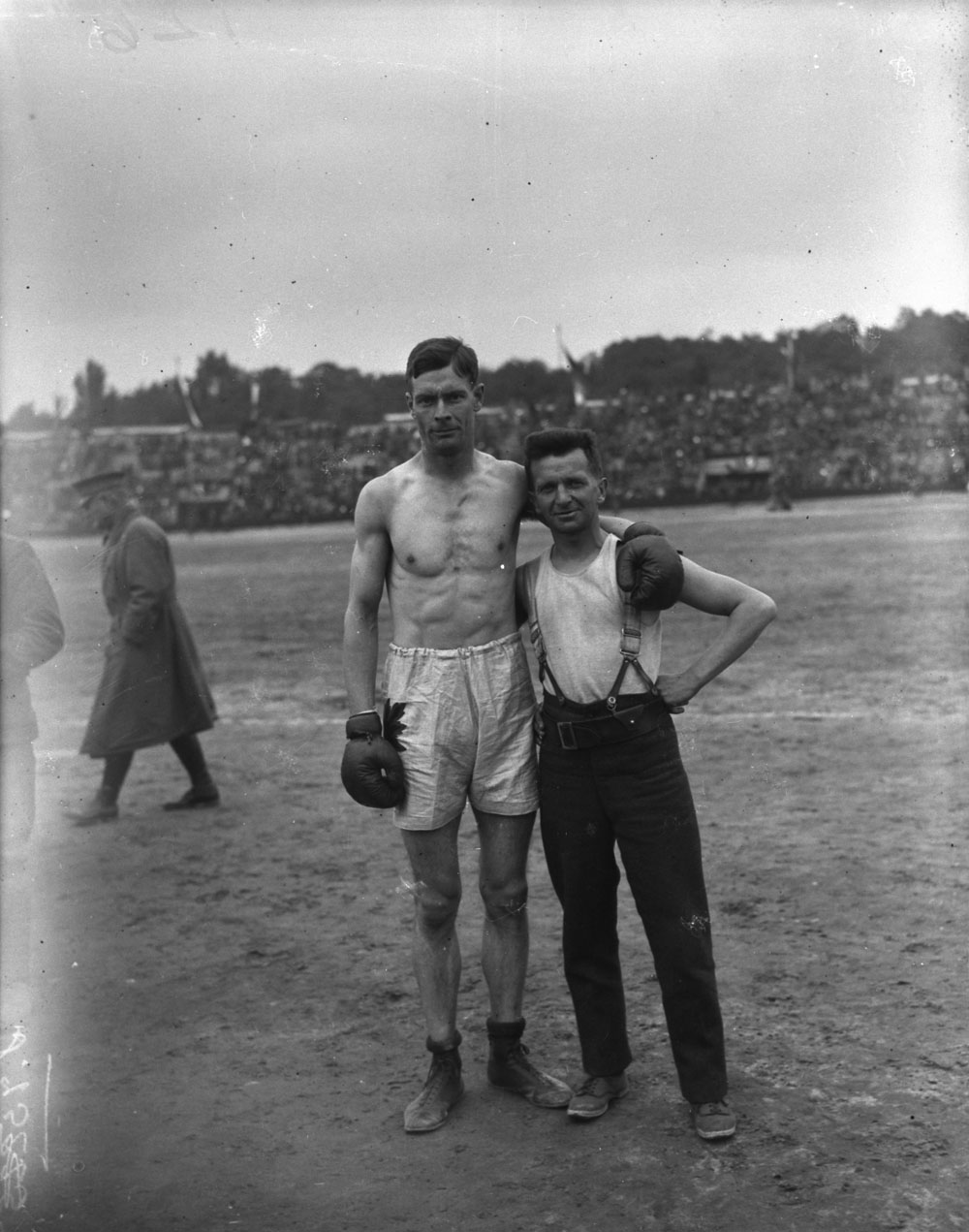
A black-and-white photograph of middleweight boxer Edwin A. Harris (Canada) in his trunks and gloves, posing with another soldier.

Edwin A. Harris (Canada), middleweight finalist in boxing, at the Inter-Allied Games, Pershing Stadium, Paris, France (MIKAN 3384730)

Today, the Canadian Amateur Boxing Association oversees the sport in coordination with 10 provincial and three territorial boxing associations. Some athletes eventually turn to professional boxing, while others retain their amateur status with the intent to represent Canada in international events, such as the Olympics or Commonwealth Games.

Visit the Flickr album now!

Guest curator: Scott Dickinson

Banner for the guest curator series. CANADA 150 is in red along the left side of the banner and then the bilingual text: Canada: Who Do We Think We Are? and under that text is Guest curator series.Canada: Who Do We Think We Are? is a new exhibition by Library and Archives Canada (LAC) marking the 150th anniversary of Canadian Confederation. This exhibition is accompanied by a year-long blog series.

Join us every month during 2017 as experts, from LAC, across Canada and even farther afield, provide additional insights on items from the exhibition. Each “guest curator” discusses one item, then adds another to the exhibition—virtually.

Be sure to visit Canada: Who Do We Think We Are? at 395 Wellington Street in Ottawa between June 5, 2017, and March 1, 2018. Admission is free.


A wedding portrait of Samuel Leonard Tilley and Julia Ann Hanford

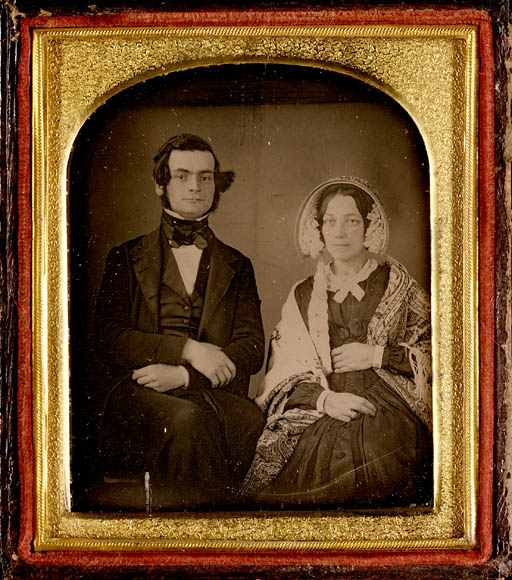
A colour photograph of a sepia-tone image in a wood and gold frame showing a seated man and woman. The man is wearing a suit, waistcoat and cravat. The woman is wearing a bonnet, dress and patterned shawl.

A daguerreotype of Samuel Leonard Tilley and Julia Ann Hanford, ca. 1843. (MIKAN 3192569)

Canada is no longer known as a “Dominion” of Great Britain. According to legend, Father of Confederation Samuel L. Tilley borrowed the word from a biblical psalm. It would become part of our nation’s first formal identity.


Tell us a bit about yourself

I became interested in history—more specifically, the history of technology and of industry—while growing up in Brantford, Ontario, an old factory town not too far from Hamilton. If Hamilton was known for making steel, Brantford was known for making farming equipment. By the time I lived there, all the big Canadian farming companies had left, leaving nothing but the old factory buildings and the memories of the older generation. Exploring that history left me deeply interested in the machines that Canadians invented, made and used—and the places where they did all three. It was the start of my journey into history. I no longer live in Brantford, but everywhere I go I find myself searching for signs of Canada’s industrial past.

Is there anything else about this item that you feel Canadians should know?

The first practical photographic process was invented in 1839 by Louis-Jacques-Mandé Daguerre, which is why this type of photograph is called a daguerreotype. Although the photograph is normal to us, the daguerreotype process is not, and probably requires a bit of explanation.

The daguerreotype used a silvered copper plate as “film.” The surface of the plate was chemically treated so that it would be sensitive to light. This light-sensitive plate was placed in a dark box—the camera—until it was exposed to the scene it was meant to capture. After another chemical treatment, the image of what the plate had been exposed to was plain to see, in a very crisp black and white. Daguerreotype images seem to float above their plates, giving them the illusion of depth, a unique property that no other form of photography has managed to duplicate.

Daguerreotype exposures are not instantaneous. One would have to hold still for up to two minutes, or the resulting image would be blurry. This is the reason why most early photographs are formal portraits of sitting individuals or other static scenes. The expense and time required also meant that taking a photograph was an event worth dressing up for.

Have you ever had to keep smiling as someone fumbles with their camera? Holding a smile for more than a few seconds can be painful. Now imagine trying to hold a smile for two whole minutes. Early photographs like this one show our ancestors to be grim, but a frown is much easier to hold than a smile!

When we look at historical photographs, we must think about not just the subject matter, but the technology used to capture the image. The Tilleys, pictured here in stiff and formal poses, were not necessarily stiff and formal people. We would never know it from these daguerreotypes, as the limitations of that technology meant only some sorts of scenes could be captured. When historians look at historic photographs, we have to think about what we have seen—and what we have not.

Tell us about another related item that you would like to add to the exhibition

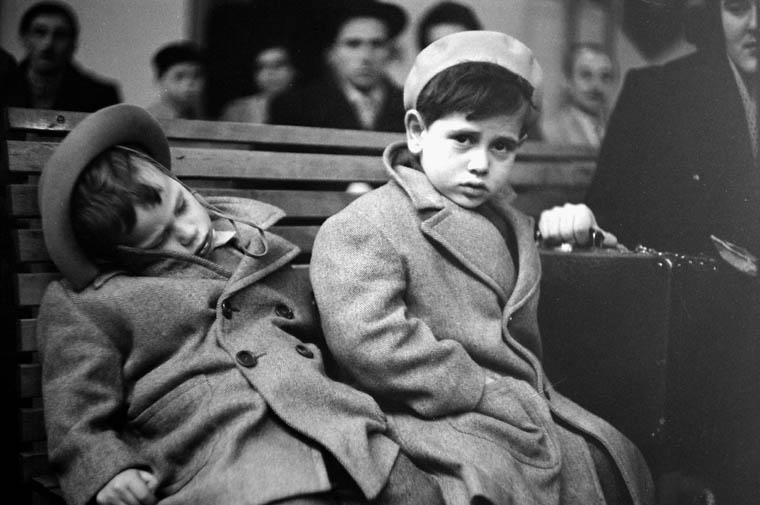
A black-and-white photograph of two small boys wearing wool coats and hats sitting on a wooden bench. One is slumped over sleeping; the other is staring the camera and holding a suitcase. A blurred crowd of people can be seen in the background.

New arrivals aboard S.S. ARGENTINA awaiting clearance in the Immigration Examination Hall, Pier 21, March 1952 (MIKAN 3212241)

There is an item in LAC’s collection that complements this daguerreotype quite well. It is another photograph, one that shows a scene quite different from the genteel setting that the Tilleys were photographed in.

More than a century after the daguerreotype of Samuel Tilley was taken, Canada was in the midst of one of its periodic booms in immigration. Photography was now more than developed enough to do what the old daguerreotype could not—candid snapshots. More importantly, photographers were now interested in taking pictures of regular people, like those of new immigrants, and later of refugees. Both are represented in this exhibit.

This snapshot is of a pair of young immigrants, waiting to be processed through Pier 21 in Halifax. The year is 1952, and these two tired-eyed children have just disembarked from the S. S. Argentina. Their faces show exhaustion, trepidation and perhaps some annoyance at the wait.

Which of these photographs show a better image of Canada? I would suggest that the versions of Canada that these photographs depict are equally valid. Both photographs show stories that are worth telling.

This photograph does not show a Founding Father of Canada. The names of these two children are not recorded. But they are Canadians, all the same. Their experience of Canada was quite different from the experience of Samuel Tilley, but both were important to the growth of our nation. Photography has become a great social leveller. It is no longer the preserve of the well-off. We are indebted to those early daguerreotypists for capturing the faces of early Canadians, but they could not capture how they looked outside of the studio. More modern photographers have given us windows into what Canadians really look like.

Biography

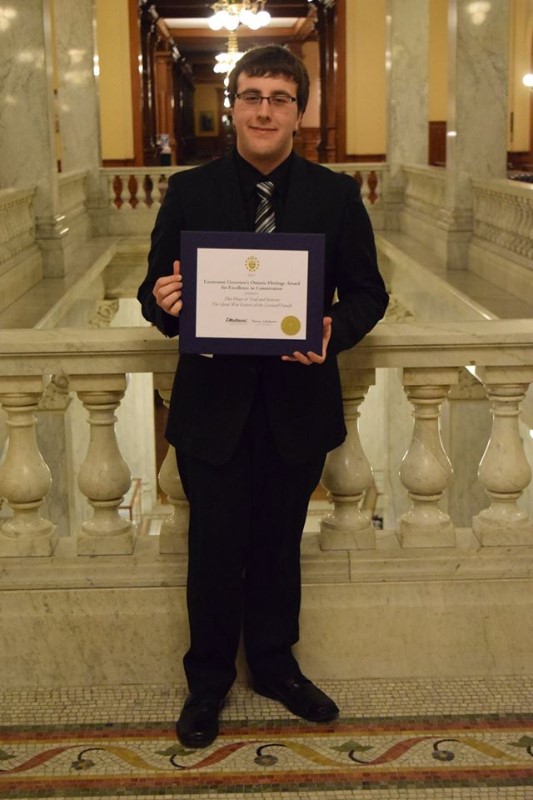
A colour photograph of a young man standing with a diploma.Scott Dickinson is a young museum professional with a great interest in the history of the technology that Canadians use every day. He holds an Honours Specialization in History from the University of Western Ontario (2014) and a Master’s Degree in Public History, also from the University of Western Ontario (2015). He is currently a student in the Museum Management and Curatorship program at Fleming College.

The Yves Baril fonds at Library and Archives Canada

By James Bone

Without a doubt, Yves Baril’s art has been printed more than that of any other Canadian artist. Yet, unless you’re absorbed in the world of Canadian philately or numismatics, you’ve also probably never heard of him. Known for his exquisite and detailed portraiture, Yves Baril is Canada’s master engraver, having produced engravings for more than 146 Canadian postage stamp issues, the Canadian bank notes printed from the late 1950s to 1990s, Canadian Tire money, share and bond certificates, labels and coupons. With millions of these products printed and circulating, and especially for the postage stamps and bank notes, Yves Baril’s work has passed through the hands of many—or perhaps most—Canadians.

Born in 1932 in Verdun, Quebec, Yves Baril grew up in Montreal’s southwest boroughs and studied the arts, including painting and typography, at the Montreal Museum of Fine Arts School and the Montreal School of Graphic Arts. Following his graduation, Baril would take up an engraving apprenticeship in 1953 in Ottawa with the Canadian Bank Note Company, Limited, a private printing company specializing in bank notes and security documents. Studying under master engraver Silas Robert Allen, Baril began by attempting to mimic the work of his teacher. His break came in 1955 when the Post Office Department rejected the engraving made by Allen for a stamp commemorating the immigration of homesteaders into Saskatchewan and Alberta. It was too late in the production cycle to start over, and in desperation Baril’s engraving was submitted as a substitute. Perhaps to everyone’s surprise, and to Allen’s chagrin, the Post Office preferred Baril’s version and accepted it, launching Baril’s career as an engraving artist.

An envelope from the Canadian Bank Note Company, Limited, sent to Yves Baril, Esq., c/o Canadian Bank Note Company, Limited, marked as First Day Cover, stamped with Day of Issue/Jour d’Émission, and signed by the engraver, Yves Baril.

Yves Baril’s autographed first day cover for the 1955 Alberta and Saskatchewan postage stamp he engraved, June 30, 1955 (MIKAN 3951112). Copyright: Canada Post Corporation (postage stamp), assigned to LAC (autograph).

Baril would spend the rest of his career with Canadian Bank Note, developing his craft with additional training with its parent company, American Bank Note, in New York City, and with its subsidiary, Bradbury, Wilkinson and Company, in London, England. In addition to Baril’s work on Canadian postage stamps, bank notes and company coupons, he is also credited with engravings for six United Nations postage stamps (used for sending mail from UN offices) and eleven United States postage stamps. His most notable work was in portraits of Queen Elizabeth II for postage stamps commemorating the royal visits in 1959 and 1964, based on a painting by Pietro Annigoni and a photograph by Anthony Buckley, respectively. These portrait engravings each required hundreds of hours of work and the Queen’s personal approval of the final product.

A red stamp featuring Queen Elizabeth II wearing a cape. An engraving of a crown is in the upper left corner.

Colour trial die proof for the 1959 royal visit (MIKAN 2212875). Copyright: Canada Post Corporation.

A block of four stamps depicting Queen Elizabeth II seated for an official portrait. Dressed in formal attire, she is wearing a crown and has a sash draped diagonally across one shoulder, clasped at the waist and adorned with jeweled pins.

Block of four postage stamps for the 1964 royal visit (MIKAN 2214233). Copyright: Canada Post Corporation

In 2009 and 2015, Yves Baril made donations of his archival material to Library and Archives Canada. These donations include log books that note which days and for how many hours he worked on each engraving, his own commentary on his work, commemorative first day covers for the issue of postage stamps featuring his work, and an album of philatelic treasures collected from material disposed by Canadian Bank Note. All of this material is available for consultation at Library and Archives Canada in the Yves Baril fonds. Also held at Library and Archives Canada in the Post Office Department fonds (RG3 / R169) are hundreds of other records related to the work of Yves Baril, including hundreds of proofs printed from his engravings and many of the original steel dies he engraved that were used to make printing plates for postage stamps.

A handwritten journal entry explaining the process for the production of a stamp.

Entry from Yves Baril’s commentary notebook on the 1973 caricatures postage stamp issues (MIKAN 4868428). Copyright: assigned to Library and Archives Canada.

Yves Baril recently visited Library and Archives Canada to discuss his fonds. While here, he spoke about his training, apprenticeship, work and experiences as a Francophone based in Ottawa through the latter half of the 20th century. He also showcased some of his other personal projects, including a steel die engraved to recreate Canada’s first postage stamp, the Three Pence Beaver, and a suite of engraving tools that he made by hand in the 1950s that are still functional today.

A picture of a stamp showing five generations of British sovereigns.

Design essay for an unissued postage stamp found in Yves Baril’s album featuring the British Monarchs from Queen Victoria to King George VI, including King Edward VIII, whose image does not appear on any Canadian postage stamp (MIKAN 4877973). Copyright: assigned to Library and Archives Canada.
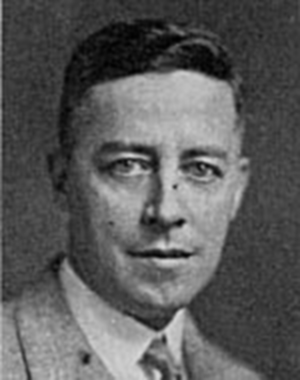

James Bone is an archivist in the Private Specialized Media Division of the Private Archives Branch at Library and Archives Canada.
 

New additions to the Virtual Gramophone – Roméo Beaudry

By Margaret Ashburner

A black-and-white photograph of a man looking right at the camera and wearing a grey suit.

Roméo Beaudry. Source: Canadian Music Trades Journal, Toronto, Fullerton Pub. Co., September 1931, ISSN 0383-0705.

Roméo Beaudry was a key figure in the emerging gramophone music scene in Canada. He founded Starr Phonograph of Quebec and specialized in producing gramophone discs for the francophone market. In addition to this, Beaudry was a busy composer and translator. He wrote many unique and popular songs as well as adapting American songs to French. This selection of newly digitized 78’s provides examples of Beaudry’s extensive work as both a translator and a composer.

Margaret Ashburner is the Special Collections Librarian of the retrospective music collection at Library and Archives Canada

Guest curator: Nicoletta Michienzi

Banner for the guest curator series. CANADA 150 is in red along the left side of the banner and then the bilingual text: Canada: Who Do We Think We Are? and under that text is Guest curator series.Canada: Who Do We Think We Are? is a new exhibition by Library and Archives Canada (LAC) marking the 150th anniversary of Canadian Confederation. This exhibition is accompanied by a year-long blog series.

Join us every month during 2017 as experts, from LAC, across Canada and even farther afield, provide additional insights on items from the exhibition. Each “guest curator” discusses one item, then adds another to the exhibition—virtually.

Be sure to visit Canada: Who Do We Think We Are? at 395 Wellington Street in Ottawa between June 5, 2017, and March 1, 2018. Admission is free.


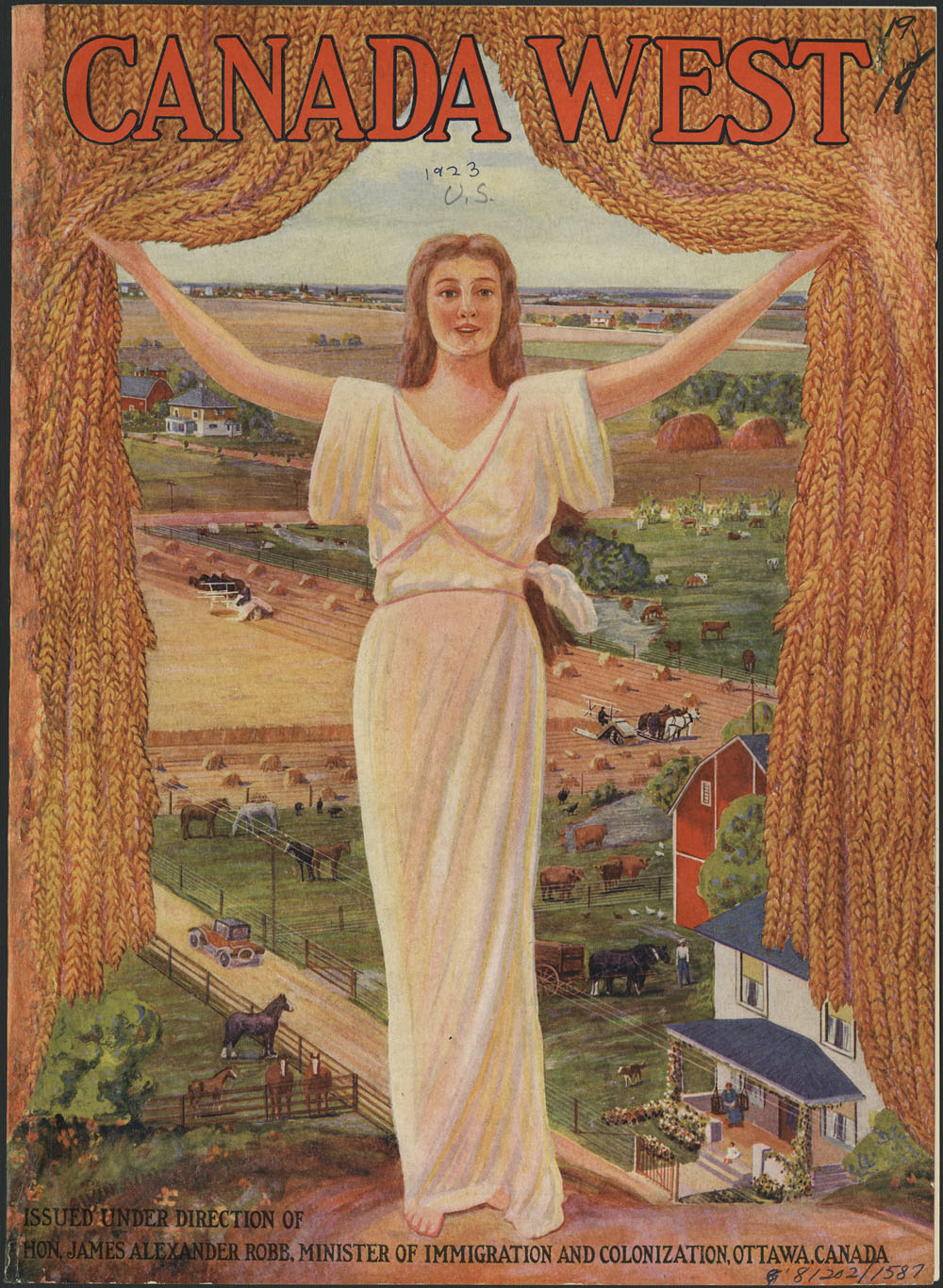
Cover from a Canada West immigration atlas published by the Department of Immigration, ca. 1923

A colour atlas cover showing a blonde woman in a white Grecian-like robe holding open a curtain of golden grain to reveal a busy farming scene complete with green and gold fields, farmhouses, barns and cattle.

Cover from a Canada West immigration atlas published by the Department of Immigration, ca. 1923 (MIKAN 183827)

Behind golden curtains of grain, we see an idealized—and inaccurate—vision of Canada. Mythologizing was common in immigration advertising. At the time, the west was just not as modern or developed as shown here.


Tell us about yourself

I was born and raised in London, Ontario as part of a close-knit Italian-Canadian family. My family’s stories about my culture inspired me to become passionate about the history of Italy.

As a result, I have travelled Italy and other parts of Europe on several occasions, and try to travel whenever I can. I had the privilege of travelling to England for school. While there, I participated in an archaeological dig along Hadrian’s Wall, and during my spare time, I was able to visit parts of northern England and Scotland. I have also travelled Europe with family and friends. During my travels, I always make an effort to visit as many historical and cultural institutions as I can. Visiting these sorts of places is interesting, as it shows you what society values.

My next travel mission is to try to see more of Canada. While I have done quite a bit of travelling outside of North America, I have never taken the time to see my country. I hope that with Canada’s sesquicentennial I will have an opportunity to look more at my country and see what sorts of things we value as Canadians.

Is there anything else about this item that you feel Canadians should know?

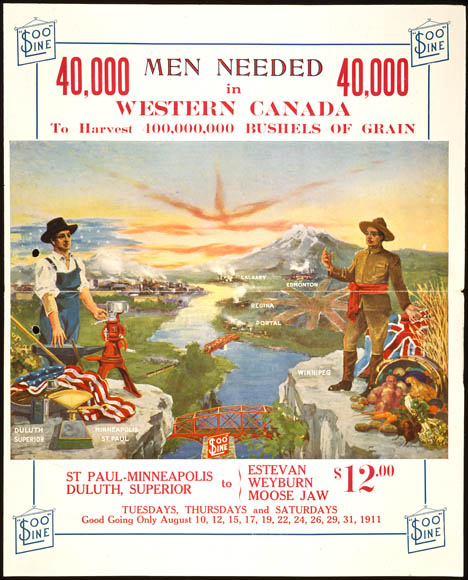
This Canada West cover is a terrific example of Canadian immigration posters from the 20th century. The Canadian Department of Immigration had begun an aggressive advertising campaign in the late 19th century hoping to attract immigrants to the sparsely populated Western provinces.

A colour poster showing a landscape with green fields and mountains with two men standing in the foreground on opposite sides of a river. One has an American flag at his feet while the other holds the Union Jack and has a cornucopia at his feet; he is beckoning the American to come to Canada. Underneath are the departure and arrival locations and dates as well as the price ($12) for the journey.

Promotional immigration poster “40,000 Men Needed in Western Canada” (MIKAN 2837964)

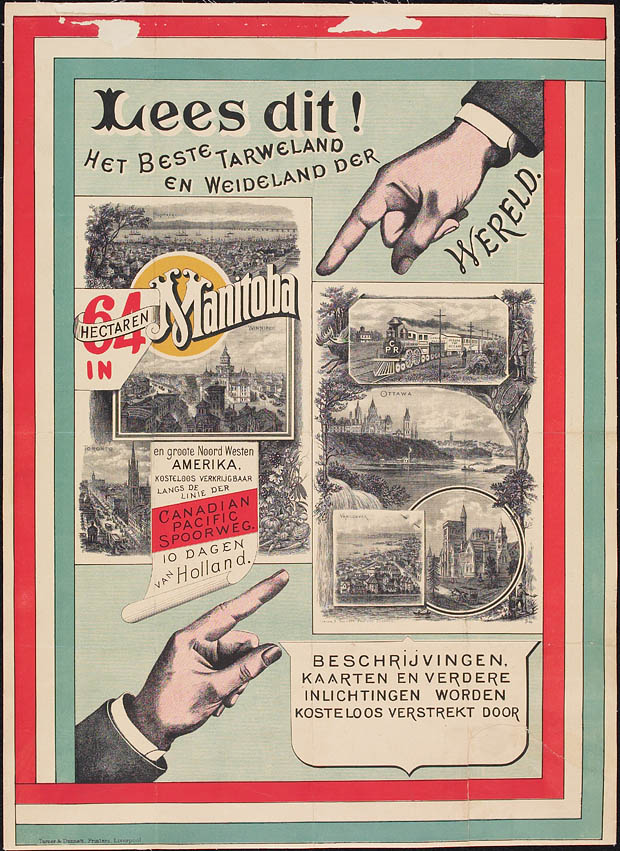
Canada and the British government originally sought to recruit English-speaking immigrants, with many advertisements circulated around the British Isles and the United States. The Department of Immigration did eventually diversify, but in the beginning still focused on white European countries as main sources for immigration. The Netherlands, Germany, and Austria-Hungary were the main targets of immigration campaigns, with text translated from English to other languages. The poster below is an example of promoting Manitoba as a viable area to settle Dutch immigrants.

A colour poster showing giant hands pointing to little vignettes of the different cities in Canada: Montréal, Ottawa, Toronto, Winnipeg and Vancouver against a light green background bordered by green and red stripes. The text is in Dutch and advertises the available land and the length of the journey by boat (10 days from Holland).

Immigration poster “Lees Dit!” [Read this!] advertising Manitoba to Dutch immigrants, ca. 1890 (MIKAN 2837963)

The Canada West cover is part of a larger tradition that used the ideal of land opportunity, abundance and farming as an idyllic lifestyle to attract newcomers to Canada. The focus was to promote Canada’s natural resource as a lifestyle for people who were not landowners in their home countries. Attractive images of wheat fields, cornucopias, and picturesque farming communities were made to sell Canada as a peaceful country full of opportunities, though the art idealized the reality. Atlases like this one also contained pages worth of information on Canada with maps of the western provinces. The information included was to further showcase Canada as a country where land and resources were readily available. Canada West was heavily distributed by the Department of Immigration all over the United States and mainland Europe.

Though these simplistic campaigns seem ineffective now, the Canadian Department of Immigration was successful. By 1911 immigration numbers were around 331, 288 per year. After the First World War, the numbers jumped to over 400,000 per year. Imaged-based advertisements, and the notion of Canada as a land of abundance were successful. These early endorsements sold Canada to people who identified as something other than Canadian. Though the images depicted in the propaganda, were not always realistic, they portrayed Canada as a land of opportunity and abundance.

Tell us about another related item that you would like to add to the exhibition

Canadian immigration and advertising has evolved substantially since the early 20th century. Our ideas of who is an immigrant, and why people choose to come to Canada has changed. How we document immigration has also changed. Technology such as photography and videography have been used to record immigration stories in the modern period.

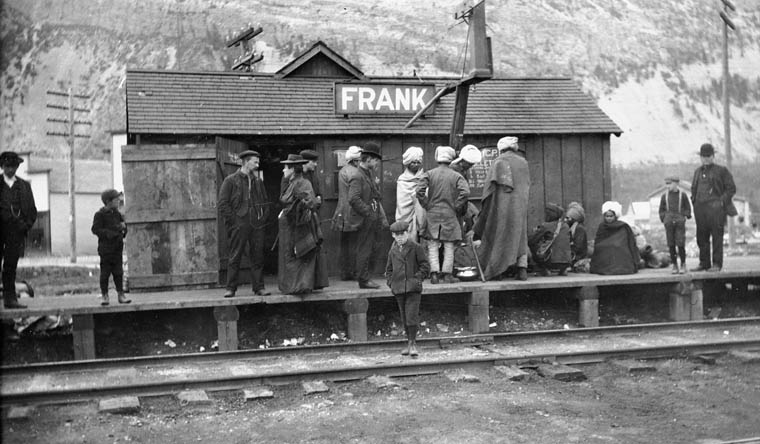
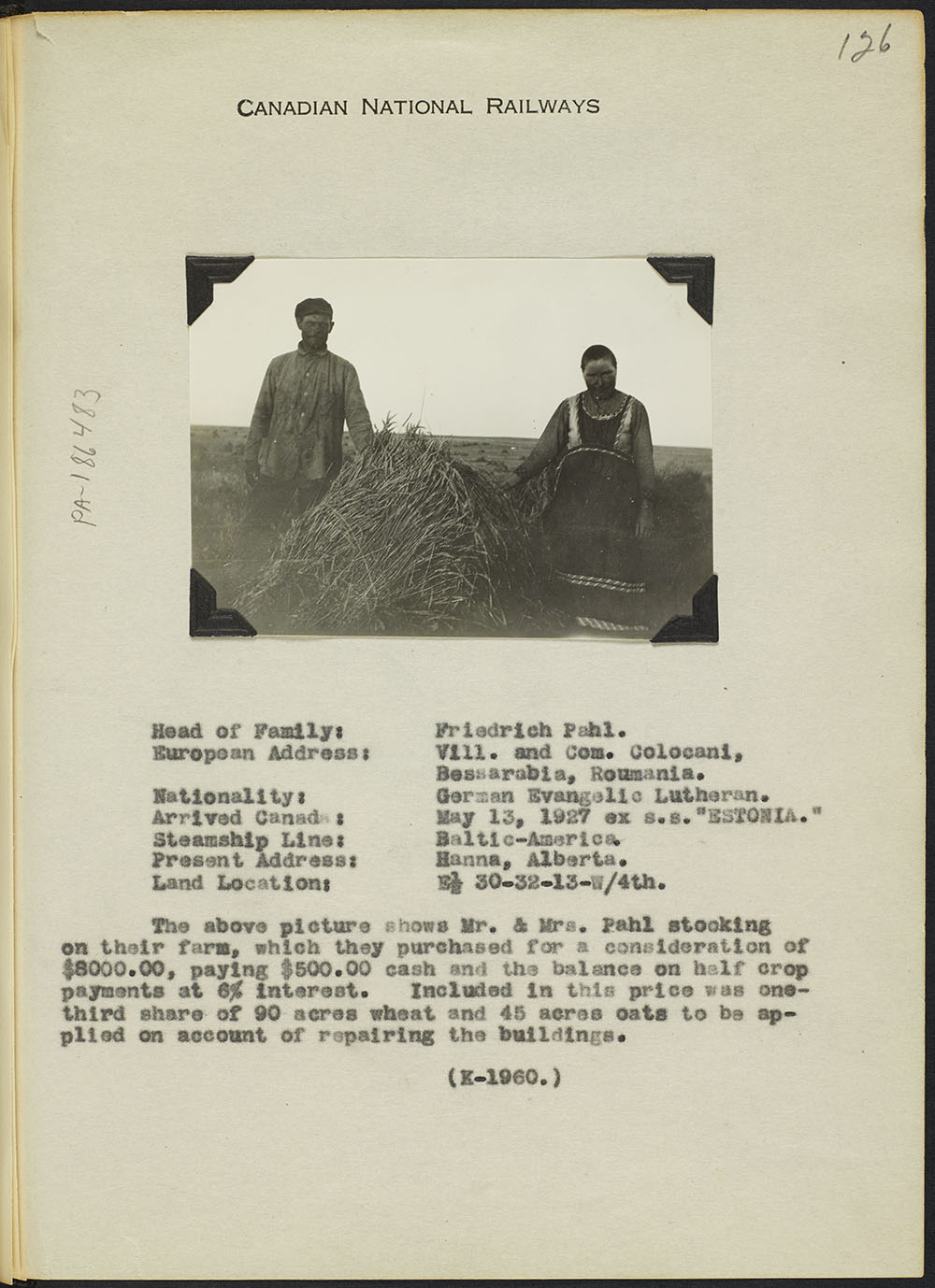
Library and Archives Canada has an amazing collection of contemporary photographs of immigrants ranging from the late 19th century to the present. These images often depict a different immigrant experience. Photos in the archives show that our immigration policies had a global impact. Many of the immigrants who arrived in Canada would not only work in rural areas, but in urban centers and have an impact on the way Canada has formed. Presently, Library and Archives Canada is working on adding more photos to their collection, highlighting the different materials in their collections. More modern photos like those in the exhibition join older photos like those shown here.

A black-and-white photograph of groups of immigrants on a train platform wearing a variety of clothing from traditional Indian garb with turbans to European styles of clothing. Behind them is the railway station, a small hut with the town’s name on the roof. The mountain rises behind the station, and a young boy stands on the tracks.

Group including Indian immigrants on platform of Canadian Pacific Railway station, Frank, Alberta. ca. 1903 (MIKAN 3367767)

A small black-and-white photograph of a man and woman on either side of a hay bale. A description of the family includes their family name, where they came from, how they arrived, where they live, and a short description of their farm.

Mr. and Mrs. Friedrich Pahl on their farm, Romanian immigrants who arrived May 13, 1927, aboard the S.S. Estonia, Baltic-America Steamship Line (MIKAN 3516853)

Library and Archives Canada also has a collection of videos and oral histories related to the immigrant experience. This collection includes videos on the history of Pier 21, one of the largest immigration points in Canada. These video testimonies show the changes in immigration trends, and how the idea of Canada is continually evolving. While we no longer see Canada as an expanse of open field, the idea behind immigration to Canada is the same. Canada is a land of opportunity for global people, and like our earlier poster, Canada is available for immigrants.

Biography

Nicoletta Michienzi has completed an undergraduate degree from the University of Western Ontario with an Honors Specialization in History and a Major in Classical Studies. During her degree, she participated in an archaeological dig in the north of England and was able to see the effects of tourism on historic sites. She continued her education at Western, completing a Master’s degree in Public History. Since graduation she has been employed by various historical institutions in London, Ontario. She is currently working as the Public Programmer at the Royal Canadian Regiment Museum and as a Historical Interpreter at Eldon House. At the Royal Canadian Regiment Museum, she organizes and conducts tours, educating the public about London’s military history and its connection to global conflict. At Eldon House, she interacts with tourists and helps conduct education programs about London’s oldest heritage home. At both institutions, she focuses on visitor services and educating the public, hopefully making visitors enthusiastic about the history of their community and their country.

Related Resources

Francis, Daniel. Selling Canada: Three Propaganda Campaigns that Shaped the Nation. Vancouver: Stanton Atkins & Dosil Publishers, c.2011.

A diplomat, a Prime Minister, and a scholar: remembering Lester B. Pearson

Version française

By Mariam Lafrenie

It goes without saying that the Right Honourable Lester B. Pearson achieved much in his life. Whether you look at his success politically, academically or even athletically—Pearson always excelled. Although Pearson served as Canada’s prime minister from 1963 to 1968, his legacy and indeed his influence began long before his prime ministership: as chairman of the NATO council (1951), as President of the United Nations General Assembly (1952), and as a Nobel Peace prizewinner (1957).

Nevertheless, Pearson’s five-year legacy is very impressive: a new flag, the Canada Pension Plan, universal medicare, a new immigration act, a fund for rural economic development, and the Royal Commission on Bilingualism and Biculturalism which led to the foundation of a bilingual civil service.

A black-and-white photograph of a formally dressed couple. The man is holding a box with a medallion.

Lester B. Pearson and his wife, Maryon at the Nobel Peace Prize Award Ceremony, Oslo, Norway, December 1957. Photograph by Duncan Cameron. (c094168)

A black-and-white photograph of a man standing up and addressing a room of people.

Lester B. Pearson, at the United Nations Conference on International Organization, San Francisco, Calif., USA, 1945. (c018532)

Rising quickly through the ranks and moving from one portfolio to another, Pearson proved himself a worthy and talented diplomat. After a 20-year career in External Affairs, his success did not end there, but followed him throughout the next decade as leader of the Liberal Party (1958-1968). Without a doubt, some of his most exciting—if not his most significant achievements—came during his time as Prime Minister.

A flag for Canada

The quest for a Canadian flag—one that represented everything that Canada had become in the last century and all that Pearson hoped it could become—was fraught with bitter debate and controversy. Indeed, as many may recall, “The Great Flag Debate” raged for the better part of 1964 and saw the submission of approximately 3,000 designs by Canadians young and old.

“Under this flag may our youth find new inspiration for loyalty to Canada; for a patriotism based on no mean or narrow purpose, but on the deep and equal pride that all Canadians will feel for every part of this good land.” – Address on the inauguration of the National Flag of Canada, February 15, 1965

These words, spoken by Lester B. Pearson during the inaugural ceremony of the Red Maple Leaf flag on February 15, 1965 at Parliament Hill, highlight precisely what he aspired to achieve—a uniquely Canadian identity. Few prime ministers can attest to leaving a legacy so great as to have forged an entirely new cultural symbol for their country.

A black-and-white photograph of a man holding an illustration of the Canadian flag.

Lester B. Pearson’s press conference regarding the new flag, December 1964. Photograph by Duncan Cameron. (a136153)

A year of celebration

Not only was Pearson responsible for championing a new Canadian flag, but he was also lucky enough to remain in office during Canada’s centennial year. In his Dominion Day speech on July 1, 1967, Pearson called on Canadians to celebrate their past and their achievements, but also encouraged them to think of the future and of the legacy that they could leave for the next generation of Canadians. Much like this year, when we celebrated Canada’s 150th anniversary of Confederation and were encouraged to think of our future as a nation, 1967 was also a year filled with celebrations.

The aim of the centennial celebrations were twofold: to create memorable events and activities for all Canadians and to create a tangible legacy that current and future generations could enjoy. In fact, both the provincial and federal governments encouraged Canadians to celebrate by creating their own centennial projects—films, parades and festivals, tattoos, recreation centres, stadiums, etc.—and agreed to match their spending. One of the most memorable celebrations was that of the 1967 International and Universal Exposition or Expo 67, as it was nicknamed. Open from April 27 to October 29, Expo 67 is considered one of the most successful World’s Fairs and one of Canada’s landmark moments.

A colour photograph of a group of men standing in front of an enlarged map of New France.

Expo 67’s opening day with its General Commissioner Pierre Dupuy, Governor General of Canada Roland Michener, Prime Minister of Canada Lester Bowles Pearson, Premier of Québec Daniel Johnson and Mayor of Montréal Jean Drapeau. (e000990918)

For many Canadians, 1967 characterized the peak of nostalgia and indeed a year filled with optimism. With this optimism and increased governmental spending, Pearson’s popularity boomed and further solidified his accomplishments as prime minister and widespread support for the Liberal Party amongst Canadians.

Conclusion

Forty-five years ago, on December 27, 1972, after a long and successful political career, Lester B. Pearson passed away. His passing struck a chord with many Canadians as more than 1,200 people attended his funeral service to pay their last respects. Pearson’s legacy and indeed his name are still present today in the numerous awards and buildings named in his honour. Paving the way for what many Canadians and the international community alike have come to love about Canada, Pearson can be said to have shaped and indeed laid the foundation for the Canada we know today.

A black-and-white photo of man standing under an interesting architectural building.

Prime Minister of Canada Lester Bowles Pearson in front of the Katimavik at Expo 67. (e000996593)

The Lester B. Pearson fonds preserved by Library and Archives Canada consists of 435.71 meters of textual records, over 3,500 photographs, 315 audio recordings on various formats, 3 films totalling 47 minutes, 54 items of documentary art, and 98 medals.

Related links


Mariam Lafrenie is an undergraduate student research fellow from Queen’s University who worked in the Private Archives Branch at Library and Archives Canada during the summer of 2017.

Library and Archives Canada releases its latest podcast episode, “A Look inside the Preservation Centre

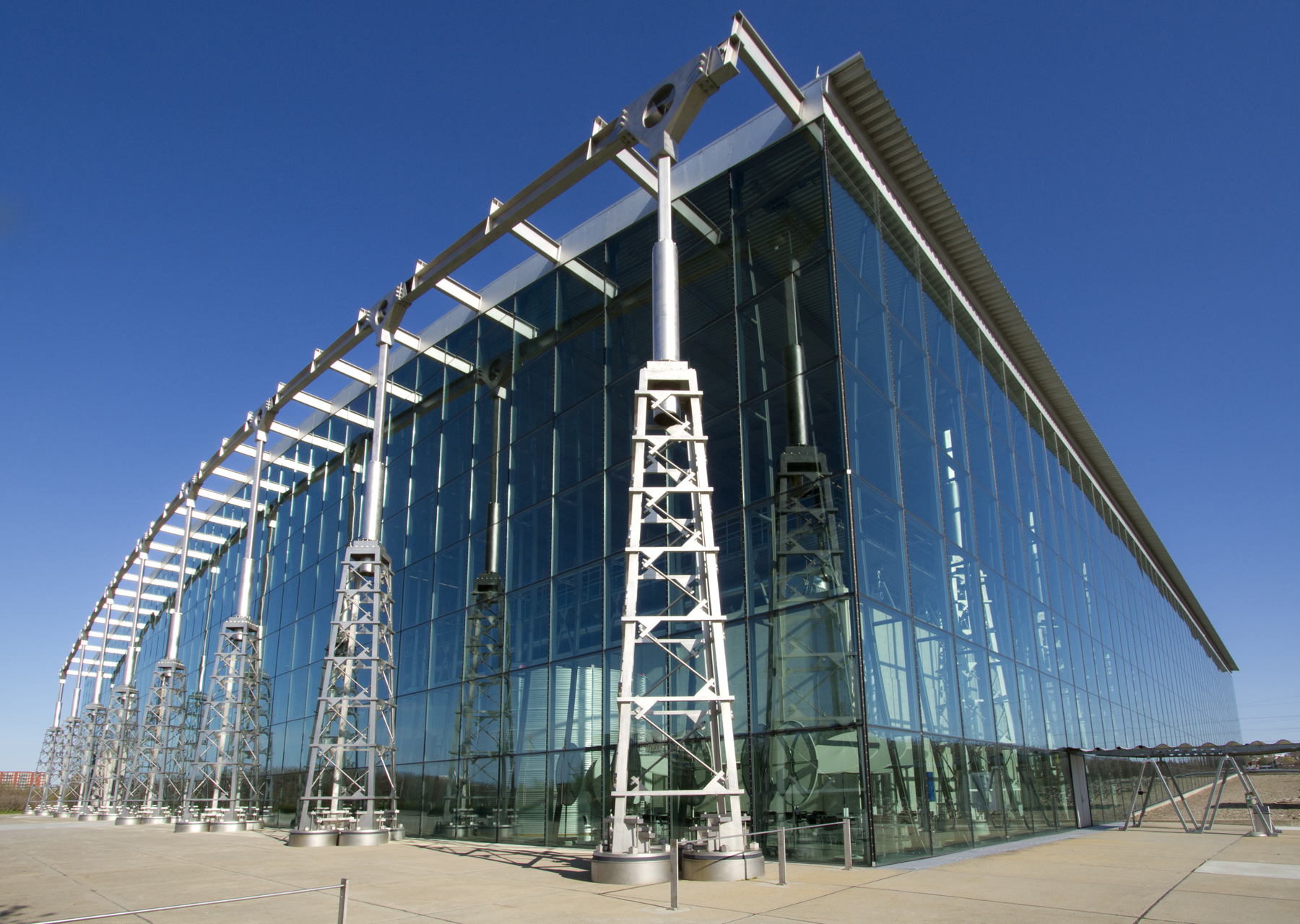
A colour photograph of a large modern building made out of glass with metal pillars.Ever wonder where Library and Archives Canada stores, protects and preserves Canada’s diverse and rich documentary heritage? Join us for this episode as we take you on a walking tour of LAC’s Preservation Centre in Gatineau, Quebec. This state-of-the-art facility is the crown jewel of documentary heritage preservation in Canada and we are celebrating its 20th anniversary in 2017. In this episode, we will guide you through the Preservation Centre, discussing its award-winning architecture and offering insight into how we store and preserve our national treasures.

To view images associated with this podcast, here’s a direct link to our Flickr album.

Subscribe to our podcast episodes using RSS, iTunes or Google Play, or just tune in at Podcast–Discover Library and Archives Canada: Your History, Your Documentary Heritage.

For more information, please contact us at bac.balados-podcasts.lac@canada.ca.

Guest curator: Katie Cholette

Banner for the guest curator series. CANADA 150 is in red along the left side of the banner and then the bilingual text: Canada: Who Do We Think We Are? and under that text is Guest curator series.Canada: Who Do We Think We Are? is a new exhibition by Library and Archives Canada (LAC) marking the 150th anniversary of Canadian Confederation. This exhibition is accompanied by a year-long blog series.

Join us every month during 2017 as experts, from LAC, across Canada and even farther afield, provide additional insights on items from the exhibition. Each “guest curator” discusses one item, then adds another to the exhibition—virtually.

Be sure to visit Canada: Who Do We Think We Are? at 395 Wellington Street in Ottawa between June 5, 2017, and March 1, 2018. Admission is free.


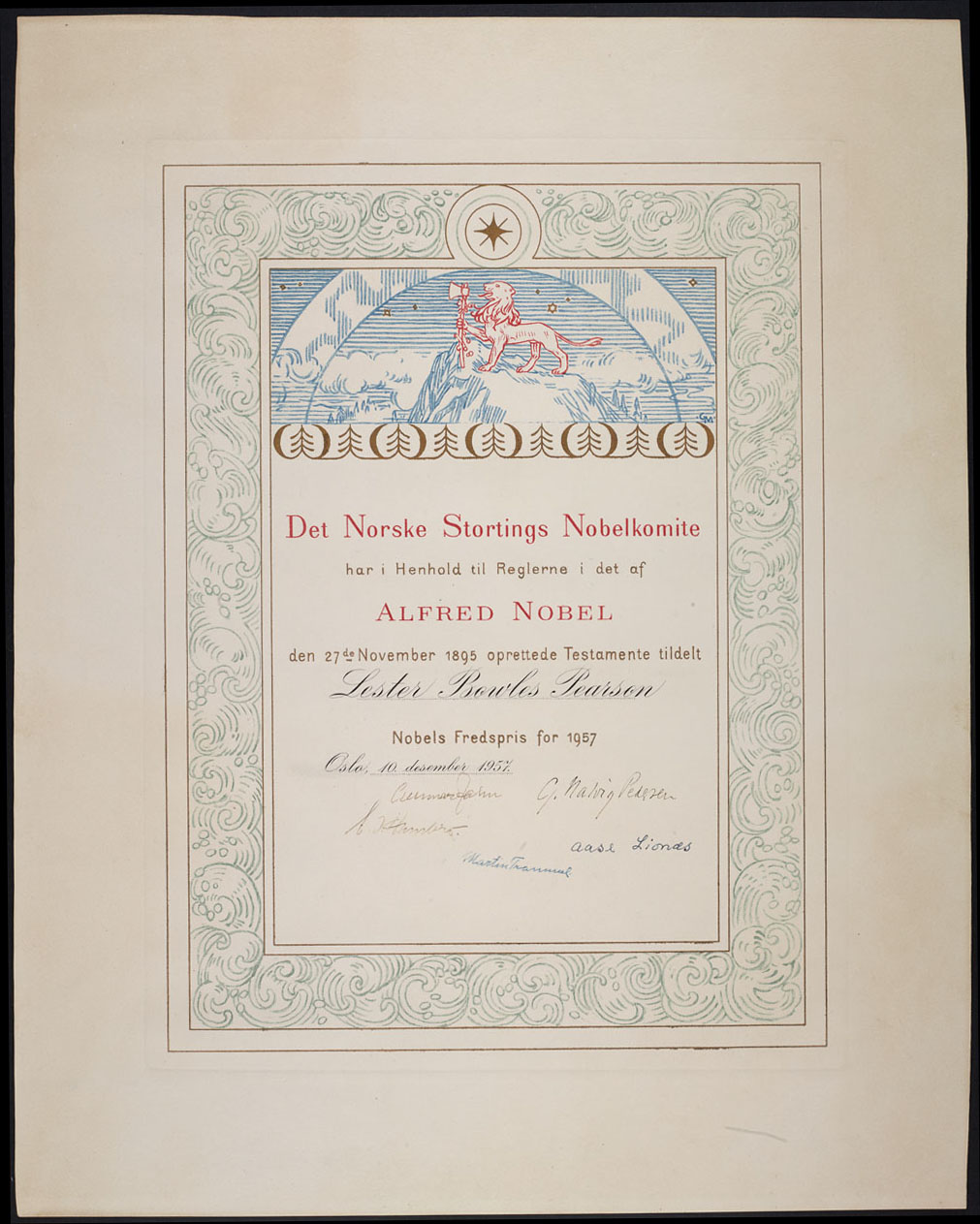
Red and black Norwegian text on a cream background awards the prize to Lester Bowles Pearson. Text is topped by a red lion holding an axe on a blue mountain bordered by blue waves with a circled star at the top.

Nobel Peace Prize awarded to Lester B. Pearson for his role in establishing United Nations Peacekeeping, 1957. Designed by Gerhard Munthe for the Nobel Committee (MIKAN 4900031)

Former Prime Minister Lester B. Pearson’s idea for a neutral military force, to help stabilize conflict zones, earned him the Nobel Prize. Most Canadians now regard peacekeeping as uniquely ours.


Tell us about yourself

I have always had an interest in graphic design. My first career was as a graphic artist and typesetter. I eventually found my way into art history, teaching and now archival work. Although I work primarily with textual documents these days, I am frequently delighted by the array of aesthetically pleasing items in LAC’s collection.

Is there anything else about this item that you feel Canadians should know?

Lester B. Pearson won the Nobel Prize for his role in negotiating a peaceful resolution to the 1956 Suez Canal Crisis. The crisis erupted when Egyptian President Gamel Abdel Nasser seized and nationalized the Suez Canal (then jointly owned by France and Great Britain), a move that threatened the supply of oil to Europe. In retaliation, France, Great Britain and Israel secretly collaborated to attack the Sinai Peninsula. The United States and the Soviet Union subsequently became embroiled in the conflict, with the Soviet Union threatening to use nuclear weapons against the assailants. Pearson, at the time Secretary of State for External Affairs and head of Canada’s delegation at the United Nations, stepped in and helped establish the United Nations Emergency Force, which was instrumental in de-escalating the conflict.

At the presentation ceremony on December 10, 1957, in Oslo, Norway, the Chairman of the Nobel Committee, Gunnar Jahn, stated that the prize was being awarded to Pearson because of “the powerful initiative, strength, and perseverance he has displayed in attempting to prevent or limit war operations and to restore peace in situations where quick, tactful, and wise action has been necessary to prevent unrest from spreading and developing into a worldwide conflagration.”

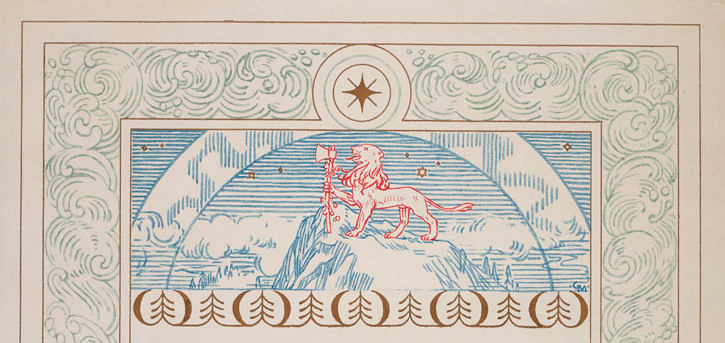
Although Pearson was awarded the Nobel Prize in 1957, the design of the certificate dates from the beginning of the 20th century. In addition to hand-drawn calligraphy, it features a lithograph designed by Gerhard Munthe in 1901, the year the Nobel Peace Prize was first awarded. A Norwegian painter, decorative artist and illustrator, Munthe took many of his artistic motifs from his native Norway. He worked in the National Romantic Style, the Scandinavian version of Art Nouveau in the late 19th and early 20th centuries. This style, which was a reaction against industrialism, promoted ideas of northern nationalism based on the renewal of interest in Norse mythology and sagas. The illustration at the top of the certificate shows a lion holding an axe, a symbol of power and courage that appeared in Norwegian folk art as far back as the 13th century. The motif also appears on the coat of arms of Norway. Atop a decorative frieze of stylized fir trees, the lion stands proudly in a wild northern landscape. Northern lights swirl above his head, and the image is surmounted by the North Star. Although the overall design is delicately rendered and restrained, it is nevertheless a powerfully evocative image.

Detail of the certificate showing a red lion holding an axe on a blue mountain bordered by blue waves and a star in a circle.

Detail of Pearson’s Nobel Peace Prize showing the lion on the certificate  (MIKAN 4900031)

Tell us about another related item that you would like to add to the exhibition

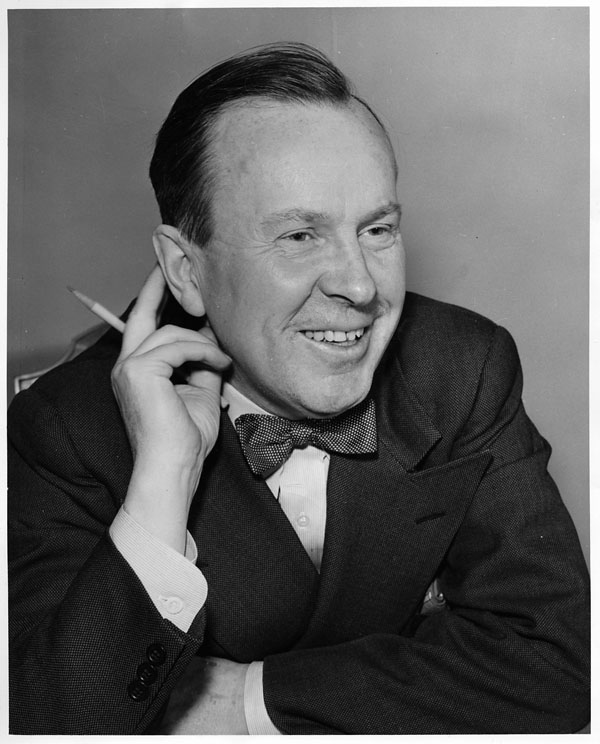
Pearson wearing a suit with a bow tie and holding a pencil in his upraised hand.

Lester B. Pearson holding a pencil. Photo taken August 11, 1944. (MIKAN 3607934)

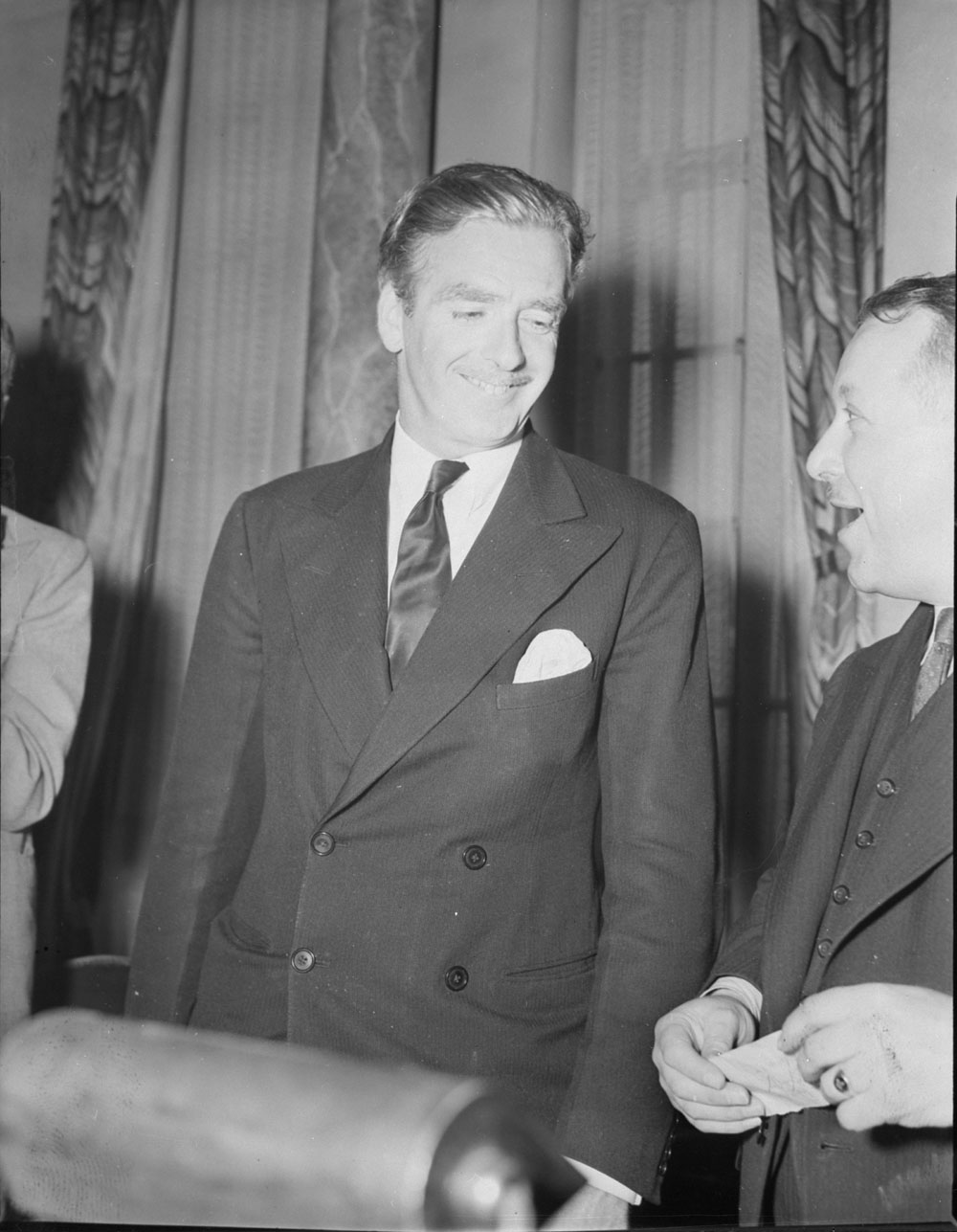
A smiling man speaking with another man against a curtained window with the drapes drawn back. Both men are wearing suits and ties.

Anthony Eden. Photo by the Alexandra Studio. (MIKAN 3215249)

I was particularly struck by a photograph that shows Lester B. Pearson with another of the key players in the Suez Crisis: British Prime Minister Sir Anthony Eden. Duncan Cameron, an Ottawa photographer from Capital Press Limited (and the only Canadian contract photographer for Time Life Inc.), snapped the photo of Pearson and Eden outside the Parliament Buildings in Ottawa on February 6, 1956. Eden, who had known Pearson since the 1930s, was visiting Canada and had just given a speech to the House of Commons. A long-time politician known for his skill in public affairs, Eden succeeded Winston Churchill as prime minister of the United Kingdom in 1955. In the photograph, the two men appear relaxed and happy; there is no premonition that a rift would develop between Canada and Great Britain a few months later, after Eden collaborated with France and Israel to invade Egypt. While Pearson went on to win the Nobel Peace Prize, become Canada’s 14th prime minister, and gain a reputation for international diplomacy, Eden’s popularity took a nosedive, and as he was in ill health, he resigned in February 1957. Interesting side note: the photographer, Duncan Cameron, would eventually join the Public Archives of Canada, where he became Photo Custodian of the National Photographic Collection. LAC holds his fonds, which consists of 175,000 prints, negatives and slides.

Biography

Katie Cholette is an archivist in the Governance and Political Archives section. She is currently working in the private military and non-LAC Act institutions areas. Katie has a BA in Art History, an MA in Canadian Art History, and a PhD in Canadian Studies. She has previously worked as the Curator of Acquisitions and Research and the Curator of Exhibitions at the Portrait Gallery of Canada (2007–2008; 2011), held two Research Fellowships in Canadian Art at the National Gallery of Canada (2006; 2012–2013), and taught courses in Art History and Canadian Studies and at the College of the Humanities at Carleton University (2003 to present). She has delivered papers and published articles on various aspects of art, architecture, culture and identity, and has worked on a number of freelance curatorial and research projects. As a student at Carleton, she was a regular patron of Mike’s Place, the graduate student pub named in Lester B. Pearson’s honour.

Portraits on Metal: Tintypes from Library and Archives Canada – an exhibition at the National Gallery of Canada

By Jennifer Roger

The tintype process was introduced in 1855 and quickly became one of the most popular ways for people to access and experience photography.

Tintypes are direct positive images, meaning they have no negatives. Created on a thin sheet of iron that is coated in a dark lacquer or enamel and layered with a collodion emulsion, tintypes are one of the most durable photographic processes. Prevalent in both museum and personal collections, they are compelling records of 19th-century life.

Much more affordable than a daguerreotype, tintypes became the medium of choice for people seeking to have their portrait made. Portrait studios offered tintypes for mere pennies. Their ease of processing created more portability, allowing mobile studios to flourish and expand their services to outdoor fairs or tourist destinations. Tintypes were used to record many outdoor scenes and events. The new medium offered the public an accessible option for capturing likenesses, and it became a catalyst in the acceptance of photography into popular culture.

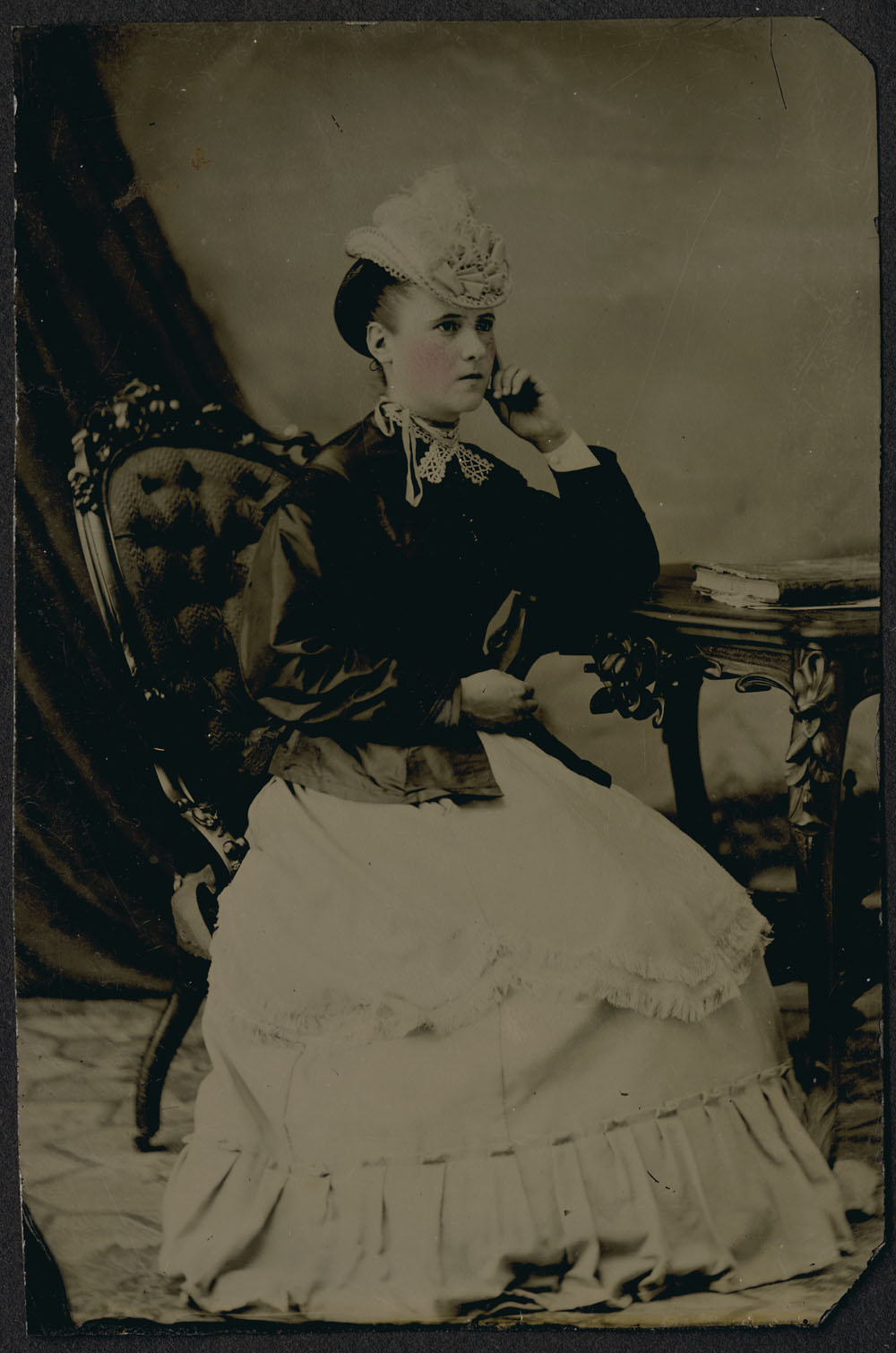
A hand-tinted, black-and-white portrait of a seated woman.

Portrait of a woman, possibly a member of the Boivin family, mid 19th century (MIKAN 3262334)

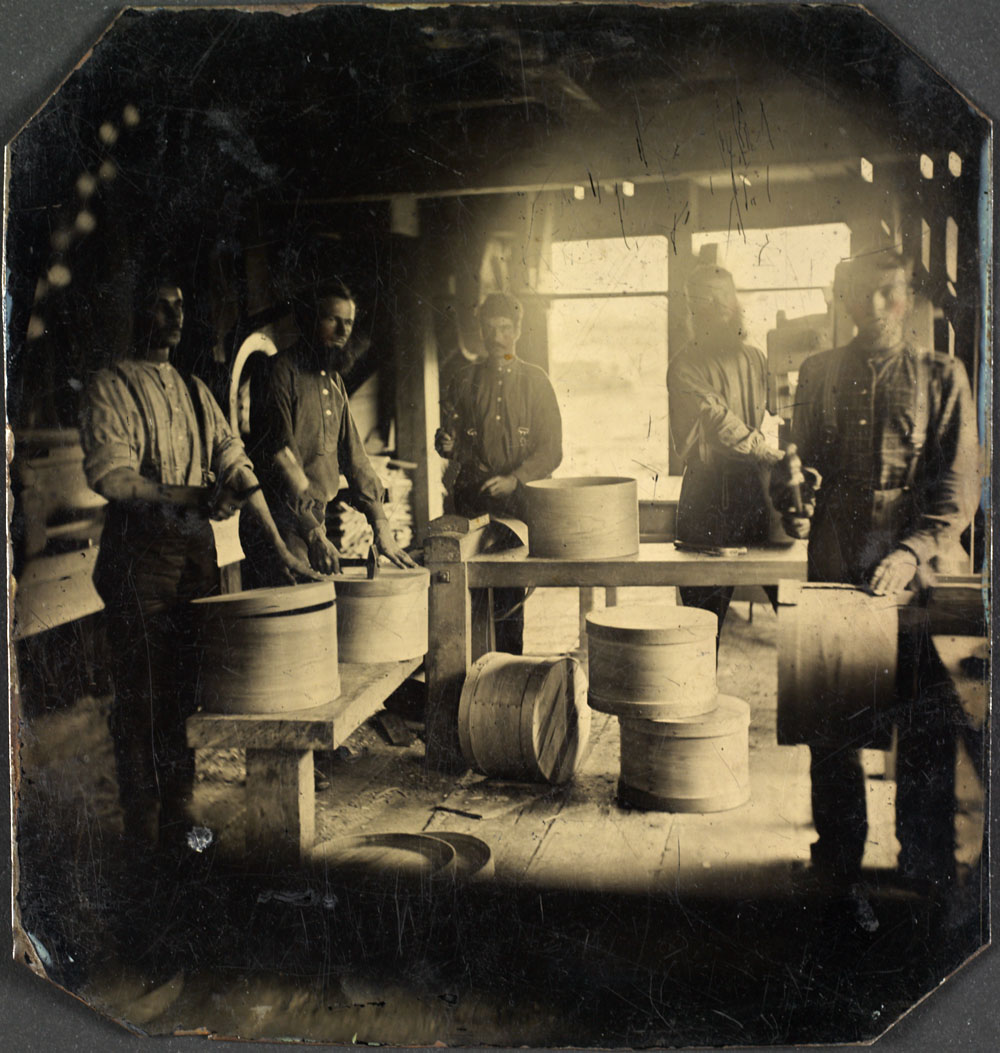
Because of their affordability and ease of production, tintypes were appealing to the middle and working classes. The move from the controlled environment of the studio to the outdoors led to a proliferation of never-before photographed scenes of 19th-century life, including people at work, street scenes, buildings and structures, and even battle scenes.

A black-and-white photograph of five men assembling wooden boxes inside a mill.

Interior of a mill, showing men assembling cheese boxes, Maberly, Ontario, mid 19th century (MIKAN 3316695)

A new exhibition at the National Gallery of Canada features a selection of these intriguing objects. Drawn from the collection of Library and Archives Canada, these tintype portraits were created both inside and outside the studio and offer glimpses of life in 19th-century Canada.

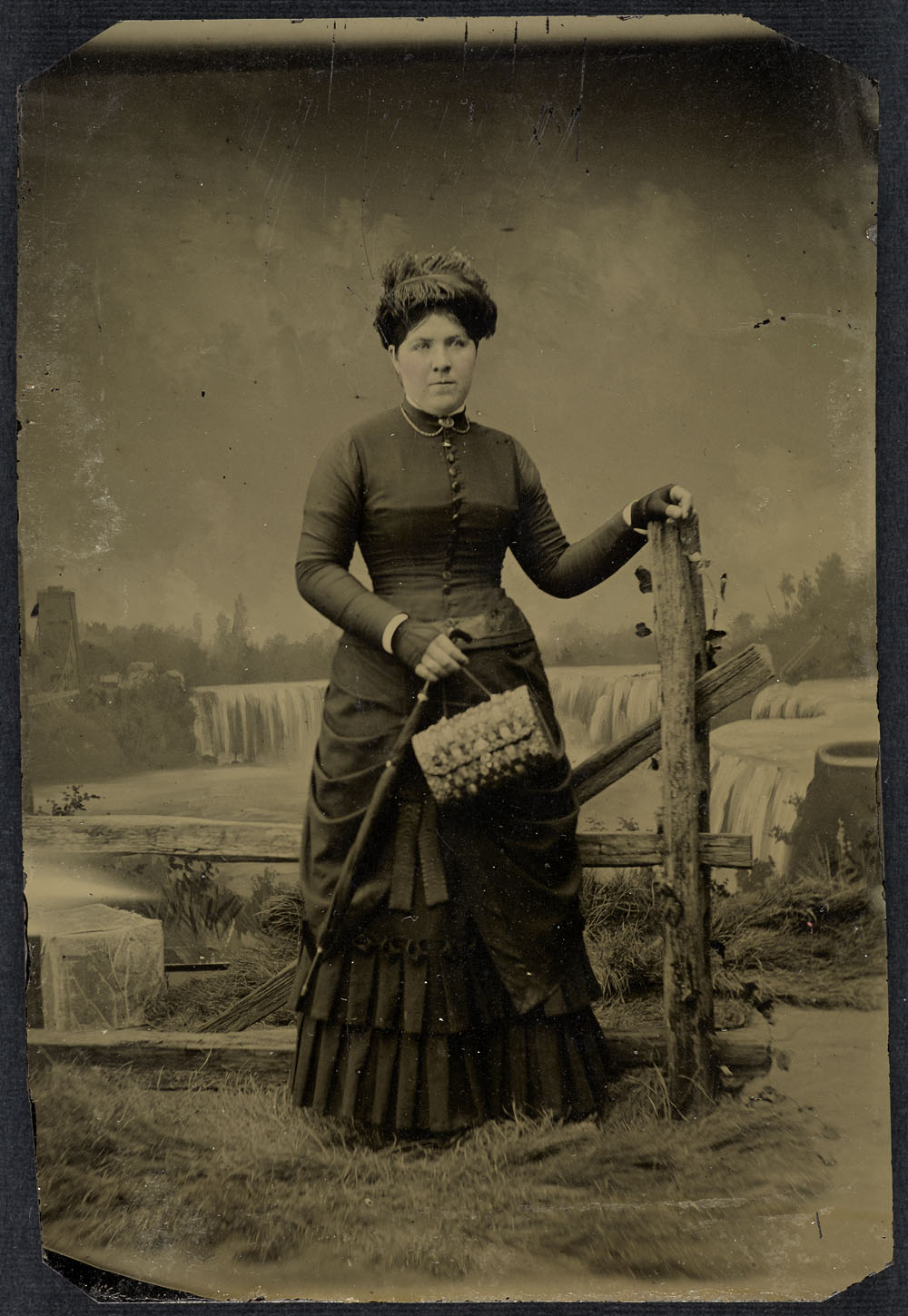
The exhibition features several studio portraits, such as one of an unidentified woman posing in front of a Niagara Falls backdrop. Backdrops and studio props were widely used in 19th-century portrait studios, not only for aesthetic reasons but also as a method of self-expression.

Niagara Falls was one of the most desirable tourist destinations in the 19th century, so when used as a backdrop, it could have served as an expression of prestige or of personal interest in the attraction. If one could not personally travel to the site, a backdrop could be the next best thing. Backdrops can also provide clues as to the identity of the photographic studio.

A black-and-white studio portrait of an unidentified woman standing next to a fence with a scene of Niagara Falls in the background.

A studio portrait of an unidentified woman standing next to a fence with a scene of Niagara Falls as the backdrop, mid 19th century (MIKAN 3210905)

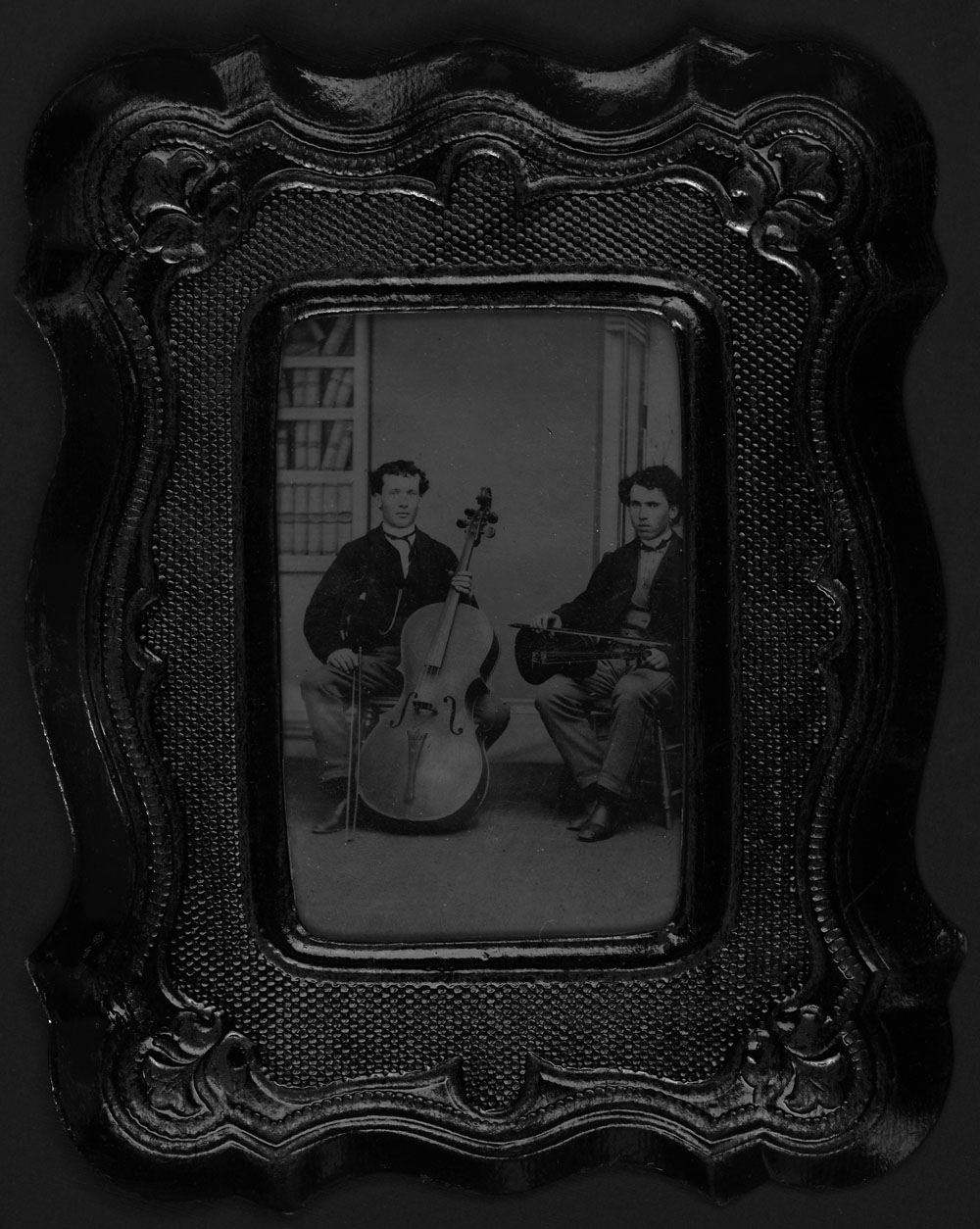
People often posed with personal items that were of sentimental value or professional significance, as a way to convey who they were or express what was important to them. Sitters chose items that they felt characterized them, such as tools of their trade, musical instruments and photography equipment. Known as “occupational” portraits, these images are revealing and intimate records of past identities.

A black-and-white portrait of two young men seated. One is holding a violin and the other is holding a cello.

Two young men seated, one is holding a violin and the other is holding a cello, mid 19th century (MIKAN 3262290)

For more examples of these intriguing tintype portraits, visit Portraits on Metal: Tintypes from Library and Archives Canada on display within the Canadian Indigenous Galleries at the National Gallery of Canada in Ottawa from December 12, 2017 to July 6, 2018.


Jennifer Roger is a Curator in the Exhibition and Loans section at Library and Archives Canada.