Jackie Robinson and the baseball colour barrier

Version française

By Dalton Campbell

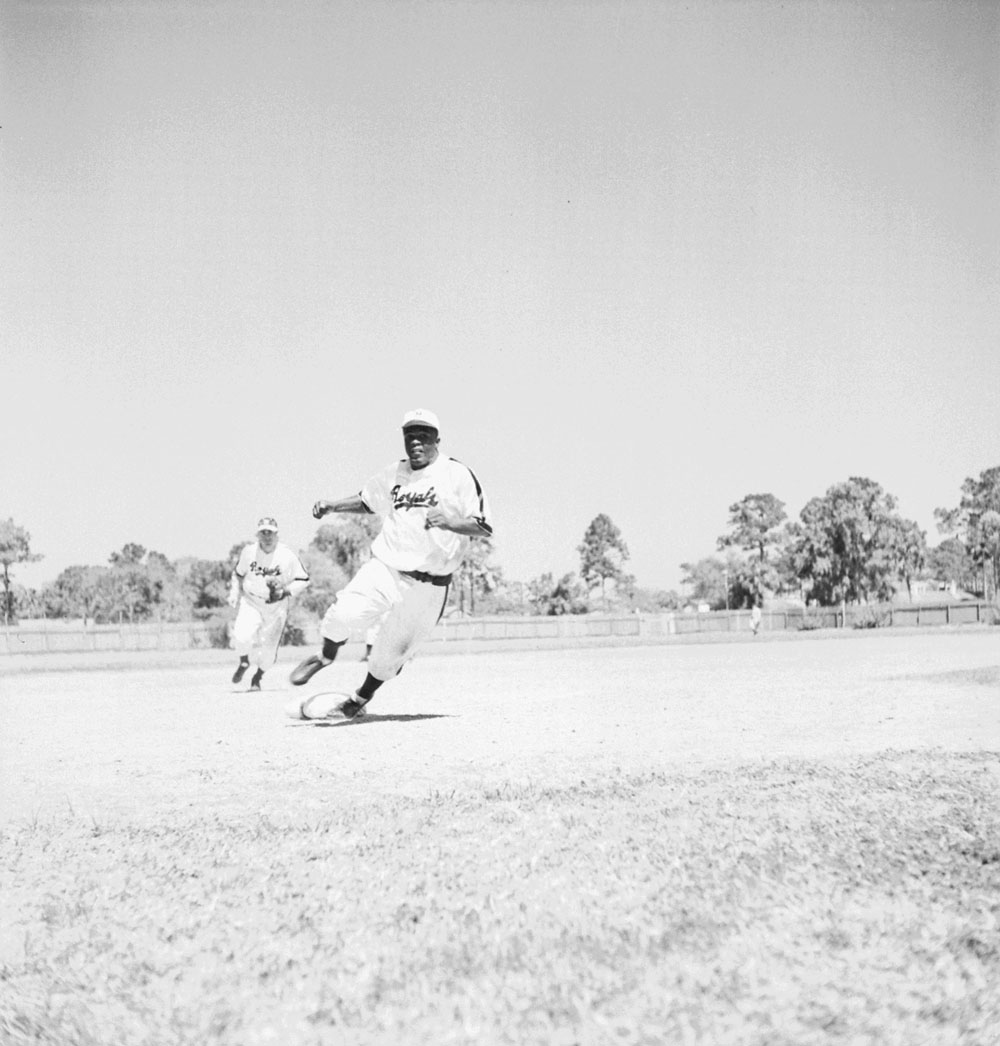
In April 1946, Jackie Robinson took the field with the Montreal Royals baseball team, which played in the International League. He was the first Black man signed to a Major League Baseball team in the twentieth century. After signing a contract in October 1945 with the Brooklyn Dodgers, he was assigned by Dodgers’ management to the Royals, the Dodgers’ top minor league affiliate, in order to gain experience. They thought that Montreal would be a less hostile city for him to learn to deal with media scrutiny and fan attention and to endure on-field discrimination and physical intimidation.

Black-and-white photograph of a baseball player running the bases. His foot is on third base and he is turning and heading to home plate. In the background are other players, and in the distance the outfield fence and trees.

Jackie Robinson, in a Montreal Royals’ uniform, circles third base and heads for home during spring training. April 20, 1946 (a201547)

In the first game of the season, he more than held his own. He had four hits, three runs, and a home run. A famous photograph captures Royals’ teammate George “Shotgun” Shuba shaking Robinson’s hand as he crossed home plate after his home run. This is believed to be the first photograph of a white man congratulating a Black man on a baseball diamond. Continue reading

Photography of John Boyd now on Flickr 

John Boyd (1865–1941) was born in Emyvale, Ireland. His family immigrated to Toronto in the late 1860s. He was a railway official as well as a photographer. His work with the railroad gave him ample opportunities to take photographs as he travelled across Ontario. The John Boyd fonds consists of photographs portraying all manner of Canadian life, all worth exploring. There are images of towns and cities, royal visits, military life, modes of transportation, industry and agriculture, social conditions, pastimes, and nature.

John Boyd

As Canadians we appreciate discovering stories about our country through the works of our painters and photographers, past and present. Canadian archives hold many collections, and sometimes the collection of a particular artist or photographer may contain literally thousands of images for us to explore. This is the case with photographer John Boyd whose collection at Library and Archives Canada (LAC) boasts 28,959 black-and-white photographs.

John Boyd (1865–1941) was born in Emyvale, Ireland. His family immigrated to Toronto in the late 1860s. He was a railway official as well as a photographer. His work with the railroad gave him ample opportunities to take photographs as he travelled across Ontario.

These photographs represent Boyd’s amateur work from 1898 to 1926. A large collection in itself, it is nonetheless dwarfed by the collections held at the City of Toronto Archives. One collection in particular is that of The Globe and Mail, which contains 140,000 of Boyd’s photographic negatives taken from 1922 to before his death in 1941.

The collections at LAC and the City of Toronto Archives complement each other in their dates of creation and subject matter.

The John Boyd fonds consists of photographs portraying all manner of Canadian life, all worth exploring. There are images of towns and cities, royal visits, military life, modes of transportation, industry and agriculture, social conditions, pastimes, and nature.

During the First World War, Boyd focused mainly on the home front, photographing recruiting campaigns, training exercises, and the manufacture of munitions, airplanes and ships. He also photographed everyday Canadians who contributed to the war effort at home as soldiers fought overseas. The following selection of images provides a glimpse of the activities during that time.

A black-and-white photograph of well-dressed men, women and children looking at and exploring an outdoor exhibit of a reconstructed Canadian military trench.

Visitors to a reconstructed 35th Battalion trench, Canadian National Exhibition, Toronto, Ontario, 1915 (MIKAN 3395547)

A black-and-white photograph of women, soldiers and children gathered outside a train. Other soldiers on the train are leaning out of the windows, presumably saying goodbye to their families.

Personnel of the Cycle Corps leaving Exhibition Camp for overseas service, Toronto, Ontario, May 15, 1915 (MIKAN 3194471)

A black-and-white photograph of two soldiers descending the steps of a train car. They are both looking down at the photographer and one is holding a kitten.

Volunteers for war and cat mascot with the 28th Regiment, Toronto, Ontario, August 22, 1914 (MIKAN 3403478)

A black-and-white photograph of soldiers re-enacting how they move out from their trenches for a crowd of spectators at an exhibition.

Soldiers moving out from their trenches, Exhibition Grounds, Toronto, Ontario, September 11, 1915 (MIKAN 3403554)

A black-and-white photograph of two soldiers stopped on a dirt road. One is taking a compass reading as the other takes notes.

Soldiers taking a compass traverse on the intelligence course at Camp Borden, Ontario, September 26, 1916 (MIKAN 3403628)

A black-and-white photograph of a soldier standing in a field holding a large wrench.

Private Vasili Salivarsky, D Company, 123rd Battalion, Toronto, Ontario, March 30, 1916 (MIKAN 3220871)

You can view a selection of Boyd’s images in this Flickr album. To explore the entire collection, start your exploration in the John Boyd fonds, and select “Lower-level descriptions.”

Happy searching!

Don’t miss a post!

There are several ways to make sure that you don’t miss any of Library and Archives Canada’s blog articles. The simplest one is to look at the bottom right corner of your browser and find the “Follow” icon.

Follow iconOnce you click on the plus sign, a box will pop up and prompt you to enter your email.

Enter your email address boxA confirmation email will be sent to you and you can confirm that you do, indeed, want to subscribe to the blog. Once you get to the confirmation page you can stipulate whether you want to receive updates daily or weekly or when an article is published.

You can also follow the blog by subscribing to the RSS (Really Simple Syndication) feed. In the lower left-hand corner of the page where an article appears, there’s a little orange icon labelled RSS – Posts.

Suscribe to our RSS feed.When you click on the icon or its label, another page opens up where you can choose which application will handle the feed. If you do not already have a default feed reader, you can select one at this point. Find out more about RSS here. Or you can follow other RSS feeds offered by Library and Archives Canada, by visiting the RSS page.

Tips for aviation accident research

Let’s be honest: Finding information on a civil aviation accident is no small feat. In the federal government, organizational changes involving aviation accident management and the evolution of records classification are making the researcher’s task even harder.

But seek and, generally, ye shall find! So let’s look at how to go about researching an aviation accident effectively.

First, you need to have certain basic information on the accident you’re researching:

  • Aircraft model
  • Accident date and location
  • Aircraft registration number
  • Aircraft type (civilian or military)

This will make things easier, because the finding aids related to aviation accidents are put together based on that basic information.

You must then determine where the records you are looking for might be located, i.e., select the right record group. The following reference table will help guide your first steps:

Years of Responsibility Department Record Group Number
1923–1936 Department of National Defence

Civil Aviation Branch

RG24 / R112
1936–1984 Department of Transport
Air Services Branch (1936-1970)
Canadian Air Transportation Administration (1970-1985)
RG12 / R184
1984–1989 Canadian Aviation Safety Board R13086
1990–present Transportation Safety Board RG156 / R1009

Each record group is divided into series and sub-series. For each of those subdivisions, you will need to consult a finding aid to determine whether a file exists pertaining to your research topic. It is a painstaking process, but some aids are available online (for example, the accession “Aviation Accident Reports 1919-1977“—RG12), which narrows down the research that needs to be done at 395 Wellington Street, Ottawa.

Here are some things to take into consideration:

  • Two types of records pertain to accidents: the accident report and the occurrence investigation. They are not always filed in the same location, so you’ll have to check the entire record group to find them.
  • In the 1920s and 1930s, National Defence had the mandate to investigate accidents. Even if your research is on a civilian aircraft, consult RG24.
  • Your file could be located in the Central Registry (records originally stored in Ottawa) or in the regional registries (stored in the regions: Maritimes, Pacific, etc.).
  • Library and Archives Canada’s (LAC) collection has gaps: we do not have all records pertaining to aviation accidents. Sometimes, a file simply does not exist.
  • Some records are still at the accession stage. They have been transferred to LAC but have not yet been processed by an archivist. If the description in our database contains a note to that effect, consult the links under the heading “Accession” (see “Scope and Content” in connection with the note “Please consult the related accessions”).

For example, here is a screenshot associated with the series Central Registry Files from the Transportation Safety Board fonds:

Screenshot showing that the files have indeed been acquired, but not yet processed.

List of accessions from Central Registry Files (RG156)

Each record group has its own challenges but the basic concepts explained here will help you to conduct your research effectively.

Standing Committees: finding their printed information, pre-1995, or print-based access (Part 2)

Now that we’ve explored finding Standing Committee information on the Web, how do we access the paper versions? We will be examining the following documents:

  • Minutes of Proceedings: the official record of the committee
  • Evidence: verbatim transcripts of the meetings
  • Reports: the final results of business or study completed by the Standing Committee, presented to the House of Commons

As in Part 1, we will use the Standing Committee dealing with the Environment as our example. AMICUS, the Library and Archives Canada catalogue, is our access point and we will use the Advanced Search so that all searching options are available.

Continuing with the environmental theme for documents published in 1986, search using the following:

  1. In the Name Keyword field, type standing committee inside quotation marks.
  2. In a second Name Keyword field, type environment.
  3. Type 1986 in the Any Keyword field,* then press Enter.

*Note: Start with the date in the Any Keyword field, as the session may span several years and you’ll have a better chance of retrieving relevant records. Or, you can omit the date completely and sort your results by date.

The results list shows:

  • the report produced that year, Forest Resources and Industries in Eastern Canada
  • two microform versions of the Minutes of Proceedings and Evidence
  • the paper version of the Minutes of Proceedings and Evidence for the session

Most importantly, we discover that the name of the committee in 1986 was the Standing Committee on Environment and Forestry.

The catalogue record for the report follows. Key information for retrieval has been highlighted.

AMICUS No. 6662440 Monograph
NLC COPIES: C.O.P. – COP.C.XC50 – Add specific Parliament, session and issue no. / Ajouter la législature, la session et la livraison désirée
NAME(S): *Canada. Parliament. House of Commons. Standing Committee on Environment and Forestry
TITLE(S): Forest resources and industries in Eastern Canada : first report / Standing Committee on Environment and Forestry
PUBLISHER: [Ottawa] : The Committee, 1986.
DESCRIPTION: ii, 95, [17, 18], 107, ii p.; 27 cm.
SERIES: Canada. Parliament. House of Commons. Standing Committee on Environment and Forestry. Minutes of proceedings and evidence of the Standing Committee on Environment and Forestry = Procès-verbaux et témoignages du Comité permanent de l’environnement et des forêts. 1984-85-86, issue no. 7
NOTES: Text in English and French with French text on inverted pages.
June 1986”.
Includes bibliographical references.
RELATIONSHIPS: Canada. Parlement. Chambre des communes. Comité permanent de l’environnement et des forêts Ressources et industries forestières de l’est du Canada :. [Ottawa] : Le Comité, 1986.

You’ll notice that the record specifies that you should “Add specific Parliament, session and issue no.” This is required for the physical retrieval of these publications at Library and Archives Canada.

Where do we find this information?

Specific Parliaments are listed on PARLINFO. In this case, 1986 spans both the 1st and 2nd sessions of the 33rd Parliament. If we were to order the report released in June 1986 (see highlighted Note in record above), we would request the 33rd Parliament, 1st Session (1984.11.05-1986.08.28), Issue no. 7 (see highlighted Series note in record above).

And so ends our brief introduction to searching the Standing Committees!

Standing Committees: finding their electronic information, post-1995, or Web-based access (Part 1)

Parliamentary Standing Committee information can be tricky to find, if you don’t know how the process works. In this two-part series, we’ll link the methods of finding the current, Web-based information to locating earlier hardcopy materials (as far back as the mid-1800s) held at Library and Archives Canada.

A good deal of parliamentary work is done in committee, where members study and amend bills, or examine current issues or departmental spending plans referred to them by the House of Commons.

After every meeting, two official documents are published:

  • Minutes of Proceedings: the official record of each committee meeting contained in a numbered issue. Each issue includes that meeting’s date, content, subjects discussed, list of witnesses, and references to any reports to the House.
  • Evidence: the verbatim transcripts of the meeting

A third official document, the committee report, is the document that most researchers are interested in. These reports are produced irregularly, upon the committee’s completion of specific business or study, and are subsequently presented to the House. There may be responses by the government and/or the parties.

As an example, we will use a study on urban conservation, produced by the Environment committee. Information about standing committees from 1995 to present day, is located on the Parliament of Canada website. The printing of paper versions of committee materials ceased in 1998.

From the front page of the website, follow the links for Parliamentary Business [tab at top of page] → Committees → House of Commons Committees → List of Committees → ENVI Environment and Sustainable Development.

How to find a report

The quickest way to find reports is to use the Search box at the top right of the page. Type “urban conservation” report (keep the words together inside quotation marks); the first item on the list is the report we’re looking for – Urban Conservation Practices in Canada.

Note: Print format [upper right] gives you the searchable .pdf version.

Upon opening the document, we discover the parliament and session in which the report was released (important for further research), i.e., 41st Parliament, 1st Session, June 2, 2011-September 13, 2013.

To search by session, go to the Committee home page, click “Select a different session” and choose the one in which our report was tabled, i.e., 41-1. This opens up a page showing the Summary of Work of the committee during that session. Click on All Reports. Here we find more information about our document—the report number, the dates it was presented to the House, and the government’s response. By clicking on Study Details for Report 7, you’re brought to the page with a list of Witnesses (Evidence) as well as the transcripts of the related Meetings (Minutes of Proceedings).

This brings us to the end of Part 1 on the Standing Committees. There’s more to come in Part 2, where we deal with the task of finding the paper formats!

Canadian company directories held at Library and Archives Canada

There are over one million companies in Canada. They include banks, grocery stores, pharmacies and department stores and we interact with them on a daily basis. If you need information about companies’ origins or how they were organized at varying points in time, the Library and Archives Canada (LAC) collection has a number of published resources to help you find what you need. With more recent information often accessible in online directories and business resources, you may find LAC’s resources more useful for historical research. This post will focus mainly on directories, a significant source of information about companies.

A company directory, whose title may change frequently in the course of its lifetime, provides factual, publicly available information that is published annually in a single resource. Directories may also differ in content and comprehensiveness. Print directories generally cover a larger time period than other formats, such as online or microform.

Well-known directories include the white pages telephone companies publish. Yellow Pages can be used to locate companies by name or line of business. LAC, meanwhile, has a historical collection of telephone books on microfilm, some dating back to the 19th century. The microfilm includes an index. A printed index is also available for consultation in the reference room on the 2nd floor of our facility at 395 Wellington Street.

Another important resource is the Financial Post family of directories, published by MacLean-Hunter Limited since the late 19th century. The FP Survey of Predecessor & Defunct Companies provides information on the status of companies including incorporation, bankruptcies and dissolutions, as well as dates and jurisdictions.

Other directories from this publisher are:

Also part of this collection is the Financial Post, later the National Post, a major Canadian business newspaper. An index for the first half of the 20th century has been published separately.

City directories include large bodies of company information and allow searches by company address, name and line of business. Names of company directors are sometimes included. Many city directories have sections dedicated to company listings and advertisements. The bibliography that follows can be used for retrospective searching. LAC has a comprehensive collection of city directories for consultation on site. Additional information on this collection can be found on the LAC website.

Other helpful directory titles include the series of directories of Dun & Bradstreet of Canada, Scott’s Directories (various titles covering manufacturing, industries, etc.), and the Canadian Trade Index. In addition, the microfiche set Annual reports and financial statements of Canadian companies includes information on both public and private companies.

If you wish to continue your company research online, helpful options include:

Furthermore, provincial company registrars, whose details can be found in the Corporations database of Innovation, Science and Economic Development Canada (formerly Industry Canada) are useful for finding information on difficult-to-locate companies.

Please note that many of these financial services companies have adapted their resources to the digital era and digitized copies of their print editions. Historical reports on the companies are also preserved and are available in both print and digitized formats.

If you have any additional questions regarding Canadian company information, we would be happy to assist you with your research!

Finding Garneau: the importance of archival accessibility

Library and Archives Canada (LAC) houses many national treasures and endeavours to make its collections visible and accessible to the public. One of the projects conducted this summer was aimed at increasing accessibility to Quebec and French Canadian literary fonds, namely the fonds of Hector de Saint-Denys Garneau.

A colour image of a handwritten poem.

Undated manuscript of Un poème a chantonné tout le jour by Hector de Saint-Denys Garneau (MIKAN 4817952). Explore this and other digitized poems.

Garneau was an influential French Canadian writer who wrote in early 20th-century Quebec. He died of a heart attack in 1943, and his posthumous work Poésies complètes (1949) and his Journal (1954) made him an important literary figure of modern Quebec. When LAC acquired his fonds in 1993, visibility for the collection was needed. While Giselle Huot’s text, Œuvres en prose: Édition critique établie (1994), has been an important scholastic link to this fonds, a detailed online finding aid in LAC’s main research database, MIKAN, was needed to help researchers explore the life and works of this important poet.

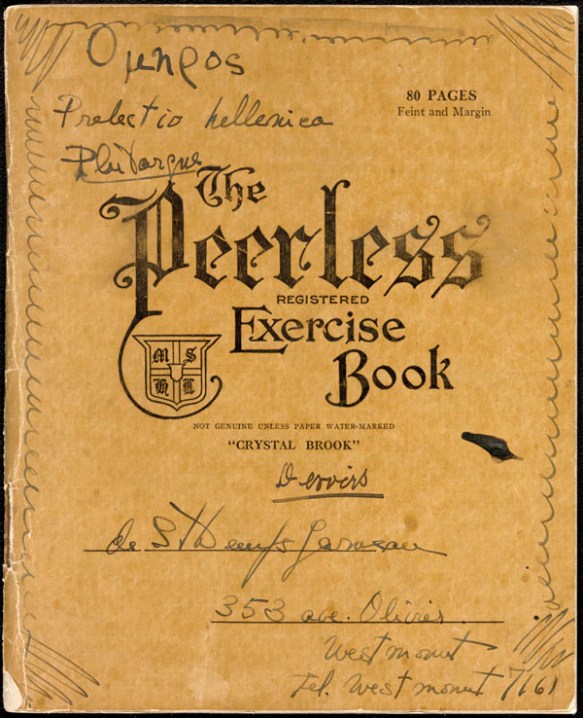
A colour image of a notebook with “The Peerless Registered Exercise Book” on the cover containing handwritten annotations and inscriptions in Greek.

Cover of de Saint-Denys Garneau’s homework notebook, undated (MIKAN 4817981). Explore other selections from his notebooks.

Now that the finding aid has been entered into MIKAN, researchers can now view a description of each individual item in the fonds from the comfort of their own home and know what is in an archival box before they order it. This finding aid opens a window on the author’s life, his relationships and artistic processes—unveiling a little more of the beautiful handwritten poems and letters of Hector de Saint-Denys Garneau.

Images of storms now on Flickr

Storms are violent disturbances of the atmosphere with strong winds and usually rain, thunder, lightning, or snow. Canadians are no strangers to these occurrences!