“The Complete Set”: Some fascinating examples in Library and Archives Canada’s portrait collection

The Library and Archives Canada (LAC) holdings include one-of-a-kind historical artifacts that relate directly to specific portraits in the collection.

In some cases, items that were separated over the years were reunited at LAC. In others, LAC was fortunate to take over the custodianship of a carefully preserved ‘set.’ In all cases, these somewhat unexpected holdings provide invaluable context for better understanding the portraits they are associated with.

Copper plate image showing Captain George Cartwright checking his fox traps during the winter in Labrador. He wears snowshoes, carries a gun over one shoulder and has a dog on a leash, tethered to his belt.

Captain Cartwright visiting his fox traps (MIKAN 3986048)

This copper plate, for example, was created as a means of ‘publishing’ the evocative oil portrait of Captain George Cartwright (1739–1819), a retired army officer who set up trade as a trapper and fur trader in Labrador.
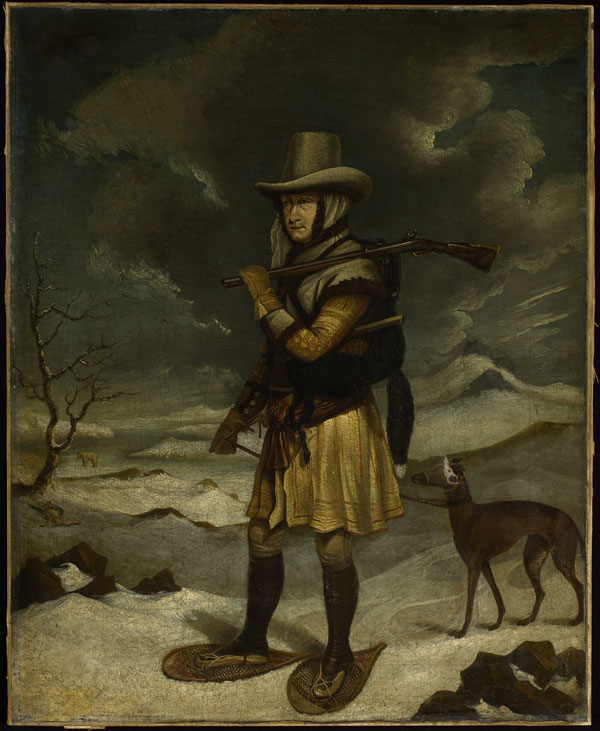
Oil painting showing Captain George Cartwright checking his fox traps during the winter in Labrador. He wears snowshoes, carries a gun over one shoulder and has a dog on a leash, tethered to his belt.

Captain Cartwright visiting his fox traps (MIKAN 3964571)

It illustrates one process that was used, before the development of photography, to “translate” paintings into a printable format, so that they could appear in books. The painted portrait was created specifically to provide a frontispiece image for Cartwright’s important Memoir, A journal of transactions and events, during a residence of nearly sixteen years on the coast of Labrador… (1792).
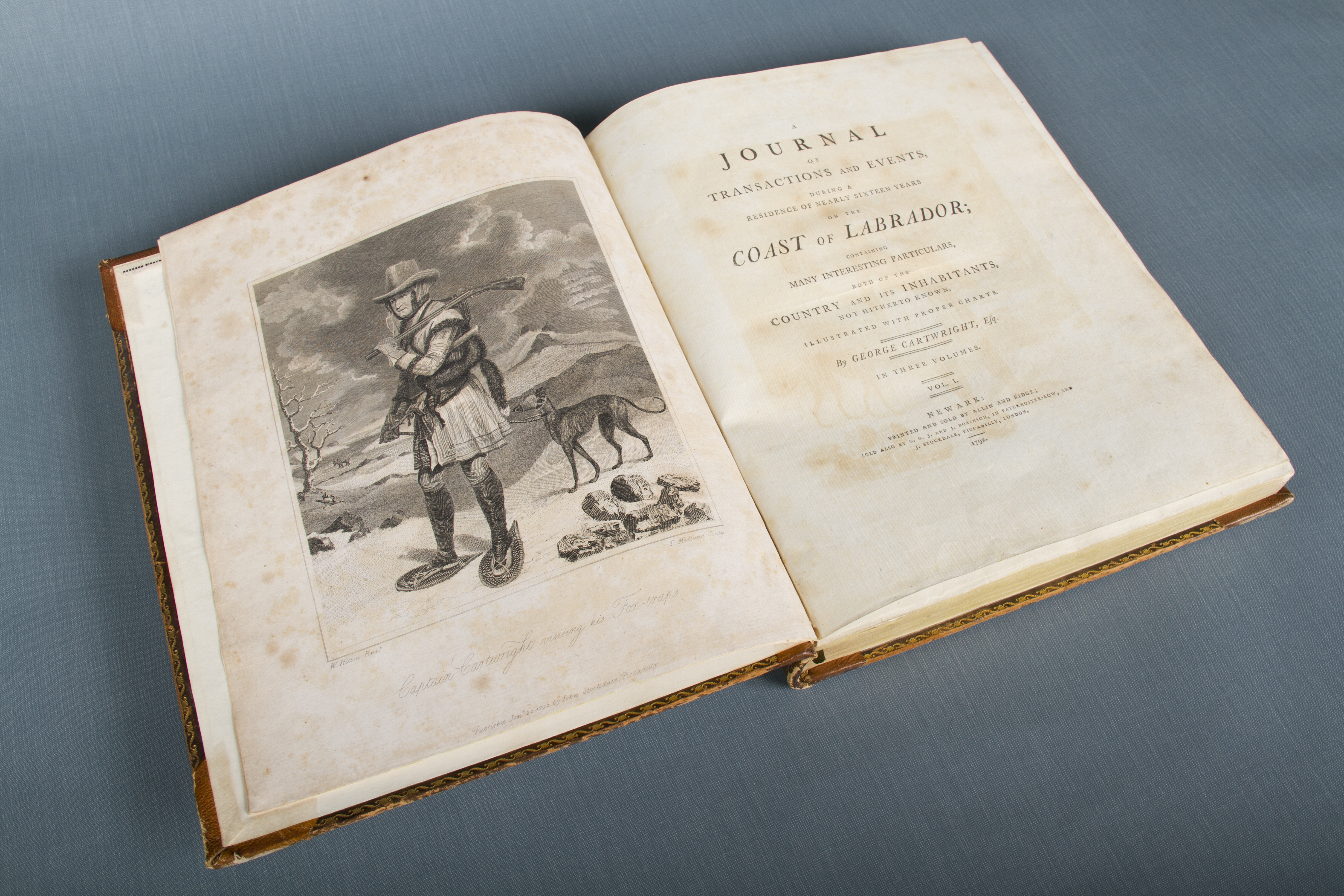
The same image as above, except in printed form, published in a first edition of the 1792 book.

Frontispiece from Captain George Cartwright’s Memoir (AMICUS 4728079)

Special Notes on the Frontispiece, compiled by Cartwright, underline the significance he attached to every one of the painting’s details. Like the Memoir, the painting reads like a primer for would-be adventurers—including innovative, Aboriginal-inspired solutions for survival, such as wearing snowshoes when checking traplines in winter.

Copper is a soft metal that allowed engravers to faithfully reproduce these details, as well as something of the feel of the original oil painting. Here, for example, the soft-edged atmospheric landscape of winter was created by protecting some areas of the plate with wax, while allowing acid to wash over other exposed areas.

It’s rare for any institution to hold a painting, its copper plate and a first-edition copy of the resulting book, but LAC’s collection includes all of these items.

Another example: LAC’s collection includes this pendant and earrings.

Colour photograph of two gold earrings with a stylized spiral pattern and a matching pendant.

Marie-Louise Aurélie Girard’s earrings and pendant (MIKAN 3994256)

This was the actual jewellery that Marie-Louise Aurélie Girard (ca. 1868–?) wore when she sat to have her portrait painted by the distinguished Montreal artist, Alfred Boisseau (1823–1901):
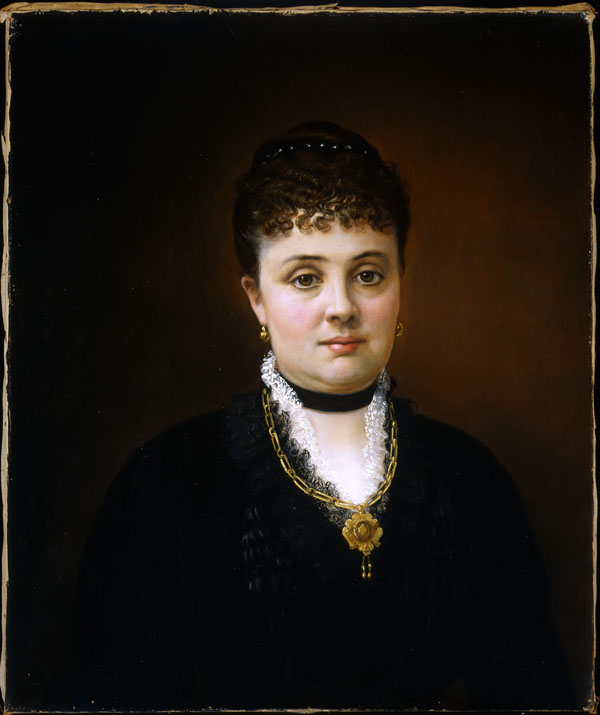
Oil painting showing a woman in a black dress looking straight at the viewer. She is wearing the same pendant and earrings as shown in the previous photograph.

Marie-Louise Aurélie Girard (MIKAN 3993116)

These precious items remind us of the human process behind historical portrait painting. Prominent and wealthy sitters would often deliberate over which items to wear or include in a portrait, not only for sentimental reasons, but also to convey social status. In this case, the sitter was the wife of a former Premier of Manitoba.

The William Redver Stark sketchbooks: the details

Over the next few months, the blog will feature a series of articles to uncover behind-the-scenes conservation work. This work ensures that the Library and Archives Canada collection is maintained, preserved and available for future generations to enjoy. We will be following along as the conservation team conserves the William Redver Stark sketchbooks. We had a preliminary overview of the restoration of the sketchbooks this year as well as a podcast about William Redver Stark. Now over the next months, the team will be conserving the sketchbooks and documenting the conservation process on the blog, Facebook and Twitter.

Examining the sketchbooks: the groundwork

The paper in the 14 sketchbooks is either wove watercolour or wove drawing paper. Wove paper is paper made on a closely woven wire roller or mold and having a faint mesh pattern. Unsurprisingly, the eight sketchbooks with drawing paper do not have watermarks. Watermarks are a design or symbol, such as the maker’s name, that is impressed on a piece of paper and can be seen when the paper is held up to the light. Three of the six watercolour paper sketchbooks have watermarks from different English papermakers.

Colour photograph showing a watercolour sketch of a horse. Along the bottom edge is the faint imprint of a watermark reading “1915 England”

Watermark reading “1915 England” on one of the sketchbooks.

The dimensions of the sketchbooks range from 84 x 126 mm to 145 x 240 mm which makes them roughly the size of a smart phone or a deck of cards. There is no pagination in any of the sketchbooks but a close examination reveals the sequence in which the artist used the sketchbooks—some were used from front to back, some back to front or in a completely random order.

Colour photograph of three stained sketchbooks on a white table with a smartphone beside them to show the relative sizes of the items.

Three sketchbooks laid out beside a smart phone for size comparison.

Further examination reveals other important nuggets of information. Some of the books have bookseller tickets, artists’ colourmen labels or ink stamps. These can provide further information on the composition of the paper, the format and provenance of the book. Some labels indicate the number of pages which is very useful in determining if pages are missing. The examination concluded that many pages were missing from these sketchbooks. The provenance information also reveals that the books came from a variety of book makers and booksellers in London and France and that some were marketed to English, French and German consumers.

Colour photograph of a yellow label with information on the maker of the sketchbook.

An example of an artists’ colourmen label showing the maker, the provenance of the sketchbook, the number of pages and quality of the paper.

The text blocks (the main book body) are composed of signatures of between four to eight folios. A signature is a group of folios. A folio is a single page, folded once. All but two of the sketchbooks were traditionally bound, one with two metal spine rings and another with a stapled binding. These two simple binding structures were hand produced and do not use the commercial industrial manufacturing commonly used in book production at the time. All the sketchbooks have hard board covers. The bindings are plain and utilitarian with no decoration on the covers or spines except for manuscript notations in ink or graphite possibly written by the artist. Two sketchbooks have leather spines with cloth on the boards. The others have beige canvas bindings with an elastic-wrap closure. Most of the sketchbooks have pencil holders.

The sketchbooks have not been previously repaired or conserved and all exhibit multiple minor or major stability issues as follows:

  • pages breaking off at the spine
  • paper tears and pieces of paper broken off
  • missing pages
  • pages out of their original order
  • broken sewing threads
  • weak or broken attachment of text blocks to covers
  • adhesive tape on covers
  • fragile areas on cloth covering and boards

The next article in the series, “The William Redver Stark sketchbooks: page mapping,” will look at how the conservation team determined the order of the pages in the sketchbooks.

Visit Flickr to view more images of the conservation examination.

Did your ancestors come from England?

Do you want to know who your first British ancestor was and when he or she left England and arrived in Canada? Are you curious about your British origins?

If so, our website is a great place to begin your research. Here you will find a page dedicated to genealogical research on the British. This page provides you with historical information, archival documents and published material from the Library and Archives Canada collection, as well as links to other websites and institutions. This page also contains a link to our resources about Home Children; it is estimated that more than four million Canadians are descendants of British Home Children.

If your ancestor came to Canada between 1865 and 1935, you might find his or her name on the passenger lists.

New Books in the Genealogy Services Collection at 395 Wellington—January 2015

Below is a list of our recently acquired genealogy publications. You can consult these publications in the Genealogy and Family History Room located on the 3rd floor at 395 Wellington. The link takes you to the AMICUS record which gives the call number to help you find the book on the shelves.

If you’re just starting out in genealogy, you should check out our Genealogy and Family History pages.

Happy exploring!

Family Histories

De nos ancêtres Houallet en France aux descendants Ouellet-te en Nouvelle-France, de François Houallet et Isabelle Barré, à leur fils René et son rêve américain by Jeannine Ouellet (AMICUS 43057598)

Généalogie ascendante de Maurice Fortier by Lise Lefebvre (AMICUS 42357176)

La descendance de Pierre Gilbert, capitaine de vaisseau: Petite-Rivière-Saint-François à partir de 1756 by Jules Garneau (AMICUS 42913904)

André Marsil dit Lespagnol: l’ancêtre des Marcil et Mercille d’Amérique (1642-1725) by Denis Marsil (AMICUS 42507286)

La famille Miville-Dechêne, Julie: l’arrivée en Nouvelle-France et les pérégrinations à Québec et dans les environs du 17e au 21e siècle by Michel Émond (AMICUS 42421839)

Larocque family by Charles G. Clermont (AMICUS 42544482)

L’histoire de la famille acadienne des Lejeune dit Briard: les sept premières générations et plus by André-Carl Vachon (AMICUS 43023469)

Looking back: a history of the Robert and Hannah (Swinton) Williamson family, 2013-1783 by M. Yvonne Brown (AMICUS 42487533)

The Amos B. Weber family history by Tim Campbell (AMICUS 42624120)

The legacy of Peter Martin by Tim Campbell (AMICUS 43040697)

The Noah B. Martin family history by Tim Campbell (AMICUS 42624089)

The scent of oil: a Nicklos/Perkins family saga by Gary May (AMICUS 39274484)

Ethnic and Local Histories

Atlas généalogique de la France ancestrale: pays des migrants vers la Nouvelle-France by Micheline Perreault (AMICUS 42213484)

Dictionnaire des souches allemandes et scandinaves au Québec by Claude Kaufholtz-Couture and Claude Crégheur (AMICUS 42651679)

Irish presence: the protestant religious history, volume 1: Villages et visages en Lotbinière (includes cemetery transcriptions), research and writing by Sylvie Bernard; translation by Claude Crégheur and Mélanie St-Jean (AMICUS 38820935)

La colonie nantaise de Lac-Mégantic: une implantation française au Québec au XIXe siècle by Marcel Fournier (AMICUS 41526971)

Le pays des filles du Roy… au confluent du Saint-Laurent et de la Richelieu by Louise Biron, Danielle Mailloux and Louise Pelletier (AMICUS 42139559)

Les Filles du roi au XVIIe siècle: orphelines en France, pionnières au Canada by Yves Landry (AMICUS 42011241)

Les sépultures du coteau des Cèdres, 1750-1780 by Jean-Luc Brazeau and Isabelle Aubuchon (AMICUS 43036058)

Patriotes, reformers, rebels & raiders: tracing your ancestors during the troublous times in Upper and Lower Canada, 1820-1851 by Kenneth Cox (AMICUS 42726565)

Pour que rien ne s’efface: Notre-Dame-de-Lourdes, 2014 by Robert Charbonneau, Mario Cyr and Huguette Plourde (AMICUS 43043082)

Répertoire des naissances, des mariages et des décès de la paroisse de Saint-Émilien, Desbiens, 1926-1941 by Société d’histoire du Lac-Saint-Jean (AMICUS 42654710)

The Irish Catholic families of Puslinch Township, Wellington County, Ontario: a genealogy by Marjorie Clark (AMICUS 42756767)

Building a case for the Proclamation of the Constitution Act 

It was raining on Parliament Hill as Queen Elizabeth II and Prime Minister Pierre Elliot Trudeau signed the Proclamation of the Constitution Act on April 17, 1982. Marks left by the raindrops, as they smudged the ink, can still be seen as physical reminders of the rich history of the Act.

The Proclamation of the Constitution Act is a fundamental document for all Canadians as it symbolizes Canada’s journey from colony to independent country. Like many of history’s most valued documents, it has spent most of its time sealed in a vault for preservation reasons.

As with the display of all collection materials, a balance must be struck. Exhibiting materials involves exposing items to potentially damaging light, while not exhibiting means restricting access to the collection. The loan of the Proclamation of the Constitution Act to the new Canadian Museum of Human Rights in Winnipeg presented an exciting challenge to the Library and Archives Canada (LAC) Preventative Care and Conservation staff—to make the document accessible to Canadians.

So, what does it take to prepare one of Canada’s most significant documents for display?

Studies conducted in 2012 by the Canadian Conservation Institute concluded that the signature inks on the Act are extremely light sensitive. In an effort to prolong its life, the document is allowed only a limited number of display hours per year. LAC staff designed and created a state-of-the-art encasement and display case to protect the Act from harmful light, vandalism and theft.

First, the Act was housed in a custom case that allows the control of humidity, UV exposure, and oxygen levels which will help to further reduce deterioration of the document. A display case was then designed to help limit the total amount of light exposure during exhibition.

Conservators fitting the interior of the case with an an activated carbon cloth which filters the air, absorbing atmospheric pollutants.

Conservators fitting the interior of the case with an an activated carbon cloth which filters the air, absorbing atmospheric pollutants.

The display case incorporates a special layer of opaque black glass (which protects the document from 97% of visible light) but, at the press of a button, it can quickly become translucent as the document is illuminated. The whole system runs on a timer, controlling the length of time the document is visible and records the total exposure over an entire loan period. This will help LAC to monitor the amount of light exposure the Act receives over the course of its life.

This project enhances public access to our country’s heritage without compromising the long-term preservation of the Proclamation of the Constitution Act, and ensures that Canadians will be able to see this national treasure, including generations to come.

Visit the Canadian Museum of Human Rights in Winnipeg for this rare opportunity to see the Proclamation of the Constitution Act and other significant documents from LAC’s collections during the museum’s inaugural exhibitions.

Images of the British Commonwealth Air Training Plan now on Flickr 

During the Second World War, the British Commonwealth Air Training Plan (BCATP) mobilized Canadian experts, initiated the building of airfields, conducted research into the development of equipment, and provided valuable training and resources to Commonwealth aviators.

Signed in 1939, the Agreement and Plan lasted from 1940 to 1945. During this time, about 151 schools were established across Canada with over 104,000 men and women serving the ground operations. By the end of the War, the BCATP had produced 131,553 aircrew; including pilots, wireless operators, air gunners, and navigators for the Air Forces of Great Britain, Australia, New Zealand and Canada.

Dora de Pédery-Hunt

“Medals are my favourite form of expression,” Dora de Pédery-Hunt once said. “They are like short poems.” You may not know who Dora de Pédery-Hunt is, but chances are, at one time or another or even now, you have an example of her work in your possession.

Black-and-white photograph of a woman holding a ceramic model of a medal and looking at it intently.

Portrait of Dora de Pédery-Hunt working on a medal (MIKAN 2267060)

Dora de Pédery-Hunt (1913–2008), was a Hungarian-born sculptor and medalist. After graduating with a master’s diploma in sculpture from the Royal Academy of Applied Arts in Budapest in 1943, she came to Canada by way of Germany in 1948. In Hungary, she had studied bronze and plaster casting along with stone and wood carving. After arriving in Canada, however, her need for regular work to support herself and her family was paramount. Setting aside her artistic aspirations for a short while, Dora took work as a housekeeper. In due time, Dora was introduced to sculptors Frances Loring and Florence Wyle (often called the first women of Canadian sculpture) by her Canadian immigration sponsor Major Thomas S. Chutter. Realizing her talent, Loring and Wyle helped Dora acquire a job teaching sculpture. Now free to devote most of her time to her art, Dora de Pédery-Hunt flourished.

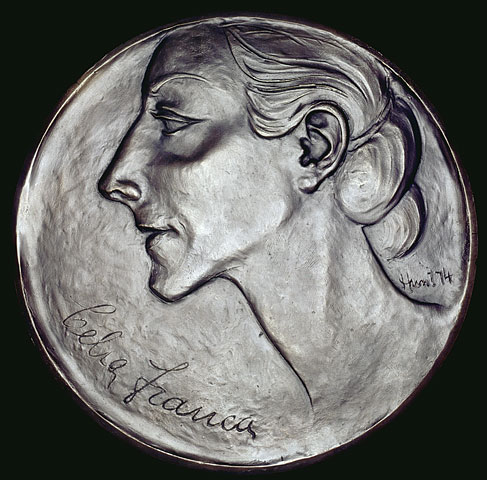
Photograph of a bronze medal showing the profile of a woman and the inscription “Celia Franca” along the bottom left.

Medal with a portrait of Celia Franca in profile (MIKAN 3704296)

Throughout the 1950s Dora received several private and public commissions. An entry Dora placed in the Canadian National Exhibition show caught the eye of Alan Jarvis, then director of the National Gallery of Canada. Through his support, Dora obtained a grant from the Canada Council enabling her to study and hone her talents in Europe for the next six months. Upon returning to Canada, Dora used the experience she gained abroad to begin working on larger scale projects, creating religious iconography such as ornate tabernacles and Stations of the Cross. At the same time, she continued to create smaller objects including many commemorative, award and portrait medals.

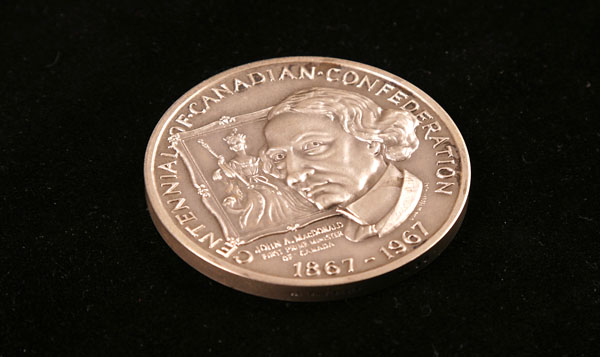
Colour photograph showing a a coin with the image of John A. Macdonald on it with a portrait of a queen behind it.

Coin commemorating the 100th anniversary of the Canadian Confederation: 1867-1967 (MIKAN 3637375)
© The Royal Trust Company. Reproduced with the permission of The Royal Trust Company.

From teaching at a small vocational college, Dora would eventually become a faculty member of the Ontario College of Art. Throughout her industrious career she received several national and international awards and accolades including the Order of Canada.

Photograph of a bronze medal showing a stylized image of a person sitting down, inscribed with the words “Canada” along the top edge and “expo 67” on the bottom right.

Commemorative medal of Montreal’s Expo 67 (MIKAN 2834429).

And what about that example of Dora de Pédery-Hunt’s artwork you most probably have in your possession? That would be the profile of Queen Elizabeth II minted on late 20th century Canadian coins.

Photograph of the face of a Canadian quarter showing the profile of Queen Elizabeth II.

Profile of Queen Elizabeth II on a Canadian quarter.

Explore the Dora de Pédery-Hunt fonds.

Images of Hockey life now on Flickr

Hockey is so popular in Canada that a number of cities claim to have started, or invented, the game. Some notable claimants are the cities of Halifax, Windsor and Kingston.

There are early recorded events, such as the 1875 indoor game in Montreal at the Victoria Skating Rink, and the 1883 Montreal Winter Carnival hockey tournament where teams from Ottawa and Quebec City participated. There were even amateur associations formed to promote the growth of the game in Canada.

Happy 100th birthday, Hockey Canada!

On December 4, 2014, Library and Archives Canada (LAC) is celebrating the 100th birthday of the national governing body for amateur hockey in Canada.

Hockey is Canada’s national winter game and is played by young and old on frozen ponds and arenas from coast to coast to coast. The centennial of Hockey Canada gives us an opportunity to understand and learn more about hockey’s roots in Canada.

Minister of State (Sport), the Honorable Bal Gosal, October 30, 2014

The Canadian Amateur Hockey Association (CAHA) was founded in December 1914 in Ottawa, Ontario as the national administrative, regulatory and developmental body for amateur hockey in Canada. Representation at the founding meeting included the provincial hockey associations of Alberta, Saskatchewan, Manitoba and Ontario; the Montreal City Hockey League; the Canadian Intercollegiate Hockey Union; the Allan Cup Trustees; the Canadian Olympic Association; and the Amateur Athletic Union of Canada. Other groups affiliated with the CAHA after its creation include the Quebec Amateur Hockey Association in 1919, the Ottawa District Amateur Hockey Association in 1920, the Maritime Amateur Hockey Association in 1928, the Newfoundland Amateur Hockey Association in 1966 and the New Brunswick Amateur Hockey Association in 1968.

Black and white composite photograph showing portraits of the entire team in little medallions with the inscription Monarch Hockey Club, Amateur Champions of Canada, Winners of Pattison Trophy’s Allan Cup 1913-1914,

Winnipeg Monarch Hockey Club. Allan Cup Winners 1913-1914 (MIKAN 3657113)

Library and Archives Canada, in partnership with Canadiana.org, provides digital access to some of the important records from the CAHA fonds such as the official rule books governing amateur hockey going back to 1927.

Reproduction of a 1927 booklet describing the rules of the game by the Canadian Amateur Hockey Association.

Rules of the Game from the Canadian Amateur Hockey Association in 1927 (source on page 77)

In 1994, the CAHA merged its activities with the Canadian Hockey Association, better known as Hockey Canada, which had been created in 1968. The new organization’s mandate was to select teams to represent Canada in international competition and to foster the development of skills in Canadian hockey players. LAC’s Hockey Canada material documents many international hockey series and tournaments, which captured the attention of all Canadians such as the 1972 Summit Series and the 1976 Canada Cup.

Black-and-white entry form for a draw to see a Canada/Soviet game in 1972.

Mail-in coupon for a draw to receive tickets for a 1972 Summit Series game
Source: Hockey Canada Fonds/ Chronological file July 4/72 to Aug 31/72/ (e001217378)

You can discover the evolution of hockey in Canada by exploring LAC’s records of Hockey Canada and its predecessor, the CAHA.

Also, be sure to explore the Hockey Hall of Fame, which has the largest collection of hockey history resources, and visit its new exhibit co-produced with LAC, The First World War and a Century of Military Ties to the Game.