Images of Fancy Dress Balls now on Flickr

Victorians from all walks of life loved to dress up in costume, or “fancy dress,” for parlour games, theatricals and balls. Assuming fantasy characters for an evening provided a form of escapism from their rigidly conventional lives. Canadians were no exception.

Characters for fancy dress were inspired by various facets of Victorian culture and different historical periods.

View the fancy dress ball images on Flickr.

July 15, 1870: Manitoba joins Confederation

Library and Archives Canada Blog's avatarLibrary and Archives Canada Blog

Before becoming a province, Manitoba was the stage for many events and pivotal moments in Canada’s history. Pending the transfer of Rupert’s Land to Canada, the federal government sent survey crews led by Lieutenant Governor William McDougall to map the Red River area in 1869. The Métis became concerned about the redistribution of land to future settlers and the effect this would have on their own lands.

The Métis group’s leader, Louis Riel, declared that the survey was a menace and established a “National Committee” of which he became secretary and John Bruce president. On October 25, 1869, Louis Riel was ordered to appear in front of the Legislative Assembly of Assiniboia to explain himself. Riel indicated that the “National Committee” would prevent the entry of McDougall or any governors into Red River unless the union with Canada was based on negotiations with the local population.

In November, Riel…

View original post 303 more words

I say Bennett, vous dites Benoit. Soundex: How to find spelling variations of a surname

You are deep into your genealogy research and coming across documents that show a code like T650 instead of a surname? What does the code mean? Well, it’s a code from the Soundex phonetic system, used to index surnames.

Many American archival records have been indexed using this system. It’s a way to search surnames while ignoring minor differences in spelling. The code uses the first letter of the surname, followed by three numbers associated with the sound of the name. Letters of the alphabet are assigned a number (0 to 9). Vowels (A, E, I, O, U and Y) and the letters H and W are ignored. Also, if the same letter occurs twice in a row in the name, it is counted only once (e.g., Lloyd becomes Loyd). If there are fewer than 3 letters in the name, 0 is used for the last digit.

Letter

Code

B P F V 1
C S G J K Q X Z 2
D T> 3
L> 4
M N 5
R 6

Examples:

SMITH = S530
TREMBLAY/TROMBLEY/TRIMBLE/TRUMBLE = T651

To help you identify different spellings of surnames, we suggest that you use the following Soundex indexing site: Avotaynu Consolidated Jewish Surname Index. It can also be used for non-Jewish surnames. To help you identify the Soundex code, you can use the JOS Soundex calculator.

Library and Archives Canada releases twelfth podcast episode: Between the Sheets

Library and Archives Canada (LAC) is releasing its latest podcast episode, Between the Sheets.

Archival assistant Gilles Leclerc joins us to talk about LAC’s sheet music collection. We explore what sheet music is, what’s included in LAC’s collection and how the collection came about. We also discuss the historical value of sheet music and why it’s still relevant today.

Subscribe to our podcast episodes using RSS or iTunes, or just tune in at: Podcast – Discover Library and Archives Canada: Your History, Your Documentary Heritage.

For more information, please contact us at podcasts@bac-lac.gc.ca.

Mary Riter Hamilton, Canada’s First Unofficial War Artist

Version française

It has been 90 years since Mary Riter Hamilton donated 180 of her oil paintings and dozens of her chalk, pastel and pencil drawings depicting the devastation in Europe after the First World War to the Public Archives of Canada (now Library and Archives Canada). These works by Riter Hamilton are not light-hearted. The subject matter deals almost exclusively with the destruction of war. They depict muddy trenches and blighted landscapes, graves and cemeteries, churches and towns ripped apart from shelling.

Memorial for the Second Canadian Division in a Mine Crater near Neuville St. Vaast.

Memorial for the Second Canadian Division in a Mine Crater near Neuville St. Vaast (e011201067)

Mary Riter Hamilton was born in 1873 in Teeswater, Ontario and grew up in Clearwater, Manitoba where her family moved to farm. She married Charles W. Hamilton at the age of 18 and by the age of 23 was widowed. It was soon before the death of her husband that Mary began attending art classes in Toronto. Recognizing her talent, most of her European-trained teachers urged her to further her studies in Paris. Mary studied first in Germany then moved to Paris where she lived and studied for the next eight years. Mary returned to Manitoba for a year in 1906 then again for eight years in 1911. During these years, Mary’s work was exhibited in galleries in Montreal, Ottawa, Toronto, Winnipeg and Calgary.

The Sadness of the Somme

The Sadness of the Somme (e011205200)

Always wanting to return to Europe, it was in 1919 while Mary was living and working on Canada’s west coast, that she was offered a commission by the Amputation Club of British Columbia to provide art work for The Gold Stripe, a veteran’s magazine. Mary left immediately, “ … to paint the scenes where so many of our gallant Canadians have fought and died.” For three years, Riter Hamilton worked tirelessly in post-war France and Belgium, painting battlefields including Vimy Ridge and the Somme, Ypres and Passchendaele. Conditions were harsh. She lived in make-shift shelters while enduring foul weather and meagre rations. She returned to Canada physically and emotionally spent. Refusing to sell her paintings, Riter Hamilton donated her work to the Public Archives of Canada. She died, poor and visually impaired, in 1954.

As the centenary of the First World War approaches, these works take on a renewed poignancy. Mary Riter Hamilton was never an official ‘war artist’ yet through her courage and talent and indomitable dedication, the sombre beauty and mournful tone of her collection serve as an enduring account of the ravages of war.

Trenches on the Somme

Trenches on the Somme (e011202180)

To learn more about Mary Riter Hamilton, to view more of her work, or to see what materials are contained in the LAC collection, visit:

Looking for your Newfoundland Ancestors Who Served in the First World War?

Newfoundland was a Dominion of the British Empire when the First World War broke out. At the time, there was no formal military presence in Newfoundland, but the Government of Newfoundland went on a recruiting drive to provide a force for British service. Many Newfoundlanders also joined the war effort by joining the Canadian Expeditionary Force (CEF) in Canada.

After Newfoundland joined confederation in 1949, the personnel records for the Royal Newfoundland Regiment and the Newfoundland Forestry Corps were transferred to the Government of Canada as these individuals became eligible for veterans’ benefits. Later, the files were microfilmed by Library and Archives Canada (LAC) and FamilySearch. The originals remain in LAC’s holdings.

Searching for Newfoundland service files

If you aren’t sure in which service your ancestor served or where he joined, you will need to look at both the CEF records using the Canadian soldiers of the First World War: 1914-1918 database for people from Newfoundland who enlisted in other parts of Canada and the general Archives Search for people who enlisted in Newfoundland regiments. For the latter group, enter the surname of the person, “Newfoundland” and RG38 in the keyword search. The results page will identify which microfilm reel you will need to order to consult the service record.

Meanwhile, the microfilms can be consulted onsite at LAC, through the Family History Centre or in the Newfoundland Provincial Archives at The Rooms in St. John’s. The latter has digitized some of the service files and these can be found in the Newfoundland Regiment and the Great War database.

LAC is presently digitizing all of the remaining 640,000 service files of the men and women who served in the First World War with the Canadian Expeditionary Force. The digitized service records will be made available on the website as they become available, but access restrictions may be in effect at times. Learn more about the digitization of the Canadian Expeditionary Forces Service Files by consulting the Fact Sheet: Digitization of Canadian Expeditionary Force Service Files.

Step back in time: Library and Archives Canada helps the National Gallery of Canada recreate a First World War exhibition experience

When Canadian troops joined the action on the western front, there were no official military photographers. The front line was unsafe for commercial photographers, and officers and men were not allowed to use personal cameras. As a result, there are no official photographic records of Canadian participation in early battles, such as the Second Battle of Ypres, in April 1915.

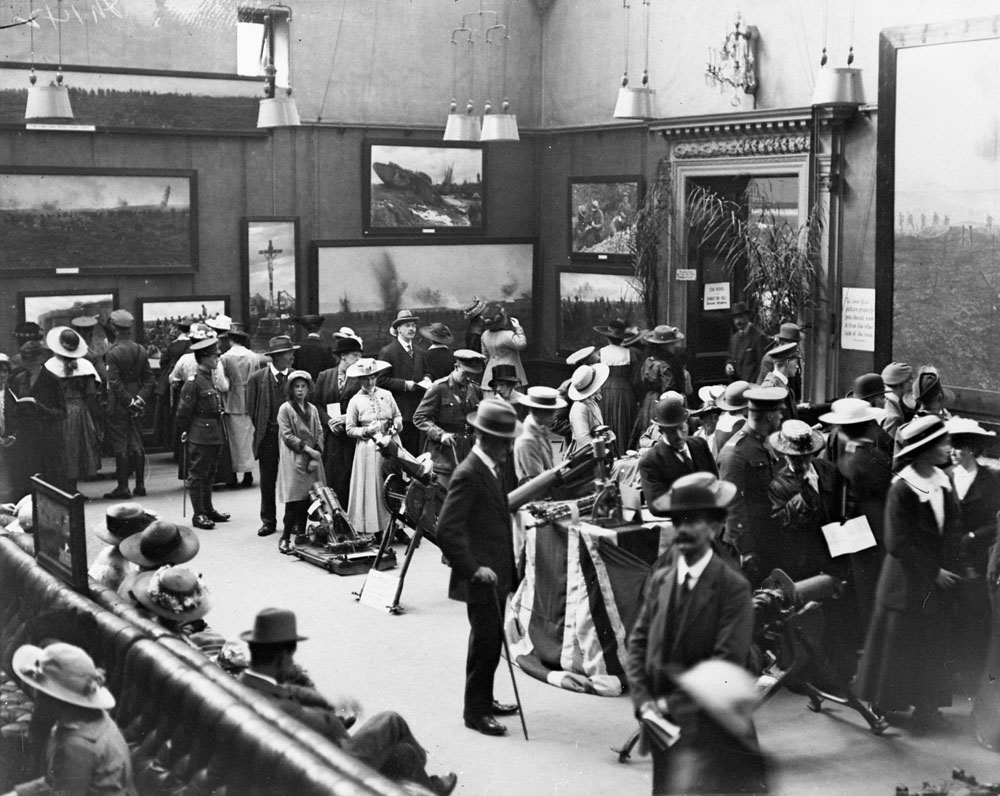
The Canadian War Records Office, established in January 1916, immediately recognized the importance of photography, both for keeping a lasting documentary record of the war and for boosting morale. The first official Canadian war photographer was appointed in April 1916. That same year, the first of several immensely popular exhibitions of official Canadian war photographs was unveiled at the Grafton Galleries, in central London.

Princess Christian among others viewing images at the Second Exhibition of Canadian Battle Pictures, Grafton Galleries, London, July 1917 (MIKAN 3394829)

Princess Christian among others viewing images at the Second Exhibition of Canadian Battle Pictures, Grafton Galleries, London, July 1917 (MIKAN 3394829)

Today, Library and Archives Canada’s (LAC) holdings include most of the negatives created by Canada’s official war photographers, preserved in their original glass plate format. These are some of the most poignant, horrifying, and yet compelling images in LAC’s photography collection.

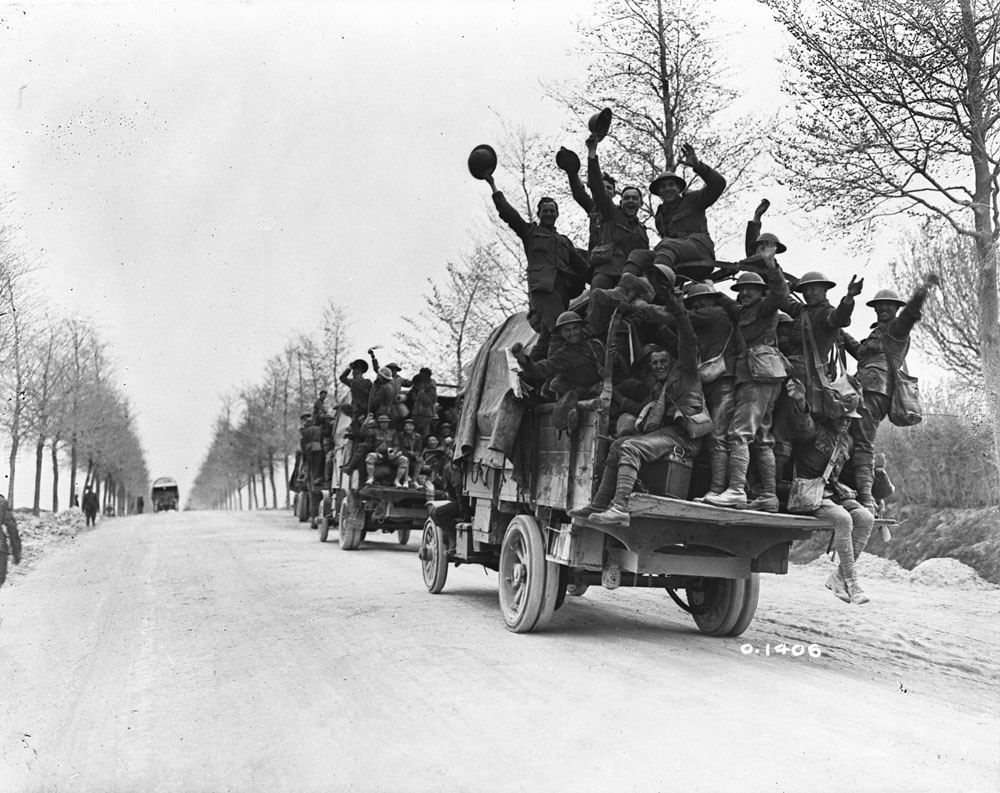
The Great War, the Persuasive Power of Photography, a new exhibition at the National Gallery of Canada, curated by Ann Thomas, incorporates many of these negatives in the near-exact recreation of one entire room from the second Grafton Galleries exhibition, held in 1917. The room, which is designed to put the modern viewer in the shoes of a viewer from 1917, features a dramatic to-scale reproduction of a photograph of the Battle of Vimy Ridge, called the largest photograph ever made during its time. It also includes a cropped version of this photograph of Canadian troops after the battle.

Canadian troops en route to destination for a rest period after taking part in the capture of Vimy Ridge (MIKAN 3521924)

Canadian troops en route to destination for a rest period after taking part in the capture of Vimy Ridge (MIKAN 3521924)

View from inside the Grafton Galleries, London, at the Second Exhibition of Canadian Battle Pictures, July 1917 (MIKAN 3394834)

View from inside the Grafton Galleries, London, at the Second Exhibition of Canadian Battle Pictures, July 1917 (MIKAN 3394834)

Canada’s official war photographers:

  • Captain Henry Edward Knobel (April 1916 to August 1916)
  • William Ivor Castle (August 1916 to June 1917)
  • William Rider-Rider (June 1917 to December 1918)

See other images reproduced for the room or visit the exhibition at the National Gallery of Canada from June 27 to November 16, 2014.

New Books in the Genealogy Services Collection at 395 Wellington

In our previous article, we discussed what you can do at 395 Wellington before your appointment. One of the suggestions was to head to the third floor where the Genealogy and Family History Room is located. There you will find reference works, finding aids, atlases, family histories, and ethnic and local histories—sources that are only the beginning in your exciting search for ancestors.

In this article, we are pleased to share a list of our recently acquired publications. The AMICUS link gives the call number where you will find the book in the stacks.

And if you’re just starting out in genealogy, you should check out our Genealogy and Family History pages.

Happy exploring!

Family Histories

L’ancêtre des familles Kirouac en Amérique, son épouse et leurs fils : synthèse d’une recherche généalogique effectuée de 1978 à 2013, by François Kirouac (AMICUS 42037458)

Barthélemy Verreau, premier Verreau en Nouvelle-France, by Jean-Marie Verreault (AMICUS 42159688)

Les 100 ans de Taschereau, by the Comité du 100e anniversaire de Taschereau (AMICUS 41969714)

Dictionnaire généalogique des familles Audet et Lapointe, 1663-2013, by the Association des descendants de Nicolas Audet dit Lapointe (AMICUS 42155162)

Généalogie de la famille Bournival, by Gilbert Bournival for the Regroupement des Bournival d’Amérique (AMICUS 42214888)

George Goodson Knowlton: His Ancestors and Descendants, by Doreen A. Smillie (AMICUS 42001478)

Hanrick / Handrick / Hendrick Family of County Wicklow, Ireland and West Québec, Canada, by Della Hendrick Dupuis (AMICUS 42445077)

Labossière : descendant, 1878-2006, by the Labossière Family Association (AMICUS 42095787)

Les mariages Dumas du Québec et des régions avoisinantes, by Michèle Dumas (AMICUS 42178843)

Munchinsky Family History, by George Muchinsky (AMICUS 40824981)

Ethnic and Local Histories

Aneroid and District, 100 Years, 1913-2013, by the Aneroid History Book Committee (AMICUS 42001472)

Beaver Tales from Castor & District, by the Castor and District History Book Committee (AMICUS 41170264)

Les filles du Roy (1663-1673) : Champlain, Batiscan, Sainte-Anne-de-la-Pérade, edited by Jean-Pierre Chartier (AMICUS 42039279)

Irish Palatine Pioneers in Upper Canada: Commemorating 300 Years, 1709-2009, by the Ontario Genealogical Society (AMICUS 40681965)

Municipal Records in Ontario: History and Guide, by Fraser Dunford (AMICUS 40681952)

Neubergthal: A Mennonite Street Village: A Sense of Place with Deep Roots, edited by Rose Hildebrand and Joyce Friesen (AMICUS 42247304)

Répertoire des mariages (1895-1986), baptêmes (1895-1986), sépultures (1895-2012), St-Jean-Baptiste de Cap-aux-Os : avec notes marginales, edited by Donat Fournier, Serge Ouellet, Élaine Réhel (AMICUS 42202061)

Victory and Beyond, by the Beechy History Book Committee (AMICUS 39465589)