Newfoundland images now on Flickr
Reply

We are pleased to inform you that more than 24,000 references about money scrip (certificates) given to Métis family members were recently added online. These cancelled land scrip certificates were once issued to the Métis by the Department of the Interior in exchange for the relinquishment of certain land claims. A scrip would be issued “to the bearer” and could be applied to the purchase of, or as a down payment on, any Dominion lands open for entry in Manitoba and the Northwest Territories. These scrip were awarded to Métis heads of families and their children in the amounts of $240, $160 and $80.
Did you know that Library and Archives Canada (LAC) has rare colour photographs from the Second World War? During that time period, colour film was a new and untested medium for most professional photographers. These images were captured on Kodak Kodachrome film by members of the Canadian Film and Photo Unit (CFPU) in the days and weeks following D-Day, on June 6, 1944.
The CFPU, formed in 1941, was under the command of Captain William Abell of Winnipeg and was staffed by enlisted Canadian men and women. Their goal was to capture images of Canadian military personnel in action, which would then be released by the Department of National Defence to various media outlets. Today these images provide an invaluable record, in living colour, of Canadian servicemen and servicewomen, as well as changing photographic technologies and techniques.
The images are part of a larger set of 1,200 digitized Second World War colour photographs that can be viewed through LAC’s online database. Included are photos of various subject matter, such as Canadian troops in England, France, Holland, Germany, Italy, and on bases and in training in Canada; portraits of notable military figures; the Canadian Women’s Army Corps; troop entertainment; hospital transport ships; and the Canadian role in liberation/occupation duties as photographed by CFPU member Ken Bell.
LAC’s complete digitized collection of colour images from the CFPU includes over 2,000 additional digitized colour images dating to 1961. To view them, consult the ZK prefix. To search within this collection, go to Advanced Archives Search and search using “ZK prefix” and the search term of your choice. An electronic finding aid for the ZK prefix sub-series is also attached to this record and can aid in locating specific images. To learn more about using finding aids in your research, read Discover Finding Aids – Part Two.
See also:
Library and Archives Canada recently launched an updated and expanded version of the Service Files of the Second World War – War Dead, 1939-1947 database. Researchers can now access more than 1000 digitized genealogy packs of service files for Canadian servicemen and servicewomen killed in action during the Second World War.
The database, available on the Library and Archives website through the Military Heritage portal, can now be searched using an increased number of access fields. These include: first and last name of the enlisted person, service number, date and place of birth, date and place of enlistment. By using these search features, Canadian students participating in Lest We Forget, a national project that gives them the opportunity to research the life stories of Canadian servicemen and servicewomen, will be able to quickly identify service files related to their community.
The digitized service files contain documents and correspondence pertaining to enlistment and appointment, training and qualifications, awards and medals, medical history, and wills and insurance. Researchers can expect to find records such as the Canadian Active Service Force attestation paper, a Record of Service with information on training and education before and during service, documents from the Department of National Defence Estates Branch, and grave registration and post-war exhumation reports.
Along with details of service, this database offers a window into the lives of those who served and the families they left behind. Throughout the Second World War (1939-1945), Canadian men and women served in great numbers with the Canadian Army, Royal Canadian Air Force, and Royal Canadian Navy. From a population of just over 11,000,000 in 1939, Canada saw more than 1,159,000 of its citizens enlist. The price of victory was high: approximately 45,000 Canadians and close to 1000 Newfoundlanders lost their lives during and immediately following the war. In addition to these, more than 55,000 servicemen were wounded and countless civilians experienced the suffering and loss brought about by war. While providing a valuable resource for research, the KIA database helps to tell the story of those who served, fought, and died in a war that stretched across the globe.

The TD Summer Reading Club 2014 was officially launched on June 3rd in Ottawa, Ontario, with the participation of the project partners: TD Bank Group, Toronto Public Library and Library and Archives Canada. The purpose of this program is to encourage children to read using fun and accessible activities that build their confidence and fire their enthusiasm for reading — all summer long.
 Children and parents can take inspiration from the theme, Eureka!, to invent, build and reimagine the world while reading captivating books at their local library. Across the country, over 2000 public libraries are participating in the Club, and over 600,000 children register enthusiastically for the program every summer.
The TD Summer Reading Club provides free program materials, including a magazine for children aged 6 to 12; a young children’s booklet for preschool-aged children; and a notebook, a poster and awesome stickers that children can collect over the summer. Of course, the Club also provides lots of suggestions for reading!
 Registering for the Club is free. Simply inquire at your local library to find out whether it offers the program. The Club’s website also offers a range of online games and activities.
This year, the TD Summer Reading Club will focus on sharing and creativity. It will be a great opportunity for the young participants to use all their ingenuity and take on the challenge with their family and friends!
May is Asian Heritage Month in Canada, during which we acknowledge the long and rich history of Asian Canadians and their contributions to Canada. Asian Heritage Month also provides an opportunity for Canadians across the country to reflect on and celebrate the contributions of Canadians of Asian heritage to the growth and prosperity of Canada.
To celebrate Asian culture, Library and Archives Canada (LAC) is pleased to announce the addition of references to its Immigrants from China database. It now includes references to the C.I.9 certificates issued to people of Chinese origin born in Canada and wanting to leave Canada for a limited time without losing their Canadian status. The actual records include a photograph and provide information such as the individual’s name, age and place of birth, as well as the port and date of departure, and the ship’s name.
On May 28, 1914, under the command of Captain Henry George Kendall, the Empress of Ireland set sail under clear skies from Québec City with 1,477 passengers and crew on board heading to Liverpool, England. The ship picked up mail at Rimouski and then continued on to the pilot station, Pointe-au-Père, where the pilot disembarked saying, “I don’t think you’ll run into much fog,” as he climbed down the rope ladder. What followed was a perfect storm of tragic events that resulted in the loss of 1,012 lives.

The R.M.S. Empress of Ireland. (e011537953)
Shortly after 1:30 a.m. on May 29, Captain Kendall saw an approaching vessel, the Norwegian coal freighter Storstad. Almost immediately afterwards, a thick fog rolled in and Kendall ordered a full stop to allow the other ship to pass safely. The two ships communicated their sailing intentions. As the Storstad entered the fog bank, her First Officer later testified, there did not seem to be any possibility of a collision.
Just before 2:00 a.m., the fully loaded coal freighter emerged from the fog bearing down on them quickly. Captain Kendall franticly attempted to alert the Storstad, but it was too late—the Empress was violently struck mid-ship. The damage sustained was irreparable, the engine rooms quickly flooded leaving the ship powerless and unable to close the watertight doors of her bulkhead. As water continued to overwhelm the Empress, she lurched violently and alarms were sounded for the sleeping passengers to abandon ship.
A few hundred people reached the deck, but only four lifeboats were safely dropped before the ship capsized. Passengers and crew were thrown into the icy waters, and within minutes the Empress disappeared, finding her final resting place at the bottom of the St. Lawrence River.
The majority of the lives lost that night had been far below deck in third class. Of the 1,477 passengers and crew that had boarded the Empress of Ireland, a mere 473 survived.
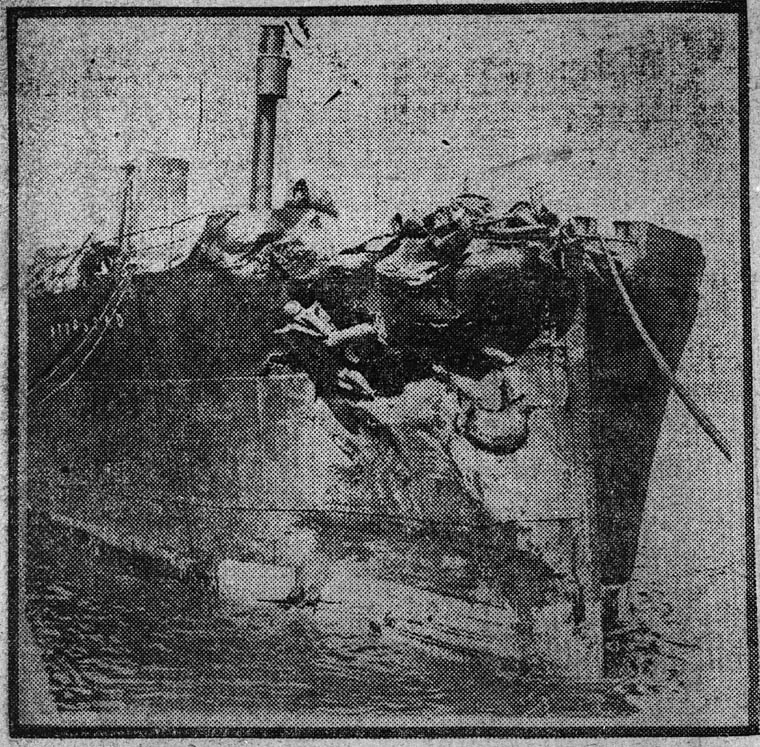
The Storstad, following the collision with the Empress of Ireland. (c001945)
Heartbreak and finger-pointing followed the tragedy. Both ships’ crew members insisted they were not to blame for the accident. Editorials at the time claimed that if you believed either captains, both ships were at a standstill and miles apart. In the end, the inquiry found the Captain of the Storstad responsible for the collision.
The wreck of the Empress of Ireland rests on the floor of the St. Lawrence, 11 kilometres off Pointe-au-Père, Quebec, in 40 metres of water marked by a surface buoy. One hundred years later, the Empress of Ireland remains the largest Canadian maritime accident that occurred during peacetime.
Library and Archives Canada (LAC) is releasing its latest podcast episode, Underwater Canada: Investigating Shipwrecks.
In honour of the 100th anniversary of the sinking of the Empress of Ireland, Marc-André Bernier, Chief of Parks Canada’s Underwater Archaeology Service, joins us to discuss shipwrecks, their importance in Canadian history, and how LAC plays an important role in researching, discovering and investigating them.
Subscribe to our podcast episodes using RSS or iTunes, or just tune in at Podcast – Discover Library and Archives Canada: Your History, Your Documentary Heritage.
For more information, please contact us at podcasts@bac-lac.gc.ca.

 Library and Archives Canada Blog