Canadian Screen Images Now on Flickr
Reply

This second article of a series depicting Immigration and Citizenship sources held at Library and Archives Canada (LAC), explains how to find arrivals between 1865 and 1935. Passenger lists reveal details such as the country your ancestor came from, his or her occupation and the intended destination in Canada.
Key resources*:
The Passenger Lists for the Port of Quebec City (1865-1900) database provides 967,017 references to names found on this list. As an example, Laura Muntz Lyall, the Canadian artist who painted Interesting Story, arrived in Canada from England in 1870. A search in the database yields a reference and a link to the image for the arrival of Laura Muntz and her family on 27 June 1870 aboard the SS Scandinavian.
Arrivals in Canada are also found in the Passenger Lists, 1865-1922 database where documents can be searched by name of ship, date, and place of arrival.
From 1919 to 1924, a form for individuals called Form 30A was used instead of the large sheet manifests of all passengers on a ship. The microfilms of these records have been digitized and can be consulted online. First locate the number of the microfilm, then consult the digitized microfilms of Ocean Arrivals, Form 30a, 1919-1924.
For ancestors who arrived between 1925 and 1935, you first consult the Passenger Lists and Border Entries, 1925-1935 database. As an example, let’s search for Johannes Nisula. He arrived aboard the Montrose at Quebec City on May 26, 1926. Click on “Search” in the left menu, type in his information, and click the “Submit” button. Looking at the result, it’s important to note all the details: name, ship, port of arrival, the volume, page number (189), and microfilm reel number (T-14722). Then navigate to the microform digitization page, select “Passenger Lists: Quebec City (1925-1935)” and click on the reel number (T-14722). Page number refers to the paper sheets, so you will have to look for the page number in the top right of the image. In our example, page 189 of the pages appears on page 335 of the microfilm. Continue reading
Recently, the Library and Archives Canada Discover Blog had a chance to interview documentary photographer Martin Weinhold about some of his photographs of Canadians at work, held in Library and Archives Canada’s collection.

Kenwyn Bertrand, I, worker. MIKAN 3842771, e010934568
The photographs are part of the “WorkSpace Canada” collection, a long-term project that still is a work in progress. The project’s goal is a general description of the world of work in Canada in the early 21st century; a kind of visual inventory centred around the human aspect of labour, work and action. The idea for this photographic documentary was triggered in 2005 when I read Hannah Arendt’s book “The Human Condition.”

Kenwyn Bertrand, II, worker. MIKAN 3842782, e010934567
I wanted to introduce Kenwyn Bertrand, a worker at a car shredder yard in Hamilton, Ontario, with a threefold approach: giving the viewer a notion of the work environment and the activity happening there, as well as showing a facet of his individual personality. This pattern is the general approach for the “WorkSpace Canada” series.
When I came to the car shredder yard I had a kind of production schedule already in mind. From previous visits and observations I knew the so-called picking shacks were one part of the operation, and I knew they were a must in the overall description of the place. I wanted to visually translate what it was like being on shift there. Kenwyn and I discussed what would be important for me to photograph and what wouldn’t. For Kenwyn, being at his workplace meant this repeated waiting for the copper parts among the rubbish on the conveyor belt—the whole reason his job existed. Then there was the locker room, the place where every shift began and ended. And the only possible place for a portrait. Although for privacy we had to wait until every worker from Kenwyn’s shift had left.

Kenwyn Bertrand, III, worker. MIKAN 3842786, e010934566
I think—I hope—the intensity of my dealing with the subject can be seen. I try to establish an intense relationship with every person I photograph. Time is the crucial precondition for that. Time is the luxury I insist on having with my documentary work. If the viewer can read the intensity in my photographs and see it as typical for a Martin Weinhold photograph—that would make me very happy.
The Sochi 2014 Games mark 90 years of Canadian athletes representing their country on the Winter Olympic stage. Canadians have competed in all Winter Olympics, starting with the first Games in Chamonix in 1924. Canada is also part of a handful of countries that have won medals at every Winter Games.
Library and Archives Canada holds a rich collection documenting memorable Canadian performances at the Games, the athletes behind these achievements, and the historical development of winter Olympic sports disciplines in Canada.
The Canadian Olympians site provides a visual history of Canada’s participation in the Games. It consists of more than 10,000 images of athletes who participated in the Winter and Summer Olympics, from the early 1900s through 2004.
Find out more about the following winter sports:
Use the Archives Search tool to discover many historical documents and images by using keywords such as athletes, sports, Olympics or medals. Here are some examples of what you may find on our website:


See also:
Enjoy the Sochi Games!
In France, nicknames were added to surnames to distinguish between families with similar names living in the same geographical area. When immigrants coming from France settled in New France, this custom continued. Some immigrants, mostly soldiers, already had an alias or a “dit name” when they arrived while others acquired a “dit name” after they settled in New France.
“Dit names” were created by taking a person’s family name, adding a nickname that described one of the individual’s unique characteristics, and connecting the two with the word “dit,” for example, Miville dit Deschênes.
These nicknames were based on the following:
Until around the 1850s, both surnames and “dit names” were used in records. After that time, only one of the two names was used.
Lists of “dit names” and their associated surnames can be found in the publications and websites that follow:
Do your own search for “dit names” in AURORA by title or subject using terms such as “name,” “family name” and “France.”
Library and Archives Canada (LAC) is releasing its latest podcast episode: Pulp Canada: between the covers. Pulps, with their screaming story titles and attention-grabbing cover art, already began to capture the public interest by the turn of the 20th century.
Professor Carolyn Strange, author of True Crime True North: The Golden Age of Canadian Pulp Magazines, and author Ian Driscoll join us to talk about LAC ’s pulp fiction collection. They discuss the different aspects of the collection and bring to light some of the incredible stories surrounding this literature form.
Subscribe to our podcast episodes using RSS or iTunes, or just tune in at: Podcast – Discover Library and Archives Canada: Your History, Your Documentary Heritage.
For more information, please contact us at podcast@bac-lac.gc.ca.
Did you know that Library and Archives Canada (LAC) has one of the most comprehensive sheet music collection in the country? Thanks to Helmut Kallmann, the founding Chief of the Music Division at the National Library of Canada (now part of LAC), who collected any early Canadian sheet music he could find.
Recently, over a thousand pieces of sheet music from this collection were digitized and are now available online. These titles were published before 1918 and include a wide variety of patriotic and parlour songs, piano pieces, sacred music, etc.
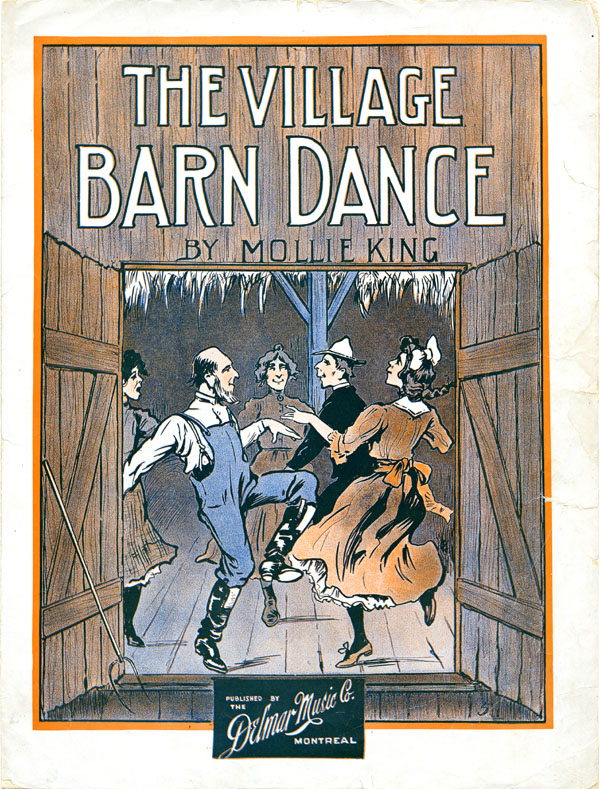
Sheet music cover image of a musical piece entitled, “The Village Barn Dance” by Mollie King. Source
Visit LAC’s Sheet Music from Canada’s Past website to learn more or to search for music sheets. Here’s how:
The browsing options in the fourth box allows you to limit your search to digitized music for which there is either printed music or audio files available. Please note that default searching has been set at “All Time Periods”, “Any Keyword” but you can modify these settings by following the above steps.
Once you have found a piece of sheet music, you will see some or all of the following information:
As the sheet music is available as PDFs, you can print the music on letter size paper.
Congratulations to the Library of Parliament and Canadiana: the Historical Debates of the Parliament of Canada portal is now live!
This new portal contains the historical debates in both official languages from 1867 to the mid-1990s. This means you can now search and browse all published debates of both the Senate and the House of Commons from Parliament 1, Session 1, until the coverage begins on parl.gc.ca.
As mentioned above, the portal was developed by the Library of Parliament, in collaboration with Canadiana.org, a membership alliance dedicated to building Canada’s digital preservation infrastructure and providing wide-ranging access to Canadian documentary heritage. Library and Archives Canada is pleased to have provided support by producing the digital page images.
You can consult our blog Looking for the Debates of the House of Commons (Hansard) online? of June 2012 to help you find information on the House of Commons debates.
 Library and Archives Canada Blog
