Hidden Treasures – Winnie the bear

Discovering hidden treasures in our institution’s vast collection of archival material is one of the exciting benefits of researching at Library and Archives Canada (LAC). Recently, two previously undescribed photographs of the bear mascot Winnie, the famous Canadian inspiration for A.A. Milne’s Winnie-the-Pooh stories, were found and made available online.

A reference technician from LAC was searching for First World War photographs taken in March 1915 of the 15th Canadian Battalion in the trenches of Neuve-Chapelle, France. The technician consulted the usual sources (online database, onsite Finding Aids, and contact cards from the Department of National Defence photographic collection) and found a description of a possible and unexpected item in the personal collection of Horace Brown.

The photographs from this collection were retrieved from storage; some of them were very small and difficult to view. One seemed to be of a soldier wearing a very odd hat. Further investigation with the aid of a lighted magnifying glass revealed the “soldier” was actually a bear cub and the curious headgear was its ears! A second image of the bear cub was also identified in the collection. A bit of sleuth work revealed that Horace Brown, a member of the Canadian Expeditionary Force, had been stationed at Salisbury Plain, England during October and November 1914, at the same time as Lieutenant Harry Colebourn with his mascot, Winnie.

Although many photographs exist of the famous bear in the Manitoba Archives and private collections, these were the first ones to be identified in LAC’s holdings. The images may now be viewed by all Winnie the bear (and Winnie-the-Pooh) fans here and here on our website.

Harry Colebourn with Winnie the bear - Salisbury Plain.

Harry Colebourn with Winnie the bear – Salisbury Plain. (e011067493-v8)

Harry Colebourn with Winnie the bear - Salisbury Plain.

Harry Colebourn with Winnie the bear – Salisbury Plain. (e011067494-v8)

Animals in War (1914–1918)

Colour poster depicting countryside combat, with a horse-drawn tank and soldiers fleeing from the cannonade.

During the First World War, the terrain on the front lines was often muddy and without paved roads, which made it difficult to use motor vehicles. This is why armies relied on a wide array of beasts of burden, including horses. These animals were used primarily by cavalry troops, but they also served to haul cannons, ammunition and food, as well as to pull non-motorized ambulances. Horses were ever-present in the theatre of operations.In September 1914, the first contingent of troops to leave Canada for England loaded up 7,636 horses! Although they belonged to the cavalry units, most of the horses were purchased by the Canadian government from private owners to meet army needs. Hundreds of thousands of additional horses were subsequently sent to the front lines. By the end of the war, the army had lost eight million horses in combat.

Other animals were also used by the army during the First World War. Mules, donkeys and cattle primarily transported materials, ammunition and food. In eastern regions, such as Egypt, camels were also used.

The terrain—continually bombarded in some areas or very mountainous in others—made it difficult to communicate, so winged or furry messengers were called
in. There were even special units responsible for maintaining a flock of carrier pigeons, ready to be sent with messages tied to their legs. Dogs were also used as messengers.

Colour sketch of a brown dog sitting.

Colour sketch of a brown dog sitting. Source

The Canadian Army had a Veterinary Corps at the time, with blacksmith and farrier units who all saw to the care of work animals. During the conflict, veterinary hospitals and mobile veterinary units were created behind the front lines to treat animals and make sure they were well fed.
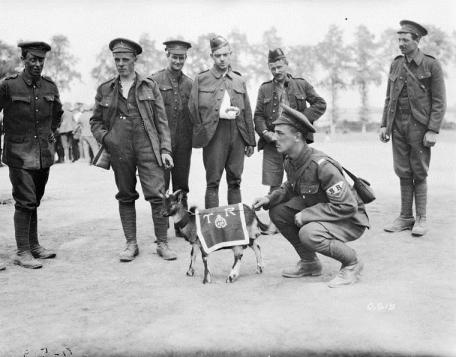
At all times, animals were alongside soldiers on the front as companions in misfortune. From the very beginning, military mascots have served to represent the group who adopted them. Even members of the Canadian Expeditionary Force had mascots during the First World War, as shown in the following image.

Group of soldiers around a goat wearing a cape with insignia.

Mascot of the 3rd Canadian Infantry Battalion, August 1916. Source

Visit our Flickr album for more photographs.

Questions or comments? We would love to hear from you!

From Enlistment to Burial Records: The Canadian Expeditionary Force in the First World War

Each year, Library and Archives Canada (LAC) receives countless questions on how to locate military services files, such as:

  • How do I find out more about a soldier (or a nursing sister) in the Canadian Expeditionary Force (CEF)?
  • When and where did he enlist?
  • How old did the soldier say he was? (Many underage soldiers gave an earlier year of birth when they enlisted)

A great place to begin your research is on our Genealogy and Family History’s Military pages.

To help guide you through the process, our experts have put together the following explanations.

Attestation papers

Also known as “enlistment” documents, these records indicate the date and place of birth, the marital status and the name and address of the next of kin.

The Soldiers of the First World War database contains references to more than 600,000 people who served during that conflict. Most of the corresponding attestation (enlistment) papers can be viewed online, including those of the Nursing Sisters.

To learn more, consult our article “Canadians and the First World War: Discover our Collection”.

Service files

These records contain key documents such as record of service, casualty form, discharge certificate and medal card. It also provides the name or number of
the unit in which the individual served overseas.

Find more information in our articles “What You Will Find in a Canadian Military Service File” and “Understand the Abbreviations Commonly Found in Military Service Files”.

War diaries

The War Diaries are a daily account and historical record of a unit’s administration, operations and activities.

Consult the War Graves page for information on the burial location of a soldier who was killed in action.

If the soldier survived the war, the Veterans Death Cards give information such as the next of kin, burial location and date of death. The digitized images, which are in alphabetical order, can be navigated in sequential order.

For the soldier who was decorated, a nominal index to medal registers, citation cards and records of various military awards provides further information on many soldiers’ achievements.

Our article “War Diaries: Discover what individuals or military units did during the war” can also guide you with your research.

Published histories

For an easy-to-read overview of the unit’s activities, we recommend starting with “published histories.” These books are often called “regimental histories” and our article Published Histories: Discover what individuals or military units did during the war” will give you more information.

Thematic guides

The Guide to Sources Relating to Units of the Canadian Expeditionary Force
lists references to records and files that complement the research in First World War records. This thematic guide further describes the contribution of most units in the CEF.

Other past articles of interest this Remembrance Day:

Questions or comments? We would love to hear from you!

New Finding Aid Online: Non-Permanent Active Militia

Library and Archives Canada (LAC) is pleased to announce that a new finding aid for the Non-Permanent Active Militia, RG 9 II-B-7, is now available online. View the 8,800 lower level descriptions today!

During the First World War, units of the Non-Permanent Active Militia were called upon to perform a variety of military tasks in Canada, notably to guard strategic sites such as armouries, bridges and canals.

The files are arranged alphabetically and can include a variety of forms dealing with enlistment, medical and dental history, hospitalization, discipline, pay, discharge and subsequent correspondence relating to the individual’s eligibility for war service gratuities and other service-related issues. Attestation papers, which are completed at the time of enlistment, are present in a number of the files. They include the recruit’s name and address, next-of-kin, date and place of birth, occupation, previous military experience and distinguishing physical characteristics.

This sub-series also contains small quantities of exceptional files: for members of the permanent force, for members of the Canadian Expeditionary Force (CEF) prior to embarkation overseas, for members of Royal Flying Corps, and for nursing sisters and other members of the Canadian Army Medical Corps.

Although the outside dates for the records are 1908-1983, the vast majority were created during the period 1914-1919.

Want to learn more about how to use finding aids? Consult our articles “Discover Finding Aids!” and “ Discover Finding Aids – Part Two”.

Be alerted when we have added new finding aids online by subscribing to our RSS feed.

For more information on recent announcements at LAC, visit “News”.

Guide to Sources Relating to Units of the CEF is Now Available Online

We are pleased to announce the launch of the Guide to Sources Relating to Units of the Canadian Expeditionary Force. The guide is an indispensable starting point for researching the records that document Canada’s participation in the First World War. It is a unique finding aid that brings together references to records and files scattered throughout several different archival fonds, which relate to almost every unit in the CEF.

The Guide was originally developed over many years by Barbara Wilson, an archivist with the former National Archives of Canada, now Library and Archives Canada. The guide has subsequently been updated with more recent acquisitions from official records, private papers and diaries, and by many other contributors from Library and Archives Canada. The guide was reviewed and updated with references to the Ministry of Militia and Defence records and daily orders, which are described by Library and Archives Canada as Record Group 9 or RG9.

For more information on recent announcements at LAC, visit “News”.