Porter Talk

By Stacey Zembrzycki

This article contains historical language and content that some may consider offensive, such as language used to refer to racial, ethnic, and cultural groups. Please see our historical language advisory for more information.

Stanley Grizzle was born in Toronto in 1918, to parents who had immigrated separately from Jamaica in 1911. His mother laboured as a domestic servant while his father found work as a chef with the Grand Trunk Railway (Grizzle, My Name’s Not George, p.  31). The eldest of seven children, Grizzle became a porter for the Canadian Pacific Railway (CPR) at the age of 22, pulled away from school to help his parents meet their dire financial obligations. “Porters,” as he puts it in his memoir My Name’s Not George: The Story of the Brotherhood of Sleeping Car Porters in Canada, “were well respected, and looked up to by many in the community because they had steady employment. In essence, they were the aristocrats of African-Canadian communities. They were the most eligible bachelors and parents often encouraged their daughters to marry a porter” (p. 37).
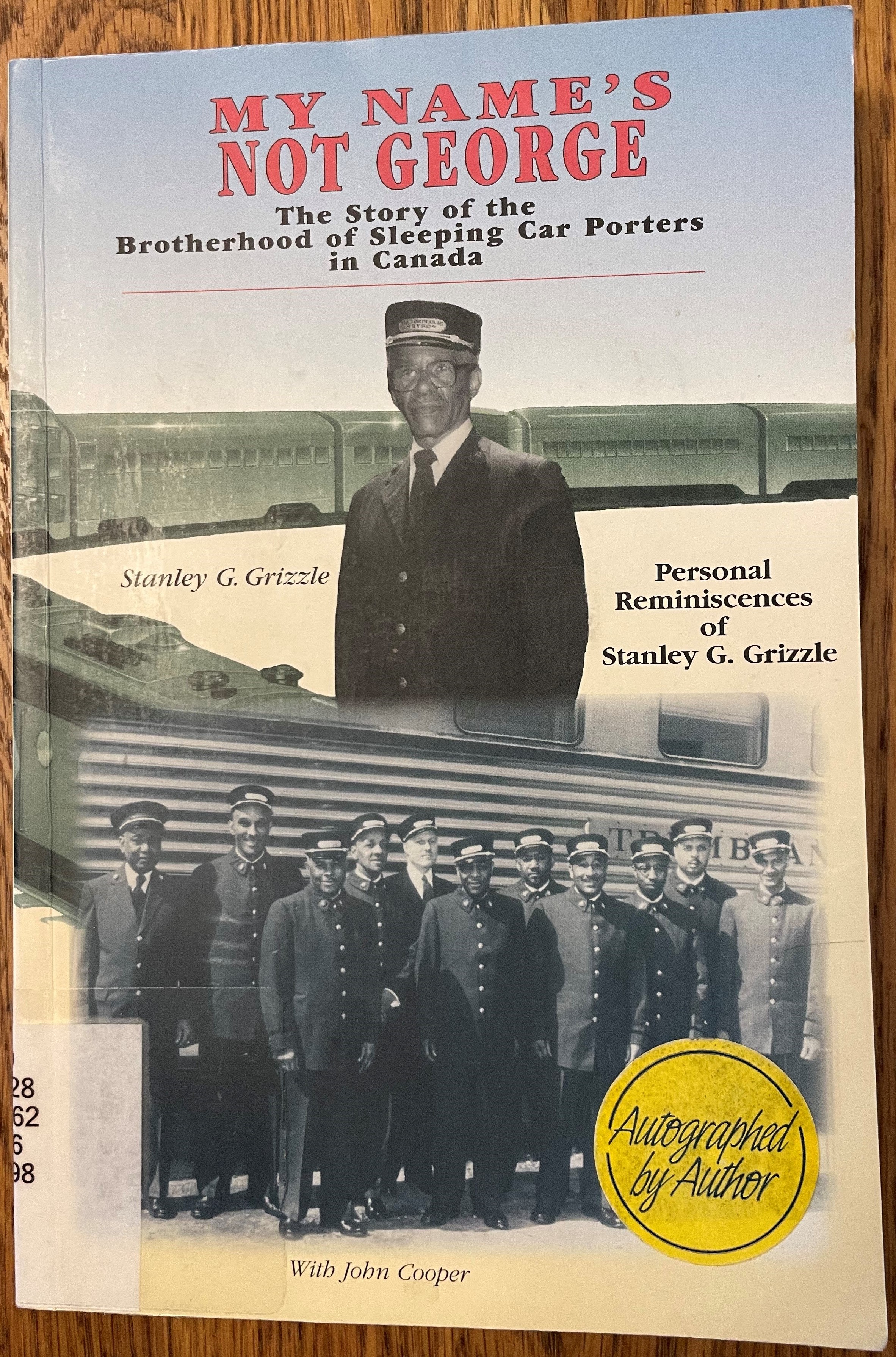
Book cover featuring a man with a train behind him, and a group of men below, all dressed in uniforms.

Book cover of My Name’s Not George: The Story of the Brotherhood of Sleeping Car Porters in Canada: Personal Reminiscences of Stanley G. Grizzle (OCLC 1036052571). Image courtesy of the author, Stacey Zembrzycki.

Grizzle’s early life began to follow this well-established trajectory, especially since portering was one of the only employment options available to Black men in the mid-twentieth century, until it was interrupted by the realities of the Second World War. Conscripted into the Canadian Army in 1942—legislation he firmly opposed throughout his life—Grizzle spent an extended amount of time away from the family he had only just started. In fact, his first child, Patricia, arrived on the very day he departed for Europe and did not have the opportunity to meet her father until he returned home, when she was three years old (Grizzle, My Name’s Not George, p. 57).

Grizzle’s early experiences with poverty, and the racism he encountered as a porter and a soldier, went on to dictate the new career path he paved for himself. First, as a celebrated labour union activist with the Toronto division of the Brotherhood of Sleeping Car Porters (BSCP), then as the first Black Canadian to be employed by the Ontario Ministry of Labour as a clerk with the Ontario Labour Relations Board, and later as the first Black Canadian to be appointed as a judge in the Court of Canadian Citizenship. There is no doubt that these experiences also informed the interviews he conducted in 1986 and 1987, now held by Library and Archives Canada (LAC).

As I mentioned in a previous blog, these 53 informal conversations among friends and acquaintances constituted what many, including Melvin Crump, referred to as “porter talk.” Meeting in Crump’s Calgary living room on November 1, 1987, the two men spent the afternoon discussing the intricacies of what it meant to be a porter. Not only did they describe what the job signified for them as Black men, they also explained how it shaped their identities and the larger Black communities that supported them.

Having been born in Edmonton in 1916 after his parents immigrated in 1911 as homesteaders from Clearview, Oklahoma, Crump’s early circumstances were much different from Grizzle’s. However, the men had both experienced the abject racism that was central to Black experience in Canada, which ultimately led them to a career with the CPR. Like Grizzle, Crump went to work for the company because it offered stable employment, away from the meatpacking plants and farms in the region that provided little stability and paid poor wages. In fact, Crump knew that this would be the only way to get ahead, so he lied about his age to obtain a job when he was just nineteen years old, thereby defying the age restriction that limited employment to those over twenty-one.

Like Grizzle, Crump spent about twenty years working for the CPR before seeking employment beyond the rails. The move from steam to diesel engines, coupled with automation, drastically changed the size, shape and appearance of this labour force, as well as passenger experience forever. As they had always done, the men moved toward a secure future. Regardless of their similar but divergent histories, both men prided themselves on having done their jobs well, and continued to stress the inherent value of unionization, regardless of the risks, nearly thirty years after leaving portering.
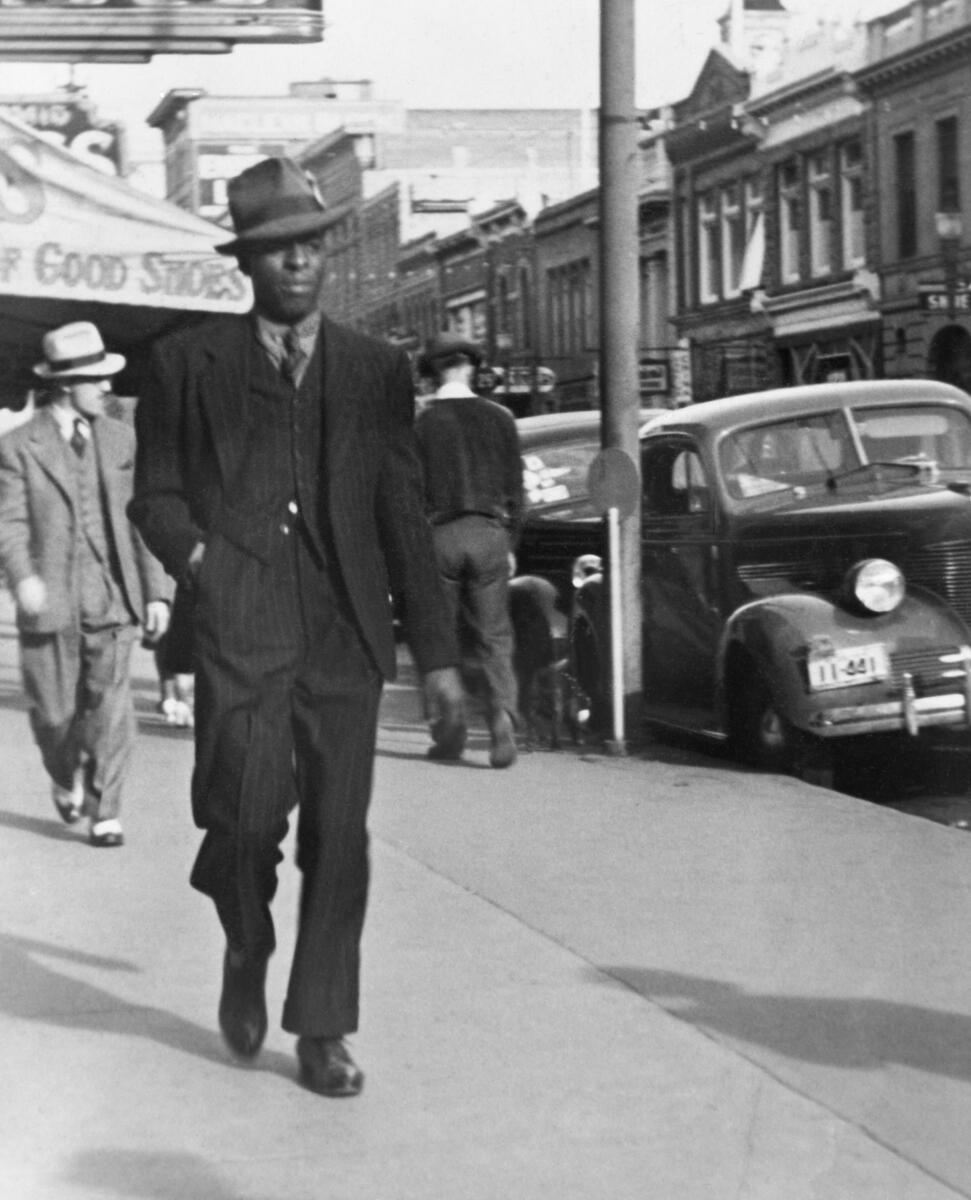
A man in a suit and hat walking down a sidewalk lined with cars and buildings.

Melvin Crump on 8th Avenue, Calgary, Alberta, ca. 1940, (CU1117465).
Photograph: Collection, Libraries and Cultural Resources Digital Collections, University of Calgary.

There is a coded language to this conversation. It is implicit, organic and almost impossible to understand without having lived through the institutional racism and systemic segregationist policies that guided nearly every aspect of these men’s lives, on and off the rails (Mathieu, North of the Color Line). The conversation is warm, the laughter is heartfelt, and the experiences intersect in complex ways. There is no need for detailed explanations between the men. These conversations were meant to support the writing of Grizzle’s memoir. While he was committed to documenting and preserving the history of portering in Canada, one wonders if these conversations were meant to be heard by others. And yet, here we are, listening in, translating their meaning and breaking the coded nature of these exchanges nearly forty years later.

By pushing Crump to articulate the particular circumstances that defined his experiences in Calgary—the friendships that were made, nurtured and even broken there, the specifics of unionization within that branch and the role of the wider community in fighting for change and supporting porters and their families—Grizzle highlighted the similar ways in which porters across the country were bound together by this demanding and often degrading profession.

And yet these intersections, which we hear across the collection, quickly become more complex when Grizzle asks Crump, as he did with all interviewees, to recount memorable railroad anecdotes. Porter talk offers insight into how each man put one foot in front of the other and built a life around portering. We get brief but powerful glimpses of who these men were, how they saw the world and why they tolerated and overcame the abuse they endured daily. As we gain a superficial understanding of each man’s personality, we also hear about resilience. Stories about memorable passengers naturally shift to stories about the other Black men with whom they shared railcars and responsibilities. The sense of community among porters and the conversations that started on the trains and flowed over into these interviews are what make these recordings so special. The laughter, reinforced by years of hindsight, reflection, recognition of service and a job well done, fuels the jovial exchanges that lead us into the realm of porter talk.

When Grizzle asked Crump to tell him about the prominence of nicknames between porters, Crump let out a roaring laugh, declaring:

Oh nicknames used between porters? Oh-oh-oh-oh, yes. Yeah, I know what you mean. You mean porter talk? You mean porter talk? Well, uh, uh, some of the porter talk names I wouldn’t wanna mention on tape, because if I did uh, it would shock some of the readers or some of the listeners, but they had a language all of their own, I’ll tell you. And some of the conversations that they would get in between themselves. I couldn’t dare, I wouldn’t dare to start to-to mention none of those things. (Interview 417403, File 2 [22:33])

And yet, porter talk is exactly what he, and nearly all of Grizzle’s other interviewees, transmit on these recordings. He couldn’t dare and yet he does. We are offered a seat at the proverbial table to listen, learn and take in a world that no longer exists, and yet remains central to who we are as Canadians.

It is this passing reference that inspired Discover Library and Archives Canada’s new miniseries Porter Talk. This will be the first in a new podcast production entitled Voices Revealed, which will delve into the vast and rich oral history holdings at LAC. While porters have figured prominently in popular culture in recent years, this will be the first time that these men, along with their wives and children, will speak for themselves. It is not enough to write about their exceptional experiences. Readers must hear these narratives. They must be able to differentiate accents, listen to laughter alongside rage, pause to ponder the challenges of portering and the resilience of Black communities in Canada, and grasp the power in these men’s voices and the history they convey.

Grizzle, Crump and all those who graciously agreed to be interviewed, will guide us through this history on their own terms, revealing why it is imperative for us to keep listening, to keep remembering, and to keep porter talk alive, especially as we continue to navigate the many challenges posed by institutional and systemic racism and discrimination in this country and beyond. The structures that these men, alongside their wives and children, worked so hard to dismantle, continue to matter. These voices remind us of the work that remains to be done.

To listen to this miniseries, you can subscribe to Discover Library and Archives Canada for free wherever you get your podcasts.

Additional resources


Stacey Zembrzycki is an award-winning oral and public historian of immigrant, ethnic, and refugee experiences. She is currently employed as a Podcast Development Specialist in the Outreach and Engagement Branch at Library and Archives Canada.
Soundscapes of the Stanley Grizzle Interview Collection

By Stacey Zembrzycki

This article contains historical language and content that some may consider offensive, such as language used to refer to racial, ethnic and cultural groups. Please see our historical language advisory for more information.

It is rare, when listening to oral history interviews, for the soundscape, the noises that one hears in the background, to be just as interesting and important as the stories being shared by interviewees. Practitioners today are trained to conduct interviews in quiet spaces, limiting noise so that every word spoken is clear and easy to understand. The crispness of each voice matters since it determines the life an interview will have among future listeners and within multimedia projects.

The Stanley Grizzle Interview Collection is fascinating because it flies in the face of this orthodoxy. When Stanley Grizzle travelled throughout the country documenting the stories of Canadian Pacific Railway (CPR) sleeping car porters, their fight to unionize and create the Brotherhood of Sleeping Car Porters (BSCP), and the important role of the women who served on the BSCP’s Ladies’ Auxiliary, he did so as an insider. A twenty-year CPR veteran, Stanley Grizzle conducted interviews that revolved around a clearly defined set of questions, which were replicated in each encounter. There were also, however, conversations among friends, many of whom Grizzle had worked with either on the railroad or during his time as a labour leader. Moving from home to home with a tape recorder that he started and stopped at will and at the request of interviewees, Grizzle instantly swept listeners into his world, where the formalities of the typical interview were cast aside, informal banter transpired, and drinks – complete with clinking ice cubes – were stirred in the background.

Grizzle’s insider knowledge both helped and hindered his ability to document the history of the BSCP. In most cases, he was immediately recognized as a “Brother.” Gaining trust was not difficult given the existence of prior relationships. As a result, many of the men tended to get right to the heart of what it meant to be a porter during the first part of the twentieth century. “Porter talk,” as Melvin Crump called it, allows listeners to see this world through the eyes of each porter with whom Grizzle met. It is an intimate look into a world that has now been lost. Viewing the job of a porter through this Black lens reveals how the men, and the women who supported them, thought about their everyday lives and viewed others. Ultimately, it also demonstrates the varied ways that they understood and negotiated societal inequality.

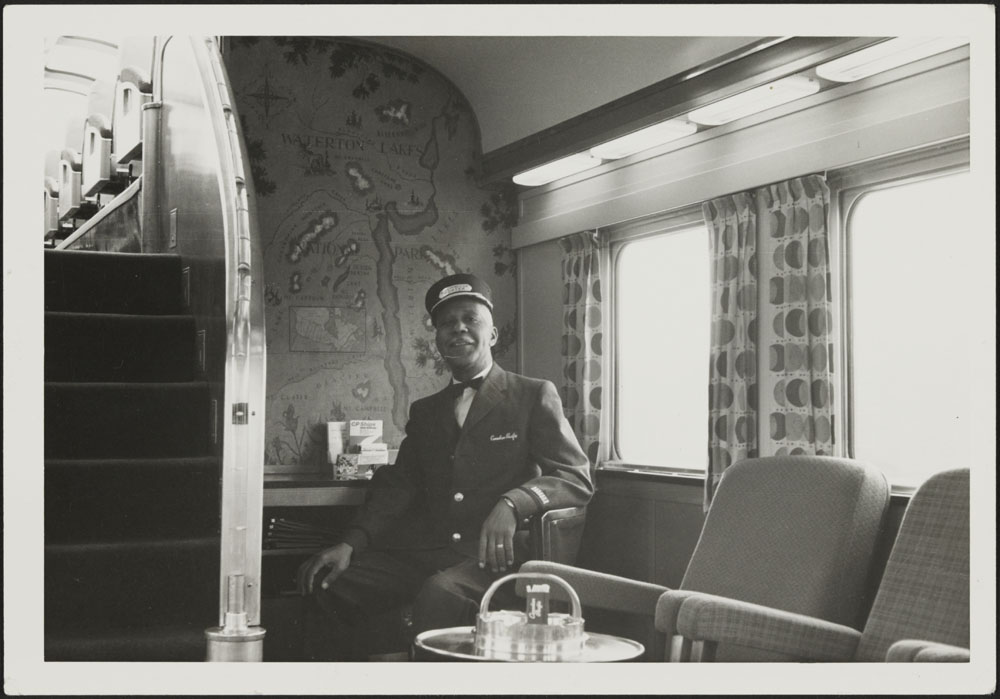
Canadian Pacific Railway sleeping car porter sitting in a train wagon.

Albert Budd, C.P.R., S.C. Porter, 1940s–1960s (e011781984)

Unfortunately, being an insider was not always beneficial. Given Grizzle’s own experiences, and his quest to document the history of the BSCP’s formation and of the men and women who made it possible, there were many missed opportunities along the way. In addition to Grizzle’s inclination to correct interviewees, stories pertaining to the fight for civil rights in the United States, experiences of migration, and some of the more problematic—and even controversial—issues that porters faced on the railroad are limited and, at times, absent from the record. The point was not to glorify porters’ diverse experiences, but there was a careful dance being done by those who recognized that reputations were at stake and the power that the company still wielded, despite the existence of the union, was real. In addition to these considerations, stories that should have been given space to be told were cut short given Grizzle’s objectives. Listeners hear the tape recorder stop and then restart at different stages in the life narratives being recounted. There is never any explanation. Listeners are left to try to listen for what was omitted, silenced, or simply lost to the past.

Nevertheless, along with these aspects of the interview, listeners are presented with wonderful opportunities to hear the ways that various sounds cut across these narratives and give us a way into a deeper understanding of who these interviewees were. Interviewees’ voices reveal the varied countries from which they descended. Heavy accents from America’s Deep South as well as those from a host of Caribbean nations tell us about lives lived elsewhere and the struggle of migrant labourers, who were often highly educated, to make a better life in Canada.

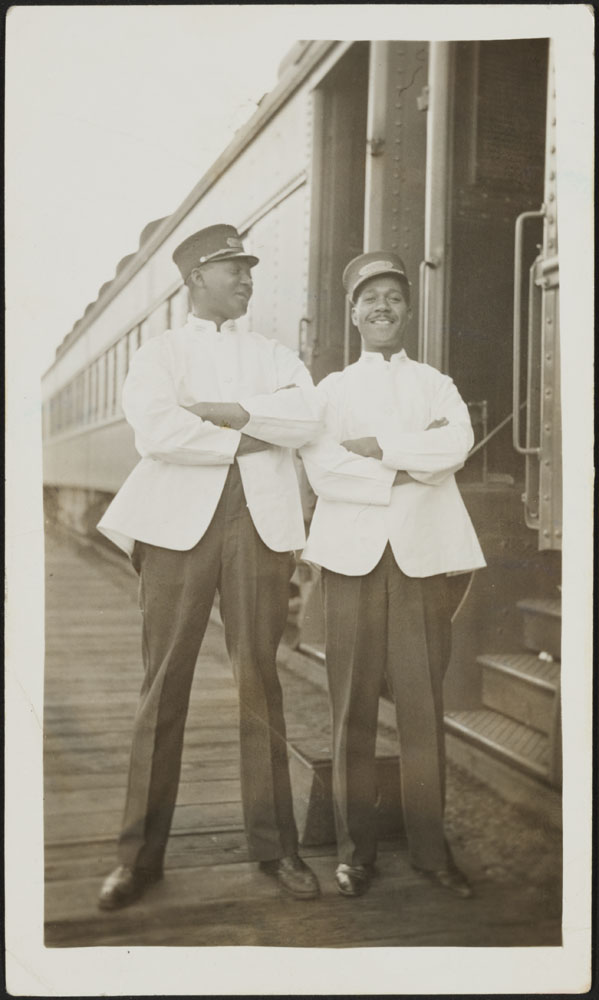
Two Canadian Pacific Railway sleeping car porters standing next to a train.

Left to right, Smitty from Montreal and Albert Budd (e011781983)

Everyday soundscapes also loom large. Radios and televisions wail alongside birds chirping in the background and children playing in neighbouring rooms. The banging of pots and pans reveals the presence of women in nearby kitchens, likely preparing a meal for their esteemed guest. The stomping of feet above the heads of Grizzle and his interviewees alongside the flushing of toilets speak to the substandard tenement housing from which some porters, then retired, were never able to escape.

We hear disability, too, when some stories are relayed. Heavy coughing and wheezing from smoking and its second-hand effects, as well as from years spent on the railcars, which picked up heavy amounts of pollutants through open windows, tell us about interviewees’ life choices in addition to the heavy toll this work took on their bodies. Men spoke of the disability pensions they collected as a result of the damage done to their backs by years of heavy lifting. On more than one occasion, Grizzle and his interviewees seem to be sitting in creaky wooden chairs, rocking back and forth, on creaky wooden floors, as the stories flow. One wonders whether the chairs speak to class, and the ability to own fancier furniture, or to disability, and the need for structure and support for aching bodies.

Group of Canadian Pacific Railway sleeping car porters gathered around a table.

C.P.R. porters, L–R Phil Witt, Jack Davis (e011781985)

The beauty of oral history is being able to listen to a story and take in the surroundings in which it is being created. It helps us process and make sense of the past. The Grizzle Interview Collection speaks to the complexity of understanding history as well as the importance of listening to the soundscapes in which everyday lives were captured and preserved for future listeners.

Additional resources

  • Oral History Off the Record: Toward an Ethnography of Practice, by Anna Sheftel and Stacey Zembrzycki (OCLC 841187000)

Stacey Zembrzycki is an award-winning oral and public historian of immigrant, ethnic and refugee experiences. She is currently doing research for Library and Archives Canada.

The Ladies’ Auxiliary of the Brotherhood of Sleeping Car Porters

By Stacey Zembrzycki

This article contains historical language and content that some may consider offensive, such as language used to refer to racial, ethnic and cultural groups. Please see our historical language advisory for more information.

Stanley Grizzle, citizenship judge, politician, civil servant, labour union activist, and porter of twenty years, travelled across the country in the late 1980s documenting the experiences of Canadian Pacific Railway (CPR) sleeping car porters and their struggle to unionize. His questions about the creation of the Brotherhood of Sleeping Car Porters (BSCP) always went hand in hand with those that documented the important role played by Black women in the BSCP’s Ladies’ Auxiliary.

Ten members of the Toronto Pullman Division’s Ladies Auxiliary posing for a photo.

Ladies Auxiliary, Toronto Pullman Division, Brotherhood of Sleeping Car Porters (e011181016)

While documenting the male “stalwarts,” as he called them, Grizzle was careful to ask about the mothers, sisters, wives, and daughters, who often lingered in this movement’s background, as well as in the background during these recorded sessions. The Stanley Grizzle Interview Collection thereby provides important gendered and generational perspectives into the forces that made unionization possible in Black communities across Canada. It also shows how involvement in the BSCP and its Ladies’ Auxiliary tended to serve as starting points for community mobilization around a broad array of issues and training grounds for community leaders.

Union leaders, inspired by A. Philip Randolph, an American labour unionist and civil rights activist as well as the organizer of the BSCP in the United States, recognized early on that women had integral roles to play in founding and sustaining this union movement. As Essex Silas Richard “Dick” Bellamy recalled:

I shall never forget when Brother Randolph came to Calgary, and Brother Benny Smith, he says, “There is no organization [that] will ever be successful unless the ladies are permitted into that organization.” And I have never forgotten, and I don’t believe you can find very many organizations [where] the ladies are…are not affiliated with the men in these various organizations. They seem to be able to give the men, uh-uh, a little more incentive to…in, in order to help them out. (Interview 417401)

Frank Collins succinctly echoed this sentiment: “…[You] had to have the women behind you before you had a strong union because, if you didn’t have them working with you, you were nowhere.” (Interview 417402)

Women’s solidarity was deeply rooted in the realities of the job. Being a porter required men to be on the road for as long as a month at a time. In their absence, porters’ wives, mothers, sisters, and daughters played principal roles, moving throughout their Black communities to encourage and promote the creation of the BSCP among both men and women, actively recruit and “card” porters at their local train stations and in their churches and community organizations, and, once the union was created, collect union joining fees and dues. Like other women, Velma Coward King, who was active in the Montreal BSCP Ladies’ Auxiliary, recognized the challenges of unionizing these men early on, noting that long stints away from home meant the men could not regularly attend meetings. Given that “[it] was the woman who was the back, uh, backbone in the house of the family,” they needed to step in. This was the only way forward, as she made clear, recognizing that: “Once you had a union to represent you and to speak for you, they knew that they couldn’t treat you as dirt.” (Interview 417383)

The power inherent in this aspect of the collection lies in its ability to tell the story of how upward mobility manifested out of unionization and women’s efforts to make that possible. The collective agreements that resulted from community solidarity led to improved working conditions and higher salaries, which, in turn, gave families the ability to move to suburbs, where they purchased homes. It also meant that there was money left over to help send children to university. Most importantly, as the Winnipeg BSCP’s Ladies’ Auxiliary first President Helen Bailey surmised: “I think men then became to even feel respect for themselves because then they had, uh, they were making a worthwhile living for their families.” (Interview 417400)

Poster advertising the tenth anniversary dance of the Toronto Division of The Brotherhood of Sleeping Car Porters and their Ladies Auxiliary.

Poster for a tenth anniversary dance organized by The Brotherhood of Sleeping Car Porters and their Ladies Auxiliary (e011536972)

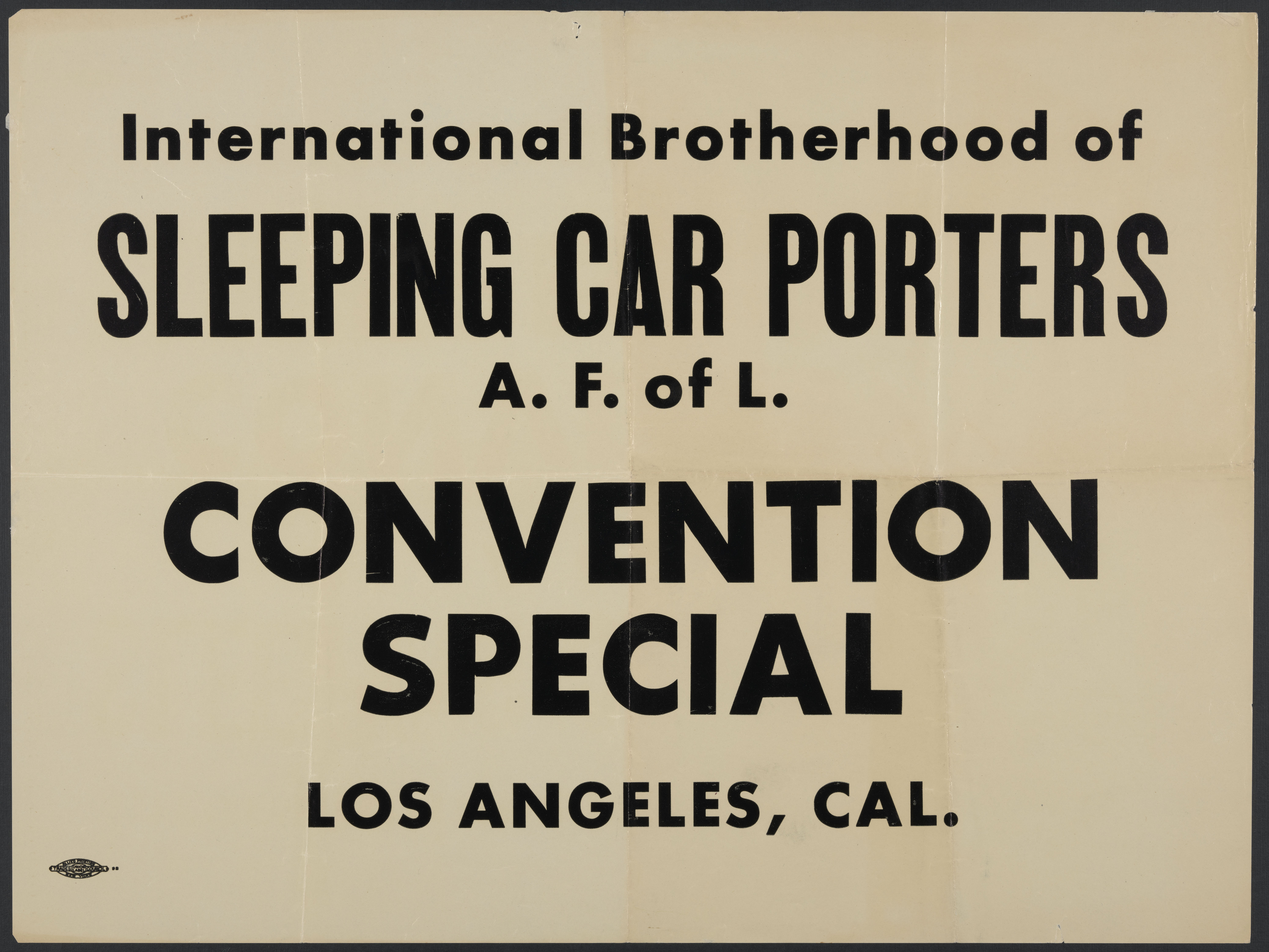
The important generational thread that winds through these interviews clearly explains how BSCP Ladies’ Auxiliaries across the country brought women of all ages together to both organize and ultimately fundraise money through various community events, which included teas, socials, and dances. This money helped move union leaders across the country, giving the BSCP strength; funded travel to national and international conventions, giving Canadian labour leaders a voice in the movement; and supplemented education through scholarship funds.

Poster for the International Brotherhood of Sleeping Car Porters’ Convention Special in Los Angeles, California.

International Brotherhood of Sleeping Car Porters poster for a Convention Special in Los Angeles, California (e011536973)

Breaking the generational reality of portering, wherein fathers and their sons were forced into this profession because of the absence of other employment opportunities, was never far from the minds of the women who were involved in the BSCP’s Ladies’ Auxiliaries. Women’s involvement also gave some, like Ivy Lawrence Mayniar/Maynier, glimpses into the systemic racism and discriminatory labour practices that were integral to Black experiences in Canada. In speaking about her father’s career as a porter and her drive to seek out higher education as a result of it, Mayniar shared a powerful memory from while she was a student at McGill University:

[…] I was then going to, to the university. And then I walked down to the…to work at the library for a while. And I walked down to the, uh, uh, station and looked for Dad’s car. And I remember one night, it was bitter. […] It was a bitter night. And I, I, I myself was just so upset about this. And…but I wanted to go down ’cause I knew Daddy was going on standby. He was standing out. And I went down, went to the station, went and looked down the track for Dad. And there he was standing outside. Dad was a short man and this, you know, tight little person. And I looked down there to catch his eye. And there he was standing with snow on top of his cap, and his shoulders pushed…pulled together like this, and the wind was going down that line there, just brutally. It was just awful. And he was just standing there, and, uh…and the snow piled up on him. And, uh, I went and I sat down in the concourse outside from where…from where the trains left…And I just sat on a bench and cried. I’ll never forget that. (Interview 417387)

Mayniar became the first Black woman to graduate from the University of Toronto Law School, but she went on to study in England, where she was called to the bar at the Inns of Court, because she recognized the limitations she would continue to face in Canada as a person of colour. She practiced law in Trinidad and Tobago, where she spent the remainder of her career fighting against the racism and discrimination that she saw exemplified in her father on that cold, wintry day at Windsor Station.

The interviews conducted by Grizzle not only document the history of the fight to unionize CPR sleeping car porters, but also speak to a history that is bound up in the advancement of Black families and their communities throughout Canada. There could not be one without the other. When listening to the voices of these men and women, one hears the power inherent in women’s collective actions, how ever small, and the pride these wives, mothers, sisters, and daughters had in knowing that they effected change on the ground for the men in their lives as well as their children and themselves. When Grizzle asked Evelyn Braxton whether the “Ladies’ Auxiliary lived up to the expectations, uh, of, uh, giving the Brothers the, the maximum support that they, uh, looked forward to,” she wholeheartedly declared: “Oh, they certainly did. The Ladies’ Auxiliary was the support of the Brotherhood men.” (Interview 417386) Women were not only the backbone of their families: they held up their communities and the generations that followed.

Additional resources:

  • My Name’s Not George: The Story of the Brotherhood of Sleeping Car Porters in Canada: Personal Reminiscences of Stanley G. Grizzle, by Stanley G. Grizzle with John Cooper (OCLC 883975589)
  • Deindustrializing Montreal: Entangled Histories of Race, Residence, and Class, Chapter 3: The Black City below the Hill, by Steven High (OCLC 1274199219)
  • North of the Color Line: Migration and Black Resistance in Canada, 1870–1955, by Sarah-Jane Mathieu (OCLC 607975641)

Stacey Zembrzycki is an award-winning oral and public historian of immigrant, ethnic and refugee experiences. She is currently doing research for Library and Archives Canada.

Black porters’ voices and stories: the Stanley Grizzle interview collection

By Stacey Zembrzycki

This article contains historical language and content that some may consider offensive, such as language used to refer to racial, ethnic and cultural groups. Please see our historical language advisory for more information.

The history of the railway in Canada is often narrated in a celebratory manner. It is seen as having united the country from coast to coast, with the last spike coming to symbolize the fruition of Confederation. And yet, this history is deeply rooted in the dispossession of Indigenous peoples from their ancestral lands and territories, the exploitation of Chinese migrant labourers, and the discriminatory labour practices experienced by Black sleeping car porters. The Stanley Grizzle interview collection, which consists of interviews with 35 men and 8 women who were either porters or had loved ones who worked the rails, offers a different account of the railway. The collection is exceptional because of its ability to bring us deep inside this history. It tells it from a new perspective that places Black Canadian and Black migrant labourers’ voices, as well as the stories of the racism that they experienced while employed by the Canadian Pacific Railway (CPR), at its centre. These interviews also offer glimpses into the Depression, the Second World War, the struggle to unionize porters, the creation of the Brotherhood of Sleeping Car Porters (BSCP) and its Ladies’ Auxiliary, and ultimately what life was like inside Black communities across the country. The difficult narratives in this collection speak to the strength and resilience of those who have long been discriminated against simply because of the colour of their skin.

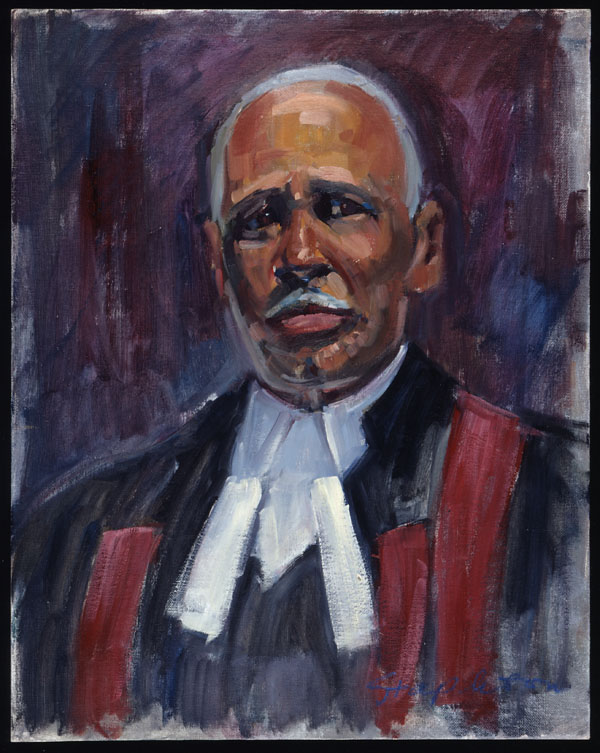
A painted head-and-shoulders portrait showing an older Black man dressed in judge’s robes and a crisp white shirt. His black robes are embellished with a burgundy sash. The man, who looks directly at the viewer, has short grey hair and a grey moustache.

Portrait of Citizenship Judge Stanley Grizzle by William J. Stapleton (c151473k)

In 1986 and 1987, Stanley Grizzle travelled across the country, to the CPR’s major junction points of Montréal, Toronto, Winnipeg, Calgary and Vancouver. There, he documented the experiences of those who were born in the first two decades of the 20th century and went on, in most cases, to have long and storied careers as porters. Grizzle was himself a porter for 20 years, as well as a labour union activist, political candidate, civil servant and citizenship judge. The narratives that he collected informed his 1998 memoir, My Name’s Not George: The Story of the Brotherhood of Sleeping Car Porters in Canada, Personal Reminiscences of Stanley G. Grizzle.

Portering was not a profession of choice. It was one of the only employment options available to Black men in the 1950s and 1960s. As Torontonian Leonard Oscar Johnston recounted:

I applied for jobs, but I was refused because of colour. Well, actually they called me “n….” And I remember one day, I walked from Jane and Bloor to River Street, along King Street, lookin’ for a job as a—I was a machinist. I had a couple of years machine shop, and I was told to shine shoes. Yeah. Now that’s 50, 60 years ago, but—and I decided, “Okay, I’ll shine shoes.” So, I went down the CPR.
(Interview 417394)

For others, being a porter was a way to escape the racial violence of the Deep South or to make a better life for themselves after leaving the Caribbean. Many of these migrant labourers were either university educated or held trade specializations but still could not find jobs in Canada. In desperation, they responded to CPR advertisements and recruitment campaigns, becoming porters. Some men stayed for 10 years, moving to other sectors once they opened up. Others remained for up to 40 years, to collect the pensions they earned for their service.

A crowd of people disembark from a train as railway employees and porters help them with their luggage.

Railway porters help passengers to disembark at a railway station (a058321)

These men were responsible for greeting rail passengers and attending to their every need while in transit. Prior to the creation of the BSCP, which ratified its first collective agreement in 1945, it was typical for porters to be on the road for three to four weeks at a time. While away from their families and communities, porters worked 21-hour days. They were permitted to sleep on the leather sofas in the smoking cars beside the bathrooms for just three hours a night, but only when all of their tasks, such as cleaning bathrooms, shining shoes, making beds, counting linens and attending to passengers’ needs, had been completed. The CPR also monitored porters’ time while on layovers, requiring them to report to the main stations daily, where they were forced to relay their activities and movements. For this work, the CPR paid porters a monthly salary of $75. This flat rate, coupled with the absence of overtime pay, meant that tips were the only way to survive.

The men, many of whom had knowledge of or experience working in other unions, knew that their situation could be improved only through unionization. They aligned themselves with famed American labour unionist, civil rights activist and organizer of the BSCP, A. Philip Randolph. The gains in their first collective agreement not only improved the lives of the men, leading to salary increases, overtime pay, assigned sleeping berths and decent meals, but also those of their families. Upward mobility, signified by purchasing homes, moving to the suburbs, and accessing higher education, were key developments that followed. The interviews in this collection describe the struggles to organize union locals across the country. They also depict the people, including the women participating in the Ladies’ Auxiliary, who made these efforts possible.

The experiences of the porters are still difficult to hear, but the interviews are fascinating, bringing us deep into the world of what Melvin Crump referred to as “porter talk” (Interview 417403). Namely, they give listeners the ability to view these experiences as the porters once did. We hear these men seamlessly move beyond the racism and discrimination that they experienced, spinning their everyday encounters into learning opportunities where fun could be had and power could be taken back. George Forray’s reflections were similar to those of others who recognized the systemic racism they faced:

“Well, I found it quite an education. I found it an education which I couldn’t have got at no university. An education in, uh, all the, uh, practically that we can say the facts of life all through and something I couldn’t have bought or earned or been taught, except when I went experienced it myself.”
(Interview 417383)

At heart, the Stanley Grizzle interview collection preserves voices and stories of survival. It tells us how porters viewed their passengers, themselves, and ultimately the world that worked so hard to beat them down.

Additional resources

  • My Name’s Not George: The Story of the Brotherhood of Sleeping Car Porters in Canada, Personal Reminiscences of Stanley G. Grizzle by Stanley G. Grizzle with John Cooper (OCLC 1036052571)
  • “Chapter 3: The Black City below the Hill,” in Deindustrializing Montreal: Entangled Histories of Race, Residence, and Class by Steven High, pp. 92–128 (OCLC 1274199219)
  • Unsettling the Great White North: Black Canadian History by Michelle A. Johnson and Funké Aladejebi, eds. (OCLC 1242464894)
  • North of the Color Line: Migration and Black Resistance in Canada, 1870–1955 by Sarah-Jane Mathieu (OCLC 607975641)
  • The Sleeping Car Porter by Suzette Mayr (OCLC 1302576764)

Stacey Zembrzycki is an award-winning oral and public historian of immigrant, ethnic and refugee experiences. She is currently doing research for Library and Archives Canada.

Travel posters in the Marc Choko collection—a Co-Lab challenge

By Andrew Elliott

The Marc Choko collection of travel posters represents a fantastic cross-section of Canadian travel poster art during the period from 1900 to the 1950s. “One’s destination,” wrote Henry Miller, as he travelled through Greece in the 1930s, “is never a place, but a new way of seeing things.” In fact, the entire Modernist movement of the era was about seeing old things in new ways. For railway companies, and later airlines, the posters helped market companies to as wide an audience as possible. While promoting their fast and efficient services, they also projected to travellers a stylish, romantic vision of travel to and within Canada.

Between 1900 and 1930, and particularly in the 1920s, there was a shift in the way people travelled. During this period, middle-class tourists rivalled immigrant travellers for space on trains. Tourism became a kind of mass culture theatrical experience, and as a result, leisure time was commodified. The publicity departments of both Canadian National Railways (CN) and Canadian Pacific Railway (CPR) developed close ties with Canadian (and American) artists to create poster art (and art for other types of marketing and publicity, including magazines and timetable booklets). In 1927, for example, CN commissioned members of the Group of Seven to create a 33-page scenic guide advertising the wild, natural and romantic beauty of Jasper National Park. (This guide, with a couple of digitized pages, can be found in the Museum Train Collection series of the Canadian National Railway Company fonds.) Neither the railway companies nor the artists operated in a vacuum; they were influenced by the travel and artistic movements that were spreading across the world in the early 20th century. There was a remarkable convergence: cars, trains, airplanes, zeppelins and ocean liners were all competing for customers. To sell their services, the various companies turned to posters that suggested, among other things, speed and experience.

The Marc Choko collection at Library and Archives Canada (LAC) features a collection of travel posters by various artists who were commissioned by transportation companies. The collection was donated to LAC in the early 1990s by Marc Choko, a professor emeritus with the School of Design at the Université du Québec à Montréal. Choko taught courses on design from 1977 to 2018 and has also published numerous books on design (website in French only), including Destination Québec; Une histoire illustrée du tourisme (2013), Canadian Pacific Posters 1883–1963 (2004) and Canadian Pacific; Creating a Brand, Building a Nation (2016).

Two of the best-known artists who created the posters were Peter Ewart and Roger Couillard. Ewart (1918–2001) was born in Kisbey, Saskatchewan, but grew up in Montréal. Upon completing his formal education, he studied art in Montréal, and later in New York. His paintings were exhibited by the Royal Academy (London, England), the Royal Canadian Academy, the Canadian National Exhibition and the Mid-Century Exposition of Canadian Painting. To learn more about Peter Ewart and his life and work, visit the comprehensive website petermaxwellewart.com.

In the late 1940s, Ewart helped to establish and then solidify a memorable advertising campaign for CPR as the “World’s Greatest Travel System.” His corporate commissions included a wide array of organizations and some events, such as Canadian Pacific Airlines, Bank of Montreal, Imperial Oil Company, B.C. Telephone Company, Calgary Winter Olympic Games, Ocean Cement and many more.

Some striking examples of Ewart’s work in the Choko collection include the following posters for CPR.

Moose in water with trees in the distance and a small company crest.

CPR poster “Hunt This Fall—Travel Canadian Pacific” (e000983752-v8) Credit: CRHA/Exporail, Canadian Pacific Railway Company Fonds

Large fish in water and a small company crest.

CPR poster “Full Information from Canadian Pacific—World’s Greatest Travel System” (e000983750-v8) Credit: CRHA/Exporail, Canadian Pacific Railway Company Fonds

The artist Roger Couillard (1910–1999) is also well represented in the Marc Choko collection. Couillard was born in Montréal and studied at the École des Beaux-arts de Montréal (School of Fine Arts in Montréal; EBAM). In 1935, the Institute of Foreign Travel organized a poster competition on the theme of “See Europe Next.” One of his posters was chosen and exhibited in Ogilvy’s department store in Montréal. Couillard opened a studio in the Drummond Building on the city’s St. Catherine Street in 1937. He later worked for the Quebec Ministry of Tourism from 1966 to 1975. (There is very little biographical information about Couillard available online. The information listed here was gleaned from a Canadian Design History/Theory course web page at the Emily Carr University of Art + Design. For further details about Couillard’s art, see Artnet.)

The following striking examples of Couillard’s work show his versatility. He was able to work for a variety of organizations, such as CPR, CN, Trans-Canada Air Lines and Canada Steamship Lines. The posters capture the essence of what travel represented for voyagers at the time.

An arrow points to the sky and has a telegram on it.

Canadian National Telegraphs, “Telegraph—When Speed Is a Factor” (e010780461-v8)

A plane flying above the message “Costs only 3¢ more to all parts of Canada.”

Trans-Canada Air Lines—Air Mail (e010780458-v8)

These less well-known artists are also represented in the Choko collection:

The collection contains some striking work by unknown artists as well. For example, one notable poster for CN has been reprinted for numerous postcards, yet the artist has not been identified. Can you help to identify this artist?

This is where the Co-Lab challenge comes in! The challenge in Co-Lab is not only to tag and describe the posters, but also to identify some of the artists. Check out the Travel Poster Co-Lab Challenge to see more posters in the Marc Choko collection.


Andrew Elliott is an archivist in the Archives Branch at Library and Archives Canada.

Top 5 topics addressed by our Reference Librarians

By Emily Dingwall

At Library and Archives Canada (LAC), reference librarians respond to requests on a wide variety of interesting topics from clients. This blog post outlines five types of reference questions librarians frequently handle and suggests resources to consult on these subjects.

The cover page from Sessional Papers of the Dominion of Canada with the title “Public Accounts of Canada, for the Fiscal Year ended 30th June, 1884.”

“Public Accounts of Canada” report found in Sessional Papers of the Dominion of Canada, 1885, Vol. 1, No. 1. (OCLC 1007491677, image from Canadiana)

  1. Federal government documents

Annual departmental reports. Clients are often seeking annual departmental reports. Annual reports from Confederation in 1867 to 1925 are printed in the Sessional Papers of the Dominion of Canada. Learn more about the Sessional Papers of the Dominion of Canada, 1867 to 1925. If you are in Ottawa, you can access the Sessional Papers at LAC by requesting them from staff in the 2nd floor reference room. They are also available through these websites:

Departmental reports post–1925 are published separately from other government documents in the Sessional Papers. You can request 1925–1930 annual reports from LAC staff or through the Internet Archive.

After 1930, search our library catalogue Aurora for annual reports by the name of the department as it was known  during that period.

Beginning with 1995, you can find annual reports at the Government of Canada’s Departmental Results Reports. For more recent years, you can search the specific government department website.

Parliamentary documents. We also receive many questions on searching parliamentary debates, journals and committee materials of the House of Commons and the Senate, such as for a speech made by a prime minister in the House. You can find these documents online:

A typewritten page with two columns of text, separated by a crest. The text on the left is in English and the text on the right is in French.

Front page of the Canada Gazette, Part II, Vol. 137, No. 23, November 5, 2003. (OCLC 1082716964, image from Canada Gazette)

  1. Legislative Research

Librarians frequently receive questions about legislation in print or legislation that can be found online through Justice Laws.

You can trace legislation through these main sources:

  • The Statutes of Canada include all acts and amendments to laws passed during each session of Parliament.
  • The Revised Statutes of Canada (R.S.C.) are consolidations of the Statutes of Canada incorporating amendments and acts that have been added since the last revision. The R.S.C have been published for the years 1886, 1906, 1927, 1952, 1970, and 1985.

The Statutes of Canada and the Revised Statutes of Canada are available in print format in our reference collection at LAC, as well as at many public and academic libraries. They are also accessible through the legal database LLMC Digital, which can be searched onsite at LAC.

To learn more about the Statutes and researching legislation, see the blog post Tracing Historical Legislation.

You can find official regulations and statutory instruments in Part II of the Canada Gazette, the official newspaper of the Government of Canada. Published in three parts, the Canada Gazette is searchable by keyword at these sites:

To learn more about the three parts of the Canada Gazette please see Canada Gazette publications.

Readings of bills, such as the First and Third readings, can be found by searching the library catalogue Aurora.

LEGISinfo, the Library of Parliament’s research tool, provides information on all bills considered by the Senate and the House of Commons since the start of the 37th Parliament in 2001.

An image of a four-column newspaper, Courrier canadien.

Courrier canadien, March 11, 1900. (OCLC 109270836)

  1. Newspaper Research

Librarians often assist clients in searching newspapers for information such as local histories, articles on individuals, or references to a past royal visit to Canada.

We hold newspapers in print and microfilm formats, which can be found through the Aurora library catalogue. We also subscribe to several newspaper databases.

The Geographical microform list names all the newspapers that we hold on microfilm (click on the OCLC number), as well as newspapers available online. The list is organized by province/territory, then alphabetically by location.

Major newspaper titles such as Le Devoir, the Montreal Gazette, and the Ottawa Citizen are available in our self-service microform reading room.

These newspaper databases can be accessed on the public workstations in our reference room: The Globe and Mail, Toronto Star, Paper of Record and Newspaper Archive.

Online newspaper resources include:

The cover page of “Official History of the Canadian Army in the Second World War.”

Cover page of Colonel C.P. Stacey’s Official History of the Canadian Army in the Second World War, Volume I: Six Years of War: The Army in Canada, Britain and the Pacific. (OCLC 317352934, image from Government of Canada publications)

  1. Military History Research

Librarians receive military history questions from clients looking for published histories of specific regiments/units, recruitment statistics per year, and locations of Canadian units in Europe during World War II.

Resources for military history research include:

An image of a Grand Trunk Railway timetable from 1922.

Timetable of the Ontario lines of the Grand Trunk Railway from 1922. (e011297622)

  1. Railway Histories

Many clients contact Reference Services about railway history research. Examples of questions we receive include the histories of specific train stations, the histories of railway companies (Canadian Pacific Railway, Canadian National Railways, Grand Trunk, etc.), and routes of particular railway lines.

We hold railway maps, as well as passenger and employee timetables in print format that can be located by searching Aurora. Many timetables are part of the Merrilees Transportation Collection, which contains about 5,000 publications including books, trade literature, technical manuals, timetables, broadsides, periodicals and pamphlets.

An Ontario railway historian has made rail timetables available on Charles Cooper’s Railway Pages.

Canadian Pacific Railway timetables from 1930–1985 are available through the Chung Collection at the University of British Columbia Library.

These are two excellent print publications to consult on railway history:

  • Andreae, C., & Matthews, G. Lines of Country: An Atlas of Railway and Waterway History in Canada. Erin, Ont.: Boston Mills Press, 1997. This publication is a comprehensive outline of railway and waterway history in Canada and includes maps of railways in Canada from early days to the present. It can be accessed in our reference room.
  • Ballantyne, B., and Bytown Railway Society. Canadian Railway Station Guide. Ottawa: Bytown Railway Society, 1998. This publication lists stations, plans and pictures.

 I hope that these resources will help you with your research on these subjects. Of course feel free to ask us a question on any topic, and a reference librarian will be happy to assist you!


Emily Dingwall is a Reference Librarian in the Reference Services Division at Library and Archives Canada.
The Grey Fox: Legendary train robber and prison escapee Bill Miner

By Caitlin Webster

Nicknamed “The Grey Fox” and “The Gentleman Bandit,” Bill Miner was a legendary criminal on both sides of the Canada–U.S. border. Although he committed dozens of robberies and escaped from multiple prisons, many saw him as a generous folk hero who targeted exploitative corporations only. Library and Archives Canada holds many documents, publications, sound and video recordings, and other materials relating to Miner, and hundreds of these documents are now available on our website as a Co-Lab crowdsourcing challenge.

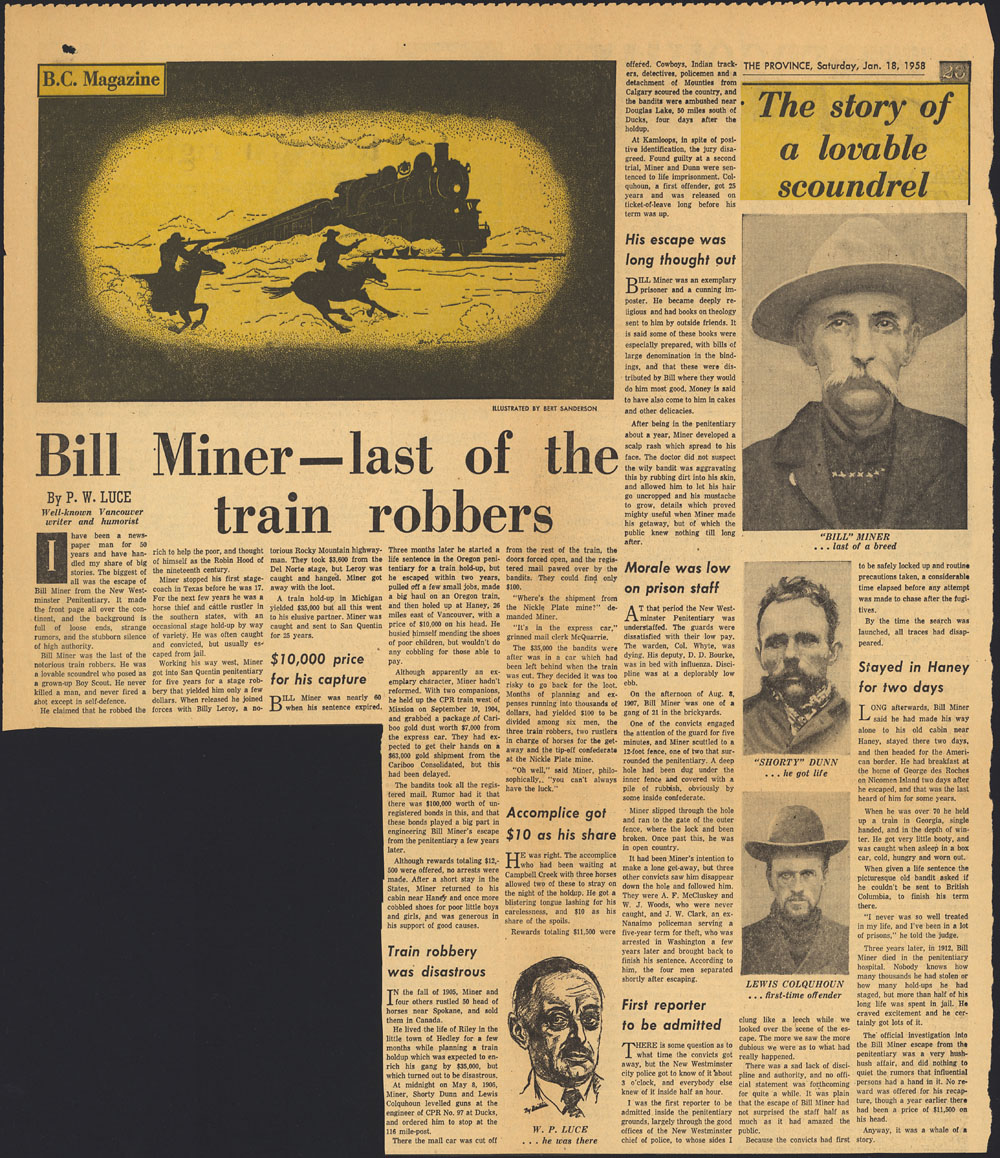
Newspaper page showing text, an illustration of two armed men on horseback approaching a train, a portrait of the author, and photographs of Bill Miner, Shorty Dunn and Lewis Colquhoun.

Article in The Province newspaper on January 18, 1958: “Bill Miner – last of the train robbers” (e011201062-019-v8)


Born Ezra Allan Miner on December 27, 1846, Miner began his criminal career as a teenager, stealing horses and robbing merchants in northern California. He later moved on to burglarizing homes and robbing stagecoaches in California and Colorado, where he and his accomplices often took away thousands of dollars in cash, gold dust, bonds and other goods. His polite, conversational manner during robberies earned him the nickname The Gentleman Bandit. Law enforcement eventually caught up with Miner, and despite multiple escape attempts, he spent decades behind bars in San Quentin State Prison.

When Miner was finally released in 1901, it was to an unfamiliar 20th-century American West. After trying his hand as an oyster farmer, he soon returned to a life of crime. As stagecoaches had been replaced by ever-expanding railroads, Miner turned to train robbery. He tried and failed twice to rob express trains in Oregon, and escaped across the border to settle in Princeton, British Columbia. There he established himself as a cattle trader and ranch hand, using the alias George Edwards. Known for his generosity, Miner was well liked in the small town.

By 1904, Miner had recruited new accomplices and was ready to target another train, this time in Canada. On September 10, along with partners Jake Terry and Shorty Dunn, The Grey Fox robbed a Canadian Pacific Railway train at Mission Junction, B.C. After taking thousands of dollars in cash, gold, bonds and securities, the bandits evaded capture for over a year and a half. Then on May 8, 1906, Miner, Dunn and a new accomplice named Louis Colquhoun held up a CPR train at Ducks (now Monte Creek), near Kamloops. However, this job was an abject disaster. The take was only $15.50, the men were forced to flee on foot, and they were captured five days later. Yet with his popularity in the area and the anti-CPR sentiment at the time, crowds of supporters greeted Miner as the Royal North-West Mounted Police brought him in to Kamloops.

On June 1, 1906, all three men were tried and convicted, and the next day Miner began his life sentence at the B.C. Penitentiary in New Westminster. During his stay, Miner expressed no remorse, reportedly telling the visiting Reverend A.D.E. Owen, “I am what I am, and I have done what I have done, but I can look God and man in the face unashamed.” The same clergyman observed how Miner charmed fellow inmates and penitentiary staff, and warned the acting warden, “Old Bill is a man who is well worth watching.”

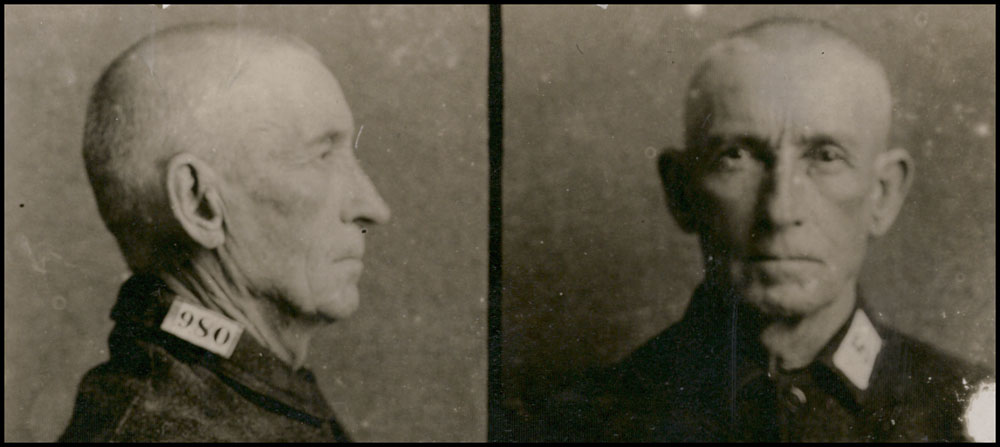
Two photographs of Bill Miner showing a front view and a profile view. They show Miner with his hair closely cut, and his mustache shaved.

Mug shot photographs of a shaven and shorn Bill Miner at the beginning of his sentence at the B.C. Penitentiary (e011201061-128-v8)

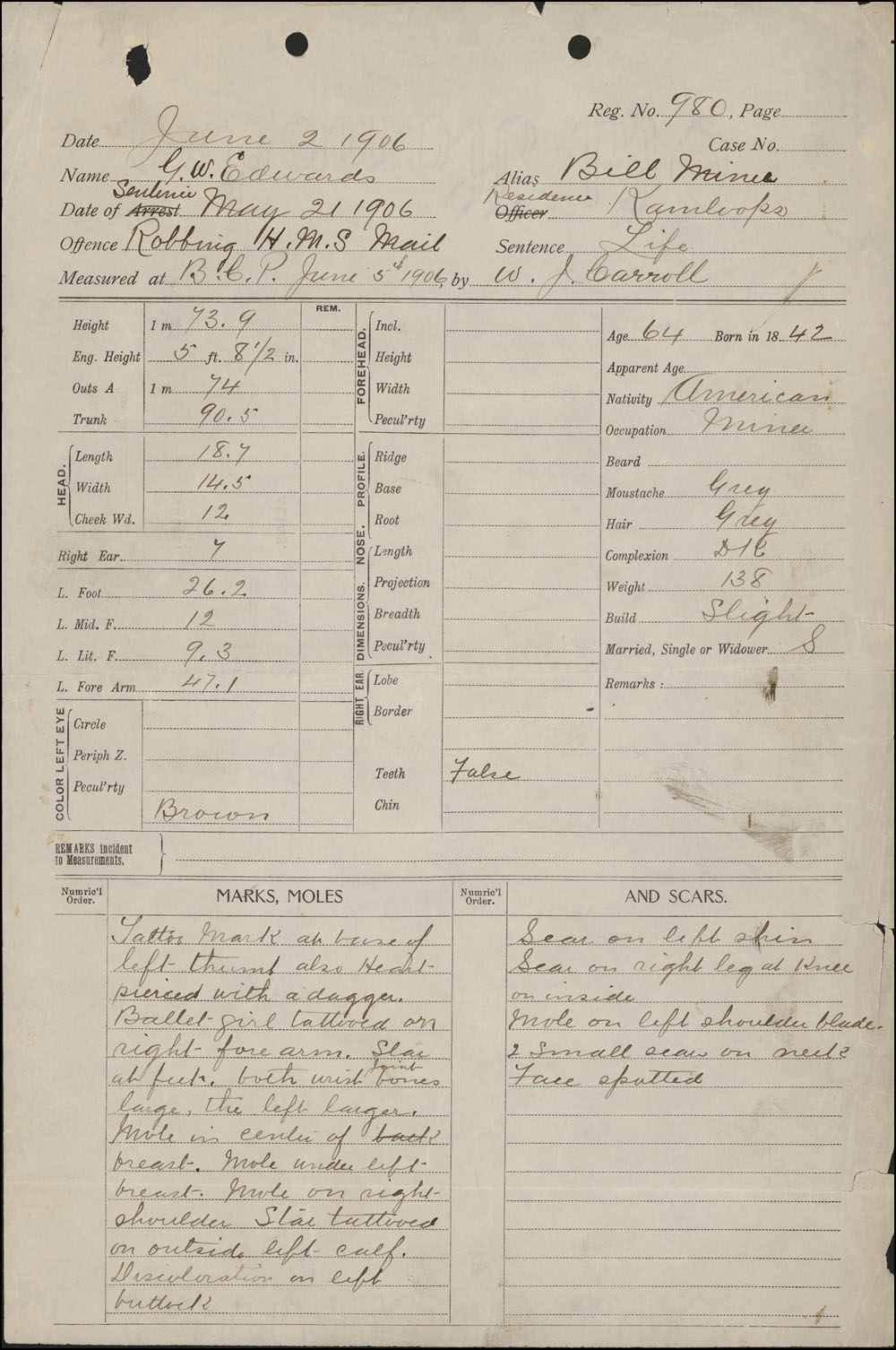
Form with physical description and criminal conviction details.

B.C. Penitentiary intake form for Bill Miner (e011201060-009-v8)


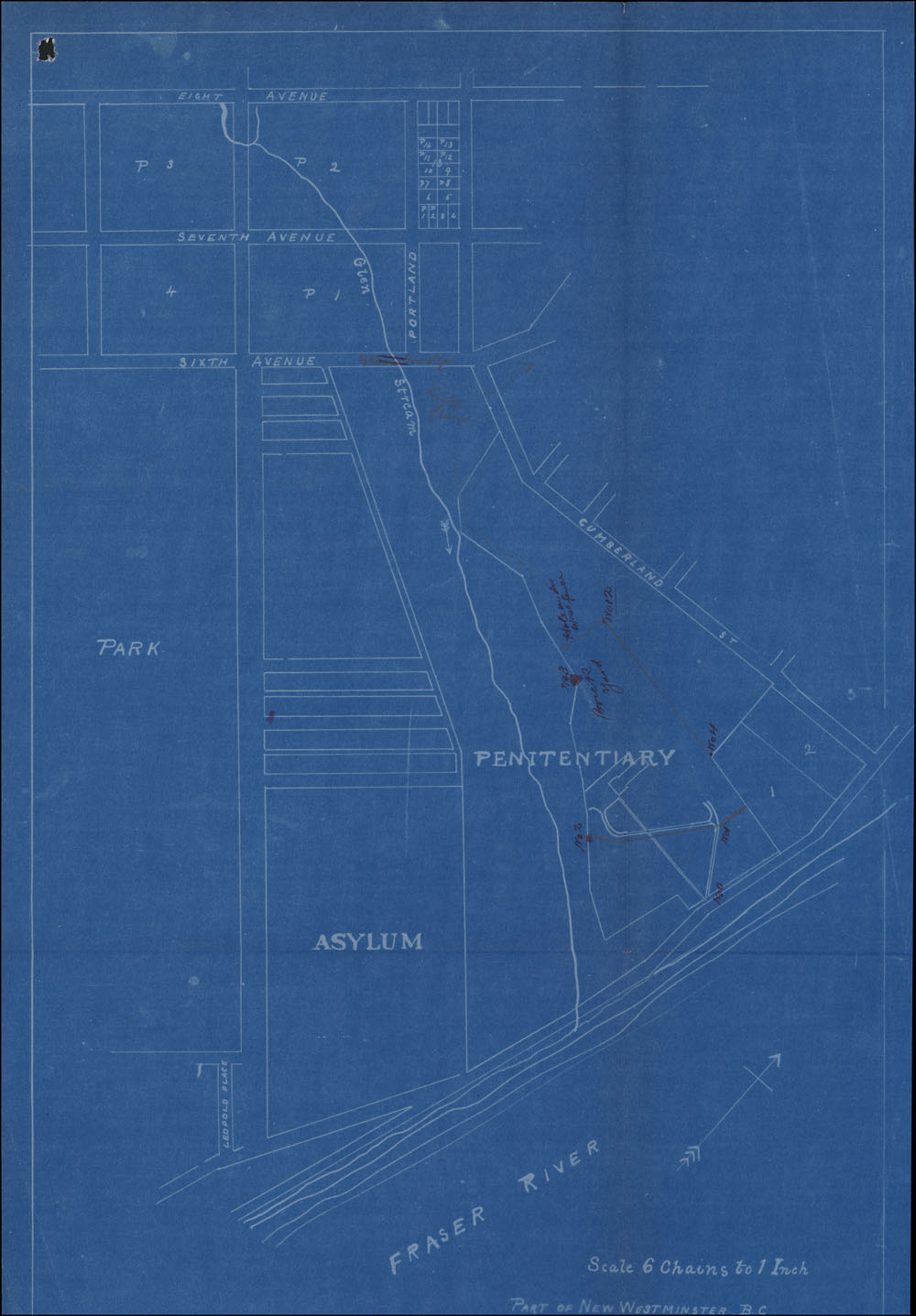
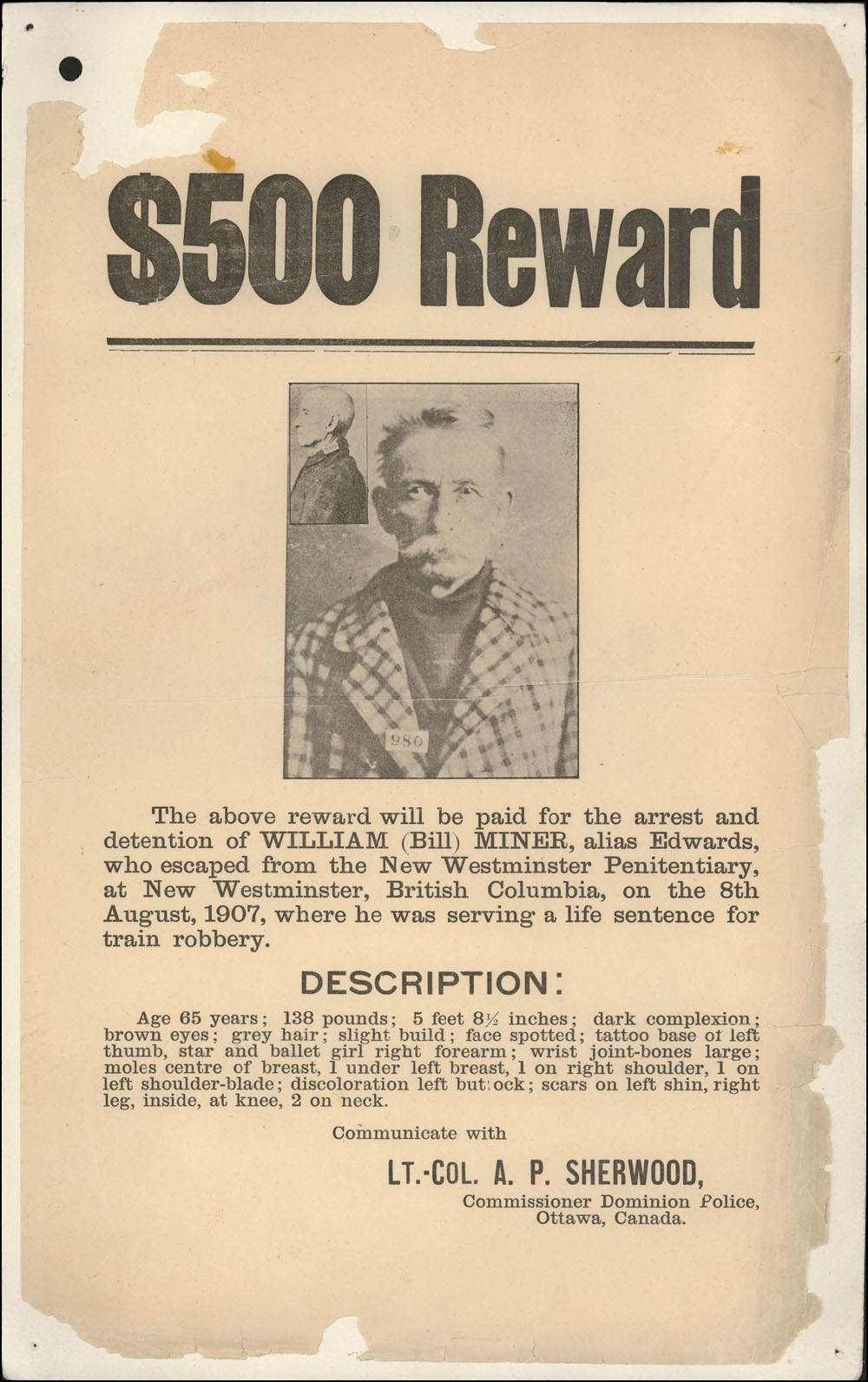
The warning was prophetic, as Miner escaped from the penitentiary on August 8, 1907. Guards and police searched the surrounding area, and then the wider Vancouver region, with no success. Rumours spread that he had received outside help to escape, in exchange for the return of bonds and securities he had stolen in the 1904 CPR robbery. In addition, newspapers reported high levels of public sympathy for Miner, with many expressing their wish that he never be recaptured.

Map on blue background, labelled to show general locations of penitentiary, asylum, and surrounding streets, park, and the Fraser River. Annotations indicate location of fence where Miner escaped, as well as other details of the local area.

Blueprint of B.C. Penitentiary site, showing location where Bill Miner escaped, as well as the surrounding area (e011201060-179-v8)

Poster showing photograph of Bill Miner, announcing a $500 reward for his recapture, listing details as to his escape, and describing his physical characteristics.

Reward notice for the recapture of Bill Miner, sent to police departments, publications and private detective agencies (e011201060-210-v8)

In the end, Miner returned to the United States and lived in Colorado until his money ran out. In 1911, he robbed a train in Georgia. He and his accomplices were caught within days, and at 64 years old, Miner was sentenced to 20 years in prison. After escaping in 1911 and 1912, Miner died in prison on September 2, 1913.

Library and Archives Canada holdings include records from the B.C. Penitentiary that provide fascinating details on Bill Miner and his escape from the prison. These documents are now available as a Co-Lab challenge, and include intake forms and mug shots of Miner, reports of prison officials, newspaper clippings, and letters from individuals claiming to have spotted The Grey Fox, even years after his death. Co-Lab is a crowdsourcing tool that invites the public to contribute transcription, translation, tags and description text. The public contributions then become metadata to improve our search tools and enhance everyone’s experience of the historical record.


Caitlin Webster is an archivist in the Vancouver office of the Reference Services Division at Library and Archives Canada.


Guest curator: Catherine Bailey

Banner for the guest curator series. CANADA 150 is in red along the left side of the banner and then the bilingual text: Canada: Who Do We Think We Are? and under that text is Guest curator series.Canada: Who Do We Think We Are? is a new exhibition by Library and Archives Canada (LAC) marking the 150th anniversary of Canadian Confederation. This exhibition is accompanied by a year-long blog series.

Join us every month during 2017 as experts, from LAC, across Canada and even farther afield, provide additional insights on items from the exhibition. Each “guest curator” discusses one item, then adds another to the exhibition—virtually.

Be sure to visit Canada: Who Do We Think We Are? at 395 Wellington Street in Ottawa between June 5, 2017, and March 1, 2018. Admission is free.


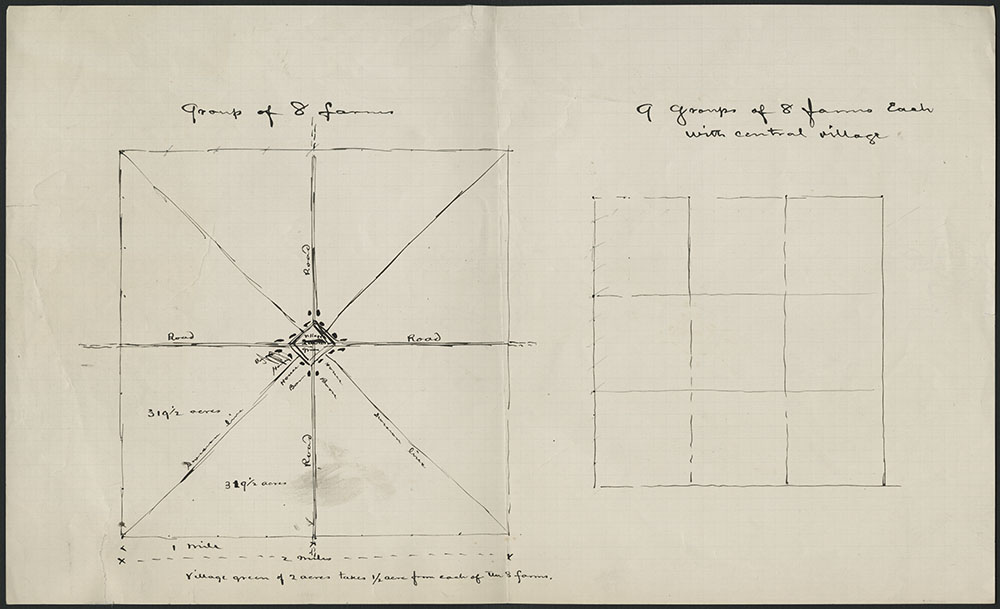
Plan for a group of eight farms by Sir William Cornelius Van Horne for the Canadian Pacific Railway, ca. 1889

Page with two grids drawn in black ink separated into squares or triangles to represent farms.

Plan for a group of eight farms by Sir William Cornelius Van Horne for the Canadian Pacific Railway, ca. 1889 (MIKAN 2925396)

This doodled design hints at the power railroad companies held to influence the look of the country. Settlements along Canada’s railway lines still reflect the grid plans imposed on them back then.


Tell us about yourself

During four very happy summers as an archival assistant at the Provincial Archives of Alberta, I worked with government records, private manuscripts and cartographic records, and I answered many reference inquiries for homestead applications (through which homesteaders obtained letters patent to confirm that they had settled former Crown land and had received legal title). During my last summer, I catalogued the series of historical township plans (maps) that covered all of Alberta.

Is there anything else about this item that you feel Canadians should know?

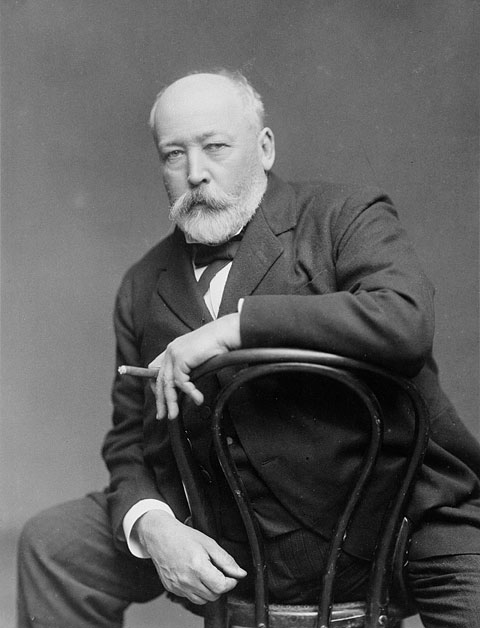
Portrait of a seated man in a suit, straddling a café chair and holding a cigar between two fingers.

Sir William Van Horne, builder of the Canadian Pacific Railway, ca. 1900–1910 by W.A. Cooper (MIKAN 3575931)

Since I am well acquainted with the Western Canadian land survey system and the homestead applications and township plans at the Provincial Archives of Alberta, this item from the Sir William Cornelius Van Horne fonds resonated with me. Those grid lines looked very familiar! But the Canadian Pacific Railway’s (CPR) influence on the look of Western Canada extends beyond this doodled sketch of a grid-based settlement plan; there is more to the story.

The CPR’s construction was supported by the government through the Canadian Pacific Railway Charter, which bestowed on the company a monetary subsidy of $25 million and land grants of 25 million acres (an area roughly the size of England), in addition to lands for rights-of-way, stations and yard works. Van Horne had direct responsibility for the CPR’s construction between 1882 and 1885, and was subsequently its Vice President, President and Chairman. Soon after the railway was completed in 1885, he and the other directors of the company realized that whatever small profits were made would be almost immediately swallowed up by the operating and maintenance costs of the difficult mountain sections.

Recognizing not only the potential lure of new settlement lands but also the grandeur of mountain scenery, Van Horne and the CPR used artwork and carefully crafted words in advertising campaigns that targeted settlement and tourism in Canada. The CPR’s influence and actions thus helped to shape Canada’s image abroad and contributed directly to the national economy.

Tell us about another related item that you would like to add to the exhibition

Van Horne is famously quoted as saying, “If we can’t export the scenery, we’ll import the tourists.” Both his passion for art and his business acumen gave him a keen interest in the development of the CPR’s tourism campaign.

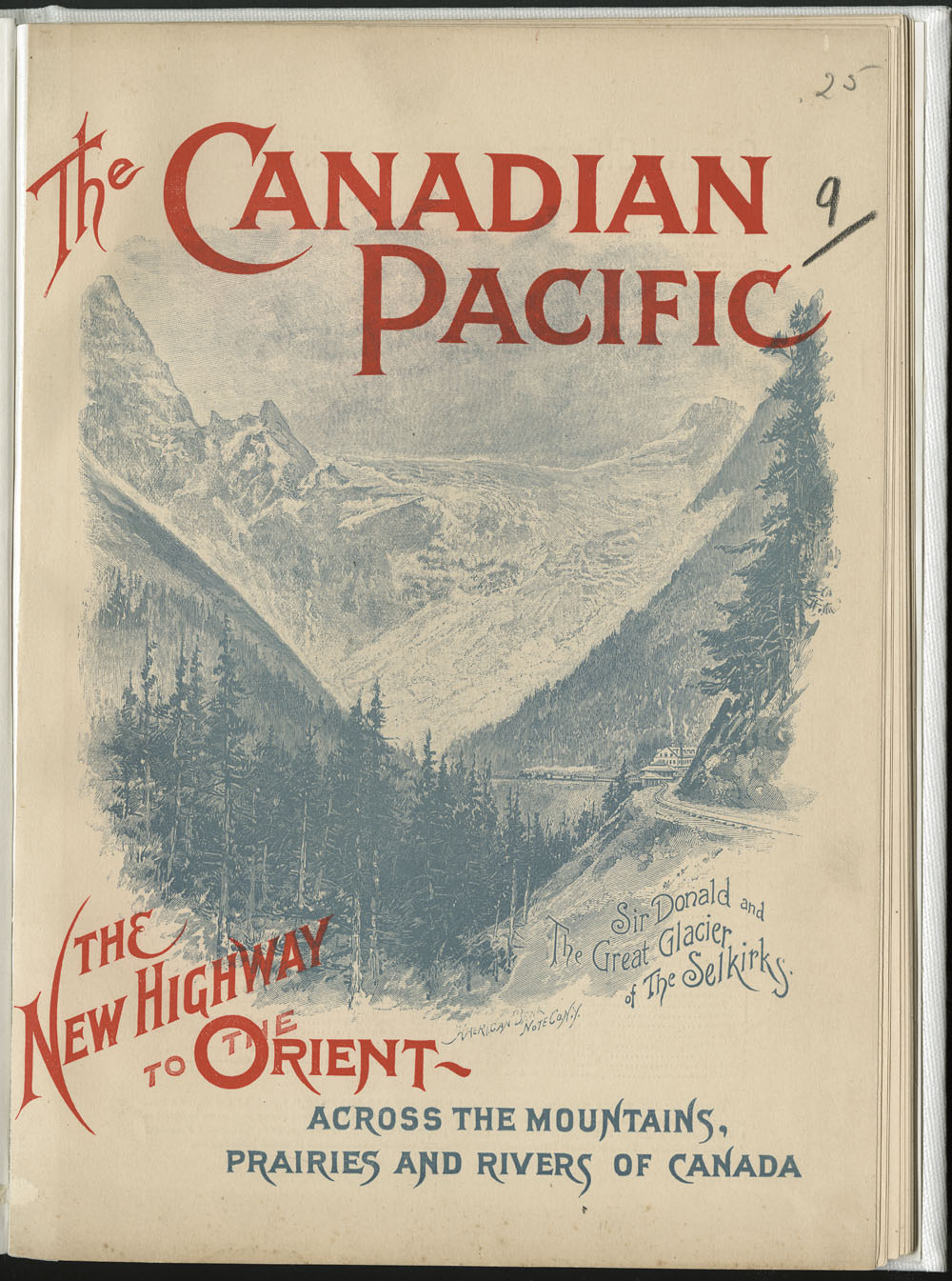
While there is a plethora of beautiful visual records at LAC and across Canada that could show how the CPR and Van Horne influenced the image of Canada abroad, I will focus instead on the complementary power of words, specifically those found in the 1891 version of the CPR tourist pamphlet The Canadian Pacific: The New Highway to the Orient Across the Mountains, Prairies and Rivers of Canada.

Image of mountain range with a small train leaving a train station, set between the title of the pamphlet at the top and bottom of the page.

Title page of The Canadian Pacific: The New Highway to the Orient Across the Mountains, Prairies and Rivers of Canada, published in Montréal by the Canadian Pacific Railway, 1891 (AMICUS 8155839)

Conceived and written by Van Horne himself, the 48-page pamphlet was originally begun in 1884 before the CPR was even completed, but it was not produced until 1887 because Van Horne insisted on having nothing but the best mountain illustrations to complement the text. He was one of the patrons behind the “Railway School” of Canadian artists that included John Arthur Fraser, Thomas Mower Martin, Frederic Marlett Bell-Smith and Lucius O’Brien. The artists were given free rail passes, with the only stipulation often being that the CPR would have first choice of the finished works for its own use.

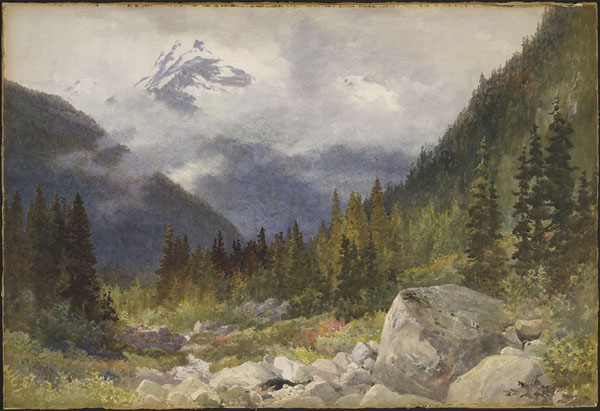
Colourful watercolour scene depicting a green forest in front of cloud-shrouded blue mountains.

View of the Rockies by Lucius O’Brien, 1887 (MIKAN 2886889)

Etching of two men on a beach putting a dead deer in a canoe. Another canoe and a wigwam can be seen at the side in front of trees with a mountain across the river.

Aboriginal Hunters with Wigwam and Canoe by a River by Thomas Mower Martin, 1885 (MIKAN 3018705)

Notwithstanding Van Horne’s passion for art, as a businessman he was not above clearly reminding artists that they owed it to the CPR to portray the mountains in a suitably grand manner to entice visitors. In one notable circumstance, described in E.J. Hart’s book The Selling of Canada: The CPR and the Beginnings of Canadian Tourism (AMICUS 3976336), Van Horne wrote to John Arthur Fraser (who had been sent out in 1886 to sketch the entire CPR line):

The black and white sketches will hardly answer our purposes, the mountains not being sufficiently imposing. I made last night a rough sketch … which will illustrate my ideas; it is made mostly from memory and I have taken a great deal of license but I do not think that any one going to the spot without the picture in hand will ever accuse us of exaggeration. For the great glacier and Syndicate Peak I would like something similar to this. … I find the perspective in the glacier not right and the peaks projecting through the glacier are not treated broadly enough to give their proper distance. You will of course be able to make a great many improvements on my sketch, but I hope you will preserve the size.

Please make a sketch of Mount Stephen, treating it in something the same manner. (The Selling of Canada, p. 35)

The New Highway pamphlet itself was clearly aimed to entice tourists:

May I not tempt you, kind reader, to leave England for a few short weeks and journey with me across that broad land, the beauties and glories of which have so recently been brought within our reach? There will be no hardships to endure, no difficulties to overcome, and no dangers or annoyances whatever. You shall see mighty rivers, vast forests, boundless plains, stupendous mountains and wonders innumerable; and you shall see all in comfort, nay in luxury. If you are a jaded tourist, sick of Old World scenes and smells, you will find everything fresh and novel. … If you are a mountain climber, you shall have cliffs and peaks and glaciers worthy of your alpenstock. (New Highway, 1891, p. 8)

The language is so evocative that reading this today, we can actually imagine what it was like to travel across Canada on the CPR in the late 19th century. The story begins with an explanation of how to reach the Montréal terminus by steamship (unless it is winter, in which case Halifax is the destination), then noting: “But you are impatient to see the mountains, and if you will permit me to choose, dear reader, we will start from Montreal by the main line of railway, and in order that we may miss nothing we will return by the great lakes, and see Toronto and the Falls of Niagara then.” (p. 12)

The pamphlet goes on to extol the facilities of the train itself before providing a detailed description of each part of the journey to the West. The voyager is taken step by step from Montréal through the Ottawa Valley, then north of Lake Superior and into Manitoba, over the great plains of the then Northwest Territories, and into the majestic mountain ranges west of Banff, before emerging from the grand yet “terrible” Fraser Canyon into the Fraser Valley and Vancouver, and concluding with a combination of apology and exhortation:

I ask your pardon, patient reader, for my persistence in showing you all sorts of things as we came along, whether you wished to see them or not. My anxiety that you should miss nothing you might wish to see is my only excuse. You have been bored nearly to death, no doubt, and I have noticed signs of impatience which lead me to suspect your desire for freedom to go and see as you like, and as you have found that no guide is necessary, I will, with your permission, leave you here … (pp. 43–44)

In the end, the CPR’s appeal to the hearts and minds of tourists to promote and exploit the mountain scenery paid off not only for the company but also for Canada’s overseas image and the national economy, a fact that was recognized and further capitalized on by the federal government in the coming years. J.B. Harkin, the first Commissioner of Dominion Parks (1911–1936), shared Van Horne’s appreciation of the economic value of Canadian scenery, regularly including statistics in his annual reports to the Minister of the Interior. Citing the expenditures of foreign and Canadian visitors to Banff between 1910 and 1915 (approximately $15 million and $8.5 million respectively), he further praised the economic value of national park scenery:

It is unique in this regard that while it brings in large sums of money it means that the country does not give in return anything which represents a loss to the country. When wheat is sold we sell a portion of the fertility of our soil. But the tourist who pays his money to see our mountains and lakes and falls, our canyons and glaciers, not only leaves his money but also leaves whole and unimpaired all those natural attractions which brought him here. These beauties remain forever to attract more tourists and more tourist dollars.”

Want to learn more about the foundations of the Canadian tourist industry and the impact of Canadian railways? Take a look at the archived LAC web exhibition Canada, by Train.

Biography

Colour photograph of a woman with short hair and wearing a crimson blazer smiling.Catherine Bailey is a senior government records archivist at LAC, where she has been responsible for the health and social welfare, transportation, justice and security portfolios. While working on her Honours BA in Canadian History (UBC, 1986), she spent summers working as an archival assistant at the Provincial Archives of Alberta, before moving on to complete her Master of Archival Studies degree (UBC, 1988). General Editor of the Association of Canadian Archivists’ journal Archivaria from 2007–2008, she received the ACA Member Recognition Award (2004) and the Archives Association of Ontario’s James J. Talman Award (2012). She has written and presented widely on archival appraisal, especially the development of macroappraisal within the Canadian federal government.

Related resources

Images for the Last Spike, 1885 now on Flickr

Craigellachie, British Columbia, located near Eagle Pass in the Rocky Mountains, is where Donald Smith, on November 7, 1885, drove the symbolic “last spike” in a ceremony marking the completion of the Canadian Pacific Railway (CPR). The CPR company was incorporated in 1881 to construct a transcontinental railway connecting British Columbia with the rest of Canada upon the province’s entry into Confederation. It was four years of dangerous work and controversies, with thousands of workers, including 15,000 temporary Chinese labourers, laying ties and rails, hammering spikes and exploding pathways through the mountains. The result of this hard labour was a country joined by transportation and enhanced communication—thanks to greater ease of mail delivery and telegraph lines that were built along the railway—and moving steadily into the twentieth century.