Joseph Thomas Kaeble, VC

By John Morden

This week in the blog series on Canadian Victoria Cross recipients, we honour corporal Thomas Kaeble, who was awarded the Victoria Cross for his valour on the battlefield on June 8 and 9, 1918. His actions took place 100 years ago today.

Joseph Thomas Kaeble was born on May 5, 1893, in Saint Moise, Quebec. Prior to the First World War, he served as a machinist. He enlisted in the 189th Battalion of the Canadian Expeditionary Force on March 20, 1916, and on November 12, 1916, transferred to the 22nd French Canadian Battalion. The following year, in April, Kaeble was wounded and admitted to hospital. He was released from hospital shortly after, in May. While in hospital, he was promoted to the rank of corporal.
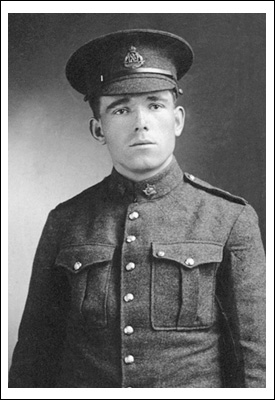
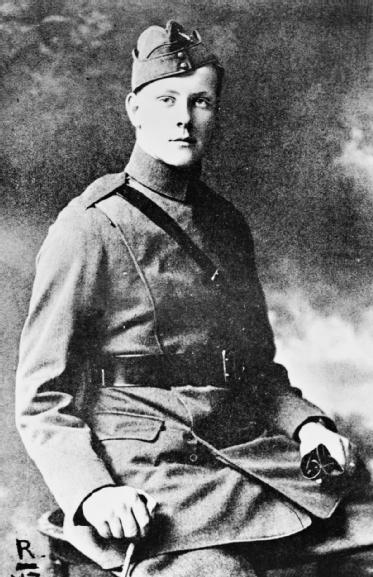
A black-and-white photograph of a soldier in full uniform.

Joseph Kaeble, undated. Source: Directorate of History and Heritage.

Kaeble earned the Victoria Cross during the 1918 Spring Offensive, Germany’s last gamble for victory on the Western Front. On the evening of June 8, 1918, while the 22nd Battalion was stationed near Neuville-Vitasse in France, the German army launched a raid against the Canadian lines. The attack was preluded by a blistering German bombardment, which left the Canadians stunned. Afterwards, a wave of 50 German soldiers came towards Kaeble’s position. With most of his comrades injured from the bombardment, Kaeble got out of the parapet, and, with a Lewis machine gun, held off the German onslaught on his own. Despite being hit several times, he held the attackers at bay until he was finally knocked back into his trench, severely wounded. While laying wounded, he was reported to have said to his brothers in arms: “Keep it up boys; do no let them get through! We must stop them!” (London Gazette, 30903, September 16, 1918)

In that battle, Kaeble suffered compound fractures in both legs, both arms, as well as a fractured hand and neck. In the end, the German raid was repulsed by the 22nd, to large extent because of Kaeble’s valiant stand.
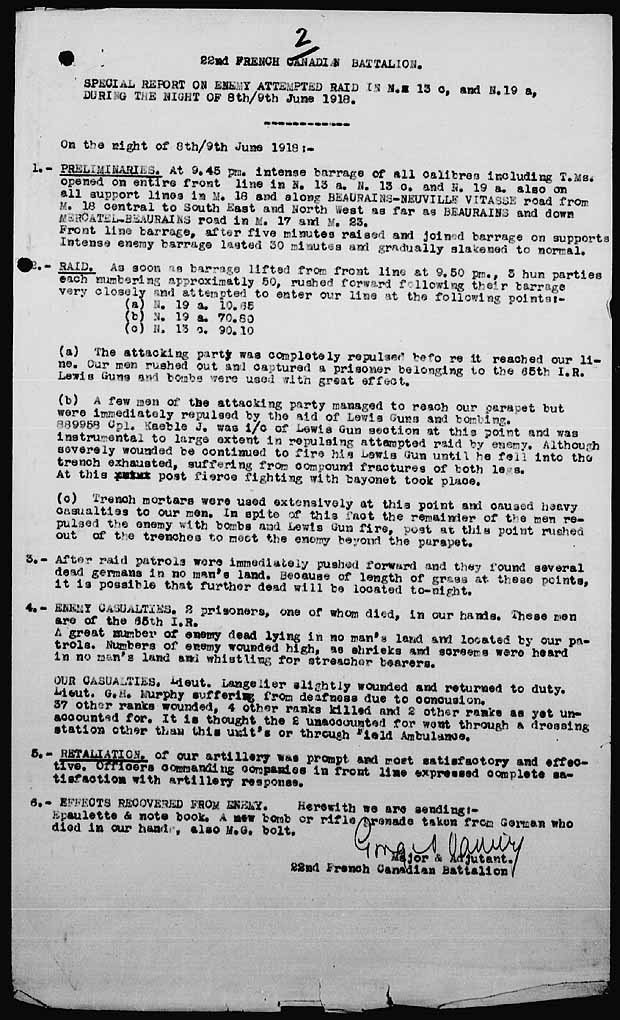
A typed report describing the events of the “night of June 8th/9th 1918”.

in the 22nd Canadian Infantry Battalion War Diary on the actions that took place on June 8 and 9, 1918 (e000963629)

Corporal Kaeble would die of his grievous wounds on June 9, 1918. Along with the Victoria Cross, he was also awarded the Military Medal for his actions in France. He was the first French Canadian to be awarded the Victoria Cross.
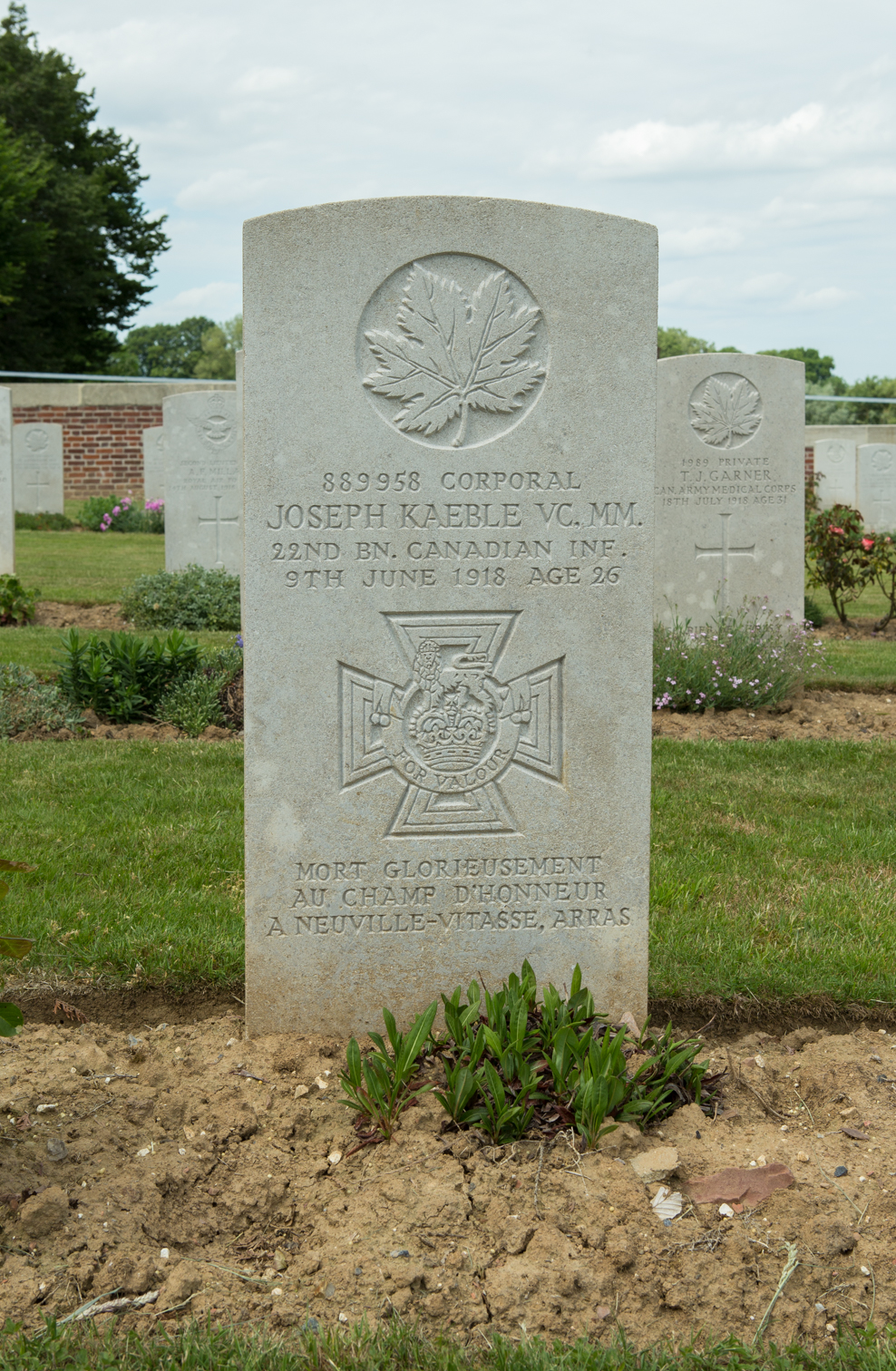
A colour photograph of a gravestone with some plants beginning to grow. In the background are other graves.

Kaeble’s grave, Wanquetin, France. Source: Wikimedia Commons. Credit: Wernervc

Kaeble’s legacy holds strong in Canada. He is honoured, among others, with a bust in Ottawa’s Valiants Memorial. In November of 2012, a new patrol vessel, the CCGS Caporal Kaeble V.C., was presented to the Canadian Coast Guard.

Library and Archives of Canada holds the digitized service file of Corporal Joseph Kaeble.


John Morden is an honours history student from Carleton University doing a practicum in the Online Content Division at Library and Archives Canada.

George Burdon McKean, VC

By John Morden

Today in Library and Archives Canada’s blog series on Canadian Victoria Cross recipients, we remember George Burdon McKean, who earned his Victoria Cross one hundred years ago today for his heroic actions on the battlefield.

A black-and-white photograph of a smiling military officer.

Lieutenant George Burdon McKean, VC, June 1918 (MIKAN 3218939)

Born on July 4, 1888, in Willington, England, McKean immigrated to Canada in 1909 and settled in Edmonton, Alberta. Before enlisting on January 23, 1915, McKean was a schoolteacher. McKean joined the 51st Battalion of the Canadian Expeditionary Force and arrived in England in April 1916. On June 8, 1916, McKean transferred to the 14th Battalion.

Sometime in the night of April 27–28, 1918, while the 14th Battalion was stationed near Gavrelle, France, McKean earned the Victoria Cross, Britain’s most prestigious military decoration. During a scouting mission, the party of men led by McKean ran head-on into a strongly defended German position. While the rest of the unit was pinned down by machine gun fire, McKean charged into the German trench with “conspicuous bravery and devotion.” Upon reaching the position, McKean killed two German soldiers, held his ground and called for more bombs. After resupplying, McKean took another position and single-handedly killed another two German soldiers and captured four more. McKean’s example rallied his men and the mission was successful. As reported in the London Gazette two months later:

“This officer’s splendid bravery and dash undoubtedly saved many lives, for had not this position been captured, the whole of the raiding party would have been exposed to dangerous enfilading fire during the withdrawal. His leadership at all times has been beyond praise.”

London Gazette, no. 30770, June 28, 1918

Later, McKean was awarded the Military Medal and Military Cross on March 28, 1917 and February 1, 1919, respectively. He would survive the war, though he would be wounded in the right leg on September 2, 1918 during the Hundred Days Offensive. He remained in England for the rest of the conflict. Following his release from hospital, McKean served as acting captain at the Khaki University of Canada in London, England, until his retirement on July 19, 1919.

He chose to remain in England after leaving the army and was killed in an industrial accident on November 28, 1926. McKean’s final resting place is Brighton Extra Mural Cemetery in Sussex, England.

Today his Victoria Cross is kept at the Canadian War Museum in Ottawa. McKean is honoured with a mountain named after him in the Victoria Cross Ranges in the Canadian Rockies.

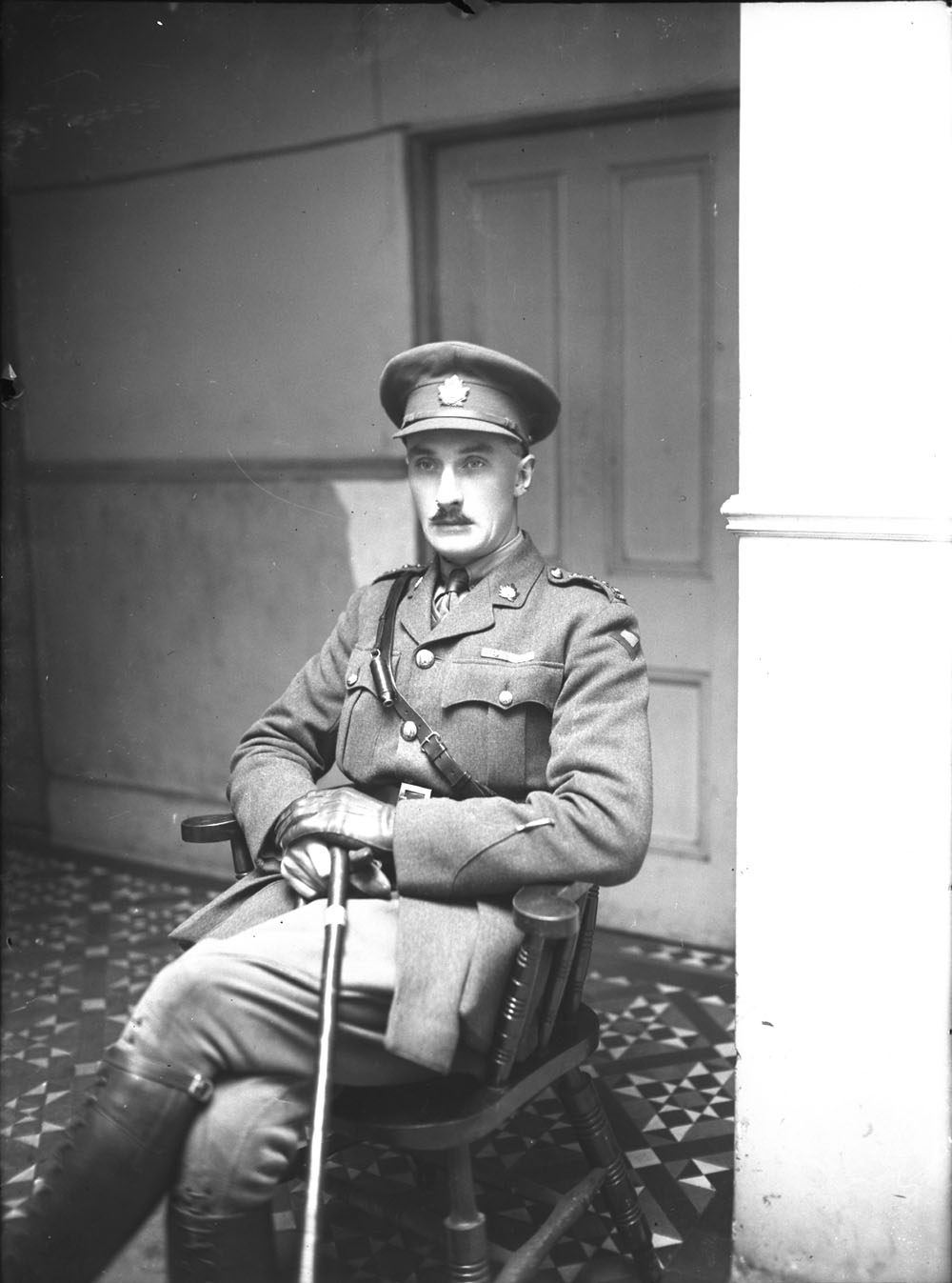
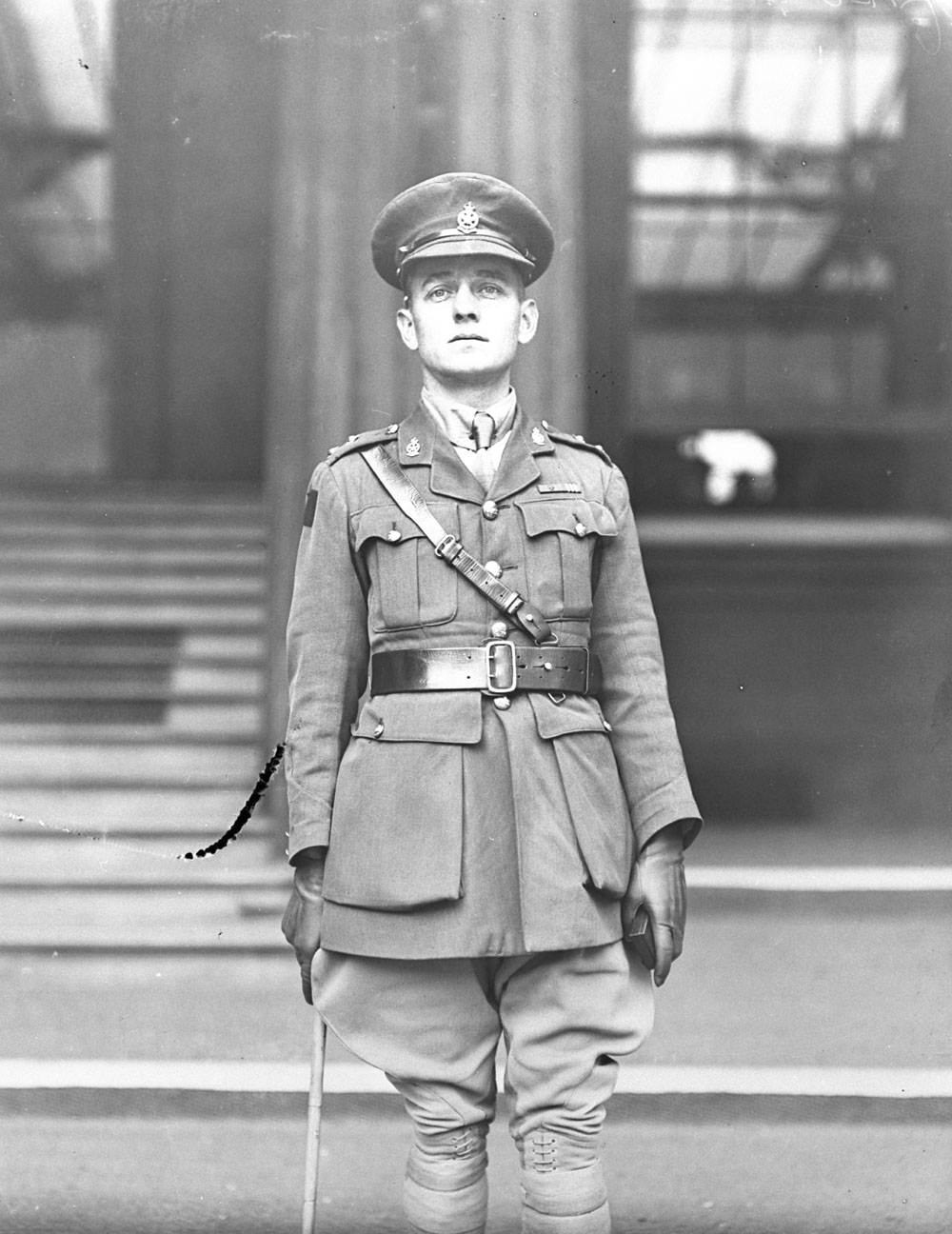
A black-and-white photograph of a soldier in an officer’s uniform with gloves and a cane standing in front of stairs and a window.

Lieutenant George Burdon McKean, VC, undated (MIKAN 3218943)

A black-and-white photograph of a group of soldiers standing and sitting in front of trees in the winter.

Officers of the 14th Battalion, France, February 1918 (MIKAN, 3406029)

Library and Archives Canada holds the digitized service file of Lieutenant George Burdon McKean.


John Morden is an honours history student from Carleton University doing a practicum in the Online Content Division at Library and Archives Canada.

The Battle of Vimy Ridge

Version française

A banner that changes from a black-and-white photograph of a battle scene on the left to a colour photograph of the Vimy Memorial on the right.Everything was in place for the hour of the assault, 5:30 a.m. on April 9, 1917.

The preceding hours of darkness aided by cloud cover had permitted the infantry to file forward unobserved into their jumping-off positions, many of which were clearly observable to the enemy in daylight. Had this movement been witnessed, an enemy barrage might have broken up the assault wave with serious casualties; as it was, the positions were gained without notice.

In the half-light of zero hour under a cold overcast sky, when manoeuvring was still largely obscured from the enemy, the intense bombardment opened with sudden fury, and the advance of the infantry began. Continue reading

Lieutenant Gordon Muriel Flowerdew, VC

By Emily Monks-Leeson

Today our First World War Centenary: Honouring Canada’s Victoria Cross recipients, remembers Lieutenant Gordon Muriel Flowerdew, who received the Victoria Cross, the Commonwealth’s highest award for gallantry, for his actions at the Battle of Moreuil Wood on this day 100 years ago.

A black-and-white photograph of a soldier taken slightly in profile.

Lieutenant Gordon M. Flowerdew, Victoria Cross recipient (MIKAN 3521609)

Flowerdew was born in Billingford, England, on January 2, 1885. He immigrated to Saskatchewan in 1903 and later settled in British Columbia as a rancher. He enlisted in September 1914 in Lord Strathcona’s Horse, a cavalry brigade, and became a commissioned officer in 1916. By 1918, Flowerdew was Lieutenant (Acting Captain) in command of “C” Squadron of Lord Strathcona’s Horse. Though the cavalry brigades had not engaged in much direct fighting because of the static nature of trench warfare, this changed in the spring of 1918 with the return to rapid, open warfare. On March 30, 1918, the Strathconas were engaged in heavy fighting at Moreuil Wood, France, having been tasked with preventing the Germans from crossing the Avre River and advancing on Amiens.

As German soldiers entered Moreuil Wood, Acting Captain Flowerdew spotted two lines of German infantry positions supported by machine guns. He ordered a cavalry charge. His squadron passed over both German lines, attacking with their swords, and then turned and passed over the lines again, driving the defending German soldiers into retreat. According to Flowerdew’s Victoria Cross citation, by then the squadron had suffered 70 percent casualties, killed and wounded, and Acting Captain Flowerdew was badly wounded in both thighs. Nonetheless, Flowerdew continued to encourage his men, ordering them to dismount.

Through hand-to-hand fighting, the survivors managed to hold the previously occupied German positions until a unit led by Lieutenant Frederick Maurice Watson Harvey joined them. Harvey had received the VC in 1917 for his role in the attack on German positions at the Guyencourt, France. Flowerdew and his men prevented the capture of Moreuil Wood and denied the advancing German army a strategically important position.

A handwritten description of the day’s actions in combat.

Lord Strathcona’s Horse war diary page with a description of Flowerdew’s actions of the day, Page 422 (MIKAN 2004721)

Lieutenant Gordon Muriel Flowerdew died of his wounds on March 31, 1918. He is buried at Namps-au-Val British Cemetery in France. Library and Archives Canada holds Lieutenant Gordon Muriel Flowerdew’s digitized service file.


Emily Monks-Leeson is an archivist in Digital Operations at Library and Archives Canada.

Lieutenant Alan Arnett McLeod, VC

By Emily Monks-Leeson

In today’s profile for Library and Archives Canada’s blog series, First World War Centenary: Honouring Canada’s Victoria Cross Recipients, we remember Lieutenant Alan Arnett McLeod who was awarded the Victoria Cross for gallantry.

Born in Stonewall, Manitoba, in 1899, McLeod attempted to enroll in the 34th Fort Garry Horse in 1913, at the age of 14 despite being underage. After war was declared, he tried several times to enlist in the army in Winnipeg and again in the Royal Flying Corps (RFC) in Toronto, but was repeatedly rejected. Upon turning 18, he enrolled in the RFC and trained as a pilot in Long Branch, Ontario. He graduated with 50 hours of flying experience and left for service in France on August 20, 1917.

A black-and-white photograph of a seated officer posing for an official portrait. He holds his gloves in one hand and a baton in the other.

Lieutenant Alan Arnett McLeod, VC, of No. 51 and 2 Squadrons RAF. (© Imperial War Museums, Q-67601)

Originally posted to No. 82 Squadron, McLeod was assigned to home defence duties flying nighttime runs in a B.E.12 after his commander found out he was only 18 years old. His first operational flight took place in December 1917 with No. 2 Squadron over Hesdigneul, France. By January 1918, McLeod and his gunner had claimed one Fokker Dr.I and an observation balloon destroyed, an act for which McLeod was mentioned in despatches.

On March 27, 1918, Second-Lieutenant McLeod and his observer Lieutenant Arthur Hammond were in an Armstrong Whitworth F.K.8 over Albert, France. They destroyed a German triplane and were immediately attacked by a formation of eight more. McLeod and Hammond shot down three German aircraft before the petrol tank of their aircraft was hit and burst into flames. McLeod tried to keep the flames away from his observer by side slipping steeply as the plane went down, all the while continuing to fire on the enemy planes. When the plane crashed in “no man’s land,” an injured McLeod dragged Hammond from the burning plane and carried him to safety under heavy fire. Both men were gravely injured but survived. Lieutenant Hammond, wounded six times, ultimately lost his leg and was awarded a bar for his Military Cross.

A black-and-white photograph of a smiling young man lying in bed.

Lieutenant Alan Arnett McLeod, VC, 1918 (MIKAN 3219066)

Lieutenant Alan Arnett McLeod received the Victoria Cross for his actions that day. After a period in hospital, he was sent back to Canada for further recovery. He died on November 6, 1918, in Winnipeg, Manitoba, from Spanish Influenza. McLeod Street in Stonewall, Manitoba, is named in his honour.

Library and Archives Canada does not hold the service record for Lieutenant Alan Arnett McLeod, VC. Men wishing to enlist in the air service joined the Royal Flying Corps, the Royal Air Force (RAF) or the Royal Naval Air Service. Personnel files for those British units are in the custody of the National Archives in England.


Emily Monks-Leeson is an archivist in Digital Operations at Library and Archives Canada.

The Halifax Explosion: Records at Library and Archives Canada

By Valerie Casbourn

On the morning of December 6, 1917, two ships, the Imo and the Mont-Blanc, collided in the Narrows of Halifax Harbour. The Mont-Blanc was a munitions ship on its way to join a convoy sailing to war-torn Europe. The cargo of the Mont-Blanc caught fire, and after burning for 20 minutes, the ship exploded. The blast ripped through the city killing almost 2,000 people, injuring thousands more and causing widespread devastation in Halifax, Dartmouth, and the Mi’kmaq community of Turtle Grove. The “Halifax Explosion” as it became known, brought the danger and destruction of the First World War home to Canada, and left an indelible mark on the city of Halifax.

A black-and-white photograph of several people walking down a street with destroyed buildings on both sides.

Aftermath of the Halifax Explosion. The building on the left was the Hillis & Sons Foundry. (c003624b)

Guides to Records about the Halifax Explosion

Library and Archives Canada (LAC) holds various records that tell part of the story of the Halifax Explosion, its aftermath, and the relief work and investigations following the disaster. The first place to look is LAC’s thematic guide, Halifax Explosion. Some of the records listed in the guide are available on digitized microfilm reels on the Héritage website. Other records are available for onsite consultation at LAC.

The guide primarily lists records about the disaster and its aftermath kept by the Canadian federal government. This includes records such as the formal investigation into the collision of the Imo and the Mont-Blanc conducted by the Dominion Wreck Commissioner (RG42, Vol. 596, Parts 1-2 and RG42, Vol. 597, Parts 3-4). There is also correspondence of the wartime Chief Press Censor, Ernest J. Chambers (RG6, Vol. 621, File 350, Microfilm reel T-102) that documents both the urgent need to report news of the disaster accurately, but not to reveal any information about the defences of Halifax Harbour.

Image of a telegram that reads: “3:45 p.m. Telegram sent to Geo. D. Perry? Gen. Mgr. G.N.W. Telegraph Co, Toronto, Ont. Telegram sent to J. McMillan, Mgr. C.P. Ry. Telegraphs, Montreal. Ottawa, Ont., December 6, 1917. In view of contradictory reports abroad regarding Halifax explosion I hope everything possible is being done to facilitate a transmission of all press reports. This most desirable from a national point of view. Ernest J. Chambers, Chief Press Censor.”

from Ernest J. Chambers, Chief Press Censor, to G.N.W. Telegraph Co. and C.P. Ry. Telegraphs (T-102, Image 119)

Image of a telegram that reads: “Ottawa, December 7, 1917. C.O. Knowles, Toronto. In connection with reports of Halifax disaster it is important that nothing be published revealing information as to defences, strength and disposition of garrison, etc. Neither should details be given as to naval and transport activities at the port during war. No photographs of Halifax or vicinity taken since commencement of war should be published. Desirable that special correspondents despatched to Halifax inform themselves as to local censorship requirements. Ernest J. Chambers.”

from Ernest J. Chambers, Chief Press Censor, to C.O. Knowles, Canadian Press Limited. (T-102, Image 136)

If you are looking for images, try LAC’s Flickr album of digitized photographs taken after the Halifax Explosion. LAC also has a more detailed description of the explosion at First World War: Tragedy on the Home Front.

A black-and-white photograph showing a line of people digging through the rubble of destroyed buildings.

Aftermath of the Halifax Explosion. (c001833)

How to Search for More Records

You can find more records related to the Halifax Explosion by using the Collection Search tool to search for keywords such as “Halifax explosion” or “Halifax disaster”; or try searching for other keywords related to the disaster. Click on the “Archives” tab to limit your search results by date, or by the type of material (i.e., photographs or textual material).

The records at LAC come from the Canadian federal government and from private individuals and organizations. Some records are available online, and others are available for onsite consultation by visiting in person, or by ordering reproductions.

Correspondence about the Halifax Explosion: Sir Robert Borden fonds

There are far too many different records about the Halifax Explosion to mention them all here, but correspondence in the Sir Robert Borden fonds (MG26-H) tells one small part of the story. Sir Robert Borden was the Prime Minister of Canada and the Member of Parliament for Halifax at the time of the explosion, and his papers include telegram messages giving news of the disaster, messages of sympathy for the people of Halifax, offers of assistance, and more.

Much of the correspondence related to the explosion is in the file “Halifax Disaster 1917–1918” (MG26-H, Vols. 89–90, Pages 46309–47016, microfilm reel C-4325, which is available on the Héritage website, starting at image 301).

A Great North Western Telegraph Company of Canada telegram, which reads: “Moncton, N.B. Dec. 6, 1917. J.D. Reid, Ottawa. It is reported that ship loaded with explosives at pier six as she was backing out of pier about half past eight this morning an inward bound ship ran into her and she caught fire, they tried to sink her before she exploded but failed. She blew up at nine o’clock. It is reported the city in bad state and much damage done but account wires being down unable to get any detail. Will give further information soon as obtained. Assistant General Manager Brown going to Halifax by Special. C.A. Hayes.”

This initial report of the disaster was sent to Ottawa from Moncton because the explosion damaged telegraph and telephone wires in Halifax and cut off communications to the city. (Reel C-4325, Image 321)

A Western Union telegram which reads: “RM Boston Mass. Dec 7 via Ottawa Ont. 8 1917. Robert Borden, Prime Minister, Halifax, NS. From your knowledge of conditions at Halifax what can we best do at once to help relieve the distress of the people at Halifax last night medical relief train left here at ten o’clock due at Halifax at eight pm tonight we have a ship here at our disposal that can leave here Sunday morning and would be due in Halifax Monday morning can she dock. H.B. Endicot Chairman Mass Halifax Relief Committee.”

An offer of help from Boston, sent to Sir Robert Borden by H.B. Endicott, Chairman of the Massachusetts-Halifax Relief Committee (Reel C-4325, Image 321)

Related Resources:


Valerie Casbourn is an archivist with the Regional Services and ATIP Division at Library and Archives Canada.

Lieutenant-Colonel Harcus Strachan, VC

By Emily Monks-Leeson
This week, Library and Archives Canada’s Discover Blog honours Lieutenant-Colonel Harcus Strachan, Canadian Victoria Cross recipient for his actions during the First World War Battle of Cambrai, which took place one hundred years ago today.

A black-and-white photograph of a seated officer wearing a cap and all the accoutrements of an officer.

Lieutenant Harcus Strachan, VC, undated (MIKAN 3221434)

Born in Borrowstounness, Scotland, in 1887, Strachan immigrated to Canada in 1908. He enlisted in The Fort Garry Horse regiment, based in Winnipeg, Manitoba, in 1915. He was a commissioned lieutenant and, on November 20, 1917, took command of a mounted squadron of The Fort Garry Horse at Masnières, France. When the squadron leader was killed, Lieutenant Strachan led the squad through the German line of machine gun posts and charged the German battery, killing seven of the gunners in hand-to-hand fighting. He then cut telephone communications three kilometers behind the German lines, rallied his surviving men, and fought his way back through to his own lines with all unwounded men and fifteen German prisoners. His citation in the London Gazette asserts that this operation “was only rendered possible by the outstanding gallantry and fearless leading of this officer” (London Gazette, no. 30433, December 18, 1917).

A black-and-white photograph of a line of mounted soldiers riding through a village.

Lieutenant Strachan, VC, and a squadron of The Fort Garry Horse passing through a village on the Cambrai front, December 1917 (MIKAN 3405685)

A typewritten report of the events of the day.

The Fort Garry Horse war diary, dated November 20, 1917, Page 2 of Lieutenant Strachan’s report (MIKAN 2004724)

Lieutenant-Colonel Strachan was promoted to captain and received his Victoria Cross from King George V on January 6, 1918. It became a tradition for the “Garrys” to hold a parade every year on the anniversary of Strachan’s Victoria Cross. Strachan survived the war and later commanded the 1st Battalion of the Edmonton Fusiliers during the Second World War. He died in Vancouver on May 1, 1982. Strachan was recently honoured with an historical plaque on the shores of Harcus Strachan Lake, 250 kilometers east of Thompson, Manitoba.

Library and Archives Canada has the fully digitized service file for Lieutenant-Colonel Harcus Strachan in the Personnel Records of the First World War database.


Emily Monks-Leeson is an archivist in Digital Operations at Library and Archives Canada.

Victoria Cross Recipients: First World War now on Flickr

The Victoria Cross (VC) is the highest military decoration in the Commonwealth and takes precedence over all other medals, decorations and orders. A recognition of valour in the face of the enemy, the VC can be awarded to a person of any rank of military service and to civilians under military command. So far, 98 Canadians have been awarded the Victoria Cross, beginning with Alexander Roberts Dunn who in 1854 fought in the Battle of Balaclava in the Crimean War. The Victoria Crosses were awarded to 71 Canadian soldiers during the First World War, and 16 were awarded during the Second World War. The remaining VCs were awarded to Canadians for the Indian Rebellion of 1857 (in which William Hall of Nova Scotia became the first-ever black recipient of the VC) and the South African War (1899–1902).

In 1993, the Canadian Victoria Cross was adopted in place of the British VC. The medal is identical to the British VC but the inscription is in Latin—Pro Valore—a linguistic ancestor to both English and French. The Canadian Victoria Cross has yet to be awarded.

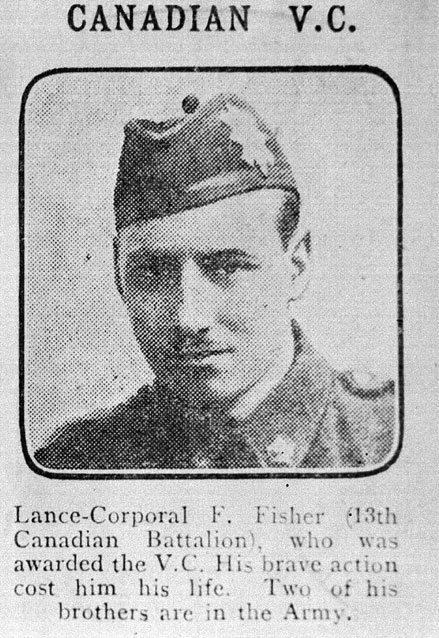
A black-and-white image of Lance-Corporal F. Fisher.

Lance-Corporal F. Fisher, April 23, 1915 (MIKAN 3215642)

A black-and-white photograph of Lieutenant George Burdon McKean.

Lieutenant George Burdon McKean, April 27-28, 1918 (MIKAN 3218939)

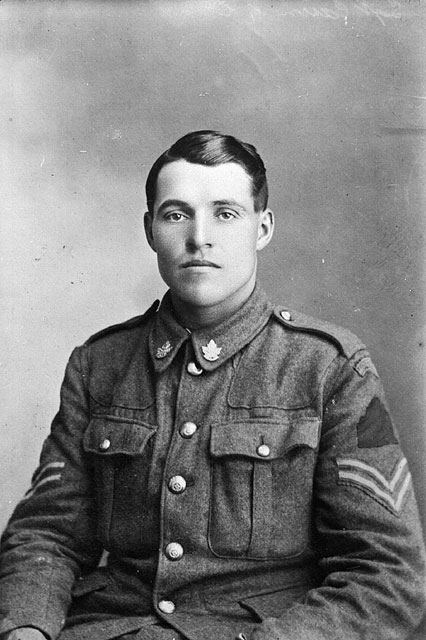
A black-and-white photograph of Sergeant Alexander Picton Brereton.

Sergeant Alexander Picton Brereton, August 9, 1918 (MIKAN 3213059)

A black-and-white photograph of Sergeant Hugh Cairns.

Sergeant Hugh Cairns, November 1, 1918 (MIKAN 3191892)

Visit the Flickr album now!

Library and Archives Canada is releasing its latest podcast episode, “Former Enemies Are Now Friends”

Version française

Colour photograph of a sculpture of two enemy soldiers leaning over to shake hands over a rugby ball.For many descendants of First World War veterans, the act of researching the service files of their relatives opens up a world of new information regarding their families. In this episode, Former enemies are now friends, we speak with Tim Hack about the amazing journey he undertook to reconnect with his great-grandfathers, who fought on opposite sides of the First World War. Tim came across the Canadian Expeditionary Force files right after starting work at LAC. This discovery inspired him to retrace his great-grandfathers’ footsteps across northern Europe. He was gracious enough to share the audio diary of his trip with us. But before Tim embarked on his trip, we invited him into our studio to talk about where this journey began and what he was hoping to achieve by walking in his great-grandfathers’ footsteps one hundred years later.

To view images associated with this podcast, here’s a direct link to our Flickr album.

Subscribe to our podcast episodes using RSS, iTunes or PodLink, or just tune in at Podcast–Discover Library and Archives Canada: Your History, Your Documentary Heritage.

For more information, please contact us at balados-podcasts@bac-lac.gc.ca.

Corporal Colin Fraser Barron and Private James Peter Robertson, Victoria Cross recipients

By Emily Monks-Leeson

Today the Discover Blog remembers Corporal Colin Fraser Barron and Private James Peter Robertson, awarded the Victoria Cross (VC) for gallantry one hundred years ago today during the Battle of Passchendaele, one of the First World War’s deadliest and most decisive battles.

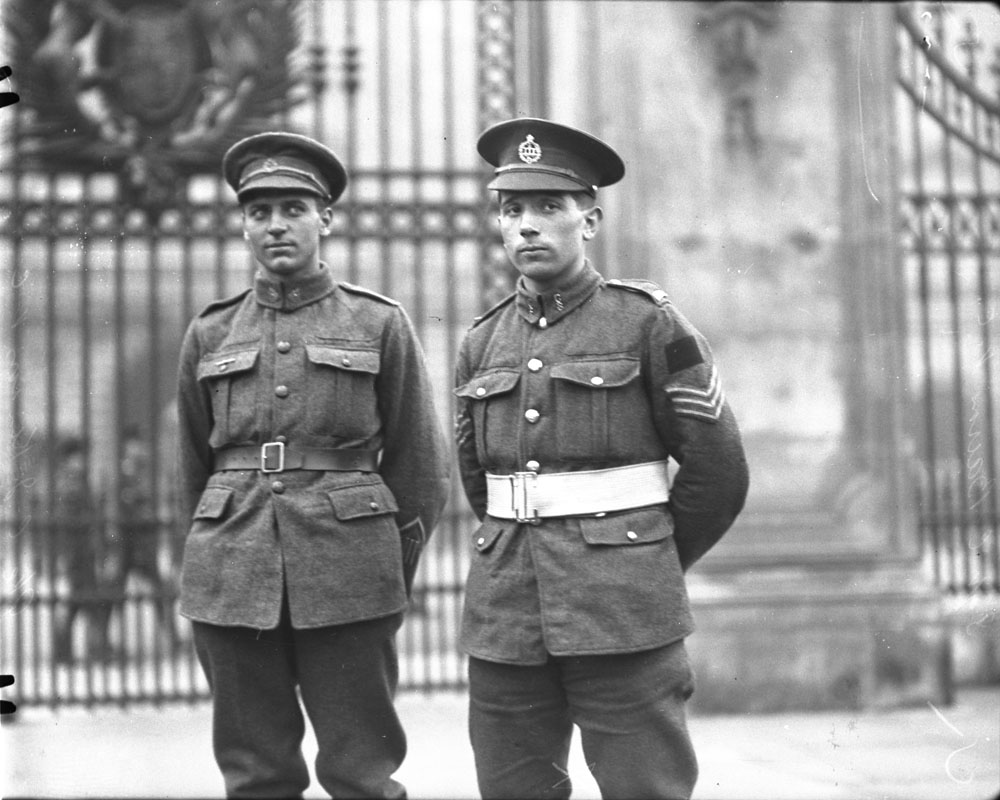
A black-and-white photograph of two soldiers standing in front of an elaborate wrought iron gate.

Sergeant Colin Barron, VC (right) and Private Cecil John Kinross, VC, undated (MIKAN 3405057)

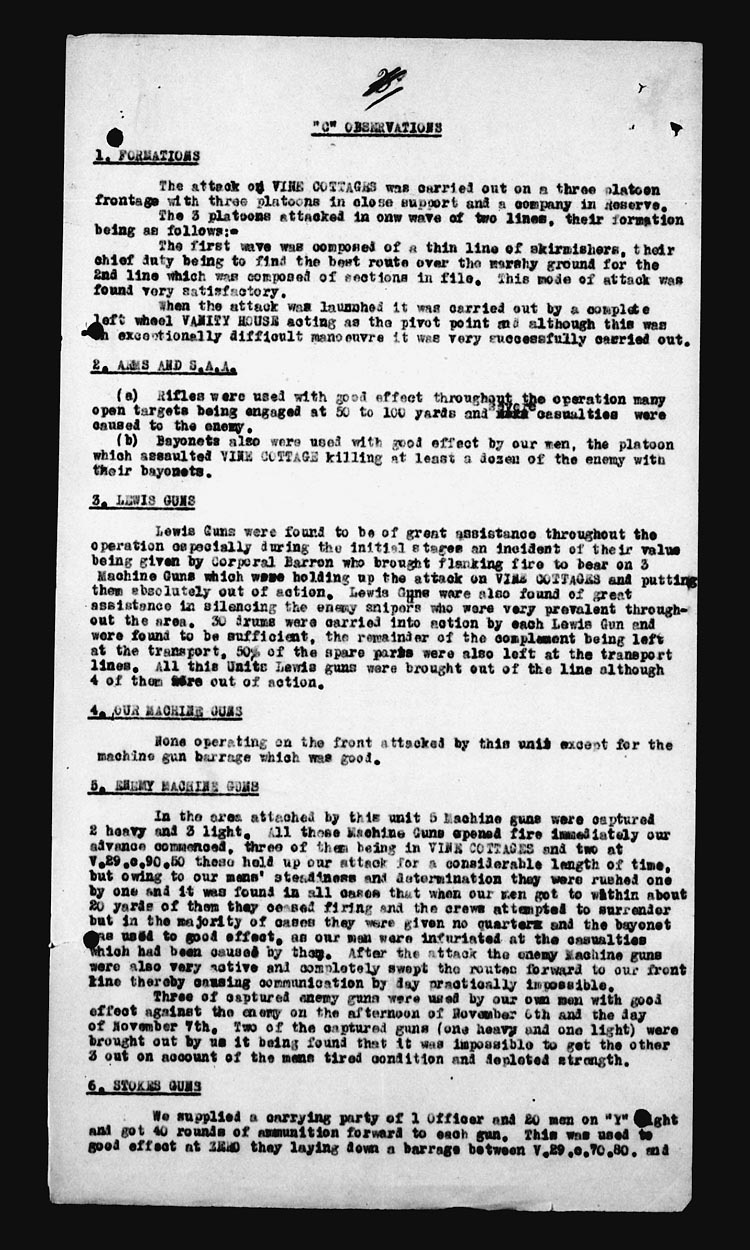
Corporal Barron was born in Boyndie, Banffshire, Scotland, in 1893. He immigrated to Canada in 1910 and enlisted with the Canadian Expeditionary Force (CEF) in Toronto in 1914. Barron was serving with the 3rd (Toronto) Battalion on November 6, 1917, at the Battle of Passchendaele. His unit’s objective was to capture a German pillbox at Goudberg Spur that was blocking the Canadian line of advance. Barron, with a Lewis machine gun, moved around the flank of the German position before opening fire and rushing the machine gun emplacements, killing four of the crew and capturing the remainder before turning the guns on the enemy to the rear. “The remarkable dash and determination displayed by this N.C.O. in rushing the guns produced far-reaching results, and enabled the advance to be continued” (London Gazette, no. 30471, January 11, 1918).

Colin Barron achieved the rank of sergeant-major. He survived the war and served during the Second World War with the Royal Regiment of Canada. He died in 1958 and is buried in the veterans’ section of Prospect Cemetery in Toronto.

A typewritten description of the events of the day.

Appendix C – Observations from the November War Diary of the 3rd Battalion (MIKAN 1883209)

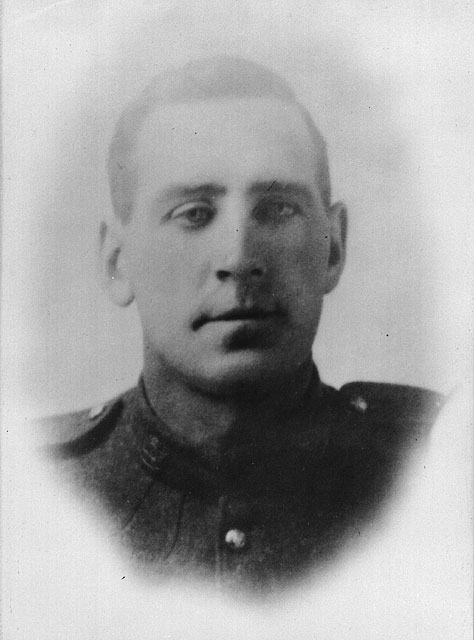
On that same day, Private James Peter Robertson was taking part in the final assault on Passchendaele Ridge with the 27th Infantry Battalion, CEF. Robertson, who was born in Albion Mines (now Stellarton), Pictou County, Nova Scotia, enlisted with the 27th (Winnipeg) Battalion in 1915. When his platoon was held up by barbed wire and machine gun fire, Robertson rushed the German gun. After a hand-to-hand struggle with the crew, he killed four gunners and sent the rest into retreat. Robertson’s citation in the London Gazette tells that, “carrying the captured machine gun, he led his platoon to the final objective. He then selected an excellent position and got the gun into action, firing on the retreating enemy.” Robertson used the machine gun to suppress sniper fire on his unit and, when two Canadian snipers were themselves badly wounded, he ventured out and managed to carry one man back under heavy fire. Tragically, he was killed by a shell as he returned with the second man. Private Robertson is buried in Tyne Cot Cemetery in Belgium.

A black-and-white photograph of a young man in uniform.

Private James Peter Robertson, VC (MIKAN 3645665)

Library and Archives Canada holds the complete service files for Corporal Colin Fraser Barron and Private James Peter Robertson.


Emily Monks-Leeson is an archivist in Digital Operations at Library and Archives Canada.