Beyond Vimy: The Rise of Air Power, Part 1

A banner that changes from a black-and-white photograph of a battle scene on the left to a colour photograph of the Vimy Memorial on the right.Library and Archives Canada is releasing its latest podcast episode, “Beyond Vimy: The Rise of Air Power, Part 1”.

April 2017 marks the 100th anniversary of the attack and capture of Vimy Ridge, when all four divisions of the Canadian Corps worked together for the first time. During the First World War, over 25,000 Canadians served with the British Flying Service as pilots, observers and mechanics, and even though the Battle of Vimy Ridge is better known as a ground offensive, many of the preparations for the assault on Vimy took place in the air. In Part 1 of this episode, we sit down with Bill Rawling, historian and author of the book Surviving Trench Warfare, and Hugh Halliday, author and retired curator at the Canadian War Museum, to discuss the role Canada and her allies played in the air over Vimy Ridge and Arras in April 1917, a month known as “Bloody April.”
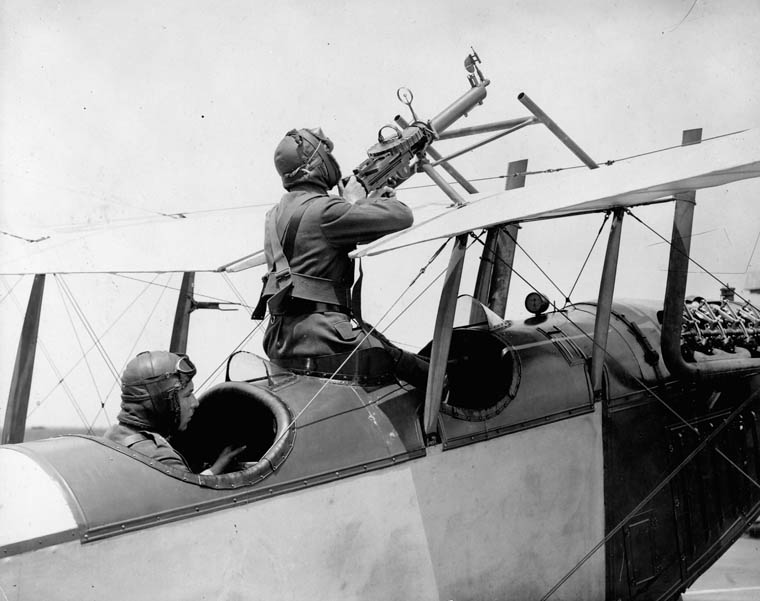
A black-and-white photograph of a biplane with two aviators in the cockpits: one is piloting and the other is at the machine gun.

A Curtiss JN-4 gun installation, pilot’s gunnery, Royal Flying Corps, Canada, School of Aerial Gunnery at Camp Borden, Ontario, 1917 (MIKAN 3404272)

To view images associated with this podcast, here’s a direct link to our Flickr album.

Subscribe with RSS, iTunes or Google Play to automatically receive new episodes.

The Battle of Vimy Ridge—preparations

Version française

A banner that changes from a black-and-white photograph of a battle scene on the left to a colour photograph of the Vimy Memorial on the right.By Dr. George Hay

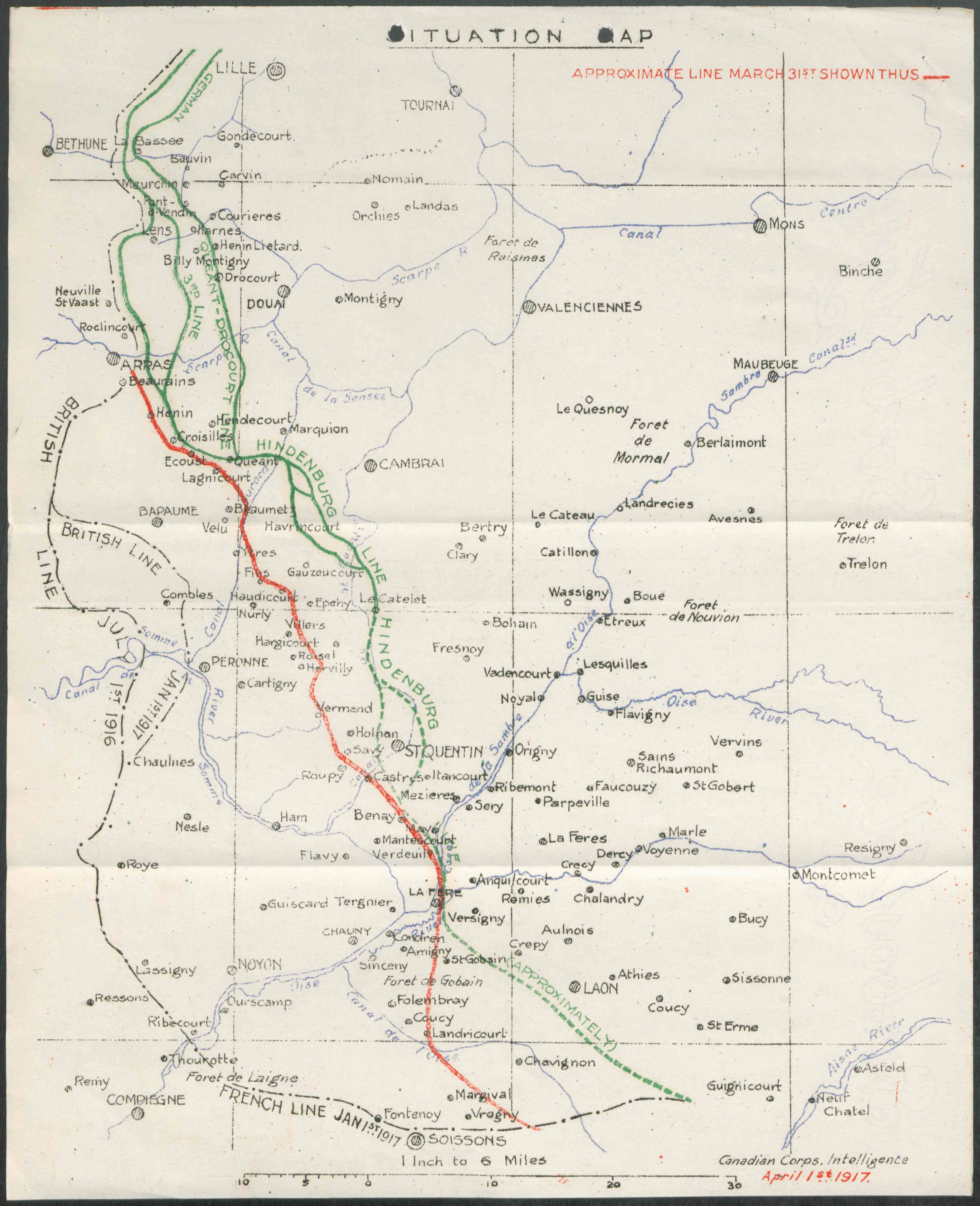
The Arras offensive of 1917 was divided into ten distinct actions comprising sizable battles along with flanking and subsidiary attacks. The first two actions of the first phase, the simultaneous battles at Vimy Ridge to the north of Arras and astride the river Scarpe in the centre, took place between April 9 and 14. The former was to be the Canadian Corps’ contribution to the offensive—the first time all four Canadian divisions had fought together—and was directed towards the formidable defences on the high ground. The original purpose of the attack was to form a defensive flank for the operations of the Third Army to the south, but given the German withdrawal to the Hindenburg Line the month before, its operational importance grew in magnitude. Possession of the ridge allowed German forces a commanding view of British and Commonwealth positions below; its capture would not only alleviate this issue for attacking forces, but would put that same advantage into the hands of the British.

A colour map showing places, rivers, and the moving lines of defence.

Situation map showing the German withdrawal to the Hindenburg Line. (The National Archives, WO 95/1049/9)

As previously outlined, these operations had been planned in principle since the end of the previous year and very careful preparations had been made in respect of the training of personnel and the accumulation of artillery and the materiel of war. Furthermore, the actual attack on April 9 was the culminating thrust of a phase of operations including a large number of raids and an incredibly destructive artillery bombardment. The steady wearing down of the enemy’s morale and defences, combined with the diligent training and preparation conducted by the Canadians, set the stage for a climactic and decisive battle.

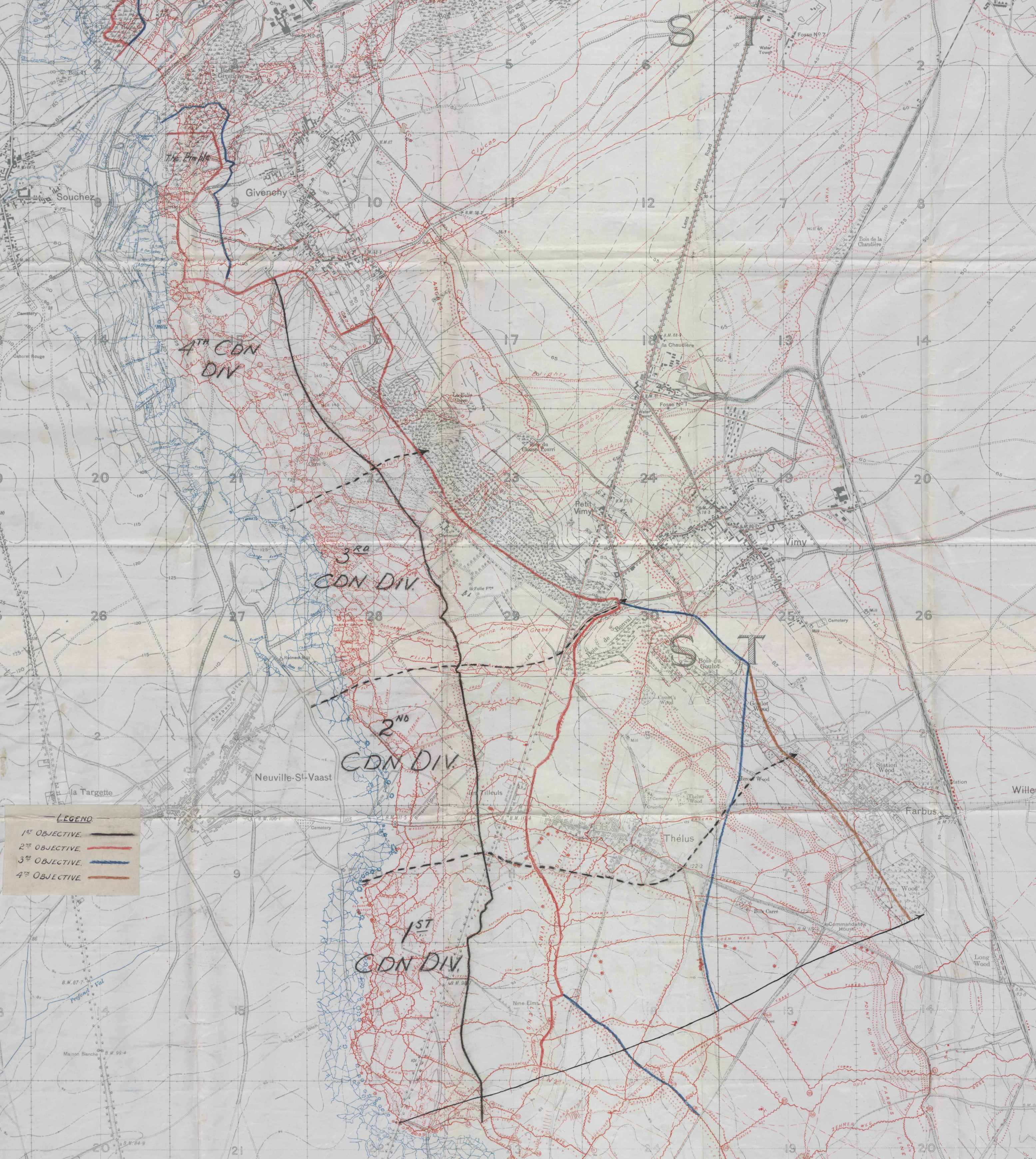
As in any major offensive operation, objectives were set for the Canadian Corps but they were specific and limited in their scope. Some were common to the divisions while others were assigned to particular sections of the line. They consisted of two primary (a black and a red line) and two secondary (a blue and a brown line).

A map of the Vimy crest showing the four stages of military objectives in colour: 1st objective in black, 2nd objective in red, 3rd objective in blue and 4th objective in brown.

A map of the Canadian Corps military objectives from the General Staff war diary, April 1917. (The National Archives, WO 95/1049/9)

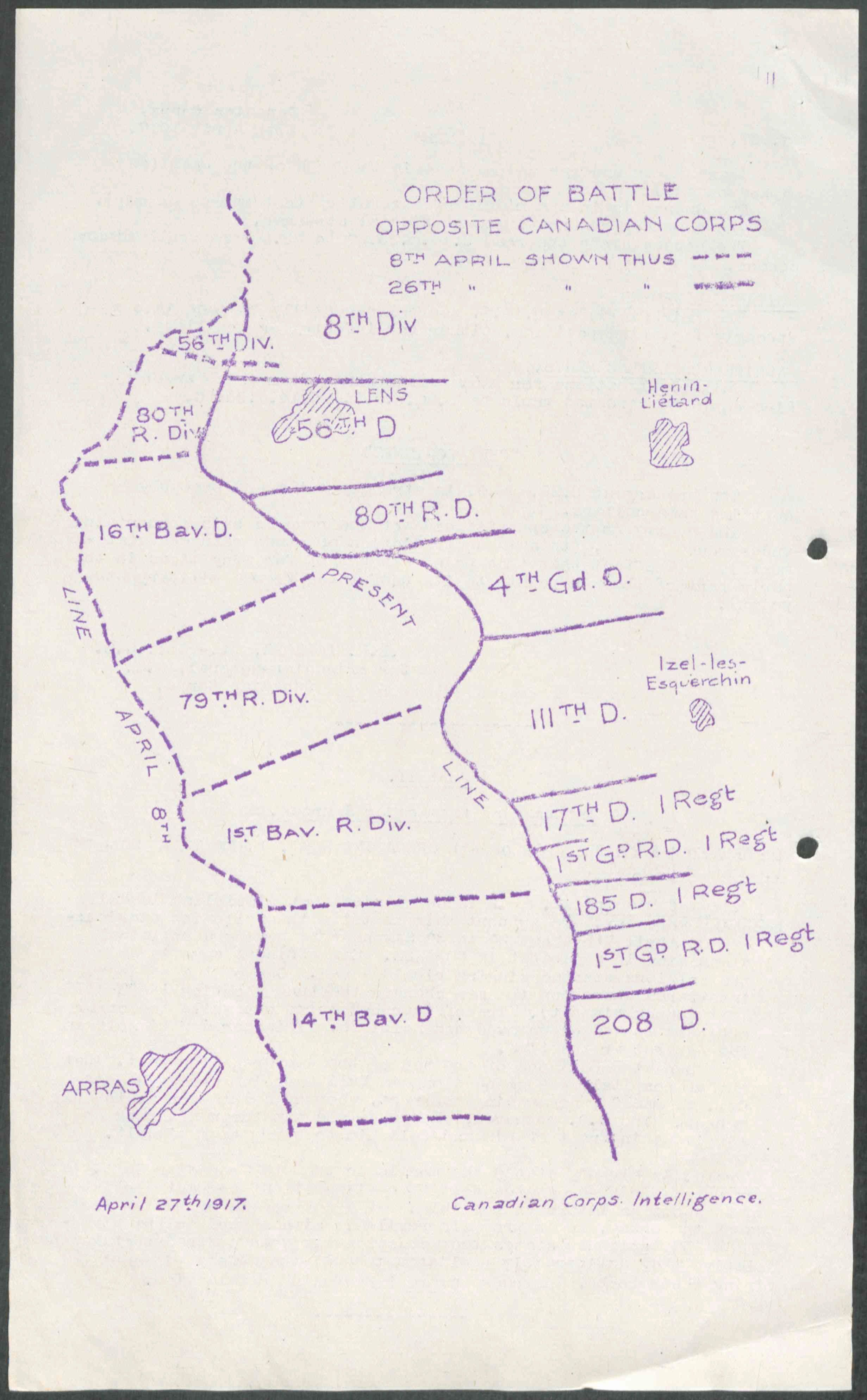
A mimeographed map using different lines to illustrate the German regiments that were located behind the trenches at these two different time periods.

Order of battle showing the lines on April 6th and 26th. The map also shows the German regiments behind the lines on both those dates. It is dated April 27th and was produced by the Canadian Corps Intelligence. (The National Archives, WO 95/1049/9)

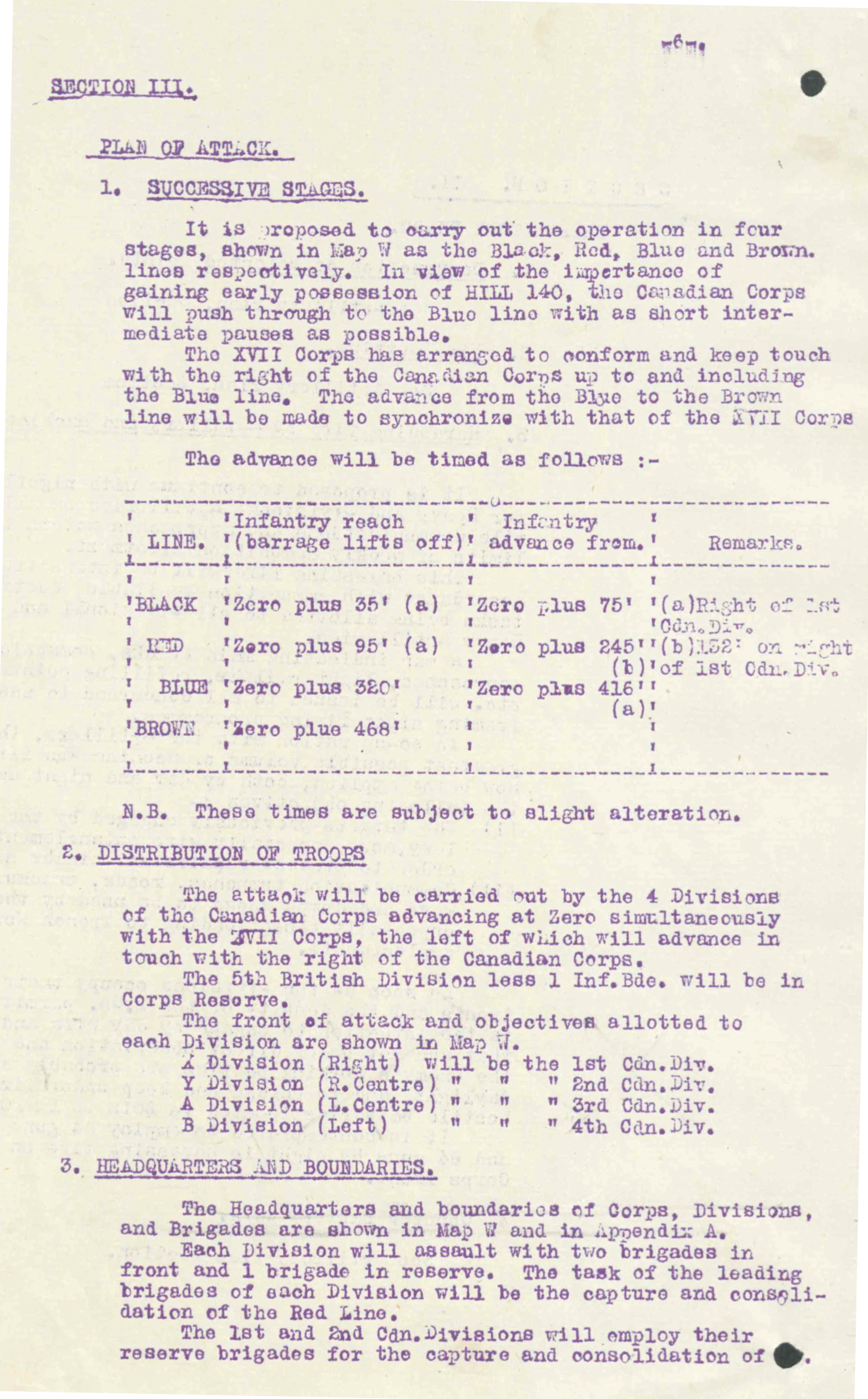
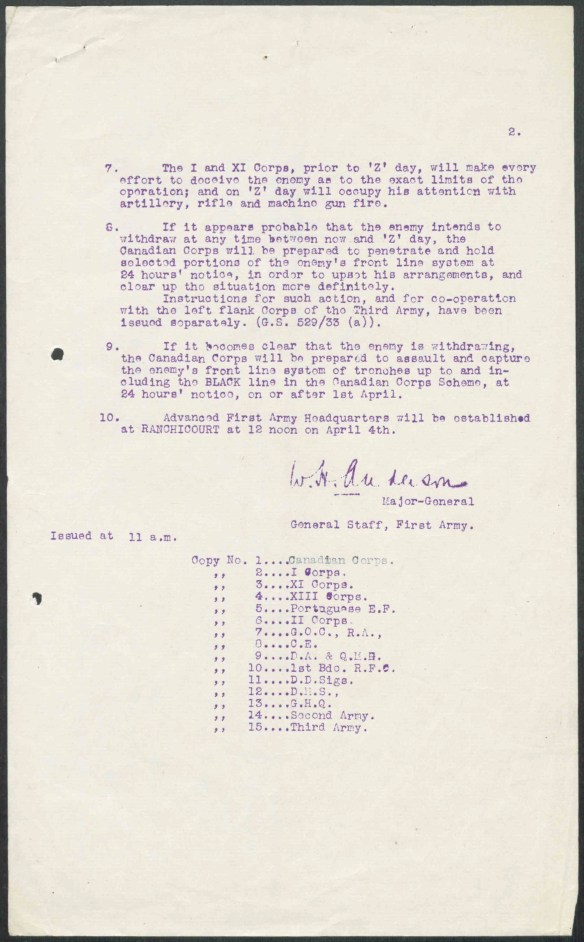
The first of these meant passing through the German frontline to a depth of around 700 yards. Once the ground was taken, the 3rd and 4th divisions would reform German support trenches into their main line of defence. The red line stood between 400 and 1000 yards ahead of the first objectives and represented the farthest goal of 3rd and 4th divisions. The blue and brown lines ran between 1,200 and 4,000 yards in front of the red line and were exclusively the responsibility of the 1st and 2nd divisions. Collectively these objectives incorporated an extensive and intricate system of trenches, dugouts, tunnels and strong points, which the German army had spent two years constructing. Their taking was to be intimately bound to the artillery fire plan, which would lift from each objective just before the infantry arrived.

A mimeographed, typewritten page divided into three different sections: successive stages, distribution of troops, and headquarters and boundaries.

Proposed plan of attack showing the four different stages and timings of the advance. (The National Archives, WO 95/169/6)

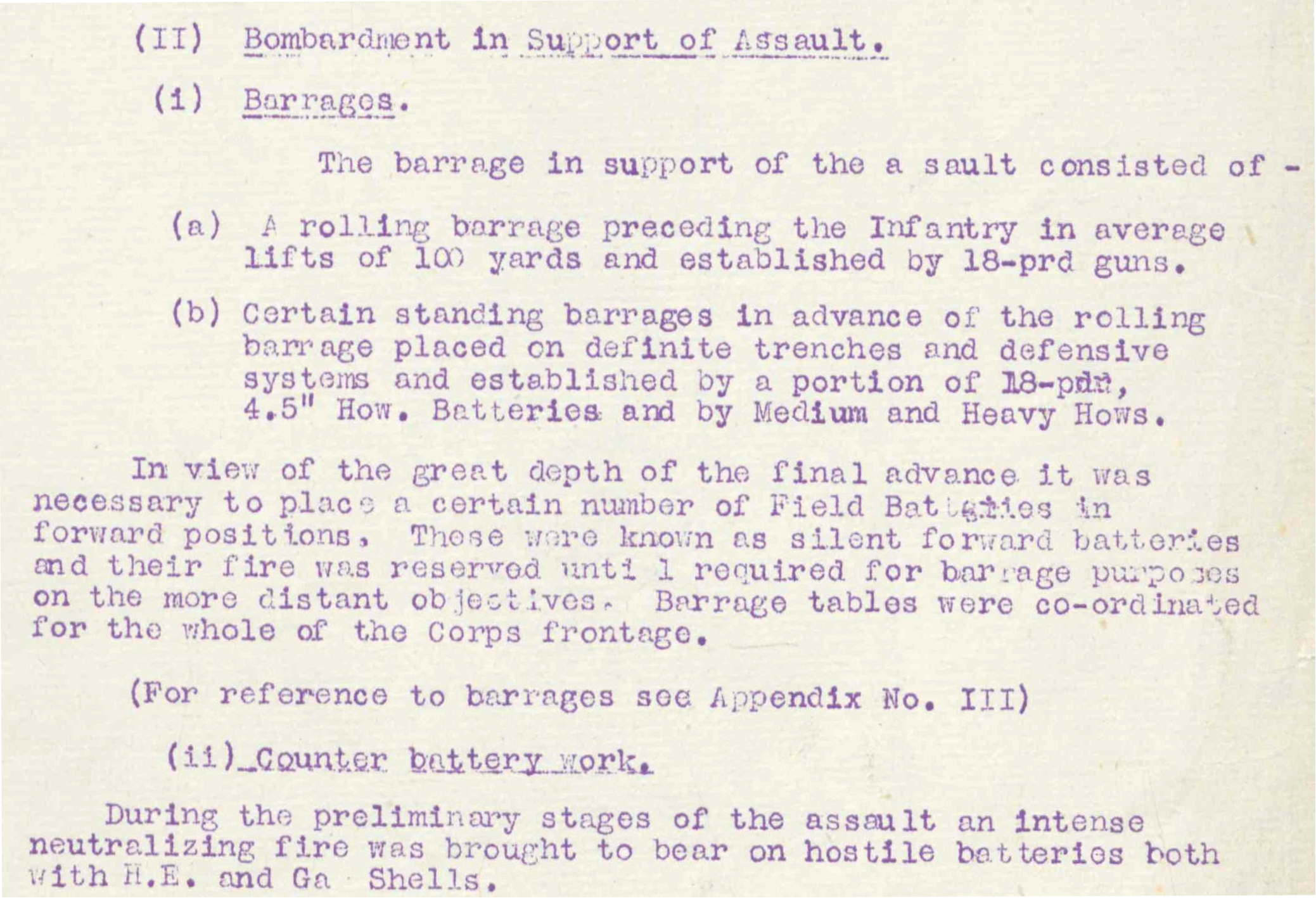
A mimeographed, typewritten extract from a page explaining the strategy behind the artillery barrages supporting the assault: the “rolling” barrage, the “standing” barrage and field batteries in forward positions (known as silent forward batteries that were silent until it was time for them to be used on the more distant objectives).

Plan of bombardment in support of the assault. (The National Archives, WO 95/1049/10)

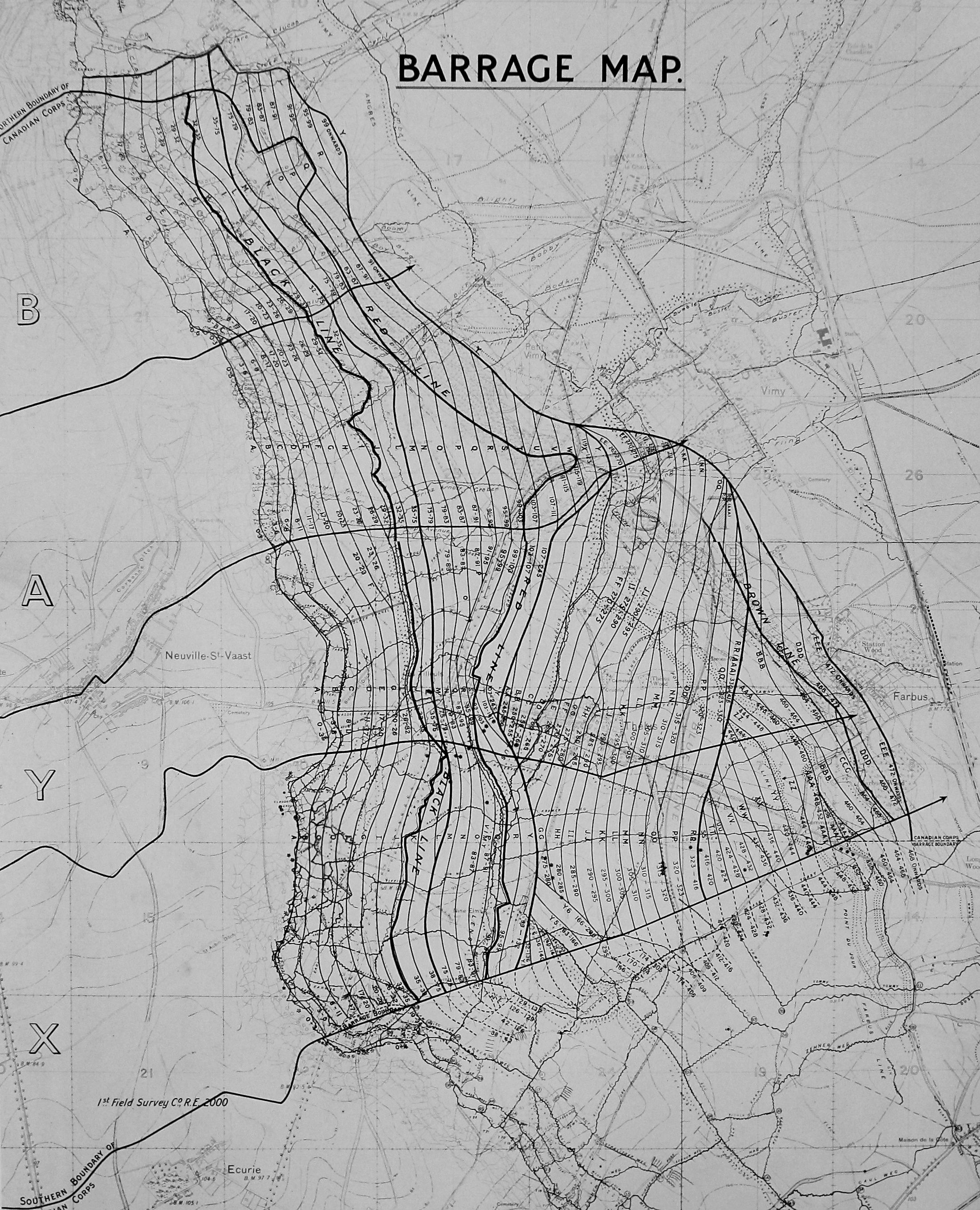
A black-and-white map showing the area around Vimy Ridge. The map is covered in wavy lines representing the rolling artillery barrage while the different objectives of the attack (black, red, blue, and brown) are represented by thicker lines.

Barrage map for the Vimy attack. (The National Archives, WO 153/1284)

Artillery preparation was understandably meticulous, beginning 20 days in advance and increasing in intensity as the day of the attack approached, all the while never giving away the full weight of firepower available. Both wire and strong points were kept under barrage, weakening German defences as well as the morale of those stationed at the front. Fire in support of the assault was similarly well planned, with a rolling shrapnel barrage due to fall in 100 yard lifts and standing barrages on defensive systems ahead of the advance. More than 200 machine guns were also to be brought to bear on the relatively narrow front, with 150 providing an indirect barrage and supporting fire; 130 due to be carried by the assaulting brigades for use in consolidation; and a further 78 held in reserve. The heavy artillery and companies of the Special Brigade Royal Engineers (gas companies armed with Livens Projectors) were to use high explosives and gas in counter-battery work to suppress German artillery.

Tanks, too, were allotted to the Canadian Corps in support of their operations. Having seen their debut at Flers-Courcelette on the Somme just seven months before, eight tanks were given the task of working around the defences of Thélus which sat between the 1st and 2nd Division—the two divisions with the furthest to travel. Despite their promise on the battlefield, all artillery and infantry planning was made without reliance on the contribution of the tanks given their limited number and reliability issues.

A black-and-white photograph of at least three teams of six horses pulling cannons into place.

Canadian Field Artillery bringing up the guns, Vimy Ridge, April, 1917. (Library and Archives Canada, MIKAN 3521867)

Reconnaissance by the Royal Flying Corps 16 Squadron and No. 1 Kite Balloon Company informed the plan of attack, while elaborate communications plans using buried cable, wireless and visual receiving stations for Forward Observation Officers of the artillery mitigated against complications on the day. Mining was used not only offensively with the intention of demolishing German strong points, but also to produce nearly four miles of tunnels and subways for the infantry coming forward for the attack and to evacuate the wounded.

Everything was in place for the hour of the assault, 5:30 am on April 9, 1917. The preceding hours of darkness aided by cloud cover had permitted the infantry to file forward unobserved into their jumping off positions, many of which were clearly observable to the enemy in daylight. Had this movement been witnessed, an enemy barrage may have broken up the assault wave with serious casualties; as it was, the positions were gained without notice. In the half-light of zero-hour under a cold overcast sky, when manoeuvring was still largely obscured from the enemy, the intense bombardment opened with sudden fury and the advance of the infantry began.

Biography

Dr. George Hay is a principal military record specialist at The National Archives of the United Kingdom and a historian of the British amateur military tradition. He holds a PhD in History.

This blog was developed under a collaborative agreement between Library and Archives Canada and The National Archives.

The Battle of Vimy Ridge – the Canadian Corps and its preparations

Version française

A banner that changes from a black-and-white photograph of a battle scene on the left to a colour photograph of the Vimy Memorial on the right.By Marcelle Cinq-Mars

Following Britain’s ultimatum to Germany and the resulting declaration of war, the Dominion of Canada found itself de facto swept up in the turmoil. Such were the ties of Empire between Great Britain and Canada in August 1914. In Canada, few opposed Canadian participation in a “European war,” as it was referred to at the time.
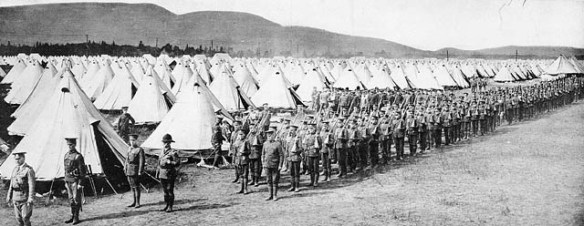
A black-and-white photo showing a field of white tents as far as the eye can see, and a long line of soldiers conducting military exercises in the foreground.

The First Canadian Army – a scene at Valcartier, 1914 (Library and Archives Canada – MIKAN 3642184)

The King accepted the Government of Canada’s offer of an expeditionary force. With a great deal of enthusiasm—and disorganization—the first Canadian volunteers were quickly sent to Valcartier Military Camp, hastily built about 30 kilometres north of Québec. In just over a month, the first Canadian contingent of about 36,000 soldiers and officers was ready to sail for England.

Canadian volunteers

Who were the first Canadian volunteers who agreed to serve “for the duration” under the British Army Act?

Almost all of the roughly 1,500 officers in the first Canadian contingent had received military training in the Canadian militia. More than two thirds had been born in Canada, while the others came from other parts of the Empire. The proportion was reversed for the soldiers: over 65% had been born in other parts of the Empire, just under 30% were born in Canada, and the rest came from the United States and other allied countries.

By March 1917, when it was preparing to take Vimy Ridge, the Canadian Corps had changed considerably. Since arriving on Salisbury Plain 30 months earlier, the Canadians had been through a trial by fire, facing the first poison gas attacks at the Second Battle of Ypres in April 1915 and fighting in the battles of Festubert (May 1915), St. Éloi (June 1916) and the Somme (July 1916). In 1916, Lieutenant-General Alderson had been replaced as Commander of the Canadian Corps by a new officer, Lieutenant-General Julian Byng.
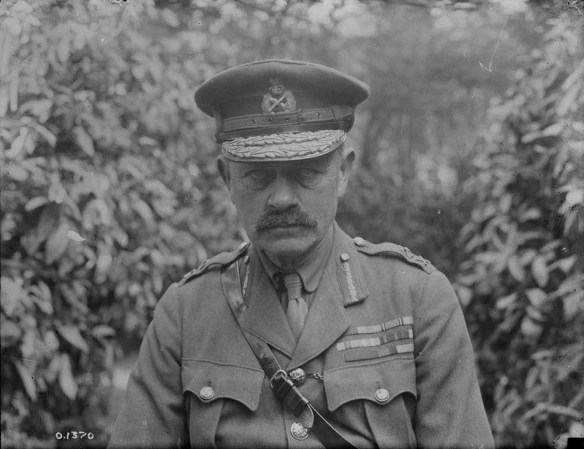
A black-and-white photo of a uniformed man with a moustache, wearing an officer’s cap and a Sam Browne belt. His tunic is festooned with medals and military decorations, and he is staring directly and impassively into the camera.

Lieutenant-General Sir Julian Byng in May 1917. Photo taken by William Ivor Castle (Library and Archives Canada – MIKAN 3213526)

Byng was thus leading the Canadian Corps, which now consisted of four divisions. It should be noted that the 2nd Canadian Division included the only francophone battalion in the whole British Empire engaged at the front: the 22nd (French Canadian) Battalion (now the Royal 22e Régiment). Created in October 1914, this battalion was commanded entirely by francophone officers; French Canadians were able to serve their country in their own language.

Attack preparations

Once Byng’s plan had been submitted, modified and approved by the military command, preparations began for the attack on Vimy Ridge. The Canadian Corps, which had been assigned this task, prepared for the assault with great determination and meticulous care. Byng had a scale model of the German defences made, and he used it behind the lines as he personally supervised the Canadians’ training. Every day, officers and soldiers practiced, as realistically as possible, the tactics that they would employ during the attack. They worked on timing their advances to follow, and benefit from, the artillery’s creeping barrage.

During this time, Canadian and British engineers had to prepare ammunition stores, water tanks and pumps. Twenty-five feet below the trenches, the tunnel system was expanded, to ensure that the troops could move toward the front-line trenches and that the communications network was secure.

A map showing a close-up of part of the Canadian and German military positions. The inset shows the front line, from the North Sea to Reims in the south.

Map of Vimy Ridge on April 9, 1917, before the battle started (Library and Archives Canada – MIKAN 178969)

Royal Flying Corps pilots were tasked with observing German positions and bombarding key targets, such as railways and German airfields. The invaluable information that they gathered was relayed behind the lines and led to over 80% of the German artillery batteries’ locations being identified.

In the lead-up to the attack, the artillery began pounding the German trenches on March 20. This bombardment continued until April 2, when it reached its maximum intensity. It is estimated that more than 1 million artillery shells were fired during this preparatory period, with over 50,000 tons of explosives hitting the German positions. The damage to the German lines of communication from the artillery fire slowed the supply line to defenders in the front lines considerably.

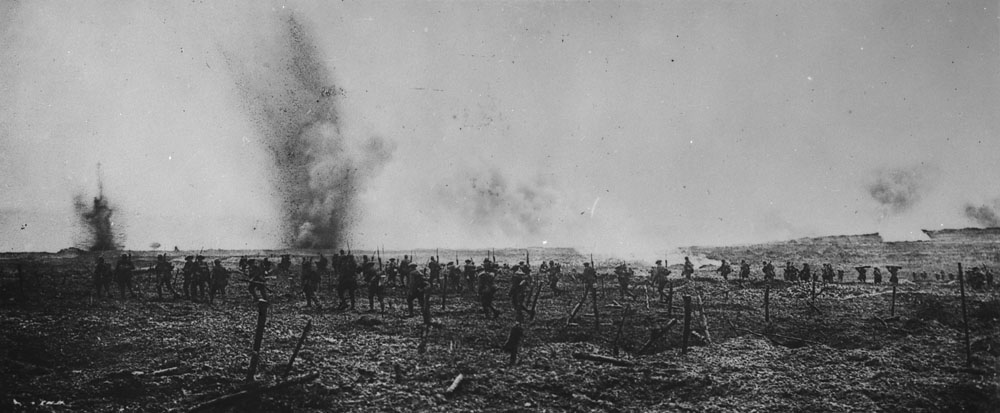
A black-and-white photo of soldiers advancing across a field, with shells exploding just in front of the advancing column.

Canadians advancing through German barbed wire, April 1917 (Library and Archives Canada – MIKAN 3404765)

On the day of the attack, the 15,000 Canadians who took part in the assault on Vimy Ridge were confident of achieving their objectives. It was a momentous day for the Canadian Expeditionary Force, which expected to clearly show its determination and effectiveness. Although the soldiers in the assault did not know it yet, it would also be a momentous day for Canada.

Related resources

Biography

Marcelle Cinq-Mars is a senior military archivist in the Government Records Branch at Library and Archives Canada. She has authored many books focusing mainly on the First World War.

This blog was developed under a collaborative agreement between Library and Archives Canada and The National Archives.

The 100th anniversary of the Battle of Vimy Ridge: a collaboration with The National Archives

A banner that changes from a black-and-white photograph of a battle scene on the left to a colour photograph of the Vimy Memorial on the right.Over the next month, Library and Archives Canada and The National Archives of the United Kingdom will be shining a light on the role that the Canadian contingent played in the Battle of Vimy Ridge, as we commemorate the 100th anniversary of this First World War battle.

In a series of blog posts exploring the Battle of Vimy Ridge through our respective records, we will cover the following topics:

  • the composition of the Canadian Corps and the context leading up to Vimy
  • what happened during the battle itself
  • how the battle ended
  • memorialization following the battle
  • artistic representations of the battle

Look for the first blog in the series on April 3 and the final one on April 21.

During that same period, we will be continuing the series First World War Centenary: Honouring Canada’s Victoria Cross Recipients, which looks at soldiers honoured for their actions during the battle.

Lieutenant Frederick Maurice Watson Harvey, VC

The Discover Blog returns to the First World War Centenary: Honouring Canada’s Victoria Cross recipients series, in which we profile each of Canada’s Victoria Cross recipients on the 100th anniversary of the day that the actions for which they were awarded the Victoria Cross took place. Today we present the story of Lieutenant Frederick Maurice Watson Harvey, an Irish-born Canadian VC recipient from Medicine Hat, Alberta.

A black-and-white portrait of an officer wearing a Sam Brown belt and looking directly at the viewer.

Captain Frederick M. Harvey, V.C., undated (MIKAN 3216613)

Harvey, born in Athboy, County Meath, Ireland, was one of three Irish rugby union internationals to have been awarded the Victoria Cross, and the only one to have been awarded the medal during the First World War. He settled in Medicine Hat, Alberta, in 1908 and enlisted on May 18, 1916 with the 13th Regiment, Canadian Mounted Rifles, transferring to Lord Strathcona’s Horse (Royal Canadians) after arriving in France.

On March 27, 1917, Harvey’s troops advanced on the village of Guyencourt, France. As German machine gun fire inflicted heavy casualties, Harvey’s Victoria Cross citation recounts what occurred next:

At this critical moment, when the enemy showed no intention whatever of retiring and fire was still intense, Lt. Harvey, who was in command of the leading troop, ran forward well ahead of his men and dashed at the trench, still fully manned, jumped the wire, shot the machine gunner and captured the gun. His most courageous act undoubtedly had a decisive effect on the success of the operation (London Gazette, no.30122, June 8, 1917).

A black and white reproduction of a war diary entry showing the place, date, hour and a summary of events and information.

Extract from the Lord Strathcona’s Horse war diaries for March 27, 1917 (MIKAN 2004721)

Lieutenant Harvey was initially granted the Distinguished Service Order but was later awarded the Victoria Cross. He received the Military Cross for his role in the Lord Strathcona’s Horse advance on Moreuil Wood on March 30, 1918 and was also awarded the French Croix de Guerre.

Harvey remained with Lord Strathcona’s Horse and was promoted to Captain in 1923. He instructed in physical training at the Royal Military College of Canada from 1923 to 1927, was promoted to Lieutenant Colonel in 1938, and, in 1939, was made Brigadier General. Harvey served as Honorary Colonel in Lord Strathcona’s Horse from 1958 to 1966. He died in August 1980 at age 91.

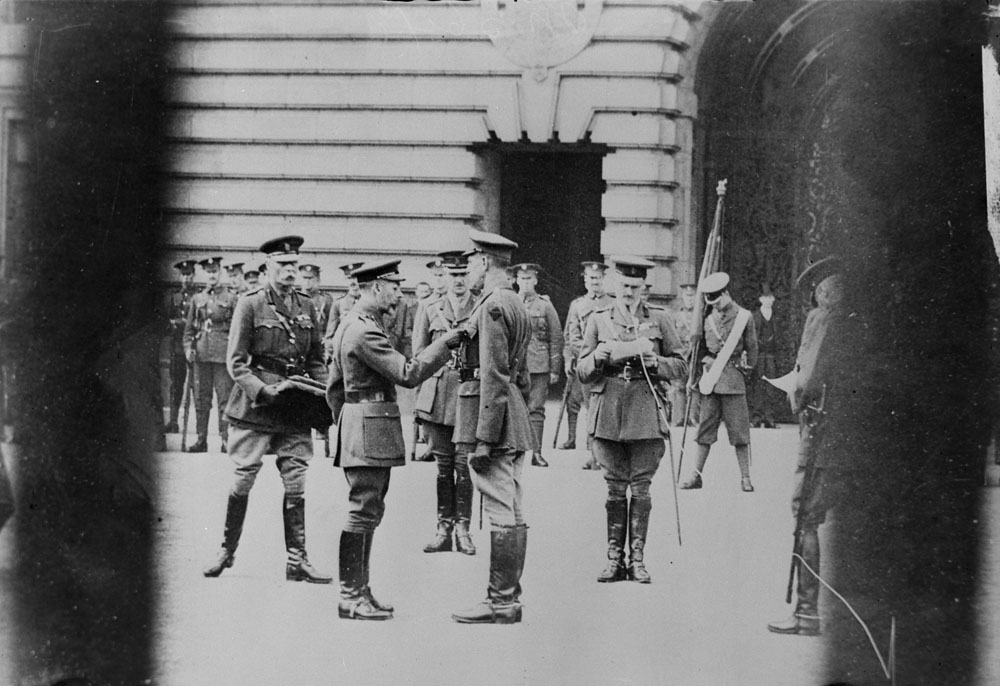
A black and white photograph of a man pining an award on another man’s pocket. Another man is reading the citation while a third man is carrying a case. In the background, rows of soldiers are standing at ease.

H.M. The King decorating Lieutenant Harvey L.S.H. with the Victoria Cross (MIKAN 3362384)

Library and Archives Canada holds the CEF service file for Lieutenant Frederick Maurice Watson Harvey.

Related Resources

120th anniversary of the birth of Harold Anthony Oaks: pioneering Canadian aviator

By Laura Brown

Harold Anthony Oaks was one of 22,000 Canadians who served with the British flying services during the First World War. While many did not return home, Oaks survived the conflict and transitioned his wartime flying experience into a successful career as a bush pilot and award-winning aviator.

Oaks was born in Hespeler (now Cambridge), Ontario on November 12, 1896. A student when he enlisted in the Canadian Expeditionary Force (CEF) in October 1915, Oaks was soon sent to France and served in the 1st Canadian Divisional Signal Company, Canadian Engineers as a motorcycle dispatch rider. While overseas Oaks continued to study, spending some time on leave learning French and Spanish. Whether it was his bookish nature or that his father was a doctor, Oaks earned the nickname “Doc,” which stayed with him for life.

In the summer of 1917, Oaks left the CEF to join Britain’s Royal Flying Corps. Less than a year later, he had cemented his reputation as a skilled fighter pilot, serving in numerous battles with the 48 Squadron in France. Oaks received a Distinguished Flying Cross (DFC) for his efforts.

A black and white portrait showing a young man in uniform. He sits facing the camera and sports a slight smile.

Harold Anthony Oaks, ca. 1918 (MIKAN 3219517)

After returning to Canada, Doc Oaks attended the University of Toronto, where he obtained a degree in mining engineering in 1922. In the following years, he began numerous aviation ventures which focused on how planes could assist in prospecting in Canada’s north. In 1926, Oaks started Patricia Airways and Exploration Limited with a former Royal Flying Corps pilot, Tommy Thompson. The goal of the one-plane operation was to transport people, goods, and mail to remote mining areas in Northern Ontario. In its first year, the company transported 260 passengers, 14,000 pounds of freight and 3,000 pounds of mail.

A yellow, green and red postage stamp showing a frontal view of a Curtiss Lark airplane in flight with trees and water below. The words “Patricia Airways and Exploration Limited” appear above the plane and “Special Delivery, Sioux Lookout to Pine Ridge and Red Lake” appear below it. Bordering the stamp is a line design with maple leaf motif in each corner, accompanied by the word “Canada.” The words “Airmail” and “Red Lake” appear on the four sides of the stamp.

Postage Stamp, Patricia Airways and Exploration Limited, 1926 (MIKAN 3854727)

The success of his first air transport business prompted Oaks to expand. He went on to become the manager of Western Canada Airways and helped establish new flying routes in Northern Ontario, Manitoba, and Saskatchewan. In addition, Oaks spearheaded a number of engineering projects that revolutionized winter flying, including special skis for planes and a portable nose hangar, which enabled crews to work on aircraft even under frigid temperatures.

A black-and-white photograph showing a floatplane at the edge of a lake. Two figures stand on the floats near the propeller and a third figure stands on the shore to the right. A fourth figure, partially in view on the far right, looks at the plane.

Harold Anthony Oaks and associates with Fairchild KR-34C, Oaks Airways Limited, Jellicoe, Ontario, 1934 (MIKAN 3390361)

In 1927, Oaks became the first recipient of the Trans-Canada Trophy for “meritorious service in the advancement of aviation.” Throughout the years, he would continue to engage in new projects including the establishment of his own airline, Oaks Airways Limited. He died in 1968 at the age of 71.

Oaks’ career as a successful aviator stems from his flying experience in the First World War. However, in January 1917, well before Oaks became a famed pilot, he was one of thousands of soldiers facing the relentless damp, cold, and mud of the Western Front. At the time, he recorded in his diary that he longed “to see a bit of real Canadian winter.” Following the war, Oaks went on to spend hundreds of hours flying above snowy Canadian landscapes. Undoubtedly, he got his wish.


Related resources


Laura Brown is a Military Archivist in the Government Archives Division at Library and Archives Canada.

Launch of First World War personnel records database

We are pleased to announce an updated version of our “Service Files of the First World War, 1914-1918 – CEF” database. The new database, now called “Personnel Records of the First World War”, provides access to the service files of members of Canadian Expeditionary Force (CEF) along with records for other First World War personnel.

The new database includes records for the following groups:

Canadian Expeditionary Force

  • Imperial War Service Gratuities recipients
  • Non-Permanent Active Militia
  • Rejected CEF volunteers
  • Royal Newfoundland Regiment and Forestry Corps

Discover the Personnel Records of the First World War collection today!

And be sure to visit the First World War page of the Military Heritage section of our website for an overview of all our First World War records.

We wish to acknowledge the participation of the Provincial Archives Division of The Rooms corporation of Newfoundland and Labrador for access to its digitized personnel files.


Piper James Cleland Richardson, VC

By Emily Monks-Leeson

Today’s blog post for the series First World War Centenary: Honouring Canada’s Victoria Cross Recipients tells the story of Piper James Cleland Richardson, awarded the Victoria Cross (VC) for gallantry during the Battle of the Ancre Heights on October 8, 1916 at Regina Trench, Somme, France.

A black-and-white photograph of a young man wearing a kilt and sporran, holding a baton in his left hand and leaning on a sculptural shelf.

Piper James Cleland Richardson, VC, 16th Battalion, CEF. (MIKAN 3192331)

Born in Bellshill, Scotland, on November 25, 1895, Richardson immigrated to British Columbia where he served as a piper in the 72nd Seaforth Highlanders of Canada. In September 1914, he enlisted with the Canadian Expeditionary Force (CEF) and went overseas as part of a large Seaforth contingent of the 16th Battalion (Canadian Scottish).

On October 8, 1916, Richardson’s company was held up by uncut barbed wire and intense fire as they attacked German positions at Regina Trench. Richardson’s commander, Lieutenant-Colonel Cyrus Peck, later wrote of Richardson’s extraordinary courage. As the unit lay trapped in the shell holes of “no man’s land,” Richardson, a teenager who had played the company “over the top,” sought the commander’s permission to play his pipes again. In full view of the Germans, he marched up and down the wire entanglements playing his pipes where his fellow soldiers lay. His citation for the Victoria Cross states, “The effect was instantaneous. Inspired by his splendid example, the company rushed the wire with such fury and determination that the obstacle was overcome and the position captured” (London Gazette, no. 30967, October 22, 1918).

Amazingly, Richardson survived the attack and was detailed to take a wounded comrade and several prisoners of war to the rear. Realizing that he had left his bagpipes behind, he returned to recover them. Richardson was never again seen alive.

A black-and-white handwritten page describing the daily events leading up to the day of the action for which Piper James Cleland Richardson received the Victoria Cross.

War diary of the 16th Battalion for October 1–8, which describes the days leading up to the attack on Regina Ridge. (MIKAN 2034171)

The remains of James Cleland Richardson were located in 1920 and he is now buried in Adanac Military Cemetery near Albert, France. His bagpipes, long believed lost to the Somme mud, were identified in 2002 as being in the possession of Ardvreck Preparatory School in Scotland, part of a 1917 donation by British Army Chaplain Major Edward Yeld Bate. They are now on display at the British Columbia Legislature.

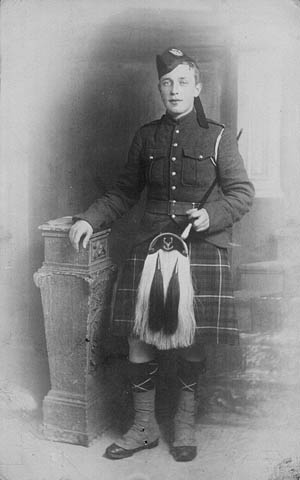
Black-and-white photograph of a young man in military uniform holding his bagpipes.

Piper James Cleland Richardson, VC, and bagpipes, 16th Canadian Infantry Battalion, CEF. (MIKAN 4922009)

Library and Archives Canada holds the CEF service file for Piper James Cleland Richardson. The James Richardson fonds contains his Victoria Cross certificate as well as an exercise book from his early schooling.


Emily Monks-Leeson is an archivist in Digital Operations at Library and Archives Canada.

Private John Chipman Kerr, VC

By Emily Monks-Leeson

As part of the First World War Centenary: Honouring Canada’s Victoria Cross recipients series, today we remember the life and military service of Canadian Victoria Cross recipient John Chipman “Chip” Kerr of Fox River, Nova Scotia.

A black-and-white photograph of two soldiers in uniform sitting on a bench. The man on the right is looking directly at the camera with a slight smile.

Private J.C. Kerr, VC, on the right. (MIKAN 3217379)

Prior to the war, Kerr worked as a lumberjack near Kootenay, British Columbia, and homesteaded in Spirit River, Alberta, with his brother, Charles Roland “Rollie” Kerr. When war was declared in 1914, the Kerr brothers, Chip and Rollie, went to Edmonton to enlist, leaving a note tacked to the door of their cabin that declared: “War is Hell, but what is homesteading?”

A black-and-white collage of three typewritten pages with the date September 15 in the margin and an hour-by-hour account of the actions taking place.

Account of the operations of the 49th Canadian Infantry Battalion from September 15–18, 1916. (MIKAN 1883261)

On September 16, 1916, Kerr was serving with the 49th Infantry Battalion of the Canadian Expeditionary Force (CEF) near Courcelette, France, not far from where Leo Clarke of the 2nd Battalion (Eastern Ontario Regiment) won the Victoria Cross the week before. Kerr’s actions on that day would earn him his own Victoria Cross. During a grenade attack carried out by his battalion, Kerr was the first bayonet man in a bombing party advancing on German positions. Recognizing that his unit’s bombs were running out, Kerr ran along the back ridge of the trench under heavy fire until he was close enough to the German troops to fire on them at point-blank range. Thinking they were surrounded, the German troops surrendered. Kerr’s citation in the London Gazette provides the details:

Sixty-two prisoners were taken and 250 yards of enemy trench captured. Before carrying out this very plucky act one of Private Kerr’s fingers had been blown off by a bomb. Later, with two other men, he escorted back the prisoners under fire, and then returned to report himself for duty before having his wound dressed. (London Gazette, No. 29802, October 26, 1916)

Chip Kerr survived the war, while his brother Rollie, also serving in the 49th Battalion, was killed in late December 1917. Kerr rejoined the army at the beginning of the Second World War, transferring to the Royal Canadian Air Force with the rank of Sergeant. He died in Port Moody, British Columbia, on February 19, 1963.

Mount Kerr, a 2,600-metre peak in Jasper National Park, is named after him, as is Chip Kerr Park in Port Moody, British Columbia.

Library and Archives Canada holds the CEF service file for Private John Chipman Kerr and his brother, Private Charles Roland Kerr.


Emily Monks-Leeson is an archivist in Digital Operations at Library and Archives Canada.

The Battle of Flers-Courcelette

By Alex Comber

Far from achieving their objectives, the Battles of the Somme, continuing into August 1916, had accomplished little, at enormous expenditure of lives and resources. The Battle of Flers-Courcelette, which took place September 15 to 22, 1916, was another attempt to achieve a decisive result on the Somme Front. Fighting as part of the British Reserve Army, the Canadian Corps, commanded by Sir Julian Byng, would contribute two of its infantry divisions to the left wing of a wider attack.

This was the first major offensive operation for the Canadians, and their first experience of the devastating human toll of combat in 1916. The battle began by a massive artillery bombardment of enemy positions, similar to the earlier Somme battles. This “creeping barrage” was better timed with the pace of advancing soldiers, and kept just ahead of them. Most enemy units did not have time to recover and prepare their defences before the Canadian infantry battalions were upon them.

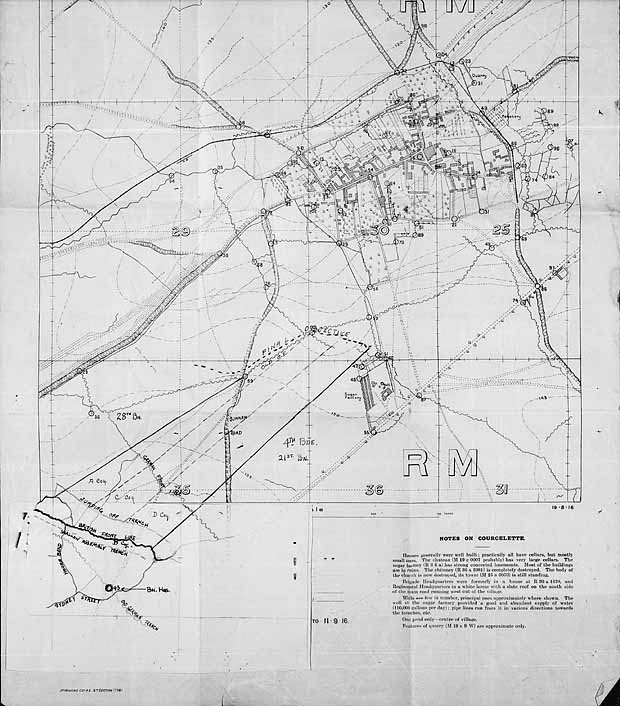
An image of a trench map, dated September 1916, showing the planned line of advance for the 27th Battalion near Courcelette, France.

This trench map, part of the War Diary of the 27th Battalion (City of Winnipeg), shows the planned lines of advance of this Battalion’s leading companies, from jumping-off trenches near Pozières (bottom left) toward the “final objective” just to the north of the sugar factory. Trench maps offer a wealth of detail, and this one shows the village of Courcelette at the top, and information about the other units that would advance on either flank of the 27th Battalion. (MIKAN 1883247)

Highlights of the successful advance of Canadian units included the capture of the village of Courcelette by Lt. Col. T.L. Tremblay’s 22nd Battalion (French Canadians) and the 25th Battalion (Nova Scotia Rifles) as well as the capture of the heavily fortified sugar factory east of the village by the 21st Battalion (Eastern Ontario). Elsewhere, the attack stalled, and hopes for a decisive success faded, as the Germans launched strong counterattacks or withdrew to fortified positions. Canadian units suffered approximately 24,000 wounded and killed soldiers during the operation.

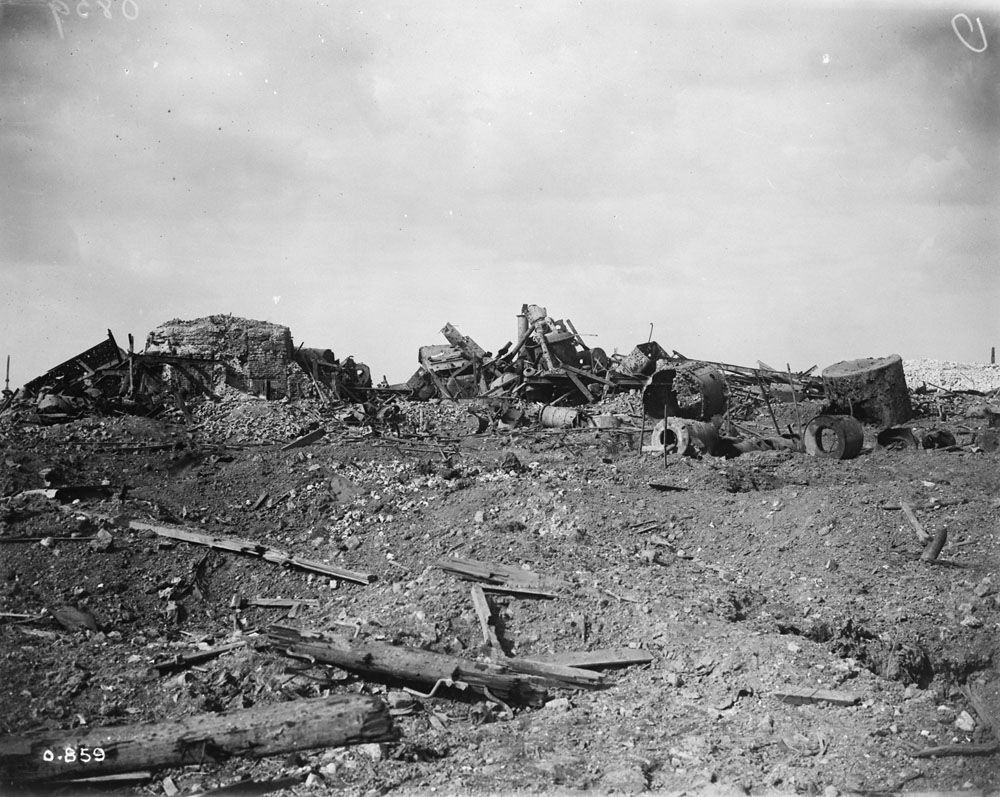
A black-and-white photograph of a ruined industrial building in a destroyed landscape.

This Canadian War Records Office official photograph of October 1916 shows the remnants of what was originally a sugar factory before the War following the bombardment and Canadian advance on the fortified German position. (MIKAN 3403776)

The first tanks, called “Land ships” appeared on the battlefields of Flers-Courcelette. They were slow, cumbersome, and mechanically unreliable, and most were put out of action or broke down before they could help the advancing soldiers. However, the few that remained operational destroyed fortified pillboxes and caused chaos in enemy lines. Lt. William Ivor-Castle, an official photographer working for the Canadian War Records Office, filmed tanks advancing to their starting positions, and these caused a sensation when published in England as the first photos of tanks “in combat.”

A black-and-white photograph of a British heavy tank advancing through a shell-cratered landscape.

This Mark 1 tank, named “Crème de Menthe,” was one of the most successful of those supporting the Canadian attack at Courcelette on September 15, 1916. Early tanks were painted with colourful “Solomon-style” camouflage. (MIKAN 3397296)


Alex Comber is a Military Archivist in the Government Archives Division at Library and Archives Canada.