The life of Rifleman Sulo W. Alanen

Version française

By Ariane Gauthier

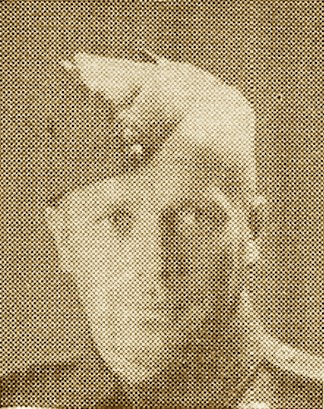
Sepia-coloured photograph of Sulo W. Alanen when he was about 30 years old, featured in a Finnish newspaper announcing his death.

Photo of Sulo W. Alanen as it appeared in a Finnish newspaper announcing his death. (Source: Canadian Virtual War Memorial)

The story of Sulo W. Alanen begins in the northern Ontarian village of Nolalu, a small settlement outside of Thunder Bay that emerged largely due to the arrival of Finnish settlers in the region. These settlers were likely drawn to the thriving lumber industry, the opportunities for farming, and the convenience of the railway passing through Nolalu.

Matti Alanen, originally from Jurva, Finland, was one of these immigrants who braved the journey to Canada in 1904, inspired by the promise of a better life. Like many of his compatriots, he settled in Nolalu, a growing Finnish community established just four years earlier. Here, he found familiarity in an unfamiliar land, with a supportive network of fellow Finns. Matti embraced farming as his livelihood. Hilma Lehtiniemi, originally from Ikaalinen, Finland, followed her family to Canada in 1908. After arriving in Nolalu, she met and married Matti, likely around 1910, as suggested by Sulo’s service file, which mentions their marriage in April 1910 in Port Arthur, Ontario.

Sulo, the couple’s third son and child, was born May 13, 1914, in Silver Mountain, Ontario, a mining settlement near Nolalu. The Alanen family’s farmstead appears to have been located between these two communities, as their place of residence alternates between Silver Mountain and Nolalu in Sulo’s service file.
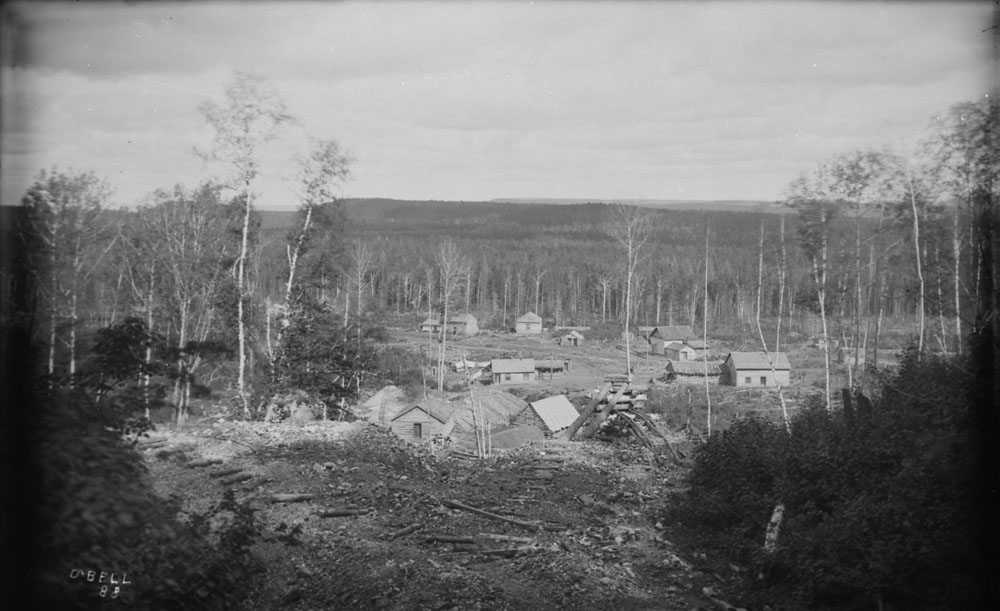
Black-and-white photograph from 1888 of the Silver Mountain mining settlement, showcasing the forest expanse and rural landscape.

Silver Mountain mining settlement, 1888. (Source: a045569)

Sulo was the middle child among five siblings. The 1931 Census provides insight into his upbringing, indicating that Finnish was his first language. This is unsurprising, given that Nolalu was a Finnish community where most settlers shared this cultural heritage. Census entries for neighbouring households confirm this pattern: nearly all family heads were originally from Finland and spoke Finnish as their first language.

Section of the 1931 Census for Nolalu, listing members of the Alanen family, their age, gender, and place of birth.

A screenshot of the 1931 Census featuring the Alanen family. Sulo’s name can be seen on line 42 of the 5th page. (Source: e011639213)

English came later for Sulo and his siblings, likely as a result of simply living in Canada, as none of them attended school or learned how to write. Much of Sulo’s childhood was spent working on the family farm. In adulthood, he continued working on his father’s farm until his enlistment for the Second World War. His service file also mentions that he occasionally worked as a bushman for extra income.

Sulo was forced to serve at the 102 Canadian Basic Training Camp in Fort William under the National Resources Mobilization Act (NRMA), enacted in 1941 by the King government as a compromise to avoid full conscription. The NRMA mandated that able-bodied men contribute to Canada’s defence and national security. After serving for 30 days under this program, Sulo made the pivotal decision to enlist voluntarily on May 4, 1943.

Sulo’s enlistment in the Canadian Army aligned with the critical Allied preparations for the D-Day landings, planned for the summer of 1944. From his initial training at Camp Shilo in Manitoba to boarding a ship bound for England, his focus was singular: preparing for the storming of Juno Beach.

Sulo’s ship arrived in England on April 11, 1944—just two months before Operation Overlord. On April 27, he was assigned to the Royal Winnipeg Rifles, specifically to the 2nd Canadian Base Reinforcement Group. This designation indicates that Sulo was not initially slated to participate in the first assault wave. Instead, as a part of C Company, he was positioned to join the Royal Winnipeg Rifles after they had pierced the Atlantic Wall.

The Royal Winnipeg Rifles’ war diary tells us what D-Day was like for Sulo and his comrades. The troops were informed at 9 p.m. the evening before that Operation Overlord was on, and all were fairly enthusiastic. The diary states: “There was an air of expectancy and sense of adventure on all craft this night, the eve of the day we had trained for so hard and long in England.”

The long day began at 4 a.m. with tea and a cold snack. The weather was cloudy and the sea was heavy. At 5:15 a.m., landing crafts were lowered from the motor vessel Llangibby Castle, still about 15 kilometres from the coast. At 6:55 a.m., the Royal Navy and air support began bombarding the coastline of France. The landing crafts arrived on shore around 7:49 a.m. with B and D companies landing first. As the war diary grimly notes: “The bombardment having failed to kill a single German or silence one weapon, these coys had to storm their positions “cold”—and did so without hesitation.”

A and C companies landed later around 9 a.m. C Company disembarked on the Mike and Love sectors of Juno Beach, where the beach and surrounding dunes were still under heavy mortar fire. Pinned down for about two hours, the soldiers eventually regrouped and, alongside A Company, pushed forward towards their objective, Banville, encountering several pockets of resistance en route but overcoming each one until just south of Banville, where the enemy had dug in on commanding ground.
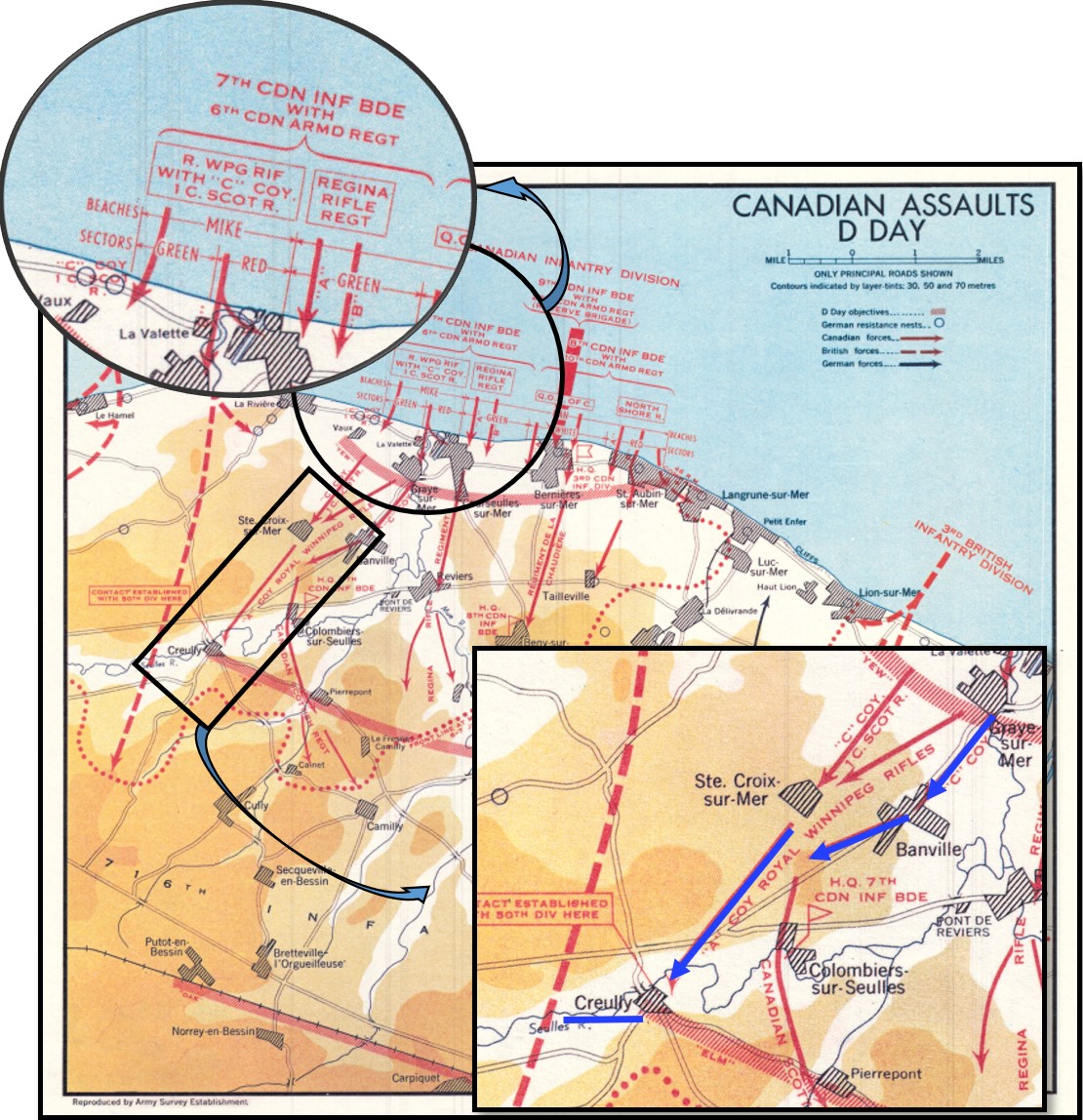
Map of Juno Beach showing the 3rd Canadian Infantry Division’s movements on D-Day. Highlights show the landing sector and path of the Royal Winnipeg Rifles’ C Company.

Map of Juno Beach showing the 3rd Canadian Infantry Division’s movements on D-Day. (Source: e999922605-u)

The first day of the Battle of Normandy brought surviving members of the Royal Winnipeg Rifles to Creully by 5 p.m., completing phase II of Operation Overlord. Little rest was had, especially for C Company, which faced an enemy patrol attack at 2 a.m. The soldiers repelled the assault and captured 19 German prisoners, allowing for a brief respite until 6:15 a.m., when they were ordered to advance once more. Their next objective was the OAK Line at Putot-en-Bessin.

This event set the tone for the Royal Winnipeg Rifles’ grueling experience in the aftermath of D-Day as they encountered some of the most ferocious and obstinate resistance by German forces.
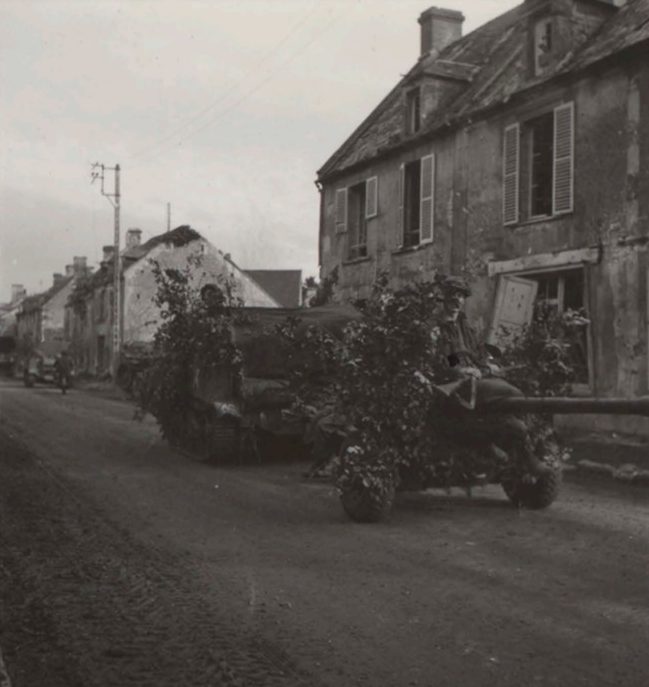
Photograph by military photographer Lt. Bell showing Canadian artillery camouflaged with foliage, Carpiquet, France, July 4, 1944.

Army Numerical 35899-36430—Northwest Europe—Album 75 of 110. (Source: e011192295)

By July 5, the Royal Winnipeg Rifles had painstakingly made it to the village of Marcelet, where they engaged in the battle for Carpiquet. While Sulo’s service file does not delve into the specifics of the injuries that ended his life on that day, the war diary tells us his regiment was subjected to enemy shelling and strafing from the air during the whole day. In this chaos, Sulo was either struck by shrapnel or collapsing buildings. Initially, he couldn’t be found and was reported missing, but when the battle calmed just enough by July 5, his body was discovered, and he was officially reported killed in action.

Like so many Canadians who gave their lives during D-Day and the battle of Normandy, Sulo W. Alanen rests at the Beny-sur-Mer Canadian War Cemetery in Calvados, France. He is buried in plot XV. G. 16, where his name liveth for evermore.

For more reading on this subject:


Ariane Gauthier is a reference archivist in the Access and Services Branch at Library and Archives Canada.
Vimy Memorial visit: fact or fiction (now a trilogy)

Version française

By Rebecca Murray

In 2022, I wrote about researching my great-grandfather’s attendance at the 1936 unveiling of the Vimy Memorial. A year later, I shared another instalment, and now, I’m back with what feels like the conclusion to this journey through my family history.

We left off with the exciting discovery that Thomas C. Phillips had indeed been at or very near the Vimy Memorial in July 1936. However, we were still missing a key piece of the puzzle—how exactly did he get there and back home again?

Given the era, it’s likely that Thomas travelled by passenger ship. Family documents tell us that he sailed to France on the SS Alaunia and I confirmed online that this ship left Montréal on July 20, 1936—a tight, but feasible window for him to make it to the unveiling on July 26. So, this is where we pick it back up!

I turned my attention to passenger lists and related records, hoping to trace Thomas’s journey. My first stop—because I have learned that a problem shared is a problem halved AND I know how smart my colleagues are—was the Genealogy Desk! I spoke with one of my colleagues (you can do this too!), who advised me that post-1935 passenger lists are under the custody of Immigration, Refugees and Citizenship Canada and are accessible through Access to Information requests. Pre-1935 records, however, are organized into various datasets that are searchable on the Library and Archives Canada (LAC) website using a variety of keywords such as “passenger,” “immigration,” and “border.”

I hummed and hawed over this—those of you who love research will understand that handing over the reins to someone else wasn’t my first choice. Not wanting to rely entirely on others, I approached the research from a new angle. Which angle you ask? Well, I went all the way to the other side of the ocean! Instead of looking for arrival records, I decided to look for departures (or, Thomas’s return trip)! This led me to the National Archives of the United Kingdom and their digitized records on Findmypast, where I discovered not one, but two passengers named Thomas Phillips who sailed to Montréal in the summer of 1936. Another big thank you to my colleagues at the Genealogy Desk, whose expertise proved invaluable in this stage of the research.

I reviewed the search results knowing that I should look for a departure date in the late summer and use Thomas’s birth year (1877) as an additional filter. I quickly found the relevant record: a passenger list for the SS Antonia, a Cunard ship built in the 1920s. Spotting Thomas’s name felt like one of those moments in the Reference Room where you want to fist pump and high-five someone—except, when you’re working remotely, all you get is a side-eye from the dog for interrupting his nap.

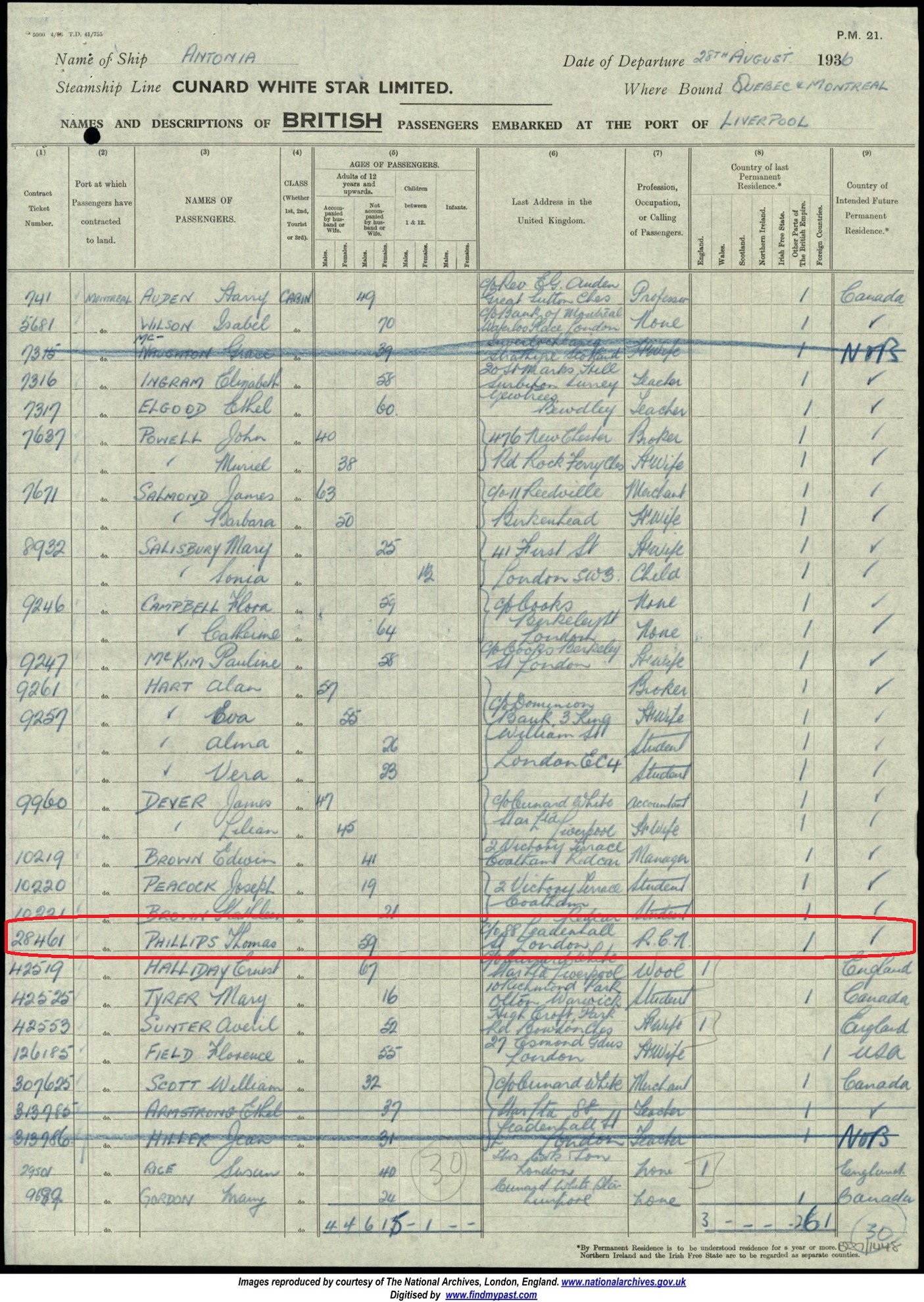
The form tells us a lot about the voyage and about Thomas. The SS Antonia departed Liverpool on August 28, 1936, bound for Quebec City and Montréal, Quebec. While most of the passenger data is standard, I found it neat to see column 8 or “Country of Last Permanent Residence,” which offers a breakdown of regions across the United Kingdom as well as options for “Other Parts of the British Empire” and “Foreign Countries.” Unsurprisingly, most of the passengers heading to Quebec on this voyage are listed as from “Other Parts of the British Empire”—perhaps other Canadian pilgrims who, like Thomas, had been in France the previous month for the unveiling of the Vimy Memorial.

Page from the passenger list of the SS Antonia, featuring the name of Thomas Phillips circled in red.

Passenger list for Cunard White Star Line’s SS Antonia with a departure date of August 28, 1936, from Liverpool, England. Information about Thomas Phillips is circled in red. Source: National Archives of the United Kingdom.

We also learn that Thomas’s last address in the United Kingdom was “c/o 88 Leadenhall St, London.” Naturally, my curiosity led me to investigate what was located at 88 Leadenhall Street in 1936. A quick Internet search revealed it was Cunard House, an eight-story building that housed the business offices of Cunard Line and its affiliated companies. Further digging suggested that it wasn’t uncommon for travellers by sea to use a “care of” (c/o) address, likely for ease of correspondence during their journey.

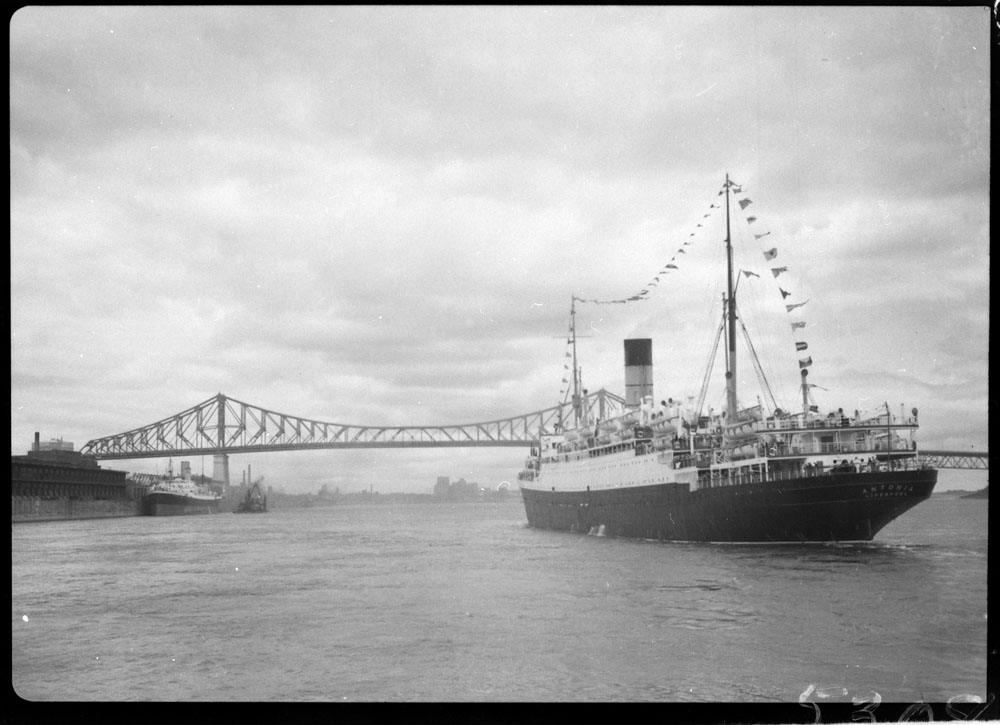
With this new information in hand, I turned to LAC’s archives to explore what else I could find about the SS Antonia and Thomas’s voyage. Archival holdings at LAC provide a rich narrative of the SS Antonia—from her early days as a passenger liner to her later role as a troop transporter during the Second World War. But of most interest to this researcher are the records related to the Vimy Pilgrimage! LAC even holds footage of the SS Antonia, as well as this beautiful photograph of her Europe-bound voyage earlier that summer.

A black-and-white photograph showing the SS Antonia, a two-toned passenger ship, moving across the water. In the background, the Jacques-Cartier Bridge and several docked ships can be seen.

Members of the Vimy Pilgrimage aboard the SS Antonia, departing from Montréal, Quebec, 1936. Source: Clifford M. Johnston/Library and Archives Canada/PA-056952.

I even scoured Montréal newspapers from early September to see if Thomas’s return was noted in the shipping news. While the Antonia’s arrival was documented, my great-grandfather didn’t make the papers. And so, this brings me to the conclusion of my research—sometimes the hardest part of archival work is knowing when you’re done.

I’ve delved into the original question of why my great-grandfather attended the unveiling of the Vimy Memorial, and along the way, uncovered answers to how he made the journey there and back. The research brought both exciting discoveries and inevitable disappointments—common in any archival exploration. Along with new insights, I’ve gained valuable research skills, which is always a welcome bonus. And far from feeling discouraged, I’m more eager than ever to tackle the next family history mystery. Bring it on!


Rebecca Murray is a Literary Programs Advisor in the Outreach and Engagement Branch at Library and Archives Canada.
All “aboat” searching for ship registries in LAC’s collections

Version française

By Elaine Young

Did you know that Canadian vessels over a certain size have had to be registered with government authorities as far back as the 18th century? Library and Archives Canada (LAC) holds various types of records related to the registration of vessels and has recently transcribed and made searchable almost 84,000 of these records. The transcriptions include the ship’s name, port of registry, registration number and year of registration, all key fields for researching the rich (and sometimes surprising!) histories of the vessels. These records are a vast resource for researching maritime history across Canada and are also a genealogical tool for tracing the family lineages tied to those ships.

This transcription project is part of LAC’s effort to improve research into the records in its collection. LAC took custody of these records, many of them ledger books, in prior years as Transport Canada (the regulator) moved increasingly towards digital recordkeeping. To support digital access to the records, LAC took digitized copies of some of these ledgers and worked with researchers in the field to identify the best information to transcribe.

The transcribed material relates to ships that were operated then de-registered (closed out) between 1838 and 1983. It includes vessels from the Atlantic, Pacific and inland waterways.

These registries contain a wealth of information about each vessel, including a description, the type of ship, its size, the ownership and when it was built. The registries offer valuable insights for anyone researching shipbuilding, shipping or coastal and open ocean industries. For example, over time these records illustrate the transition from wind to steam-powered ships, as well as the introduction of fibreglass and composite hulls. The records also contain information relevant for genealogical research, as many ships were passed down within families.

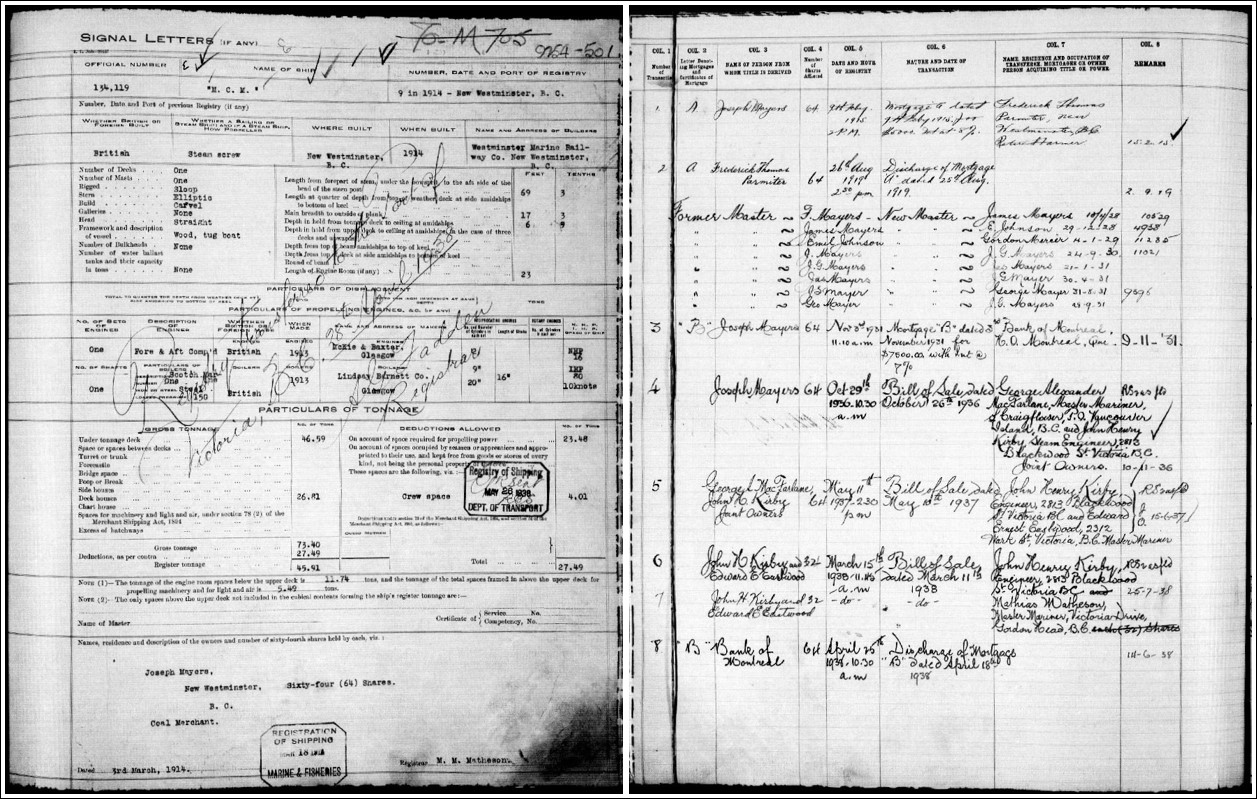
Example of a typical ship registration:

Page one and page two of the registration document for the ship M.C.M. The document has been filled out using both a typewriter and by hand in cursive writing.

[M.C.M., Port of Registry: NEW WESTMINSTER, BC, 9/1914] R184, RG12-B-15-A-i, Volume Number: 3041. (e011446335_355)

The first page of this register for M.C.M., a ship registered in 1914 in New Westminster, British Columbia, contains details about the ship such as its construction, size and so on. The second page includes the names of the vessel’s owners over time.

The caption above demonstrates the naming convention that users will see in Collection search: Vessel name / port of registry / a consecutive number assigned for each vessel newly registered at that port in a year / year of registration.

To find the records on LAC’s website using Collection search:

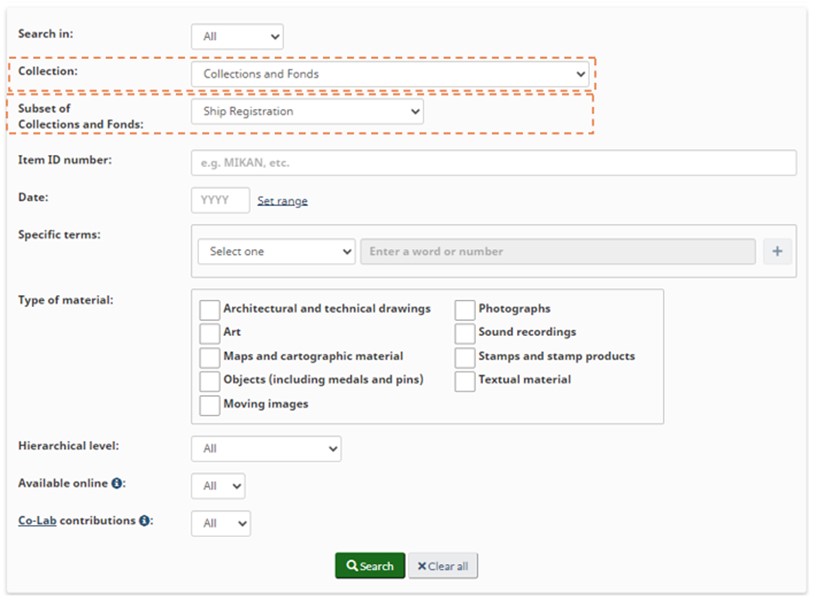
1. Go to advanced search
2. Select “Collections and Fonds” under Collection
3. Select “Ship Registration” under Subset of Collections and Fonds

Screenshot of the Collection search advanced search page. The “Collection” and “Subset of Collections and Fonds” drop down menus are marked with orange boxes.

How to locate Ship Registrations in Collection search. (Library and Archives Canada)

4. To search specific word(s) in the database, enter them in the search bar at the top. You may also enter a date or date range in the Date field (this will reflect when the ship was closed out). If you prefer to browse all ship registrations, leave the fields blank and click “Search.”

Screenshot of the Collection search advanced search page. The search term “Dora Mae” is entered in the “All of these words” search box, and the date range of 1940 to 1950 has been entered in the date range boxes. These fields are highlighted with orange boxes.

How to narrow down your vessel search using keywords and date ranges. (Library and Archives Canada)

For a more specific search, use the “All of these words” field at the top to search by name, port of registry, official number and year of registration.

Name:

  • The name is assigned by the owner at the time of initial registration and usually lasts the lifetime of the vessel, but it can be changed (often when there is a change of ownership).
  • Once a vessel has been closed out, there is a waiting period before that ship’s name can be used again. Two vessels cannot have the same name at the same time.
  • Vessels may have similar, but different names (for example, Karen Dawn, Karen and Dawn, and Karen & Don). Adding a Roman numeral after a name that had been taken remains a common way to create a new name (for example, Dora-Mae II).

Port of registry:

  • The port where the vessel was registered.
  • Vessels may be registered in ports close to where they were built or operated.
  • This can be useful in identifying shipbuilding activity in a specific area.
  • Vessel registration may have passed to different ports over time, as owners were expected to update their ship registration to the closest port of registry when they moved or if the ship was sold and transferred to another region.

Official number:

  • The unique number assigned to a vessel when it was registered—no other vessel will ever have this number.
  • The number remains the same for that vessel’s life, even if it is no longer in service or destroyed.
  • The official number can help you find information on that vessel in other record types:
    • Appropriation books: books that include the inventory of official numbers assigned to various ports of registry
    • Transaction books: books documenting supplemental transactions when the two pages per vessel in a registry book were filled
    • Construction books: books documenting ships under construction
    • Ship dockets: individual files opened by port of registry offices for specific ships

Year of registration

  • The consecutive number, starting from 1, assigned to each ship that was newly registered / (slash) the year that the vessel was registered. For example, 22/1883 would mean the 22nd vessel registered at a particular port of registry in 1883.

The closed-out ship registries can also be accessed via LAC’s staff research list, which provides direct access to the records at the series level. From there, you can navigate to individual ship registration records.

The new searchable ship registries transcriptions make tens of thousands of records accessible in a way that was not possible before. Users can now more easily research information on family histories, shipbuilding, shipping and many other areas. This valuable resource illuminates the complex and varied histories of Canadian shipping and shipbuilding, the communities built around these trades and the lives of the individuals and families who owned these vessels.

The team and LAC wish to thank Don Feltmate residing in Nova Scotia and John MacFarlane residing in British Columbia, who have been tireless advocates for the importance of these records and for making them more accessible.

Additional resources


Elaine Young is an analyst in the Partnerships and Community Engagement Division at Library and Archives Canada.

Advice for genealogy newbies

Version française

Are you new to researching your family tree? Not sure how to start exploring your roots? We are here to help! Visit our new How to begin your genealogy research page to discover:

Hopefully, you will find this to be an enjoyable hobby, or maybe it will become a passion for lifelong learning about Canada, Canadian history, and beyond.

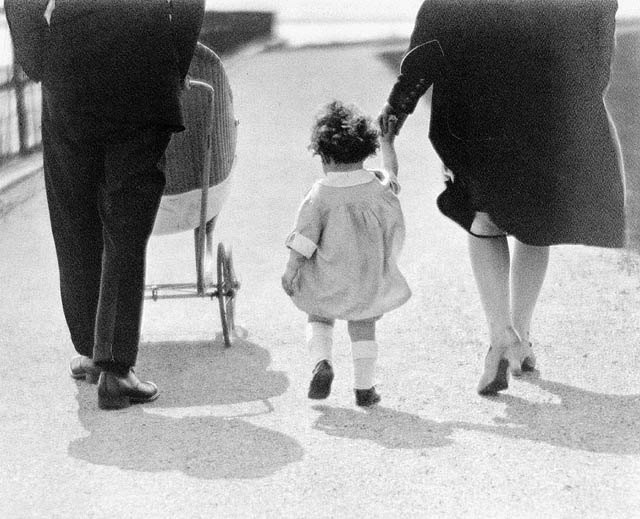
Black-and-white photograph featuring three people walking from behind. A man on the left pushes a stroller, while a small child in the centre holds the hand of a woman on the right.

“The Family,” Toronto, Ontario, ca. 1928. Photographer: John Pearson Morris. Library and Archives Canada/PA-126728

Continue learning from our Genealogy and family history pages. These resources are frequently updated, so be sure to check back often. Feeling more adventurous? Explore our A to Z tools and guides covering a wide range of topics related to Canada.

If you get stuck with your genealogy searches or need advice, use our handy online form to Ask genealogy a question.

Happy ancestor hunting!

The 1931 Census: a reading list

Banner for The 1931 Census series.

In preparation for the release of the 1931 Census returns, some of us at Library and Archives Canada have done a lot of reading. We thought we’d share a few census publications that piqued our interest.

Instructions to Commissioners and Enumerators, Seventh Census of Canada, 1931, and Instructions to Enumerators, Census of the Northwest Territories [and certain other northern areas], 1931

Ready to read cursive handwriting? Although these instructions don’t help us decipher cursive (alas!), they do help us understand some abbreviations used in the census returns. Enumerators were instructed to use certain abbreviations, such as “(ab)” for “absent.” The instructions also detail what enumerators were told to record and how; for instance, who was to be considered part of the family for the purpose of enumeration. Sara Chatfield’s recent blog, “How to conduct a census – in 1931,” highlights elements new to the instructions in 1931.

Note that the Dominion Bureau of Statistics issued separate Instructions to Enumerators for the 1931 Census of the Northwest Territories, certain parts of Yukon, eastern shore of Hudson Bay north of Great Whale River, and southern shore of Hudson Strait and Ungava Bay. This separate set of instructions was issued because the census of population in these areas was recorded using a separate form (Form I-N.W.T.), and also because the census in these northern areas was taken earlier—at any convenient time between October 1, 1930, and June 1, 1931, rather than as of June 1, 1931—for logistical reasons.

A printed page with titles and a crest.

Screenshot of cover page of Instructions to Enumerators, Census of the Northwest Territories [and certain other northern areas], 1931 (Library and Archives Canada/CS98-1931I-1-eng, title page)

The Administrative Report on the Seventh Census of Canada (Seventh Census of Canada, 1931, Volume I, Summary)

The Administrative Report on the Seventh Census of Canada provides good reading for those of us who are curious about what the Dominion Bureau of Statistics did with the handwritten census returns after they arrived in Ottawa from across the country.

The “New Census Machines—Sorter-Tabulator and Verifier” section (pages 58–62) provides insight into how the information in the handwritten census returns was processed at the Dominion Bureau of Statistics. This section explains what the Bureau did with the census returns that we preserve at Library and Archives Canada. For the purposes of sorting and tabulating results, Bureau employees punched a general card for each individual listed in the census returns, meaning that the Bureau must have punched over 10 million general cards. Can you decipher the information recorded on the following general card? For an answer, see page 59 of the report.
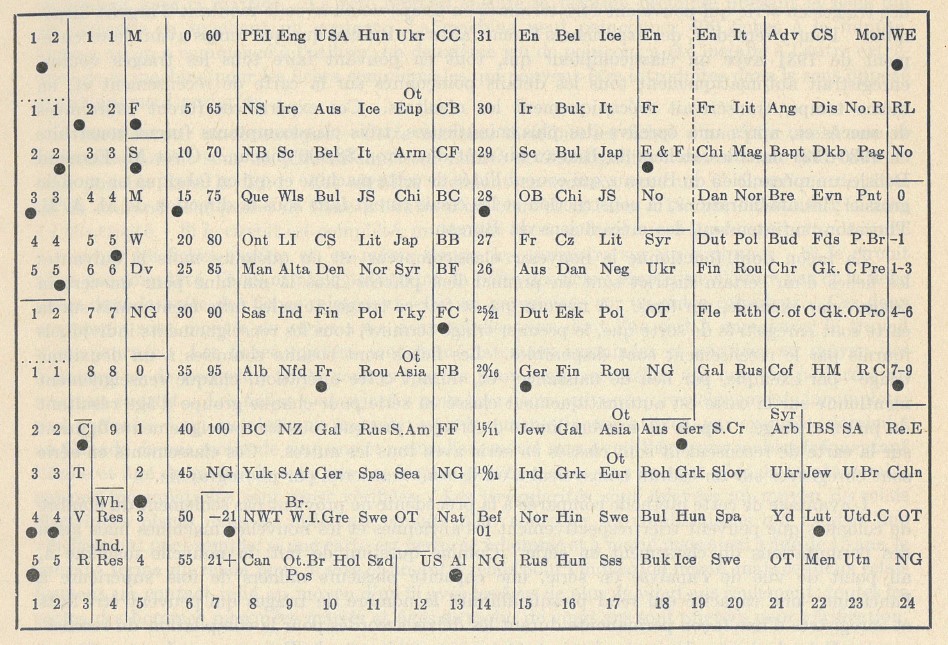
A rectangular card with 20 irregular divisions, each featuring numbers or letters, some of which are punched, and numbers 1 through 24 along the bottom of the card.

A general card used by the Dominion Bureau of Statistics for sorting and tabulating activities during the 1931 Census (OCLC 796971519)

A second type of card, the family and occupation card, “was used for the purpose of compiling statistics relating to the Canadian home and family” (page 59).

A rectangular, 80-column Hollerith Card (punch card), featuring column headers such as household, private family, personal, occupations and earnings, and unemployment.

A family and occupation card used by the Dominion Bureau of Statistics for sorting and tabulating activities during the 1931 Census (OCLC 796971519)

Sorting, counting and recording proceeded mechanically. The Dominion Bureau of Statistics had developed, in-house, a new sorter-tabulator for the 1931 Census, increasing possibilities for cross-analysis “several thousands of times” (page 60). The Administrative Report describes how this new sorter-tabulator worked and features a photograph—admittedly grainy—of the machine as well as of others, such as the verifier and the gang-puncher, on pages 72–73.

A black-and-white photograph of a large, high-ceilinged room in which approximately 80 employees (mostly women) sit at machines, punching in information recorded on a large roll in front of each machine. The employees sit in six columns, each of about a dozen rows, facing the photographer. The rows of employees are so numerous that they seem to extend into the distance. In the foreground, drawers of cards are lined up carefully on desks. In the middle ground, a woman stands observing a woman sitting at a punching machine. At the far right and in the background, additional personnel (mostly men) sit at additional rows of desks or are walking about.

Employees working on the 1931 Census in the punching room at the Dominion Bureau of Statistics (from Statistics Canada’s 2018 online HTML version of Standing on the shoulders of giants—History of Statistics Canada: 1970 to 2008, by Margaret Morris)

Another section in the Administrative Report, “The Field Work” (pages 51–56), describes the task of enumerating each person within the borders of Canada at that time. Additionally, in this section, the Bureau reports not only the number of enumerators involved but also the enumerators’ regular occupations. Among the 13,886 people working temporarily as enumerators, their regular occupations were most frequently the following:

A screenshot of text from a printed document.

A listing of the “most numerously represented occupations” of 1931 Census enumerators, from the Administrative Report on the Seventh Census of Canada (OCLC 796971519)

The Administrative Report was republished as Part I of the Dominion Bureau of Statistics report on the Seventh Census of Canada, 1931, Volume I, Summary (Ottawa, King’s Printer: 1936).

“Radio sets in Canada, 1931”

New for the census of population in 1931 was a question about radio sets. The Dominion Bureau of Statistics 1932 bulletin “Radio sets in Canada, 1931” provided a preliminary count of the result. The bulletin tabulated radio sets by province, census division and urban centre of more than 5,000. People in Montréal—listed as the biggest urban centre, with a population of 818,577—owned a total of 70,164 radio sets. However, Toronto—listed as the second-biggest urban centre, with a population of 631,207—reported the highest total of radio sets owned: 91,656.

A photograph of a man in a cardigan with a pipe in his mouth sitting at a typewriter; his surroundings include a bookshelf, a lantern and a radio.

A radio features in the background of this January 1931 photograph of Richard Finnie typing notes in Kugluktuk, Nunavut (a100695)

Not all of our reading was pleasant. Reading through publications from the 1930s is a reminder of the varied ways in which racism, sexism and colonialism were manifest at that time. Those attitudes shaped the taking of the census and have had enduring legacies into the present.

We’ve mentioned just a few examples of what we’ve been reading from among the many publications that preceded or resulted from the 1931 Census of Population. Generally speaking, the Dominion Bureau of Statistics released preliminary counts and summaries as soon as possible after the 1931 Census, as it did with “Radio sets in Canada, 1931.” The Bureau subsequently published definitive findings and analyses in the multi-volume official report of the 1931 Census. Statistics were published in volumes I through XI during the years 1933 to 1936, and additional thematic analyses on topics such as “housing in Canada” and the “lengthened dependency of youth” were published as volumes XII and XIII in 1942. These publications and many more are found in the library collections at Library and Archives Canada. Many such publications have been digitized by Statistics Canada and made available on the Internet Archive and the Government of Canada Publications catalogue.

If you’re interested, we invite you to browse some of the published heritage from the 1931 Census of Canada. And good luck interpreting cursive handwriting in the census returns!

Puzzling through 1931 Census sub-districts – Part 2

This article contains historical language and content that some may consider offensive, such as language used to refer to racial, ethnic and cultural groups. Please see our historical language advisory for more information.

This is Part 2 of the blog series Puzzling through 1931 Census sub-districts. If not done already, you may want to read Part 1, as it provides tools to help identify the census district that would have included your place of interest in 1931.

As a reminder from Part 1, to find the census returns for a place of interest, we generally need to narrow down, in order, the:

  1. province or territory;
  2. census district or federal electoral district; and
  3. census sub-district

that would have included the place of interest in 1931.

In this blog post, we go over the last step.

STEP 3. Determining the census sub-district

Each 1931 Census district was divided into multiple sub-districts – anywhere from three to 148 – for the purpose of enumeration. The majority of census districts were divided into at least 50 sub-districts.

The hitch is that no maps of 1931 Census sub-district boundaries are known to still exist. Figuring out in which census sub-district one’s place of interest was enumerated requires using one of the following tools:

  1. Street indexes (for 11 major cities)
  2. Finding aid for “Indian Reserves” (First Nations)
  3. Written descriptions of sub-district boundaries.

If your place of interest was in neither a major city nor a First Nations Reserve in 1931, skip directly to the last tool, the written descriptions of sub-district boundaries.

Tool 1: Street indexes

Indexes are available for Halifax (N.S.), Saint John (N.B.), Quebec (Que.), Montréal (Que.), Toronto (Ont.), Hamilton (Ont.), London (Ont.), Winnipeg (Man.), Edmonton (Alta.), Calgary (Alta.) and Vancouver (B.C.). Street indexes list street names and indicate in which census district and sub-district(s) those streets were enumerated.

The indexes for Hamilton and Calgary are specific to the 1931 Census. The indexes for the remaining cities cover multiple census years. In those indexes, for the purposes of locating district numbers for the 1931 Census, consider only entries beginning with “31.” The numbers that follow are the district and sub-district numbers, respectively, for 1931. So, for instance, if we are looking for a place of interest on Montréal’s Chemin de la Côte-des-Neiges in the census district of Mont-Royal (Census District no. 84), we find:

Typewritten entries for “Côte des Neiges” from the Montréal Street Index.

Excerpt from the Montréal Street Index (Finding Aid 31–80)

The numbers in the first line depicted above – “31–84–39, 40, 41, 43, 44, 45” – indicate that, in 1931, Chemin de la Côte-des-Neiges was enumerated in Census District no. 84, in census sub-districts 39 through 41 and 43 through 45.

Note: the street names featured in the indexes are historical; in other words, they are as written by the enumerator at the time, generally speaking.

Beware: the same street may have had its name written in multiple ways and thus appear in separate parts of the alphabetically ordered street index. In the case of Montréal’s Chemin de la CôtedesNeiges, entries are spread across three separate areas of the Montréal index, with the street name written as “Côte-des-Neiges,” “Côte des Neiges” and “Cote des Neiges.”

Tool 2: Finding aid for “Indian Reserves” (First Nations)

A listing of reserves by 1931 Census district and sub-district is available. This unverified finding aid could be useful if your place of interest was (in) a First Nations Reserve in 1931. We are currently working to adapt this pre-existing finding aid to include respectful terminology.

Tool 3: Written descriptions of sub-district boundaries

Written descriptions of sub-district boundaries were compiled by the Dominion Bureau of Statistics. These descriptions have been transcribed into finding aids for each province or territory: P.E.I., N.S., N.B., Que., Ont., Man., Sask., Alta., B.C., Y.T., N.T.

Note: the transcription of sub-district descriptions for select major cities may be forthcoming.

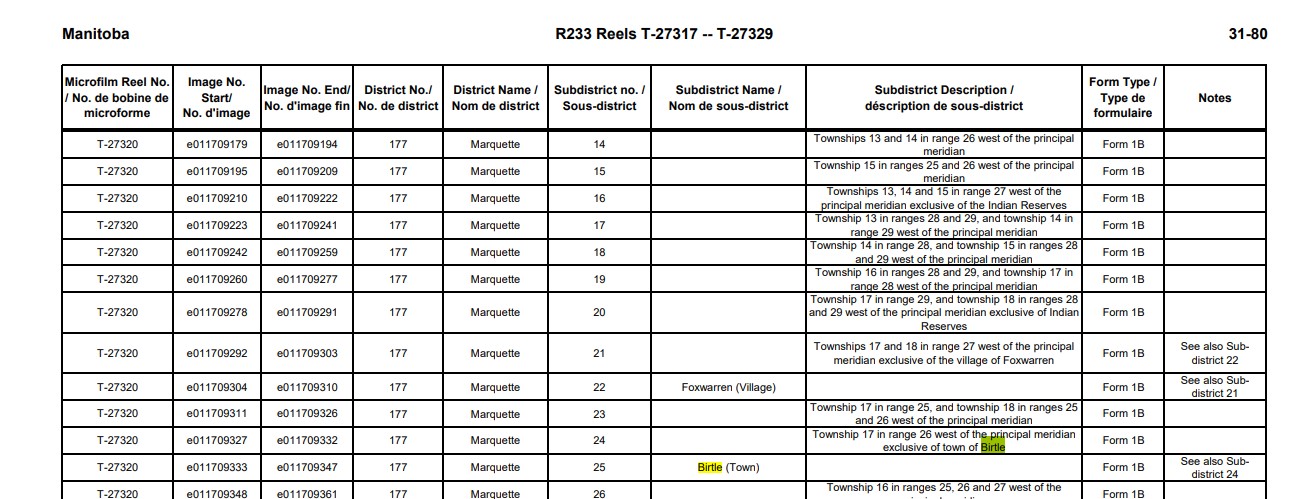
You may choose to begin with a keyword search related to your place of interest in the finding aid for a province or territory. For example, searching the Manitoba sub-district description finding aid for “Birtle” yields three results within the census district “Marquette”: sub-district 25 for “Birtle (Town)”; sub-district 24 for “Township 17 in range 26 west of the principal meridian exclusive of town of Birtle”; and sub-district 63 for the residential school of the same name. Alternatively, you may choose to navigate to a particular census district (like “Marquette”), then browse all sub-district descriptions within that census district.

An excerpt of a finding aid for Manitoba. The excerpt features several sub-district names and descriptions for within the Census District “Marquette.” Two instances of the word “Birtle” are highlighted.

Excerpt from the Finding Aid for the 1931 Census Returns for Manitoba (Finding Aid 31–80)

The characterization of census sub-districts varies tremendously. The descriptions may refer to townships, municipalities, city wards, polling divisions, reserves, parishes, meridians, ranges, lots, roads, islands, rivers, etc. Making sense of the descriptions may require consulting local maps from the era or learning about the local, provincial or other federal geographies leveraged for the purposes of the 1931 Census (e.g., municipal boundaries may have been established in contemporary provincial law).

Sometimes the sub-district descriptions do not themselves allow us to narrow things down to a single sub-district. To illustrate what we mean by that, we can look at sub-district descriptions for the census district of Mont-Royal.

A typewritten card listing sub-district ranges for different parts of the Mont-Royal district in Quebec, 1931.

The Dominion Bureau of Statistics’ working description of sub-districts in District 84, Mont-Royal (from material accompanying the transfer of the 1931 Census returns to Library and Archives Canada). Library and Archives Canada/Statistics Canada fonds/District 84, Mont-Royal, Quebec, 1931

The sub-district descriptions for Mont-Royal create a situation in which it is challenging to identify a single sub-district of relevance. If you face this situation, you then have two options:

  1. flip through the census returns for all relevant sub-districts; or
  2. narrow things down using other working tools, such as city directories, which might list wards, or using additional tools such as a Street Index, which is likely the best approach in the case of Montréal.

Sometimes additional sub-district descriptions feature on the title card preceding the sub-district’s census returns. Scans of the original Dominion Bureau of Statistics’ working descriptions of sub-districts are available online and, though cumbersome, may be used for troubleshooting purposes. To view these scans, go to the archival description for the 1931 Census returns in Collections Search, toggle open the details, then toggle open the finding aid section and scroll down.

Additional resources

  • To learn about the system of townships, ranges and meridians used in the three prairie provinces and the railway belt of British Columbia, consult the section titled Western Canada Land System Description on the homepage for our Land Grants of Western Canada database.
  • The blog post “Finding Royalton: Searching the 1921 Census” describes how a staff member locates small rural hamlets or unincorporated villages. It offers insights and ideas about how to overcome stalemates.
  • If you had already found your place of interest among the census returns from the 1921 Census of Canada or 1926 Census of Prairie Provinces, consider viewing the sub-district description in Census Search for that earlier census year. It might assist you in navigating the sub-district descriptions for the 1931 Census.

Again, wishing us all the best in our searches for people and places of the past.

As always, don’t forget that we can help: reach out to our genealogy team by using our Ask genealogy a question online form.

Puzzling through 1931 Census sub-districts – Part 1

This article contains historical language and content that some may consider offensive, such as language used to refer to racial, ethnic and cultural groups. Please see our historical language advisory for more information.

Sometimes we researchers – including staff at Library and Archives Canada – need to navigate the archived census returns according to how the returns themselves are organized: by census sub-district. We don’t usually navigate census returns this way, since we have Census Search, our one-stop-shop database for genealogy. Once every few years, navigation by sub-district is necessary while we work to incorporate new census records into our database.

When we begin our work – and it is often tricky work – of navigating the archived census returns geographically, we often use a “step-wise” approach to narrow them down by

  1. province or territory;
  2. census district or federal electoral district; and
  3. census sub-district

that would have included our place of interest. We use this approach to be more efficient when searching, because there are so many census sub-districts involved: 15,167 sub-districts in the 1931 Census, to be exact.

This blog series offers five tools to help you find your place of interest among the census returns. Get ready to learn how to navigate the 1931 Census returns geographically!

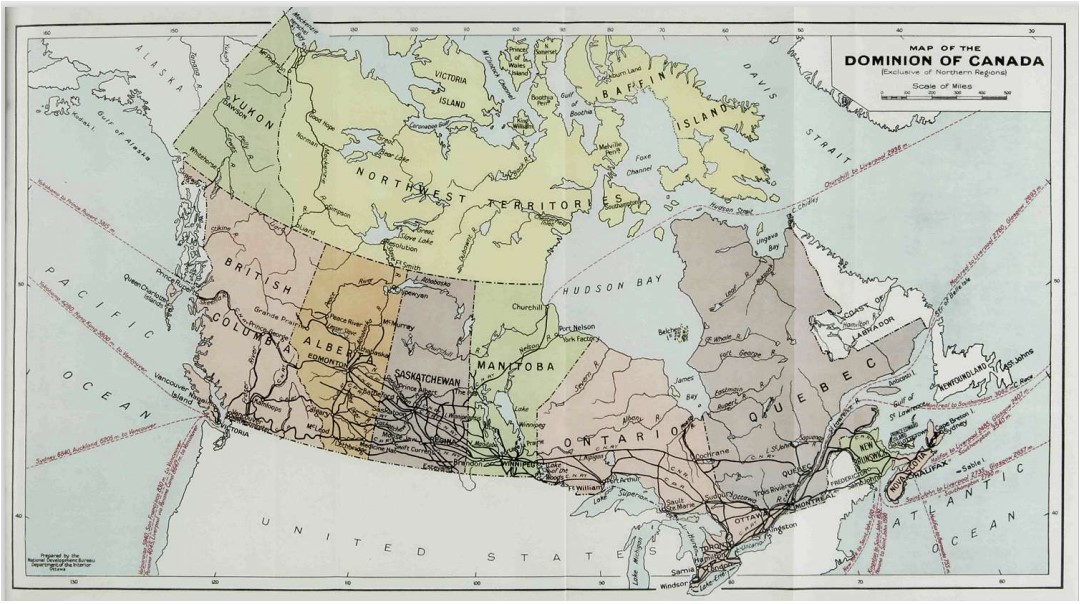
Map of Canada (without some northern regions) in which each province and territory is a different colour. Major railway lines are indicated with a thick black line. Major sea shipping routes are indicated with a dotted red line featuring the name of the two cities linked, and the mileage between them.

“Map of the Dominion of Canada (Exclusive of Northern Regions)” featured in the Dominion Bureau of Statistics The Canada Year Book, 1931 (OCLC 300543070)

STEP 1. Determining the province or territory

Reminders:

  • The Northwest Territories had different boundaries in 1931 than it does today.
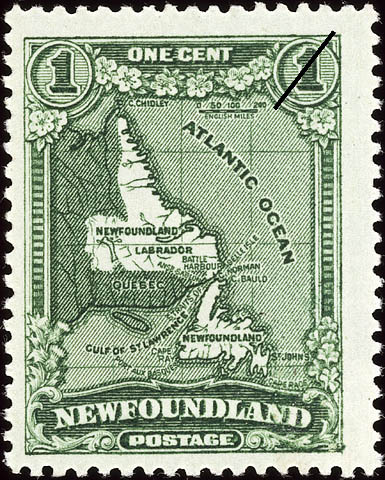
  • Newfoundland and Labrador became a province of Canada in 1949, and so its population is not enumerated in the Seventh Census of Canada. (Information about the separate censuses taken of Newfoundland and Labrador in 1921, 1935 and 1945 can be found on our Newfoundland and Labrador: Census and Enumerations web page.)
Green and white one-cent Newfoundland postage stamp.

Map of Newfoundland and Labrador, July 1931, one-cent Newfoundland stamp, Perkins, Bacon & Company, © Canada Post (s001670k)

STEP 2. Determining the 1931 Census district

Lucky scenarios that let you skip Step 2

There are a few scenarios in which you may go directly to Step 3 (forthcoming in the next blog post); these scenarios include when your place of interest is

  • located on a street in a major city for which Street Indexes have been prepared; or
  • an “Indian Reserve” (First Nations) listed in the relevant finding aid; or
  • included in the description* of sub-district boundaries.

*You can try a quick keyword search of the province-specific finding aids for sub-district descriptions: P.E.I. finding aid, N.S. finding aid, N.B. finding aid, Que. finding aid, Ont. finding aid, Man. finding aid, Sask. finding aid, Alta. finding aid and B.C. finding aid.

If your place of interest is in the territories, note that

  • Yukon was census district no. 241; and
  • the Northwest Territories was census district no. 242,

and go directly to Step 3 (in the next blog post).

If you cannot skip Step 2, your investigation begins with picking your preferred tool.

At Library and Archives Canada, we mainly use five online tools to help us determine in which 1931 Census district our place of interest was enumerated. The online tool that we choose is often a matter of personal preference. Some of us like lists; some of us like scrolling through old maps; some of us like navigating from the present, going backward in time; some of us prefer a quick database search; some of us know county names.

Tool 1: 1931 Census Maps research tool

This research tool lists 1931 Census districts. It also features links to maps approximating each census district. This tool is best used in a situation in which one or two census district names jump out as being likely candidates.

Note: This research tool does not include the census districts of the Northwest Territories, the District of Patricia (northern Ontario) or Unorganized (northern) Quebec.

Tool 2: Atlas of federal electoral district maps, 1924

To get a general sense of the 1931 Census district boundaries within each province, turn to the province-specific overviews in the digitized, 12-volume atlas prepared by the Department of the Interior of federal electoral district maps, 1924.

  • Why federal electoral district? The boundaries of the 1931 Census districts nearly always match the boundaries of a federal electoral district as established by the Representation Act of 1924. (Stay tuned to learn why in our upcoming blog, “Why are the 1931 Census records organized geographically?”)
A map depicting federal electoral districts in British Columbia. The boundaries are indicated by thick blue lines, and the names are indicated in blue type. The map was prepared on a base map of British Columbia featuring mountain ranges, rivers and cities. Additional detail is provided in two inset outline maps, for Vancouver and district, and for the City of Victoria.

“Map of British Columbia showing the federal electoral districts, 1924” from an atlas of federal electoral district maps, 1924, prepared by the Department of the Interior (e011315905)

You can flip through quicker-loading thumbnail-sized images of the atlas maps; the province-specific ones are the first 11 thumbnail images of the atlas. Should you need a higher-resolution image, use the overviews: P.E.I. overview, N.S. overview, N.B. overview, Que. overview, Ont. overview, Man. overview, Sask. overview, southern Alta. overview, northern Alta. overview and B.C. overview. The digitized overview maps are hard to read in some instances, but if they are decipherable for your place of interest, they may help to identify the federal electoral district, and therefore (typically) the census district, of relevance. Should the overview map be too difficult to read, consider browsing through thumbnail images for the entire province volume in the Federal electoral district maps, 1924 atlas. You can consult the thumbnail image range for each provincial atlas in the 1931 Census Maps research tool (“digitized image item no.”). That research tool also provides links to higher-resolution images of individual maps.

Should you want a more detailed sense of the boundaries of a particular federal electoral district (and therefore, usually, census district) in a province or Yukon, consult the map for that individual federal electoral district in the digitized atlas. You can navigate to a higher-resolution image of any particular electoral district in the atlas using the 1931 Census Maps research tool.

A map page from a previously bound atlas featuring a black-and-white map of the electoral district of Mount Royal and a paragraph describing the district.

Electoral district map for the Mont-Royal electoral district in Quebec, from an atlas of federal electoral district maps, 1924 (e011315941)

Note: If you are looking for a place in northern Ontario or Quebec, note that the District of Patricia was census district no. 244, and areas of northern Quebec were enumerated as census district no. 245.

Tool 3: Library of Parliament online list of ridings

This online resource lets you do the following:

  • View a listing of federal ridings as they existed at the time of the 1931 Census. Consult the Library of Parliament’s online resource “Elections and Candidates” for the 17th Parliament, and view the constituency titles listed for the general election of July 28, 1930.
  • Navigate the list of ridings represented in the House of Commons from 1867 to today. You can choose to:
        • Navigate from the current federal riding, going backward in time to 1931. (Note: You can find a current federal riding using Elections Canada’s Voter Information Service database.) From the list of current federal ridings, click on a riding name. From the page for that riding, click through to previous ridings. When you get to a riding that existed in 1931, look for its description under the Information subheader “S.C. 1924, c.63” (referring to the Representation Act of 1924); or
        • Search for historical ridings. On the Library of Parliament landing page for the list of ridings, in the top-right corner of the table, clear the default “currently active” filter by choosing “select all” for active and inactive ridings.

There is usually a very close match between the federal electoral riding that existed in 1931 and the 1931 Census district. You can choose to double-check the correspondence between a federal electoral riding and a census district using the 1931 Census Maps research tool.

Tool 4: Post Offices and Postmasters database

If your place of interest was likely to have had a post office in 1931, investigate what is available in our Post Offices and Postmasters database, which includes electoral districts. Try keyword searching.

Tool 5: Map of counties (and the like)

Try navigating by provincially established county (or the like). Only use this option if your place of interest is in Ontario, Quebec or an Atlantic province.

  • Why counties? Ontario and eastward, provincially established counties (and the like) often, but not always, informed the shape of census districts in the early 20th century. Sometimes counties (and the like) were grouped into one census district, and sometimes counties were split into several census districts. Either way, many county names featured in census district names.
An outline map of Canada, its provinces and Yukon. Each province is then divided further, with each division numbered.

“Index map showing the counties and census divisions as organized at the census of 1931,” in the Dominion Bureau of Statistics 1937 Illiteracy and School Attendance, by Murdock C. MacLean, p. 16 (OCLC 1007622268)

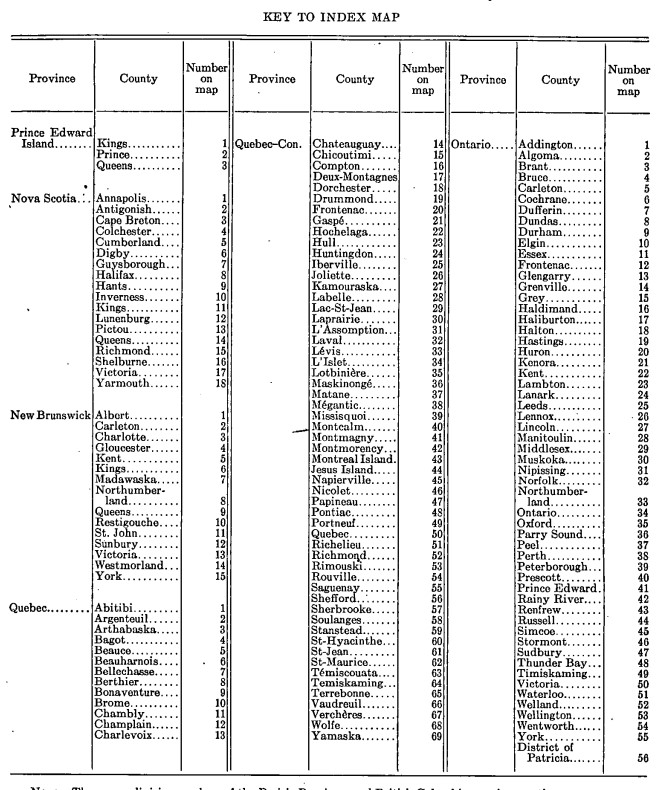
First, identify the county name. To do that, consult the “key to index map” provided below or this very high-level index map of counties (if you need to zoom in). Then, pay attention to the county name (numbers are not important for our purpose). If you identify a county name, search by keyword for that county name in 1931 Census Maps research tool. If you get a unique hit in the list of 1931 Census district names, you are now ready to go to Step 3 (in the next blog post). You can always double-check if you have the right census district by using that same research tool to consult the relevant map. If the county index map is tricky to navigate for your place of interest in Ontario or eastward, don’t bother with the county index.

  • Beware: The county map above does not help us to navigate the census districts used to organize the census returns from the Prairie provinces or British Columbia.
  • Beware also: Census districts used to collect the census returns were sometimes different than the census divisions used to tabulate and publish the census results.
A typed table listing county names for Prince Edward Island, Nova Scotia, New Brunswick, Quebec and Ontario, as well as the number on the map corresponding to that county.

Counties, not census districts! Key to Index Map, from the Dominion Bureau of Statistics 1937 Illiteracy and School Attendance, by Murdock C. MacLean, p. 16 (OCLC 1007622268)

Don’t forget that we can help! Reach out to our genealogy team by using our Ask genealogy a question online form.

Stay tuned for Part 2 of this blog. In the meantime, we wish everyone the best in all of our searches for people and places of the past!

Improving your online experience: What to expect at LAC’s new online home

Image of fingers on a keyboard

By Andrea Eidinger

Here at Library and Archives Canada (LAC), we take user feedback very seriously. Over the years, one point has come through loud and clear: our existing website is not meeting the needs of the public. This is why we are proud to announce that we will be launching a completely new website later this summer—library-archives.canada.ca. In this blog post, I will go over what LAC’s new web presence will involve and how these changes will impact your experience.

New website

So, what does this mean in practical terms? We spent a lot of time gathering feedback from members of the public, expert researchers and members of our staff to make our website user-centric. This involved creating several working groups as well as user-testing different possibilities for the new website. We also incorporated the latest research on how people actually use websites.

A major part of this work has been to ensure that all our users can easily find and understand the information on our website. Two very important components of the new website are consistent web navigation and plain language. All our new web content is organized in the same way so that users always know where to go, and the language has been simplified to make it clearer and easy to understand, no matter your skill level.

Finally, our website is dynamic. Our goal was to create a website that lives and breathes. Gone are the days of web pages being posted and then never touched again. Part of renewing our web presence is a commitment to continually update the website with new material and make improvements based on user feedback. We are also taking what is called an “iterative approach.” Essentially, we will start with a scaled-back version of the new website. This will be a launching pad for us. Our work will build on this initial version to develop the new website.

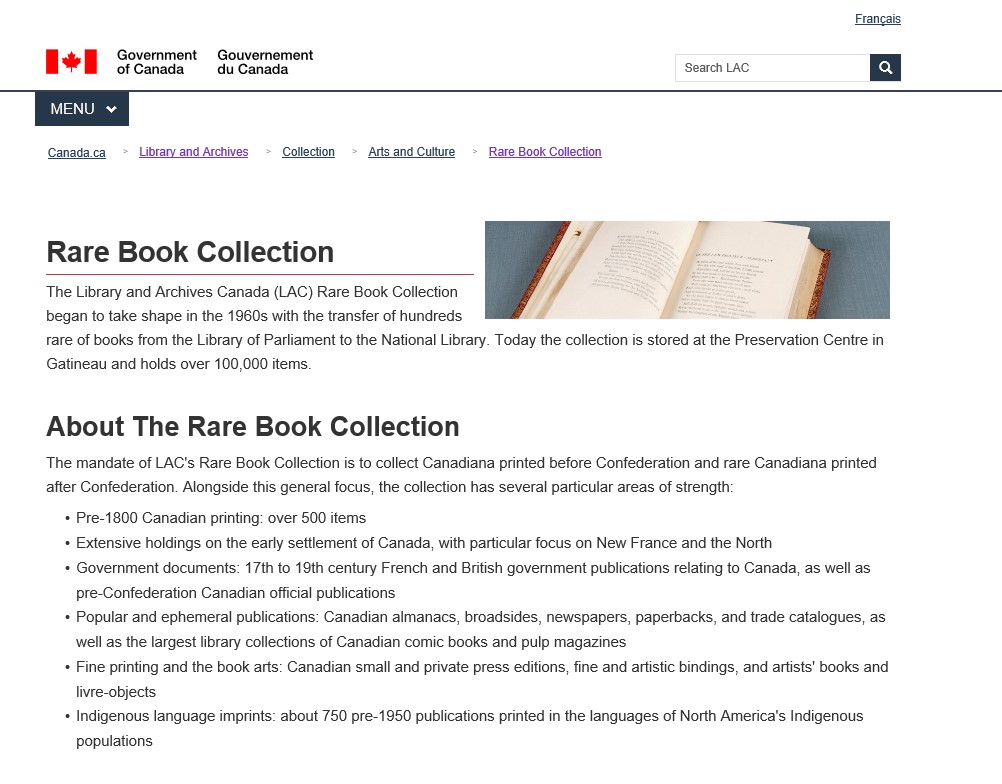
Screenshot of the Rare Book Collection webpage on the LAC website.

An example of the new template for subject guides for the new LAC website.

New structure

One of the biggest changes users will notice is the look and feel of the website. To make the information on the website more easily accessible to the public, we have developed a new structure for the website based on tasks, topics and themes that align with our users’ needs. In other words, we looked closely at how members of the public were using our existing website and what they were looking for (tasks). We then grouped those tasks into broad categories (topics). Finally, we grouped these topics into themes.

These themes are the basis for the website’s new structure and align with the Government of Canada’s design system. This system provides a more practical, consistent and reliable online experience for people who access Government of Canada digital services.

The first theme, Corporate, contains all of the institutional information relating to LAC. This includes information about our mandates, policies, initiatives and partners. This is where you will also find information about transparency at LAC and be able to read reports and plans about our activities.

The second theme, Services, is self-explanatory. It is where users can access our services or complete a task related to one of our programs. Under this theme, users will find information on how to visit us, how to order material, how to apply for ISBN numbers, how to make an ATIP request, and more. Also under this theme is information about the various services that we offer for gallery, library, archives and museum (GLAM) professionals, publishers, public servants, and Indigenous communities and individuals. This section will also contain information about our different funding programs.

Finally, there is the Collection theme. Our goal in rethinking how we present the Collection theme was to build user autonomy and discovery. This section will be home to all kinds of materials that will help Canadians access the documentary heritage under LAC’s care. In this section, you will find our databases, guides on researching various topics, publications, and podcast episodes, as well as a basic introduction to research. This section also includes many of LAC’s more interactive features, such as Co-Lab, our transcription program.

New navigation

One of the biggest challenge that users faced on our website was finding the information they were looking for. This was a problem particularly for material included under the Collection theme. Often, users would travel down rabbit holes and never be able to find their way back again. We have corrected this problem with a completely new navigational system based on tables. The new navigational table will include all pages listed by topic, sub-topic and type. For example, a web page on the First World War personnel files we have available would be appear as follows:

First World War Personnel Files – Military History – First World War (1914-1919) – subject guide

Even more important: this table will be filterable and searchable. This means users can easily see all of the resources that we have on a particular topic and find their way back without difficulty.

New content

The last exciting change to tell you about is the new content on our website. The existing site is enormous: it consists of 7,000 pages. Much of the information it contains is no longer up to current web and historical standards. We also know that many of the pages are hard to read, especially for beginners, and sometimes confusing. In preparation for our new website, we have systematically reviewed every single one of those 7,000 pages. Anything outdated or no longer up to current standards was archived (and will be available to the public), and the rest of the pages were reworked. All of the information on LAC’s new website is presented in plain language and is therefore clear and easy to understand. We hope this approach will attract an entire new wave of users interested in learning about Canada’s documentary heritage.

Since there is so much content, we focused on preparing material for the three most popular and most consulted topics for the launch: genealogy and family history, Indigenous history, and military history. Please note that, in the weeks and months ahead, we will add more material to these and other topics. We will be updating our material regularly in response to user feedback and to reflect the latest available information.

We’re so excited to show you all of the new material we’ve been working on! So, while this does mean that your URLs will change, we’re hoping that these changes will make your online experience at LAC a more positive one. Since this work is only beginning, the best is yet to come!

We look forward to your feedback. Please send us your comments and thoughts when we go live.


Andrea Eidinger is a team lead in the Online Experience Division at Library and Archives Canada.

“Were my ancestors UEL?”

A group of people, with tents and animals, by a body of water.

Loyalist camp on the banks of the St. Lawrence River (c002001k)

When I started working in the Genealogy section at Library and Archives Canada (LAC), I quickly realized that there was a lot to learn. To be effective at the job, you had to be a jack-of-all-trades in Canadian (and world) history. In just one afternoon, you could be called on to help researchers with wide-ranging topics like the Newfoundland Regiment at Beaumont-Hamel, the Chinese Head Tax, Ottawa Valley logging history and New France census records.

One of the first questions I fielded at the Genealogy desk was “Were my ancestors UEL?” I recall that day like it was yesterday. A cold panic came over me. I froze and stared at the researcher like a deer in headlights. I did not recognize the acronym. Luckily, after the researcher patiently spelled it out for me, my training, education and experience kicked in, and I remembered the United Empire Loyalists (UEL) and all the material LAC has about this unique group. Fortunately, that momentary blank did not happen again, as UEL was a very popular research topic.

The term “United Empire Loyalists” refers to the American colonists who remained loyal to the British Crown during the American Revolution (1775-1783), and may also have fought for Britain during that conflict. They fled the newly created United States and settled in what are now the provinces of Nova Scotia, New Brunswick, Prince Edward Island, Quebec and Ontario. Archives in each of these provinces hold records relating to Loyalists, some of which are searchable online.

Two people walking along a dirt road beside a cart, in which one person is sitting.

Black Loyalists in Bedford Basin, near Halifax (c115424k)

Loyalists became an even more popular topic after Lawrence Hill’s novel The Book of Negroes was published in 2007. Hill’s remarkable novel about a Black Loyalist won many prizes, including the Commonwealth Writers’ Prize in 2008, CBC’s Canada Reads for 2009 and Radio Canada’s Combat des livres in 2013. It was also released as a TV miniseries in 2015. The novel was named after a ledger preserved at the National Archives in England, which lists the names of approximately 5,000 people, including 2,831 Black men, women and children who travelled — some as free people, and others the slaves or indentured servants of white United Empire Loyalists — in 219 ships sailing from New York between April and November 1783. This ledger is part of a large collection called the British Headquarter Papers, also known as the Carleton Papers. LAC has a microfilm copy of these records and created a database indexing this important ledger.  More information about Black Loyalists, including their names, can be found in the Port Roseway Associates Muster Book of Free Blacks: Settlement of Birchtown 1784 and the Ward Chipman Muster Master’s Office (1777–1785) collections, which can be searched on Collection Search and Ancestors Search.

LAC holds a variety of sources relating to the United Empire Loyalists who settled in Canada after the American Revolution (1775–1783). For more information about Loyalist records held at LAC, visit the Loyalist section of our website.

Additional resources:


Sara Chatfield is a project manager in the Exhibitions and Online Content Division at Library and Archives Canada.

Charlie Chaplin goes to war — Part II: Going beyond a First World War record for your genealogy research

By Emily Potter

In Part I of this blog article, we explored how to start your genealogy research using a First World War file. I chose a random name to search in Library and Archives Canada’s (LAC) Personnel Records of the First World War database and selected the file of William Charles Chaplin. From his First World War file, we found out the following genealogy information about him:

  • Date and place of birth: June 23, 1870, Chatham, Kent, England
  • Date and place of marriage: Unknown
  • Date and place of death: October 5, 1957, place unknown
  • Mother’s name: Unknown
  • Father’s name: Unknown
  • Spouse’s name: Eliza Agnes Turton, daughter of Agnes Eliza; died before March 2, 1916
  • Children’s names: Miriam, James, Richard, George, Agnes, William, and Celia

Now, let’s see whether we can fill in some of those unknowns by searching other genealogy sources held at LAC.

Veterans Death Cards

I’m going to start at the end and see whether we can find out where Chaplin died by searching the Veterans Death Cards. Created by Veterans Affairs Canada, Veterans death cards—although ominous sounding—are index cards that include information about a First World War veteran’s death, such as the date and place of death and the next of kin. They usually also indicate whether the death was a result of the veteran’s military service.

Although a very helpful resource, the cards have limitations. There is not a card for every First World War veteran because Veterans Affairs was not always notified of the death. Moreover, the cards include only deaths that occurred up to the mid-1960s.

By following these instructions, I was able to find the card for William Charles Chaplin:

We know this is the correct card, because the regimental number and the date of death match those we saw on the envelope in Chaplin’s file, as discussed in Part I.

We now know that Chaplin passed away in Toronto. The line that reads, Death not, indicates that his death was not attributed to his First World War service.

Census

Now that we’ve searched the Veterans Death Cards, let’s explore another important genealogy research tool: censuses. Census returns are official Government of Canada records that enumerate the country’s population. They are an invaluable source of information for genealogy research because they provide details about each person in the household, such as age, country or province of birth, ethnic origin, religious denomination and occupation. In some years, the census also indicates the year of immigration.

We already know that Chaplin was born in England, but the 1911 census may help us find out when he immigrated to Canada, as Chaplin was in Canada by the start of the First World War.

After a few tries, I found a reference to Chaplin and his family by using the search terms seen in the image below.

Screenshot of the LAC 1911 Census of Canada database.

Search screen of the 1911 Census database.

Screenshot of the LAC 1911 Census of Canada database results page for W Charles Chaplain.

1911 Census database, W Charles Chaplain.

Chaplin’s name in the census appears as “W Charles Chaplain.” This serves as an excellent example of how common spelling variations can be in older documents. If you’re having trouble finding reference to your ancestors in the census, see Research Tips on our census page for help with name and place searching.

Let’s have a closer look at the census image.

Census document with columns and handwritten entries.

1911 Census, Toronto, Ward 4, page 7 (e002028460).

As we can see from the above image, the family immigrated to Canada in 1904. From what we saw in Part I, Miriam (or Marian) was the eldest child, born in 1898 or thereabouts. In this census, we see reference to a child by the name Annie, or Amia. The year of birth indicates that it is likely this is in reference to Miriam. The name we see here could have been a middle name, a nickname or an error, and we already know how common it is to see name variations in older records. Regardless, from this census, we gather that Annie/Amia/Miriam/Marion was born in England, along with her siblings James and Richard, whereas Agnes, William, Charles and George were all born in Ontario. This suggests that William and Agnes were most likely married in England, not in Canada. Their first child was likely born in 1898. Therefore, they were likely married that year or earlier.

Passenger lists

The census indicated that the family immigrated to Canada in 1904. Can we confirm this information?

Library and Archives Canada has several immigration databases, all of which are listed on LAC’s Ancestor’s Search page. For this search, we will be using the Passenger Lists for the Port of Quebec City and Other Ports, 1865-1922 database.

Screenshot of the Passenger Lists for the Port of Quebec City and Other Ports, 1865-1922 database search page.

Passenger Lists for the Port of Quebec City and Other Ports, 1865-1922 database search page.

From the database search screen, I searched using only his first and last names. I chose not to enter a year of arrival to keep the search as broad as possible to start.

Luckily for me, there were only eight results, and the first one was in reference to our William Chaplin.

As we can see, the family actually arrived in 1905, not in 1904. This is no surprise, because, as we learned in Part I, it is quite normal to see discrepancies in older records.

A close-up screenshot of the Chaplin family entry from a passenger list form.

Detail of passenger list showing William Chaplin’s arrival on the S.S. Dominion to Halifax, RG76, microfilm reel T-499.

William Chaplin, his wife, Agnes, and their three children are listed. Once again, we see Miriam’s name listed under a variation; in this case, it looks like “Amy.” Amy would have been born in 1898. This matches what we saw in the census and in the First World War file for Miriam.

Other than an additional name variation, the passenger list did not add to our list of missing information, but it did confirm the date on which the family immigrated.

  • Date and place of birth: June 23, 1870, Chatham, Kent, England
  • Date and place of marriage: England, likely 1898 or earlier
  • Date and place of death: October 5, 1957, Toronto, Ontario
  • Mother’s name: Unknown
  • Father’s name: Unknown
  • Spouse’s name: Eliza Agnes Turton, daughter of Agnes Eliza; died before March 2, 1916
  • Children’s names: Miriam, James, Richard, George, Agnes, William, and Celia

Reviewing our list of information on William Charles Chaplin, we see that we have added that his place of death was Toronto, Ontario, and that he was likely married in England in 1898 or earlier. We also learned more about his family, such as approximate birth dates, the country and province of birth for each family member, and the date on which the family immigrated to Canada.

That being said, we are still missing some key details about Chaplin, primarily… who were his parents?

At this point, we’ve searched through the primary genealogy sources held at LAC, but many other helpful genealogy sources are maintained by other institutions. We won’t search them here, but I’ll outline what my next research steps would be if I were to continue researching Chaplin and his family.

Civil registration

In order to find out the names of Chaplin’s parents, my first step would be to look for his marriage record. Civil registration records are extremely helpful genealogy sources, and both birth and marriage records usually indicate parents’ names.

I would start with Chaplin’s marriage record since we know his wife’s name. This will help us to identify the correct record. If we were to start with his birth record, we would have no means of knowing whether we had found the correct William Charles Chaplin or simply another baby with the same name.

We know that Chaplin was married before he immigrated to Canada. So, we would need to search English records.

British birth, marriage and death records are held at the General Register Office (GRO) in England. The indexes to those records are arranged by year and can be searched on various websites, including FreeBMD.

We could also find out more information about Chaplin’s family by searching civil registration records for each family member. In Canada, the civil registration of births, marriages and deaths is a provincial and territorial responsibility. As a federal institution, LAC does not hold those records. Information about the records, including how and where to access them, can be found on our Places pages, which include resources for each province.

There is definitely a lot more genealogy research we could do on William Chaplin and his family, but after reading these two blogs, I bet you’re itching to get started on your own research.

Information about how to start your family history research can be found on LAC’s How to Begin page.

Finally, don’t forget LAC’s Personnel Records of the First World War database, which you can search for references to your ancestor’s service in the Canadian Expeditionary Force.

Thanks for reading!


Emily Potter is a genealogy consultant in the Public Services Branch of Library and Archives Canada.

Tags: William Charles Chaplin, genealogy, immigration, passenger list, S.S. Dominion, census, 1911 Census of Canada, Veterans Death Cards