LAC’s collection of labour union charters

Version française

By Dalton Campbell

Library and Archives Canada (LAC) has a collection of approximately 300 labour union charters dating from the 1880s to the 1980s. A sample of the charters has been digitized: the images are available through Collection Search.

These charters were formal documents granted by unions to the locals when they were officially accepted into the union. The charters in the LAC collection can also tell us a lot about the unions, their membership, Canadian workers and work life in the twentieth century.

For example, the Brotherhood of Maintenance of Way Employes charter features a detailed illustration showing the range of jobs done by its members, including tending to trains in the yard, inspecting and maintaining the rails, signals, water towers and buildings, as well as clearing the wreckage of rail cars.
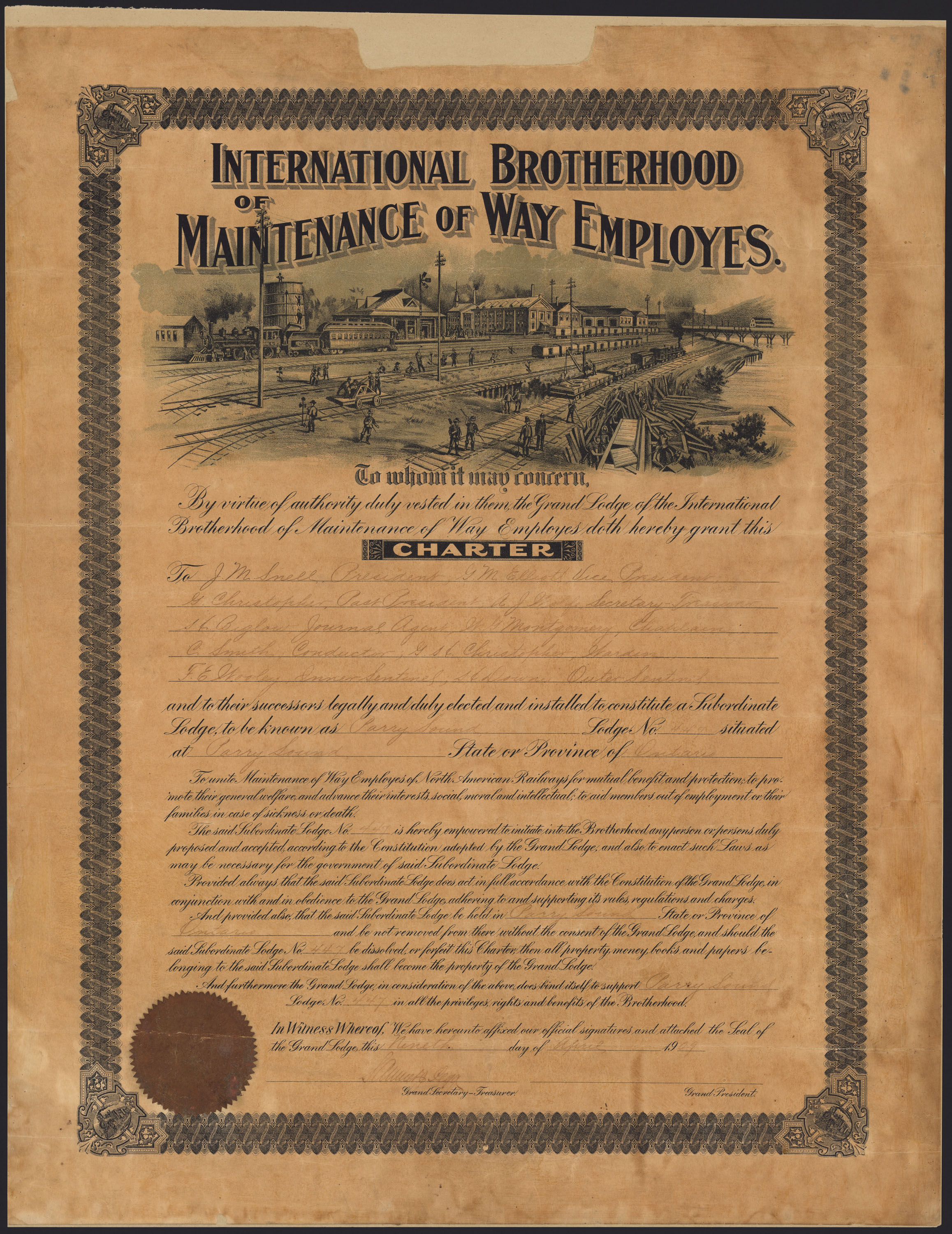
Textual document titled International Brotherhood of Maintenance of Way Employes featuring a drawing of a train station filled with people and railcars at the top of the document.

Charter granted by the International Brotherhood of Maintenance of Way Employes to the Parry Sound Lodge no. 447, Parry Sound, Ontario, April 1909. (e011893857)

This charter, like many of the charters in the LAC collection, includes the names of the members of the local, potentially making charters a small piece of documentation in family history research. Some charters are also a window into social history. For instance, the members’ names listed in the Canadian Congress of Labour (CCL) charters show the industries and companies where women were employed in the 1920s, 1930s and 1940s.

Illustrations of union members at work and their workplaces are a common theme in the charters. The Amalgamated Society of Carpenters and Joiners charter uses a series of illustrations of workers in different workplaces as well as illustrations of workers receiving benefits from their union.

The International Association of Machinists charter features a workshop scene without any workers, showing only a lathe, drills, workbenches, clamps and hand tools—leaving it to the viewer to picture the tasks performed at each workstation.
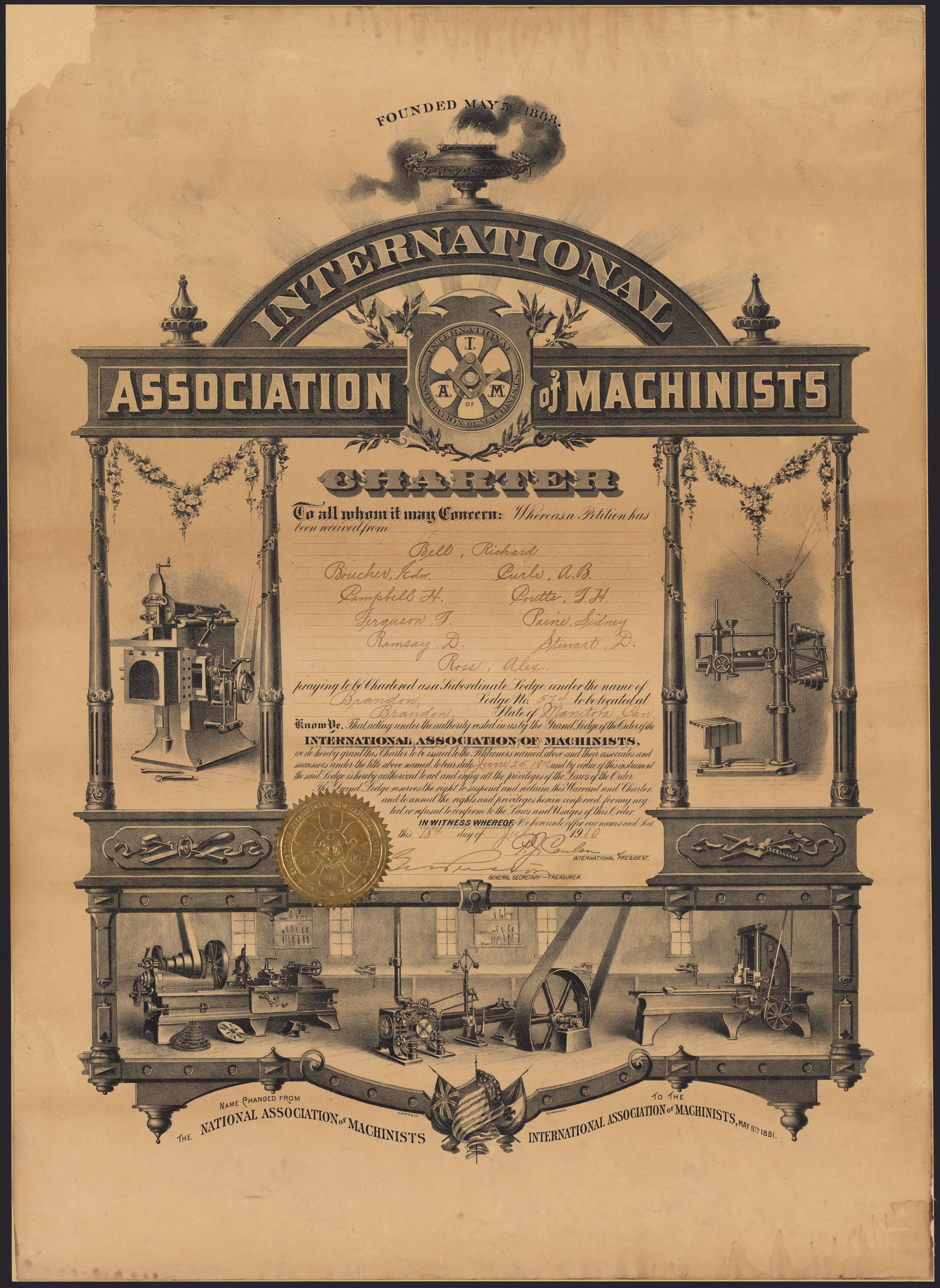
Document titled International Association of Machinists featuring text and drawings of machinery.

Charter granted by the International Association of Machinists (IAM) to Local 574, Brandon, Manitoba, July 1910. (e011893856)
This charter is very different from the charter granted by the same union 20 years earlier, in 1890, to Pioneer Lodge no. 103, Stratford, Ontario. (See: MIKAN 4970006)

The International Chemical Workers Union used the same theme, featuring the beakers, flasks and glass tubing of a laboratory in the foreground with an external view of a chemical plant in the background. The Brotherhood of Painters, Decorators and Paperhangers took a different approach, using text to list the many trades and industries in which the union membership worked.

Many of the charters in the LAC labour collection rely primarily on text, with few or no illustrations. Some feature a small illustration such as the union’s seal or logo, something associated with the industry, or something representative of union membership in general (such as a handshake). In some cases, illustrations of figures such as Benjamin Franklin or a bald eagle clearly show that the Canadian local was part of a U.S.-based international parent union.

Some of the text-only charters use detailed, colourful and eye-catching lettering, as seen in those from the International Typographical Union and the Hotel and Restaurant International Employees’ Association.

Textual document titled International Typographical Union Charter.

Charter granted by the International Typographical Union (ITU) to the Ottawa Typographical Union, Local 102, Ottawa, Ontario, 1883. The charter states the local was in “Ottawa, Canada West;” Canada West had been renamed Ontario in 1867. (e011893860)

The most ambitious and arguably most artistically successful charter in the collection is the Canadian Labour Congress (CLC) charter, designed by CLC artist Harry Kelman in the 1950s.
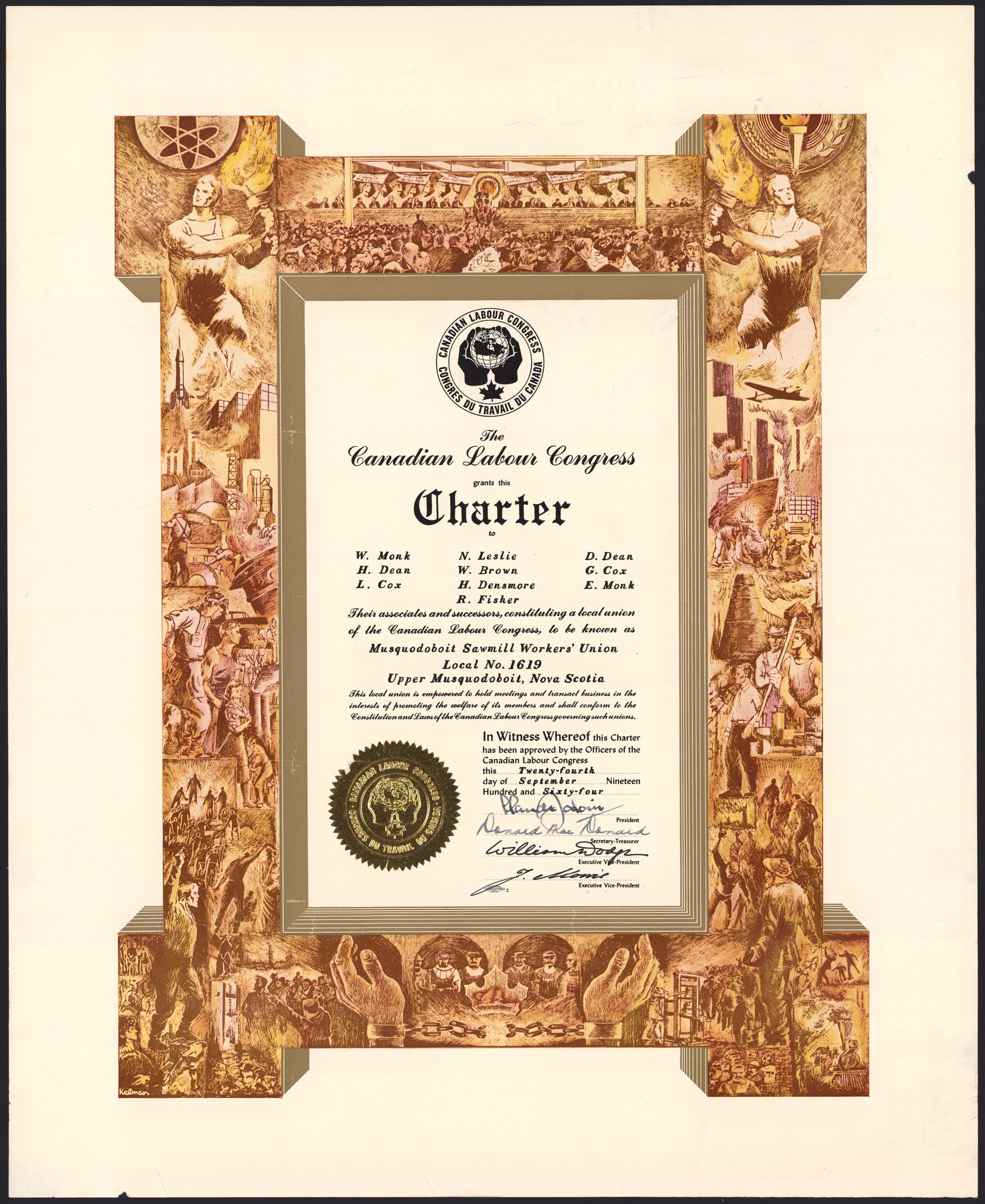
Textual document titled The Canadian Labour Congress.

Charter granted by the Canadian Labour Congress to the Musquodoboit Sawmill Workers’ Union, CLC Local 1619, Upper Musquodoboit, Nova Scotia, September 1964. (e011893866)
For a detailed explanation of the illustrations in this charter, please consult: MIKAN 2629372.
The CLC also printed this same charter in a different colour scheme: see, for example, Buckingham Plastic Workers’ Union, Local 1551, Buckingham, Quebec. (e011537977)

The illustration in this charter uses realistic figures and symbols to show a brief history of the Canadian labour movement from the nineteenth century to the 1950s. The bottom panel shows working conditions in the nineteenth century. This was the time when, as historian Desmond Morton wrote, there was the “harsh reality of […] appalling rates of sickness, death and injury” in lumber camp bunkhouses, high rates of death in mining, and an “appalling toll of life and limb, often of young children” in factories and mills.

The vertical panels on the left and right of the charter show life in the twentieth century. The workers step into the light to work in an industrialized Canada, manufacturing cars and refining minerals; they then move into the “space age,” where they are building and operating rockets, aircraft, skyscrapers and telecommunication systems. The horizontal panel at the top shows the founding convention of the CLC in 1956. The CLC charter has an optimistic tone. The workers contribute to economic and technological progress and they share in the benefits. The present is bright and the future will be brighter.

Looking at the LAC collection of charters, it’s also interesting to look at what is under the surface and what that can show us of life in the early- to mid-twentieth century.

The workers depicted in the charters have little or no safety equipment, reflecting the standards of the era. The charters feature few images of desk workers, but it seems that only a small percentage of locals in the early to mid-twentieth century represented clerical and other office workers.

Additionally, the flag shown in the charters of the Machinists, the Brotherhood of Painters and other unions was the old Red Ensign. The unions designed these charters years, and sometimes decades, before the current Canadian flag was adopted in 1965.

The smokestacks in the CLC charter are symbols of progress and wealth and not pollution and environmental damage.

As well, the workers depicted in the charters are almost entirely white men. The CLC charter includes a few women workers; the only other depictions of women in charters are as customers or grieving widows. Racialized workers and workers with disabilities are absent from the illustrations.

According to files in the labour fonds, it appears that many of the charters in the LAC collection were returned to the union, and later donated to LAC, when the local dissolved, the membership of the local voted to move to another union, the union merged into another union or the union asked the local to leave the union.

In some cases, locals in good standing sometimes had old charters in their offices. In 1972, the CLC asked its locals to return any old charters to the head office and then the CLC would in turn donate the old charters to LAC.

Originally created as official documents to mark the affiliation between locals and the unions, these charters also fostered a sense of shared identity and membership while providing a visually appealing addition to the offices and meeting rooms of the locals. Today, the charters have a secondary value as a window into the unions, workers, workplaces and work life of the twentieth century—and as an introduction to LAC’s collection of labour archives.

Further research:

  • Charters of the Canadian Labour Congress (CLC) (MIKAN 107969)
    • The Canadian Labour Congress Charter. Development and interpretation of its imagery (MIKAN 2629372)
  • Charters of the Canadian Congress of Labour (CCL) (MIKAN 107924)
  • Charters of the All-Canadian Congress of Labour (ACCL) (MIKAN 107906)
  • Charters of the Trades and Labor Congress (TLC) (MIKAN 107903)
  • Charters of the International Association of Machinists (IAM) (MIKAN 191424)
  • Charters of the United Electrical, Radio and Machine Workers of America (UE) (MIKAN 130940)

Published sources on Canadian labour history:

  • Titles available to read online:
    • Carmela Patrias and Larry Savage, Union power: solidarity and struggle in Niagara (OCLC 806034399)
    • David Frank and Nicole Lang, Labour landmarks in New Brunswick = Lieux historiques ouvriers au Nouveau-Brunswick (OCLC 956657952)
    • Eric Strikwerda, The wages of relief: cities and the unemployed in prairie Canada, 1929-39 (OCLC 847132332)
  • Other titles:
    • Desmond Morton, Working people: an illustrated history of the Canadian labour movement (OCLC 154782615)
    • Steven C. High, One job town: work, belonging, and betrayal in Northern Ontario (OCLC 1035230411)

Dalton Campbell is an archivist in the Science, Environment and Economy section of the Private Archives Division at Library and Archives Canada.

The roots of Labour Day

Version française

By Dalton Campbell

Labour Day first became a national holiday 130 years ago in 1894. In April of that year, labour leaders met with Prime Minister Sir John Sparrow David Thompson. They made a number of demands; he agreed to only one, saying that he would work towards establishing Labour Day. By summer, legislation was enacted to make the first Monday of September a statutory holiday.

A parade through city streets.

Labour Day parade, Main Street, Winnipeg, Manitoba, 1895. Sir William Van Horne fonds (e011367824-005). Desmond Morton writes that in the 19th century, “[p]rocessions, with floats, banners, and regalia, were a form of mass entertainment and a demonstration of order and respectability rather than militancy.”

By choosing early September, the Canadian government chose a date for a national holiday that would bridge the gap between July 1 (now Canada Day) and Thanksgiving, fit into the rhythm of the seasons (when summer turns to autumn) and avoid any associations with the overtly political May Day.

Parade through city streets.

Labour Day parade, Front Street, Belleville, Ontario, 1913. Topley Studio fonds (a010532).

A national day celebrating labour was not a new idea in 1894. The holiday had been recommended five years earlier in the final report (1889) of the Royal Commission on Relations of Labor and Capital in Canada.

The Commission’s recommendations were not implemented. However, the report still represents a significant document in Canadian labour history. It included testimonies from workers and their family members discussing the unsafe working conditions, long work hours, low wages, workplace fines, discipline, child labour and other problems. Factories in 19th century Canada were, as Jason Russell describes, “dark spaces with machinery that lacked guards to protect the workers operating them. The factories were places of boilers, steam engines and open flywheels […] and achieving even a 10-hour workday was a major objective for craft unions.”

Before Labour Day was proclaimed, local labour day celebrations had been, as Craig Heron and Steven Penfold write, “an established event on the local holiday calendar in several cities and towns.” There was a long tradition of people taking over public spaces for parades and festivals throughout the 19th century in Canada; in the 1880s, “unionized craft workers in the country took over the traditions [of parades] and made up a new one.”

A parade with marching band through city streets.

Knights of Labor procession, King Street, Hamilton, Ontario, 1880s. Edward McCann collection (a103086). Originally from the United States, the Knights of Labor entered Canada when they became established in Hamilton in 1881. They quickly expanded to become one of the most important labour organizations in 19th century Canada.

Miners in Nova Scotia organized what appears to have been the first local labour holiday in 1880, followed by Toronto in 1882 and then by Hamilton and Oshawa (1883), Montreal (1886), St. Catharines (1887), Halifax (1888), Ottawa and Vancouver (1890) and London (1892).

The Trades Union Advocate, a weekly labour newspaper, described the July 1882 labour parade in Toronto in detail.

The parade featured workers from various craft unions with small workstations set up on flatbed wagons. As they went through the city, they presented their work to the crowds: the lithographers printed leaflets and pictures, the cigar makers rolled tobacco “with remarkable dexterity and nimbleness,” the seafarers had equipped their trailer as a ship and so on. The parade included dignitaries, union members marching on foot holding banners and signs and a dozen marching bands scattered among the floats. The Toronto Globe reported that at least 3 000 people marched in the parade and 50 000 watched from the sidewalks.

In addition to the Trades Union Advocate, the LAC labour collection also has a number of Labour Day photographs: some of these images are included here and others are available in this LAC Flickr album, with all of them being available through Collection Search.

A woman at a microphone.

Labour leader and social activist Madeleine Parent at the microphone. Labour Day, Valleyfield, Quebec, 1948. Madeleine Parent and R. Kent Rowley fonds (a120397).

The LAC labour collection also includes approximately 50 Labour Day messages from the 1930s to the 1970s by labour leaders A.R. Mosher, Pat Conroy, Jim MacDonald, Donald MacDonald, Jean-Claude Parrot and others. The messages touch on universal themes: the gains of labour unions, the need to organize more workplaces and the vital role of workers to corporate profits, production and the economy. Each year’s message also touched on contemporary events, making the speeches a small historical snapshot of that year. The perennial message, however, was one of support for workers. In 1966, Canadian Labour Congress (CLC) president Claude Jodoin captured this in words that still resonate in the 21st century, “Trade unions have devoted a major part of their efforts to obtaining for workers the right to leisure and relaxed enjoyment of the fruits of their labour.” Labour Day, a holiday enjoyed today by millions of Canadians, is one of the results of those efforts.

Further research:

Published sources:

  • Craig Heron and Steven Penfold, The workers’ festival: a history of Labour Day in Canada (OCLC 58545284)
  • Jason Russell, Canada, a working history (OCLC 1121293856)
  • Desmond Morton, Working people: an illustrated history of the Canadian labour movement (OCLC 154782615)
  • Report of the Royal Commission on the Relations of Labor and Capital in Canada (OCLC 1006920421, Government of Canada publications publications.gc.ca 472984)
  • Greg Kealey, ed., Canada investigates industrialism: the Royal Commission on the Relations of Labor and Capital, 1889 (OCLC 300947831)

Dalton Campbell is an archivist in the Science, Environment and Economy section of the Private Archives Division at Library and Archives Canada.

The 1919 Winnipeg General Strike: six weeks of solidarity in the fight for workers’ rights

By Kelly Anne Griffin

In the spring of 1919, tensions boiled over in Winnipeg. Social classes were divided by both wealth and status. Labourers gathered in a common front, and ideas about workers’ rights spread.

Canada’s largest strike and its greatest class confrontation began on May 15. Even though changes were slow to come in the aftermath of the six-week general strike, it was a turning point for the labour movement, not just in the city of Winnipeg but for workers across this sprawling country.

During those important weeks in 1919 Manitoba, workers fought peacefully and tirelessly for basic rights such as a living wage, safety at work and the right to be heard; these things are often easily taken for granted in our own day and age. The Winnipeg General Strike was a revolt of ordinary working-class citizens frustrated with an unreliable labour market, inflation and poor working conditions. Collectively they fought, and united they stood.

The perfect storm

The labour market in Canada was precarious in 1919. Times were difficult for skilled labour, and inflation made it harder and harder for workers to make ends meet. For example, in the year 1913, the cost of living rose by 64 percent. In addition to insecure employment and inflation, the success of the Russian Revolution in 1917 contributed to unrest among workers.

Unions were gaining traction in Canada and growing quickly. As a result, labour leaders met in an attempt to form One Big Union. Although unions had become more common, employers did not recognize bargaining rights.

The First World War also contributed to what happened in Winnipeg in spring 1919. The length and magnitude of that war inevitably resulted in many changes for the economy and an increase in employment at home. But when the war ended, production dropped, and a rush of returning soldiers struggled not only to adjust to civilian life but also to find jobs.

Work was scarce in the once-booming prairie city. Some returning soldiers also viewed immigrants as having taken jobs that should have been theirs instead. Many Canadians, both soldiers and civilians, had sacrificed much during the war, and many thought that their reward would be a better life. Instead, at war’s end, their hardships increased as they faced unemployment, inflation and an unstable economic outlook.

On May 1, 1919, building workers in Manitoba declared a strike after many futile attempts at negotiation. They were followed the next day by metalworkers. Two weeks later, the Winnipeg Trades and Labor Council called for a general strike.

On the morning of May 15, telephone operators in Winnipeg did not report for work. Factories and storefronts remained closed, mail service stopped, and transportation ground to a halt. Over the next six weeks, around 30,000 workers, both unionized and non-unionized, took to the streets and made their sacrifices for the greater good.

Black-and-white image of strikers in a crowded city street holding signs.

Strikers gathered peacefully on the streets for six weeks in 1919, standing as one to fight for basic labour rights that we often take for granted today. (a202201)

A city divided will not stand

The strikers were orderly and peaceful, but the reaction from the government and employers was often hostile. As is the case with any labour dispute, the views of the working class and the views of the ruling class were very different. Some attempts were made to bridge the communication gap in the lead-up to the strike, to no avail.

The social setting in the city at the time aggravated the situation. Though strikes were not new—in 1918, for example, North America had a record number of strikes—the events in Winnipeg were unprecedented in size, nature and the seeming determination of those on strike.

Sign reading “Permitted by authority of strike committee,” with a date stamp and a signature authorizing the notice.

The Central Strike Committee, which represented all of the unions affiliated with the Winnipeg Trades and Labor Council, was tasked with communication and keeping order in the city. The lack of services because of the strike caused suffering for many poor families. To tackle this, the committee authorized operation permits, as seen here, for essential services. (e000008173)

The Central Strike Committee, made up of representatives from each of the unions, was created to negotiate on behalf of the workers and to coordinate essential services during the strike. The Citizens’ Committee of One Thousand was the organized opposition from the government and employers. From the outset, the Citizens’ Committee ignored the strikers’ demands. The strikers were portrayed in the media as a revolutionary conspiracy, a dangerous radical uprising based on Bolshevik extremism.

There were many displays of solidarity across the country in the form of sympathy strikes. The issues that had reached a boiling point in Winnipeg were manifest across the country, and these acts of support were of great concern to the government, and to employers throughout Canada. This fear saw the government finally intervene in the strike.

The Citizens’ Committee held the firm view that immigrants were largely to blame for the strike. As a result, the Canadian government amended the Immigration Act to allow British-born immigrants to be deported. The definition of sedition in the Criminal Code (controversial section 98, repealed in 1936) was broadened so that more charges could be laid. The government’s actions also included jailing seven Winnipeg strike leaders on June 17, who were eventually convicted of a conspiracy to overthrow the government and sentenced to prison terms ranging from six months to two years.

Saturday, Bloody Saturday

On June 21, 1919, the strike reached a tragic boiling point. Main Street in Winnipeg was a scene of unprecedented upheaval.

Black-and-white image of strikers filling a street in front of a large building.

On June 21, 1919, crowds gathered outside the Union Bank of Canada building on Main Street. By the end of the day, 2 strikers were dead and 34 wounded in what became known as Bloody Saturday. (a163001)

The normally peaceful demonstrations took a violent turn. Strikers overturned a streetcar and set it ablaze. The Royal North-West Mounted Police and the newly created Special Police Force, astride their horses and heavily armed, waded through the crowd swinging bats and wielding wagon spokes as weaponry. Machine guns were also used. Two strikers were killed, 34 wounded, and the police made a total of 94 arrests. Western Labor News, the official publication of the movement, was shut down. Five days later, feeling dejected and fearful of what they had witnessed on Bloody Saturday, the strikers ended their efforts for change.

Black-and-white image of a streetcar with smoke rising from it, with onlookers in the foreground.

On Bloody Saturday, the usually peaceful demonstrations turned violent. Strikers overturned a streetcar and set it on fire, and the authorities escalated the situation. (e004666106)

Short-term pain for long-term gain

Those who have been on strike will attest to the struggle of living on strike pay. The extent and duration of the Winnipeg General Strike reflect the deep passion, and anger over their plight, of the workers at the time.

As we consider the history 100 years later, what do we see as the legacy of the events that unfolded over six weeks in Winnipeg?

At the end of the strike, the workers won very little for their valiant efforts, and some were even imprisoned. It would take nearly 30 more years for Canadian workers to secure union recognition and collective bargaining rights. To add insult to injury, the immediate situation in Winnipeg worsened, with the economy in decline. The tensions and sentiments that led to the uprising lingered, which caused increasing divisiveness in labour relations in the city.

Still, it is undeniable that the strikers’ fight helped to pave the way for where we are today. The provincial election in Manitoba the following year, 1920, saw 11 labour candidates win seats, a positive step toward legislative change. Strike leader J.S. Woodsworth, who was imprisoned for a year because of his leadership during the strike, founded the Co-operative Commonwealth Federation, predecessor of today’s New Democratic Party.

Black-and-white image of protestors in a street, with a sign reading “Prison bars cannot confine ideas.”

The arrest of leaders of the Winnipeg General Strike in June 17 led to Bloody Sunday. Here, a group of demonstrators protest the trials of the men arrested. (C-037329)

Although the strike ended without the desired gains, the ideals it stood for live on. Workers in Winnipeg rallied around the common challenges faced despite differences in race, language or creed. A century later, Canada has made great strides regarding workers’ rights, and much of this is thanks to the solidarity and resilience of the general strikers in Winnipeg during that fateful spring in 1919.


Kelly Anne Griffin is an archival assistant in the Science and Governance Private Archives Division of the Archives Branch at Library and Archives Canada.