Freemasons and Factotums

By Forrest Pass

Have you ever been so captivated by a research topic that you start seeing evidence of it everywhere? While doing research for the exhibition Unexpected! Surprising Treasures From Library and Archives Canada, I delved deep into the records of two Eastern Ontario Masonic lodges to reconstruct the history of a magnificent early-nineteenth-century ritual painting known as a “tracing board.” By chance, this search led me down another research rabbit-hole.

I became intrigued by the retailer’s label on the endpaper of a book containing the bylaws of Kemptville Lodge No. 28, which had inherited the tracing board from an earlier lodge in nearby Burritts Rapids. The label, for Ottawa stationer Henry Horne, features the typical offerings of a stationery shop: ledgers, paper, paintbrushes, pens, and a small seal. However, what caught my eye was the arrangement of a compass and square near the label’s base. Was the similarity to the Masonic emblem purely coincidental, or was this label a discreet advertisement of Horne’s own Masonic membership?

Print of open book surrounded by books and stationery supplies. “Henry Horne, Wholesale & Retail Manufacturing Stationer, City of Ottawa” is written in the open book.

Label of Henry Horne, Manufacturing Stationer, in Bylaws of Kemptville Lodge No. 28, Ancient Free and Accepted Masons, 1848 (e011782492).

As Newspapers.com has digitized several Ottawa newspapers, I ran a few searches for Henry Horne, hoping to find an obituary that might confirm that he was a Freemason. Having no luck, I filed a picture of the label for another day and moved on to other projects.

Months later, however, I came across the “possibly Masonic” label again. This time, it was on the endpaper of a letterbook that had belonged to Sandford Fleming from 1874 to 1876, when he was chief engineer of the Intercolonial Railway. The design of the labels was identical, but the name of the company was different: “J. Hope & Co.” in place of “Henry Horne.”

Print of open book surrounded by books and stationery supplies. “J. Hope & Co., Manufacturing Stationers, Book-binders & Importers, Ottawa” is written in the open book.

Label of J. Hope & Co., Manufacturing Stationers, in Sandford Fleming Letterbook, January 1874 – April 1876 (e011782493).

The change in name is easily explained: In 1864, Henry Horne and James Hope became partners in Horne’s stationery business, and Hope took over the company after Horne’s death, in 1865. Updating the shop’s label was easy because it was printed using an ingenious printing block called a “mortised cut.”

Mortised cuts have existed since the earliest days of printing with moveable type. The first examples were “factotums,” decorative printing blocks with a slot into which the typesetter could insert any piece of standard type. Factotums, from the Latin word for a servant having multiple responsibilities, allowed thrifty printers to incorporate decorative initials into their publications without having to buy a full set of twenty-six decorative letters.

Newspaper showing how the printer could insert any letter—in this case, “P” and “O”—into the decorative factotum block to create a custom decorative initial.

Factotum initials on the front page of the May 5, 1791, issue of The Quebec Gazette / La Gazette de Québec. The printer could insert any letter—in this case, “B” and “W”—into the decorative factotum block to create a custom decorative initial (e011782495).

By the 1800s, more elaborate mortised cuts joined factotums in printers’ type cases. Whereas a typical factotum housed a single interchangeable letter, nineteenth-century mortised cuts could accommodate full words, addresses, and messages. A state-of-the-art method called “electrotyping,” which uses an electrical charge, fixes a thin layer of copper to the inside of a typecasting mold. This method made it possible to produce thousands of durable, identical mortised cuts from a single wooden engraving so that printers across North America and around the world could use the same mortised cuts. Think of these printing blocks as the analog ancestor to the twenty-first-century “meme generator”: a recurring image with text that changed according to the requirements of printers and their clients.

Examples of various mortised cuts in a catalogue.

Examples of mortised cuts (here with the variant spelling “morticed”) in an 1865 Montréal type-founder’s catalogue. By inserting type into the blank mortised space, printers could create custom labels, business cards, advertisements, and announcements for their clients (e011782494).

Having established that the Henry Horne and Hope and Co. labels were likely printed from the same mortised cut, I set out to find its source. A Google Lens search for the label turned up a blank version of the cut in the database of a stock image service, credited to a New York type manufacturer’s catalogue from 1882. However, none of the digitized versions of that company’s catalogue includes the cut. I feared that I had reached another dead end.

But, then, I caught another lucky break. An Ottawa Citizen advertisement from the time of Henry Horne and James Hope’s brief partnership in 1864–1865 features the same cut, but this time with the signature “Whitney & Jocelyn, N.Y.”

Newspaper advertisement for Horne & Hope using the open book mortised cut.

Advertisement for Horne & Hope, Manufacturing Stationers, Ottawa Citizen, August 12, 1865, page 3.

Engravers and electrotypers Elias J. Whitney and Albert Higley Jocelyn were not in business together for long: They became partners in 1853 and separated about 1855. Both continued separately in the engraving and electrotyping business, producing a wide variety of products, including printing plates for book and periodical illustrations, postage stamps, bond certificates, watch papers (the numbers and inscriptions appearing on the faces of pocket watches), and stationers’ labels. Whitney went on to head the Brooklyn Academy of Design, while Jocelyn patented a new method for producing artificial slate blackboards—a lucrative industry as accelerated European settlement and compulsory education laws increased the number of schools in the United States and Canada alike.

In all the biographical details I discovered on these engravers, I found nothing to indicate that either was a Freemason. Yet it appears that a copycat engraver may have interpreted the arrangement of the compass and square as a Masonic allusion.

Advertisement by a publisher using a similar mortised cut of the open book, but minus the arrangement of the compass and square that could be viewed as a Masonic allusion.

Advertisement for a Boston publisher and bookseller featuring a similar mortised cut by engraver D.T. Smith. Source: Annual of Scientific Discovery: or, Yearbook of Facts in Science and Art for 1861 (Boston: Gould and Lincoln, 1861), via Internet Archive.

Rival engravers routinely copied and adapted each other’s products, and an uncannily similar cut appeared in the advertising for a Boston bookshop in 1861. Details, such as the placement of the tiny tin labeled “WAFERS,” strongly suggest that this engraver, one “D.T. Smith,” took the Whitney & Jocelyn cut as his inspiration. However, Smith also removed several elements, including the compass and square. Was this simply an engraver tidying and adapting an existing design, or was Smith, too, struck by a possible Masonic reading of the image?

In the end, for all I have found out about factotums and mortised cuts, the mystery of the Masonic image remains—a small gap, or perhaps a “mortise,” waiting patiently to be filled.

Additional Resources


Forrest Pass is a curator with the Exhibitions team at Library and Archives Canada.

A page in Canada’s history: Carnegie libraries

By Sara Chatfield

A black-and-white photograph of a two-storey stone building with a columned portico and ivy growing up its sides.

The Ottawa Public Library opened in 1905, funded by a Carnegie grant. (a044774-v8)

Libraries have always been special places for me. When I was young, my grandmother worked as a reference librarian at my local library, making my visits to the library extra memorable. I have always appreciated the scope of what you could find within the walls of a library: I loved the books, the magazines and chatting with the librarians about new arrivals. But the thing I loved most (and still love most today) about libraries are the buildings that house library collections, especially historic Carnegie library buildings. Carnegie libraries are distinctive buildings built in the late 1800s and early 1900s by Andrew Carnegie to promote free library access in North America and the world.

A colour photo of a one-storey building with brown-brick exterior walls and a green roof. A small set of stairs and a railing lead up to the entrance.

The Renfrew Public library, built in 1919/1920 and funded by a Carnegie grant. Photo credit: Sara Chatfield

To me, Carnegie library buildings have a majestic yet welcoming appearance. The early buildings (1901–1905) were not designed according to standardized plans. The architects, who hailed from Canada and the United States, were free to use their imaginations. Later buildings have similar design elements, such as arched windows, cupolas, porticos and symmetrical columns.

A black-and-white photo of a two-storey building with a columned portico. A man is walking in front of the building. Power lines can be seen to the right and behind the building.

The Galt Public Library, built in 1903, through a Carnegie grant given in 1902 (a031832)

I am not alone in my love of Carnegie library buildings. A former Ontario Minister of Citizenship and Culture once wrote that “Carnegie libraries represent a significant part of the cultural history and architectural heritage of Ontario.”

Carnegie libraries would not have existed without Andrew Carnegie and his lifelong love of libraries and learning. Andrew Carnegie (1835–1919) was born in Scotland and immigrated to the United States with his family in 1848. He amassed a fortune with his Carnegie Steel Company, which he sold in 1901. He placed the money from the sale in trust for philanthropy, which became his main occupation. In total, the philanthropist gave grants to build 2,509 free public libraries to English-speaking communities worldwide. Andrew Carnegie believed the best way to provide free education and foster growing communities was to establish public libraries.

A black-and-white photograph of two ornate buildings, one with a columned portico and a cupola. People walking, a street car, and power lines are in the foreground.

The Vancouver Public Library (right) opened in 1903 with funding from a Carnegie grant. Since 1980, this building has served as the Carnegie Community Centre, which houses a library branch on the main floor. (a009531)

Carnegie provided the grant for each library building, but did not contribute funds towards the purchase of books or staff salaries. To secure a Carnegie grant for a library, cities and towns had to fulfill the “Carnegie Formula.” Among other criteria, this formula stipulated that cities provide the site, guarantee an annual budget and ensure free public access. Many applications for grants were refused because a town or city already had adequate library services or would not be able to guarantee the yearly funds needed for the upkeep of the facility. Some communities did not apply for or accept money from the Carnegie foundation, as they viewed Andrew Carnegie as a robber baron and disapproved of his business methods.

Of the 2,509 Carnegie libraries built in the early 1900s, 125 were constructed in Canada. Of those 125 libraries, 111 were built in Ontario. The majority of the libraries were built in the United States and Great Britain/Ireland. Carnegie libraries were also built in South Africa, Australia, Serbia, New Zealand, Fiji, Mauritius, Barbados and Guyana, among other places.

A colour photo of a brown-brick building with several beige accent columns as well as pediments and curved windows. There are red flowers to the left in the foreground.

The former Perth Carnegie Library, now known as the Macmillan Building. The two-storey library was designed in the Beaux-Arts style by renowned architect Frank Darling. The building was severely damaged by fire in 1980 and restored in 1982. Photo credit: Emily Tregunno

I have always found it interesting that the Carnegie Foundation gave grants to build libraries in both small towns and large cities. For example, in 1901, a grant was given to Ayr, Ontario, whose population was 807. At the time of construction of its Carnegie library, Perth, Ontario, had a population of slightly more than 3,500 residents.

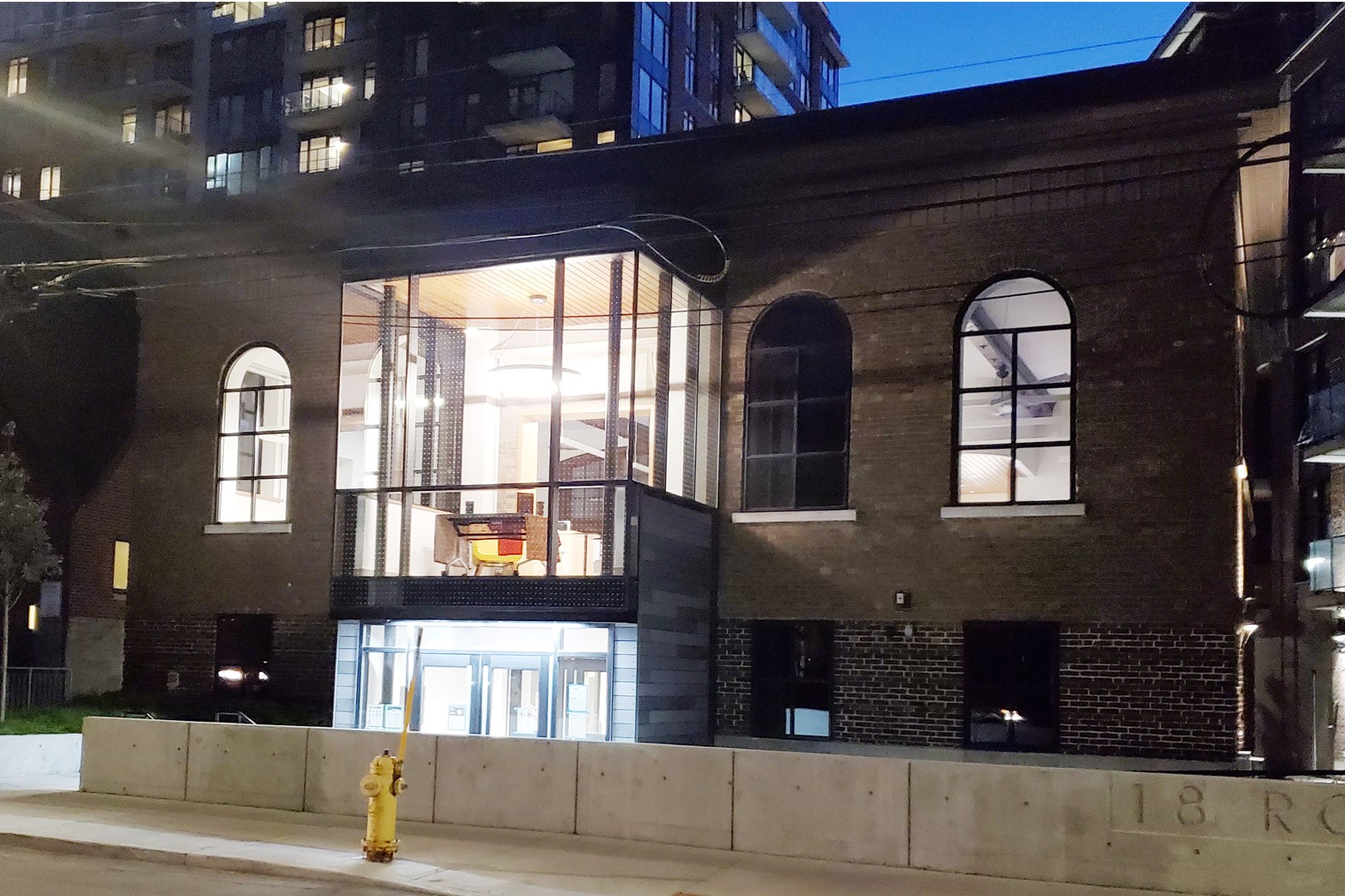
A brown brick 2 storey building with curved windows on the top floor. The entrance is glass and there is a yellow fire hydrant in the foreground.

Ottawa’s Rosemount Branch of the Ottawa Public Library, built in 1918. A major renovation to upgrade the branch took place recently. Photo credit: Sara Chatfield

Many library collections outgrew their original Carnegie library buildings. Some of the buildings have been torn down, some have been damaged by fire, some of the buildings have been repurposed, and some municipalities have chosen to expand and renovate. Ottawa’s Rosemount Branch, originally known as the Ottawa West Branch, is an example of a Carnegie building that has undergone substantial renovations. Interestingly, the 1917 grant to build the Ottawa West/Rosemount Branch was the last of its type given in Canada.

A black-and-white photo of a two-storey square building with a large number of pedimented windows, a columned portico and a small balcony. There is text written across the bottom, which reads “HJW, 1788, Dawson Yukon, Carnegie Library July 1907.”

The Dawson City, Yukon, Carnegie Library. The grant for this library was given in 1903. The building was designed by Robert Montcrieff. Construction was completed in 1904. (a016721-v8)

Unfortunately, some communities could not sustain the financial strain of maintaining a library. The Dawson City library, built in 1903/1904 was popular and well attended. However, by 1920, the city’s population had shrunk to fewer than one thousand people, and the city could not continue to fund the institution. In 1920, the building was sold to the Masonic Lodge.

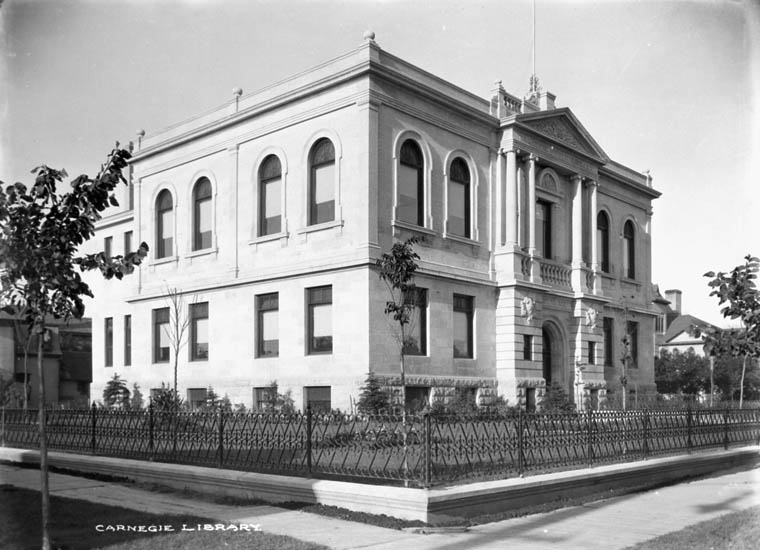
A black-and-white photo of a two-storey square building with several windows, some of them arched, an arched entrance, and columns. The building is surrounded by a decorative metal gate. There is text written across the bottom, which reads “Carnegie Library.”

The Winnipeg Carnegie Library, built in 1904/1905. This was the city’s first public library. It served as the city’s main branch until 1977. (a031593)

From 1995 to 2013, the Winnipeg Carnegie Library building was home to the City of Winnipeg Archives. According to a 2019 report by the Association of Manitoba Archives, construction was under way in 2013 to transform the former Carnegie Library into state-of-the-art facilities for the municipal archives, when an intense rainstorm damaged the roof and sent staff and the archive holdings to a temporary warehouse location.

Of the 125 library buildings built in Canada from 1904 to 1922, approximately 20 have been demolished. Several of the buildings are still being used as libraries as originally intended.

  • A colour photograph of a brown-brick building with a curved entrance. Two short flights of stairs lead to the building entrance.
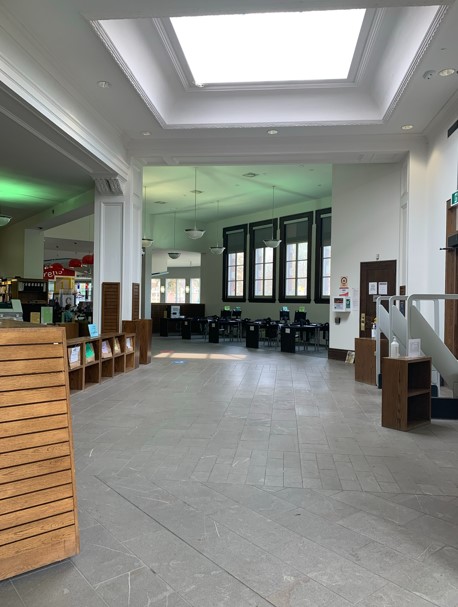
  • A colour photograph of the inside of a library. A large skylight, book shelving and computer terminals can be seen in the room. There are four windows at back.
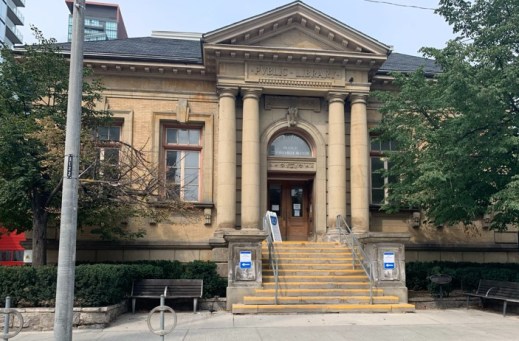
  • A colour photograph of a beige building with a columned entrance and a pediment above the front door. There is single set of stairs leading to the building. The words “Public Library” are etched above the entrance.
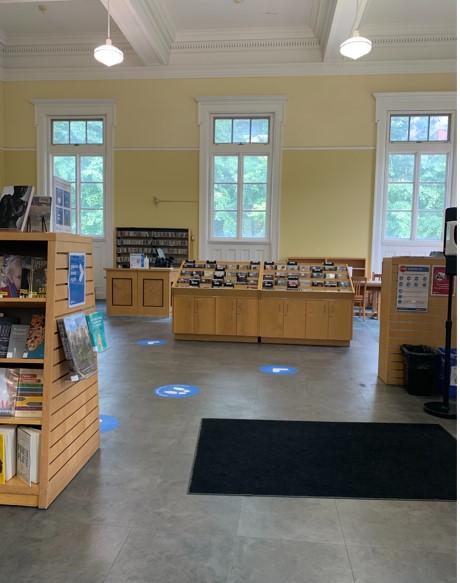
  • A colour photograph of a large room with three windows, two hanging lights, a black mat and book shelves.
 

Keep an eye out for these historic buildings. You might come across one in a small town near you!

Additional resources:

  • Local Library, Global Passport: The Evolution of a Carnegie Library, by J. Patrick Boyer (OCLC 191759655)
  • The Man Who Loved Libraries: The Story of Andrew Carnegie, by Andrew Larsen and Katty Maurey (OCLC 970404908)
  • The Best Gift: A Record of the Carnegie Libraries in Ontario, by Margaret Beckman, Stephen Langmead and John Black (OCLC 11546081)
  • Ottawa Carnegie Library – Application for State papers (RG2, Privy Council Office, Series A-1-a, vol 964)

Sara Chatfield is a project manager in the Exhibitions and Online Content Division at Library and Archives Canada.