First World War Centenary: Honouring Canada’s Victoria Cross Recipients – Battle of Second Ypres

In the first week of April 1915, members of the 1st Canadian Division, including many of the earliest volunteers of the war, were moved north from Bethune, France to the active section of the line near Ypres, Belgium. A medieval Belgian city, Ypres was the scene of one of the war’s earliest and bloodiest battles in 1914 and had assumed great strategic importance. When the front stabilized in November 1914, the Allied lines bulged out around the city into the German line, forming a salient, surrounded on three sides by higher ground.

On April 22, 1915, in an effort to eliminate the salient, Germany became the first nation to use chemical weapons, releasing over 160 tons of chlorine gas across the Allied front. Members of the 1st Canadian Division, who had been in their trenches barely a week, found themselves desperately trying to defend a 6.5-kilometre gap in the Allied lines as the French division to their left crumbled in the face of Germany’s new weapon. The chlorine gas clung to the ground and filled the trenches, forcing the troops to climb out and into the path of heavy machine-gun and artillery fire.
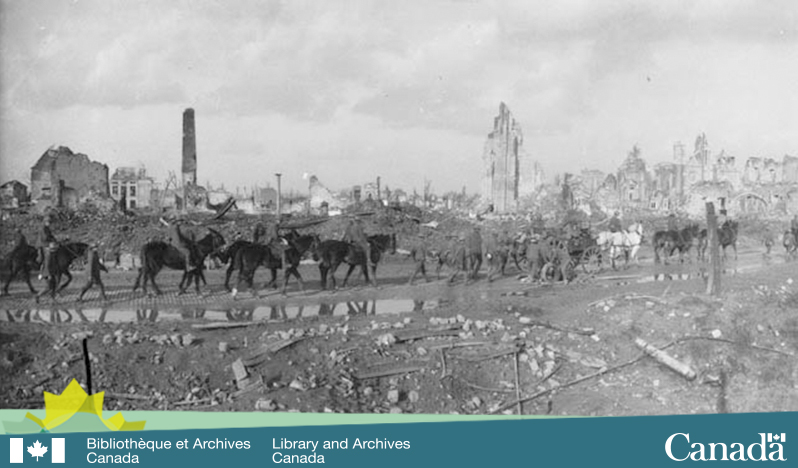
A black-and-white photograph showing a city completely destroyed by war. A column of troops, most on horseback, are travelling through it.

A scene of the destroyed city of Ypres, showing the Cathedral, Cloth Hall, and Canadian troops passing through, November 1917 (MIKAN 3194491)
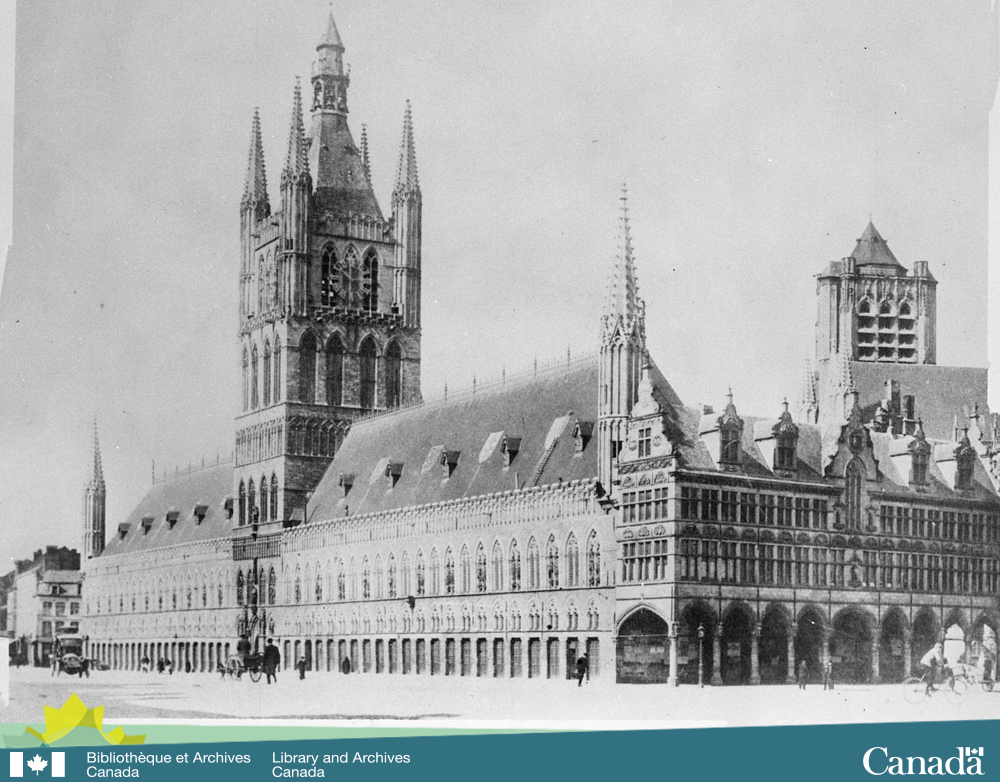
A black-and-white photograph of an ornate gothic building and other adjacent buildings.

The Cathedral and Cloth Hall in Ypres, before the Great War (MIKAN 3329077)

German troops moved forward but, having planned only a limited offensive and lacking adequate protection against their own chemical weapons, they were unable to exploit the break in the line. Throughout the night and the subsequent days, Canadian and British troops struggled to maintain the line. Canadians mounted a counterattack at Kitchener’s Wood (derived from Bois-de-Cuisinères) and endured the terrible fighting at St. Julian: their Canadian-made rifles jamming in the mud, and soldiers violently sick and gasping for air. Somehow, they managed to hold the line until reinforcements arrived on April 28. The losses were tremendous: 6,035 Canadians (or one in three soldiers) became casualties by the time the 1st Canadian Division was relieved. This toll among an army whose members had almost all been civilians just months prior.

At Second Ypres, the Canadians were initiated into the horrors of modern warfare, and from this moment on they would continue to develop into a highly respected formation in the Allied forces.

From April 23 to 25, as part of our series, First World War Centenary: Honouring Canada’s Victoria Cross Recipients, we will tell the stories of Lance-Corporal Frederick Fisher, Lieutenant Edward Donald Bellew, Company Sergeant-Major Frederick William Hall, and Captain Francis Alexander Caron Scrimger.

View the Flickr album – Canada at Ypres
First World War Centenary: Honouring Canada’s Victoria Cross recipients

As part of its commemoration of the centenary of the First World War, over the next three years we will profile each of Canada’s Victoria Cross recipients. Each profile will be published on the 100th anniversary of the day that the actions for which the recipient was awarded the Victoria Cross took place.

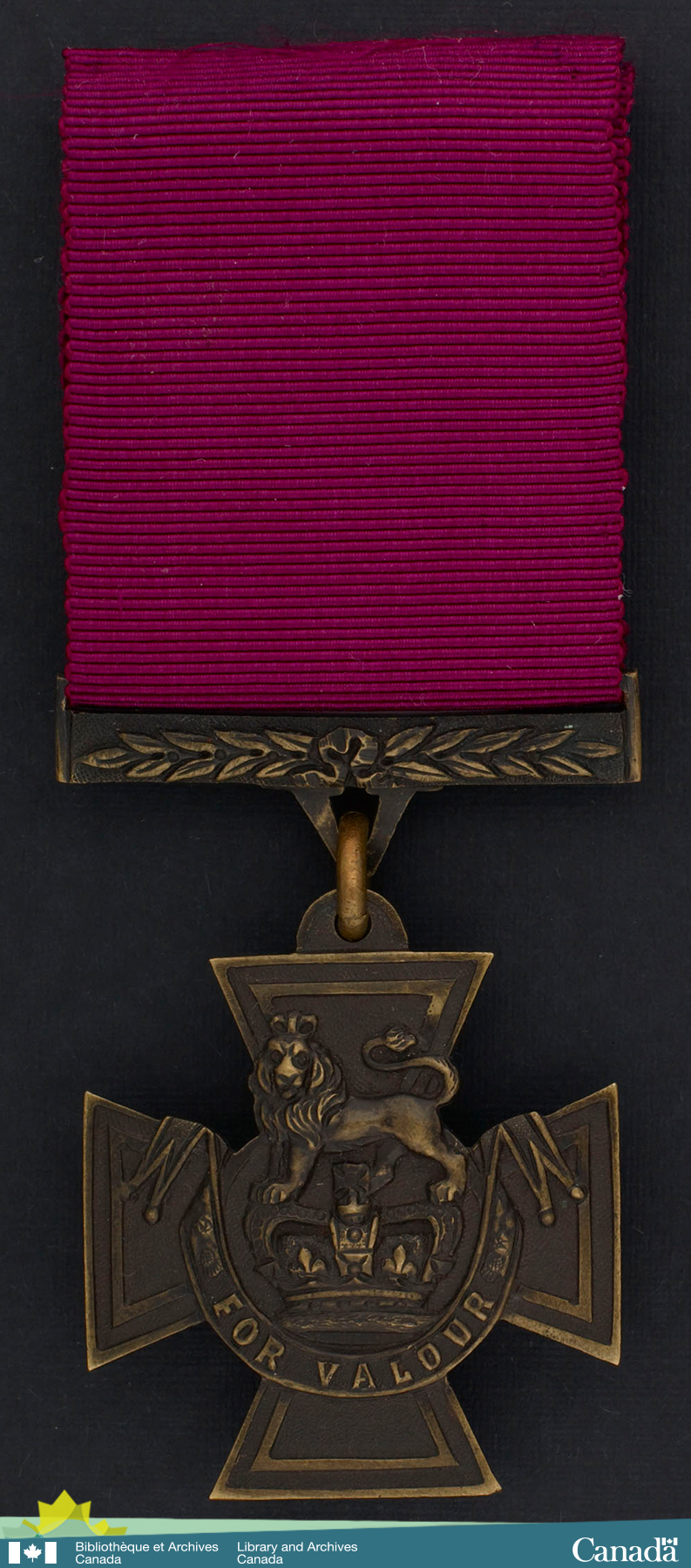
Colour photograph of a medal. Ribbon is crimson. Cross-shaped medal is bronze with a lion above a crown bearing the inscription For Valour on a scroll.

The Victoria Cross (MIKAN 3640361)

The Victoria Cross (VC) is the highest military decoration in the Commonwealth and takes precedence over all other medals, decorations and orders. A recognition of valour in the face of the enemy, the VC can be awarded to a person of any rank of military service and to civilians under military command. So far, 98 Canadians have been awarded the Victoria Cross, beginning with Alexander Roberts Dunn who in 1854 fought in the Battle of Balaclava in the Crimean War. The Victoria Crosses were awarded to 71 Canadian soldiers during the First World War, and 16 were awarded during the Second World War. The remaining VCs were awarded to Canadians for the Indian Rebellion of 1857 (in which William Hall of Nova Scotia became the first-ever black recipient of the VC) and the South African War (1899–1902).

In 1993, the Canadian Victoria Cross was adopted in place of the British VC. The medal is identical to the British VC but the inscription is in Latin—Pro Valore—a linguistic ancestor to both English and French. The Canadian Victoria Cross has yet to be awarded.

The profile series will also include links to photographs, service papers, war diaries, and other digitized artifacts in Library and Archives Canada’s collections that help to tell the stories of the Canadians who experienced the Great War on many fronts, including the home front, and whose actions and memories shape how contemporary Canadians remember and understand the first truly global conflict.

We will begin our First World War Victoria Cross profiles with Lance-Corporal Frederick Fisher.

Images of 1st Canadian Division now on Flickr

When war broke out in 1914 between Germany and its allies versus Britain and France, Canada’s Prime Minister Sir Robert Borden immediately offered assistance in raising a contingent of troops to defend Europe. Calls for volunteers started in August 1914.

With a small army of approximately 3,000 soldiers, a small navy, and some militia units, Canada was able to enlist about 35,000 men in a matter of a few months. They were stationed at Valcartier Camp situated northwest of Québec City for initial training and formed into battalions of the Canadian Expeditionary Force, and into a division—the 1st Canadian Division.

Comprising 31,000 men, the Division was sent overseas by convoy for further training at Salisbury Plain in England where it continued training through the winter of 1914, and was finally sent to France in February 1915. The 1st Canadian Division saw combat at a variety of locations, such as the Ypres Salient (Second Battle of Ypres), Festubert, Givenchy-en-Gohelle, Somme, Vimy Ridge up to the end of the First World War, and serving into the present. The history of the 1st Canadian Division is rich, long-lived and backed by distinction as seen in its motto, “Agile, Versatile, Ready.”

Images of the British Commonwealth Air Training Plan now on Flickr 

During the Second World War, the British Commonwealth Air Training Plan (BCATP) mobilized Canadian experts, initiated the building of airfields, conducted research into the development of equipment, and provided valuable training and resources to Commonwealth aviators.

Signed in 1939, the Agreement and Plan lasted from 1940 to 1945. During this time, about 151 schools were established across Canada with over 104,000 men and women serving the ground operations. By the end of the War, the BCATP had produced 131,553 aircrew; including pilots, wireless operators, air gunners, and navigators for the Air Forces of Great Britain, Australia, New Zealand and Canada.

Victoria Cross recipient and Second World War tough guy: Major David Vivian Currie

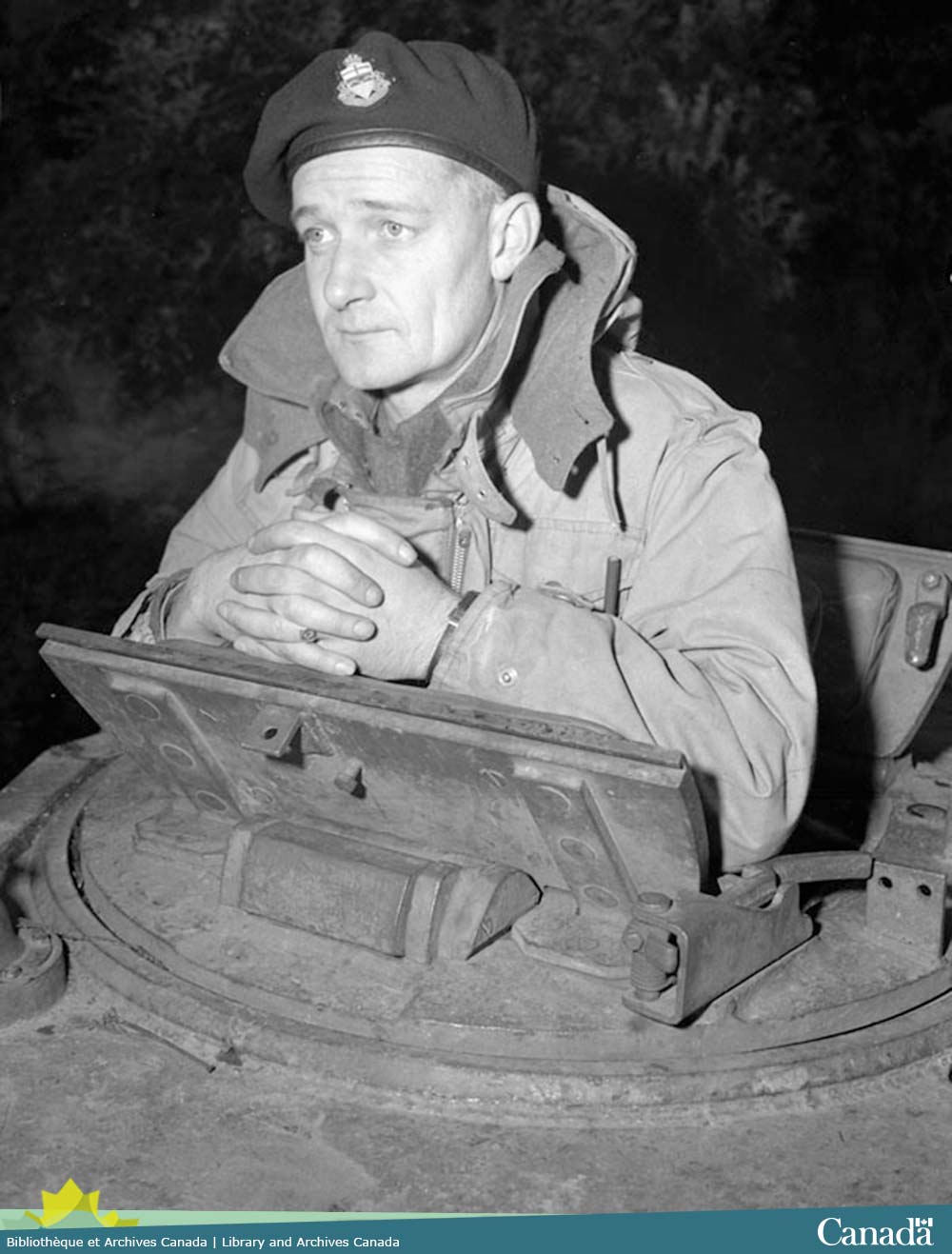
Seventy years ago, on August 18, 1944, Major David Vivian Currie led 200 men and a dozen M4 Sherman tanks into the town of St. Lambert-sur-Dives, France in order to block the escape route of the German 7th Army out of the Falaise Pocket. Though hugely outnumbered by a detachment of the German 2nd Panzer Division, the actions that Currie and his men took effectively sealed off the only escape route for the Germans. For his efforts, Currie earned the Victoria Cross, the highest military gallantry decoration in the British Commonwealth.

Black and white photograph showing a man peering out over a tank turret.

Major David V. Currie, VC, South Alberta Regiment, Breda, Netherlands, November 25, 1944. (MIKAN 3224834)

Major Currie was born in Sutherland, Saskatchewan in 1912 and trained as an auto mechanic and welder. A major in the 29th Armoured Reconnaissance Regiment (South Alberta Regiment) in 1944, Currie had only ten days of combat experience when he was tasked with capturing, cutting off, and holding the road through St. Lambert.

Currie was leading “C” Squadron, a small force of tanks and anti-tank guns, together with two infantry companies of the Argyll and Southerland Highlanders, with no artillery support and little reconnaissance. When his first attack was repulsed, Currie snuck into the village on foot, surveyed the German defences, and rescued the crews of two disabled Canadian tanks. The following day, he had seized and consolidated a position half-way inside the village. Over the next 36 hours, Currie so skillfully organised his defences in the face of near-constant counterattack that he not only held the unit’s position but inflicted disproportionately heavy casualties on the German forces.

Black and white photograph showing a man sitting on top of a tank, leaning against the machine gun and looking off to the left.

Major David V. Currie, VC, of the South Alberta Regiment in a Humber I scout car, Halte, Netherlands, November 12, 1944 (MIKAN 3227188)

The Germans attempted their final breakthrough of the Canadian positions on the evening of August 20th but were routed by a surprise Canadian assault. Over 2,100 German soldiers were taken prisoner by Currie’s force of less than 200. Currie then completed the capture of the village, thus denying the remnants of the German armies their last escape route from the Falaise Pocket. The battle of St. Lambert was to be the final battle of the Normandy Campaign.

Black and white photograph showing a group of German soldiers with their arms raised in the air surrounded by Canadian soldiers.

Major David V. Currie (third from left with pistol in hand) of The South Alberta Regiment accepting the surrender of German troops at St. Lambert-sur-Dives, France, August 19, 1944. (MIKAN 3396233)

In the months following St. Lambert, Currie participated in the Battle of the Scheldt and the liberation of the Netherlands. He later achieved the rank of lieutenant colonel and served as sergeant-at-arms in the Canadian House of Commons from 1960 to 1978. He died in 1986. The armoury in Moose Jaw, Saskatchewan is named the Lt. Colonel D. V. Currie Armoury in his honour, as is Currie Avenue in Saskatoon.

To learn more about Canada’s military past, visit the Military Heritage pages.

Photography of the First World War – Part I: The Canadian War Records Office

The year 2014 marks the centenary of the First World War. In preparation for this date, archivists at Library and Archives Canada (LAC) have been cleaning up the Official Canadian War Photographs Records. They have been made more accessible to Canadians by enhancing their descriptions through thematic organization in the online database. This has been part of a much larger project to organize and describe the entire Department of National Defence’s photograph collection at LAC to ensure that the records are accurate, complete and accessible to the public. When the war began in 1914, most photographers and journalists were ordered away from the front. The First Canadian Division entered the European war theatre the following year. Finally, in 1916, millionaire press baron Max Aitken was granted permission to start the Canadian War Records Office (CWRO) and it became Canada’s “eyewitness to war” sending reports home from the front. Soon, these reports were also accompanied by photographs and paintings.

In addition to acquiring photographs from various sources, over the course of the war the CWRO hired three photographers—Captain Henry Edward Knobel, William Ivor Castle and William Rider-Rider—to travel to France and photograph battles, life at the front, and other activities. These photographs can be accessed under the Canadian War Records Office and were organized and given prefixes by the CWRO such as:

The largest of these CWRO-created prefixes is the “O” prefix. It includes about 4705 images, which were taken between May 1916 and May 1919. We find some of the most famous Canadian images of the war in this series. It includes William Ivor Castle’s shots of “Going over the Top” and the “29th Battalion advancing over No Man’s Land during the Battle of Vimy Ridge.”

Black and white photograph showing soldiers climbing over a ridge.

Canadian troops ‟going over the top” during training course at a trench-mortar school. (MIKAN 3206096)

Both of these photographs were later found to be manipulations: the first being a photograph of a drill, and the latter being a composite of two images to add dead bodies and puffs of smoke.

Black and white composite photograph of soldiers advancing through a field of mud. There's puffs of smoke in the air and bodies in the foreground.

The 29th Infantry Battalion advancing over “No Man’s Land” through the German barbed wire and heavy fire during the Battle of Vimy Ridge (MIKAN 3192389)

The next part of this series will explain how to search for First World War photographs in the Canadian War Records Office collection.

Other related materials:

First Canadian casualties of the First World War

It is well documented that George Lawrence Price, who was killed by a sniper two minutes before the Armistice on November 11, 1918, was the last Canadian soldier to die in combat during the First World War. But who was the first?

It turns out, the answer is a bit complicated. On August 4, 1914, Britain declared war on Germany. As a dominion of the British Empire, Canada automatically entered the war. Members of the Canadian Expeditionary Force only arrived at the battlefields of France and Belgium in early 1915; however, some Canadians who were overseas when war broke out joined British forces and saw active service more quickly. British units were fighting in Belgium and France as early as August 1914, with intense combat at Mons, the Marne and Ypres, resulting in 500,000 casualties by October 1914.

Canada’s Books of Remembrance, along with the Canadian Virtual War Memorial, contain the names of more than 118,000 Canadians who fought and died in wars since Confederation. While primarily commemorating soldiers killed within Canadian units, the Books of Remembrance also commemorate those killed serving with British regiments. They include the names of Canadians who died in service of other causes—disease, illness, accident, or injury—as well as those killed in action and as the direct result of injuries received in or related to combat.

Death in service, but not in combat

Private Harry B. Little of the Princess Patricia’s Canadian Light Infantry enlisted on August 10, 1914, at the age of 26. He died four days later from heart failure while on a troop train in Alberta. Little was buried in Czar Cemetery, Alberta.

Death in battle, but not for Canada

Corporal Charles Raymond served with the British infantry, 2nd Battalion, King’s Royal Rifle Corps. Raymond was born in Windsor, Ontario, and was killed in combat on September 14, 1914, at the age of 32. He is buried in La Ferté-sous-Jouarre Memorial cemetery, Seine-et-Marne, France.

Death in battle and for country

Finally, the first Canadians to die in combat while serving with a Canadian unit during the First World War were Malcolm Cann, John Hatheway, William Palmer, and Arthur Silver, on the Pacific Ocean, approximately 80 kilometres off the coast of Chile in the Battle of Coronel. They were in the first class of the newly created Royal Naval College of Canada. Under the command of British Rear Admiral Sir Christopher Cradock of the Royal Navy’s North American and West Indies station, Cann, Hatheway, Palmer, and Silver were taken as midshipmen on the HMS Good Hope, part of a squadron of ships that set out to defend British commerce from German naval aggression in the eastern Pacific. They engaged a German squadron commanded by Admiral Graf Maximilian von Spee on November 1, 1914, off the coast of Chile. In what would be the worst British naval defeat in a century, more than 1,600 Allied sailors were killed in the battle, including the four Canadian midshipmen, whose ship was sunk with all hands on board.

Related resources

New Research Guides Online!

Library and Archives Canada is pleased to announce the launch of two new guides: Guide to Sources Relating to the Canadian Militia, 1855–1988 and Guide to Sources Relating to Canadian Naval Vessels, 1909–1983. The guides were originally compiled over many years by the late Barbara Wilson (1931–2014), an archivist with the former National Archives of Canada, now Library and Archives Canada.

Guide to Sources Relating to the Canadian Militia, 1855–1988

This guide is an indispensable starting point for researching the records that document Canadian militia units. It is a unique finding aid that brings together, by militia unit name, references to records and files scattered throughout several different archival fonds held at Library and Archives Canada.

Guide to Sources Relating to Canadian Naval Vessels, 1909–1983

This guide is an indispensable starting point for researching the records documenting Canadian naval vessels that served with the Royal Canadian Navy. It is a unique finding aid that brings together—by ship’s name—references to records and files scattered throughout several different volumes of archival fonds of the Department of National Defence.

Sergeant Ernest Alvia “Smokey” Smith, VC

Ernest Alvia “Smokey” Smith (May 3, 1914 – August 3, 2005) was the last living Canadian recipient of the Victoria Cross (VC) and the only private in the Canadian Armed Forces to receive this decoration during the Second World War. It is the highest military honour awarded to British and Commonwealth Forces.

Private Ernest Alvia “Smokey” Smith, V.C.

Private Ernest Alvia “Smokey” Smith, VC (e010786349)

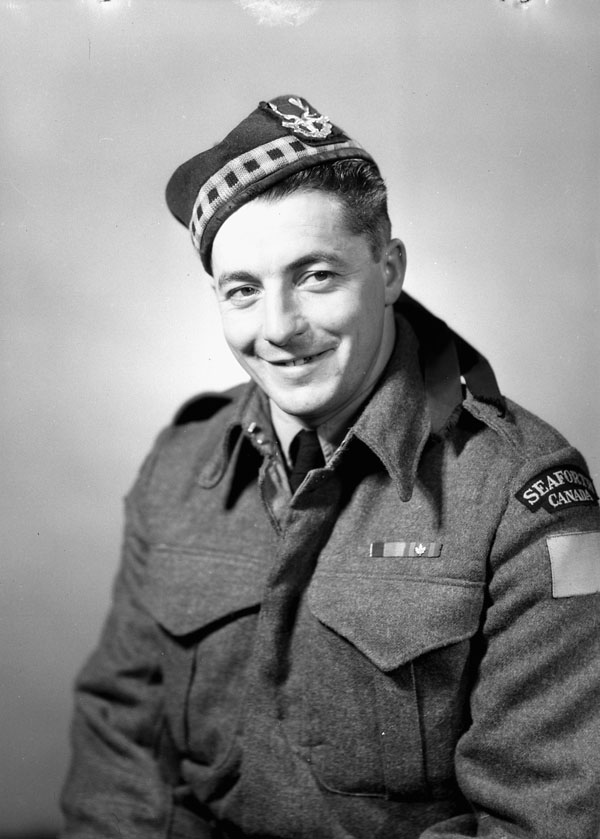
Private “Smokey” Smith earned this distinction 70 years ago—on October 21 and 22, 1944—in Savio, Italy, where he was fighting with the Seaforth Highlanders of Canada. His unit was ordered to establish a bridgehead across the Savio River, which had risen significantly due to torrential rain, making it impossible for tanks and anti-tank guns to cross. Having successfully crossed the river, the unit’s right flank was attacked by the German 26th Panzer Division. Smith, an experienced member of the anti-tank platoon, had participated in the amphibious Allied invasions of Sicily and Italy, been wounded twice, and been part of fierce street fighting during the advance in Italy. Sheltering in a ditch as a German Panther tank rolled toward him and machine guns raked his position, Smith waited until the tank was within 30 feet of his PIAT (Projector, Infantry Anti-Tank, a.k.a. “tank-stopper”) and then stood up, fired, and disabled the tank. Still in full view of the enemy, he drove back the Germans who leapt from the burning tank, along with a second Panther and 30 infantry soldiers, all the while protecting a wounded comrade. According to his VC citation, “Private Smith, still showing utter contempt for enemy fire, helped his wounded friend to cover and obtained medical aid for him behind a nearby building. He then returned to his position beside the road to await the possibility of a further enemy attack.” (The London Gazette, no. 36849, December 20, 1944). Smith’s unit consolidated the bridgehead position and paved the way for the capture of San Giorgio Di Cesena and a further advance to the Ronco River.

Private Ernest Alvia “Smokey” Smith, V.C., of the Seaforth Highlanders of Canada

Private Ernest Alvia “Smokey” Smith, VC, of the Seaforth Highlanders of Canada (MIKAN 3227168)

As Smith later told it, he was placed in a Naples jail by Military Police to keep him out of trouble until he could be sent to London to receive his VC. He was, by his own words, a man who didn’t like to take orders but who believed firmly in the job he had to do. Following the war, Smith re-enlisted in the army but did not see combat. He later served as a recruiting sergeant in Vancouver and remained in the army until his retirement in 1964. Smith received the Canadian Forces Decoration and was invested as a Member of the Order of Canada in 1996 in recognition of his service to Canadian veterans’ organizations.

To learn more about Canada’s military past, visit the Military Heritage pages.

Images of Princess Patricia’s Canadian Light Infantry now on Flickr 

The Princess Patricia’s Canadian Light Infantry is one of three Permanent Force infantry regiments of the Canadian Army.