Bilingual census data: a better search experience for all Canadians

Web banner for The 1931 Census series. On the right, typed text: "The 1931 Census". On the left, moving train going by a train station.By Julia Barkhouse

This article contains historical language and content that some may consider offensive, such as language used to refer to gender, racial, ethnic and cultural groups. Please see our historical language advisory for more information.

Library and Archives Canada (LAC) is the guardian of Canada’s distant past and recent history. It holds the historical census returns for Canada, including some dating back to New France and some for Newfoundland. We have indexed some dating from 1825 to 1926, and these are available online through Census Search.

Before Confederation, censuses were generally collected in either English or French, depending on the location. The Dominion Bureau of Statistics (now Statistics Canada) phased in bilingual forms after Confederation in 1867.

Example of a bilingual Census 1921 form enumerated in English and French:

A census-taking sheet from Census 1921. This particular image is page 6 for the sub-district of Scots Bay in Kings District, Nova Scotia.

Census 1921 form enumerated in English (e002910991).

A census-taking sheet from Census 1921. This particular image is page 19 for the sub-district of Wolfestown (Township) in Richmond-Wolfe District, Quebec.

Census 1921 form enumerated in French (e003096782).

The language used to record answers to census questions may reflect the language preference of the enumerator or the language in which the answers were provided. The historical census data that we have reflects our linguistic duality as a nation. Census returns from Quebec and some parts of New Brunswick and Manitoba are written (or, enumerated) in French, while the rest of Canada was enumerated in English.

When our partners, including Ancestry and FamilySearch, indexed the censuses from 1825 to 1926, we produced a wealth of data with names of individuals, their gender, marital status, etc. However, we were faced with a serious challenge: census data could be collected in either English or French depending on the personal preference of the enumerator. So how did we handle this?

Life as an Enumerator

Let us detour for a moment and describe the journey of the enumerator. Enumerators were Canadians hired by the Dominion Bureau of Statistics to collect census data in one or more sub-districts. They received a book of instructions (such as this one for Census 1921) that detailed what they were supposed to write on the form depending on what people answered. They were given a booklet of census return forms and instructions on which sub-districts to enumerate. Then this person had a timeframe to enumerate a number of sub-districts and mail these forms back to the government department. You can imagine this person going from door to door in a horse-drawn carriage or perhaps an early automobile (maybe a Ford Model T) by 1921.

The enumerator knocked on the door and asked to speak to the head of the household (typically the father and/or husband). They might be invited in to sit at the kitchen table as they asked questions. If the family was not home, there might be a notice or calling card left on the door with contact details to follow up and meet the enumerator by a given date to be counted in the census.

Depending on the province in Canada, the enumerator either wrote down information in the language of the person speaking or in their personal language preference. Therefore, it is possible that French regions of Canada around Quebec, New Brunswick and Manitoba were enumerated in one or both languages depending on the enumerator’s personal preference.

Fast forward: the data captured on the forms was transcribed by our partners around 92 years after the census taking and put online.

Language Barriers

When LAC put these databases online, we noticed that we had data in both languages. If you wish to search for your ancestor, you have to search in the language of the enumerator. Did the enumerator write your grandmother’s information in English or French? Does your name have an accent (é, è …) that might have been misheard (or not captured) by the enumerator? Does your uncle’s name have a silent “h” that might have been omitted? This creates a language barrier for our researchers, who want to find people but do not speak the language used at the time. Some of our Francophone researchers have to search in English to find their French-speaking ancestors. This is an unbalanced search experience for Canadians who access our Census Search interface in French.

Creation of Census Search

When the Digital Access Agile Team reorganized and consolidated the 17 census databases into Census Search last November, we wanted to deliver a better search experience for all Canadians. Our aim was to provide the same search experience for Francophones as for Anglophones, so that any of our clients who use the French Census Search interface can search and get the same results as if they were searching in English.

So how do you do this? How do you translate information like gender, marital status, ethnic origin and occupation for over 44 million individuals to offer an equal experience for all Canadians? It’s actually very simple. The solution? Data cleanup.

A Peek Under the Hood

Let’s go behind the scenes for a moment to look at how census data is saved. Census Search is the public interface that LAC clients can use to search. The census data for each individual in Census Search is saved in one master table called EnumAll.

Census data saved in a table in SQL Management Server.

Screenshot of Census.EnumAll from SQL Management Server (Library and Archives Canada).

In this table, each line represents an individual person. The data captured about that person is separated into columns. If we do not have data in a particular column, it says NULL.

Creation of Common Data Pools

Census.EnumAll acts as the master data table. From this, we created common data groups (or, pools). What do I mean by this? We copied all of the data for one of the columns (Gender, Marital Status, Ethnic Origin, Religion, etc.) into a separate table. The only information in this separate table is a list of Genders or options for Marital Status, etc. We call this a common data pool, meaning that all the data in this table (or, pool) relates to one piece of information.

The common data table separates the data (e.g., “Male” or “Female”) from the individual person. If you look at 44 million individuals, you see the same data repeated, such as the number of times the enumerator wrote “Male” or “Married.” In a common table, you see “Male” only once, with a value count for the number of people with this information (which we call an attribute).

This is where the magic happens.

The Gender table in the back end of Census Search. Of note, there are variances (Male and M, Female and F) and two columns titled TextLongEn (English display) and TextLongFr (French display).

Screenshot of T_Gender from SQL Management Server (Library and Archives Canada).

As you can see in this separate common data table, we can do more things. With codes, we establish one way to write each Gender (in this example). This is called an authority. We then perform cleanup so all the variants point to this one authority. In the screenshot above, you’ll notice a variance between “Male” and “M.”

Once we have this authority, we create columns for how we want to display the information in Census Search. We create an English (TextLongEn) and a French (TextLongFr) display. We then add the bilingual translation once and it applies to everything. In this case, we translated “Male” to “Homme,” and it applies to all 20,163,488 people who identified as “Male” across 17 censuses.

We then put all the tables back together and index the records to display in Census Search. So depending on the language of your choice, the interface and the data itself will now translate for you.

English Census Search interface showing Gender drop-down with values for Female, Male and Unknown alongside the French Census Search interface showing the same drop-down with Gender values for Femme, Homme and Inconnu.

Screenshots of Census Search in English and French (Library and Archives Canada).

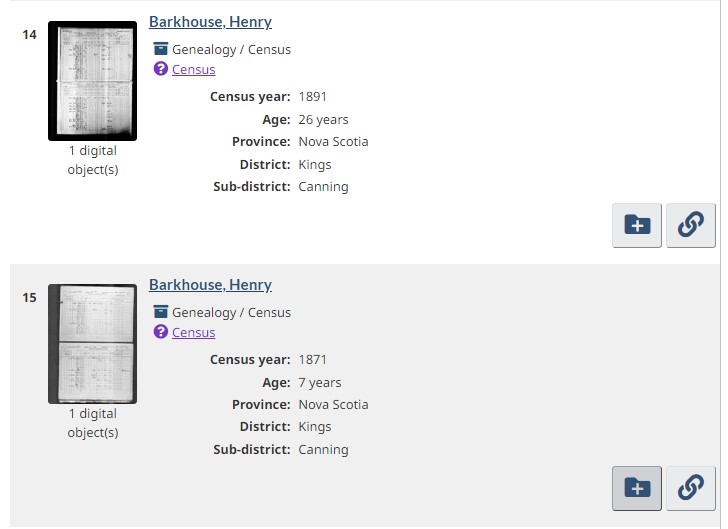
Now, when I search for my great-grandfather, Henry D. Barkhouse, and display any of his census entries, the data translates as well.

Two screenshots, one in English and one in French, of a Census 1911 record for Henry D. Barkhouse, with arrows pointing out where the data translates.

English and French display of Census 1911 record for Henry D. Barkhouse (e001973146).

Progress Check-in

As you can imagine, this work takes time as we diligently clean up and translate our data. Our first priority was to create drop-down menus on Census Search for Gender and Marital Status. Now, if you wish to search by either of these fields, you will see a short list of terms that are translated and available in both official languages. As we continue this work, our next priorities are Ethnic Origin and Place of Birth. We are about 60–70% finished with these two, and our clients should see new options coming to Census Search in 2024. After these two priority fields, we will continue to translate other fields like Religion, Relationship to head of household, Occupation, etc.

Conclusion

Consolidating all 17 censuses into one platform, Census Search, gave us the opportunity to create a bilingual display for our census data by cleaning up the data. Since its launch, our platform delivers a more equal search experience in the language of your choice. I encourage you to try it out and tell us if your search experience has improved.

As always, we love to read your feedback and ideas via our email or you can sign up for a 10-minute feedback session with us.


Julia Barkhouse has worked at Library and Archives Canada in data quality, database management and administration for the last 14 years. She is currently the Collections Data Analyst on the Digital Access Agile Team.
Creation of Census Search

By Julia Barkhouse

We all love the Census. It’s the number one genealogical resource for finding ancestors because it gives reliable information on every Canadian, where they lived, how old they were, whether they worked, and other useful tidbits. It provides a snapshot of our population at a given time and place.

I love the Census for making it possible to track the movements of my great-grandfather, Henry D. Barkhouse. He was the inspiration for the recent work that my team, the Digital Access Agile Team, did to consolidate and release Census Search Beta in November 2022.

I want to take you through my journey in researching Henry D.’s life in the Census. He was born in 1864 and died in 1947 in Nova Scotia. My father never knew him, as he passed before my father was born. A very tall man, he married my great-grandmother, Samantha Udora (Dora) Butler, in 1899 in Scots Bay, Nova Scotia. They had eight children. He was a farmer, and his homestead has been passed down in my family to the present day. Other than this basic information, I know very little about him.

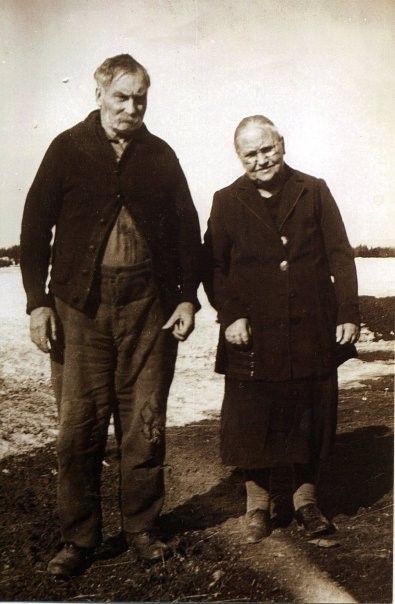
Photo of Henry D. Barkhouse and Samantha Udora (Dora) Butler at their homestead.

Henry D. Barkhouse (1864–1947) and Samantha Udora (Dora) Butler at the Barkhouse homestead in Scots Bay, Nova Scotia (c. 1930–1947). Image courtesy of the author, Julia Barkhouse.

Before starting my research, I record the information that I know about Henry D.:

  • Last name: Barkhouse
  • First name: Henry D.
  • Gender: Male
  • Dates: 1864–1947
  • Occupation: Farmer
  • Province: Nova Scotia (I didn’t know the district or sub-district)

Armed with this information, I expect to find Henry D. in the censuses from 1871 to 1921. The 1931 and 1941 censuses are not yet available.

The research journey begins, and I find him in the 1871 Census.

A page from the 1871 Census of Canada featuring Henry Barkhouse’s information.

Page of Census of Canada, 1871 (Item Number: 3150873)

With the first hit, I learn more about him. The census record confirms that he was born in 1864 and that he was seven at the time of the Census in 1871. Now, I can fill in the gaps with the district and sub-district names for Scots Bay. I also learn his religion. I can view the image and get more information about his education and whether he had any infirmities. I can also connect to his parents (James and Rebecca) and his brothers and sisters. Now, I have more information that I can use to find him in other censuses, and I can update my family tree.

At this point, I realize that I have to replicate this search in other Census of Canada databases. I decide to perform the same search in the 1881, 1891, 1901, 1911 and 1921 censuses. Performing the same search five more times will be long and (dare I say) frustrating.

Inspiration strikes: What if I could consolidate all the censuses into one master database of census records? This would allow me to use the same search parameters, search Henry D.’s name once, and get all the hits from all Census databases. I could view the results from 1871 to 1921 on one screen and use our built-in tools to save these results to MyResearch in order to come back to them later. This would shorten the time it takes to do research on each ancestor.

This idea required some quality thinking. Each census is slightly different. While it appears that all censuses capture similar information, the early ones (before Confederation) differ greatly from those conducted after 1867. As well, there were censuses of individual provinces (Ontario and Manitoba) and the Prairie Provinces (formerly “the Territories”). The search raised a number of questions, the biggest of which was: What happens when you put that amount of data in one database?

Conducting the search was a daunting task. Library and Archives Canada has 17 Canadian censuses comprising almost 44 million names. Each name is a record in our database. The search started with a detailed analysis of each census to compare and contrast the data captured in our databases. In this analysis, my team came up with a workplan and identified several improvements or questions to address after the launch. Our first release is Census Search Beta, which combines the 17 Census databases into a single interface. We call it “Beta” to indicate that our product is nearly complete and is being improved every two weeks. Our acceptance criteria before releasing the Beta product to the public were the following:

  • A search interface with all the fields currently available in our standalone databases plus a few more based on feedback from our clients (for example, gender, ethnic origin, place of birth, religion, occupation);
  • Search results with filters for province, census year, district and sub-district;
  • An item display that shows the digital object in our harmonized viewer and the full list of available fields (such as name, gender, age).

Once the censuses were migrated and available in Census Search, we were able to improve the overall search experience for our clients. Now, you can zoom the images with our harmonized viewer or view in fullscreen. You can also download and export your search results in a variety of formats (HTML, XML, CSV or JSON). You can save records to MyResearch and come back to them later. You can add transcriptions or comments to Co-Lab to tag or translate the images. You can suggest a correction to a record and help us improve the Census data.

Screenshot of Census Search with Julia Barkhouse’s great-grandfather’s information by first name, last name, and province limited to Nova Scotia.

Screenshot of Census Search (Library and Archives Canada website)

The first release for Census Search was a considerable task, and we are very happy with our achievement. We also have a blueprint for improvements moving forward. Following our initial launch, we have a number of questions and issues that we want to investigate and for which we want to come up with viable solutions. You will see these released as improvements to Census Search as we move out of the Beta phase. The purpose of this work is to:

  • bundle the images so users can navigate to the next page and view persons or families who may have been enumerated at the bottom of one page and whose information is continued on the next;
  • program the search interface to adjust itself with greyed-out text or pop-up messages for instances where not all censuses have data for all fields (for example, ethnic origin, place of birth, religion)
  • track the geographical changes to the country over time. Once the data was put together, we wanted to track the changes to provinces, territories, districts and sub-districts;
  • find a way to isolate one person and connect this person in each census, or to connect a person and their relationships to other people;
  • add any additional schedules (for example, agricultural schedules) to Census Search, and identify whether a person has additional information there;
  • clean up the data, and create historical data dictionaries that contextualize the terms used at the time (for example, “ethnicity”);
  • sort the search results to group together people by census year or in alphabetical order (ascending or descending).

As for my great-grandfather? Now, when I search for Henry D. in Census Search, I get his results from 1871 to 1921. I can save them to a list in MyResearch and come back to them to trace other family members as well. As we add more enhancements to Census Search, I will be able to page through the Census and view his family if they are enumerated over two pages. I will be able to see whether Henry D. has an entry in the agricultural schedules, since he was a farmer. I might learn how large his farm was and whether he kept chickens, pigs or cows.

Screenshot of Census Search results saved in MyResearch.

Screenshot of Census Search results saved in MyResearch (Library and Archives Canada website)

Creating Census Search has been a journey, and we have only just begun. As you can see, we have many enhancements and features coming to make the experience more enjoyable for you, our clients. Consolidating 17 datasets into one database was only the first step. We hope you will join us as we develop this free resource for you. You can send us your feedback via our email. You can also sign up for a 10-minute feedback session with us.


Julia Barkhouse has worked at Library and Archives Canada in data quality, database management and administration for the last 14 years. She is currently the Collections Data Analyst on the Digital Access Agile Team.

Serving despite segregation: No. 2 Construction Battalion

Version française

By Andrew Horrall

Library and Archives Canada (LAC) holds the largest collection of records documenting No. 2 Construction Battalion, a segregated unit of the Canadian Expeditionary Force in the First World War. They wanted to fight, but racist attitudes among political and military leaders, and in society in general, prevented them from serving in the front lines. Instead, the unit was assigned to the Canadian Forestry Corps. The men spent the war in the French Alps, cutting down trees, milling raw logs into finished lumber and transporting the wood to the railway. The work was vital, since huge quantities of wood were needed to build and reinforce front-line defences, but it was far from the type of service that the men had hoped for.

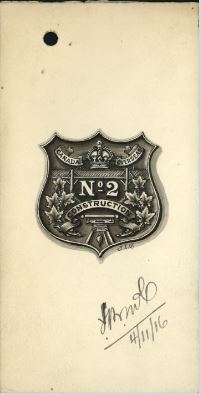
A black-and-white drawing of a badge in the shape of a shield. At the top is a royal crown and a banner reading “Canada Overseas.” Beneath are the words “No. 2” above another banner with the word “construction.” Maple leaves adorn each side, and a wooden bridge below the crown and a tool under the second banner symbolize that the unit’s members were builders.

The cap badge for No. 2 Construction Battalion (e011395922)

Canadian Expeditionary Force service files

  • (unit members are identified by “No. 2 Construction Battalion” in the database’s “Unit” field

Users should be aware that the military service files of over 800 men indicate No. 2 Construction Company as their unit, though many of these men never actually served with No. 2 Construction Company. Instead, they served with other CEF units. The reasons for the discrepancy between the information in personnel files and unit files is not entirely clear. It is likely that Canadian military authorities intended for the men to serve with No. 2 Construction Company, but pressing needs caused them to assign the men to other units. In other cases, the war may have ended before individuals could physically join No. 2 Construction Company.)

The unit was mobilized at Truro, Nova Scotia, in July 1916. It recruited from established Black communities in the Maritimes, southwestern Ontario, and across Canada, the Caribbean and the United States. At least two members were from much farther away: Cowasjee Karachi (regimental number 931759) came from modern-day Yemen, and Valdo Schita (regimental number 931643) was born near Johannesburg, South Africa.

A black-and-white photograph depicting 21 soldiers. They are casually posed outdoors, either sitting or standing on a pile of long wooden planks. Eight of the men appear to be in Russian uniforms, and the rest are Canadians, including two Black men.

Lt. F.N. Ritchie, Lt. Courtney and a few of the enlisted men of the Canadian Forestry Corps in France. This is the only photo of the unit held in the collection at LAC (a022752)

While the unit was composed of Black men, the officers were white, apart from the chaplain, Captain William “Andrew” White.

The unit is referred to by both the terms “battalion” and “company” in archival documents and published sources. It was originally created as a battalion, a unit composed of about 1,000 men in the Canadian Expeditionary Force. When only about 600 men arrived in England in 1917, military authorities redesignated it as a company, which better reflected its size.

The unit returned to Canada at the end of the war and was officially disbanded in September 1920. The story of No. 2 Construction Battalion faded over time, until families, community members and historians began recovering it in the early 1980s. By that time, there were only a handful of surviving members.

A note about terms used in the records

Many of the records documenting No. 2 Construction Company contain terms that were commonly used during the First World War but are no longer acceptable. LAC has replaced such terms in descriptions, but they are still found in many of the original documents. The use of these terms by military authorities is evidence of the racism faced by the men in the unit.


Andrew Horrall is an archivist at Library and Archives Canada. He wrote the blog and, with Alexander Comber and Mary Margaret Johnston-Miller, identified records relating to the battalion

100th anniversary of legendary fishing schooner Bluenose

By Valerie Casbourn

This year marks the 100th anniversary of the first racing victories of the Bluenose, the legendary fishing schooner from Lunenburg, Nova Scotia. The Bluenose was launched in March 1921 and triumphed in the International Fishermen’s Cup Race the following October. Winning the trophy, it sailed into the hearts and minds of those in Nova Scotia and beyond. The remarkable schooner quickly became a well-known Canadian icon.

The inaugural International Fishermen’s Cup Race was held in the fall of 1920, and the Halifax Herald newspaper donated a trophy for the winner. The race was established for working fishing schooners; vessels had to have fished on the Grand Banks for at least one season to be eligible. Elimination races were held off the coasts of Halifax, Nova Scotia, and Gloucester, Massachusetts, to select the challenger from each country. The two finalists then competed to win two out of three races for the cup. The American challenger, the Esperanto, won the trophy races in 1920 and sailed home with the prize. In response, a group from Nova Scotia decided to build a new schooner, giving it the long-standing nickname for Nova Scotians, “Bluenosers,” as a name. A local naval architect, William Roué, designed the Bluenose to be both a competitive racer and a practical fishing vessel. The Smith and Rhuland Shipyard in Lunenburg built the schooner. With an enthusiastic crowd looking on, the Bluenose was launched on March 26, 1921.

Black-and-white photograph of the Bluenose at the finishing line of a race.

The schooner Bluenose crossing the finish line, W.R. MacAskill, 1921 (PA-030802)

The Registrar of Shipping in Lunenburg entered the registration for the Bluenose in its ledger on April 15, 1921. Ship registration records include information about ownership, and also the type, dimensions and means of propulsion of vessels. Library and Archives Canada holds archived records from Ports of Registry across Canada, and many older registers are indexed in the Ship Registrations, 1787–1966 database. The Bluenose of Lunenburg, registered in 1921, is one of seven vessels with the same name in the database.

Some older registers are available on digitized microfilm reels, on a partner website, Canadiana Héritage. The Bluenose appears on page 34 in the Lunenburg shipping register for the years 1919 to 1926 (RG42 volume 1612 [old volume 399]), and a digitized copy is available on microfilm reel C-2441. The Bluenose was official number 150404, and the owner of the vessel was the Bluenose Schooner Company Limited of Lunenburg, Nova Scotia.

Copy of the two-page registration entry for the Bluenose in the ledger of the Registrar of Shipping in Lunenburg, Nova Scotia.

The registration page for the Bluenose from 1921, in the records of the Registrar of Shipping in Lunenburg, Nova Scotia (Reel C-2441, image 615; RG42 volume 1612 [old volume 399], page 34)

Captain Angus Walters and the crew of the Bluenose headed to sea and successfully completed their first fishing season. In October 1921, the Bluenose entered the second International Fishermen’s Cup Race. The Annual Report of the Fisheries Branch of the Department of Marine and Fisheries for 1921–1922 includes a description of the race. After the elimination race to select the Canadian challenger, the Bluenose sailed against the American challenger Elsie in two races and won both. The trophy races were “held off Halifax on Saturday and Monday, October 22 and 24, and enlisted very great interest, visitors being present in large numbers” (Sessional Papers of the Dominion of Canada, 1923, volume 59, number 6, sessional paper number 29, page 38). The annual report describes the second and final race as follows:

The second race, Monday, October 24, the Elsie again being first to cross the starting line—9.00.32—the Bluenose following at 9.01.52. For nearly three hours the Gloucester schooner had the Bluenose trailing in her wake, but the Lunenburg schooner showed her quality on the homeward stretch and crossed the finish line at 2.21.41, followed ten minutes later by the Elsie.

These races have awakened intense interest and will doubtless result in evolving a type of fishing schooner well adapted for both the salt and fresh fish fisheries.

Black-and-white photograph of sailing vessels at the start of a race.

The start of the elimination race, W.R. MacAskill, 1921 (PA-030801)

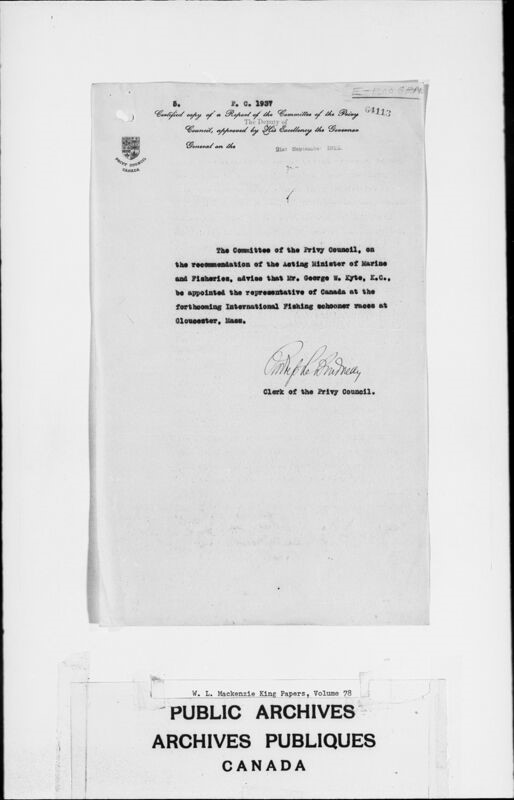
The victory of the Bluenose inspired great pride and interest in Nova Scotia, and this quickly spread further afield. The next year, the International Fishermen’s Cup Race took place off Gloucester, Massachusetts. In honour of the race, a delegation from Nova Scotia attended. The Canadian government also sent a representative and the escort HMCS Patriot. Prime Minister Mackenzie King wrote to George Kyte, Member of Parliament for Cape Breton South and Richmond, on September 23, 1922, to confirm that Kyte would represent the Canadian government at the forthcoming schooner race. The Privy Council passed an Order-in-Council to that effect (PC 1922-1937).

One-page copy of Order-in-Council PC 1922-1937, dated September 21, 1922.

Copy of PC 1922-1937, the Order-in-Council appointing George Kyte, Member of Parliament for Cape Breton South and Richmond, the Canadian government’s representative at the 1922 International Fishermen’s Cup Race (Reel C-2246, image 211; MG26-J1 volume 75, page 64113)

The Bluenose won the trophy again in 1922 and continued to race in the three subsequent International Fishermen’s Cup Races held in 1923, 1931 and 1938. The schooner became increasingly famous. In 1928, the Post Office Department began to depict Canadian scenes on regular issue stamps. The Bluenose was one of the first subjects chosen for a scenic stamp, representing the fisheries, shipbuilding and seamanship of Nova Scotia. Less than a decade after the launch of the schooner, the Post Office Department issued the Bluenose 50-cent stamp on January 6, 1929. The stamp has a composite design that shows the Bluenose racing off Halifax Harbour, based on photographs by Wallace R. MacAskill.

Canada Post 50-cent stamp with an engraving showing two images of the schooner from different angles.

Bluenose, 50-cent postage stamp, date of issue January 6, 1929, copyright Canada Post Corporation (s000218k)

The Bluenose continued to be a working schooner, fishing on the banks of the North Atlantic. The crew set a record for the largest catch of fish brought into Lunenburg. Additionally, the vessel and crew represented Nova Scotia and Canada internationally. The Bluenose sailed to Chicago for the 1933 World’s Fair and to England for King George V’s Silver Jubilee in 1935.

As time went on, circumstances changed, and the schooner was sold in 1942. Sadly, the original Bluenose was lost in 1946 after striking a reef off Haiti and sinking. However, the “Queen of the North Atlantic” is remembered fondly and commemorated in a variety of ways. For instance, Captain Angus Walters and naval architect William J. Roué are each featured on their own commemorative stamps, issued in 1988 and 1998 respectively. The schooner first appeared on the Canadian dime in 1937, and it is featured in a song by Canadian folk singer Stan Rogers. The Bluenose II, a replica of the original vessel, continues to sail from the port of Lunenburg as an ambassador for the province.

Related resources

Nova Scotia Archives virtual exhibit: Bluenose: A Canadian Icon

Canadian Museum of History: Items in the William James Roué collection


Valerie Casbourn is an archivist in the Reference Services Division at the Halifax office of Library and Archives Canada.

Forgotten Flags

By Forrest Pass

In 2015, Canadians observed the 50th anniversary of the National Flag of Canada with its iconic red maple leaf. Library and Archives Canada’s collection features materials related to the tumultuous debate that led to the flag’s adoption in 1965. However, our collection also sheds light on the earlier adoption of some lesser-known Canadian flags, also featuring maple leaves. If these flags proposed in 1870 were still in use, we would be marking their 150th anniversary this year.

Paintings of six early flag designs survive in the records of the Privy Council, attached to an 1870 Order-in-Council. Five of these, based on the Union Jack, served as personal flags for the Governor General and the lieutenant governors of the four original provinces: Ontario, Quebec, Nova Scotia and New Brunswick. The sixth, a British Blue Ensign with a Canadian shield, identified federal government ships such as fisheries vessels.

A painting of a blue flag with a Union Jack design in the upper-left-hand corner and a crest in the bottom-right-hand corner. There is handwriting to the right and at the bottom of the flag.

Proposed Blue Ensign, 1870 (e011309109)

The Governor General’s flag features a wreath of maple leaves This was the first use of the maple leaf on an official Canadian flag. Within the wreath is a shield bearing the coats of arms of the first four provinces. This was Canada’s first national coat of arms, designed by the heralds of the College of Arms in London and proclaimed by Queen Victoria in 1868.

A painting of a flag consisting of a Union Jack design with a crest surrounded by a wreath of maple leaves in the middle. There is handwriting to the right and underneath the flag.

Proposed flag for the Governor General, 1870 (e011309110)

The provincial lieutenant governors’ flags feature the newly designed arms of their respective provinces, each within a wreath of maple leaves. The designs for the Ontario and New Brunswick shields survive unchanged to this day, but time itself has altered the Ontario painting slightly. The anonymous artist may have coloured the top portion, or “chief,” of the Ontario shield with real silver paint. This has tarnished over the years, giving it a dark grey hue. Today, most heraldic artists use white paint to represent the heraldic metal “argent” to avoid this change.

A painting of a flag consisting of a Union Jack design with a crest surrounded by a wreath of maple leaves in the middle. There is handwriting to the right and underneath the flag.

Proposed flag for the Lieutenant Governor of Ontario, 1870 (e011309113)

A painting of a flag consisting of a Union Jack design with a crest surrounded by a wreath of maple leaves in the middle. There is handwriting to the right and underneath the flag.

Proposed flag for the Lieutenant Governor of New Brunswick, 1870 (e011309111)

The fleurs-de-lis, lion and maple leaves of the Quebec arms represent three periods in the province’s history: the French regime, British colonial rule and the Confederation era. The provincial government still uses these arms today, but it added one more fleur-de-lis and altered the colours slightly in 1939. These changes make a stronger visual allusion to the former royal arms of France.

A painting of a flag consisting of a Union Jack design with a crest surrounded by a wreath of maple leaves in the middle. There is handwriting to the right and underneath the flag.

Proposed flag for the Lieutenant Governor of Quebec, 1870 (e011309114)

The arms on the 1870 flag for the Lieutenant Governor of Nova Scotia are different from the provincial coat of arms today and recall a misunderstanding. Today’s Nova Scotia coat of arms dates from Sir William Alexander’s failed attempt to found a Scottish colony in North America in the 1620s. In 1868, the English heralds may not have known about the earlier Scottish design, and they designed an entirely new emblem for the province. The Lieutenant Governor’s flag displayed this new coat of arms, featuring three Scottish thistles and a salmon to honour the province’s fisheries. At the request of the provincial and federal governments, the College of Arms reinstated the original Nova Scotia arms in 1929.

A painting of a flag consisting of a Union Jack design with a crest surrounded by a wreath of maple leaves in the middle. There is handwriting to the right and underneath the flag.

Proposed flag for the Lieutenant Governor of Nova Scotia, 1870 (e011309112)

As the choice of emblems suggests, the impetus for these flags came not from within Canada but from Great Britain. In 1869, Queen Victoria authorized the governor of each British colony to use a Union Jack bearing his colony’s emblem as a distinctive personal flag. In Canada, an unknown artist at the Department of Marine and Fisheries painted these illustrations at the request of the federal Cabinet.

Canadians would not have seen these flags very often; initially, they flew on ships at sea only. As late as 1911, the Lieutenant Governor of Saskatchewan decided that he did not need an official flag because his province was landlocked. Over the years, the federal and provincial governments have adopted new, less “colonial” flags for the Governor General and the lieutenant governors. These fly daily on official residences and on other buildings when the Governor General or a lieutenant governor is present. Preserved in the archives, these paintings recall the British origins of some of our national and provincial emblems.


Forrest Pass is a curator with the Exhibitions team at Library and Archives Canada.

Maritime voices: Alistair MacLeod

By Leah Rae

About 360 kilometres from downtown Halifax, on the west coast of Cape Breton Island, lies the tiny community of Dunvegan. Too small to be a town, Dunvegan is a fork in the road located between Inverness and Margaree Harbour. It was here, in a small, hand-built shed overlooking the Atlantic Ocean (with Prince Edward Island in the distance) that writer Alistair MacLeod spent his summer vacations. It was in this shed that he wrote some of the greatest short stories in the English language and his one and only novel No Great Mischief.

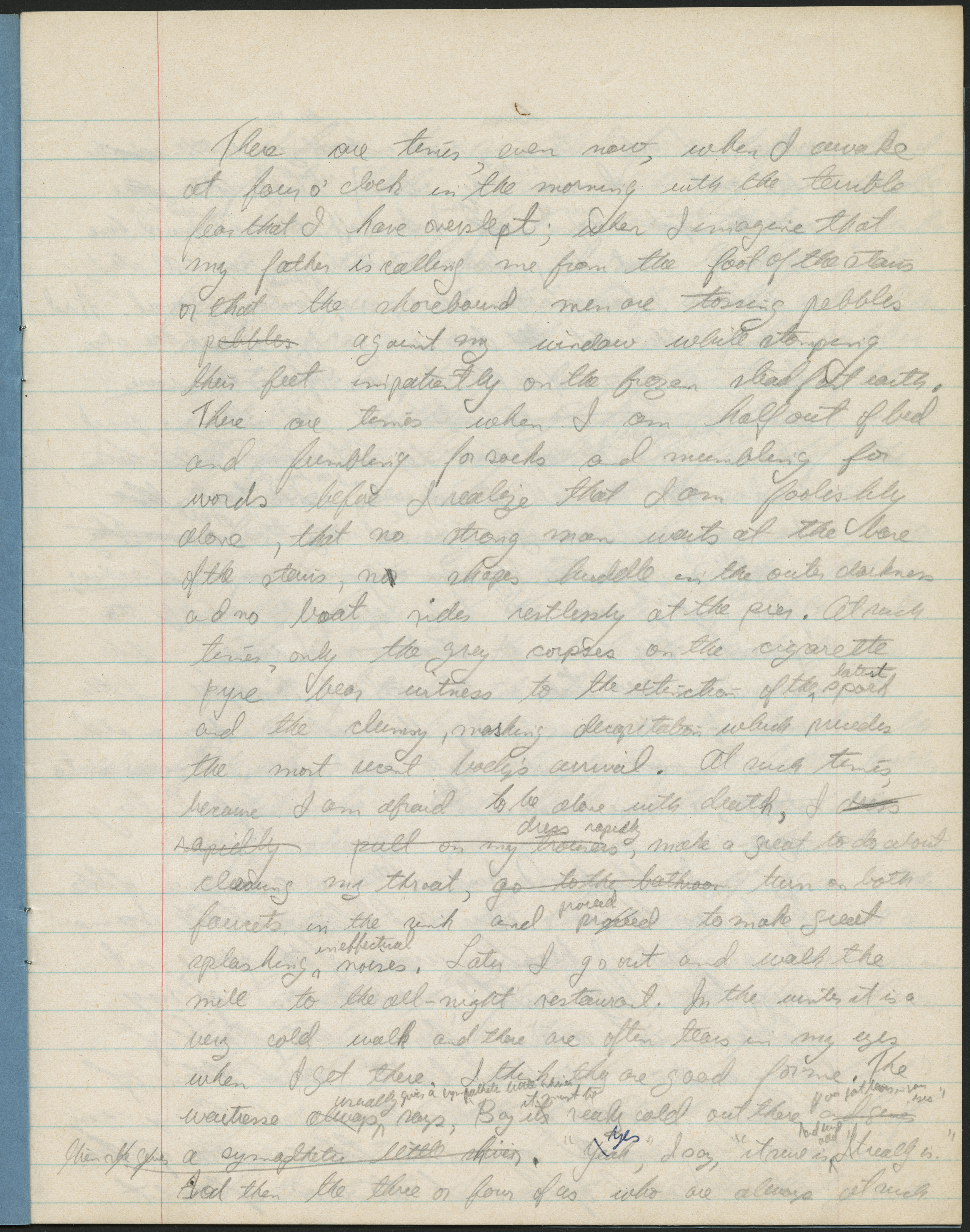
A handwritten first page of The Boat.

Front page of the manuscript for The Boat by Alistair MacLeod. © Estate of Alistair MacLeod (e011213687)

Like many “Capers” before him, MacLeod spent his youth working as a miner and a logger. He used his income to pay for his education, earning both his undergraduate degree and teaching degree from St. Francis Xavier University in Antigonish, Nova Scotia. MacLeod spent his career as an English and creative writing professor at the University of Windsor in Ontario. Between the demands of being a full-time professor and a father to six children, he found it challenging to find time for his writing during the school year. However, during his summer vacations, he and his family returned to the family home in Dunvegan (named for Dun Bheagan on the Isle of Skye in Scotland) where he had the opportunity to focus on his writing. MacLeod’s work examines the daily struggles of the people of Cape Breton Island. What gives MacLeod’s writing its power and its majesty is its lyricism: MacLeod often read his work out loud as a way to perfect the cadence of each line. He was a slow and methodical writer, carefully considering every word. Although he produced a very small body of work in his lifetime, the quality of that work is outstanding.

Library and Archives Canada (LAC) is lucky to be the repository for the Alistair MacLeod fonds. In the early 2000s, LAC acquired about 4.5 metres of material (both textual and graphic) created by MacLeod in Ontario and in Nova Scotia. The material spans his career as both a writer and a teacher. The fonds includes manuscripts, correspondence, essays, thesis notes, clippings, photos of MacLeod and more.

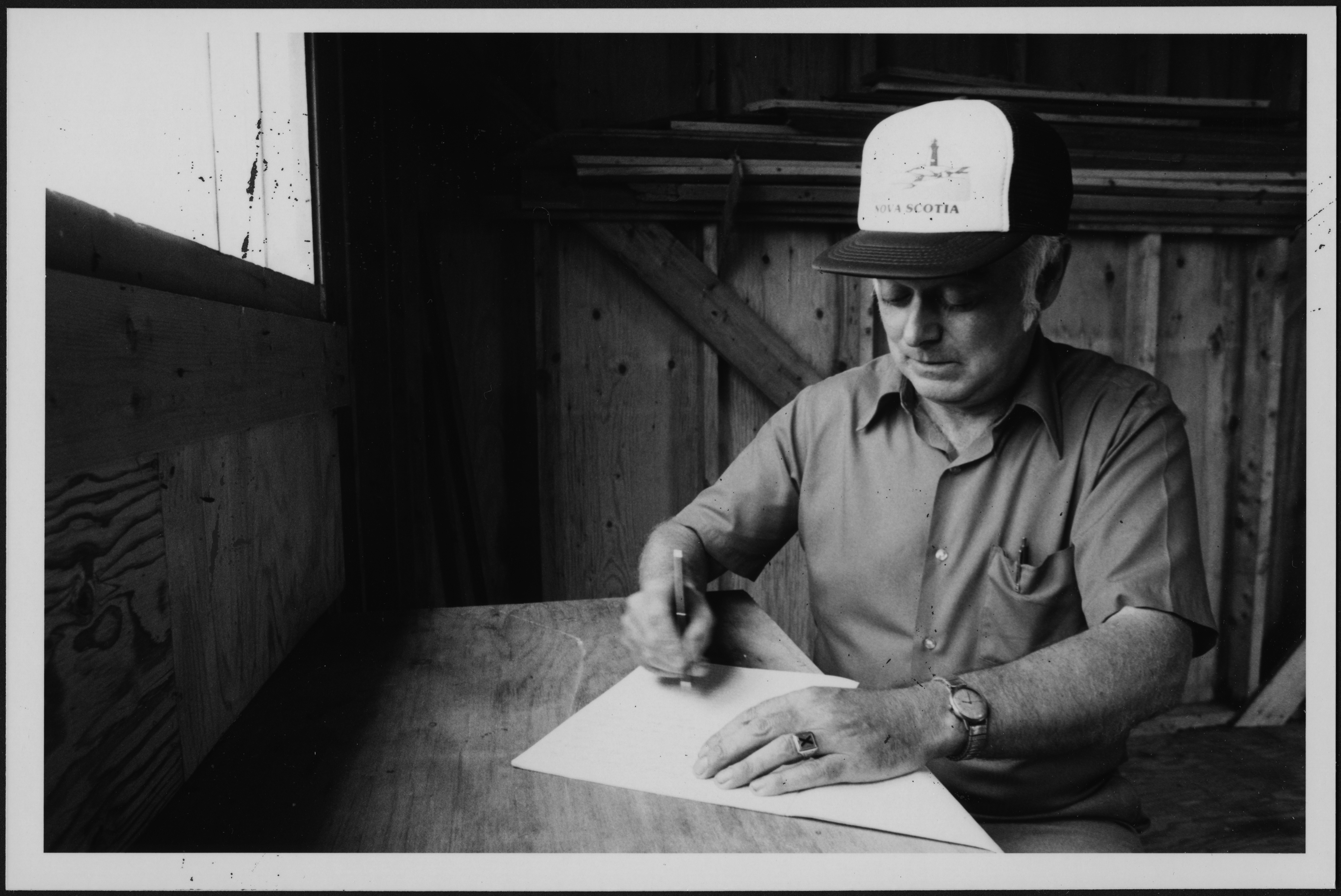
A black-and-white photograph of a man sitting at a rough desk with paper and pen in hand.

Alistair MacLeod working in his writing shed in Dunvegan, Nova Scotia. © Chuck Clark (e011213686)

Looking at MacLeod’s original manuscripts gives us a fascinating glimpse into his process as a writer. He was known in the Canadian literary community as a perfectionist, and you can see this is true in his manuscripts. The first draft of his short story The Boat is handwritten in an examination booklet from Notre Dame University (where MacLeod earned his PhD). If we look at the published version of the first paragraph of that story—perhaps one of the most beautiful paragraphs in English literature—it is nearly identical to the author’s draft version.

MacLeod continued the practice of handwriting his work throughout his career (a practice perhaps perceived by many writers today as very old fashioned!) He also wrote part of his manuscript for his novel No Great Mischief by hand. It is quite a special thing to see a work of this calibre written in long hand rather than as typewritten words on a page that we are so used to seeing nowadays. It gives you a very personal sense of MacLeod working diligently away during his few precious hours of free time, overlooking the beautiful cliffs of Cape Breton and the sea below.


Leah Rae is an archivist based in Halifax in the Regional Services and ATIP Division of Library and Archives Canada.

Images of Nova Scotia now on Flickr

Nova Scotia is one of three Maritime provinces in Canada, with New Brunswick to the northwest and Prince Edward Island to the north across the Northumberland Strait. The Mi’kmaq are the dominant First Nations group in the area, with ancestral roots tracing back 10,000 years.

Interactions between First Nations groups and French settlers early during the fur trade were positive overall, and Nova Scotia in time became part of the area called Acadia. Yet, over the course of the 18th century, Britain gained control of all of France’s possessions in North America and renamed these colonies. After the American Civil War, the migration of Loyalists northward drove up the British colonial population, as settlers with grants claimed the land and pushed the Mi’kmaq to the margins of their territory.

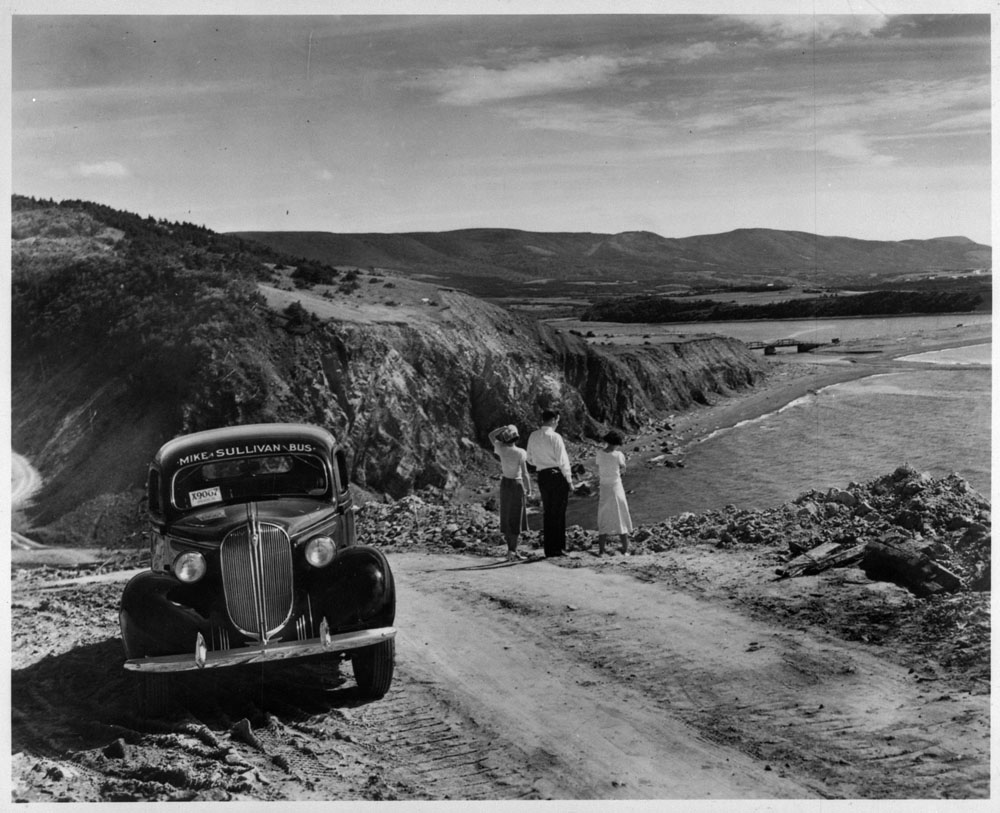
Black and white photo of two women and a man standing on the edge of a dirt road near the coast looking at the ocean

Tourists with Mike Sullivan’s Bus take in the view at Cape Breton Highlands National Park, Nova Scotia (MIKAN 3265746)

Nova Scotia was awarded responsible government in 1848, ahead of the other British colonies, and took part in the road to Confederation. It became one of the first Canadian provinces in 1867 under pro-Confederation leader Charles Tupper. However, many Nova Scotians were largely against it, voting for an anti-Confederation government in the following provincial election.

Did you know?

  • Nova Scotia is Latin for “New Scotland,” named for its first Scottish settlers during the British colonial period.
  • Nova Scotia was home to the largest free Black settlement in North America, inhabited by Black Loyalists who migrated north after the American Revolution.

Visit the Flickr album now!

Portia White: In honour of the 75th anniversary of her Toronto debut

By Joseph Trivers        

Throughout the 20th century, great operatic singers have populated Canada’s cultural landscape—from Raoul Jobin, Maureen Forrester and Jon Vickers to Gerald Finley and Measha Brueggergosman. Their lives are often as dramatic and inspiring as the roles they play on stage in an opera. The life of Portia White, Nova Scotian contralto, was no exception. Praised for her radiantly beautiful and consistently even tone as well as her regal and dignified stage presence, White was the first African-Canadian concert singer to win international acclaim. November 7, 2016, marks the 75th anniversary of her triumphant national debut in Toronto and gives us a welcome opportunity to reflect on her life, accomplishments and career.

“I really made my debut here [in Toronto] when I sang in November, 1941. It was my fourth professional engagement, but it was my first big city. The next day I received a contract. I always feel it was Toronto which discovered me.” – Portia White

White’s remarks about her debut in Toronto might give the impression that her success came quickly. However, the path to that 1941 concert, and the contract that followed, was marked by years of hard work, some good fortune, and plenty of support from her family and the people and governments of Halifax and Nova Scotia.

Early life and education

It seemed as if Portia was destined for a career in the performing arts and to have a strong and determined character. She was given the name Portia after the heroine of Shakespeare’s Merchant of Venice by a family friend. In the play, the character Portia achieves her goal of marrying the suitor of her choice through intelligence, grace and quiet determination. Whether or not such a name foreshadowed these same traits in Portia White, her upbringing certainly encouraged them.

Her parents were themselves remarkable people. Her father, the Reverend William A. White, was the son of freed slaves from Virginia, only the second African-Canadian admitted to Acadia University and the first to receive a doctorate in Divinity from Acadia. He also served as the only black chaplain in the British Army in World War I. Portia’s mother, who was descended from Black Loyalists in Nova Scotia, gave Portia her first music lessons. The family moved from Truro, Nova Scotia, to Halifax after Portia’s father returned from the First World War and became the pastor of the Cornwallis Street Baptist Church.

The family’s life was centred around the church, so it is no surprise that much of Portia’s early musical life and education began there. She began singing in the church choir under her mother’s direction. She later took teacher training at Dalhousie and became a teacher in black Nova Scotia communities such as Africville and Lucasville. The work helped to pay for her music lessons. Throughout the 1930s, she took lessons from Bertha Cruikshanks at the Halifax Conservatory of Music. A scholarship enabled White to study with the Italian teacher Ernesto Vinci at the Conservatory in 1939. It was Vinci who began to have her train and sing as a contralto.

Toronto and beyond

Portia White first gained recognition and acclaim in Nova Scotia by performing in local festivals and benefit concerts and by singing on her father’s weekly radio program. She won the Helen Kennedy Silver cup at the Halifax Music Festival in 1935, 1937 and 1938. Further opportunities beckoned when Edith Read, principal at Branksome Hall, a private girls’ school in Toronto, heard her singing. Read was originally from Nova Scotia and was on vacation from Toronto at the time. It was through the support of the Branksome Ladies Club that White came to sing at Eaton Hall in Toronto on November 7, 1941.

The Toronto concert was such a success that White was immediately offered a contract by a branch of Oxford University Press for concerts and a touring career. She resigned from her teaching job to devote more time to her music. In 1942 and 1943 she toured across Canada, which helped boost her Canadian reputation, eventually giving a command performance for the Governor General. White eventually gave her first performance in the United States at New York City’s The Town Hall, in March 1944, to wide acclaim. She moved to New York to be closer to her managers, and was supported financially by the governments of Halifax and Nova Scotia through the Nova Scotia Talent Trust. It marked the first time two different levels of government came together to support an artist’s career. White signed with Columbia Concerts Incorporated and went on to tour Canada, parts of the United States, the Caribbean, and Central and South America.

Later career and legacy

Concert life was hectic, and White eventually began to feel she didn’t rest enough between concerts and travelling. She started experiencing difficulties with her voice, and some critics began complaining of flaws in her voice. This, and disagreements with her managers, led White to retire from public performance. She settled in Toronto, where she took further singing lessons at the Royal Conservatory with the soprano Gina Cigna. She also taught singing privately and at Branksome Hall. White did perform again, throughout the 1950s and 60s, but not very often. One such notable concert was for Queen Elizabeth on October 6, 1964, at the Charlottetown Confederation Centre of the Arts in Prince Edward Island. Less than four years later, in February 1968, White passed away in Toronto after a battle with cancer.

As an artist, Portia White was renowned for her versatility and varied repertoire. She was equally at home singing spirituals as she was singing arias from Italian operas, German Lied or French mélodies. No commercial recordings of White were made during her lifetime; however, Library and Archives Canada (LAC) acquired audio recordings, from the White family, of concerts she gave in Moncton, New Brunswick, and New York City. Some commercial recordings were released posthumously, including the album Think on Me from 1968, two songs on the Analekta label’s Great Voices of Canada (Volume 5), and the album First You Dream (1999), all of which are in LAC’s collection. A documentary, Portia White: Think on Me, was directed by Sylvia Hamilton and released in 1999. White’s legacy continues to live on in the trust fund that was created in her name. Each year the Nova Scotia Talent Trust presents the Portia White Scholarship to a young person showing “exceptional potential as a vocalist.” The Government of Canada named Portia White a person of historical significance 1995 and honoured her with a millennial stamp issued in 1999.

A colour stamp featuring, in the foreground, a young woman singing and, in the background, a close-up of the woman’s face with her eyes closed. A musical score with notes and lyrics appears faintly in the bottom half of the stamp.

Portia White: Irrepressible Talent [philatelic record], 46-cent Canadian millennial stamp (MIKAN 2266861)


Joseph Trivers is Music Acquisitions Librarian in the Published Heritage Branch at Library and Archives Canada.