The Children of Topley – Pint-sized portraits from the William Topley collection

The William Topley collection at Library and Archives Canada is an invaluable resource for those interested in nineteenth-century Canadian photographic portraiture. Comprised of over 150,000 glass plate negatives as well as studio proofs and counter books, the Topley collection dates from 1868 to 1923, and illustrates the prolific career of Topley, a Montreal-area native, who began his solo career by opening a branch of the William Notman studio on Ottawa’s Wellington Street. While Topley did photograph subject matter other than people, portraits were his chosen specialty and the collection is a wonderful example of early Canadian studio work.

By the early 1870s Topley had purchased the studio he had been managing for William Notman, and was attracting upwards of 2,300 sitters per year. Topley’s prestigious downtown Ottawa location—he moved multiple times over the years, but always within walking distance to parliament—meant he attracted much of the city’s elite, including politicians and other important figures, who made their way to the photographer’s studio to have their portraits taken.

Children were often the subject of these portraits, posing alone or with siblings. In looking through these images we notice not only recognizable names, identifying some of these children as the offspring of the capital city’s movers and shakers, but something unchanged despite the time period. We see beyond the formality, the constricting clothing and stiff poses, and recognize that these portraits are not too different from those we might take today. We recognize children dressed up for a photo, attempting to sit still, looking either overly eager or slightly bored.

Black-and-white photograph of a young girl in a white dress.

Missie McLaren, 1873 (MIKAN 3461050)

Studio photographers of this era often had clients pose with props, and Topley was no different. In his portraits of children we notice items like books, skipping ropes, dolls or pets clutched in the hands of the small sitters. Some children stand or sit up very straight with serious, concentrated expressions on their faces, while others lounge tiredly in chairs. In these ones especially, we can imagine how tedious the long exposures must have felt to a child, how many plates the photographer might have had to take to get a proper, non-blurry image.

Black-and-white photograph of a young girl with her chin resting on her hands, a book beside her.

Missie Cambie, 1877 (MIKAN 3435180)

Also interesting are the portraits of babies with hidden, or barely-in-the-frame mothers. It was quite common at the time for babies to sit on their mothers’ laps for a portrait, while a blanket or other fabric was thrown over the mother so that only the baby would be the focus. In several of Topley’s portraits of babies, we see a more subtle approach, with the mother encouraging the child from the edge of the frame. The photographer would later crop the mother out for the final print.

Black-and-white photograph of a young child with the mother to the right, partially blacked out.

Missie Ruttan, 1876 (MIKAN 3434482)

These wonderful portraits provide an alternative perspective on the face of Canada’s capital in the nineteenth century, and seem to offer a bridge from past to present, where some things never change.

Black-and-white photograph of two young boys in black jackets, one seated and one standing on a chair.

Two boys posing—Master Borthwick, 1882 (MIKAN 3418410)

Black-and-white photograph of a young girl dressed in winter clothing.

Missie Helena Topley, 1882 (MIKAN 3418246)

Related resources:

Ottawa Winter Carnival, 1922 edition

Version française

“A Week Without Worry!”… “Mirth Will be King for Carnival Week.” These were some of the slogans used to describe the first Canadian National Winter Carnival—otherwise known as the Ottawa Winter Carnival—of 1922. This was no tame affair. Instead, for a week at the end of January and early February 1922, Ottawans partied—and even went foolishly wild.

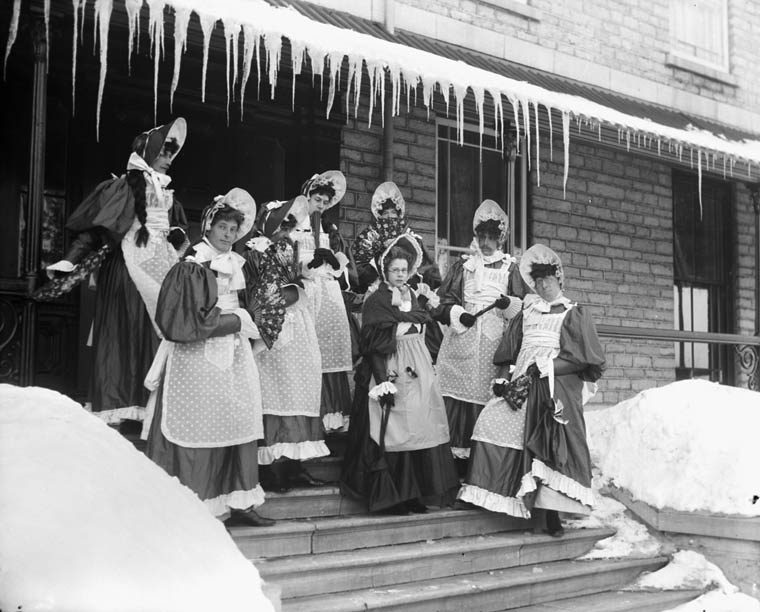
Canadians were used to winter parties. Since the late 19th century, there had been somewhat more genteel winter carnivals, which featured ice forts, informal skating parties and hockey matches. During these, there was only the occasional leap into the absurd. An example is the February 1894 skating masquerade at Rideau Hall where Lord Aberdeen’s male staff dressed up as schoolgirls:

Black-and-white photograph showing eight people standing on a snowy staircase, holding decorative fans. They are all wearing similar costumes comprised of dresses, pinafores and bonnets. Close inspection reveals that some of them have mustaches and look somewhat masculine.

Lord Aberdeen’s staff dressed as schoolgirls for a masquerade skating party at Rideau Hall, called “Dame Marjorie School”. (MIKAN 3422882)

The 1922 Ottawa carnival was the brainchild of stock broker and mayor, Frank Plant. He organized everything within a matter of weeks. Lord Byng, the Governor General, was asked to open the festivities, which he did outside the Château Laurier on Saturday, January 28, 1922, with 10,000 people in attendance.

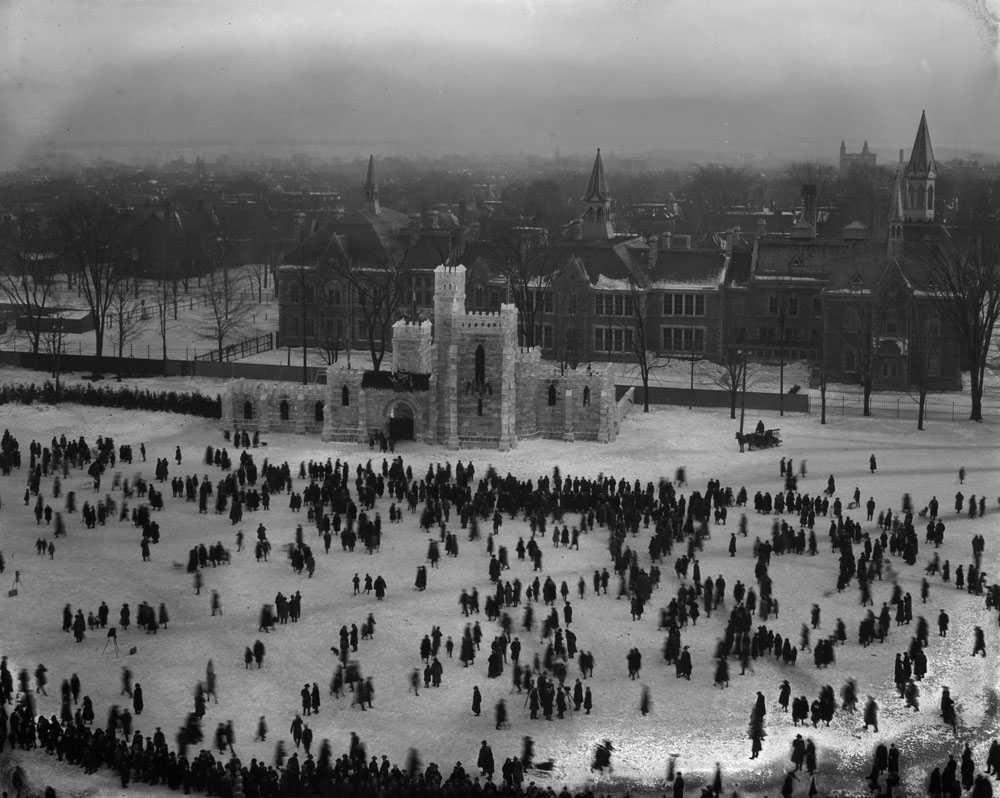
Black-and-white photograph of an ice castle taken from a very high vantage point. Crowds of people are milling about and the city fades into the distance.

Ice Palace at the Ottawa Winter Carnival. (MIKAN 3517932)

The carnival included the following activities:

  • torchlight snowshoe parades on downtown streets
  • a grand ball at the Château Laurier
  • hockey matches between the Ottawa Senators and the Montreal Canadiens
  • curling and boxing
  • nightly bean dinners in Lowertown
  • giant bonfires at Major’s Hill Park and at Connaught and Cartier Squares
  • ice castle climbing
  • midnight dances
  • horse-drawn passenger cutters that ferried people around the city
  • ski jumping off the cliffs at Rockcliffe Park

Although prohibition was in effect in the province of Ontario, alcohol was still legal in neighbouring Quebec. And with the exuberant party atmosphere, authorities turned a blind eye to the reveling hordes travelling back and forth across the river from Hull (now Gatineau) with bottles of booze.

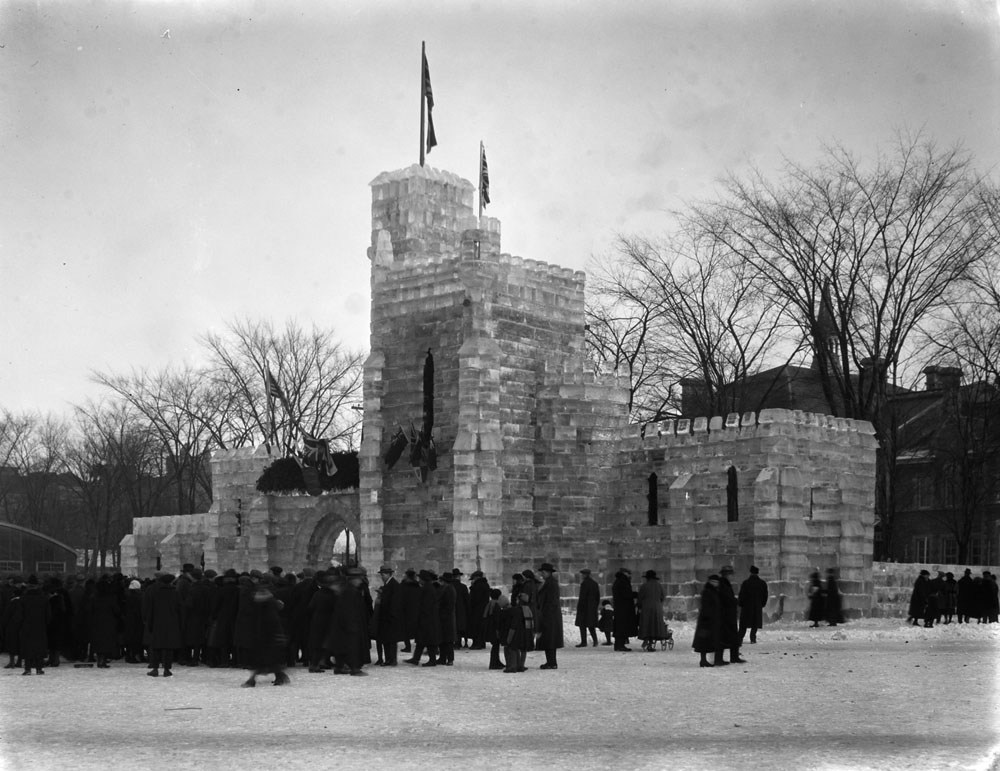
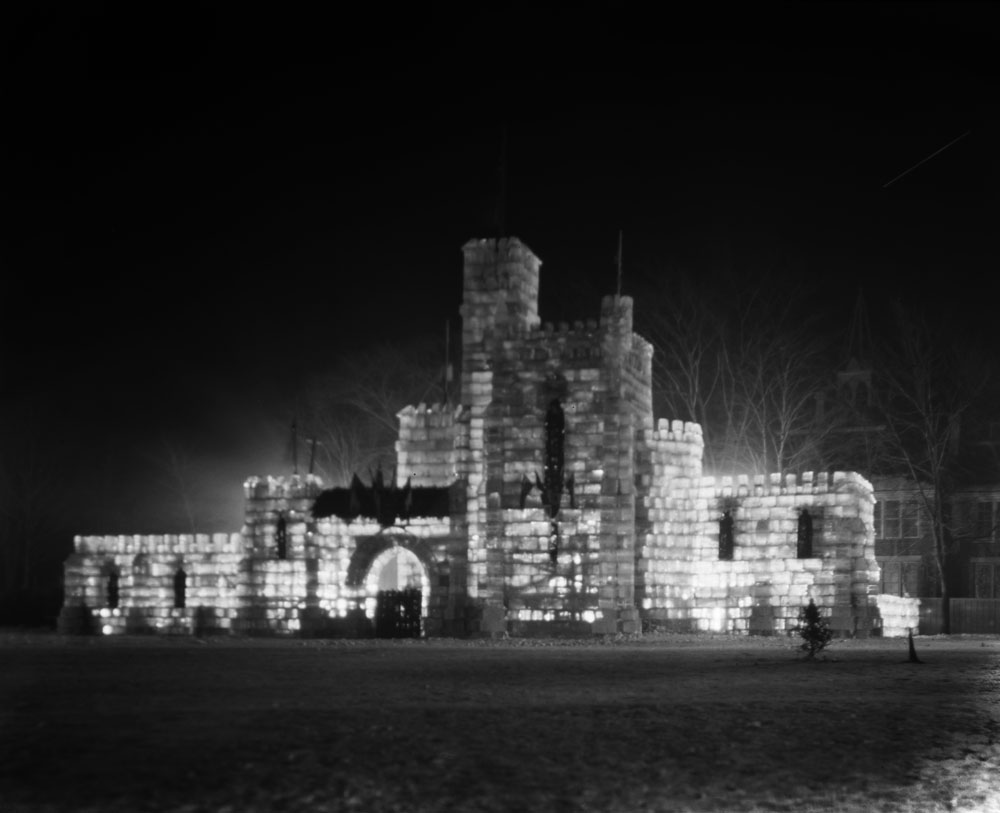
There were three major attractions. The first was the 22-metre Ice Palace located at Cartier Square on Elgin Street.

Black-and-white photograph showing many people standing, possibly queuing, around an ice castle.

The Ottawa Winter Carnival Ice Palace during the day. (MIKAN 3517934)

Black-and-white photograph showing an ice castle, brightly illuminated from the inside.

Ottawa Winter Carnival Ice Palace at night. (MIKAN 3517933)

The second attraction was the giant ice column that towered over Connaught Square (now Confederation Square, roughly where the National War Memorial is located) between Union Station, the old Post Office, and the Château Laurier.

Black-and-white photograph of an ice column topped with a crown. A man stands beside it.

Ice column in front of the old Post Office (presently the location of the National War Memorial), Ottawa Winter Carnival, Jan. and Feb., 1922. (MIKAN 3384979)

And the pièce-de-résistance—the ski and toboggan slide.

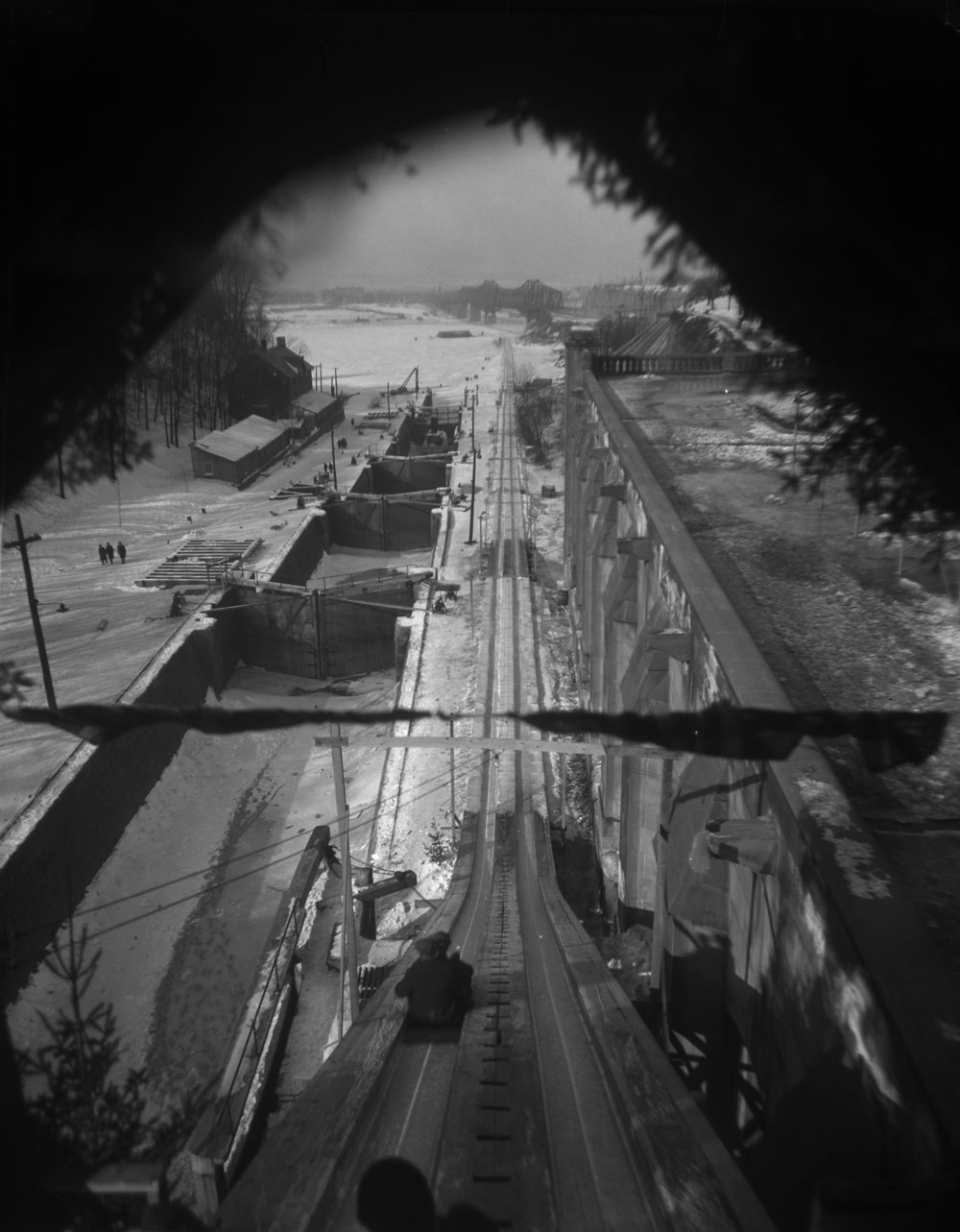
“Ride a mile for a dime” was the slogan attached to this breathtaking chute. Built out of ice blocks with deep tracks, it extended from the Château Laurier down to the Ottawa River following the side of the Rideau Locks. The departure gate looked like an innocent-enough rustic wooden construction covered in evergreens. But when you entered and looked down, this is what you saw:

Black-and-white photograph of a view of the toboggan chute looking down towards the river and beside the Rideau Canal Lock. The track is very long and steep, and almost reaches the Alexandra Bridge in the distance.

Ski and toboggan chute for the Ottawa Winter Carnival. (MIKAN 3517935)

If you were brave enough to venture forward, the chute fell at a daring 45-degree angle which levelled out somewhat before being punctuated by a series of steep dips, rather like a roller coaster. (For more views, see the Flickr album). Lord Byng presided over the first toboggan ride, which held Mayor Plant, prominent businessman A.J. Major, and two others. Throughout the week, daredevil ski jumpers would conduct daily demonstrations on the slide. And the rest of the time, thrill seekers bravely took the plunge on toboggans, racing down and out onto the frozen expanse of the Ottawa River at speeds of over 100 kilometers an hour!

When the week was over, the first Canadian National Winter Carnival was declared a resounding success, with tens of thousands of revelers (the city’s population had only just reached 100,000). The present-day equivalent of the Canadian National Winter Carnival—Winterlude—now garners more than half a million visitors every year.

Capital City Portraits: Faces from the Topley Collection

One of the most popular collections at Library and Archives Canada is the William James Topley photograph collection, acquired in 1936. The Topley collection is comprised of over 150,000 glass plate and nitrate negatives, in addition to 68 studio proof albums, daily assignment logs and account books.

Dating from 1868 to 1923, the large collection illustrates the prolific career of Topley, a Montréal-area native, who began his solo career by opening a branch of the William Notman studio on Ottawa’s Wellington Street. Having worked in Montréal for a number of years as an apprentice to the well-known photographer, William James Topley, would eventually drop the Notman name and run his own studio from a series of Ottawa addresses, moving from Wellington Street to the corner of Metcalfe and Queen, and finally to two separate addresses on Sparks Street.

The photographs produced during Topley’s lengthy career serve as a fascinating visual reference to life in Ottawa, as well as other Canadian cities and towns. His images include street scenes documenting daily life, commissioned photographs of store fronts, Parliament Hill before, during, and after the 1916 fire, and perhaps most compelling, his portraits of citizens, both famous and otherwise.

By 1872, the Topley studio was attracting more than 2,300 sitters a year, including prime ministers, governors general, members of Ottawa’s high society, businessmen, and average citizens. He created his famous composite image of the first major Canadian fancy dress ball, hosted by the Earl of Dufferin and his wife, in 1876.

Many of Topley’s clients were the families of Ottawa’s movers and shakers. Being the capital city, it was common for relatives of politicians, land owners and lumber barons to make their way to Topley’s studio at some point, to sit for a portrait. In the early nineteenth century, it was still a somewhat prestigious event to have your portrait taken, and wives, children, and even pets were photographed at the studio, some of them multiple times over the years.

In viewing these wonderful portraits, it is fascinating to see the clothing, hairstyles, and expressions of Ottawa’s earlier citizens, and interesting to see the faces of people for whom some of Ottawa’s streets, parks and schools are named.

Miss Powell, 1870

Miss Powell, 1870 (MIKAN 3479280)

Miss E. Pattie and cat, 1873

Miss E. Pattie and cat, 1873 (MIKAN 3461227)

Mr. Brewer, 1875

Mr. Brewer, 1875 (MIKAN 3433630)

Miss Sparks and Miss Magee, 1889.

Miss Sparks and Miss Magee, 1889 (MIKAN 3448969)

Mrs. Bronson, 1869

Mrs. Bronson, 1869 (MIKAN 3478860)

Other local portait sitters

For further research