Reflecting on my path in photography

Version française

By Ellen Bond

Photos surround us every day. Whether its framed photos hanging on a wall, advertisements seen as you drive by, or folks taking selfies, images are everywhere. In honour of World Photography Day, I want to share how much photography means to me and how it has shaped my world.

Photography brings me joy. I remember my parents’ Polaroid camera and the excitement of seeing the photo magically appear after it slid out of the camera and the air exposed the image. Though the quality wasn’t as great compared to a film camera, the instant gratification was like today’s cell phone cameras—you could see what you captured right away.
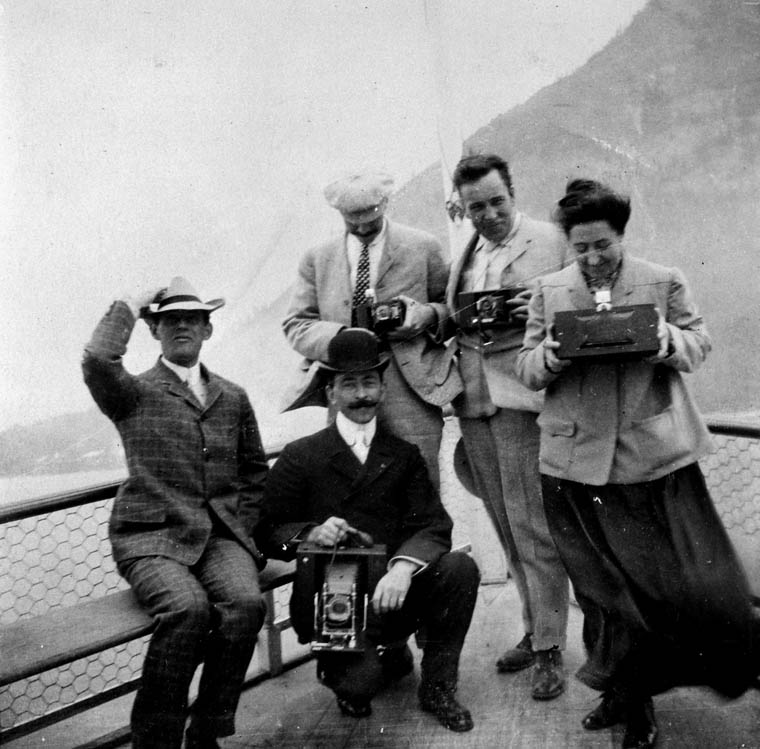
A woman and four men posing for a photograph. Four of them are holding cameras of their own.

People showing various types of cameras, 1904. (a148285)

While finishing my photography diploma, I began taking pics for a community newspaper in Ottawa. This had me visiting local stores and events and interviewing and photographing locals for a regular feature. The summer between my first and second year, I shot thousands of photos in and around Ottawa. At the end of my last semester, our class took a field trip to Library and Archives Canada’s (LAC) Preservation Centre in Gatineau, and I knew I wanted to work there.
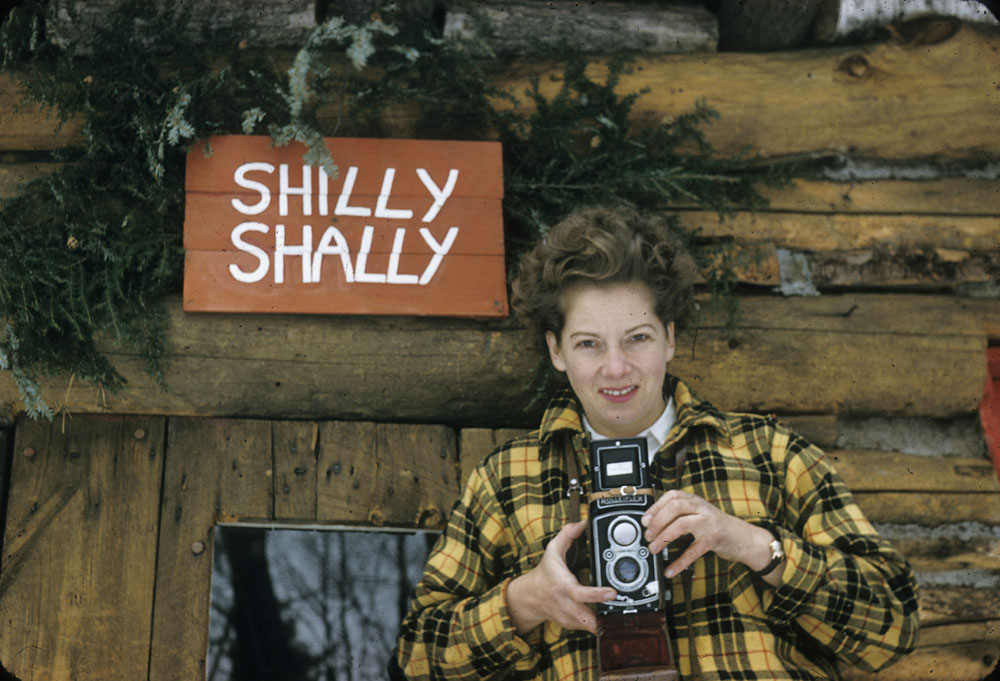
Woman holding a camera while posing for a picture leaning against a wooden cabin with a Shilly Shally sign.

Photographer Rosemary Gilliat Eaton holding a twin-lens camera. LAC holds many of Gilliat’s photos in its collection. Credit: Rosemary Gilliat Eaton. (e010950230)

In the summer of 2016, after graduating, my vision came true. I began working on LAC’s Canadian Expeditionary Force digitization project, during which time I helped digitize over 622,000 files relating to Canadians who served in the First World War. You can now search for those files by name using LAC’s Personnel Records of the First World War database. I used my skills to digitize a variety of files, maps, certificates, X-rays, pay forms, medical forms, attestation papers, personal correspondence, and too many files labelled “missing in action” or “killed in action.” I gradually learned more and more about LAC and applied for a job with their Online Content team.

When I started working with the Online Content team, I contributed to blog posts, the podcast, and finding photos for Flickr albums. I also began working on Project Naming and eventually became the project manager of this endeavour, which is rooted in sharing historical photographs of First Nation, Inuit and Metis Nation people whose names were not recorded when their photos were captured.
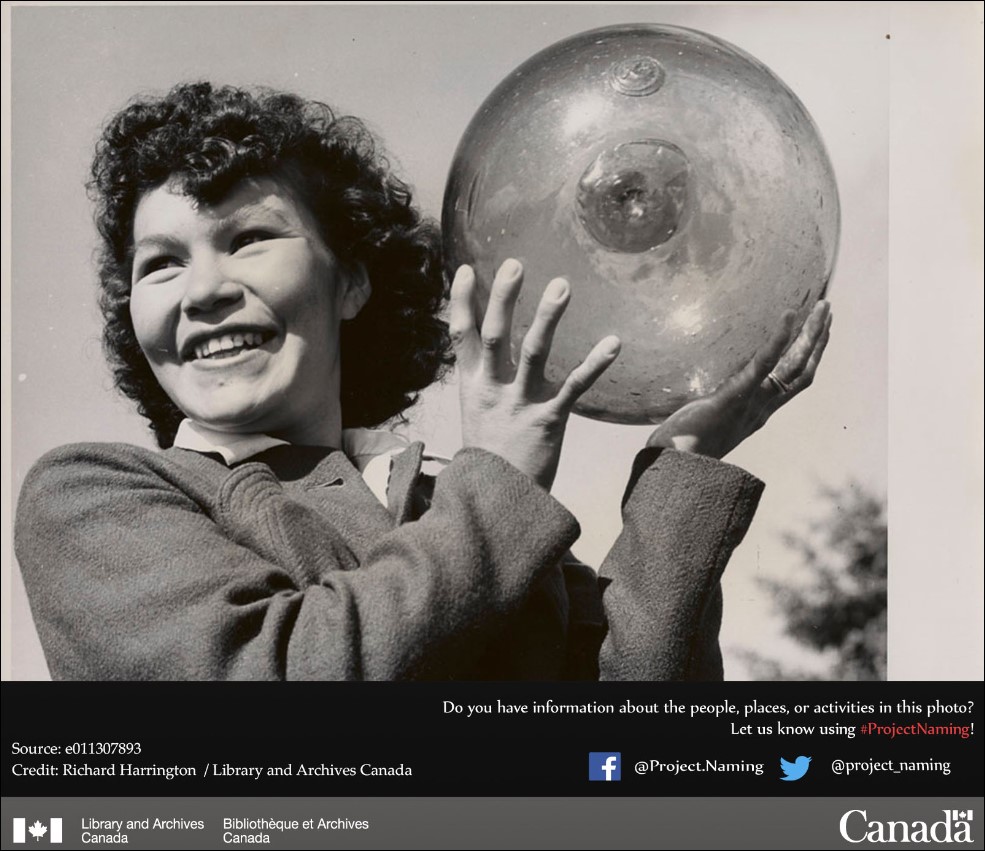
A photo used as part of Project Naming with text inviting the public to provide information about the person photographed.

A Haida woman holding up a Japanese glass net float, Skidegate, Haida Gwaii, British Columbia, ca. 1959. Thanks to Project Naming, the person in this photo was identified as Flossie Yelatzie, from Masset. Credit: Richard Harrington. (e011307893)

Participation in Project Naming helps improve the narrative of photographic records held at LAC. Photos are posted three times a week on Project Naming’s social media pages. When names or information are received, the records are updated, which helps preserve and honour the people in the photos for generations to come. As a way of saying thank you, we offer a high-resolution print of the photo at no charge to the people who shared the information. The best part of my job is adding someone’s name to the record database. That name becomes attached to the record, making it searchable forever.

Outside of LAC, I continue to hone my photography skills by working for local college athletic teams and theatres, a local newspaper, other athletic teams, and various Ottawa events. This past year, I photographed the Professional Women’s Hockey League (PWHL) for The Hockey News. This led to an opportunity to take photographs at the 2024 International Ice Hockey Federation (IIHF) Women’s World Championships, where Canada defeated the United States in the gold medal game. I hope to someday donate my hockey photos to LAC to document the first year of the PWHL, Canada’s gold-medal win, and this major step in women’s hockey.

Female hockey players celebrating their win on the ice with the crowd celebrating them in the background.

The moment after Canada defeated the United States for the gold medal at the 2024 IIHF Women’s World Hockey Championship. Photographer: Ellen Bond.

Female hockey players posing with their gold medals, championship banner and trophy on an ice rink.

Team Canada, 2024 IIHF Champions. Photographer: Ellen Bond.

I look forward to the future with my camera in hand!


Ellen Bond is a Project Manager with the Online Content team at Library and Archives Canada.

Judith-Pauline White, Nunatsiavut photographer

On the left of the graphic, Tatânga Mânî [Chief Walking Buffalo] [George McLean] in traditional regalia on horse. In the middle, Iggi and girl engaging in a “kunik”, a traditional greeting in Inuit culture. On the right, Maxime Marion, a Métis guide stands holding a rifle. In the background, there is a map of Upper and Lower Canada, and text from the Red River Settlement collection.By Heather Campbell

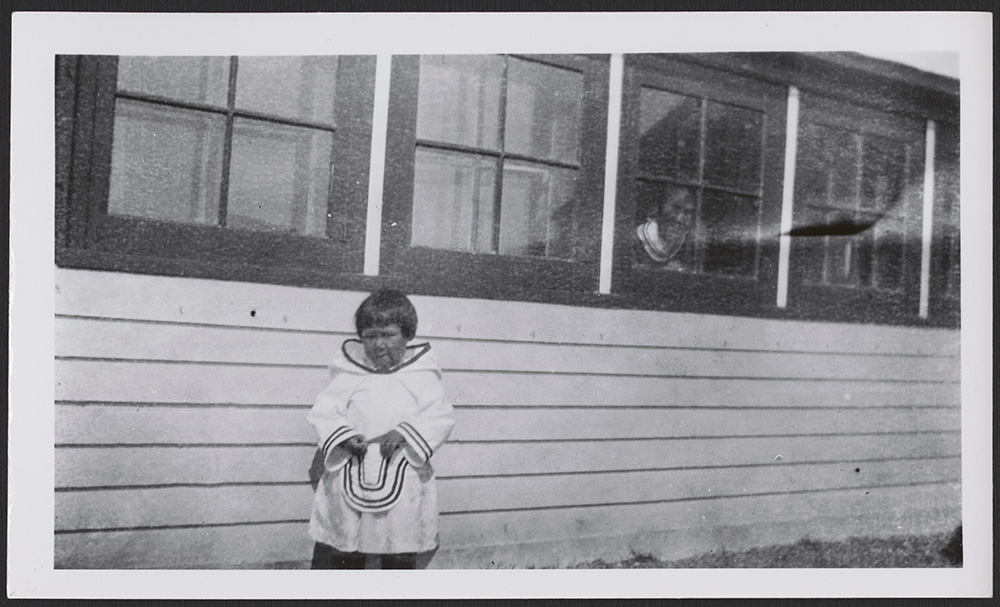
A black-and-white photograph of an Inuk girl facing the camera. The young girl is wearing a white amauti (a girl’s or woman’s coat with a large hood) and stands in front of a building as a woman peeks out from a window behind her.

An Inuk girl stands as a woman peeks out from a building behind her, circa 1900–1950 (e011307844)

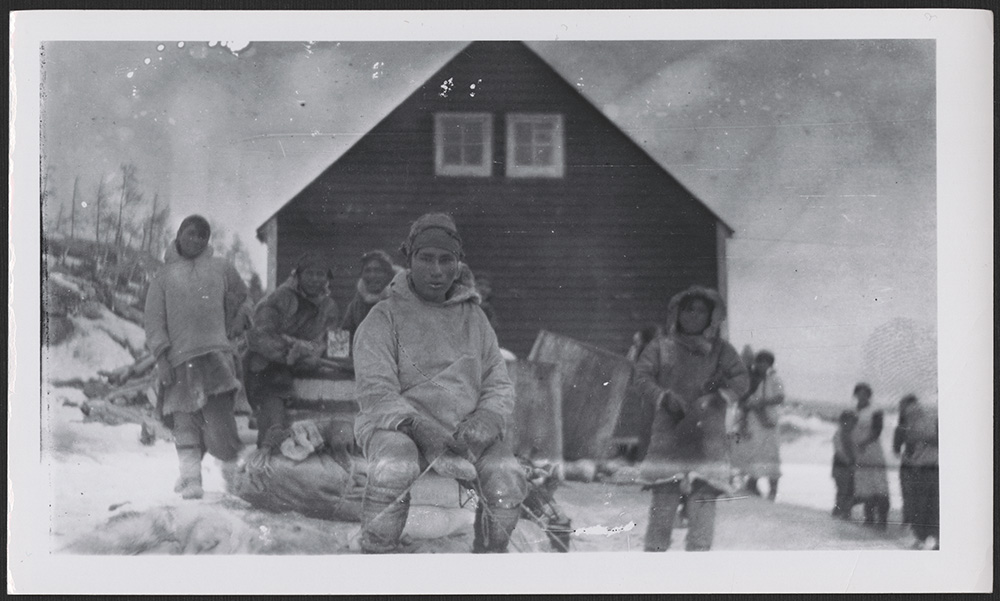
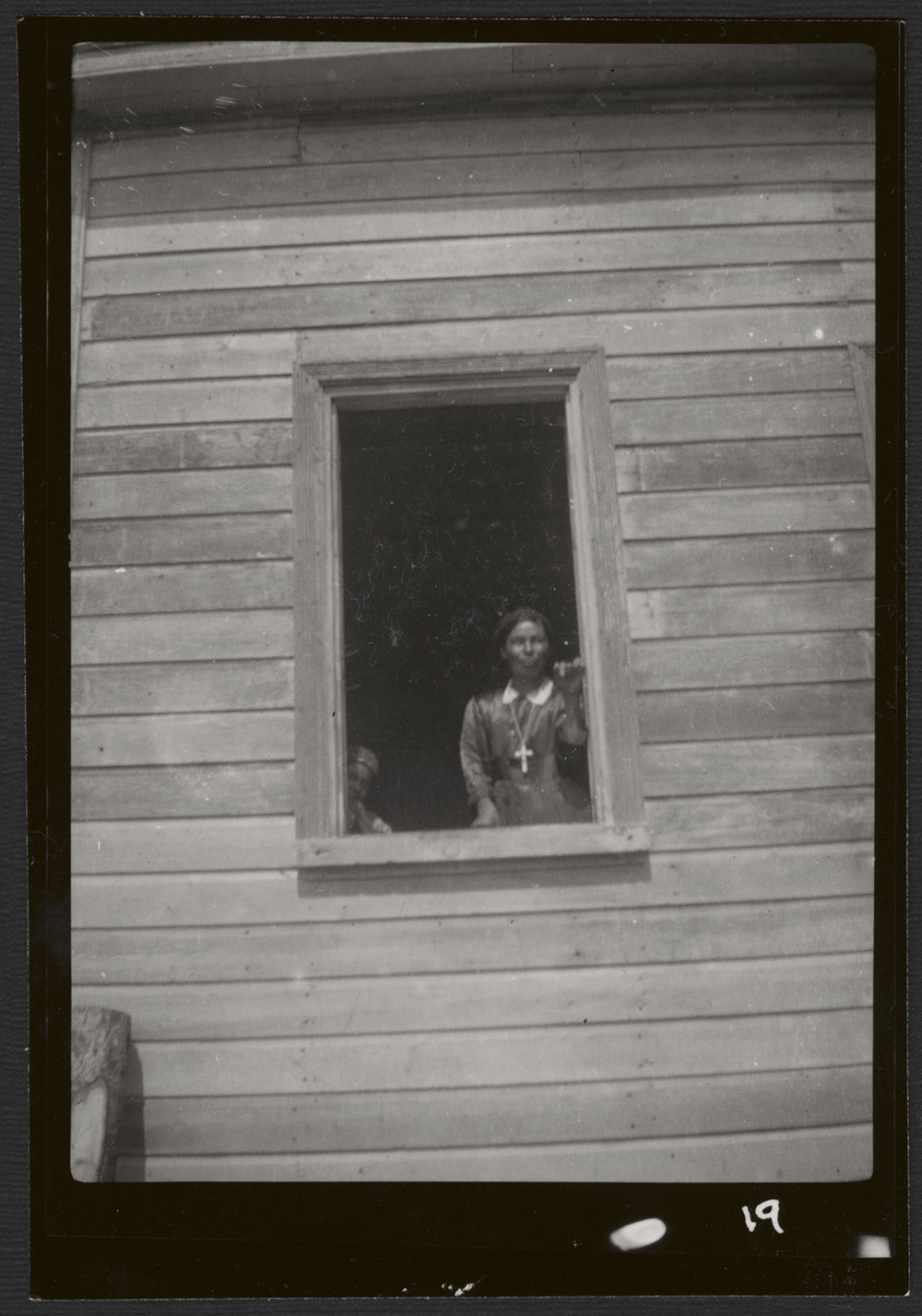
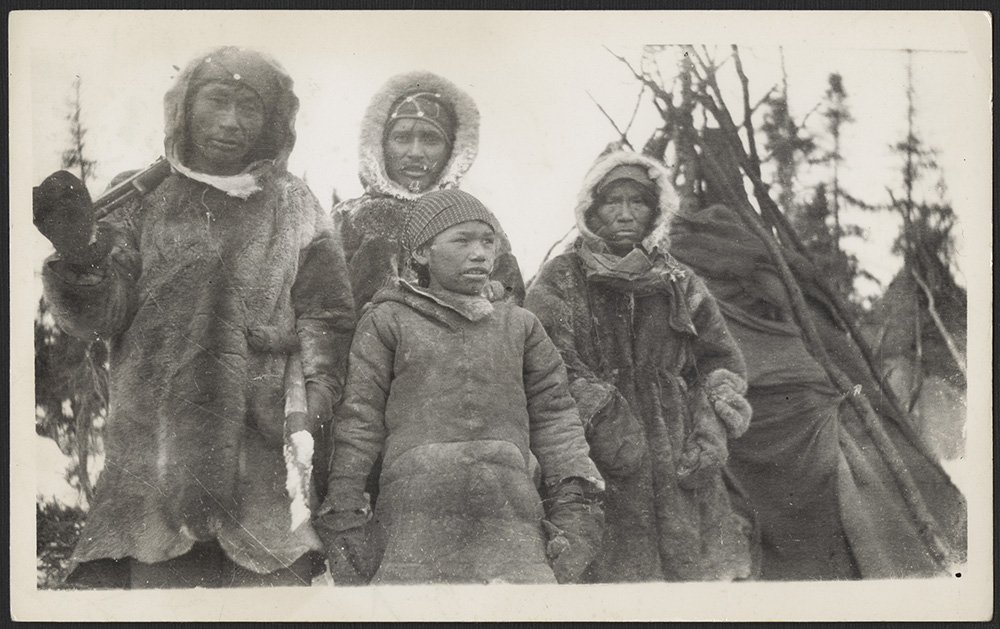
Judith-Pauline White (née Hunter) was an Inuk woman born in 1905 in Hebron, Newfoundland (now Newfoundland and Labrador), about 200 kilometres north of Nain in Labrador. She married a well-known trading post owner, Richard White, in 1922 and became stepmother to his daughter; the couple would have five children together. The Richard (Dick) White Trading Post (now a heritage building) is located in Kauk, approximately 4 kilometres south of Nain and 34 kilometres north of Voisey’s Bay. Ms. White, an amateur photographer, took photos in the area starting in the 1920s. In the 1950s, she met anthropologist Alika Podolinsky Webber, who travelled to Labrador to conduct research for her thesis about the art of the Mushuau Innu (of the Innu Nation). Podolinsky Webber went to Kauk because she was aware that the trading post was a hub for Innu and Inuit along the north coast of Labrador. Ms. White sent a shipment of material to Podolinsky Webber after Mr. White died in 1960. The material included photographs and negatives for over 200 images of daily life in and around the trading post. White’s photographs (see lower levels) feature both Innu and Inuit, and are a visual documentary of life in Labrador from the 1920s to the 1950s. This wealth of knowledge, which was tucked away for decades before being donated to Library and Archives Canada in 2007, is now accessible to everyone.

A black-and-white photograph of an Innu man staring at the camera, wearing traditional clothing and sitting on a pile of supplies. In the background, many other people are standing in front of a dark-coloured house with two small windows.

Innu on the move, circa 1925–1940 (e011305800)

As an Inuk woman from Nunatsiavut, an artist and a former curator, I am interested in the life and work of this early photographer. I cannot help but think of the well-known Inuk photographer Peter Pitseolak from Cape Dorset. His snapshots of Inuit life in the 1940s and 1950s are some of the earliest examples of Inuit individuals turning the camera on their own communities, rather than being the topic of ethnographic study by others. Unbeknownst to Pitseolak and those who followed his work, an Inuk woman in Nunatsiavut was also taking photos of everyday life. Why have we not heard of her? As Inuk scholar Dr. Heather Igloliorte writes in the Fall/Winter 2015 issue of the Inuit Art Quarterly, the Indian Act excluded Inuit in Nunatsiavut when Newfoundland joined Confederation in 1949:

Labrador Inuit artists were unfortunately omitted from virtually all of the developments that emerged from the concerted efforts of [James Houston (who “discovered” modern Inuit art)], the government, the Canadian Guild of Crafts, the Hudson’s Bay Company, and others, because the federal government did not officially recognize that there were Inuit in Labrador until decades later. We did not establish studios, form co-operatives, build relationships with the southern Canadian art world, and develop national or international markets for our work. We were not even permitted to use the ubiquitous “Igloo Tag” for authentification until 1991.

A black-and-white photograph of a woman standing in a window of a wooden building, wearing a dress with a white collar and a necklace with a large cross. In the left-hand corner of the window frame, a child is peeking out, looking toward the camera.

Woman standing in a window, circa 1900–1950 (e011307849)

When Newfoundland joined Confederation, White was still taking photographs, but galleries and exhibitions at the time did not feature Nunatsiavut Inuit artists. Instead, these artists sold their works door to door, at local craft shops or to the occasional visitor. We can only imagine how the Inuit art world would have reacted to White’s work had the contemporary provincial or federal governments given support and recognition to Nunatsiavut Inuit artists. We are thankful to the Alika Podolinsky Webber estate for its valuable gift. It is a visual reminder of Judith-Pauline White’s passion for photography and her recording of Labrador Innu and Inuit culture, which is now available online for all to enjoy.

A black-and-white photograph of an Innu man and three members of his family. The men and young boy are dressed in fur jackets and mittens. A tent and trees are in the background.

Innu man Pasna and his family, circa 1920–1940 (e008299593)

Visit Flickr to see more of Judith-Pauline White’s photographs.

This blog is part of a series related to the Indigenous Documentary Heritage Initiatives. Learn how Library and Archives Canada (LAC) increases access to First Nations, Inuit and Métis Nation collections and supports communities in the preservation of Indigenous language recordings.


Heather Campbell is an archivist in the Public Services Branch at Library and Archives Canada.