Hidden Treasures – Winnie the bear

Discovering hidden treasures in our institution’s vast collection of archival material is one of the exciting benefits of researching at Library and Archives Canada (LAC). Recently, two previously undescribed photographs of the bear mascot Winnie, the famous Canadian inspiration for A.A. Milne’s Winnie-the-Pooh stories, were found and made available online.

A reference technician from LAC was searching for First World War photographs taken in March 1915 of the 15th Canadian Battalion in the trenches of Neuve-Chapelle, France. The technician consulted the usual sources (online database, onsite Finding Aids, and contact cards from the Department of National Defence photographic collection) and found a description of a possible and unexpected item in the personal collection of Horace Brown.

The photographs from this collection were retrieved from storage; some of them were very small and difficult to view. One seemed to be of a soldier wearing a very odd hat. Further investigation with the aid of a lighted magnifying glass revealed the “soldier” was actually a bear cub and the curious headgear was its ears! A second image of the bear cub was also identified in the collection. A bit of sleuth work revealed that Horace Brown, a member of the Canadian Expeditionary Force, had been stationed at Salisbury Plain, England during October and November 1914, at the same time as Lieutenant Harry Colebourn with his mascot, Winnie.

Although many photographs exist of the famous bear in the Manitoba Archives and private collections, these were the first ones to be identified in LAC’s holdings. The images may now be viewed by all Winnie the bear (and Winnie-the-Pooh) fans here and here on our website.

Harry Colebourn with Winnie the bear - Salisbury Plain.

Harry Colebourn with Winnie the bear – Salisbury Plain. (e011067493-v8)

Harry Colebourn with Winnie the bear - Salisbury Plain.

Harry Colebourn with Winnie the bear – Salisbury Plain. (e011067494-v8)
Project Naming: The first ten years and beyond

Initiated in 2002, Project Naming is a community engagement and photo identification project that aims to reconnect Inuit with their past by identifying the people and events portrayed in photographs held at Library and Archives Canada (LAC). We have added the names of individuals and descriptions of activities to our database, which you can search online.

Over the last ten years, we have digitized more than 8,000 of those photographs and have received identifications for approximately 1,900 individuals. New information about these pictures is gathered through a variety of methods, including an online form, community slide shows and other social gatherings, weekly features in local newspapers, social media and on-site research visits.

Quite often, identifications come as a result of intergenerational conversations that take place in person or virtually—or both. Such was the case when Nunavut News/North published a photograph of Rhoda Qaqsauq, and her daughters, Lucy Evo and Janet Tagoona, on February 11, 2013; upon discovering this picture, Deborah Kigjugalik Webster shared it on Facebook, thus sparking a lively conversation between her and other family members.

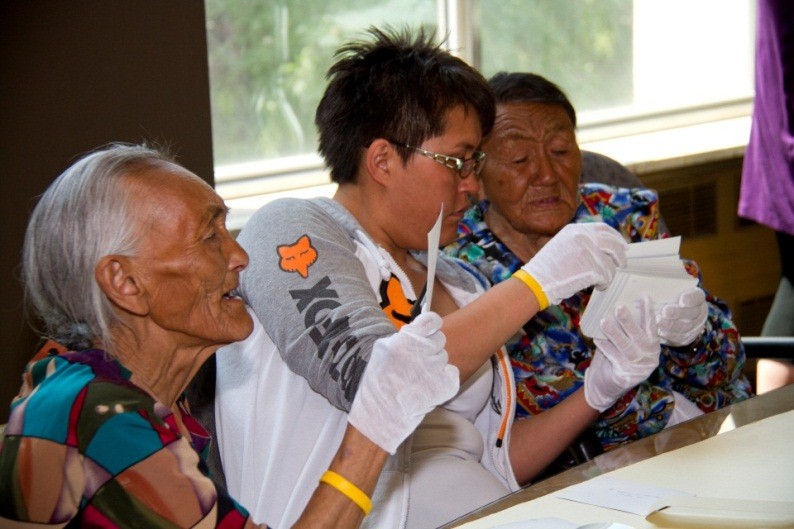
An example of a successful on-site visit occurred in June 2012 when a group of Elders and youth from Arviat, Nunavut, located on the southwest coast of Hudson Bay, made a trip to Ottawa. They looked through hundreds of photographs and negatives taken between the 1920s and the 1970s.

This enabled them to identify 31 family members in 17 images. Louisa Gibbons discovered her mother, Catherine Kopak, and her grandmother, Yarat, in a picture taken in Kingayualik, near Padlei.

Elder Eva Muyunaganiak (left), Louisa Gibbons (centre) and Elder Mary Nowtalik (right).

Elder Eva Muyunaganiak also discovered a photograph of her mother, Uyaupiak, dating from the late 1960s. Today, the remaining 22 Elders in the community of Arviat are the only ones able to recognize people and describe what life was like in photographs taken more than 50 years ago. Elder Muyunaganiak passed away in September 2012; her death reminds us of how time-sensitive an initiative Project Naming is.

Project Naming has now evolved into a broader community engagement initiative that has expanded beyond the territory of Nunavut to other Aboriginal communities in the Yukon, the Northwest Territories, Nunavik (northern Quebec) and Labrador. We hope to build upon this dialogue with members of Northern communities using new technologies and social media.

To learn more, listen to our Project Naming and Canada’s North podcast.

Yesterday Once More: Canada’s Music Industry in Portraits

Do you have a favourite popular musician or rock group from the last three or four decades of the 20th century? There’s a good chance you’ll be able to find their photographs documented in the Library and Archives Canada (LAC) Portrait Portal.

The Portal contains photographs taken between 1963 and 2000, selected from LAC’s RPM fonds, an archive that includes thousands of Canada’s and the world’s most popular artists and bands. It also features actors, music and entertainment executives, broadcasters, politicians and sports figures rubbing shoulders with music industry greats. These portraits have been digitized and added to the Portrait Portal as part of LAC’s ongoing digitization initiatives.

What is the significance of the RPM archive to the Canadian music industry?

Founded in Toronto in 1964, RPM was a Canadian weekly trade publication that focused on the Canadian music recording and radio industries. In 1964 it established the RPM Gold Leaf Awards (also referred to as the Maple Leaf Awards), which would soon evolve into the JUNO Awards. RPM was among the parties that lobbied for Canadian content regulations in the broadcast media, and it inaugurated the RPM MAPL logo (with MAPL standing for music, artists, production, lyrics) that has been widely used to identify the Canadian content of commercial sound recordings. The periodical ceased publication in 2000.

According to Cheryl Gillard, a Library and Archives Canada music specialist, the collection of RPM photographs, now available online through the Portrait Portal, “allows anyone, anywhere to take a behind-the-scenes look at the inner workings of the music industry. Also, for the first time, the Portal’s collection of RPM photos allows less high-profile but historically important Canadian music professionals to be documented and honoured.” This collection showcases Canadian popular culture and reflects the interconnection between the music industries in Canada and the United States.

You can search for photographs of popular musicians in the LAC Portrait Portal simply by entering the name of your favourite band or musician into the keyword search field.

For more information about Canada’s music industry, check out LAC’s RPM database, which contains the digitized versions of the music charts in RPM Weekly from 1964 to 2000. The Canadian Academy of Recording Arts and Sciences (CARAS) website is also a great place to search for a list of past JUNO award recipients—and more!

The Canadian Coast Guard celebrates its 50th anniversary- Part I

Black and white photograph of ship cutting a path for icebound vessel.

The CGS Stanley cutting a path for icebound vessels out of Bridgewater, Nova Scotia Source

Did you know that the Canadian Coast Guard (CCG)—which celebrates its 50th anniversary this  year—is heir to a long tradition originating in Canada’s East Coast? It is there that the first Canadian lighthouses and lifeboats were built during the
18th century.

Created in 1962 by the Honourable Leon Balcer, the then Minister of Transport, the CCG’s mission is to ensure safe and accessible waterways for Canadians. Library and Archives Canada (LAC) owns many archival records that document the activities of the CCG since its creation. Today, we invite you to discover some of these holdings, including photographs as well as government and political records.

Browse a few examples of digitized documents in the Archives Search Results page .

PHOTOGRAPHS

GOVERNMENT RECORDS

The Government fonds include textual records, technical drawings and boat plans.

POLITICAL RECORDS

LAC holds the archival fonds of former ministers of Transport, which contain records of the CCG. Here are two examples:

Please remember that not all of our material is available online. To learn more, consult our article How to Consult Material that Is Not Yet Available Online.

To view images, please visit our Flickr set.

Stay tuned for our next blog to discover more Canadian Coast Guard history, including caricatures, audiovisual records and publications.

Questions or comments? We would love to hear from you!

Celebrating the International Day of Peace – Part II: Thérèse Casgrain

Woman in a dress, standing in front of a stair case.

Thérèse Casgrain Source

Recently, to mark the International Day of Peace last September 21, we introduced you to Julia Grace Wales, champion for peace. Today, we present Thérèse Casgrain.

In the 1950s, Thérèse Casgrain became the first woman to be elected to the leadership of a political party in Canada. She was a fierce activist for women’s rights her entire life, and for two decades campaigned to obtain for Quebec women the right to vote in the provincial elections. Throughout her career, she also worked to correct many social injustices, to say nothing of the significant role she played in the promotion of peace. To that end, in 1961, she founded the Quebec chapter of the Voice of Women (Voix des femmes), an organization devoted to world peace—of which she became president the following year.

Thérèse Casgrain fonds

More can be learned about Thérèse Casgrain by consulting the speeches, memorabilia and digitized newspaper clippings (in French only) of the Thérèse Casgrain fonds, in which she talks about what motivated her: [TRANSLATION] “Long convinced that women can be a dynamic force in building peace, I resolved to establish, in February 1961, the Quebec branch of the Voice of Women. […] women of Ontario appealed to all women in our country to raise their voices against the tensions of a cold war and the imminent threat of a nuclear conflict.”

The fonds also comprises photographs, including many that are digitized. Not all the material in this fonds is digitized, but the titles of the various files may be consulted using our online research tool  [PDF].

Remember: Not all our material is digitized and accessible online. For more information, read our post How to Consult Material that Is Not Yet Available Online.

Questions or comments? We would love to hear from you!

John George Diefenbaker images now on Flickr