Library and Archives Canada (LAC) preserves a unique collection of railway materials dating from the 1880s to the 1950s. A portion of the collection showcases photographs of railway hotels, stations, trains and travel across the country.
Tag Archives: Photography
“The Pointe”
Pointe St. Charles or “The Pointe” as it is more commonly known, is a Montréal, Quebec neighbourhood located southwest of downtown that has a rich and varied history. The area known as Pointe St. Charles was first acquired by Charles le Moyne in 1654, and is named in his honour. Throughout its early history, it was occupied by various religious communities and is also where Marguerite Bourgeoys, founder of the Congregation of Notre-Dame, welcomed and housed les Filles du Roi, the young French women who immigrated to New France to increase its population. Thereafter, Pointe St. Charles remained primarily a farming community until the mid-nineteenth century.

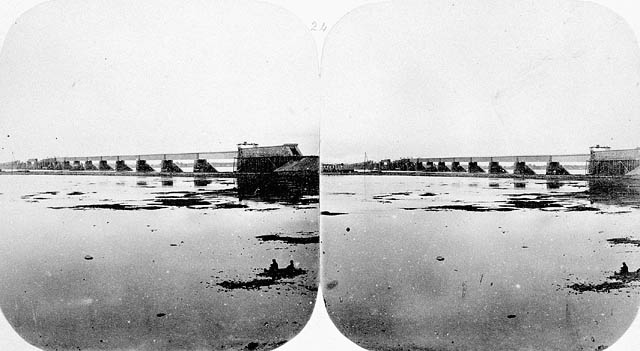
Stereoscopic photograph of the Victoria Bridge construction in progress from Pointe St. Charles (MIKAN 3357662)
The landscape and population of Pointe St. Charles changed dramatically upon completion of the Lachine Canal in 1848, and further still with the new railway infrastructure and construction of the Victoria Bridge to Montréal’s south shore. Several companies were drawn to the area; new jobs were created, and land previously given to agriculture was bought for residential housing. According to Héritage Montréal, by the beginning of the 20th century, Pointe St. Charles had become the largest industrial sector not only in Montréal but in all of Canada. It was at this time that The Pointe also became the quintessential example of an ethnic melting pot. Populated primarily by English (75%) and French (25%) Canadians, The Pointe increasingly became home to many different ethnic groups.

“Trevithick” railway engine under construction at Pointe St. Charles, from the Alexander Mackenzie Ross collection by William Notman, 1859 (MIKAN 3192802)
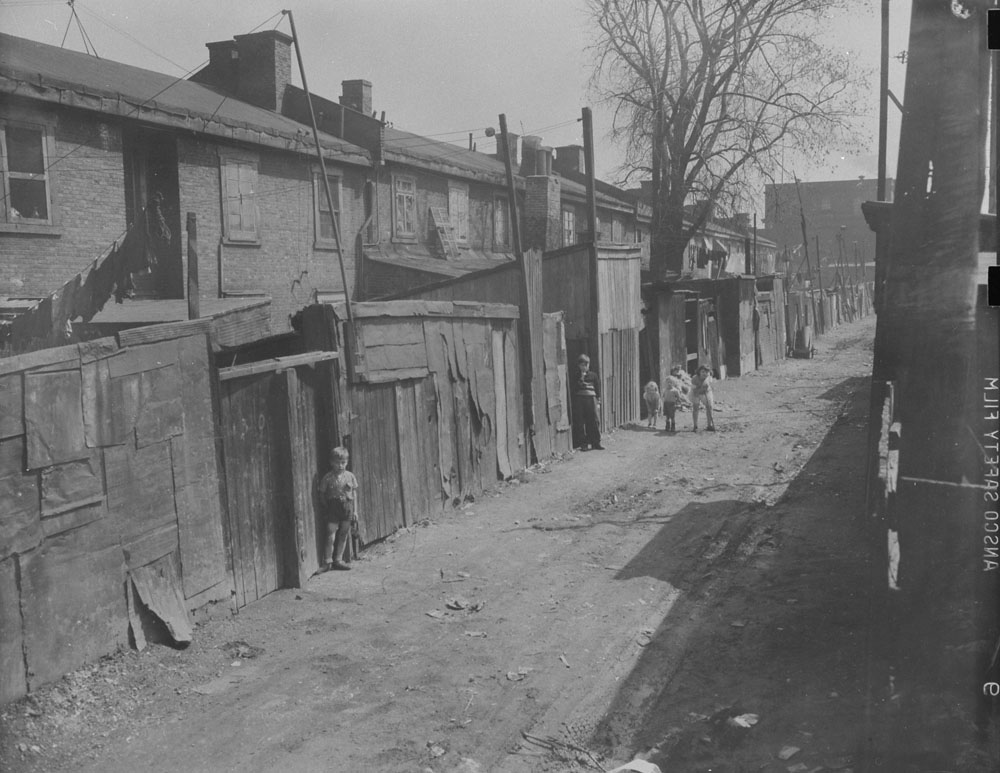
Several factors would contribute to The Pointe’s dramatic turn from Canada’s largest industrial sector to one of its most notorious slums. The Great Depression was the first event that contributed to the decline of the area’s primary economic activities. This was followed by the exodus of various factories and businesses to other industrial areas around Montréal, then culminating with the opening of the St. Lawrence Seaway in 1959 and the closing of the Lachine Canal. Adding further to the area’s decline was the building of expressways that now run along The Pointe’s north and southwest borders. The Richard Arless photographic collection held by Library and Archives Canada substantiates the existence of these slum conditions. Montréal-born Richard Graham Arless (1906-1995) began his career as a Second World War military photographer. After the war, he worked for various newspapers and magazines, eventually opening his own commercial studio in Montréal. His photographs of the slum conditions of Pointe St. Charles, all taken on the same April day in 1946, capture the bleakness and poverty of this once vital, now broken-down and battered neighbourhood.

Children playing in a courtyard in the Pointe St. Charles district, April 25, 1946 by Richard Arless (MIKAN 3380642)

View of a child in a narrow, garbage-strewn lane in Pointe St. Charles district, April 25, 1946 by Richard Arless (MIKAN 3380643)
The people of Pointe St. Charles have always been a gregarious and hardy bunch. As their population dwindled and their neighbourhood and living conditions deteriorated, the residents banded together to confront and improve their lot. Community groups were started to improve housing, build parks and promote recreation and health care.

View of a dilapidated back alley in Pointe St. Charles district, April 25, 1946 by Richard Arless (MIKAN 3380652)
Most recently, The Pointe has experienced a revitalization. Land around the Lachine Canal was transformed for recreational use with bike paths, while many of the abandoned factories have been converted into condos that have attracted many new residents.
Nursing images now on Flickr
Nursing in Canada can be traced back to 17th century Quebec.
Children of Topley Images now on Flickr
The William Topley collection at Library and Archives Canada is an invaluable resource for those interested in nineteenth-century Canadian photographic portraiture. Comprised of over 150,000 glass plate negatives as well as studio proofs and counter books. While Topley did photograph subject matter other than people, portraits were his chosen specialty and the collection is a wonderful example of early Canadian studio work.
Children were often the subject of these portraits, posing alone or with siblings.
Early Canadian Travel Photography now on Flickr
The concept of Canadian tourism emerged during the early nineteenth century. Improved modes of transportation, such as new railways stretching across the country, facilitated leisure travel and offered people the chance to witness some of the nation’s greatest marvels and modern achievements.
Photographs were the ideal medium with which to attract potential visitors, and photographers were hired by transportation companies to produce images of majestic scenery that would promote destinations. Later rivaled by amateur picture-takers, eager to create their personal holiday mementos, these photographs were a vital component of the burgeoning tourist industry. The imagery created during this period helped to characterize the country, establishing a sense of national identity by introducing viewers to iconic images of Canadian scenery.
For the Record: Early Canadian Travel Photography – an exhibition at the National Gallery of Canada
In the early 19th century, tourism in Canada was an emerging concept. Improved modes of transportation, such as new railways and passenger steamships, finally allowed Canadians and visitors alike the chance to witness some of the nation’s greatest sights and scenery.
Contrasting interests dictated what the most popular tourist attractions were, with pristine, untouched nature (waterfalls and mountains) as well as industrial, modern achievements (bridges and railways) being the biggest draws.
A new exhibition at the National Gallery of Canada in Ottawa showcases some of these fascinating images. Drawn from the collection of Library and Archives Canada, these photographs show us how visitors saw the country, often for the very first time. They demonstrate the wonder travellers felt with the natural world, and with the new impressive infrastructure that was developing all around them.

Great Cedar Tree, Stanley Park, Vancouver, British Columbia, 1897 (MIKAN 3192504)
Almost immediately, capturing and recording these experiences became a popular and lucrative endeavour. Photography was the ideal medium with which to attract potential tourists, and it was quickly utilized by professional photographers who produced images for promotional material as well as traveller souvenirs. Later, as amateur photography became easier and more affordable, the personal snapshot rivalled these commercial images.

Victoria Bridge, Grand Trunk Railway, Montréal, Quebec, 1878 (MIKAN 3323336)
Niagara Falls was the first major tourist destination in North America, and was a bustling scene of commercialism even in the 19th century. Having your picture taken in front of the Falls was a prestigious event, but if you couldn’t make it there in person, you could always have Niagara as a painted backdrop in your studio portrait.

Studio portrait with Niagara Falls backdrop, ca. 1870 (MIKAN 3210905)
Vital components of both the burgeoning tourist industry and of the growing interest in amateur photography, the travel and tourism photographs produced during this period helped to define the country. By creating a familiarity with popular scenery, these images introduced the viewer to what are now recognized icons of the Canadian landscape.

Bow River Valley, Banff, Alberta, 1900 (MIKAN 3509496)

Public Gardens, Halifax, Nova Scotia, n.d. (MIKAN 3509481)
Visit the exhibition at the National Gallery of Canada, in Ottawa, from March 6 to August 30, 2015. Check out our Flickr set to see more 19th-century travel photographs or listen to the podcast – Canada’s photographic memory!
Images of 1st Canadian Division now on Flickr
When war broke out in 1914 between Germany and its allies versus Britain and France, Canada’s Prime Minister Sir Robert Borden immediately offered assistance in raising a contingent of troops to defend Europe. Calls for volunteers started in August 1914.
With a small army of approximately 3,000 soldiers, a small navy, and some militia units, Canada was able to enlist about 35,000 men in a matter of a few months. They were stationed at Valcartier Camp situated northwest of Québec City for initial training and formed into battalions of the Canadian Expeditionary Force, and into a division—the 1st Canadian Division.
Comprising 31,000 men, the Division was sent overseas by convoy for further training at Salisbury Plain in England where it continued training through the winter of 1914, and was finally sent to France in February 1915. The 1st Canadian Division saw combat at a variety of locations, such as the Ypres Salient (Second Battle of Ypres), Festubert, Givenchy-en-Gohelle, Somme, Vimy Ridge up to the end of the First World War, and serving into the present. The history of the 1st Canadian Division is rich, long-lived and backed by distinction as seen in its motto, “Agile, Versatile, Ready.”
Photography of the First World War – Part II: Finding First World War Photos
Following on the first part of this series: The Canadian War Records Office, here are some strategies for locating photographs of the First World War produced by the Canadian War Records Office.
Browsing
You can browse the lower-level records by selecting the ‟sub-series” or ‟sub-sub-series consists of” hyperlinked entries. For example, trying this within the “O” prefix record yields “4134 lower level description(s)” (Note: records are being continually added so this number may change).
Choosing this strategy makes it possible to view the pictures by browsing through them sequentially. This works well if you’re not quite sure what you are searching for but want to have an idea of the way the pictures are described and the type of photographs that can be found in the collection.
Searching
A more robust strategy to locate specific photographs within each series is to use the advanced Archives Search function. You can search using the “O-?” (with the quotes) or the original accession number “1964-114,” and a name or keyword. Using quotes limits the search words to a specific order. Using the question mark (?) allows for an open-ended search. A similar use of the asterisk (*) allows a search that looks for the variants of a word, for example: nurs*: nursing, nurse, nurses.
If you are unsure which series will contain photographs that are of interest to you, try entering the accession number “1964-114” and a specific term, such as “Vimy” (349 results) or “bishop” (21 results).
The following image shows items for nurs*, resulting in nurse and nursing sisters.
Some of the search results may yield records that appear to be duplicates. This is because archivists often create bilingual records to make it easier for all Canadians to find items in the language of their choice. In the case of panoramas, duplication may come from multiple negatives for one finished photographic print, with each part of the negative having its own record.
Explore the Canadian War Records Office images, and discover the “official” photographic record of Canada’s involvement in the First World War.
Other related materials:
Photography of the First World War – Part I: The Canadian War Records Office
The year 2014 marks the centenary of the First World War. In preparation for this date, archivists at Library and Archives Canada (LAC) have been cleaning up the Official Canadian War Photographs Records. They have been made more accessible to Canadians by enhancing their descriptions through thematic organization in the online database. This has been part of a much larger project to organize and describe the entire Department of National Defence’s photograph collection at LAC to ensure that the records are accurate, complete and accessible to the public. When the war began in 1914, most photographers and journalists were ordered away from the front. The First Canadian Division entered the European war theatre the following year. Finally, in 1916, millionaire press baron Max Aitken was granted permission to start the Canadian War Records Office (CWRO) and it became Canada’s “eyewitness to war” sending reports home from the front. Soon, these reports were also accompanied by photographs and paintings.
In addition to acquiring photographs from various sources, over the course of the war the CWRO hired three photographers—Captain Henry Edward Knobel, William Ivor Castle and William Rider-Rider—to travel to France and photograph battles, life at the front, and other activities. These photographs can be accessed under the Canadian War Records Office and were organized and given prefixes by the CWRO such as:
- “HS” prefix: Historical Section
- “I” prefix: Individual portraits of Victoria Cross recipients
- “M” prefix: Miscellaneous
- “N” prefix: Navy
- “O” prefix: Official photographs
- “S” prefix: Sports
The largest of these CWRO-created prefixes is the “O” prefix. It includes about 4705 images, which were taken between May 1916 and May 1919. We find some of the most famous Canadian images of the war in this series. It includes William Ivor Castle’s shots of “Going over the Top” and the “29th Battalion advancing over No Man’s Land during the Battle of Vimy Ridge.”

Canadian troops ‟going over the top” during training course at a trench-mortar school. (MIKAN 3206096)
Both of these photographs were later found to be manipulations: the first being a photograph of a drill, and the latter being a composite of two images to add dead bodies and puffs of smoke.

The 29th Infantry Battalion advancing over “No Man’s Land” through the German barbed wire and heavy fire during the Battle of Vimy Ridge (MIKAN 3192389)
The next part of this series will explain how to search for First World War photographs in the Canadian War Records Office collection.
Other related materials:
Taking It All In: The Photographic Panorama and Canadian Cities Exhibition at the National Gallery of Canada
Most of today’s digital cameras come with a simple, point-and-shoot mode for creating panoramic images.
But back in the days of film cameras, creating a panoramic photograph meant either spending hours in the darkroom, painstakingly stitching images together by overlapping exposures onto the finished photo paper or buying an expensive panoramic format camera.

Possibly members of the Benjamin Low family on a passenger steamer showing various types of cameras, including a panoramic camera, 1904 (MIKAN 3191854)