Freedom to Read

By Mary-Francis Turk

At Library and Archives Canada (LAC), we never judge a book by its cover (or its content, for that matter)! We want to make sure that readers and researchers have access to all Canadian publications. LAC’s mandate, as outlined in the Preamble to the Library and Archives of Canada Act, puts emphasis on preserving the documentary heritage of Canada while making it available to the public.

Libraries across Canada have a responsibility to create policies that protect the freedom to read and intellectual freedom. As a national library, LAC has created a permanent collection by acquiring published books, rare and early editions of books and related print material of all kinds.

Through its legal deposit program, LAC acts as a quiet champion against censorship. Every Canadian publication has its place in the national collection. The program has been crucial in aiding LAC’s ongoing efforts to build an inclusive, expansive and accessible national collection.

LAC works closely with publishers to build its collection through the legal deposit program, which is responsible for collecting “materials created in Canada and intended for sale or public distribution.” In doing this, we are able to make material available and preserve it for future generations.

Materials accepted through legal deposit

Canadian publishers and producers submit materials such as

  • Books (monographs)
  • Serials (such as magazines, journals, newsletters)
  • Physical music and video recordings
  • Audiobooks
  • Sheet music
  • Maps
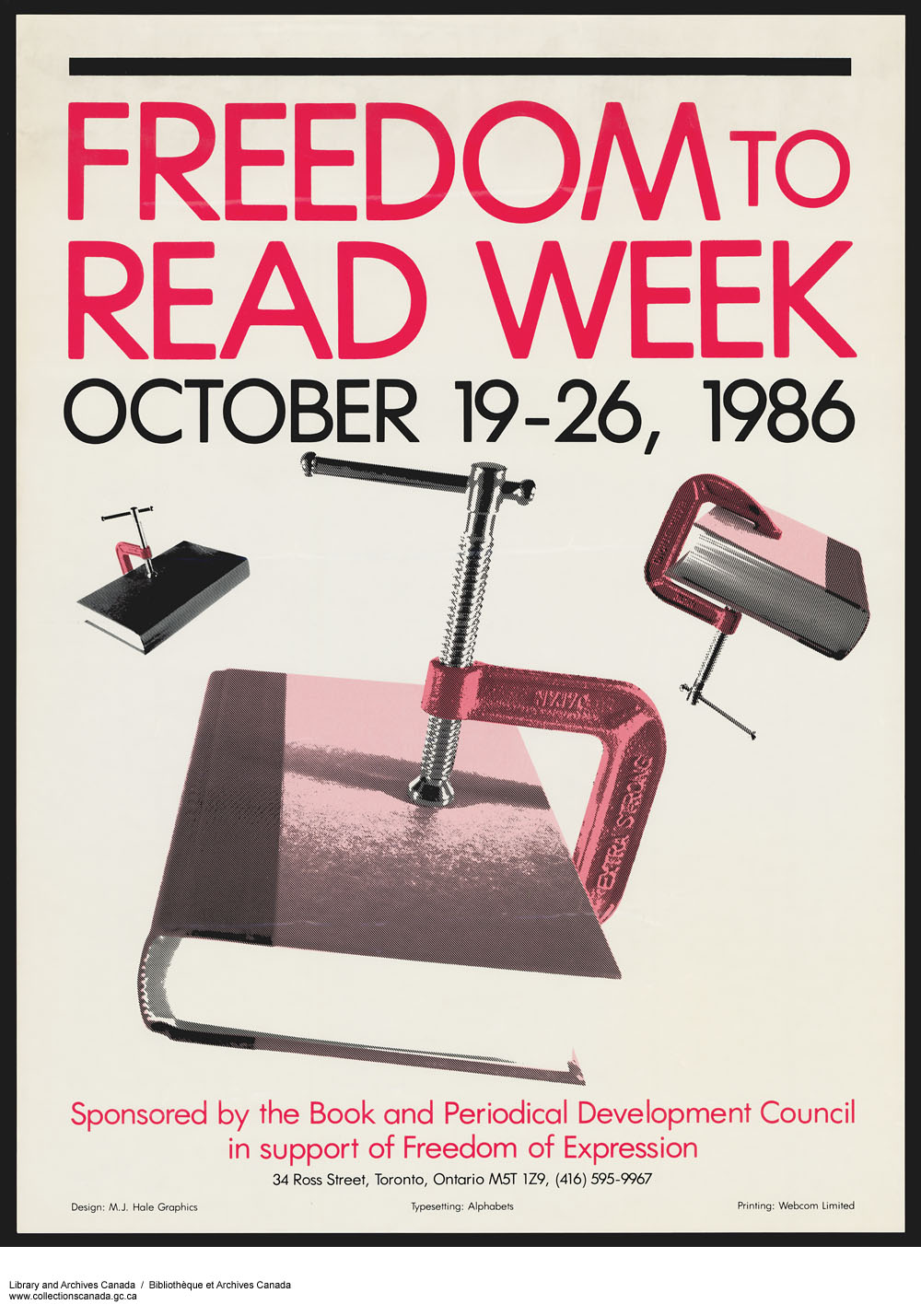
Poster for Freedom to Read Week dated October 19–26, 1986, with three books closed by clamps.

An advertisement promoting reading put out by the Book and Periodical Development Council for Freedom to Read Week in 1986. Library and Archives Canada/Robert Stacey fonds/e010758305. Credit: Michael Hale / Susan Reynolds.

Although it can sometimes feel like censorship is something from the past, there are many examples of more recent instances of challenged publications. This includes several publications that can be found in LAC’s collection:

  • In 2018, David Alexander Robertson’s book Betty: The Helen Betty Osborne Story was “not recommended” for use in Alberta classrooms.
  • In 2016, Robin Stevenson’s book Pride: Celebrating Diversity and Community met resistance during Stevenson’s school visits in British Columbia, Ontario and Quebec.
  • In 2011, Timothy Findley’s book The Wars was used by an Ontario school board in Grade 12 English classes and was subsequently challenged by parents. The school board ultimately decided to keep the book as part of the secondary curriculum.

Canada’s Book and Periodical Council’s Challenged Works List reminds us that publications have historically been and continue to be challenged and censored in Canada. Freedom to Read Week further reminds Canadians that access to publications should not be taken for granted.

Making Canadian publications available to the public and ensuring they are available for future generations is imperative to ongoing intellectual freedom in Canada. This is exactly what we strive to do here in LAC’s legal deposit team.

As we reflect on the freedom to read and the right to intellectual freedom, the task of acquiring and making Canadian publications available to readers across the country seems more important than ever.

Interested in learning more about free expression and censorship in Canada? See a list of the Book and Periodical Council’s English or French works on free expression and censorship in Canada.

Additional resources


Mary-Francis Turk is a Legal Deposit Supervisor in the Private Archives and Published Heritage Branch at Library and Archives Canada.

Sheet Music from Canada’s Past: The Great War

By Emilie Gin

Did you know that you can view, download and print digitized versions of sheet music from LAC’s collection? A portion of the collection—including pieces from the First World War—has been digitized and can be accessed online from LAC’s library catalogue, Aurora. Here’s how to search special collections using Aurora.

Sheet Music from Canada’s Past provides a rich opportunity to dive deeper into the sounds and lyrics that punctuated the Canadian experience of the First World War or “the Great War.” Canadians at home and those fighting abroad found comfort, courage and a sense of patriotism in music.

What is sheet music?

Sheet music typically refers to individual popular music pieces that were printed on one or more folding sheets of paper. Both professional composers and amateur songwriters published and distributed sheet music for sale. These musical scores were unbound and inexpensive for publishers to produce and relatively affordable for consumers as well.

Sheet music played an important role in the musical lives of Canadians. While some upper class households of the early 20th century had phonographs or gramophones to play recorded music, many could not afford these new technologies. For many, the only way to enjoy music was to hear it live, either at a concert hall or by playing music themselves using sheet music.

Music and the national narrative

While music functioned as entertainment and a form of catharsis during the complicated and tumultuous time of the Great War, it was also a medium ripe for the promotion of a government-approved national narrative.

A colour drawing of a soldier with a rifle standing in front of the British flag, a war medal and a portrait of a H.W. Ellerton in uniform.

Cover art for “The Khaki Lads” (OCLC 25442742)

The War Measures Act of 1914 required that all publications (including sheet music and other forms of media such as novels and posters) be approved by the Department of Militia and Defence. Although it is difficult to assess the true impact of music and its messages, sheet music does gives us a window into the everyday life of Canadians during the First World War.

Canadian identity—The Maple Leaf and Britannia

Expressions of Canadian patriotism and allegiance to Britain were extremely prevalent themes in published sheet music during the First World War. This is no surprise—these types of pieces boosted morale by supporting a national narrative of unity through patriotism among soldiers and those at home. They instilled courage and reminded soldiers in the fray of their duty and purpose. These pieces presented a narrative of Canadian identity that was nearly exclusively Anglophone and still fervently tied to Britain.

A colour drawing of a soldier holding a rifle, with a green maple leaf in the background.

Cover art for “They Heard the Call of the Motherland (The Men of the Maple Leaf)” by Edward W. Miller (OCLC 123910582)

Following Canada’s involvement in important battles such as Vimy Ridge, the Somme and Passchendale, the First World War marked an important shift in Canada’s self-awareness from a colony to a nation. However, the Conscription Crisis of 1917 brought up significant and important questions about Canada’s ties to Britain, as well as about the relationship between French and Anglophone Canadians.

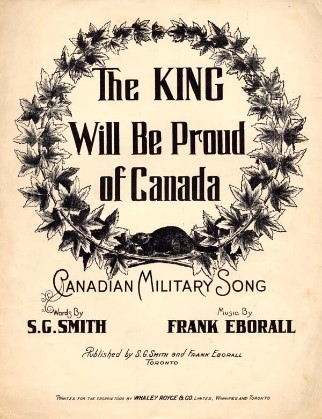
A black and white image where the words The King Will Be Proud of Canada are surrounded in a wreath of leaves and a beaver.

Cover art for “The King Will Be Proud of Canada: Canadian Military Song” by S.G. Smith and Frank Eborall (OCLC 123910650)

Here are a few examples of patriotic sheet music that can be downloaded from LAC’s collection:

Everyone’s doing their bit: The home front

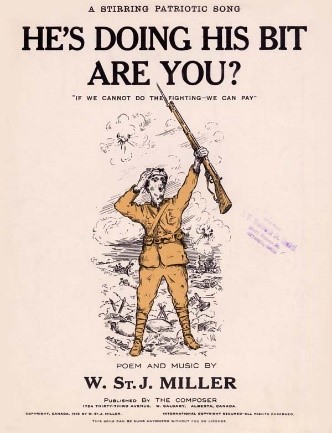
Music was an important part of everyday life on the home front. Volunteerism was an especially common message found in popular sheet music. Knitting garments for soldiers, donating money, buying war bonds or volunteering for nursing efforts were all suggested activities that would contribute to the war effort. Pieces such as “He’s Doing His Bit, Are You?” reinforced citizens’ duties to Canada and the Crown, stating “If we cannot do the fighting—we can pay.”

A colour drawing of a soldier dressed in a tan uniform holding a rifle above his head.

Cover art for “He’s Doing His Bit, Are You? If We Cannot Do the Fighting—We Can Pay” by W. St.J. Miller (OCLC 1007491809)

Here are a few pieces that illustrate messages encountered by Canadians on the home front:

The Duality of Music in Wartime

Sheet music occupied somewhat of a double life in public consciousness in wartime. Acting as both entertainment and a form of governmental subliminal messaging, it is difficult to ascertain exactly how Canadians might have felt about popular music. Music likely offered a welcome break from atrocities and troubling news from the front, however there is no denying that sheet music publishers published materials that supported a government-approved national narrative.

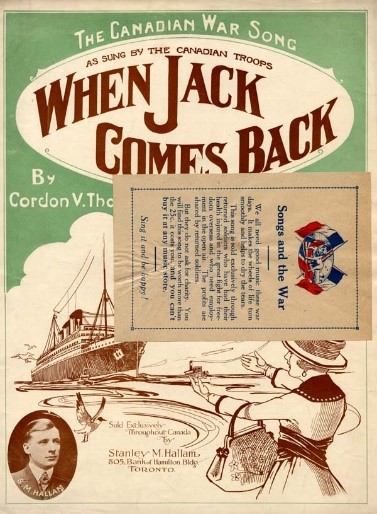
An colour image comprised of a large ship, a dove, a woman welcoming the ship and a portrait of S. M. Hallam.

Cover art for “When Jack Comes Back” by Gordon V. Thompson (OCLC 1007593602)

Nevertheless, this note found on the cover illustration for the piece “The Canadian War Song: When Jack Comes Back,” by Gordon V. Thompson, surely rang true for many Canadians during the First World War:

                “We all need good music these war days. It makes the wheels of life turn smoothly and helps to dry the tears.”

To learn more about Canadian sheet music, check out our podcast “Between the Sheets”.


Emilie Gin is a student acquisitions librarian working in the Published Heritage Branch at Library and Archives Canada.
Library and Archives Canada releases twelfth podcast episode: Between the Sheets

Library and Archives Canada (LAC) is releasing its latest podcast episode, Between the Sheets.

Archival assistant Gilles Leclerc joins us to talk about LAC’s sheet music collection. We explore what sheet music is, what’s included in LAC’s collection and how the collection came about. We also discuss the historical value of sheet music and why it’s still relevant today.

Subscribe to our podcast episodes using RSS or iTunes, or just tune in at: Podcast – Discover Library and Archives Canada: Your History, Your Documentary Heritage.

For more information, please contact us at podcasts@bac-lac.gc.ca.

Sheet music from Canada’s past

Did you know that Library and Archives Canada (LAC) has one of the most comprehensive sheet music collection in the country? Thanks to Helmut Kallmann, the founding Chief of the Music Division at the National Library of Canada (now part of LAC), who collected any early Canadian sheet music he could find.

Recently, over a thousand pieces of sheet music from this collection were digitized and are now available online. These titles were published before 1918 and include a wide variety of patriotic and parlour songs, piano pieces, sacred music, etc.

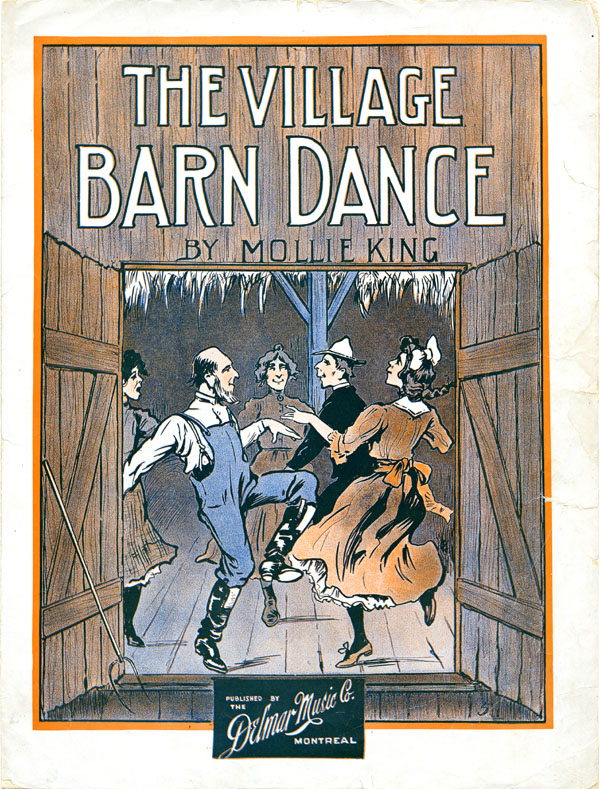
Colour image depicting people dancing in a barn.

Sheet music cover image of a musical piece entitled, “The Village Barn Dance” by Mollie King. Source

Visit LAC’s Sheet Music from Canada’s Past website to learn more or to search for music sheets. Here’s how:

  1. Click on Search Sheet Music located in the left menu.
  2. In the first box, click the down arrow and choose the time period you would like to search, e.g. “1900-1913.”
  3. In the second box, click the down arrow and choose the type of search, e.g. Title keyword (song title).
  4. In the third box, you can enter a search term, e.g. “barn”.
  5. Click the “Submit” button at the bottom.

The browsing options in the fourth box allows you to limit your search to digitized music for which there is either printed music or audio files available. Please note that default searching has been set at “All Time Periods”, “Any Keyword” but you can modify these settings by following the above steps.

Once you have found a piece of sheet music, you will see some or all of the following information:

  1. A description of the music.
  2. A small colour image of the front cover.
  3. A large colour image of the cover.
  4. A “View sheet music” icon.
  5. An “Audio” icon

As the sheet music is available as PDFs, you can print the music on letter size paper.