“Are You Fit, Soldier?”: Fitness in the CEF during the First World War

Version française

By Dylan Roy

Are you fit, soldier? Do you have what it takes to make it in the Canadian Expeditionary Force (CEF)? War is upon the world since 1914, and we need brave young recruits like yourself to take up the mantle of freedom and fight for the Crown!

However, before you can join the fight, we need to ensure that you are ready for the arduous rigours of battle! I do not say that lightly; it will be a gruelling task. Are you up for it?

To get you in shape, we need you to exercise regularly. However, the Special tables. Physical training note that “Exercises if correctly performed strengthen and stimulate every portion of the body. Some are harmful if correct positions are not assumed.” So remember, not only do you need to exercise, but you need to do it properly for it to be effective.

To get you in gear whilst carrying your gear, we need you to carry out the following exercises.

First, we need to train you how to stand at attention. Although it may seem like a simple thing, you must avoid two main faults: do not slouch back nor lean too far ahead. We need you straight and narrow. If you can first properly stand at attention, you are well on your way to being a disciplined soldier. For visual cues, consult the picture below:

Guide with two figures in incorrect positions of attention and two figures in correct positions of attention.

Guide on how to stand at attention (MIKAN 3831498).

Marching effectively is a fundamental aspect of any soldier worth his salt. However, one cannot simply march around willy-nilly. There needs to be structure and order in the way a soldier marches. The image below shows how to execute both a proper march and jump within the CEF’s principles:

Guide with three figures showing how to slow march, double march and upward jump.

Guide on how to properly march and jump within CEF’s principles (MIKAN 3831498).

Now that we have the fundamentals in order, we need to show you how we are going to make you true soldiers who can overcome the numerous obstacles that await you on the other side of the pond. This requires strength, agility and flexibility, and there are numerous exercises that will test such abilities.

“On-the-hands” exercises will allow you to rise up from a prone position. This is essential in warfare as taking cover and recovering from the prone position is crucial to success during battle. It could also be the determining factor between life and death.

Leg raises will test your core muscles as well as your upper body and legs. All these muscles work in conjunction with one another to facilitate full-body movements. A good soldier needs to be able to contort and control his body in many ways in order to execute both simple and complex actions.

Leg raises are great exercises as they can be performed in a variety of ways. You can do a sideways one-handed leg raise; a two-handed variation with the trunk facing the floor; and, finally, leg raises with your back on the ground. Remember, the core is the connector of both the arms and legs, and it therefore needs to be strong and flexible!

Below you will find examples of on-the-hands movements and leg raises, as well as the trunk backward-bend, which aids in flexibility. All these exercises will help to ensure both your safety and that of your comrades-at-arms while in battle!

Guide with five figures showing exercise positions of on the hands, on the left hand turn with leg raised, on the hands with leg raised, trunk backward-bend and right leg raised from lying on back with arms raised upward.

Guide of leg raise exercises and trunk backward-bend (MIKAN 3831498).

Where would the CEF be without the speed and agility of its soldiers? One way to ensure quick speed is through strong legs. To make a powerful lower body, train it! Exercises like heel raises and knee bends will strengthen the multitude of leg muscles necessary to run, sprint, march, jump, dip, duck, dodge and dive. Fortify them and you in turn fortify yourself! For examples of these two critical movements, see the picture below:

Guide with five figures showing position of closed, open and full open feet, heel raises and knee bends.

Guide on how to build strong legs (MIKAN 3831498).

Where would the legs be without the arms? We need strong soldiers who can lift their share and shoulder the burden that is sure to surface during the war. One of the best types of exercises to improve the strength of the arms is heaving exercises. As the Manual of physical training explains, “Heaving exercises are those in which the body hangs by the hands from some apparatus, either without other support or with the weight partially taken by the feet.” To see examples of heaving exercises, consult the image below:

Guide with eight figures showing the proper positions of pull-ups and one figure showing the incorrect way to do a pull-up.

Guide on how to improve arm strength through heaving exercises (MIKAN 3831502).

To conclude, we need soldiers who can not only face the hardships of war but who can overcome them. To do so requires strict discipline, obedience and regimentation. So what say you, soldier, are you fit enough to join the CEF?


Dylan Roy is a Reference Archivist in the Access and Services Branch at Library and Archives Canada.

Discovering my grandfather, Robert Roy Greenhorn, a “Home Child” (Part 1)

Version française

Group of boys working in a field at the Philanthropic Society Farm School.By Beth Greenhorn

This article contains historical language and content that some may consider offensive, such as language used to refer to racial, ethnic, and cultural groups. Please see our historical language advisory for more information.

Robert Roy Greenhorn (1879–1962), my paternal grandfather, was among the thousands of children brought to Canada by William Quarrier’s Orphan Homes of Scotland. This made him a “Home Child,” a term I first encountered in 2003, when I began working at Library and Archives Canada (LAC). In fact, it was only in 2012 that I learned that my grandfather and two of his brothers, John and Norval, were Home Children. Eleven years have passed since I discovered this information. During the past summer, I decided that it was time to write about my grandfather’s story.

This is the first of a four-part series about Robert Roy Greenhorn and is a tribute to my grandfather. LAC is publishing this article on November 20 to mark National Child Day in Canada.

Photographic portrait printed on linen of a young man shown from the chest up, wearing a button-down shirt, tie, vest and suit jacket in an oval frame.

Robert Roy Greenhorn, unknown place, early 1900s. Courtesy of the author, Beth Greenhorn.

Like many Canadians, I had never heard the term Home Child and was not taught about Home Children in school. Nor was it ever mentioned by my father or older family members. I finally learned about child migration schemes while doing research for images to accompany an LAC podcast about Home Children in 2012. My curiosity about my grandfather and the circumstances as to why he emigrated to Canada was piqued. Thus began my journey to uncover his story.

From the 1860s to the mid-1900s, more than 100,000 orphaned, homeless and poverty-stricken children in Great Britain were relocated to Canada and other British colonies. They worked as indentured servants for families in rural Canada until they were 18 years of age, mostly as domestic help and farm labourers. The term for the children sent to Canada was Home Children because they went from emigration agency homes in Great Britain to receiving homes in Canada.

Industrialization in 19th-century Britain caused hardship and suffering for hundreds of thousands of people. This period saw a rise in pollution, poverty, slum housing and social inequalities (“The Home Children” by Patrick Stewart, p. 1). Children from poverty-stricken homes were particularly hard hit. A search through headlines of British newspapers during the Victorian era reveals the harsh labels given to children experiencing misfortune: “waifs and strays,” “paupers,” “delinquents” and “street urchins,” to name a few. There were no social welfare systems to care for the increasing numbers of impoverished, neglected and orphaned children. Describing the dire conditions of the working poor in industrial Great Britain, Patricia Roberts-Pichette writes in “About Home Children” (p. 7):

Most home children came from the poorest working-class families who lived in the worst slums of the great industrial cities. Their families were living in or had fallen into abject poverty because of job loss, illness and incapacity or death of the breadwinner. . . . Social activists, church and civic officials viewed them [children] as being in danger of adopting delinquent behaviours just to feed themselves and thus becoming criminals.

Philanthropic, benevolent and religious organizations were convinced that social and economic problems would be managed by removing the children, as Susan Elizabeth Brazeau explains in “They Were But Children: The Immigration of British Home Children to Canada” (p. 1):

The intention of the child migration schemes was to remove children from what were believed to be unhealthy and socially and morally unacceptable living conditions in England, and place them in Canadian homes, farms and families. Here, it was expected the children would learn skills and become productive members of the working class. . . . These children migrants came to be known as “Home Children.”

The British child migrant program thus served a few purposes: to lessen the burden created by destitute children in Great Britain, while increasing the population in the colonies, and providing a cheap source of farm labour.

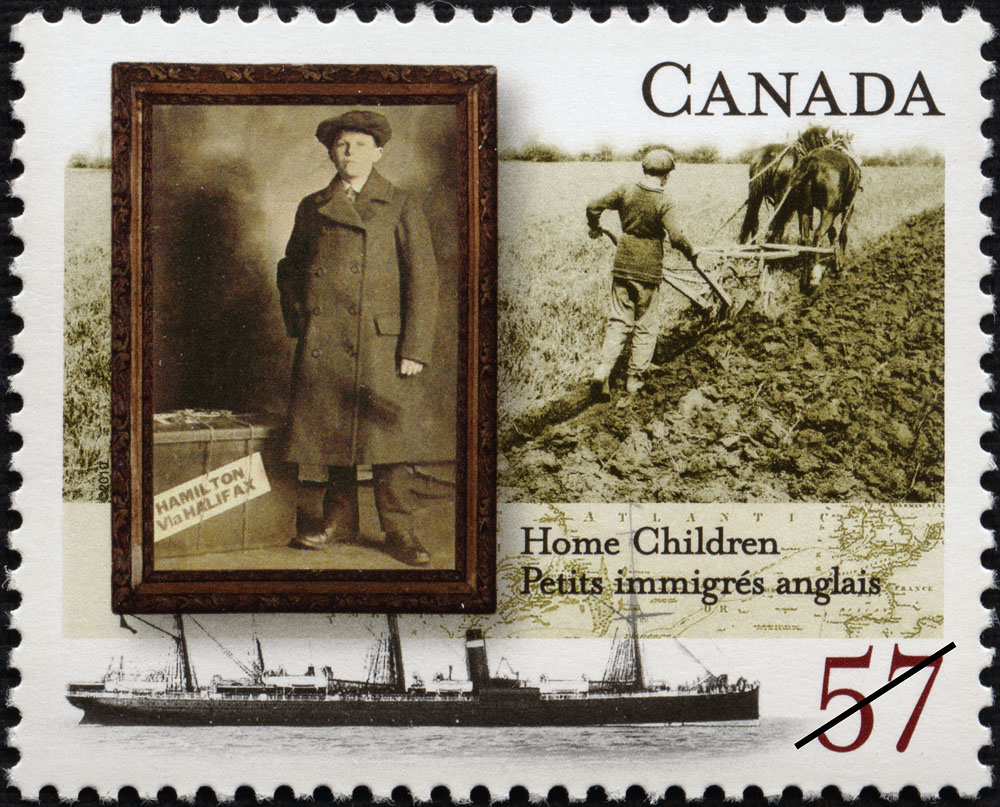
Postage stamp with a framed sepia photograph of a boy in a long coat with a suitcase, overlaid on a sepia photograph of a boy ploughing a field with two horses. There is a black-and-white photograph of a ship across the bottom of the stamp.

Canadian postage stamp, issued on September 1, 2010, to commemorate Home Children (e011047381).

Quarrier’s Orphan Homes of Scotland was among the many child migration agencies created in the 19th century. Founded by shoemaker and philanthropist William Quarrier (1829–1903), this private organization was responsible for bringing my grandfather and his brothers to Canada. From 1870 to 1938, Quarrier, and later his daughters, relocated more than 7,000 children to Canada, most of whom ended up in Ontario.

Sadly, I never met my paternal grandfather, Robert Roy Greenhorn. He passed away before I was born. My knowledge of him is what I pieced together from some recollections shared by my father, and a few family photographs. My father, the youngest in his family, had a close relationship with his mother, Blanche (née Carr, 1898–1970). As the “baby” of the family, and given the rigidly prescribed gender roles of the era, my father likely spent more time helping his mother and sisters around the house and vegetable gardens than with his father. My grandfather was also 51 years old when my father was born. This difference in age probably added to the lack of connection between the two. Consequently, most of my father’s memories of his childhood were about his mother and siblings, particularly his brother Arnold, who was the closest in age, being just three years older.

Black-and-white photograph of three women crouched in front of five men and a woman standing behind them.

Front row, left to right: Aunt “Jo” (Josephine), Aunt Jean and Aunt Jennie. Back row, left to right: Uncle Roy, Uncle Arnold, my grandfather Robert, my grandmother Blanche, Uncle John, and my father, Ralph, Philipsville, Ontario, 1947. Courtesy of the author, Beth Greenhorn.

I have little information about my grandfather Robert’s childhood. I know that he had two brothers, John and Norval, and that they were all born near Glasgow in Scotland and emigrated to Canada when they were boys. I also know that they came without their parents. I have since learned that they were orphaned when very young. I had always assumed that my grandfather and his brothers travelled together. While researching my grandfather’s story, I learned that Robert and John departed for Canada in March 1889, and Norval arrived five years later, in April 1894.

In an unpublished memoir from 2015, my father shared one of his few memories of my grandfather:

My dad. [He was] a hard worker… that was his forte. Yes, he laughed, and he was a pretty good hockey player so I understand, but I think the easiest way to sum it up was that the environment had really left its scars, and he was living behind that curtain of scars… I wish I’d asked him more questions about his childhood. I would have understood him more.

Initially, Canadians supported juvenile emigration organizations and welcomed the immigrant children. But as Susan Elizabeth Brazeau describes in “They Were But Children” (pp. 5–6), enthusiasm waned after stories began circulating of children running away, attacking their hosts, stealing food, starving, and in one case, dying. Public opinion changed from acceptance to mistrust, and people questioned whether Great Britain was “ridding itself of the lowest of the low: guttersnipes, idiots, the ill, and children with criminal intent.”

I will never know my grandfather Robert’s perceptions or his experiences as an orphan. Given the derogatory labels used to describe children from impoverished backgrounds, I am sure that the stigma and shame attached to being a Home Child did indeed leave a “curtain of scars.” I wanted to learn about my grandfather’s life and what might be buried behind the “curtain.” What happened to the boys’ parents? What were the circumstances causing him and his two brothers to become wards of the Orphan Homes of Scotland?

In the second article in this series, I will continue with Robert Roy Greenhorn’s story. This will take us to his roots in Gartsherrie and Falkirk, Scotland.

Additional resources


Beth Greenhorn is an Online Content Manager in the Outreach and Engagement Branch at Library and Archives Canada.
Far in distance, but near at heart: the thorny issue of Canadian war graves

By Ariane Gauthier

Many Canadian war graves and military cemeteries have been established around the world, as a result of the conflicts in which Canada has been involved since Confederation (1867), from the Boer War (1899–1902) in South Africa to the conflict in Afghanistan (2001–14).

Three graves of Canadian soldiers who died in the Boer War (1899–1902).

The graves of soldiers Elliott, Laming and Devereaux, killed in the South African War (e006610211).

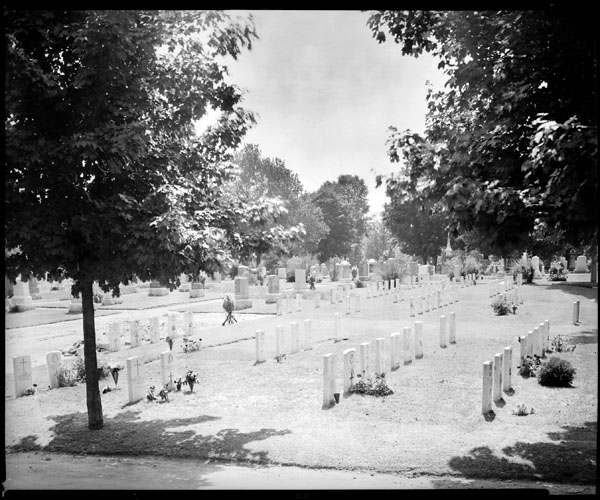
Photo of military cemetery in Ottawa, Ontario, taken by renowned photographer Yousuf Karsh on August 13, 1934.

Colonel H.C. Osborne, war graves (e010679418_s1).

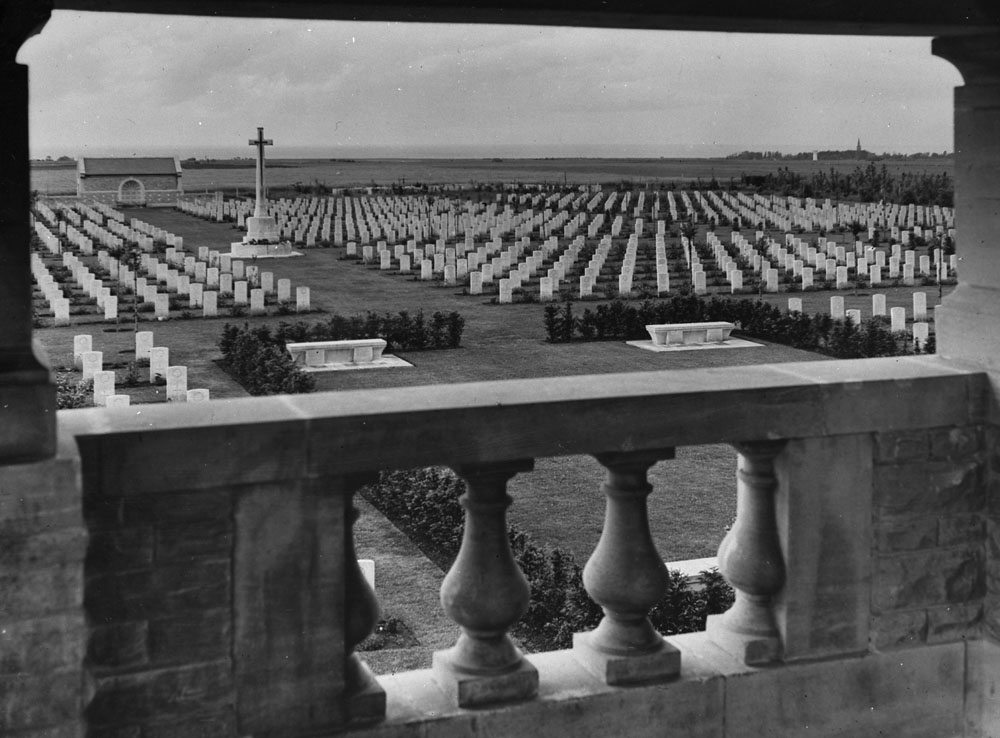
The Canadian cemetery at Bény-sur-Mer in France, where Canadian soldiers who lost their lives during D-Day and the Battle of Normandy in 1944 are buried.

Canadian military cemetery at Bény-sur-Mer, France (e011176110).

The Canadian cemetery in Agira, Italy, where Canadian soldiers who died during the Sicily campaign in 1943 are buried.

Canadian cemetery in Agira, Sicily (e010786150).

War cemetery in Japan, where Canadian soldiers who were killed during the Korean War (1950–53) are buried.

Mrs. Renwick lays a wreath on behalf of Canadian mothers and wives on Remembrance Day in Japan (a133383).

Have you ever wondered why so many Canadian families allowed for the final resting place of their loved ones to be where they fell in combat?

Quite simply, because it was the only option—at least, initially.

To understand, we must delve into the context of the First World War, the first mass industrial war. The technological and military advances of the modern era caused skyrocketing mortality rates. As a result, the British Empire had to manage the rapid recruitment of reinforcements in addition to the thousands of deaths in a war where the repatriation of bodies was practically impossible if not discouraged. It was dangerous to search for remains in active combat zones, and moving so many corpses could easily have led to worldwide epidemics. That said, the door remained open to changing the status quo once hostilities were over. On May 10, 1917, the Imperial War Graves Commission was created by Royal Charter, with a mandate to look into the issues of deceased soldiers and war cemeteries for the entire British Commonwealth.

Text document dated May 10, 1917, written by J.C. Ledlie, from “At the Court at Buckingham Palace, Present, The King’s Most Excellent Majesty in Council.”

War Office (United Kingdom) – Imperial War Graves Commission – Charter (MIKAN 1825922).

There was no consensus among families regarding the question of cemeteries being maintained in perpetuity. Lively debates about the war graves issue took place in many parliamentary institutions. Speakers appealed to the humanity and compassion of politicians, so that the families of fallen soldiers could bring home the bodies of their fathers, brothers, husbands or sons, and in some cases, their sisters and daughters. However, no petition could change the verdict issued by the Imperial War Graves Commission:

Two-page text document explaining that the repatriation of soldiers’ bodies is not permitted.

War Office (United Kingdom) – Imperial War Graves Commission – Refusal to permit removal of bodies from countries in which they are buried (MIKAN 1825922).

“To allow removal [of war dead] by a few individuals (of necessity only those who could afford the cost) would be contrary to the principle of equality of treatment; to empty some 400,000 identified graves would be a colossal work, and would be opposed to the spirit in which the Empire had gratefully accepted the offers made by the Governments of France, Belgium, Italy and Greece to provide land in perpetuity for our cemeteries and to “adopt” our dead. The Commission felt that a higher ideal than that of private burial at home is embodied in these war cemeteries in foreign lands, where those who fought and fell together, officers and men, lie together in their last resting place, facing the line they gave their lives to maintain. They felt sure (and the evidence available to them confirmed the feeling) that the dead themselves, in whom the sense of comradeship was so strong, would have preferred to lie with their comrades. These British cemeteries in foreign lands would be the symbol for future generations of the common purpose, the common devotion, the common sacrifice of all ranks in a united Empire. […]”

This decision ensured that Canadians who had died overseas during the First World War remained on those fields of honour. The cemeteries that were built in their memory can still be visited today; they are maintained by the Imperial War Graves Commission, now the Commonwealth War Graves Commission. On July 15, 1970, Canada’s policy on the repatriation of soldiers who had died overseas changed. Order in Council P.C. 1967-1894 stated that the family of a soldier killed in action on or after that date could request his or her repatriation for a funeral. The loved ones of deceased service members can now have them brought home.

Additional resources


Ariane Gauthier is a reference archivist in the Access and Services Branch at Library and Archives Canada.

The Battle of Beaumont-Hamel: commemoration and remembrance

By Ethan M. Coudenys

The Battle of the Somme began on July 1, 1916, at 7:30 a.m., but preparations for the attack took longer than expected. The advance was planned to relieve pressure on the French forces fighting at Verdun, and it was meant to take place during the last few days of June. However, because of poor weather, the attack was delayed. For the First Newfoundland Regiment (later the Royal Newfoundland Regiment), this meant lying in wait for the assault to begin. On the first day of July, at 7:20 a.m., the Hawthorn Ridge Redoubt held by the Germans was blown up, and the British attack began 10 minutes later.

Over the course of 45 minutes (between 9 and 9:45 a.m.), the Newfoundlanders sent their men over the top of the St. John’s Road trench into no man’s land. Unfortunately, due to the high casualty rates during the early phases of the attack that morning, the Newfoundlanders had to walk above the trenches, instead of benefitting from the relative safety of the communication trenches that linked the secondary line to the primary and observation lines. In this period, nearly 85 per cent of the Regiment would be killed, wounded, or missing. Of the nearly 900 Newfoundlanders in the field, only 65 would be present at roll call the following day.

The Battle of Beaumont-Hamel was the bloodiest day in Newfoundland’s history, and in the First World War as a whole. The loss of life was too much for the British Dominion of Newfoundland. It was forced to revert to colony status in the 1920s and eventually joined the Canadian Confederation in 1949. The commemoration of this battle is a moving story that deserves more attention.

Soldiers stand on hill with caribou monument, as crowd below watches in front of wall with bronze plaques.

Beaumont-Hamel dedication ceremony for the Royal Newfoundland Regiment (e010751150).

The Beaumont-Hamel Newfoundland Memorial Park, currently administered by Veterans Affairs Canada, is located at the site of the battle. Canadian student guides are there every day, sharing the story of the Newfoundlanders of the Great War who gave their lives in service to their nation. The park itself is incredibly pristine, with massive trees, magnificent gardens and an excellent visitors centre. But the landscape tells the tale of the horrific impact that the Battle of Beaumont-Hamel had on the Dominion of Newfoundland, and the terrifying reality of war for the regiment.

The memorial site itself officially opened on June 7, 1925, and it offers a setting with a sense of home for the soldiers who were killed in the battle. The park’s landscape architect, Basil Gotto, created this ambiance by including over 5,000 trees native to Newfoundland. The major memorial is the Caribou Monument, which stands more or less on the British front line. This massive bronze statue faces toward the direction of the advance by the Newfoundlanders on July 1, 1916. The caribou’s mouth is open, and it appears to be calling out to the fallen, calling them back home. The Caribou Monument is one of seven such memorials in France, Belgium, Turkey, and Newfoundland and Labrador, which mark major moments in the Royal Newfoundland Regiment’s participation in the First World War.

The caribou statue stands at the top of a massive mound. At the base of the mound is a wall with three bronze plaques. These have the names of the 823 fallen soldiers, sailors and merchant seamen who died in the war without a known resting place. The youngest of these was 14 years old at the time of his death, while the oldest was 60. These plaques, which are original to the site, have survived a second world war and several weather events. During the Second World War, in fact, the only element from the memorial park that did not survive was the bronze lions next to the 51st Highland Division monument near the rear of the park.

Caribou monument on rocky hill, covered with fog.

Beaumont-Hamel Caribou Monument, around December 2022. Image courtesy of the author, Ethan M. Coudenys.

Today, the Beaumont-Hamel Newfoundland Memorial Park is one of the most well-preserved and moving memorials to the sacrifices made during the First World War. With Canadian students providing free guided tours, and the atmosphere of the park itself, it truly demonstrates the tragedy of the Battle of Beaumont-Hamel and the unfathomable losses suffered by the Royal Newfoundland Regiment.

Additional resources


Ethan M. Coudenys is a Genealogy Consultant at Library and Archives Canada, and a former student guide at the Beaumont-Hamel Newfoundland Memorial.

Indigenous Peoples in the First World War: researching forgotten veterans

On the left of the graphic, Tatânga Mânî [Chief Walking Buffalo] [George McLean] in traditional regalia on horse. In the middle, Iggi and girl engaging in a “kunik”, a traditional greeting in Inuit culture. On the right, Maxime Marion, a Métis guide stands holding a rifle. In the background, there is a map of Upper and Lower Canada, and text from the Red River Settlement collection.By Ethan M. Coudenys

This article contains historical language and content that some may consider offensive, such as language used to refer to racial, ethnic and cultural groups. Please see our historical language advisory for more information.

Understanding the First World War from the perspective of the Indigenous Peoples of this land has been of paramount importance for many Indigenous researchers, such as myself. Dedicating hours upon hours to research a single Great War veteran is sometimes required just to identify that they were indeed Indigenous. While we have excellent resources about some of the very well-known First Nations, Inuit and Métis Nation service members from that war, there is still much to discover in this realm of historical knowledge.

This post is not meant to convey the story of the Indigenous people who served during the First World War, nor would I attempt to simply generalize the experiences of Indigenous peoples into a single blog post. Instead, I will share the stories of two very different individuals and relate how research techniques can be used to better research an Indigenous person who served in the Great War.

The story of John Shiwak

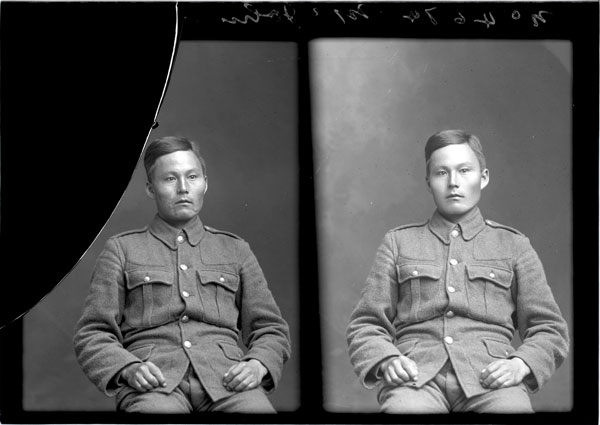
Two side-by-side photos of the same man seated and wearing an army uniform.

John Shiwak, Royal Newfoundland Regiment # 1735. The Rooms, Item E 29-45.

John Shiwak was born in 1889 in Rigolet, Labrador. A member of an Inuit community, he was an experienced hunter and trapper when he enlisted with the First (later “Royal”) Newfoundland Regiment on July 24, 1915. He was still in training when the regiment was sent over the top of the St. John’s Road trench at Beaumont-Hamel on July 1, 1916, the first day of the Battle of the Somme. When Shiwak joined the regiment in France a few weeks later, on July 24, he was one of many who saw the aftermath of the near destruction of the regiment in the 45 minutes that they fought on the Somme battlefield. In April 1917, Shiwak was promoted to lance corporal. Unfortunately, that November, less than a year before the guns fell silent, Lance Corporal John Shiwak met a sad end. In the middle of the battle for Masnières (during the larger First Battle of Cambrai), Shiwak’s unit was struck by a shell, killing him and six others.

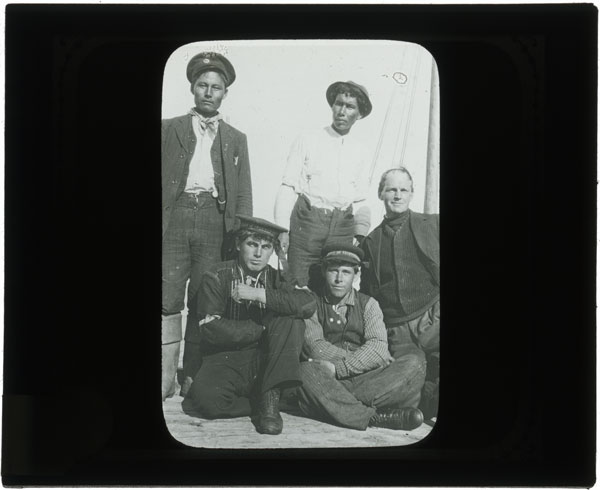
Group of five men standing or sitting.

Members of the Legion of Frontiersmen (before 1915); John Shiwak is standing at the left. The Rooms, Item IGA 10-25.

This story is not uncommon in accounts of the First World War. The Inuk man was killed in the line of duty, in the midst of his brothers in arms. Yet his story is even sadder: until now, the gravesite of Shiwak and those six other brave men were never located. It is theorized that a school was built above the grave, the construction happening without the knowledge that seven soldiers of the Great War were buried there. Nevertheless, as with all casualties without a known resting place, Shiwak is commemorated. His name is forever etched on the bronze plaques at the Beaumont-Hamel Newfoundland Memorial in France, and at a similar memorial in St. John’s, Newfoundland and Labrador.

The story of Angus Edwardson

The story of Private Angus Edwardson is of personal interest to me. He was my great-great-grandfather and fought at Passchendaele. He was born in 1894 in the northern, primarily Algonquin Anishinaabe, community of Lac-Barrière, about 300 kilometres northwest of Ottawa. On his enlistment form, Edwardson stated that he and his family resided in Oskélanéo, Quebec. For a very long time, our family did not know that he was Indigenous, nor did we know about his time in the trenches in any detail.

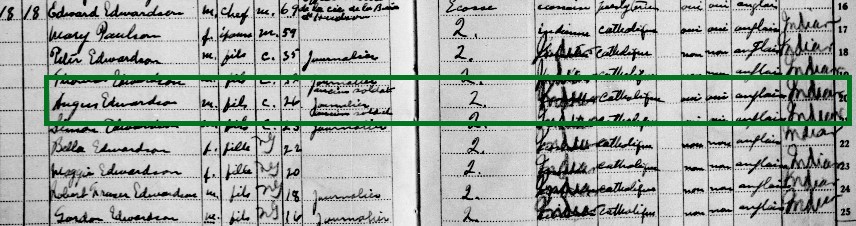
Luckily, in my line of work, one can discover some very interesting pieces of information. During a search through the 1921 Census, I found information that he was an “ancien soldat” (veteran); I was therefore able to find his attestation papers. While Edwardson’s story is much less noteworthy than that of Shiwak, his story provides an insight into the challenges of researching Indigenous men who fought in the Canadian Expeditionary Force (CEF) and indeed in the British forces as a whole.

Two pages of the attestation papers of Angus Edwardson.

Attestation papers of Angus Edwardson (regimental number 1090307).

In the physical description of Edwardson, the enlistment officer wrote that his complexion was “fair,” his eyes “blue,” and his hair “dark.” This description does not reflect the racial idea of an Indigenous person, nor did the enlistment officer note that Edwardson was First Nations by writing the commonly used term “Indian” under the section of the form entitled “Distinctive marks, and marks indicating congenital peculiarities or previous disease.”

From what we can see in his records, Edwardson was a member of the 253rd (Queens’ University) Highland Battalion, though he served with a number of other battalions and regiments during his time on the front. Notably, while serving with the 213th Battalion on August 28, 1918, he was wounded in the left hand by a bullet.

Challenges facing researchers

As I mentioned, not knowing that a member of the CEF was Indigenous is a major sticking point for researchers. The attestation files may not contain this information at all. In fact, this is very common in the later years of the First World War. Neither of the two men that I have written about have the telltale designation “Indian” on their attestation forms. The only way we can know for certain that these two men were indeed Indigenous is by relying on additional sources.

The first of such sources is the often-overlooked census records. The census provides vital information about research subjects, and individual information can greatly increase success in researching Indigenous members of the CEF and the Royal Newfoundland Regiment (RNR). In the case of Edwardson, I discovered that he was in fact Indigenous by looking at his record in the 1921 Census. For Shiwak, there was an entirely different route to finding his identity, which was incredibly difficult. I uncovered information about Shiwak’s ethnic heritage through the memoirs of Sydney Frost, a captain with the RNR, entitled A Blue Puttee at War. This memoir, however, is not the only way to find out that Shiwak was Indigenous.

List of names, ages and genders from the 1921 Census.

Census entry for Angus Edwardson and family, 1921 (e003065155).

Secondary sources about the First World War are numerous. For Shiwak, several appear when simply searching his name, but for other, lesser-known Indigenous members of the CEF, this may be more difficult. The excellent book For King and Kanata: Canadian Indians and the First World War by Timothy Winegard shows how we may be able to improve search techniques for Indigenous individuals and groups that served in the CEF. Though not explicitly, Winegard indicates the role of individual communities and their part in deciding to send men to enlist for the war effort. That said, this effort can be difficult, and it is worth reaching out to local genealogical societies and/or Indigenous communities for help in locating a list of names or simply an idea of how many men served from that community.

The final source of information that is quite useful in these cases is the so-called Indian Registers. These are archival documents with lists of names of members of bands. While the registers are a great resource for those researching members of a specific First Nations band and who are able to visit Library and Archives Canada in Ottawa, there are challenges remaining for those who do not know the band of their research subject or whether their subject died during the war. For individuals researching an Inuk or a member of a Métis Nation community, the challenges deepen, as there is very little primary source material from the period immediately after the Great War. It may be possible to identify Inuit or Métis Nation members of the CEF or RNR through secondary sources, but this can be challenging and take time.

Conclusion

Lance Corporal John Shiwak and Private Angus Edwardson both fought during the First World War. The former was Inuk and the latter was First Nations. The two cases exemplify the many challenges that face researchers when they are looking to find information about members of the CEF or RNR who were Indigenous. These challenges are multi-faceted, and they can pose significant difficulties in research into the stories of Indigenous veterans who fought in the Great War. There are some solutions and resources, including consulting archival records (census records specifically), checking with local Indigenous communities, and accessing some resources specific to Indigenous Peoples at Library and Archives Canada. Nevertheless, these proposed solutions can only go so far in helping researchers find information about Indigenous people who served in the First World War.

Additional resources 


Ethan M. Coudenys is a Genealogy Consultant at Library and Archives Canada. They are proudly of Innu heritage and the descendant of a residential school survivor.