Library and Archives Canada releases its latest podcast episode, “Kindred Spirits After All”

Library and Archives Canada is releasing its latest podcast episode, “Kindred Spirits After All.”

Few Canadian authors have achieved the universal appeal of Lucy Maud Montgomery, whose iconic series “Anne of Green Gables” continues to resonate with book lovers of all ages. In this episode, we speak with inveterate book collector Ronald I. Cohen who donated his entire Lucy Maud Montgomery collection to Library and Archives Canada (LAC) between 1999 and 2003. Mr. Cohen speaks to us about his relentless pursuit of a Lucy Maud Montgomery collection that would be unmatched the world over, and his gracious decision to donate it all to LAC.

LAC Special Collections Librarian, Meaghan Scanlon, took the opportunity to interview Mr. Cohen about his generous donation, and gave him a tour of the vault where the Lucy Maud Montgomery collection now resides.

Subscribe to our podcast episodes using RSS or iTunes, or just tune in at Podcast–Discover Library and Archives Canada: Your History, Your Documentary Heritage.

For more information, please contact us at bac.balados-podcasts.lac@canada.ca.

Anne in the library: introducing the Cohen Collection

Version française

By Meaghan Scanlon

In five accessions between 1999 and 2003, Canadian lawyer, film producer, and bibliographer Ronald I. Cohen donated his extensive Lucy Maud Montgomery collection to Library and Archives Canada. (See OCLC 1007773673 for a description of the collection.) The collection contains materials related to adaptations of Montgomery’s work, as well as anthologies and periodicals in which Montgomery is featured. But the bulk of the collection consists of various editions of Montgomery’s published novels, including, of course, her most famous book, Anne of Green Gables.

Among the approximately 420 items in the Cohen Collection are no fewer than 46 copies of Anne of Green Gables. Three of these are in Japanese, two in French, and one each in Korean, Finnish, Norwegian, and Swedish. The other 37 are in English.

Why, you might ask, would anyone need 37 English-language copies of Anne of Green Gables? Isn’t the story the same every time? The answer is that for book collectors, it’s often not about the story told in the text. Rather, collecting is an opportunity to discover the story of the book itself, its publication, and the way it has been marketed and received. Many book collectors set out to document the history of an author or title as completely as possible through their collections. For some, this means amassing many copies of the same title.

The Cohen Collection traces the spread of Anne of Green Gables across the English-speaking world through its inclusion of early American, British, Australian, and Canadian editions. The novel was originally published in Boston in April 1908 (OCLC 367111). This first edition was extraordinarily popular and Montgomery’s publisher, L. C. Page, reprinted it at least 12 times before the end of 1909. The Cohen Collection contains copies of the sixth (November 1908) and eleventh (August 1909) printings.
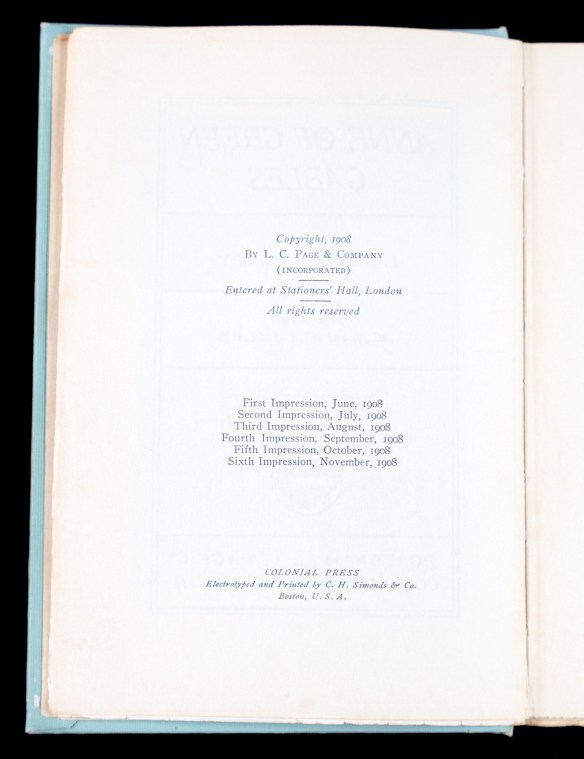
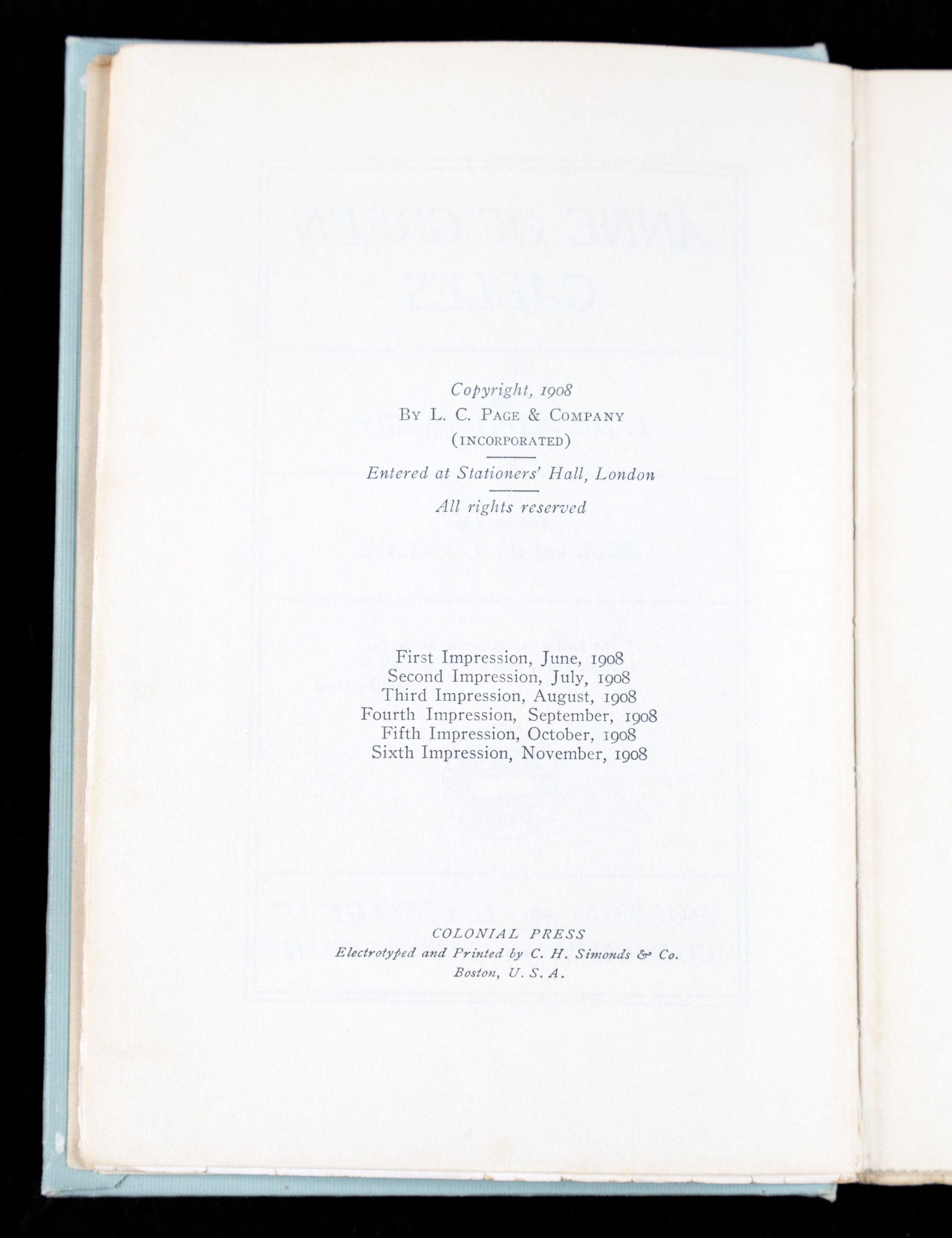
Copyright page of the Cohen Collection copy of the sixth printing of the first edition of Anne of Green Gables

Copyright page of the Cohen Collection copy of the sixth printing of the first edition of Anne of Green Gables (OCLC 367111, copy 5). “Impression” is another word for printing.

The first British edition of Anne of Green Gables was also published in 1908 (OCLC 19230504). Anne then made her way to Australia in 1925 (OCLC 220130129). Interestingly, despite the iconic status of Montgomery and her work in Canada, the first Canadian edition of Anne of Green Gables (OCLC 1006977498) did not appear until 1942. This edition, too, went through several printings; the earliest copy in the Cohen Collection dates from 1948.

Although the story remains the same in each edition, the depiction of its heroine, Anne Shirley, on the books’ covers does not. Audiences in different places and time periods have encountered different representations of Anne, from the mature-looking woman on the first edition to the sometimes cartoonish drawings on later versions. The Cohen Collection’s copies of Anne of Green Gables document the visual history of the character through their illustrations, cover art, and dust jackets.

In fact, when Ronald I. Cohen started collecting L. M. Montgomery’s books, finding copies with dust jackets was one of his main goals. Historically, dust jackets were often discarded by readers (and libraries!) and early examples can be extremely hard to find. The numerous rare dust jackets in the Cohen Collection are therefore a highly valuable resource for researchers looking at the history of one of Canada’s most beloved literary classics.

To learn more about the Ronald I. Cohen Collection of Works by L. M. Montgomery, listen to the latest episode of Library and Archives Canada’s podcast, Kindred spirits after all!


Meaghan Scanlon is the Special Collections Librarian in the Published Heritage Branch at Library and Archives Canada.

Finding Garneau: the importance of archival accessibility

Library and Archives Canada (LAC) houses many national treasures and endeavours to make its collections visible and accessible to the public. One of the projects conducted this summer was aimed at increasing accessibility to Quebec and French Canadian literary fonds, namely the fonds of Hector de Saint-Denys Garneau.

A colour image of a handwritten poem.

Undated manuscript of Un poème a chantonné tout le jour by Hector de Saint-Denys Garneau (MIKAN 4817952). Explore this and other digitized poems.

Garneau was an influential French Canadian writer who wrote in early 20th-century Quebec. He died of a heart attack in 1943, and his posthumous work Poésies complètes (1949) and his Journal (1954) made him an important literary figure of modern Quebec. When LAC acquired his fonds in 1993, visibility for the collection was needed. While Giselle Huot’s text, Œuvres en prose: Édition critique établie (1994), has been an important scholastic link to this fonds, a detailed online finding aid in LAC’s main research database, MIKAN, was needed to help researchers explore the life and works of this important poet.

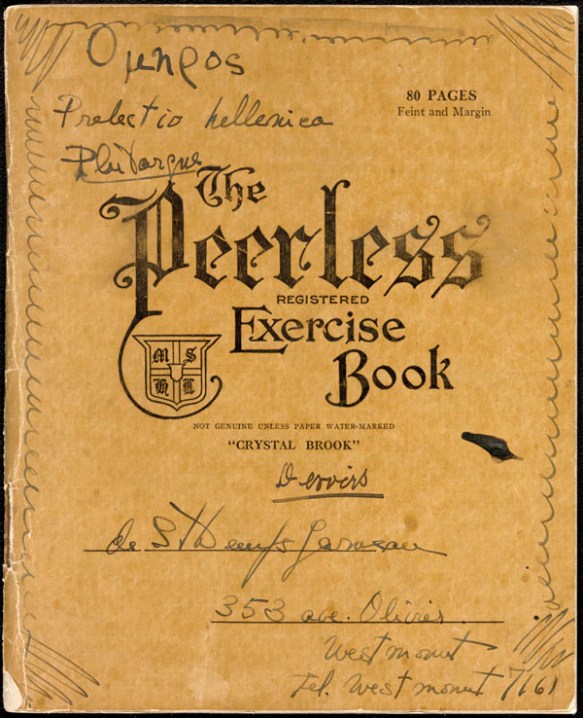
A colour image of a notebook with “The Peerless Registered Exercise Book” on the cover containing handwritten annotations and inscriptions in Greek.

Cover of de Saint-Denys Garneau’s homework notebook, undated (MIKAN 4817981). Explore other selections from his notebooks.

Now that the finding aid has been entered into MIKAN, researchers can now view a description of each individual item in the fonds from the comfort of their own home and know what is in an archival box before they order it. This finding aid opens a window on the author’s life, his relationships and artistic processes—unveiling a little more of the beautiful handwritten poems and letters of Hector de Saint-Denys Garneau.

Library and Archives Canada releases its latest podcast episode, “Guardians of the North: Comic Books in Canada”

Library and Archives Canada (LAC) is releasing its latest podcast episode, Guardians of the North: Comic Books in Canada.

You don’t have to go far to see the influence that comic books have had on contemporary culture, but you might be surprised to learn that LAC holds an extensive collection of comic books and related material within its vaults. In this episode, we speak with comic book historians Hope Nicholson and Rachel Richey about their work and LAC’s role in it. We also talk to special collections librarian Meaghan Scanlon who takes us deep into the comic book collection, and tells us what can be found there and online.

Subscribe to our podcast episodes using RSS or iTunes, or just tune in at Podcast–Discover Library and Archives Canada: Your History, Your Documentary Heritage.

For more information, please contact us at podcasts@bac-lac.gc.ca.

Comic books at Library and Archives Canada

As the keeper of Canada’s national documentary heritage, Library and Archives Canada (LAC) collects a wide range of published Canadiana, including comic books. The collection includes not only comics published in Canada, but also comics by Canadian creators published in other countries. Comic books published in Canada are often acquired via legal deposit. But LAC has also received two important collections from private sources that greatly enhance its holdings of Canadian comics. The largest of these is the John Bell Canadian Comic Book Collection. Donated by comic book historian and former LAC archivist John Bell, the collection includes approximately 4,000 comic books, ranging from Second World War era superhero comics to 21st century zines. Currently, the collection is uncatalogued, but a complete list of all items in the first two accessions is available in AMICUS.

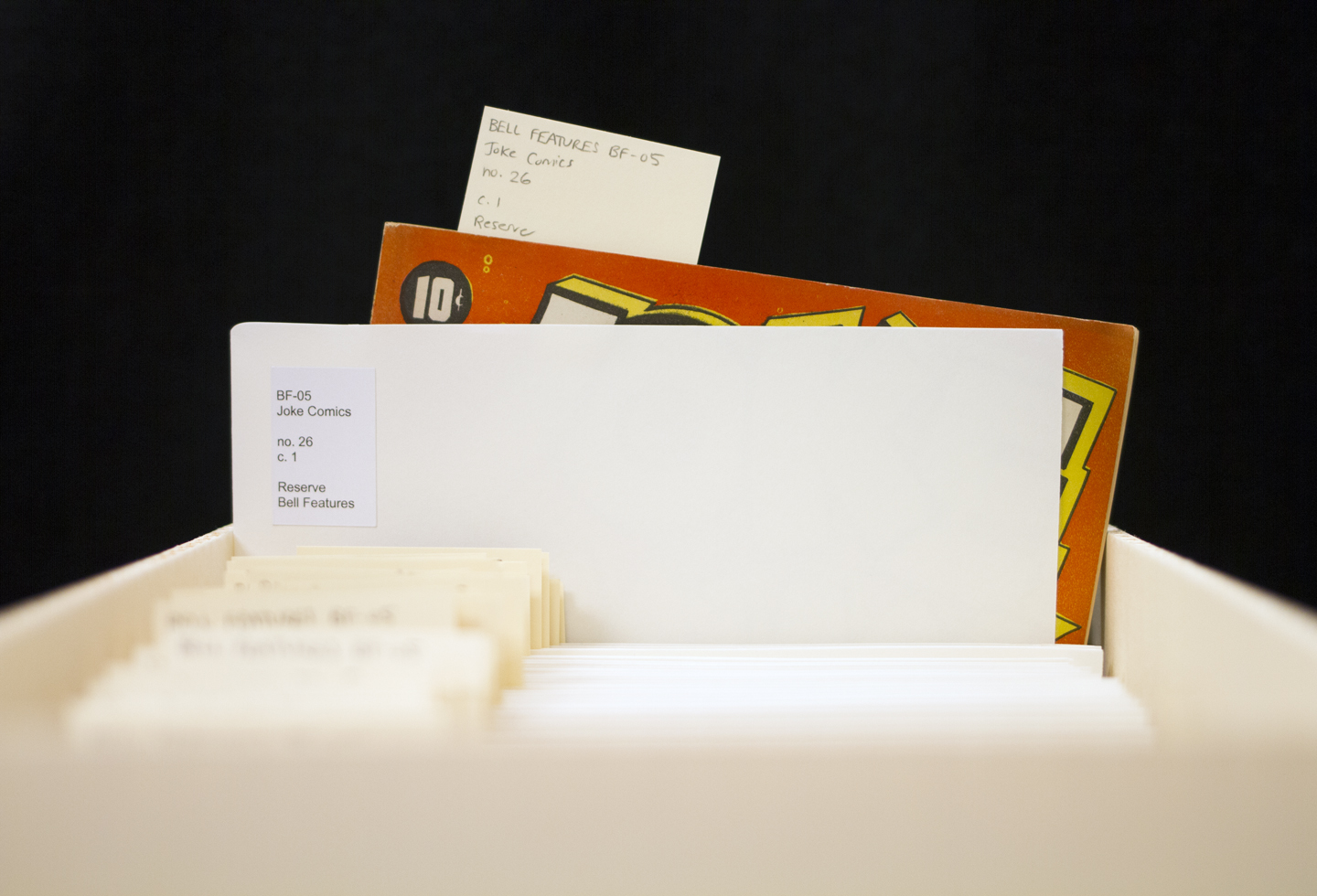
Colour photograph showing a filing box with folders with labels, one is pulled out half-way and a red comic book with the 10¢ price peeks out of the folder.

One box from the catalogued and housed Bell Features Collection

Second World War era Canadian comics are also well-represented in LAC’s Bell Features Collection, which consists of 382 comic books from the corporate archive of one of the major publishers of the period, Toronto-based Bell Features. These older Canadian comics are extremely rare, and the Bell Features Collection is one of the richest resources available. The collection has been fully catalogued, and a collection-level description listing all the titles is available in AMICUS. Over the last few decades, comic books and graphic novels have been increasingly recognized as a literary genre worthy of serious study. In the 1940s, however, comics were considered “throwaway” books for children, as demonstrated by the fact that many Bell Features comics include games and activities for young readers. Because of their ephemeral nature, 1940s comic books were printed on cheap, poor-quality newsprint. As a result, there are various conservation issues to consider when storing comics. Fortunately, the vaults at LAC’s state-of-the-art Preservation Centre provide optimal environmental conditions. The Bell Features Collection is stored in acid-free, closed boxes that protect the comics from harmful light exposure and dirt. Inside the boxes, each comic book is kept in a paper envelope that is open on the top and front edges allowing the comics to slide in and out of their housing with a reduced risk of catching or tearing on a tight opening. The envelopes also contain an alkaline reserve that helps slow down the harmful effects of the acid in the paper. Listen to the podcast Guardians of the North: Comic Books in Canada to learn more about Canadian comics.

Related resources

100th anniversary of the composition of the iconic poem “In Flanders Fields”

John McCrae’s “In Flanders Fields” is one of the best-known literary works to emerge from the First World War. The poem’s most lasting legacy is its popularization of the poppy as a symbol of remembrance for those killed in war.

McCrae is thought to have written the poem during the second week of the Second Battle of Ypres while he was stationed at what later became the Essex Farm Advanced Dressing Station, just north of the town of Ypres. McCrae, a Major and military doctor, was second-in-command of the 1st Brigade Canadian Field Artillery. The exact circumstances in which the poem was written, however, remain the stuff of legend. The most cited stories of the poem’s origin centre on McCrae’s grief over the death of his friend, Lieutenant Alexis Helmer, an officer of the 1st Brigade Canadian Field Artillery who was killed by a direct hit from a German shell on the morning of May 2. One account says that McCrae was so distraught after his friend’s funeral (for which McCrae, himself, said the committal service in the absence of a chaplain) that he composed the poem in just 20 minutes as a means of calming himself down. Another story has it that McCrae was seen writing his poem the next day, May 3, sitting on the rear step of an ambulance while looking at Helmer’s grave and the poppies that had sprung up near the dressing station. His commanding officer, Lieutenant-Colonel Morrison, tells a third story: that McCrae drafted his poem while passing time between the arrivals of wounded soldiers. Adding to the mystery is the fact that the Imperial War Museum in England has a tracing of an original holograph of the poem, written by McCrae for Captain Tyndale-Lea, which claims that McCrae wrote the poem on April 29, 1915, three days before Lieutenant Helmer’s death.

The handwritten poem on yellowed paper in very faded ink.

A copy of “In Flanders Fields” written in John McCrae’s hand. Morrison was a friend and the commanding officer of the poet as well as a physician, December 8, 1915 (MIKAN 179238)

How the poem was submitted for publication is also a matter of speculation. By one account, McCrae threw the poem away but it was recovered by another soldier and sent to a London newspaper. Possibly McCrae himself submitted it, as he made a number of handwritten copies to give to friends shortly after drafting it. The poem was printed by Punch magazine on December 8, 1915. Within months it became the most popular poem of the war.

While no institution is known to have John McCrae’s original first draft of the poem, Library and Archives Canada (LAC) has two manuscript versions of it, both written and signed by McCrae. One is dated December 8, 1915 and is part of a collection donated to LAC by Major-General Sir Edward W.B. Morrison, who was McCrae’s friend and fellow officer. The other is typed on paper and is part of a collection of documents donated by James Edward Hervey McDonald, an original member of the Group of Seven painters. LAC also holds an extensive and richly detailed collection of John McCrae’s letters and diaries, spanning much of his life, from childhood to shortly before his death from pneumonia in January 1918.

Black-and-white photograph showing a man in military uniform sitting down on steps with a dog at his side.

Lt.-Col. John McCrae and his dog Bonneau, circa 1914 (MIKAN 3192003)

Additional Resources

Lucy Maud Montgomery: From Potboilers to Poetry

Version française

Lucy Maud Montgomery, was born in Prince Edward Island on November 30, 1874 and lived there until her marriage in 1911 to Reverend Ewan Macdonald.

Picture from a page in Everywoman’s World magazine that shows a black-and-white photograph of a house with fruit trees in the foreground and a grove of trees to the left with the following caption, “My old home at Cavendish, Prince Edward Island, taken from the front. In the grove to the left was our playhouse with the wonderful door that we made ourselves.”

Lucy Maud Montgomery’s home at Cavendish, P.E.I. (MIKAN 3641481)

Montgomery began her career writing for Canadian and American children’s magazines. Her first novel, Anne of Green Gables, published in 1908 brought her immense international fame. Anne of Green Gables was published by L. C. Page and Company of Boston, Mass., which published another seven of her books before she left them over legal matters and lawsuits in 1917. She turned to Canadian publisher McClelland Stewart and American publisher Frederick Stokes in 1919. During this time period, L. C. Page published a collection of short stories in their possession, Further Chronicles of Avonlea, spurring another lawsuit.

Stamp showing an illustration of a young girl with red hair sitting on a box with a leather satchel beside her. She appears to be thinking or waiting for somebody.

Stamp in honour of Lucy Maud Montgomery’s novel, Anne of Green Gables. (MIKAN 2218216)

By the time she died in April 1942, Montgomery had published 22 novels and books of short stories, articles, and a book of poetry, The Watchman, and Other Poems. She also had a portfolio of unfinished poetry. Despite her international fame and success, Montgomery was disappointed that her poetry was not as well received as her popular novels that she sometimes referred to as “potboilers.”

Library and Archives Canada has resources available in:

  • Collection search—you may find six different archival collections that have material, such as correspondence, art, and photos
  • Aurora—with over 5,000 references to works by or regarding Montgomery
  • Theses Canada—has 22 theses with references to Montgomery’s life and works

Related site:

    • L. M. Montgomery Institute—the Robertson Library at the University of Prince Edward Island is dedicated to helping students and scholars study Montgomery’s life, works, and influence

Library and Archives Canada releases fifteenth podcast episode, “Out of the Ordinary: Rare Books”

Library and Archives Canada (LAC) is releasing its latest podcast episode, Out of the Ordinary: Rare Books.

Special Collections librarian Meaghan Scanlon joins us to discuss rare books and the collection (held at Library and Archives Canada) that has grown from relatively modest beginnings into one of the finest collections of rare printed material in the country.

Subscribe to our podcast episodes using RSS or iTunes, or just tune in at Podcast–Discover Library and Archives Canada: Your History, Your Documentary Heritage.

For more information, please contact us at podcasts@bac-lac.gc.ca.

The TD Summer Reading Club is back!

Banner for the TD Summer Reading Club

The TD Summer Reading Club 2014 was officially launched on June 3rd in Ottawa, Ontario, with the participation of the project partners: TD Bank Group, Toronto Public Library and Library and Archives Canada. The purpose of this program is to encourage children to read using fun and accessible activities that build their confidence and fire their enthusiasm for reading — all summer long.

Image of a stack of booksChildren and parents can take inspiration from the theme, Eureka!, to invent, build and reimagine the world while reading captivating books at their local library. Across the country, over 2000 public libraries are participating in the Club, and over 600,000 children register enthusiastically for the program every summer.

The TD Summer Reading Club provides free program materials, including a magazine for children aged 6 to 12; a young children’s booklet for preschool-aged children; and a notebook, a poster and awesome stickers that children can collect over the summer. Of course, the Club also provides lots of suggestions for reading!

A picture of a mouse building a robotRegistering for the Club is free. Simply inquire at your local library to find out whether it offers the program. The Club’s website also offers a range of online games and activities.

This year, the TD Summer Reading Club will focus on sharing and creativity. It will be a great opportunity for the young participants to use all their ingenuity and take on the challenge with their family and friends!

Remembering cartoonist Roy Peterson

On September 30, 2013 Canada lost one of its most talented and renowned editorial cartoonists, Roy Peterson. As a tribute, let’s take a look at his remarkable career spanning 40 years at the Vancouver Sun.

Mr. Peterson was born in Winnipeg in 1936 and studied at the Vancouver School of Art. His first forays into the art of cartooning came when he was a young man. While working as a window display artist, he began mailing his cartoons to various newspapers in northern British Columbia. In 1962 Mr. Peterson began his cartooning career at the Vancouver Sun where he carried out his duties as staff editorial cartoonist until 2009.

Early career

In addition to his work with the Vancouver Sun, Roy Peterson also collaborated with journalist Allan Fotheringham, producing illustrations for Mr. Fotheringham’s back page editorials for Maclean’s magazine. Mr. Peterson also collaborated with journalist Stanley Burke, producing a number of bestselling books aimed at satirizing Canadian politics and politicians of the day in the form of serialized children’s stories. Titles of these stories include Swamp Song, Frog Fables and Beaver Tales and The Day of the Glorious Revolution. In 1979, The World According to Roy Peterson, a solo collection of his cartoons and caricatures, was published by Douglas & McIntyre.

A unique style

Mr. Peterson had a very unique artistic style, relying heavily on the use of cross-hatching when producing his work. In Mr. Peterson’s pre-digital artistic world, cross-hatching (being a series of small intersecting lines in close proximity to one another) was produced laboriously by hand and used to designate shading and to differentiate between light and darker areas.

Distinctions

Throughout his long and distinguished career, Mr. Peterson has been the recipient of many awards, most notably as the record-breaking winner of seven National Newspaper Awards. Mr. Peterson also helped found the Association of Canadian Editorial Cartoonists. His work has been well-received internationally with exhibits at both the Smithsonian Institution and the United Nations.

In December of 2004, Roy Peterson was invested into the Order of Canada, being cited as one of Canada’s “… finest editorial cartoonists. Expertly blending humour and satire, he has provided insightful commentary on our political landscape.”

Want to learn more about Roy Peterson?

Library and Archives Canada began acquiring the work of Roy Peterson in 2000. The Roy Peterson fonds (Mikan #160207) contains 1,871 pen and ink drawings and documents his work for the Vancouver Sun from 1962 to 1993.