Reading hockey at the Canadian Museum of History

By Jennifer Anderson

Library and Archives Canada (LAC) is about more than just “stuff”; it is also the home of leading experts in Canadian history and culture. While LAC archivist Jennifer Anderson was at the Canadian Museum of History (CMH) on an Interchange Canada agreement, she co-curated the popular exhibition, “Hockey.” During the exhibition research, she consulted LAC staff and experts across the country. LAC also loaned 30 artifacts to the museum for this exhibition, and offered digital copies of hockey images from its vaults.

You can see the results that teamwork brings! Having run from March 10 until October 9, 2017 in Gatineau, the exhibition will start up again on November 25, 2017 (the 100th anniversary of the NHL) in Montréal at Pointe-à-Callière, before continuing its cross-country tour.

“Hockey”: the exhibition that started with a book…

…or two…or a few hundred. Biographies, autobiographies, histories—comic books, and novels for young people; we read those, too! And as many newspaper and magazine articles as we could find.

The exhibition team swapped books like fans trade hockey cards!

Books moved us, pushed us, challenged us and at times even frightened us. I cried and laughed over them, took notes and then forgot to because I was too engrossed in the reading. We read about big personalities like Maurice Richard and Pat Burns, about game changers like Sheldon Kennedy and Jordin Tootoo, and about Ken Dryden’s observations of young people and families in the game. We were deeply inspired by Jacques Demers’ work to advance youth literacy initiatives. Borrowing literacy teachers’ best practices, we chose to use fonts of different sizes and based the look of our exhibit on the style of a hockey card. The goal: make reading fun and accessible.

One of the first books I read was Paul Kitchen’s fascinating tale of the early history of the Ottawa Senators, Win, Tie or Wrangle (2008). Kitchen did much of his research from a desk at LAC, and he spun some of his discoveries into an online exhibition, Backcheck. From his book, we were able to identify a little-known shinty medallion depicting a stick-and-ball game, which took place on the grounds of Rideau Hall in 1852. Drawing on Kitchen’s footnotes, I reached out to the Bytown Museum, and was thrilled to learn they would be happy to lend the artifact for the exhibit. The conservators at the CMH buffed it up a bit, and images of this early piece of hockey history were included in the exhibition souvenir catalogue.
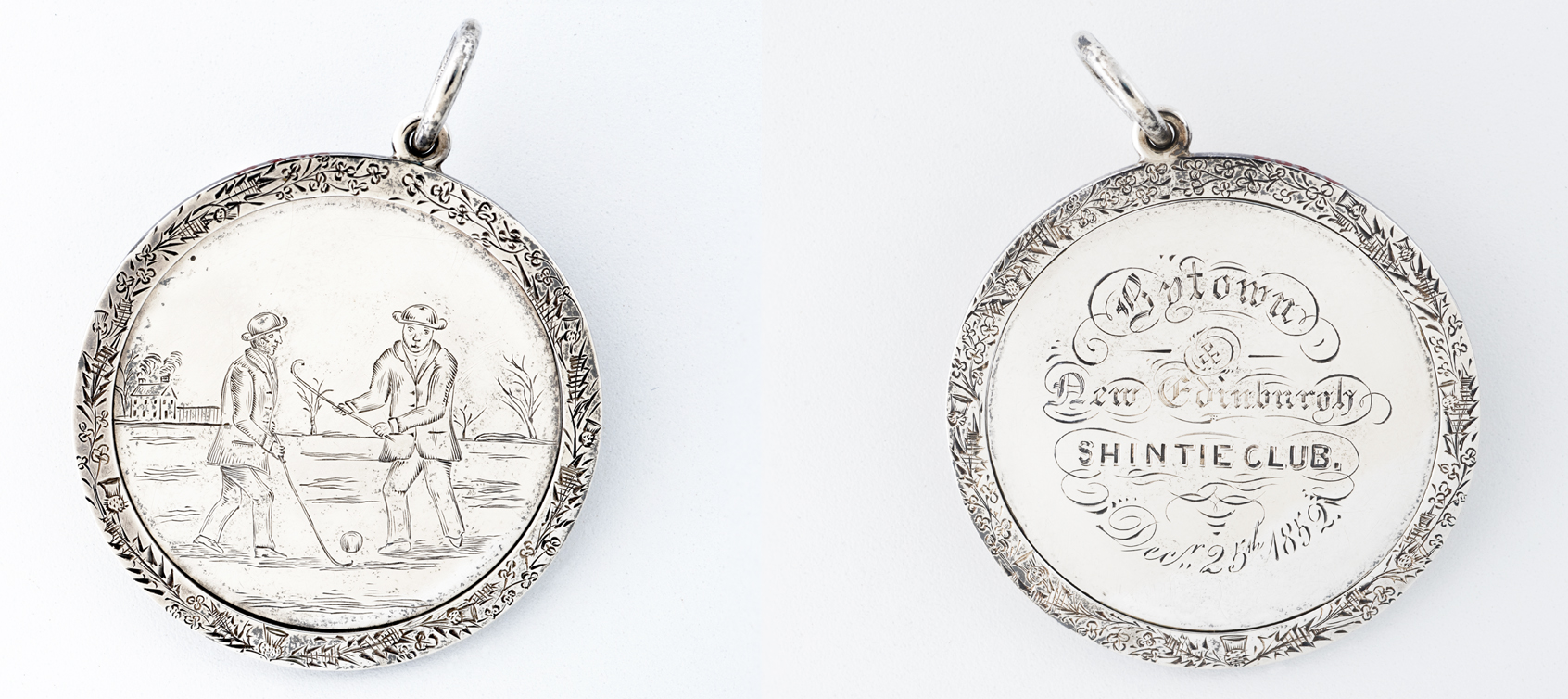
A colour photograph showing two sides of a silver medallion. The one side shows a game of shinty taking place outdoors and the second side reads “Bytown and New Edinburgh Shintie Club, Dec. 25th 1852.”

Front and back views of the silver New Edinburgh Shintie Club medallion, 1852, Bytown Museum, A203. Canadian Museum of History photos, IMG2016-0253-0001-Dm, IMG2016-0253-0001-Dm.

Paul Kitchen would probably be the first to acknowledge that any research project is a team sport, and our exhibition team reached out to many experts who had earlier worked with Kitchen, or had been inspired by him. Within LAC, Normand Laplante, Andrew Ross, and Dalton Campbell have continued the tradition of sports history, and their archival work led us to explore LAC’s collections for material to place in the exhibit. At the CMH, there are hockey experts galore, but Jenny Ellison is the “captain.” The team brought on Joe Pelletier as a research assistant to scout out images and hidden bits of information, based on the work he had already provided voluntarily. Hockey researchers and curators from across the country sent us artifacts, images and information.

Loaning originals is such an important part of the diffusion of any collection. Thirty individual items were loaned by LAC to the CMH for this exhibition. The LAC Loans and Exhibitions Officer admitted to being particularly touched by the team’s interest in The Hockey Sweater by Roch Carrier (now a popular animated film). As a child, she had received this book from one of her best friends, and only recently located this much-loved book. She has since shared it with her own children, and enjoyed telling them about her own childhood memories of this popular story about hockey.

A colour image of a book cover showing boys dressed like Maurice Richard getting ready for a hockey game

The Hockey Sweater by Roch Carrier and illustrated by Sheldon Cohen. Used by permission of Tundra Books, a division of Penguin Random House Canada Limited (AMICUS 4685355)

Carolyn Cook, LAC curator, was pleased to see Bryan Adams’ portrait of Cassie Campbell in the exhibition. This portrait was one of several taken by Adams for Made in Canada, a book of photographs of famous Canadian women sold as a fundraiser for breast cancer research. “Cassie Campbell is an iconic figure in the world of women’s hockey,” said Cook. “Her on-ice accomplishments opened the door to the next generation of girls coming up in the game and, as the first woman to do colour commentary on ‘Hockey Night in Canada,’ she has broken through the glass ceiling. This close-up portrait of her exudes strength, control and determination—qualities that have contributed to Campbell’s success.”

In the early research period, Richard Wagamese’s book, Indian Horse, hit a chord and resonated with the team. Michael Robidoux’s book on Indigenous hockey, Stickhandling Through the Margins, motivated us to ensure that space be put aside for the full integration of Indigenous voices in the game, whether from the early leadership of Thomas Green, or through the artwork of Jim Logan to spark discussion of hockey in society.

Drawing on Carly Adams’ book, Queens of the Ice, the museum acquired and exhibited a rare Hilda Ranscombe jersey. We also read the footnotes in Lynda Baril’s Nos Glorieuses closely, and as a result were able to secure a number of important artifacts that were still in private collections, including a trophy awarded to Berthe Lapierre of the Montréal Canadiennes in the 1930s. And when we read about Hayley Wickenheiser skating to school in the drainage ditches along the roadside, building up the muscles that made her a leader in the sport, on and off the ice, we put her story near the centre of the exhibition.

A few of our favourite books found their way directly into the museum cases, to tell their own stories.

For instance, where we highlighted the role of the team-behind-the-team, we gave Lloyd Percival’s book The Hockey Handbook a central spot in the case. Gary Mossman’s recent biography of Percival was a big influence here, and in particular, I was fascinated by the powerful impact Percival’s book had on how hockey players and coaches approached the game. Imagine a time when players ate more red meat and drank beer the night before a game, rather than following Percival’s advice to eat yogurt and fresh fruit! And yet it was not that long ago! Apparently the book was taken up by Soviet hockey coach Anatoli Tarasov, and we saw its impact on the ice in 1972. Percival also had an interesting perspective on burnout, or “staleness” as he called it—a theory that has application for both on- and off-ice players.

Stephen Smith, author of Puckstruck, lent the museum collectible and fun cookbooks that teams published—this spoke to the overlap between popular fan culture and the down-to-earth and very practical realities of nutrition in high-performance sport.

The Museum of Manitoba loaned bookmarks that had been distributed to school kids by the Winnipeg Jets, each with a hockey player’s personal message about the importance of literacy in everyday life. These were displayed next to the hockey novels and comic books from LAC.

The exhibition team wondered about how to tackle prickly issues like penalties, violence and controversy. Then we hit on the most natural of all approaches—let the books and newspaper articles tell the stories! So next to an official’s jersey, you will find our suggested reading on the ups and downs of life as a referee, Kerry Fraser’s The Final Call: Hockey Stories from a Legend in Stripes. In the press gallery section, the visitor gets a taste for the ways that sports journalists have made their mark on the game. Next to a typewriter, an early laptop and Frank Lennon’s camera, we placed Russ Conway’s book Game Misconduct: Alan Eagleson and the Corruption of Hockey.

To capture the importance of youth literacy, we carefully chose books that we tested ourselves for readability.

A book cover showing a man walking in a hockey arena carrying a large red duffel bag and a hockey stick.

C’est la faute à Ovechkin by Luc Gélinas, Éditions Hurtubise inc., 2012 (AMICUS 40717662)

A book cover showing a child playing hockey wearing a yellow-and-black uniform and chasing a hockey puck.

La Fabuleuse saison d’Abby Hoffman by Alain M. Bergeron, Soulières, 2012 (AMICUS 40395119)
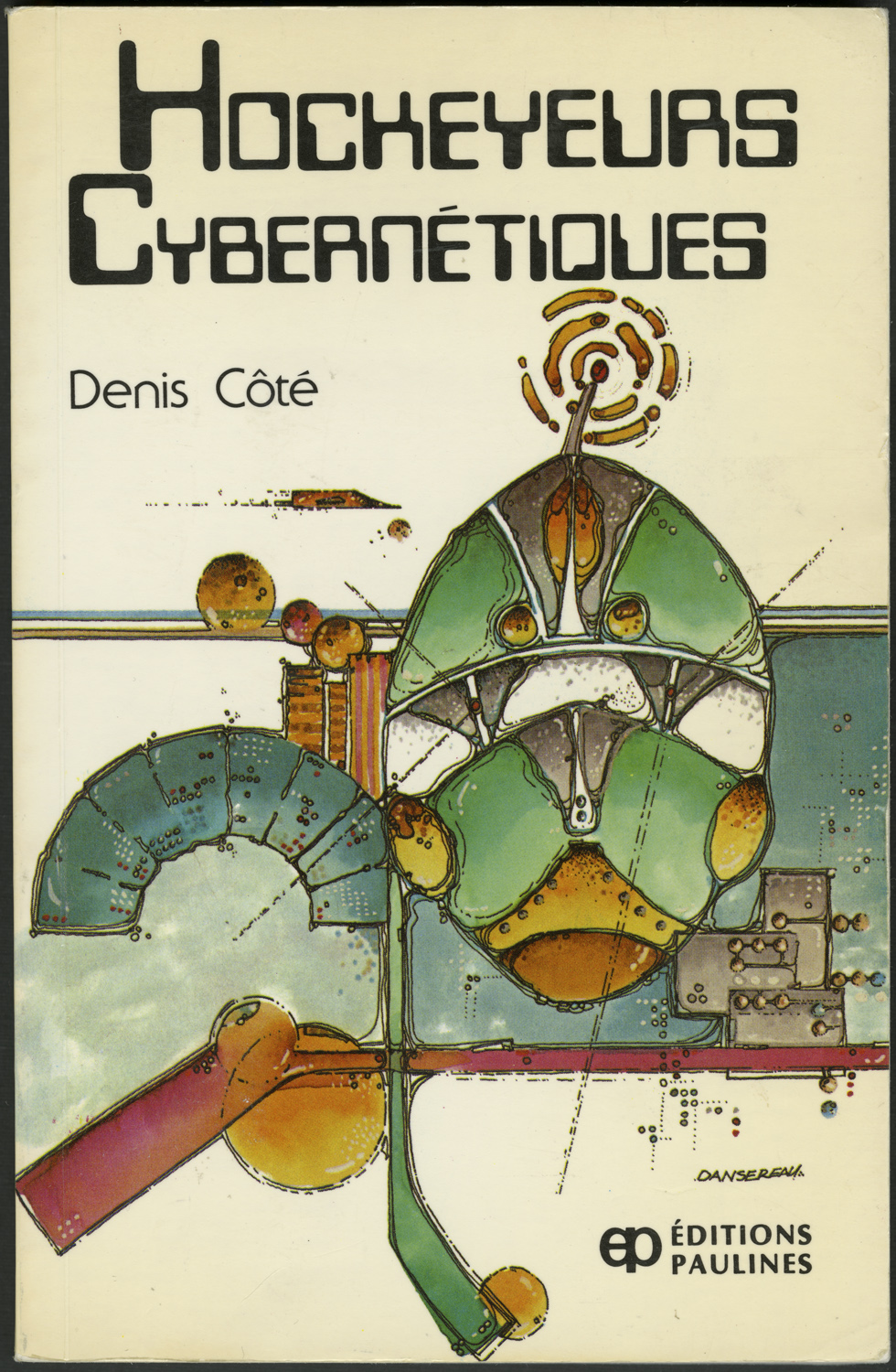
A book cover showing an abstract illustration that incorporates a hockey stick.

Hockeyeurs cybernétiques by Denis Côté, Éditions Paulines, 1983 (AMICUS 3970428)

Literacy became a thread running through the exhibition, in ways big and small. Thanks to all the librarians who helped us get our hands on these books! It may be too ambitious, but I continue to cherish the hope that the exhibition and this blog will inspire you to pick up a book, visit a library, and enjoy the game as much as we did.

Wishing to bring a fresh read to the sport, Jenny Ellison and I are editing a group of new essays on the sport, to be published in 2018 (Hockey: Challenging Canada’s Game — Au-delà du sport national) Check it out!

Do you have a favourite book about hockey?  Let us know in the comments.


Jennifer Anderson was co-curator of the exhibition “Hockey” at the Canadian Museum of History. Currently, she is an archivist in the Archives Branch at Library and Archives Canada.

Beating hearts: John Alexander Hopps and the pacemaker

By Rebecca Meunier

Quick! Think of five inventions that have revolutionized the way we live.

Now try to think of five Canadian medical inventions. Not so easy, is it?

Why is it that most of us are able to think of five inventions that have helped to shape the world we live in, such as the wheel, but struggle to name even two Canadian medical inventions?

Though we might have the impression that countries such as the United States or England have the upper hand when it comes to the total number of medical inventions, we must not forget that Canada has long been a leader in the advancement of healthcare across the world. Some Canadian inventions include the discovery of insulin by Sir Frederick Banting; the invention of Pablum, an enriched infant cereal; and cobalt therapy.

There is one Canadian medical invention, however, that outshines all others. It has the power to make your heart beat steadily when you exercise and even when you are in love. That invention is the artificial pacemaker. Canadian electrical engineer John Alexander Hopps is credited with the invention of the artificial pacemaker (also known as the stimulator-defibrillator), and it is through Hopps’s work with Dr. Wilfred Bigelow and Dr. John Callaghan that the device first began to save lives.

A black-and-white photograph of an operating room scene with four men in surgical gowns and masks gathered around a prone patient who is hidden from view.

Dr. John Hopps in the background overlooking an operation in an operating theater, undated (a207051 )

John Alexander Hopps was born in Winnipeg on May 21, 1919. He graduated in 1941 from the University of Manitoba, where he had studied electrical engineering. He then worked at the National Research Council (NRC) in Ottawa on wartime radar development. In 1949 he was assigned to work in Toronto with Dr. Bigelow, who had recently discovered that there was a reduced risk of complications if, before an open-heart surgery, the patient was kept in a state of hypothermia. His work with Dr. Bigelow and Dr. Callaghan led to the development of the cardiac pacemaker in the 1950’s—a device that, though he did not know it at the time, would help prolong his own life. From 1957 until 1958 Hopps worked in Sri Lanka, helping to establish the first colonial engineering unit in Southeast Asia. Fifteen years later, in 1973, he became the head of the NRC’s new Medical Engineering Section. He continued to work on new medical innovations and became a leading voice for the importance of hospital safety standards. He was especially concerned with the protective measures taken by hospitals to reduce the risk of operating room electric shock hazards.

Hopps’s unique knowledge of technology and medicine brought him into contact with all kinds of challenges relating to technology and human health. He even wrote a research paper detailing his findings on the potential health hazards of a microwave oven used by the staff at the Riverside Hospital, concluding that there were no significant harmful effects associated with its use.

Hopps also became the first president of the Canadian Medical and Biological Engineering Society, and in this role continued to promote the use of engineering in the medical world.

The pacemaker that we know today looks very different from its predecessor. The world’s first pacemaker was about the size of a microwave oven and had to be placed outside the body. Over the years, countless doctors and inventors helped to shrink the size of the pacemaker so that it was eventually small enough to be placed inside the human body during a less invasive surgery.

A black-and-white photograph of a small machine with various knobs and dials. Two black wands are connected to the machine by a cord.

Operating room model of the stimulator-defibrillator (e011200816-v8)

The pacemaker became quickly invaluable to doctors and was included in mobile cardiac units.

A black-and-white photograph of a man wearing a lab coat, surgical mask and surgical cap. He is looking at his watch and standing next to a large machine with many drawers, knobs and wires. The machine has a sign on it that reads Mobile Cardiac Resuscitator.

Mobile Cardiac Resuscitator (e011200817-v8)

Black-and-white photograph of a young man wearing glasses and a bowtie.

John A. Hopps, circa 1945 (e011200814-v8)

In 1986, Hopps became an Officer of the Order of Canada. He died in 1998, after having permanently altered how medicine and technology interact with one another.

If you would like to read more about John Alexander Hopps and the pacemaker, you can explore his fonds, which is housed at Library and Archives Canada. Hopps’s fonds includes a wide range of materials, from textual documents relating to his work to pictures that help shed light on the evolution of the pacemaker to images of cardiac operations.


Rebecca Meunier is a student orientation technician at Library and Archives Canada.

Library and Archives Canada docks at Pier 21 in Halifax

By Leah Rae

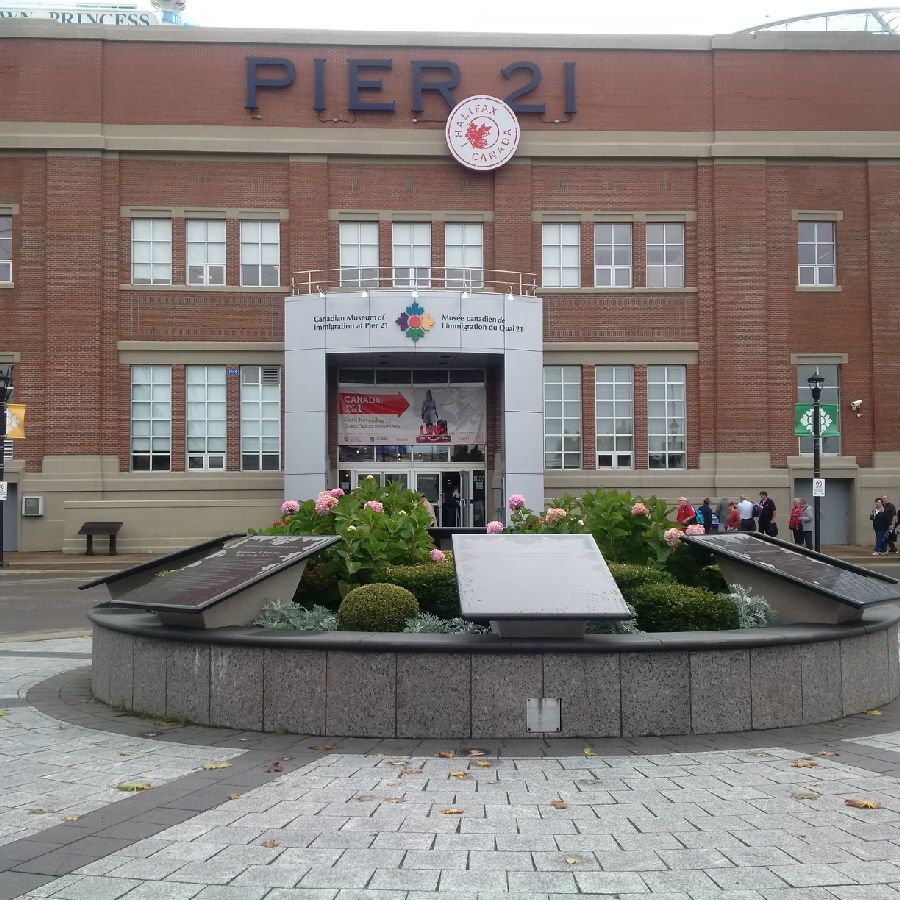
In May this year, a big change came for the Library and Archives Canada (LAC) Halifax team when we moved into the Canadian Museum of Immigration at Pier 21 in beautiful downtown Halifax. The time has flown since then, and we have already passed our first summer at our new location.

A colour photograph of a red brick building bearing the sign “Pier 21.” In front of its main entrance is a raised garden enclosed within a circular stone form that supports several large plaques.

Providing reference services to researchers in the Halifax region from our new service point at Pier 21.

Not only do we now share office space with Pier 21, we also opened a new service point to make LAC’s collection more accessible to the local communities in the region. Officially launched on June 19, it is located within Pier 21’s Scotiabank Family History Centre, just inside the museum. During the summer we have seen a steady increase in client visits. People come in with all different kinds of questions for us about lighthouses, immigration, family history, military history, war brides, home children, the coal mining industry in Cape Breton, Indigenous genealogy, and much, much more. In addition to the knowledgeable employees who staff our service point on weekdays, we also have a kiosk that provides clients with access to LAC databases, as well as other subscription databases, such as Ancestry.ca. Researchers can drop by anytime during our hours of operation to use the kiosk or speak with someone at the orientation and reference desk. For up-to-date hours of operation, please visit the Service Points Outside of Ottawa page. Researchers can also make an appointment with an archivist on site for assistance with more in-depth questions or with help preparing for a research trip to consult material at LAC in the National Capital Region, Winnipeg, or Vancouver.

A colour photograph of a woman sitting at a desk in front of a computer looking at the camera. On the wall behind her is the sign “Library and Archives Canada – Bibliothèque et Archives Canada.”

LAC archivist Leah Rae at the new orientation and reference desk

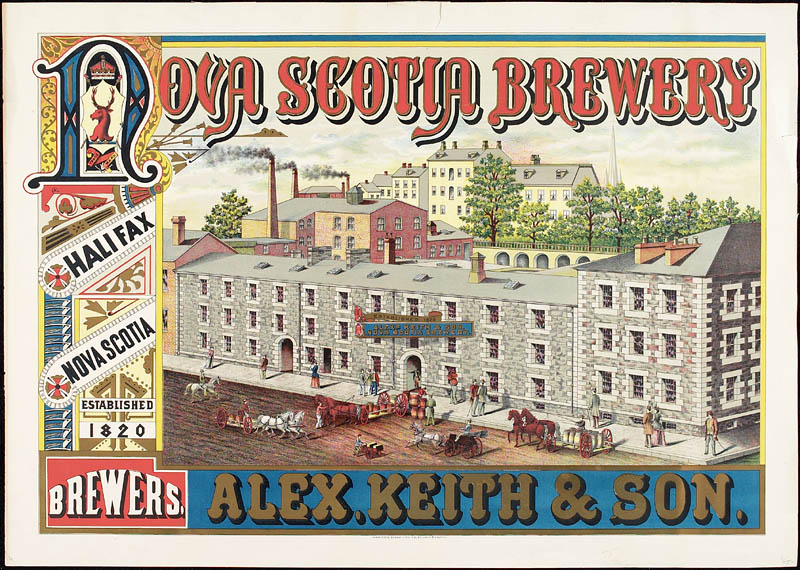
Co-locating with Pier 21 also gives us the opportunity to work with the museum on some of its most popular events. Canada Day has been the largest event for us so far, with this year marking the 150th anniversary of Confederation. We set up an information booth in the museum and were delighted to receive over 300 visitors. People were excited to meet us and to enter a draw to win one of five reproductions of original images from LAC’s vast collection.

A colour print of an ad for Alex. Keith and Sons. Nova Scotia Brewery.

One of the prints reproduced for the draw on Canada Day (e000756699)

Canada Day was the first of many planned collaborative events between LAC and Pier 21. We are looking forward to more opportunities to highlight our collection to Haligonians and other visitors.


Leah Rae is an archivist based in Halifax in the Regional Services and ATIP Division of Library and Archives Canada.

Guest curator: Taryn Dewar

Banner for the guest curator series. CANADA 150 is in red along the left side of the banner and then the bilingual text: Canada: Who Do We Think We Are? and under that text is Guest curator series.Canada: Who Do We Think We Are? is a new exhibition by Library and Archives Canada (LAC) marking the 150th anniversary of Canadian Confederation. This exhibition is accompanied by a year-long blog series.

Join us every month during 2017 as experts, from LAC, across Canada and even farther afield, provide additional insights on items from the exhibition. Each “guest curator” discusses one item, then adds another to the exhibition—virtually.

Be sure to visit Canada: Who Do We Think We Are? at 395 Wellington Street in Ottawa between June 5, 2017, and March 1, 2018. Admission is free.


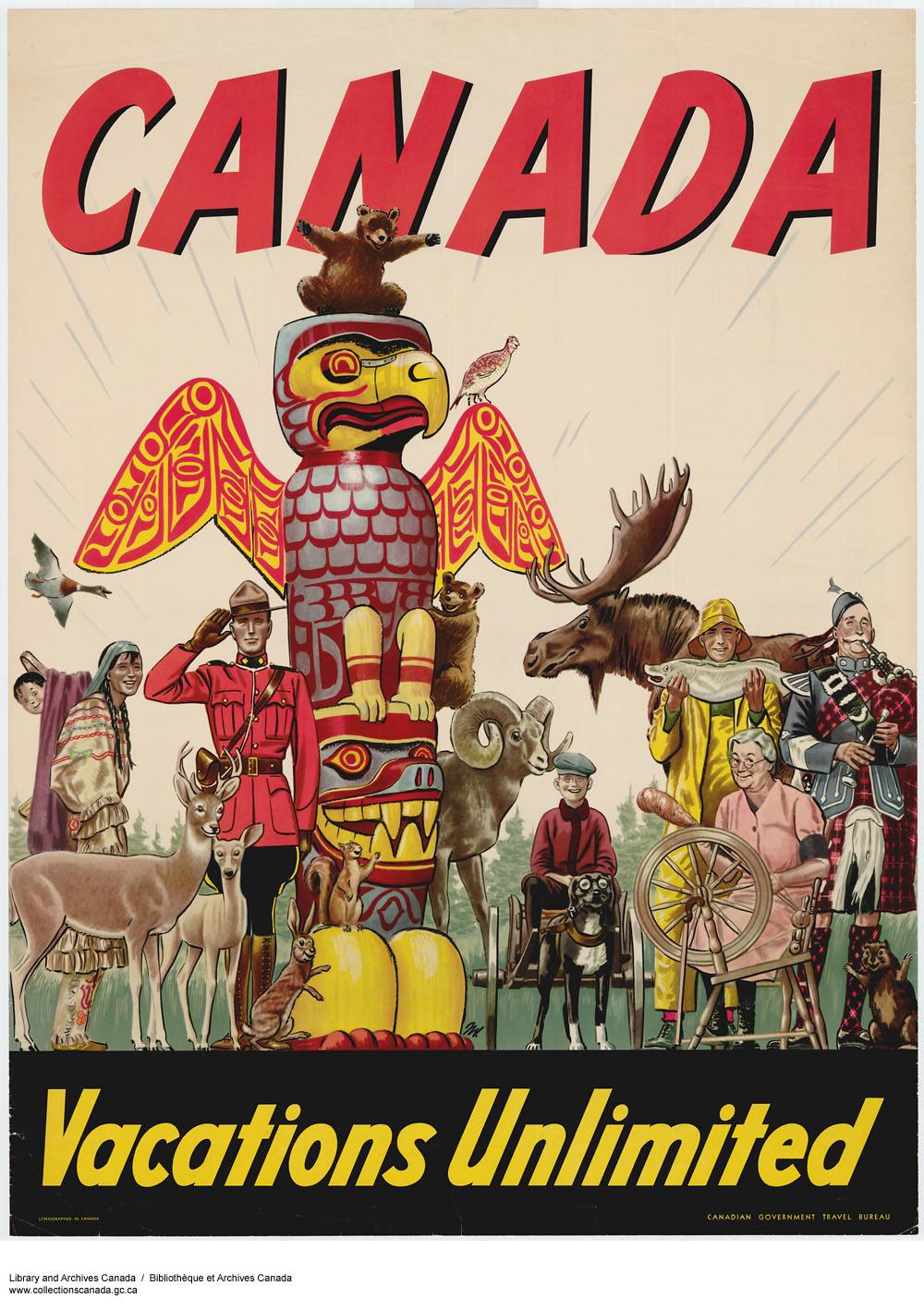
Tourism Poster from Canada Vacations Unlimited, ca. 1947

Colourful poster depicting a moose, deer, bears, a rabbit, a squirrel, a beaver, a fisherman, a piper, a woman spinning wool, a Mountie, an Indigenous woman and child, a boy driving a dog cart, and a totem pole. The words “Canada” and “Vacations Unlimited” are printed across the top and bottom of the poster.

Tourism poster from Canada Vacations Unlimited, ca. 1947 (MIKAN 3007692)

More American tourists preferred seeing sights to going camping, according to early market research. This ad campaign, featuring Canadian cultural symbols, was the—often questionable—response. Is any Canadian stereotype missing?


Tell us a bit about yourself

In 2015, I moved to Fort McMurray, Alberta to work at the Oil Sands Discovery Centre as an interpreter. I grew up in Hamilton Township, Ontario, near Lake Ontario. Our family spent a lot of time camping and visiting museums on vacations. My move from Ontario to Fort McMurray let me travel across the country and gave me a much better perspective on just how big Canada really is.

Is there anything else about this item that you feel Canadians should know?

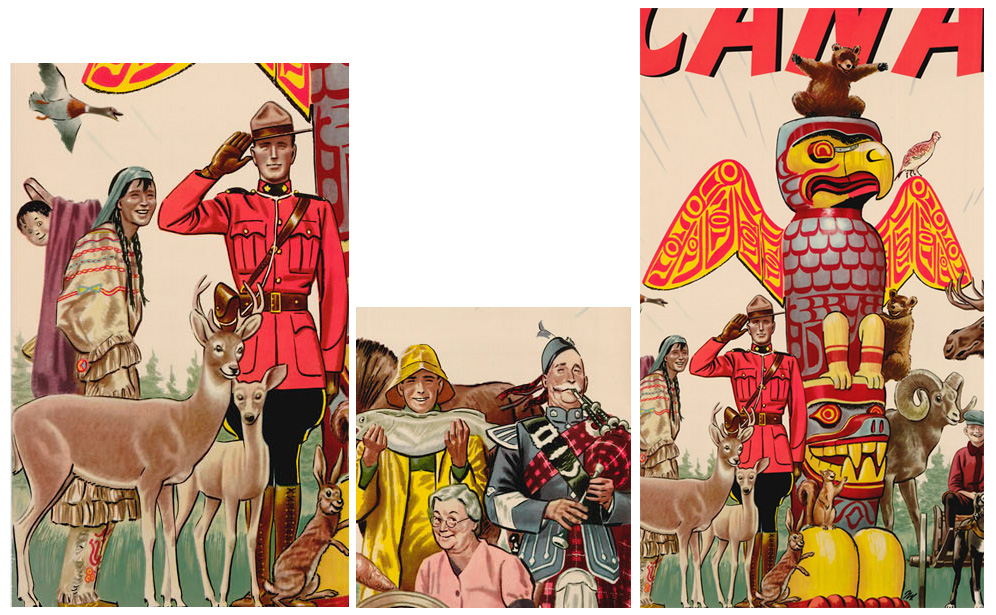
Three detailed images from the poster. One has a uniformed Mountie, and a First Nations woman wearing a blue-and-red striped dress carrying a baby on her back with deer and a rabbit in the foreground. The second has a fisherman in yellow rain gear holding a large fish and a man in a blue dress coat playing the bag pipes with a white haired woman seated between them. The third has a colourful totem pole shaped like an eagle with its wings spread on top surrounded by wildlife.

Detail of individual images from the poster: a Mountie and First Nations woman and child, a fisherman and a piper, and a totem pole. (MIKAN 3007692)

This Canada Vacations Unlimited poster captures a number of different Canadian stereotypes from the east to the west—the fisherman, the Mountie, the First Nations woman and child, and the totem pole. The poster also references some of the settlers who came to Canada such as the piper. Since the 1930s to 1950s when this poster was created, Canada has become even more diverse. While these are some of the prominent images of Canadians during that time period, it is important to recognize that not every “Canadian-ism” could ever be captured in a single image.

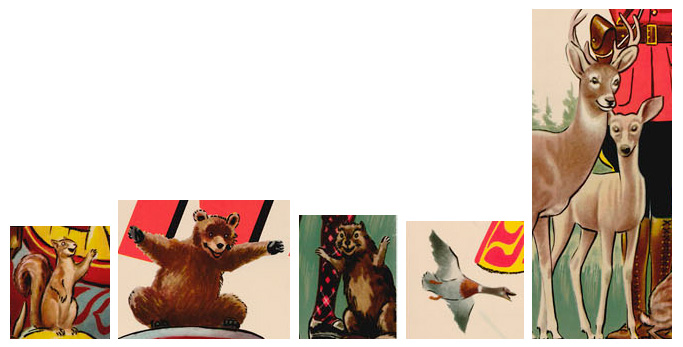
Details of a small brown squirrel; a crouching brown bear with his front paws spread out; a small brown beaver with his front paws spread out; a flying duck; and two brown deer, a stag and a doe.

Details of smaller animals from the poster. (MIKAN 3007692)

This poster features many wild animals as well as a forest in the background. While Canada has a lot of natural beauty, not everyone has a view of the Rocky Mountains or the Canadian Shield outcroppings. According to Statistics Canada, 66% of Canada’s population now lives within 100 kilometres of our southern border with the United States. This represents only four percent of Canada’s land area, which means there are many people living in metropolitan areas now. Some of our biggest cities such as Toronto, Vancouver, and Montréal have attractions that are also well known as tourist destinations.

Tell us about another related item that you would like to add to the exhibition

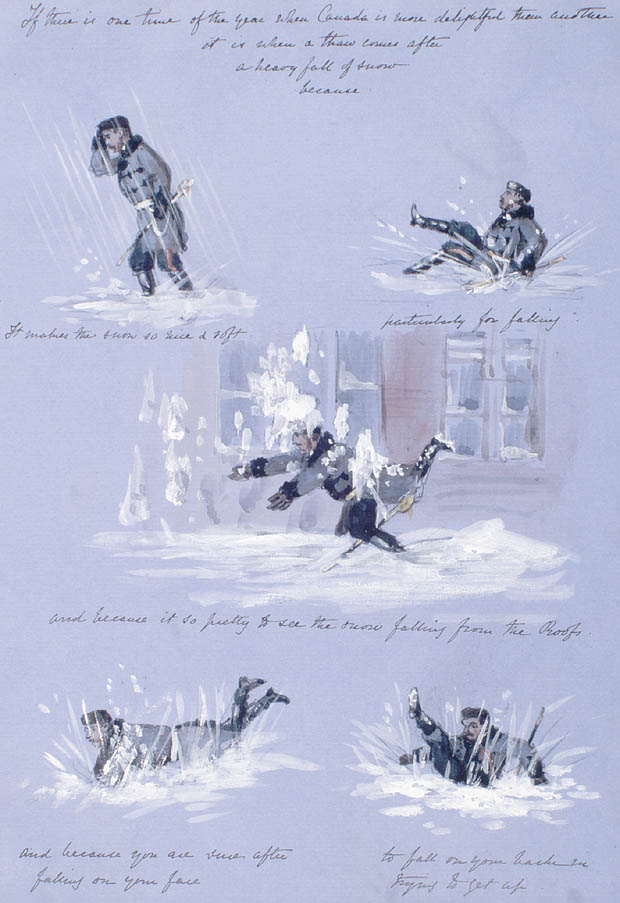
One thing that struck me when I was looking at the Canada Vacations Unlimited poster was that there were no signs of winter. While there are a number of other artifacts in Canada: Who Do We Think We Are that do focus on winter, it struck me that in this particular poster that focused on Canadian stereotypes there was no snow. For most of us in Canada, winter takes up a fair bit of the year. Yes, shovelling snow and driving through snowstorms are not activities that we tend to enjoy, but it is still better to make the most of what we have instead of just waiting for spring to arrive. To help provide a better look at what happens in Canada year-round, I think that this painting from the mid-1800s would be a good pairing for the Canada Vacations Unlimited poster.

A series of vignettes against a blue background depicting a male figure walking through soft snow, falling in various positions, or getting hit by snow. A running line of text describes each image: "If there is one time of the year when Canada is more delightful that another / it is when a thaw comes after / a heavy fall of snow / because / It makes the snow so nice & soft. / particularly for falling / and because it (sic) so pretty to see the snow falling from the Roofs. / and because you are sure after / falling on your face / to fall on your back in / trying to get up."

One time of year when Canada is more delightful than another. (MIKAN 2837052)

The painting focuses on a series of images of a man trying to walk through heavy snow. Its witty title is “One time of year when Canada is more delightful than another.” I think this is an interesting way to poke fun at something many of us grumble about during the winter—slogging through the snow, trying not to fall into it. The inscription that accompanies each figure works to turn an unpleasant experience into a tale of adventure.

Putting these two posters together shows Canadians in different walks of life surrounded by nature and finding ways to deal with the winter. This helps to express some of what Canada has to be proud of. Canada is more than just its natural beauty or its weather. Canadians are the ones who make the most of what this country has to offer and help to make it a better place to visit and live in.

Biography

A colour photo of a woman with glasses smiling at the photographer.

Taryn Dewar has a Master of Arts in Public History from the University of Western Ontario. She works as an Interpreter at the Oil Sands Discovery Centre in Fort McMurray, Alberta.

Sergeant Holmes, Major O’Kelly and Lieutenant-Colonel Shankland, Victoria Cross recipients

By Emily Monks-Leeson

Sergeant Thomas William Holmes is Canada’s youngest recipient of the Victoria Cross (VC). Born in Montreal on October 14, 1898, Holmes gave his date of birth as August 17, 1897, when he enlisted with the 147th Grey Overseas Battalion, making himself out to be older than he was. He served with the Canadian Mounted Rifles and was part of the first assault against the German defences at Passchendaele 100 years ago. When the right flank of the Canadian force was halted and heavy casualties inflicted by machine-gun and rifle fire from a German pillbox, Holmes repeatedly ran forward alone and bombed the machine gun crew, eventually taking the pillbox’s 19 occupants prisoner. Sergeant Holmes survived the war and returned to Canada. He died on January 4, 1950, and is buried at Greenwood Cemetery in Owen Sound, Ontario.

A black-and-white photograph of a smiling young man in uniform with his cap slightly askew.

Private Thomas William Holmes, VC, dated January 1918 (MIKAN 3216873)

Major Christopher Patrick John O’Kelly, born on November 18, 1895, in Winnipeg, Manitoba, was commissioned as a second lieutenant in the Canadian Expeditionary Force (CEF). At the age of 21 he was an acting captain in the 52nd Battalion (96th Lake Superior Regiment), leading his men against the German defences at Bellevue Spur near the Passchendaele Ridge. Captain O’Kelly led his unit almost a kilometer into German-held territory without artillery support and successfully captured the German positions. He then organized and led attacks against German pillboxes, capturing 100 prisoners and 10 machine guns. For his leadership, Captain Christopher O’Kelly was awarded the Victoria Cross. He later achieved the rank of major. O’Kelly survived the war, but died a few years after in a boating accident near Red Lake, Ontario, on November 15, 1922.

A black-and-white photograph of a muddied soldier leaning on the wall of a trench, smoking a cigarette and looking directly at the photographer.

Captain Christopher Patrick John O’Kelly, VC, MC, dated December 1917 (MIKAN 3219566)

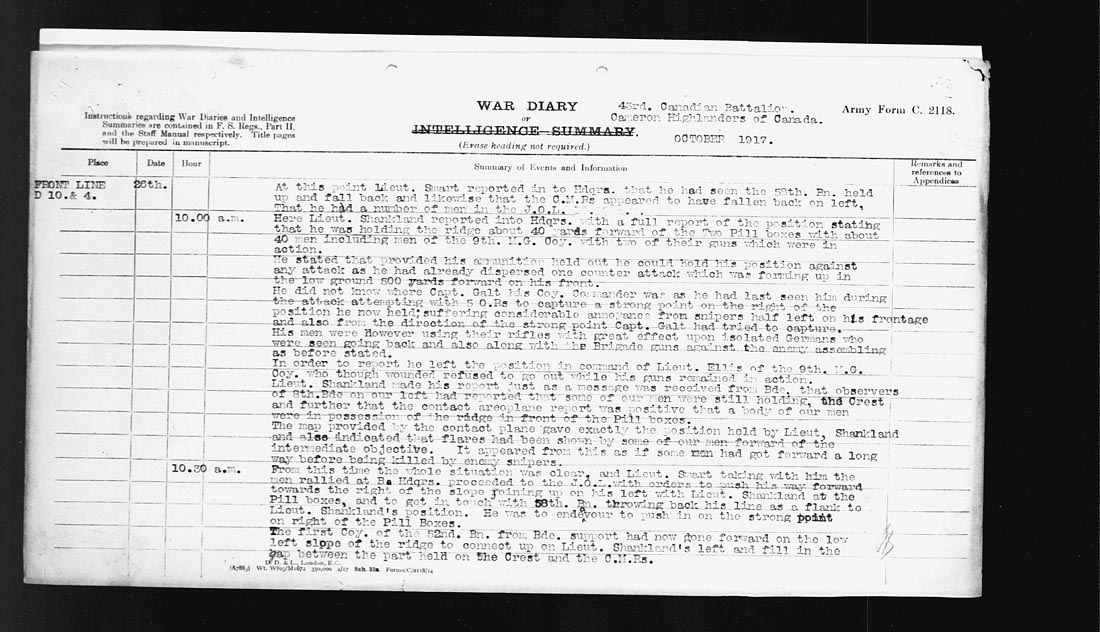
A densely typed page carefully describing the events of the day and mentioning both Captain O’Kelly and Lieutenant Shanklin [sic].


War diary of the 52nd Canadian Infantry Battalion, dated October 26, 1917, Page 19 of the war diary (MIKAN 1883263)

Lieutenant-Colonel Robert Shankland, born in Ayr, Scotland in 1887, immigrated to Canada in 1910 and settled in Winnipeg, Manitoba. He enlisted as a private with the 43rd Battalion and earned the Distinguished Conduct Medal at Sanctuary Wood in June 1916, after which he received a battlefield commission. On October 26, 1917, Shankland and a platoon of 40 men captured and held the crest of Bellevue Spur in the face of heavy fire and the collapse of the Allied line. With both flanks exposed, Shankland turned over command to another officer and set out alone to reach battalion headquarters, where he gave a plan for counter-attack. He then returned with reinforcements to carry out the attack. His citation in the London Gazette from December 14, 1917, reads:

Having gained a position he rallied the remnants of his own platoon and men of other companies, disposed them to the command the ground in front, and inflicted heavy casualties upon the retreating enemy. Later, he dispersed a counter-attack, thus enabling supporting troops to come up unmolested.

A typed list of the events of October 26, 1917; specifically, what was happening to the 43rd Canadian Infantry Battalion between 10 and 10:30 a.m.

War diary of 43rd Canadian Infantry Battalion from October 1917, Page 14 of the War diary (MIKAN 1883254)

LieutenantColonel Shankland survived the war and served overseas during the Second World War as camp commandant of the Canadian Army Headquarters in England. He lived on Pine Street in Winnipeg, Manitoba, along with two other Victoria Cross recipients: Leo Clarke and Frederick William Hall. Pine Street was renamed Valour Road in 1925 to honour the three men.

Library and Archives Canada holds the CEF service file for Sergeant Holmes, Major O’Kelly and Lieutenant-Colonel Shankland.


Emily Monks-Leeson is an archivist in Digital Operations at Library and Archives Canada.

Behind the scenes at the library: a glance at cataloguing librarianship

By Arouce Wasty

October is Library Month, a time to celebrate libraries and the work that librarians, library technicians and library staff do to ensure that knowledge and information resources are available and accessible to everyone. In the spirit of this month, let us look at a side of the library not normally visible to library-goers and library staff. We’ll take a behind-the-scenes look at the work of the cataloguing librarian.

A black-and-white photograph of two women in a library. One is looking through a card catalogue and the other is holding a book and looking at the work of the other.

An archival image of librarians processing books. Photograph taken March 1941 (MIKAN 3571070)

You’ll rarely, if ever, see a cataloguing librarian behind the reference desk at your local library. Often, cataloguing librarians work in a different building—though one just as packed with books as the library itself, if not more so! The cataloguing librarian, along with cataloguing technicians, prepares the various resources, such as books, CDs, DVDs, video games, etc., to be placed within the main library. Furthermore, they enter the bibliographic information from these library items into the library’s computer system. The main goal of cataloguing is to enter accurate bibliographic information for an item, making that item easy to find through the library catalogue.

Seems fairly simple, right? Actually, cataloguing can be quite complex. Essentially, there are two major steps in cataloguing: descriptive cataloguing and subject analysis.

Descriptive cataloguing involves finding and entering information describing the library item according to cataloguing standards. Descriptive information includes pieces of information such as the name of the author, the title, the name of the publisher, the number of pages, the file type, and so on. These pieces of information are entered into the bibliographic record for that item.

Next is the subject analysis of the item. Here, the cataloguing librarian determines the main topic presented by the item. This is where things can get quite tricky. Even if the librarian figures out the subject of the item, s/he has to use tools such as Library of Congress Subject Headings (LCSH), or Canadian Subject Headings (CSH), to find the appropriate term(s) or heading(s) associated with the subject. For example, for a book about cars, the appropriate subject heading, according to LCSH, would be “Automobiles”, and not “Cars”. Sometimes multiple terms are put together to create a subject heading. For example, a book about the social conditions of African countries in the 1990s would likely have the subject heading “Africa—Social conditions—20th century”. Some items may have multiple subject headings to cover either the range of major topics they touch on or all the aspects of a topic they discuss.

Another aspect of subject analysis is assigning a call number to the item. A call number groups the item with others on the same subject. You may be familiar with the Dewey Decimal System used in public libraries; academic libraries use the Library of Congress Classification system. A cataloguing librarian assigns either one or both of these types of call numbers to an item. Call numbers and subject headings are also entered into the bibliographic record.

A colour screen capture of a cataloguing entry showing the division of descriptive and subject information.

Figure 1: Example of a bibliographic record

Remember, cataloguing is not just about describing or determining the subject of an item. The main aim of cataloguing is to allow library users to find and access library items. Descriptive cataloguing allows users to find items via the library catalogue by using keyword searches as well as advanced search options, such as title or author searches. Subject analysis allows library users to find items on a particular subject by using the “subject search” option in their local library catalogue. And, of course, call numbers allow users to find the item on the library shelves.

This is just a glimpse of the work of cataloguing librarians and technicians. Although you may never see or meet with them, the work they do has a great impact on the workings of a library and the experience of the library user.


Arouce Wasty is a cataloguing librarian in the Descriptive Division of Published Heritage.

O Canada! A bilingual history

Version française

By Jessica Di Laurenzio

Library and Archives Canada has recently acquired the records of the Frederick Harris Music Company, a large Canadian music publisher often associated with the Royal Conservatory of Music in Toronto. In the company’s early days, beginning in the 1910s, Frederick Harris rigorously fought to obtain Canadian copyright for as much music as possible. One of the songs he published around this time was the English-language version of “O Canada.” However, the “O Canada” that Harris first published was not the same song that Canadians know today as their official national anthem.

“O Canada” became the official national anthem in 1980, exactly 100 years after Calixa Lavallée first composed the music. He was commissioned to write it by Lieutenant Governor Théodore Robitaille of Quebec. Judge Adolphe-Basile Routhier wrote the French lyrics at the same time, and the anthem was performed on Saint Jean-Baptiste Day in Quebec City in 1880. “Chant National” (the original name for “O Canada”) was an anthem for the French-Canadian people, written in part as a response to the popularity of “God Save the Queen” in English Canada.

A black-and-white photograph of a man with a prominent mustache, wearing a suit and bow tie. The photo is oval-shaped on a grey matte board.

Portrait of Calixa Lavallée (e010900310)

People in English Canada liked Lavallée’s music so much that, a couple of decades later, they decided to create their own version. However, rather than simply translating Routhier’s lyrics into English, several Anglophone lyricists wrote their own words, which helps explain why today the meaning of some of the French and English lyrics of “O Canada” differ greatly.

Sheet music cover. In the centre, there is a photo of a man in an overcoat and trousers holding a top hat and a cane. The composer’s and lyricist’s names are at the bottom between a sketch of the city of Québec and a tree that stretches to the top of the page to decorate the title with maple leaves.

Cover of the first edition of “O Canada” (OCLC 1007545258).
L.N. Dufresne, cover “O Canada” (Québec: Arthur Lavigne, 1880).
Musée de la civilisation, bibliothèque du séminaire de Québec. Fonds ancient, 204, SQ047145.

Original French lyrics by Routhier:

O Canada! Terre de nos aïeux,
Ton front est ceint de fleurons glorieux!
Car ton bras sait porter l’épée,
Il sait porter la croix!

Ton histoire est une épopée
Des plus brillants exploits.
Et ta valeur, de foi trempée,

Protègera nos foyers et nos droits.

English Translation:

O Canada! Land of our ancestors,
Glorious deeds circle your brow.
For your arm knows how to wield the sword,
Your arm knows how to carry the cross.

Your history is an epic
Of brilliant deeds.
And your valour steeped in faith

Will protect our homes and our rights,
Will protect our homes and our rights.

English-speaking lyricists took a different approach to the lyrics, often focusing on Canada’s natural beauty instead of the country’s valour and epic history. Sometimes, their approaches were a little too similar, causing accusations of plagiarism. Robert Stanley Weir and Edward Teschemacher were two of the Anglophones who came up with their own versions, and both chose to use the phrase “our home and native land.” The similarities created copyright tension between Delmar Music Co. and Frederick Harris, the respective publishers of the Weir and Teschemacher versions, both published around 1910.

Cover of sheet music for “O Canada!,” Canadian National Anthem by C. Lavallée.

Cover of sheet music for “O Canada,” published by Frederick Harris Music Co., 1914, words by Edward Teschemacher (OCLC 1007512736).

Along with Weir and Teschemacher, people across Canada came up with their own English versions of “O Canada.” By 1927, the Weir version had emerged as the most popular rendition, and was used as an official song for the Diamond Jubilee of Confederation. However, because so many other versions existed, it did not gain official status as the national anthem for some time.

Prime Minister Lester B. Pearson tried to introduce a bill to make it the official version in 1967, but it was not until the centennial anniversary of Lavallée’s music, in 1980, that “O Canada” became the country’s official national anthem. Routhier’s original lyrics from 1880 made up the French version, while Weir’s words gained official status as the English version—regardless of the fact that their meanings were so different.

Photo of a rectangular postage stamp with colourful graphics of three men, with their names written beside them: Calixa Lavallée, Adolphe-Basile Routhier, and Robert Stanley Weir. The stamp reads “Canada Postes-Postage, O Canada! 1880–1980.”

Commemorative stamp, 1980, showing Lavallée, Routhier, and Weir (s000844k).


Jessica Di Laurenzio is an archival assistant with Literature, Music, and Performing Arts, Private Archives Branch at Library and Archives Canada.

Highlights from the Sir Sandford Fleming Diaries

By Andrew Elliott

As I have noted in a previous post, Sir Sandford Fleming—inventor of International Standard time, creator of Canada’s first postage stamp, surveyor and mapmaker—was a productive individual in 19th-century Canada. He seemed to have time for many things, including recording his activities in various diaries. And Fleming was a voracious writer. While he didn’t write novels, he did record everything he saw and experienced in his world. He combined his written observations with the occasional pencil sketch from landscapes, to people, to every day implements, to engineering works.

Remarkably, these diaries were kept for most of his long life, dating from 1843 when he was 15, until his death in 1914. Being a man who also thought of how he would be perceived in posterity, in later life Fleming transcribed the most important parts of his diaries into three condensed diaries. Additionally, Fleming kept various journals that recorded many special trips across Canada, England and the United States. All these are here within the Sir Sandford Fleming fonds at Library and Archives Canada. See specifically the diaries, journals of trips and miscellaneous journals and notebooks.

There are many things of interest to read in these diaries. A couple of diaries from Fleming’s early life are of particular interest. One dating from 1843 records his thoughts and observations about school life in Kirkcaldy, Scotland. Here there are numerous sketches from drawings of ships, a church, and a diagram of early roller skates.

Another two diaries from 1845 record Fleming’s voyage—mostly by ship—from Kirkcaldy, Scotland to the town of Peterborough, Upper Canada. The first diary has handwritten entries for late April to early June 1845, while the second diary documents the remaining portion of the journey from June to August 1845. The second diary contains his visual documentation of the trip, a graphic record of a journey before photography. There are views of Scotland from on board the ship, sketches of ships passing by, sketches of his cabin and other people on board, views of the first sighting of landfall in North America, a view of Québec City, a sketch of the locks at Bytown (now Ottawa), a view of Niagara Falls, and several sketches of Peterborough buildings.

A pencil sketch showing a person reading on the deck of a ship, with another ship in the background.

Sketch of part of a ship, 1845. (MIKAN 4938907)

Fleming arrived in Canada with valuable skills—drawing, drafting, surveying, engraving—and he used these to make a living. For Fleming, the diary was a way to record his movements, key events, and family events especially; he often made no entries if his day had been a routine one. The diaries contain irregular and brief entries noting board meetings, social engagements, arrivals and departures of prominent persons, health and fortune of family and friends, and travel in Canada and abroad. This last point about travel is particularly striking. While he was based first in Toronto, his work meant that he had to travel extensively. In the 1840s and 1850s, for example, despite having to travel by stagecoach, sleigh, and steamer, he would cover an area almost as extensive as the Greater Toronto Area. Later, while based in Halifax and Ottawa, numerous rail trips would see him frequenting remote parts of Ontario, Quebec, the Maritimes, and Western Canada.

Two pages from a journal. The first page shows a sketch of a campsite in a river valley with woods and mountains in the background with some handwritten text underneath. On the second page is a sketch of a tent with someone sitting in front of it, tending a fire.

Excerpt from the journal about his Intercolonial Railway survey, dated 1864. (MIKAN 107736)

In the early 1870s, Fleming travelled with others on a surveying expedition. A digitized record of this expedition can be found in Master-Works of Canadian Authors: Ocean to Ocean.

An 1885 diary has a pocket containing a six-page handwritten account of a train trip across Canada in November. Included in this account are his impressions of the November 7 ceremony at Craigellachie, British Columbia of the driving of the “last spike” to complete the Canadian Pacific Railway.

He also kept a list of all the trips he made by ship across the Atlantic Ocean. Here’s a sampling for the period from the 1840s to the 1880s, such as a May 17, 1863 voyage to England on the S.S. United Kingdom.

A handwritten list of dates, destinations and names of ships, which has been attached to some ruled paper.

A list of Fleming’s trips made between 1845 and 1883, which includes the destinations and names of ships. (MIKAN 107736)

Fleming also wrote about his personal and family life. Here are a few examples of diary entries from the 1850s and 1860s (spelling is his own):

  • December 31, 185 9: “Another year on the eve of closing and here I am sitting in Mr. Halls family, Peterboro, with my good wife close by, two dear little boys, and little girl sound asleep in bed…”
  • June 6, 1861: He writes that his wife “gave me my second little daughter about 12 o’clock (noon) today at Davenport. She did not feel very well at breakfast and thought I had better go for the nurse and doctor.”
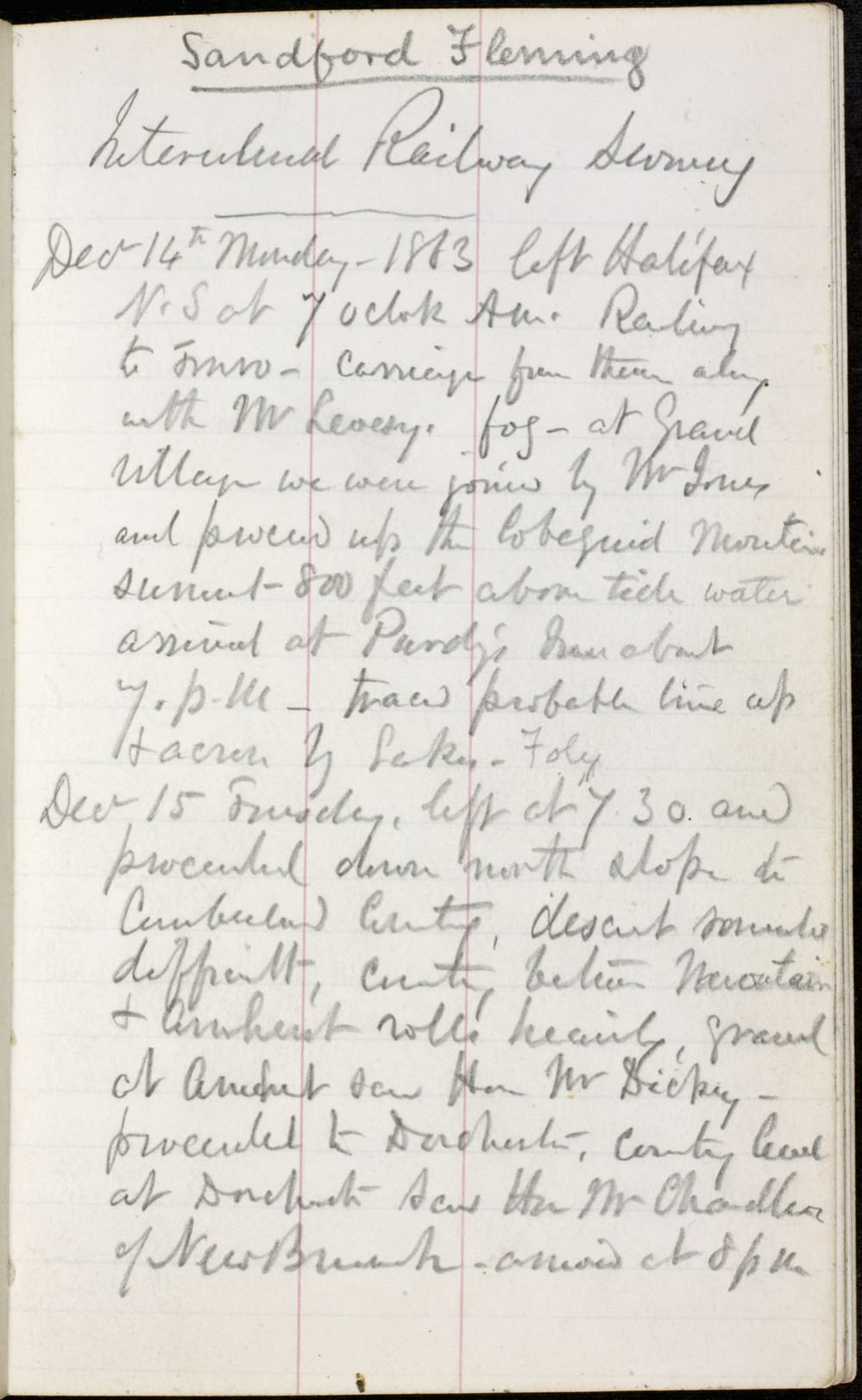
  • September 9, 1863: “Messrs Tilly and Tupper informed me that they had decided, subject to approval of their government) to appoint me to act on behalf of Nova Scotia and New Brunswick…to proceed at once with survey.” Here’s a scanned image of an entry he made about the Intercolonial Railway survey:
Handwritten entries in pencil for two days.

Excerpt of two diary entries dated December 14 and 15, 1863, describing activities during the Intercolonial Railway survey. (MIKAN 107736)

  • January 1, 1864: “Morning train to Collingwood, Stage to Craigleith—Father and Mother had all their children around them…they thought I was in New Brunswick and were astonished and glad to see me…very cold and stormy.”
  • February 28, 1866: Fleming writes about the death of his 3-month old son, “This morning about 4 o’clock after rallying a little…our dear child at last passed quietly away…This is the first death that has really come home to me—part of us is now really in another world.”
  • June 29, 1867: “Preparing for Celebration of Confederation of the Provinces next Monday.”
  • July 1, 1867 (Dominion Day): “Up at 5 o’clock, very cloudy and rainy…putting up flags etc. Clouds cleared away. Halifax very gay, a perfect sea of flags. Beautiful day. The demonstration went off splendidly.”

Although Fleming was at the centre of the modernization of Canada, the hundreds of mundane details Fleming recorded also reveal something of the world he inhabited. There is a wealth of information here, if one is willing to take the time to read them and decipher his handwriting.


Andrew Elliott is an archivist with the Science, Governance and Political Division of Library and Archives Canada.
Images of Steam Power now on Flickr

Boiling water creates steam, which is a hot vapour of water droplets.

A black-and-white photograph of a man on a small platform examining the pressure gauge of a turbine steam generator.

Workman checks the steam pressure on the turbine of the first steam generator in the steam and power plant of the Polymer Rubber Corporation facility (MIKAN 3197025)

Inventors, scientists and engineers experimenting with the capture of steam under pressure discovered that the expansive force of steam could be used to power machines, or in chemical processes. The basic steam engine and its variations were used for pistons, cranks, and pumps to power cars, boats, farm equipment, construction vehicles, and locomotives.

A black-and-white photograph of a steam pumper fire engine on a flatcar, as men use the pump to fight a fire near a rail line and sheds.

Steam pumper fire engine on flat car fighting fire at Grand Trunk Railway, Barton St. freight sheds, Hamilton, Ontario (MIKAN 3283663)

Canadian transportation and industry benefited immensely during the steam-powered era that lasted well into the 20th century. Steam power is still used today but to a much lesser extent.

A black-and-white photograph of a small steamboat on the Rideau Canal, with three men located at the stern, midship and bow of the boat, respectively.

Steam boat on the Rideau Canal, Ottawa, Ontario (MIKAN 3392841)

Visit the Flickr album now!

Stony Mountain Penitentiary

By Anne Brazeau

While Manitoba was declared a province in 1870, the Manitoba Penitentiary and Asylum, now Stony Mountain Penitentiary was established in 1871. The penitentiary is present throughout the history of Manitoba. It was built by the Hudson’s Bay Company and was originally located in Lower Fort Garry. The penitentiary incarcerated many significant historical figures such as Poundmaker and Big Bear, who participated in the 1885 Northwest Resistance, as well as several leaders of the 1919 Winnipeg General Strike.

The records

Library and Archives Canada – Winnipeg houses a collection of over two hundred records pertaining to Stony Mountain Penitentiary dating back to 1871. Among these are library records, medical records, records of class attendance, inmate admittance and histories, and administrative letters and diaries. These records, while partly restricted, shed light on the circumstances surrounding those within the correctional system from the late nineteenth century until the mid-twentieth century.

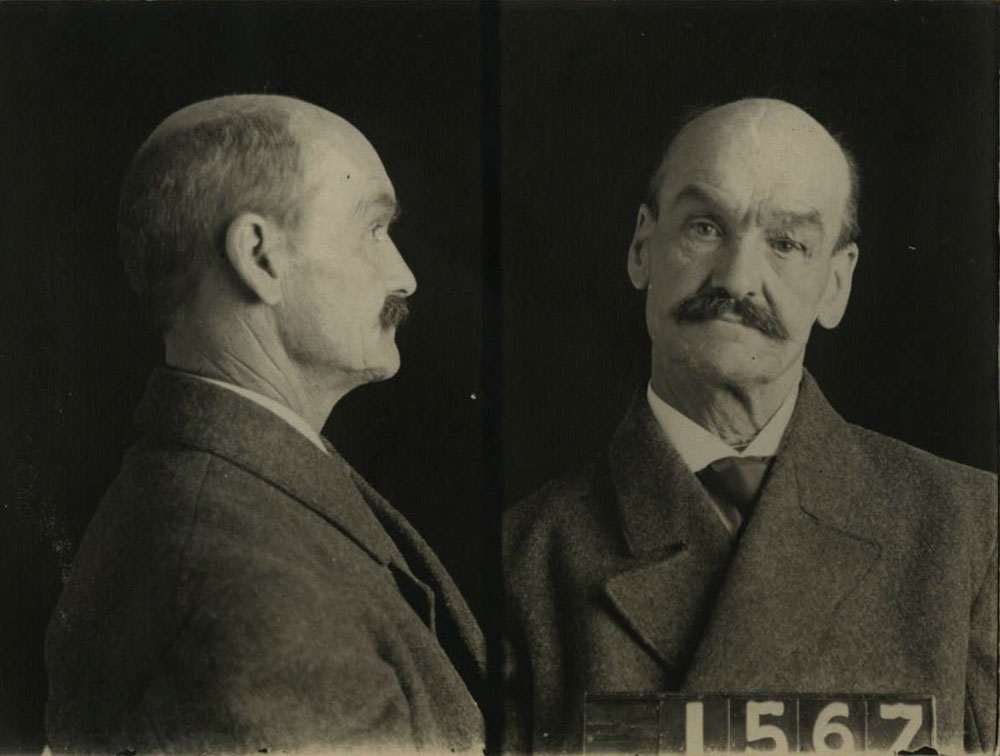
A black-and-white mugshot of a slightly balding man with a moustache seen in profile and straight on. He holds up a sign with the number 1567.

Inmate No. 1567 (e011202727)

A black-and-white mugshot of a very young man seen in profile and straight on. He holds up a sign with the number 1585.

Inmate No. 1585 (e011202728)

The medical records list the afflictions of prisoners, as well as the prescribed remedies. Some of the diseases have a dated sound to them, like Scrofula (a kind of tuberculosis) and Dyspepsia (indigestion), and several of the antidotes are equally old school: mustard plasters, cigarettes and alcohol.

Library records from the late 1800s list the titles which were available to inmates, providing insight as to what kind of books appealed to criminals around the turn of the last century (thrillers, unsurprisingly, as well as books about military and natural history). Each convict received two blank pages which he could fill with loan receipts.

Classes, conduct and industry

However, many convicts lacked the literacy necessary to partake in the library, and so they enrolled in school. Among the material assigned to inmates taking courses were dictionaries, books on English composition and books on geography. Classes took place nearly every day (save holidays and when the instructor was unavailable) and attendance was recorded in a ledger, with remarks alongside each convict’s checkmarks of attendance. These remarks indicate enormous variety in the competency of those housed at Stony Mountain, as some are recorded as completely illiterate and others as having previously studied algebra. Several inmates are listed as literate only in their native tongues.

The collection has several volumes of Conduct and Industry records, journals in which prisoner misbehaviour and the punishments administered were recorded. Among the in-prison offences listed in the Conduct and Industry books were talking whilst bathing and step-dancing in a cell. Some conduct which was obviously unacceptable, for instance being in possession of a knife, received oddly scant punishment, in this case a reprimand. However, one convict, for having left his work station without permission and having talked out of turn, received a punishment of 21 consecutive meals of bread and water taken in his cell with his hands tied to the cell gate. Another, who tried and failed to escape, received the same treatment as well as a literal ball and chain.

Inmate Histories

The highlights of the Stony Mountain Penitentiary records are the inmate histories. They list the name, religion, occupation, marital status, crime, and sentence of inmates. The very few women inmates have their occupation listed as ‘female’. One Jewish Englishman sentenced to life in prison for attempted murder was listed as a cowboy.

While the inmate histories begin in the 1870s, those dating from the twenties onward provide all the same information, as well as physical descriptions and mug shots. Such images serve as effective reminders of just how young most of these people were at the start of their terms (usually between the age of 18 and 22). These more recent histories accompanied by photographs contain information pertinent to people who may still be living, may have died fewer than twenty years ago, or otherwise were not born more than one-hundred-and-ten years ago, and so much of these records are, for privacy’s sake, restricted to the public.

The institution is woven into Manitoba’s history and its records could feasibly be used in the study of corrections and perhaps of prison reform. They are a glowing example of the very neat archival material housed at the Winnipeg branch of Library and Archives Canada.
Related links


Anne Brazeau is an FSWEP student working at Library and Archives Canada – Winnipeg.