Newfoundland and the 100th Anniversary of the Battle of the Somme

Among the most infamous battles of the First World War and the most emblematic of its horrific slaughter, the Battle of the Somme began on July 1, 1916.

A black-and-white photograph of a pastoral landscape.

General view of the battlefield looking towards Contalmaison (Battle of the Somme). July, 1916 (MIKAN 3520937)

The attack was launched along a 30-kilometre front in northern France. Initially planned by the Allies as a French-British assault, it was intended to divert German forces from their ongoing siege at Verdun. The expectation was that an eight-day preliminary artillery bombardment would destroy the German wire and the forward German lines, allowing advancing forces to simply walk in and take possession of the territory. The artillery, however, failed to destroy either of these targets and at 7:30 a.m. on July 1, 1916, when the bombardment lifted, German infantry emerged from their bunkers to aim their machine guns at the gaps in the otherwise intact wire. An estimated 60,000 British and Allied troops, including close to 800 Newfoundlanders, were killed or wounded on that one day alone. The Battle of the Somme lasted until November 18, 1916. Only 12 kilometres of ground were gained, with 420,000 British, 200,000 French, and 500,000 German casualties.

A black-and-white photograph of a devastated forest, only a few tree trunks are left standing

Scene in Maple Copse (Battle of the Somme). July, 1916 (MIKAN 3520908)

Continue reading

Images of fore-edge paintings now on Flickr

Fore-edge images are painted images on the edges of book pages. The pages are either fanned or closed for the image to be visible. These types of paintings can be found as far back as the 10th century. Early images were symbolic or decorative, but the art evolved into scenic landscapes or portraiture by the 18th century. Library and Archives Canada’s (LAC) Rare Book Collection has 12 volumes that are known to have fore-edge paintings.

Polysar, or the adventure of producing synthetic rubber in Canada

By François Larivée

If you were born before 1980, you may remember a picture of a large industrial complex on the back of the ten-dollar bill. An image of the Polysar (originally Polymer) plant in Sarnia, Ontario, was featured on the bill between 1971 and 1989. The company was created by the Government of Canada in 1942 as a Crown corporation, and its archives are held by Library and Archives Canada. Its history is nothing short of fascinating.

Black and white photograph showing three large spherical reservoirs and a complex network of pipes in the foreground. In the background we see a tall chimney spewing out flames and smoke as well as a building with five other chimneys.

View of pipes and three Horton Spheres storing a mixture of butylene and butadiene used in the manufacture of synthetic rubber at the Polymer Rubber Corporation plant, September 1944 (MIKAN 3627791)

Continue reading

Letters of a passionate politician: Library and Archives Canada’s collection of Wilfrid Laurier’s correspondence

By Théo Martin

Library and Archives Canada (LAC) is home to the fascinating correspondence of Wilfrid Laurier, Canada’s seventh prime minister and the first French-Canadian to hold that office. Wilfrid Laurier (1841–1919) was born in Saint-Lin, Quebec, and would go on to enjoy an outstanding career as a journalist, a lawyer, a politician and, of course, a prime minister.

c008103

Sir Wilfrid Laurier, ca. 1906, unknown photographer (MIKAN 3623433)

Continue reading

The real deal vs. the microfilm reel

Access is a key part of Library and Archives Canada’s mandate. Staff strive to provide access to original material whenever possible, but what happens when material has been removed from circulation and you need to consult the original?

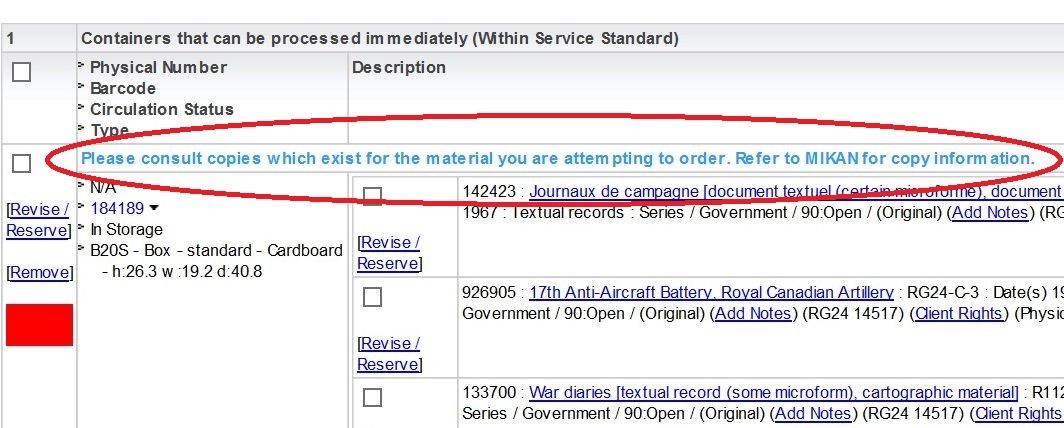
Screenshot of Library and Archives Canada’s internal Collection Management System highlighting a message stating “Please consult copies which exist for the material you are attempting to order. Refer to MIKAN for copy information.”

Screenshot of Library and Archives Canada’s internal Collection Management System

Material may be withdrawn from circulation for a variety of reasons such as:

  • Material has been copied and is available in another format (usually microfilm copies)
  • Material has been identified as requiring conservation treatment
  • Material is fragile or at risk of being damaged
  • Material is withdrawn for health reasons (e.g. the material is contaminated with mould)

When you request material that has been removed from circulation, a staff member from the consultation desk will contact a Collection Manager or Holdings Management Assistant and inform them that a researcher wishes to consult originals and provide the reason the researcher needs to view them.

Some of the common reasons for needing to consult originals are:

  • You need to view originals for litigation purposes
  • Microfilm copies are illegible
  • Microfilm copies are missing pages
  • Health reasons (e.g. the use of microfilm readers causes vertigo)

The Collection Manager or Holdings Management Assistant will assess the requested material and determine whether the material can safely travel to 395 Wellington for consultation.

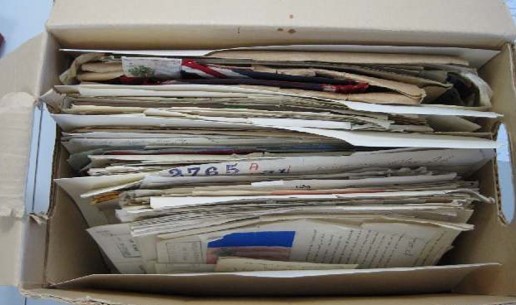
An open container showing textual material ready to be assessed.

Textual material ready to be assessed.

Common reasons for refusing a request to view originals are:

  • Material is too fragile to transport from the storage facility
  • Material is restricted by law (you must first apply for access rights)
  • Material poses a health risk and must be treated first (e.g. mould)
  • Material has been requested for a loan or an exhibition

Additionally, the following material does not travel outside of the Preservation Centre:

  • Treaties
  • Pre-1899 atlases, early maps, oversized matted documents
  • Oil paintings, pastels, charcoal works, miniatures
  • Medals, globes
  • Glass plate negatives, large panoramas, cased photographic objects
  • Certain philatelic material

If the material is considered to be too fragile or exceptionally valuable, the Collection Manager will stipulate that supervised consultation is required.

Library and Archives Canada staff do their best to facilitate access but in some cases material simply cannot travel. When this happens, you have the option of setting up an appointment to view the originals at the Preservation Center in Gatineau under the supervision of a reference archivist and a member of the Holdings Management team.

EMP….. Electro-Magnetic Pulse?! No: Environmental Monitoring Program!

Did you know Library and Archives Canada has an Environmental Monitoring Program in place in most areas where collections are stored? We collect information on the temperature and humidity levels in the collection storage areas to ensure that the material is held in the optimum conditions so it will remain in its current state as long as possible. If material is stored in too hot an environment, the rate of degradation or discolouration increases, especially if the items are chemically unstable, such as colour photographs. If stored in too cold an environment, items can get brittle and tend to crack. The worst case is where the temperature rapidly fluctuates between too warm and too cold: the worst of both conditions!

Relative humidity is also critical. Too high a relative humidity can cause items to start to swell, oxidize and grow mould, whereas too low a relative humidity can cause items to shrink and crack. Books are especially susceptible to humidity problems, with their multiple components and the wide variety of materials used to construct and bind them.

Below are two of the many different types of data loggers used at Library and Archives Canada to monitor environmental conditions. They range from old-fashioned looking linear chart recorders to web-enabled electronic data loggers.

A colour photograph showing two levers with pens marking a red lined drum, enclosed in a plastic case with a handle on top.

A linear chart recorder, which is a two-pen, drum-style device about the size of a toaster. The drum is wrapped with a paper chart that can log for one day, one week or one month.

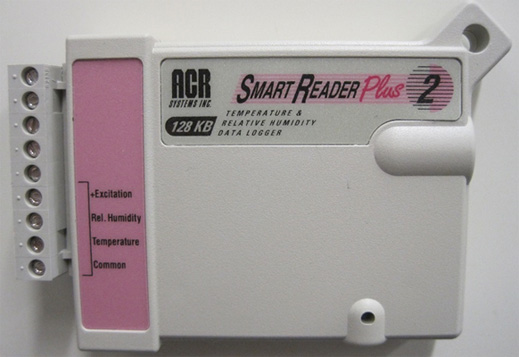
A colour photograph of a box about the size of an audio cassette that is mounted to a wall. It - records -twodifferent types of items: - Relative Humidity, Temperature-internally, along with hook-ups for external temperature and humidity sensors.

An ACR SmartReader is an electronic data logger. It records relative humidity and temperature.

With monthly data dumps and random spot checks, we are able to monitor the collection storage conditions to ensure that the temperature and humidity are at the optimum levels, in accordance with internationally recognized standards. So there you have it:EMP, what it is, and why we do it at Library and Archives Canada!

“If my work has stirred any interest in our country and its past, I am more than paid”––Charles William Jefferys

Charles William Jefferys (August 25, 1869 – October 8, 1951) determined that Canada needed a visual history and a national mythology and he would create it. He chose to portray Canada’s epic events of discovery, courage, war and nation-building. His images placed an almost mythological importance on the nation’s historical events.

In the early 20th century Canadians struggled to define what it meant to be Canadian and how to express their budding feelings of nationalism. Jefferys’ work reflects this and; his historical illustrations are an expression of this growing nationalism. They are representative of the period, and may not be how we would define ourselves today.

A pen and black ink drawing of four men standing and a vignette of four head portraits of other men wearing hats.

Métis Prisoners, North-West Rebellion, 1885 (MIKAN 2834663)

Some of his illustrations were faithfully copied from existing images such as portraits or photographs, while others were based on meticulous historical research on period costumes. In either case, he strove to accurately portray all aspects of early Canadian life. Continue reading

Drawn from Real Life: Hillborough Studio’s First Canadian Comic Book Heroes

By Meaghan Scanlon

In August 1941, a small Toronto-based comic book publisher called Hillborough Studio released the first issue of its first title, Triumph Adventure Comics. The series is an anthology, with each issue containing several one-page humour strips along with a few longer feature stories. These features showcase heroic characters like Cape Breton strongman Derek of Bras d’Or and Inuit demigoddess Nelvana of the Northern Lights.

The fact that these characters both have distinctly Canadian identities is no coincidence. The first issue of Triumph Adventure Comics includes a letter from the comic book’s editor to its readers, which notes that the stories in issue no. 1 “all have a Canadian background, which will delight you not only in this edition, but in the many issues to follow.” Who would produce these Canadian stories? Naturally, the editor says Hillborough employs “the best artists in Canada.”

The team of artists and writers behind Triumph Adventure Comics sometimes drew on real-life Canadians for inspiration. The creators of Derek of Bras d’Or based the character on Angus McAskill (sometimes spelled MacAskill), a Cape Bretoner famous for his incredible strength and gigantic stature. McAskill, who was almost eight feet tall, toured the world as a curiosity during the 1840s and 1850s.

A black-and-white photograph of two men standing: one is very tall and the other is very short.

Angus MacAskill and Tom Thumb. (MIKAN 3531760)

Continue reading

Journey to Red River 1821—Peter Rindisbacher

Version française

By William Benoit

This article contains historical language and content that may be considered offensive, such as language used to refer to racial, ethnic and cultural groups. Please see our historical language advisory for more information.

Peter Rindisbacher was 15 years old when he immigrated to Selkirk’s Red River settlement in 1821. Already an accomplished artist when he arrived in North America, he produced a series of watercolours documenting the voyage to Rupert’s Land and life in the settlement. His watercolours from the Red River area are among the earliest images of western Canada. Peter Rindisbacher is considered the first pioneer artist of the Canadian and the American West.

Library and Archives Canada is possibly the largest holder of Rindisbacher’s works. Viewing the Rindisbacher watercolours in sequence allows Canadians to appreciate the difficulty of the journey to the Red River.

A watercolour on wove paper showing an anchored three-masted sailing ship surrounded by skiffs bringing passengers and loading supplies.

Departure from Dordrecht under Captain James Falbister, May 30, 1821. The English colonist transport ship Wellington of 415 tons. (MIKAN 2835769)

On May 30, 1821, Rindisbacher and his family left Dordrecht in the Netherlands with a contingent of mostly Swiss emigrants aboard the Lord Wellington, bound for York Factory, in what is now Manitoba, on Hudson Bay. During the sea voyage, Rindisbacher sketched icebergs, the Inuit and other ships. The route would take the settlers past the Orkney Islands and Greenland.

A watercolour on wove paper showing an anchored three-masted sailing ship surrounded by skiffs bringing passengers and loading supplies.

Departure from Dordrecht under Captain James Falbister, May 30, 1821. The English colonist transport ship Wellington of 415 tons. (MIKAN 2835770)

Continue reading

More than just books

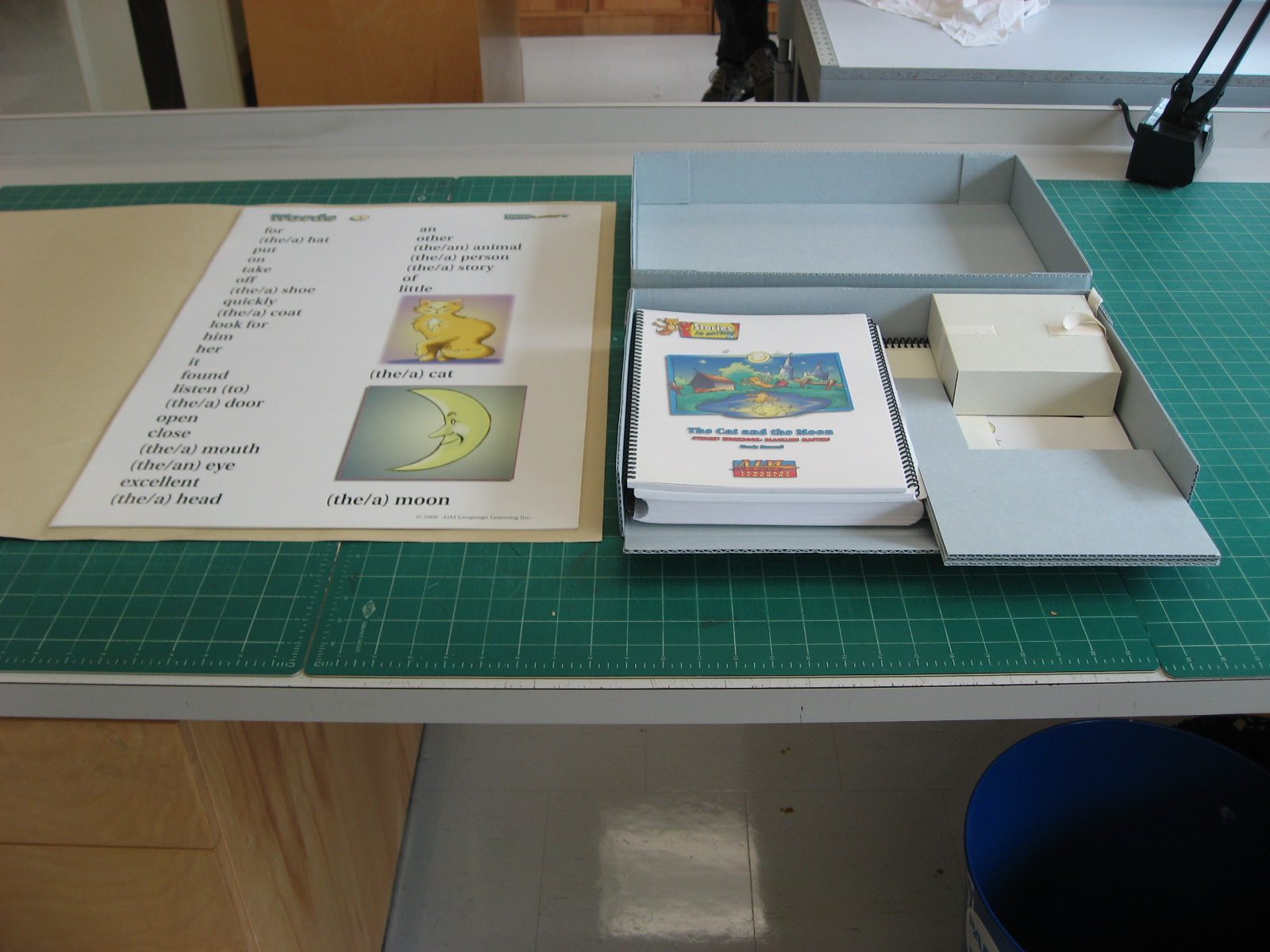
Library and Archives Canada (LAC) receives a wide range of published heritage material through legal deposit, such as books, periodicals, government publications, etc. Occasionally LAC receives multimedia kits that must be re-boxed by the Preservation Services Unit. Multimedia kits contain more than books, but all items still need to be stored together, as much as possible. A good example of a multimedia item would be an educational kit designed for use in schools. A kit may include bound textbooks, binders with loose-leaf pages, posters, pamphlets, CDs and DVDs. Older kits may include items such as cassette tapes, slides, video tapes, and film strips—the popular media used when the kit was published.

A custom-made container and spacers are constructed for each kit to keep the components together for research purposes and to secure the different-sized items in the box. The container also provides protection from environmental harm such as light or water damage.

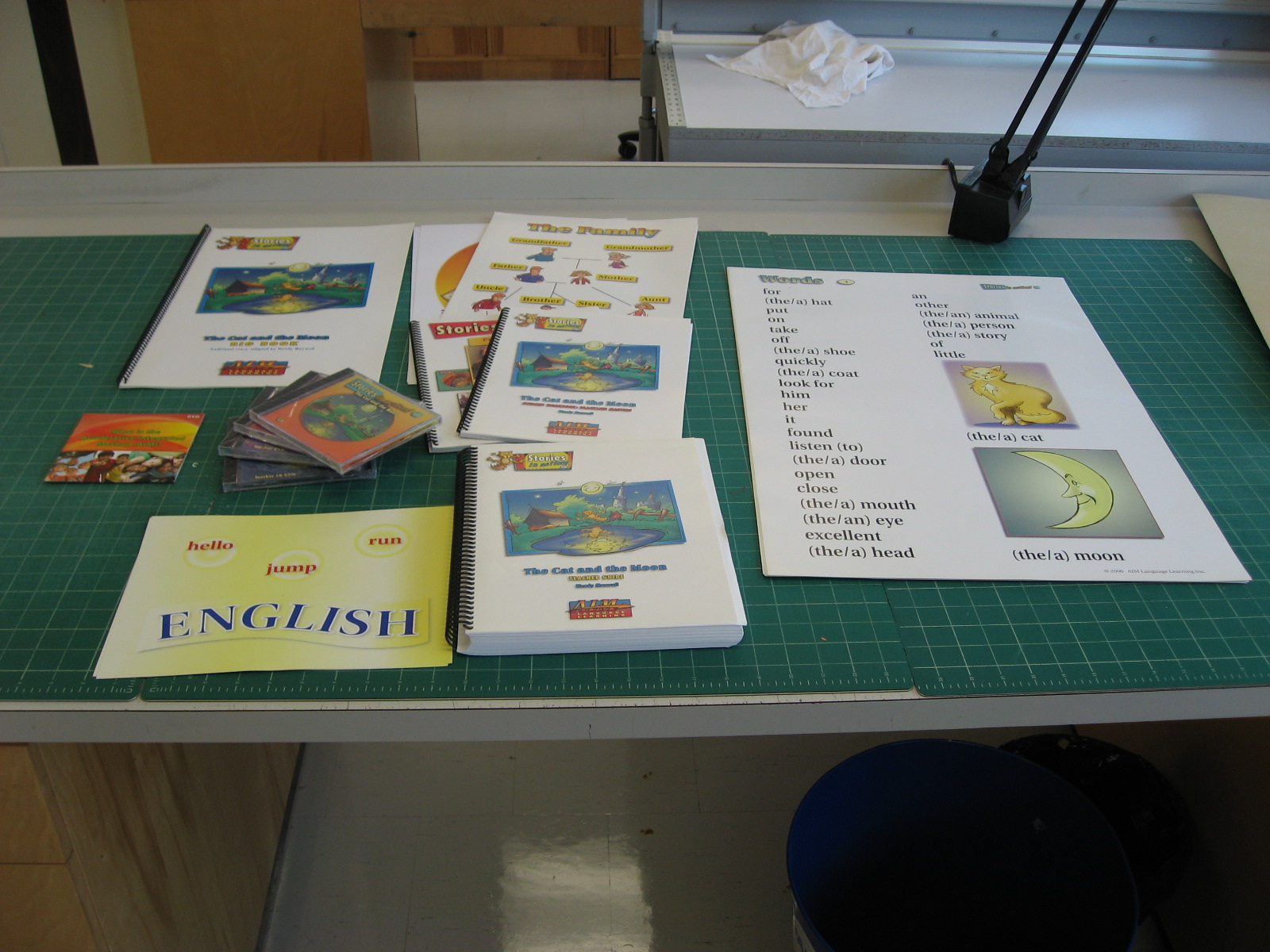
Before

A colour photograph showing a multimedia kit containing a variety of items spread across a worktable.

An example of the components of a multimedia educational kit.

After

A colour photograph of a custom container and a custom folder for a poster.

Sample of a custom folder for a poster and box created for a multimedia educational kit. All the items in the multimedia kit have their own space, making it ideal for access and preservation.

Large rolled posters are flattened, placed in a custom folder, and filed in a flat storage drawer. A separate box for CDs and DVDs is constructed and held in place with a custom spacer so that they don’t shift when the box is moved.

All materials used in the construction of these containers are archival quality so they are acid-free and meet strict standards for material composition and longevity.

This is another example of how the Collection Management Division ensures the preservation of collection items through the skills, craftsmanship, and dedication of its staff.