Thomas Fuller’s Post Offices

At the end of October 1881, the Government of Canada appointed architect Thomas Fuller (1823–1898) to the job of Chief Architect in the Department of Public Works. Fuller—already celebrated for his design work for Ottawa’s Parliament Buildings—would continue in this job until his retirement in 1897. During his sixteen-year tenure, he was responsible for the design and construction of numerous public buildings across the country, including some 80 post office buildings. Fuller designed post offices that were landmarks, and as such helped to foster a federal architectural image (or “Dominion Image”) that was instantly recognizable to ordinary citizens.

Fuller’s post offices were of a unique character, and yet each had a family resemblance. They were usually two-and-half storeys high, rectangular in shape, and had a one-storey rear extension. They also had high gables located at the centre of the street-facing facade as well as a distinctive combination of French Renaissance and High Gothic architectural details.

Fuller also took advantage of site location. His post offices were located at a town or city’s important intersection or at the end of a main street. Fuller used a distinctive picturesque formula—on some buildings he added a tower, on others he might have added a side projection or a corner entrance, a side elevation that duplicated the gable of the main facade, or even a central clock tower. Continue reading

Open Datasets – What’s New?

Library and Archives Canada is in the process of extracting from outdated storage devices, and then preserving, the datasets of studies undertaken by federal departments. The studies covering a wide range of topics, such as the environment, health and immigration, are being made available on the Open Data portal. To learn more about the structure of the data see our blog Open Data: Providing access to historical Government of Canada studies.

Here is a summary of the datasets we have made available over the past few months. Curious about what these studies discovered? Check them out on the Open Data portal

  1. Longitudinal study of immigrants – 1969–1971 arrivals
    This longitudinal study investigated the economic and social adaptation of immigrants to life in Canada.
  2. Canadian airmen of the First World War
    This file includes personnel information for all traceable Canadian airmen who served in the First World War in the British flying services.
  3. Results of Canadian Federal Elections 1974, 1979, 1980, 1984, 1988
    These files contain the voting records for each polling station, electoral district and province for all candidates in Canadian federal elections.
  4. Canadians and Work
    These studies were undertaken in the 1970s and relate to Canadians and work. They include national surveys undertaken to assess job satisfaction and work ethic, Public Service Staff Relations Board pay-rate surveys and an employment study assessing the employment adjustment processes of Canadian graduates in the physical sciences.
  5. Environment – Fire and Water
    • The Test fire, fuel moisture and weather observations datasets contain information collected between 1931 and 1961 about weather, fuel moisture and test fire behaviour measurements for eleven field stations across Canada.
    • The 1968-1979 Canadian Oceanographic Identification Centre dataset includes taxonomic data used to produce group, genus, and species catalogues for the Arctic, Atlantic and Pacific freshwater areas.
    • The St. Lawrence River studies were undertaken between 1974 and 1976 to describe the water properties, pollution levels and sediment quality of the St. Lawrence River.

The beginning of airmail delivery

By Dalton Campbell

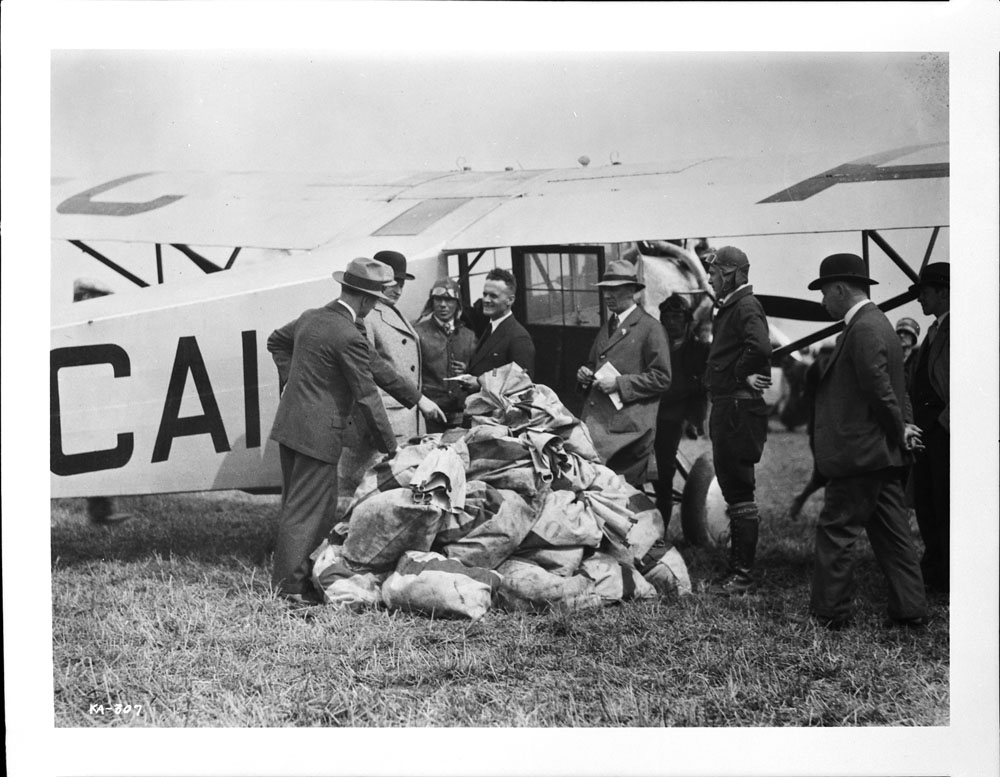
On December 25, 1927, a Fairchild aircraft flew along the north shore of the St. Lawrence from La Malbaie to Sept-Îles, Quebec. As the plane approached each town, the pilot lowered the altitude of the aircraft and threw out a packet of mail attached to a parachute. The postmaster retrieved the parachute and mail as the pilot flew to the next town.

This was the first official Post Office air mail delivery for the communities along the north shore of Quebec. In the winter, these communities—like many others throughout Canada—had been isolated with irregular mail delivery arriving after slow transport by boat or dogsled.

A black-and-white photograph of a group of men standing in front of a single-engine aircraft. The men are arranged in a semi-circle around many sacks of mail piled on the ground.

Reknowned pilot Roméo Vachon at the doors of the Fairchild FC-2W aircraft of Canadian Transcontinental Airways Ltd. inaugurating airmail service between Montreal and Rimouski, Quebec, May 5, 1928. The mail was transferred from transatlantic ships at Rimouski and flown to Montreal and then to Toronto, saving 24 hours in delivery. (MIKAN 3390347)

Continue reading

Subscribe to the Society of Young Artists’ 1815-1816 theatre season

At the turn of the 19th century, the theatre scene was languishing in Canada. Some plays were a huge success, such as Colas et Colinette, which was performed between 1790 and 1807 and was written by Joseph Quesnel, one of the first playwrights in the country. However, it was often too expensive to maintain theatre companies on a permanent basis. Moreover, the companies faced the disapproval of the Church, which did not like these types of performances.

Most often, it was theatre lovers—members of the social elite composed of French Canadians, military members and British merchants—who arranged venues and presented shows. American actors on tour also entertained audiences in major Canadian cities. When the Theatre Royal opened in Montreal in November 1825, the dramatic arts in Lower Canada were given a new boost.

This watercolour painting of a street scene depicts a four-storey neoclassical building. In the distance, more modest buildings can be seen.

Mansion House Hotel (Theatre Royal), St. Paul Street, Montreal, by Henry Bunnett (1888). (MIKAN 2878039)

Support for the Society of Young Artists

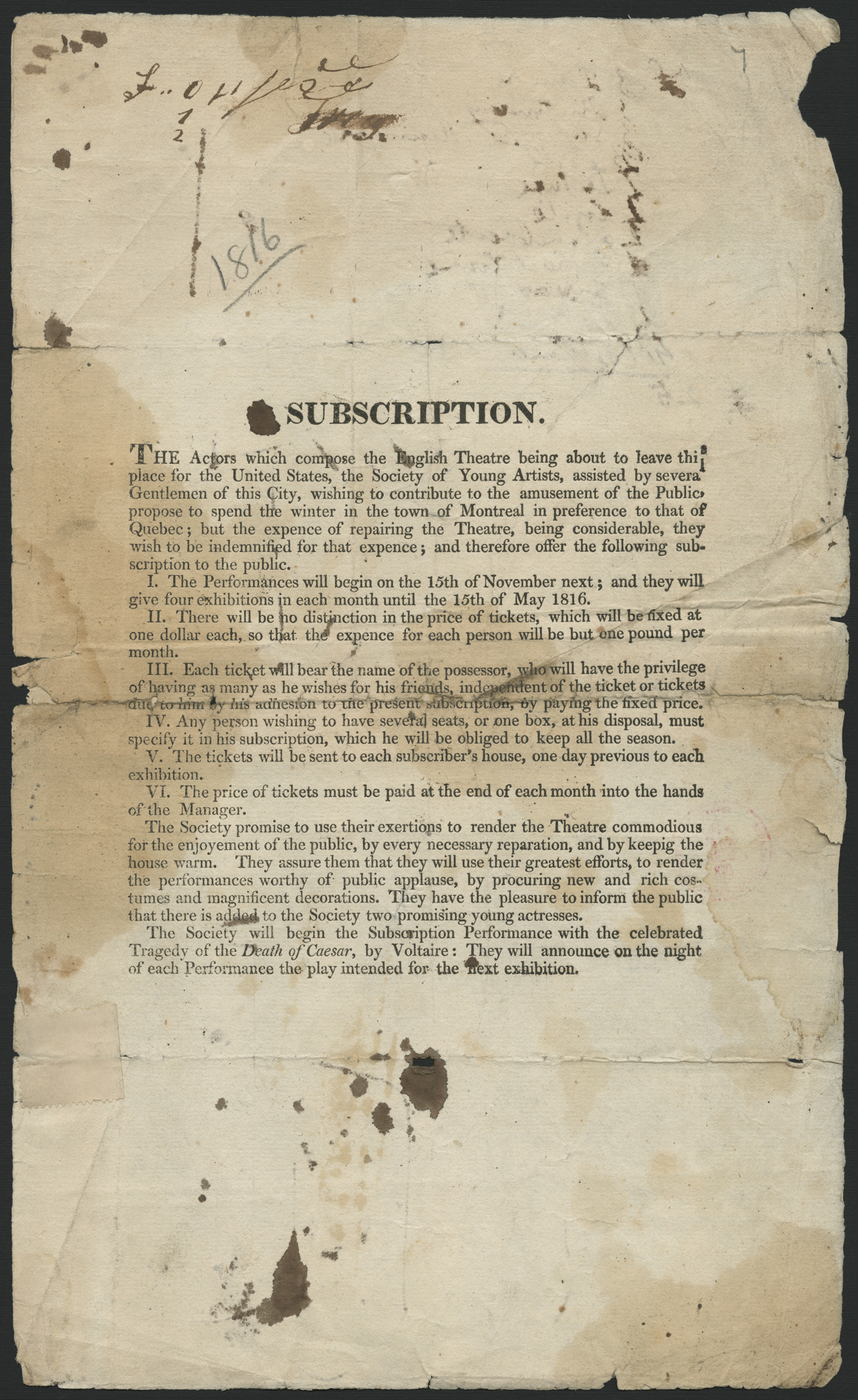
Under these circumstances, shortly after the War of 1812, a company called the Society of Young Artists was formed. Driven by the revival of the theatre scene and the English Theatre’s move to the United States, it launched its first season in fall 1815, performing shows mostly in Montreal. The company promoted its season by printing a bilingual leaflet advertising its first play, Voltaire’s The Death of Caesar.

The leaflet’s main goal was to seek funding from the public through subscribers who committed to paying for tickets each month. For its part, the company promised to give four performances a month, under the best possible conditions, from November 15, 1815, to May 15, 1816. The ticket price was set at one dollar, for a monthly total of one louis (or one Halifax pound).

The Canadian newspapers at that time, such as the Spectateur Canadien dated November 20, 1815 (in French only), also promoted the Society’s shows.

Text printed in French explaining the subscription’s conditions and the company’s commitment to its audience.

Subscription in French for the Society of Young Artists’ 1815-1816 theatre season. (MIKAN 4814815)

Text printed in English explaining the subscription’s conditions and the company’s commitment to its audience.

Subscription in English for the Society of Young Artists’ 1815-1816 theatre season. (MIKAN 4814828)

An intriguing list

Interesting fact: a list of items was written on the back of the English leaflet. Valued at 25 pounds (Halifax rating), these items could have been used either on stage or to meet the Society’s needs. The list is very difficult to read, but the following items can be identified: millwork, cloth, a pulley, rope, green flannel, white iron and costumes—in short, the items needed for the company’s activities.

A list of items written in ink that is very difficult to read.

List of items on the back of the English subscription for the 1815-1816 theatre season (MIKAN 4814828)

Repertoire: Molière, Shakespeare and company

Unfortunately, we do not know all the plays performed by the Society of Young Artists. However, in his book L’activité théâtrale au Québec (1765-1825), Baudoin Burger gives us an idea of the repertoire on the French stage at that time. From 1814 to 1819, the Montreal and Quebec City audiences could enjoy the plays of Molière, Beaumarchais, Voltaire, Regnard, Bruyes and Dancourt. On the English stage, the artists performed Molière, James Kenney, and of course Shakespeare, who remained the most popular.

A unique record

Very few archival records remain that document the beginnings of Canadian theatre under the English regime. The leaflets from the Society of Young Artists are therefore important and even unique records of our theatre heritage. They also show the love of art that pushed the Society to take the stage despite financial difficulties and varying levels of attendance. These people are, in a way, pioneers who believed in artistic development in Canada.

 

How to access Orders-in-Council preserved at Library and Archives Canada

The article “How to find Orders-in-Council at Library and Archives Canada” explains how to find complete references to these Orders-in-Council (OICs). But then how do you access the OICs that interest you?

You have several choices: consult the originals on site, search in the Canada Gazette, consult the OICs on microfilm, or request a reproduction.

For OICs that are discoverable and accessible online, see the article on “Orders-in-Council: What you can access online.” Continue reading

How to find Privy Council Orders at Library and Archives Canada

In the article “Orders-in-Council: What you can access online” we learn that Library and Archives Canada holds the Privy Council Orders-in-Council published between 1911 and November 1, 2002. However, many of them are not available online. You must therefore do your research on site to find the full references.

Can’t come in person? You can send a reference request using the form Ask Us a Question, or you can hire a freelance researcher. Please note that our research services are limited.

Privy Council Office fonds

Orders-in-Council are part of the Privy Council Office fonds, series “Orders-in-Council,” sub-series “Minutes, Annexes and Reports.” The entire group is identified by the document group number RG2-A-1-a, an essential part of the reference number.

Indexes and registers

It is important to first consult the annual registers and indexes, which list all the Orders-in-Council submitted by the Privy Council Office and provide details to be included in the references (including order numbers and approval dates). Most registers are bound to their respective indexes.
A number of indexes and registers are on microfilm; please see the list in finding aid FA 2-6. Continue reading

The Central Technical School of Toronto: a century of learning

Toronto’s Central Technical School (CTS), located near the intersection of Harbord and Lippincott streets in Toronto, is celebrating an important anniversary this fall. Officially opened on August 31, 1915, the school has been a significant local and national landmark since day one. The building was lauded in the October 1915 Construction Magazine as being a “beautiful and lasting monument to the determination and energy of the little minority who realized the importance and the great future of technical education.” The estimated cost of 1.5 million dollars was borne by the City of Toronto.

A black-and-white photograph showing a large building taken from the side.

Front of the Central Technical School in Toronto, photo taken by John Boyd on October 23, 1915 (MIKAN 3327188)

Once considered to be the largest school of its kind in the British Empire, it is designed in a Collegiate Gothic architectural style. Many early 20th-century Canadian schools were built in this style. Continue reading

New version of the “Home Children Records” Database

Library and Archives Canada is pleased to announce the launch of a new version of its online database, Home Children Records.

This online database has been extended to include more than 245,000 entries for British children sent to Canada between 1869 and 1932. Names have been indexed from a variety of sources, such as records from sending organizations, publications, governmental and private records.

Start searching home children records now!

Born to Serve: Georges P. Vanier

Born in Montréal on April 23, 1888, Georges Vanier would feel the influence of his bilingual parents throughout his life. After graduating from high school, he attended Loyola College and then the Université Laval where he received a law degree in 1911. He started practicing law thereafter, although priesthood was also on his mind. It was the outbreak of the First World War however, that eventually grabbed his attention and he enlisted in the Canadian Army. He was a strong recruiter and played an important role in the creation of the French-Canadian 22nd Battalion. It was also during the war that he was injured and had to have his right leg amputated.

A black-and-white photograph showing a man smiling broadly in an officer’s uniform with cap.

Major Georges P. Vanier of the 22nd Battalion, June 1918 (MIKAN 3192070)

Continue reading

Multiple Contexts: Library and Archives Canada at the Canadian Museum of Immigration at Pier 21

Five pieces from the rich collection of Library and Archives Canada (LAC) are currently part of the new exhibition space at The Canadian Museum of Immigration at Pier 21 in Halifax, Nova Scotia. These objects including a commemorative medal, stamps, a map, and a land treaty will help illustrate the complex experience of immigration that continues to shape Canada’s past and present.

Attestation papers—informative documents from Canada’s history

One of the items from the Library and Archives collection included in the exhibition at Pier 21 is a document known as an attestation paper. An attestation paper was a form that recruits filled in and signed to show their willingness to serve overseas in the Canadian Expeditionary Force (CEF) in the First World War. Library and Archives Canada currently holds 620,000 attestation papers, all of which are digitized and available online.

A black-and-white image of a typed form describing Joseph Wilder’s personal and physical information. It is signed by him and witnessed by a medical officer.

Joseph Wilder’s attestation paper (MIKAN 46114, Box 10355-39, 312833)

The details these papers provide allow us to learn a lot about individual soldiers. For example, each form provides details about their physical appearance such as height, eye colour, and chest measurements. Recruits also had to state their “trade or calling” (job), place of birth, next of kin and present address, among other information. When trying to learn about individuals from the past who did not leave a lot (or any!) documentation behind, attestation papers can be incredibly helpful in piecing together histories.

Joseph Wilder—Medical Sergeant and pharmacist

The attestation paper included in the exhibition at Pier 21 belonged to a man named Joseph Wilder. From this document, we learn that he lived at 140 Alfred Avenue in Winnipeg, Manitoba, was born in Romania, and made his living as a druggist (pharmacist). The information about Joseph Wilder that can be found on his attestation paper is valuable to a number of interest groups such as his later descendants, members of Winnipeg’s local community, and Canada’s national history. It also complements the information available about Wilder in his two books Read All About It: Reminiscences of an Immigrant Newsboy and Lotions, Potions and Liniments Pure: A Look at the Drug Trade in Winnipeg in the 1900’s.

You can find out more information about the Soldiers of the First World War database and the large-scale digitization initiative to make these documents available online.