Where art and history meet: exhibitions of historical photographs at the National Gallery of Canada

What happens when the practical also has a poetic side?

In recent months, visitors to the National Gallery of Canada have had a chance to explore the answer to this question. A series of small exhibitions of historical photographs, drawn from Library and Archives Canada’s collection, considers the aesthetic, as well as the documentary properties of images created “on-the-job” by 19th-century surveyors, public servants and engineers.
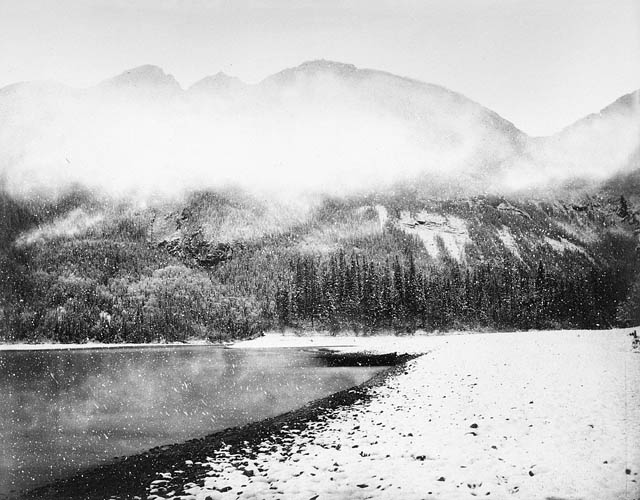
In the heart of the Rocky Mountains: A snowstorm, by Charles Horetzky

In the heart of the Rocky Mountains: A snowstorm, by Charles Horetzky (Source: MIKAN 3264251, e011067226)

At first glance, this beautiful photograph, which was part of the past exhibition Early Exploration Photographs in Canada, seem to be exactly as labelled — a view of the Peace River in British Columbia, as it appeared during a snowstorm in October 1872. It turns out, however, that Charles Horetzky, official photographer with Sir Sandford Fleming’s Canadian Pacific Railway survey team, deliberately enhanced its dramatic effect: paint splatters were added to the image in order to create the effect of non-existent snow.

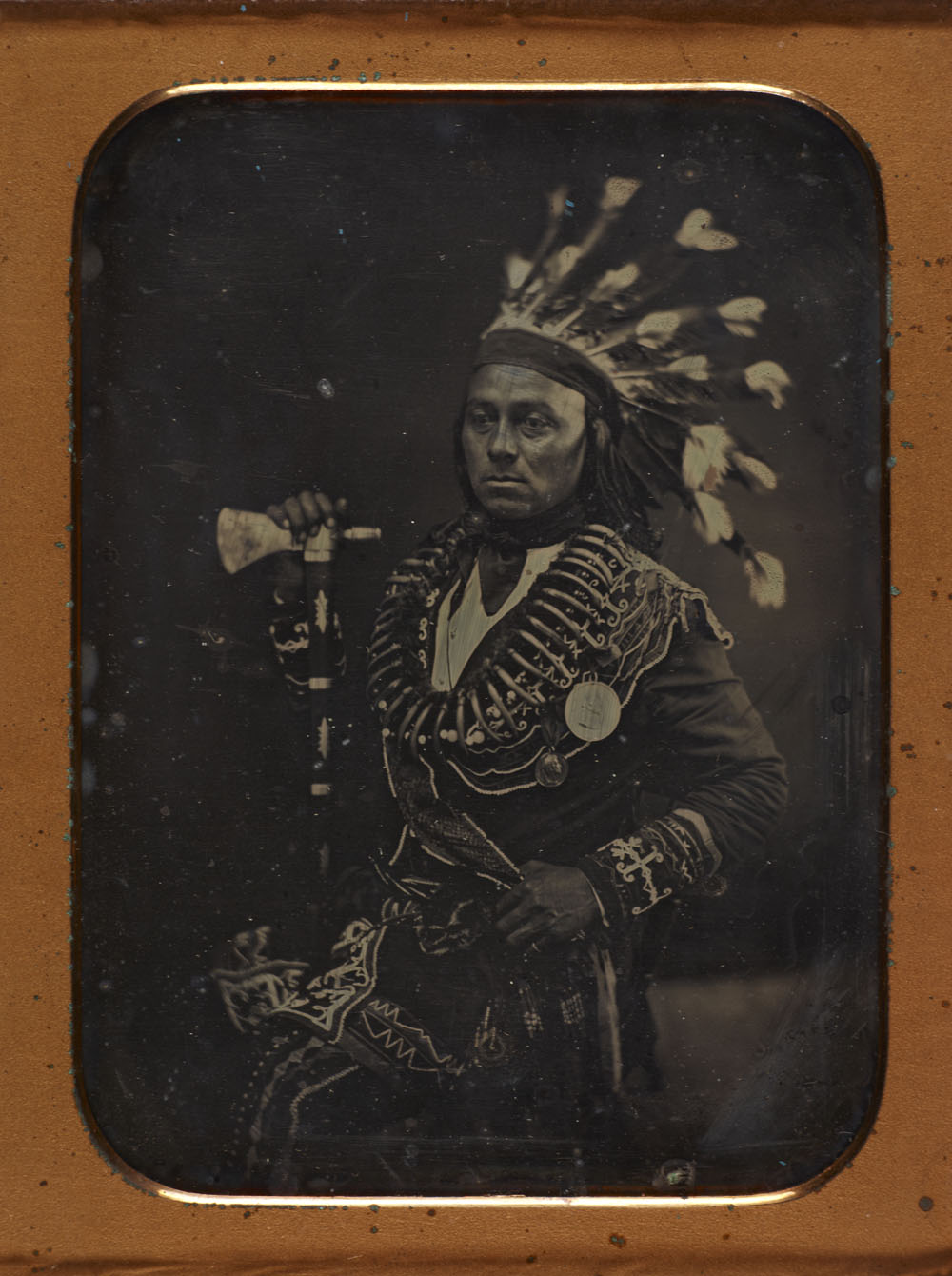
The current exhibition, Paul-Émile Miot: Early Photographs of Newfoundland, on view until February 2, 2014, includes this portrait from the 1800s, by French naval officer Paul-Émile Miot.

Mi’kmaq man, by Paul-Émile Miot

Mi’kmaq man, by Paul-Émile Miot (Source: MIKAN: 3535989, e011076347)

It was taken while surveying and mapping the coastal areas of Newfoundland — at the time, France maintained a commercial fishing interest in these waters. Though Miot was capturing the earliest known photographs of members of the Mi’kmaq Nation, the extravagant pose of his subject suggests 19th-century European romanticism.

So-called inaccuracies or created effects in 19th-century documentary photographs do not negate the worth of these images as records of past events. If anything, they add fascinating nuances of meaning to these items, as artifacts.

We invite you to stay tuned for the next exhibition, on Arctic exploration photography, opening on February 7, 2014.

Understanding the Italian Campaign (1943-1945)

This year marks the 70th anniversary of the battles fought by Canadian troops on Italian soil during the Second World War. Why Italy? In 1942, the Soviets were calling for the opening up of a second front in Western Europe to provide relief from German attacks on their territory. Convinced that there were insufficient resources to invade France, the Americans backed Britain’s proposal to organize a landing on the coast of French North Africa instead, which took place on November 8, 1942 (Operation Torch) The campaign to drive the Germans out of Africa was successfully concluded in Tunisia on May 13, 1943. The offensive continued in Italy, considered to be the weakest link in the German defences in Europe.

Under the command of the British Eighth Army, the 1st Canadian Division came ashore on the beaches of Sicily on July 10, 1943. With the capture of Messina by the Americans on August 18, the conquest of Sicily was complete. On September 3, Canadian troops landed in mainland Italy. Meeting no opposition, the brigades were able to deploy rapidly. Italy capitulated on September 8, and the next day, Anglo-American landings were launched in the Gulf of Salerno.

Three critical battles will forever stand out in Canadian military history: the battle of Ortona, the breach of the Hitler Line (Liri Valley), and the breach of the Gothic Line. The Italian Campaign continued until the spring of 1945, but the Canadians would not participate in the final victory; after having engaged in vicious fighting for 18 months, Canadian troops were withdrawn from the front at the end of January 1945 and redeployed to the Netherlands.

As a result of the attention focused on the Normandy landings and the North-West Europe Campaign, there is a tendency to overlook the importance of the Italian Front and the Allied soldiers who fought there. A total of 92,757 Canadians served in Italy. Of these, 5,764 were killed, 19,486 were wounded and 1,004 were captured. Library and Archives Canada’s collection contains numerous textual, photographic and audiovisual records and published materials relating to the Italian Campaign.

Learn more about this subject:

Government of Canada Acquires Historically Significant Documents About the 1758 Siege of Louisbourg

Library and Archives Canada has acquired a two-part manuscript diary about the 1758 siege of Louisbourg in Cape Breton. The siege, a substantial battle of the Seven Years’ War, ended the French colonial era in Atlantic Canada, and contributed to France’s loss of Quebec City in 1759. The loss of Louisbourg, Quebec City and Montreal in 1760 led to the 1763 Treaty of Paris when France formally ceded Canada to Britain. “Our Government is pleased to have acquired this historically important manuscript diary, as it provides a rare glimpse, from a French perspective, into one of the most important events in Canada’s history,” said the Honourable Shelly Glover, Minister of Canadian Heritage and Official Languages. The two-part diary, totalling about 180 pages, was written by an unknown French infantry officer from the “Régiment de Cambis” who witnessed the events during the summer of 1758. The diary’s first part details the siege, defense and capture of Louisbourg from the witness’ point of view. The second part describes the aftermath of the French surrender on the troops and more specifically, on the fate of “Régiment de Cambis”, which was held in captivity in England until 1759. These singular, original documents will greatly enrich Library and Archives Canada’s collection related to these events. The item was acquired for a total of about Can$50,000, including insurance, transportation and auction house fees, at an auction held by Sotheby’s in New York yesterday.

Did your ancestors come from Finland?

Do you want to know who your first Finnish ancestor was and when he or she left Finland and arrived in Canada? Are you curious about your Finnish origins?

If so, our website is a great place to begin your research. Here you will find a page dedicated to genealogical research on the Finns. This page provides you with historical information, archival documents and published material from the Library and Archives Canada collection, as well as links to other websites and institutions.

If your ancestor came to Canada between 1865 and 1935, you might find his or her name on the passenger lists.

Kingston Penitentiary: Home to Canada’s most notorious criminals

Canada’s oldest penitentiary opened on June 1, 1835, under the name “Provincial Penitentiary for Upper Canada.” Located in Portsmouth, now part of Kingston, this institution was designated for the incarceration of prisoners from both Upper Canada and Lower Canada. Kingston Pen, as it is commonly known, closed its doors on September 30, 2013.

Who were the inmates over the course of the penitentiary’s 178 years of existence? To discover their stories, consult the Kingston Penitentiary inmate history description ledgers, which have been digitized and can be viewed on the Library and Archives Canada (LAC) website.

The ledgers provide photographs (mug shots) of inmates and information such as name; alias; age; place of birth; physical description; occupation; crime committed; and date, place and length of sentence.

Sample page, Kingston Penitentiary inmate history description ledgers.

Sample page, Kingston Penitentiary inmate history description ledgers. (e011054572-v8)

To find the pictures of some of the inmates who were incarcerated at the Kingston Penitentiary, search for a person’s name in the Collection Search menu: type their name and add “RG73” and “Kingston” as keywords, then select “Collections and Fonds” in the dropdown menu. The list of results will show the photographs.

Where else to look

Census returns, the official record of the population of Canada, also list the inmates who were incarcerated at the time of the census enumeration. In addition, nominal indexes can be searched for a reference to an inmate’s name. Remember that spelling variations are common.

Search for books on the Kingston Penitentiary and other Canadian penitentiaries in AMICUS using the author’s name, the book title, or subject keywords such as Kingston (or name of the city), penitentiary, prisons and criminals.

The Governor General’s Literary Awards for 2013

The Governor General’s Literary Awards are given annually to the best English-language and the best French-language book in each of the seven categories of Fiction, Literary Non-fiction, Poetry, Drama, Children’s Literature (text), Children’s Literature (illustration) and Translation.

Every year, Library and Archives Canada works to ensure that each Canadian nominee is acquired, catalogued and made available prior to the final announcement of the winners. Usually, this is done through legal deposit, but in some cases the nominated books are not published in Canada and need to be acquired through other means so that a complete selection of the Governor General’s nominees are preserved for future generations.

Congratulations to all!

Fiction
English
The Luminaries, by Eleanor Catton (AMICUS 41787649)
French
Quand les guêpes se taisent, by Stéphanie Pelletier (AMICUS 40915742)

Poetry
English
North End Love Songs, by Katherena Vermette (AMICUS 40823688)
French
Pour les désespérés seulement, by René Lapierre (AMICUS 40824154)

Drama
English
Fault Lines, by Nicolas Billon (AMICUS 41530643)
French
Bienveillance, by Fanny Britt (AMICUS 41316358)

Non-Fiction
English
Journey with No Maps: A Life of P.K. Page, by Sandra Djwa (AMICUS 40812690)
French
Aimer, enseigner, by Yvon Rivard (AMICUS 40909709)

Children’s Text
English
The Unlikely Hero of Room 13B, by Teresa Toten (AMICUS 41749214)
French
À l’ombre de la grande maison, by Geneviève Mativat (AMICUS 40696767)

Children’s Illustration
English
Northwest Passage, by Matt James (AMICUS 40320781)
French
Jane, le renard et moi, by Isabelle Arsenault (AMICUS 41921688)

Translation
English
The Major Verbs, by Donald Winkler (AMICUS 40717619)
French
L’enfant du jeudi, by Sophie Voillot (AMICUS 40772400)

The Man Behind the Grey Cup

Library and Archives Canada Blog's avatarLibrary and Archives Canada Blog

Although Albert Henry George Grey, 4th Earl Grey won’t be at this year’s 100th Grey Cup game and party, he would no doubt be proud of his legacy. Earl Grey, who served as Governor General of Canada from 1904 to 1911, commissioned and donated the trophy, which bears his name for posterity.

In the spirit of promoting Canadian sports and culture, Lord Grey first intended to donate a trophy for the senior amateur hockey championship in Canada. But Sir Hugh Andrew Montagu Allan beat him to it, and today the Allan Cup continues to serve that role. Not to be deterred from making a name for himself in Canadian sports, Lord Grey donated the Grey Cup as an annual award for the senior amateur football champions, in 1909.

Lord Grey only lived eight more years after donating the cup, dying in his home in Howick, England, in 1917. However, his…

View original post 173 more words

The digitization of the Lord Grey banner

We have explained the origins of a large banner donated to Canada by Lord Grey in a previous blog.This current blog post reveals the work involved in digitizing this unique piece of Canadian history.

Library and Archives Canada’s (LAC) digitization staff are accustomed to handling a range of objects, such as documents, photographs, negatives, microfilm, paintings, maps and books. Occasionally, non-conventional objects present unusual challenges, such as the digitization of the Lord Grey banner, a tall embroidered banner in fragile condition.

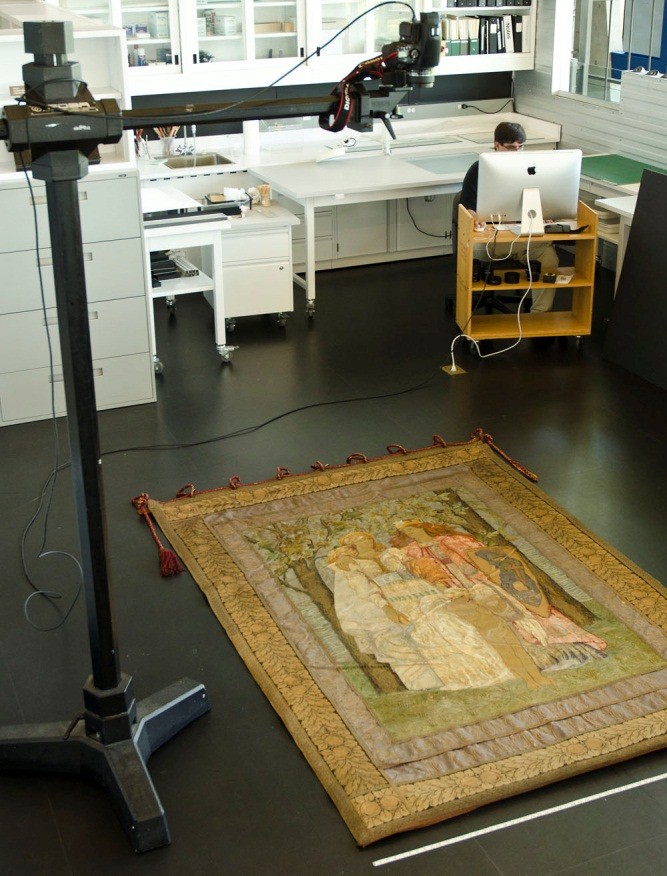
Due to limitations in the existing digitization equipment and the size and condition of the banner, the technicians needed to come up with some creative solutions. To minimize the amount of movement, the banner was delivered from storage to the photo conservation lab in LAC’s Preservation Centre in Gatineau, Quebec. As it could not be hung vertically, it was placed on the floor in an evenly lit open space.

The camera is positioned above the banner, which is laid on the floor.

The camera is positioned above the banner, which is laid on the floor.

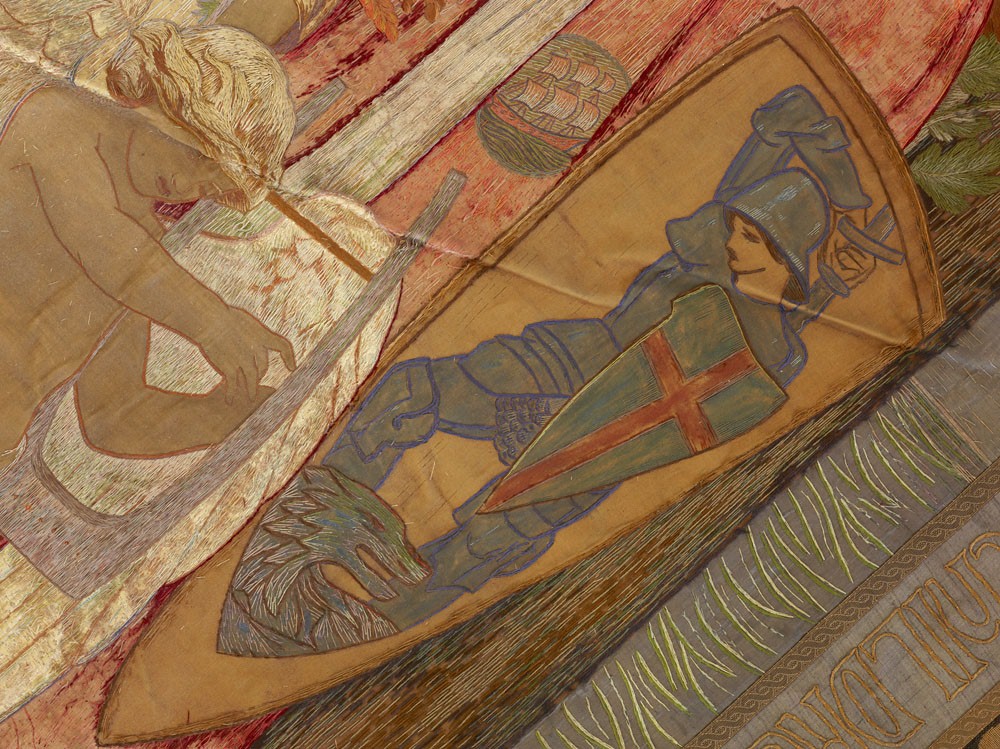
Images of the banner were taken using a Phase One 645 DF+ medium format digital camera mounted on the largest camera stand available. With the camera suspended seven feet away, the banner was captured in eight separate sections and the images reassembled using Photoshop for a complete view. Switching to a 150 mm macro lens, the camera was then lowered to get a selection of detail shots showing the many parts of the banner, such as the signature on the back, the shield with St. George and the dragon, and the types of stitching used. When the front was fully documented, the banner was turned over so that the back could also be captured.

Part of the fabric depicting St. George, patron saint of England and the dragon.

Part of the fabric depicting St. George, patron saint of England and the dragon.

The digitization work was undertaken to create a visual representation of the banner, providing the details of its design and the beautiful workmanship. LAC has now created a permanent digital record, making the banner accessible online, reducing the need to handle the physical item and thereby ensuring its long-term preservation.

Visit our Facebook album to see what went on behind-the-scenes to digitize this banner.

Unravelling the mystery of the Lord Grey banner

A large banner depicting two female figures in a rural setting is among the most interesting and unique items in the Library and Archives Canada (LAC) collection. Measuring 2.4 x 1.8 metres, this needlework is made from linen, cotton and wool, in addition to being beautifully embroidered with silk and other threads. On the back of the banner, more embroidery indicates that is was “worked by Agnes Sephton 1907.” According to former archivists, Governor General Albert Henry George Grey, 4th Earl Grey, gave the banner to the Dominion Archives sometime between 1907 and 1911. The banner hung in the office of the Assistant Dominion Archivist until 1953 when it was put into storage. In 1967, it was moved to the National Archives at 395 Wellington Street in Ottawa, and has been housed at LAC’s Preservation Centre in Gatineau, Quebec since 2000.

The banner donated by Lord Grey.

The banner donated by Lord Grey. Source

During preparations for the latter move, staff learned more about the circumstances surrounding the banner’s creation. It is thought to be one of a series commissioned by Lord Grey in hopes of making a lasting impression upon the minds and hearts of young Canadians. He planned for banners to be hung in schools across the country to reinforce the ties between Great Britain and Canada. According to legend, St. George, the patron saint of England, demonstrated immense courage in slaying a dragon. Lord Grey wanted young men and women to emulate these heroic qualities. St. George can be found on the shield held by Britannia, the female figure dressed in red. She extends a protective arm around young Canada, who is wearing a white dress adorned with doves and pine trees.

Recently, while preparing the banner to be photographed, LAC staff tracked down the identity of the woman who created it. When Canadian sources failed to reveal a possible candidate, archivists found one in British census and marriage records. Agnes Bingley was born in 1868 in London, England, the daughter of James Bingley, a landscape artist. In 1901 she married George Sephton, who was a painter. The couple lived in London and were associated with a group of artists and designers linked to the Arts and Crafts Movement. It is hoped that further research will reveal more clues about Agnes Sephton’s banner and how it came to LAC .

About Face: Library and Archives Canada portrait exhibition at Queen’s Park

Three original works of art and over 30 high-quality reproductions from the Library and Archives Canada (LAC) portrait collection are on display in the Lieutenant Governor’s Suite at Queen’s Park in Toronto until March 31, 2014. The portraits are part of About Face: Celebrated Ontarians Then and Now, an exhibition developed by the Office of the Lieutenant Governor of Ontario in collaboration with LAC. These historical and modern portraits represent men and women from a wide range of cultural backgrounds and walks of life, who helped shape the Ontario of today.

This rare portrait of Maun-gua-daus, for example, is one of the earliest photographs of an Indigenous person in LAC’s collection. A member of the Ojibway nation, Maun-gua-daus was educated by Methodist missionaries and served as a mission worker and interpreter in Upper Canada (now Ontario). From 1845 to 1848, he took part in a tour of England, France and Belgium, demonstrating the ritual, dance and sport found in Ojibway culture. This photograph was probably taken during that tour, in about 1846. It was made using the daguerreotype process, the first method widely used for producing photographic images.

Maun-gua-daus (or Maun-gwa-daus), alias George Henry, original chief of the Ojibway nation of Credit (Upper Canada)

Maun-gua-daus (or Maun-gwa-daus), alias George Henry, original chief of the Ojibway nation of Credit (Upper Canada) (Source: MIKAN 3198805)

An iconic portrait of figure skater Barbara Ann Scott was taken in 1946 by another notable Ontarian, Yousuf Karsh. At the time, the young lady from Ottawa was a Canadian national champion, but had yet to win a European championship and a world figure-skating title. Scott became “Canada’s sweetheart” and Olympic gold-medal champion in 1948, at the age of 19. In this photograph, Karsh frames the skater’s youthful face in what appears to be a saintly halo.

Barbara Ann Scott

Barbara Ann Scott (Source: MIKAN 3192044)

Come see for yourself! Contact the Office of the Lieutenant Governor of Ontario, Queen’s Park to arrange a viewing of the exhibition.